Ethereum
 Solana
 Hyperliquid
 Arbitrum
 Base
Base BNB Smart Chain
 Tempo
Tempo Monad
Monad Avalanche
 Aptos
Aptos TRON
TRON Ronin
Ronin zkSync Era
 Optimism
 Sonic
Sonic Polygon
 Unichain
 Fantom
 Gnosis Chain
 Sui
Sui Avalanche Subnets
 Polygon CDK
 Starknet Appchains
 zkSync Hyperchains




 Refer and earn
 Discord
 Telegram
 X (Twitter)
How to get Plasma testnet tokens with Chainstack faucet

Plasma is a blockchain designed for stablecoin-native applications, combining sub-second finality with high-throughput execution, powered by PlasmaBFT consensus. As more teams experiment with payments and settlement flows, reliable infrastructure and test resources become essential for development and testing.
Developers are experimenting with smart contracts and stress-testing performance. But test XPL is still scarce, which slows down experimentation.
So we decided to ship one. On Chainstack, you can now request Plasma testnet XPL directly from our Plasma faucet. Beyond the faucet, Chainstack provides production-grade infrastructure for Plasma, including reliable RPC endpoints, archive access, documentation, and node management through the Chainstack console.
In this guide, we’ll show you how to get free XPL test tokens and start interacting with the Plasma testnet.
How the Plasma testnet faucet works
Before you push anything to mainnet, you dry-run the flow — deploy a contract, test stablecoin transfers, fire transactions against a Plasma testnet RPC, or validate payment and settlement logic. For any of that, you need XPL.
We’re one of the first to ship a Plasma faucet built for that. It’s tied to your wallet address and lets you claim 0.05 XPL every 24 hours, with no Twitter authentication in the mix. Just sign in, point it at your wallet, and you’re ready to test.
From there, you can use your balance to cover gas on testnet, validate smart contract deployments on Plasma, or run automated checks in your dev loop. And when you’re ready to go beyond test tokens, you can deploy a Plasma node in the console and plug into mainnet or testnet RPCs all in one place.
⚠️ Faucet requirements:
To safeguard against misuse, the Chainstack faucet implements two key checks
before disbursing funds:
- The requesting address must have a minimum balance of 0.08 ETH on the
Ethereum mainnet. - The address should have a history of holding ETH on the mainnet; it should
not have been recently empty.
These precautions help maintain the integrity of the faucet, ensuring fair and
equitable access for all users.
How to use the Plasma testnet faucet on Chainstack
Getting test XPL from our Plasma faucet is simple.
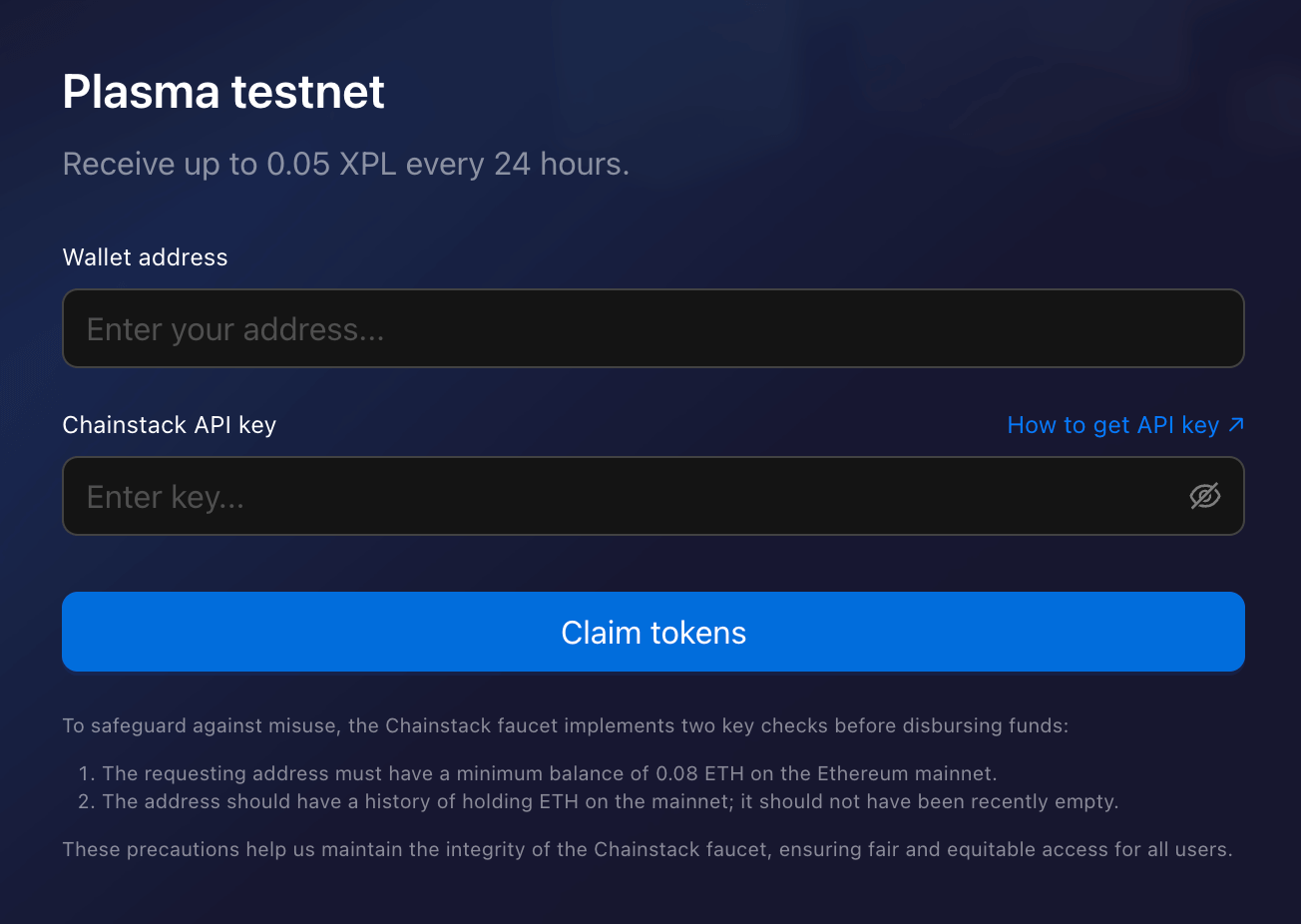
- Sign in — Log into your Chainstack console.
- Get your API key — In the console, go to Settings → API keys and copy an active key. You’ll need it to authenticate with the faucet.
- Open the faucet — Navigate to the Plasma faucet page and paste your API key when prompted.
- Enter your wallet address — Paste the address you want to fund.
- Claim tokens — Submit the claim. You’ll receive 0.05 XPL every 24 hours.
- Confirm balance — Check your wallet or query your Plasma RPC endpoint.
Once your wallet has balance, you can use it to pay gas on testnet, deploy contracts, or run integration scripts against the Plasma testnet. If you need stable, high-performance infrastructure, alongside tokens, you can spin up a Global Node for quick tests or a Dedicated Node for latency-sensitive workloads. Both expose HTTPS and WebSocket RPC URLs that slot straight into wallets, frameworks, or custom tooling.
What you can do with Plasma testnet XPL
On Plasma, nothing moves without XPL, even on testnet. XPL is used to pay gas for smart contract deployments, transaction calls, and anything you send through a Plasma testnet RPC. That makes a faucet a baseline tool if you want to:
- Test stablecoin transfers and payment flows
- Run bots or scripts against real RPC responses
- Validate settlement logic for stablecoin-based applications
- Backtest or stress-test without burning real funds
- Onboard teammates or teach flows without risk
Once you’ve got tokens in your wallet, the natural next step is to wire them into infrastructure you control. In the Chainstack console, you can spin up a Plasma node, copy the HTTPS or WebSocket RPC URL, and start routing calls through your own endpoint.
Plasma tooling
Beyond the faucet and nodes, Plasma provides developer tooling you can integrate into your stack. You can interact with the network using standard EVM-compatible tooling over JSON-RPC, making it easy to work with smart contracts, query chain state, and run automated workflows.
Plasma works with familiar Ethereum developer tools and libraries, allowing you to reuse existing Solidity code, frameworks, and scripts without custom integrations.
For the full set of SDKs, APIs, and integration guides, check the Plasma tooling docs.
Wrap up: more for Plasma builders
Faucet XPL gets you moving, but production-grade stablecoin and payment workflows need more than just gas. On Chainstack, you can run reliable Plasma RPC infrastructure to query historical data, debug transactions, and stream state changes over WebSocket connections.
If you prefer starting from code, Chainstack provides examples and reference implementations that show how to interact with Plasma RPC endpoints using standard EVM-compatible tooling. The Plasma API refers to the standard Ethereum-compatible JSON-RPC interface exposed by Plasma RPC nodes.
Between the faucet, stable RPC infrastructure (Global or Dedicated Nodes), and up-to-date documentation, you get an end-to-end setup: test with faucet tokens, validate against production-like infrastructure, and move to mainnet without reworking your stack.
Additional resources
Power-boost your project on Chainstack
- Discover how you can save thousands in infra costs every month with our unbeatable pricing on the most complete Web3 development platform.
- Input your workload and see how affordable Chainstack is compared to other RPC providers.
- Connect to Ethereum, Solana, BNB Smart Chain, Polygon, Arbitrum, Base, Optimism, Avalanche, TON, Ronin, Plasma, Hyperliquid, Scroll, Aptos, Fantom, Cronos, Gnosis Chain, Klaytn, Moonbeam, Celo, Aurora, Oasis Sapphire, Polygon zkEVM, and Bitcoin mainnet or testnets through an interface designed to help you get the job done.
- Fast access to blockchain archive data and gRPC streaming on Solana.
- To learn more about Chainstack, visit our Developer Portal or join our Telegram group.
- Are you in need of testnet tokens? Request some from our faucets. Sepolia faucet, Hoodi faucet, BNB faucet, zkSync faucet, Scroll faucet, Hyperliquid faucet.
Have you already explored what you can achieve with Chainstack? Get started for free today.
FAQ
You can claim them from the Chainstack Plasma faucet. Enter your wallet address and you’ll receive 0.05 XPL every 24 hours. No Twitter authentication is required.
Yes. Plasma is EVM-compatible, which means you can deploy Solidity smart contracts and use standard Ethereum tooling and libraries.
XPL is used to pay gas fees on the Plasma network. On testnet, XPL covers smart contract deployments, transaction calls, and interactions sent through a Plasma testnet RPC endpoint.
Yes. Plasma testnet is designed for safely deploying and testing smart contracts, running scripts, and validating integrations before moving to mainnet.
Yes. Public RPC endpoints are shared and subject to rate limits. For predictable performance and higher throughput, you can deploy a Chainstack node and use dedicated RPC endpoints.