Create a Global Node endpoint for stable, high-throughput access to TRON Mainnet and the Nile Testnet.

 Ethereum
 Solana
 BNB Smart Chain
 Polygon
 Arbitrum
 Base
Base Optimism
 Avalanche
 TON
TON Ronin
Ronin Blast
Blast zkSync Era
 Starknet
 Scroll opBNB
 Sonic
Sonic Fantom TRON
 Aptos
Aptos Cronos
 Gnosis Chain
 Kaia
Kaia Celo
Celo Oasis Sapphire
 Bitcoin
 Sui
Sui Berachain
 Taiko
Taiko Plume
Plume Soneium
 Hyperliquid
 Etherlink
 WeMix
WeMix Shibarium
 Bitlayer
 Metis
Metis Fraxtal
 Unichain
 Centrifuge
 Mantle
 Dogecoin
 Katana
 Cardano
 Astar
Astar zkLink
 Bsquared
 Merlin
 Linea
Linea Polkadot
 Lens
Lens Ink
Ink Core
Core Hashkey
 Apechain
 Zora
Zora Mind
Mind Zircuit
 Plasma
 Monad
Monad Tempo
Tempo MegaETH
 Robinhood
 Arc
Arc Canton Network
 Stable
 World Chain
 XRP Ledger
 Stellar
 Elysium
Connect to TRON through geo-balanced infrastructure that scales with request volume and routes traffic for reliable access across regions, with HTTP, JSON-RPC, and gRPC on one endpoint.
Run TRON workloads on isolated infrastructure with single-tenant resources and greater control over node configuration.
Build with managed TRON endpoints on Mainnet and the Nile Testnet. Every node serves the TRON HTTP API (/wallet and /walletsolidity), gRPC, and a read-only /jsonrpc endpoint, and keeps the complete block and transaction history from genesis. WebSocket is not supported.
SOC 2 Type II and ISO 27001 certified.
HTTP, solidity, JSON-RPC, and gRPC run on the same Chainstack node, so you can pick the interface that fits each workload.
Use /wallet for full node operations, including transactions, and /walletsolidity for confirmed (solidified) data. TronWeb.js handles deployment and transfers.
The Wallet, WalletSolidity, and Database services run on one :443 endpoint, authenticated with an x-token header, for indexers and high-throughput backends.
A limited Ethereum-compatible /jsonrpc endpoint lets web3.py, Hardhat, and Foundry read from TRON. Writes go through TronWeb.js and the HTTP API.
Nodes run in archive mode: every block and transaction from genesis, plus historical TRX balances, at 1 RU per request with no archive split.
Copy your endpoint and x-token from Access and credentials in the console, then run any of these.
const { TronWeb } = require('tronweb');

const tronWeb = new TronWeb({
    fullHost: 'YOUR_CHAINSTACK_ENDPOINT'
});

const address = 'TWiEv2wfqQ8FkbAJ6bXt1uA2Uav9ZWvXip';

async function getBalance() {
    try {
        const balanceInSun = await tronWeb.trx.getBalance(address);
        const balanceInTRX = tronWeb.fromSun(balanceInSun);

        console.log(`Address: ${address}`);
        console.log(`Balance in SUN: ${balanceInSun}`);
        console.log(`Balance in TRX: ${balanceInTRX}`);
    } catch (error) {
        console.error('Error getting balance:', error);
    }
}

getBalance();
import grpc
import sys
sys.path.insert(0, './generated')
from api import api_pb2, api_pb2_grpc
ENDPOINT = "tron-mainnet.core.chainstack.com:443"
X_TOKEN = "YOUR_X_TOKEN"
def get_now_block():
# Create secure channel with TLS
credentials = grpc.ssl_channel_credentials()
channel = grpc.secure_channel(ENDPOINT, credentials)
# Create stub
stub = api_pb2_grpc.WalletStub(channel)
# Add x-token to metadata
metadata = [("x-token", X_TOKEN)]
# Call GetNowBlock
response = stub.GetNowBlock(
api_pb2.EmptyMessage(),
metadata=metadata,
timeout=15
)
print(f"Block number: {response.block_header.raw_data.number}")
print(f"Transactions: {len(response.transactions)}")
channel.close()
get_now_block()from web3 import Web3
# YOUR_CHAINSTACK_ENDPOINT is the node HTTPS endpoint with the /jsonrpc postfix
web3 = Web3(Web3.HTTPProvider('YOUR_CHAINSTACK_ENDPOINT'))
print(web3.eth.block_number)
Run high-volume production workloads with flat monthly billing based on your selected requests per second tier.
Keep infrastructure costs predictable as USDT transfer and exchange traffic grows.
Run TRON workloads on production-grade infrastructure with stable latency, predictable capacity, and reliable resources on Chainstack.

“We are pleased to collaborate with Chainstack to make the blockchain experience seamless for users and developers.”


“With Chainstack’s full support we’re excited to keep empowering the Arbitrum ecosystem with infrastructure that will continue to provide for the community.”


“If you need stable node access across multiple chains and you actually need the data to be correct — that's what Chainstack is for.”


“Chainstack was the obvious choice when it comes to scaling our system and improving performance. We’re delighted by the 5-star support we’ve received.”


“Chainstack has been a game-changer for us. Their platform made it a breeze to integrate more than 5 chains into our protocol, providing unparalleled ease and speed.”


"Chainstack is what you see, what you get — enterprise-grade, high performance. It's good to know that Chainstack has got our back."

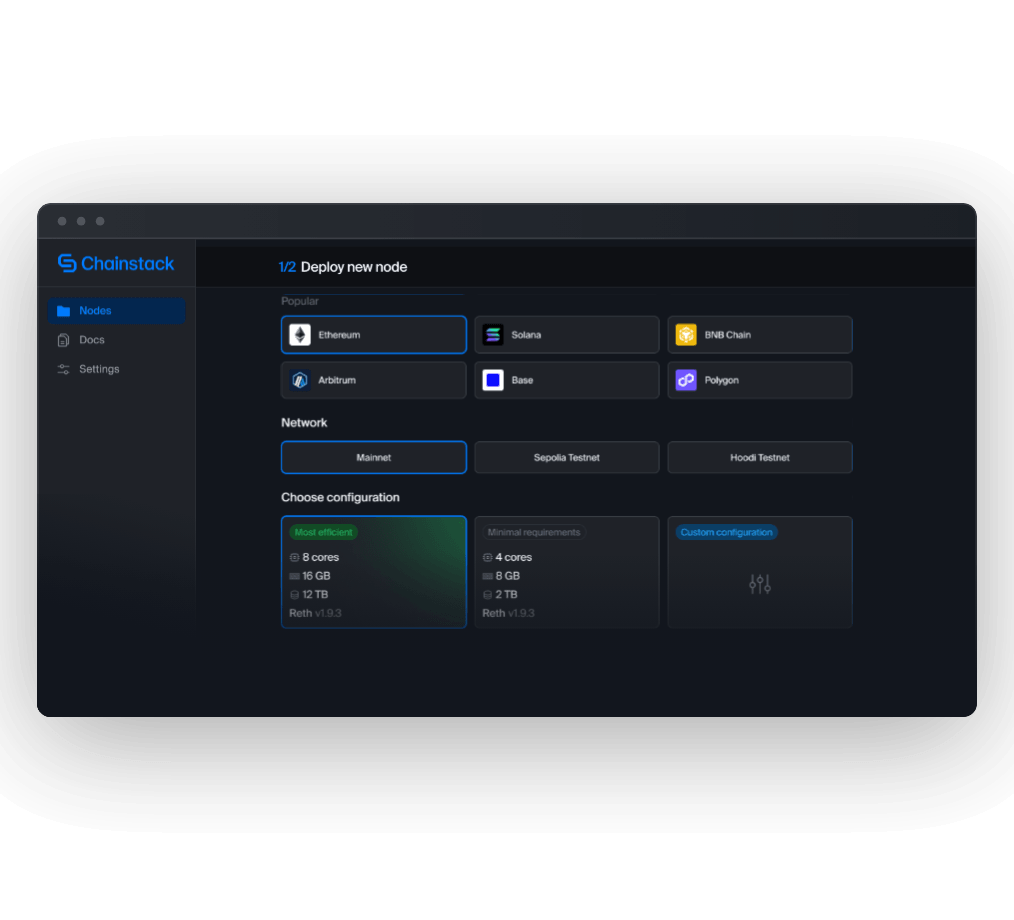
Deploy and operate TRON nodes with one-click deployment, self-healing, snapshots, and right-sized configurations using Chainstack Self-Hosted.
Get isolated infrastructure for production workloads that require predictable resources, advanced configuration, and consistent performance at scale.

TRON uses its own HTTP API and gRPC interface, not Ethereum JSON-RPC. Your Chainstack node serves four surfaces on one endpoint: /wallet (full node operations, including transactions), /walletsolidity (confirmed data), a limited read-only /jsonrpc, and gRPC at tron-mainnet.core.chainstack.com:443 (Nile: tron-nile.core.chainstack.com:443) with the x-token header. gRPC serves protocol.Wallet, protocol.WalletSolidity, and protocol.Database; WalletExtension and Monitor return UNIMPLEMENTED. WebSocket and event subscriptions are not supported. Use TronWeb.js for transactions and deployment; web3.py, Hardhat, and Foundry can read through /jsonrpc. Nodes run in archive mode with the complete block and transaction history from genesis but no historical contract state, and every request costs 1 RU.
You can also access TRON through the Chainstack MCP server — query onchain data, deploy nodes, and search Chainstack docs from Claude, Cursor, Windsurf, ChatGPT, Codex, Pi, Gemini, or any MCP-compatible or SKILL-compatible AI agent.








 AI-ready infrastructure
 Refer and earn


 Ethereum
 Hyperliquid
 Solana
 Arbitrum
 BNB Smart Chain
 Base
Base Polygon
 TRON
TRON Sui
Sui Robinhood


