AI-ready infrastructure
 Refer and earn


 Ethereum
 Hyperliquid
 Solana
 Arbitrum
 BNB Smart Chain
 Base
Base Polygon
 TRON
TRON Sui
Sui Robinhood


Self-hosted blockchain nodes: 5 myths engineers believe in 2026

There’s a recurring argument in the RPC-provider space that goes roughly: self-hosted blockchain nodes are a maintenance trap, the ops burden is only getting worse, and the sensible move is to hand the nodes off to a managed provider. It’s an argument with real teeth, because the failure modes it points at are real: nodes silently falling behind the chain tip, client upgrades landing across dozens of ecosystems every week, archive storage that grows faster than the ops calendar can absorb. Anyone who has been paged at 3 a.m. for stale reads on a “healthy” Geth node has felt the truth of it.
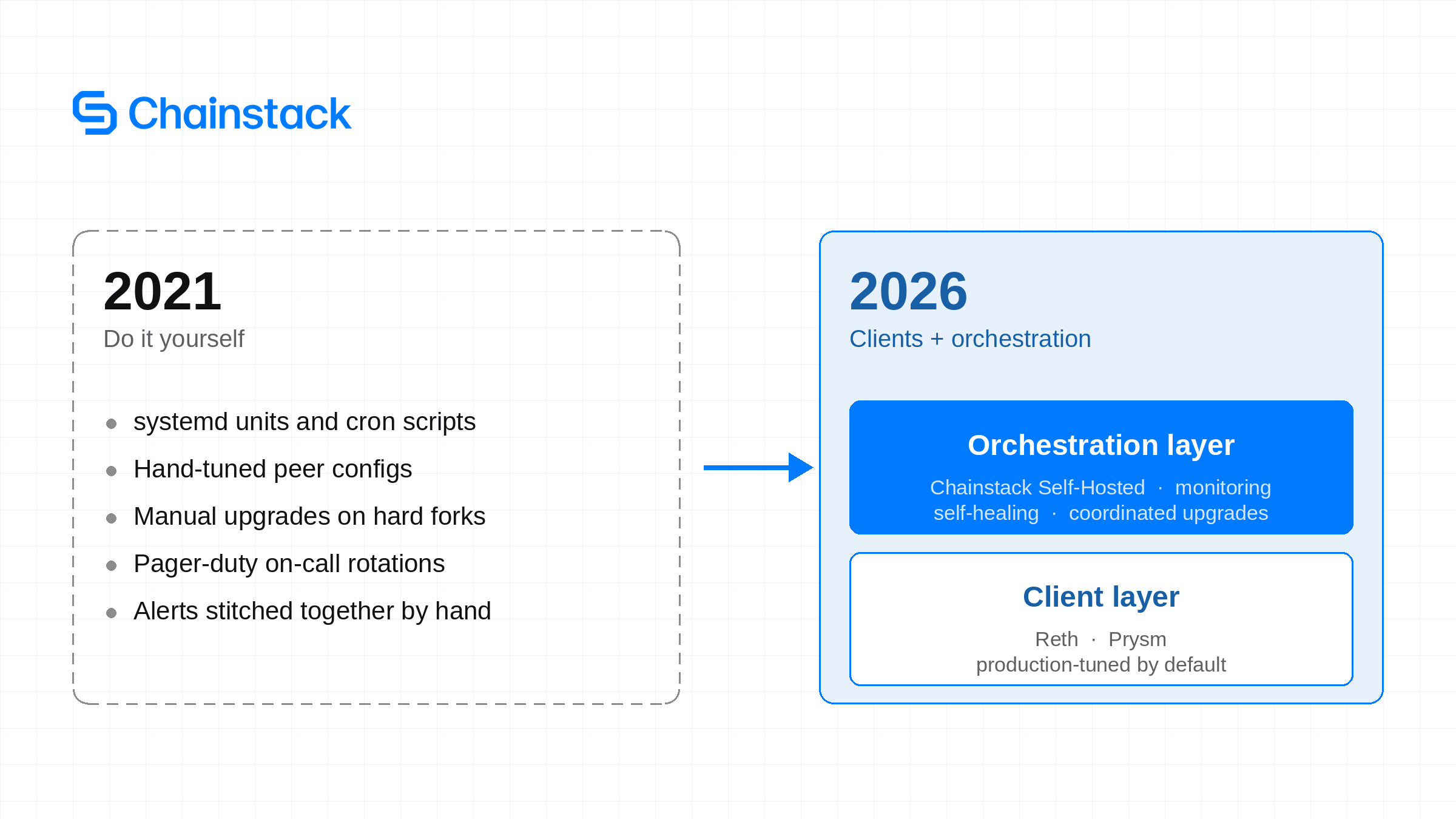
The problem is that the conclusion doesn’t follow from the evidence. It assumes self-hosting means what it meant in 2021 — bash scripts in a Git repo, a Grafana dashboard someone forked from a gist, and a compatibility matrix maintained mostly in Slack. That version of self-hosting is genuinely painful, and if that’s what a team is running, moving to managed infrastructure is reasonable. But it’s not what modern self-hosting looks like, and the industry moved on more than most operators realize.
This article walks through five myths that keep engineers stuck on the old picture, compares dedicated infrastructure against modern self-hosted honestly, and marks the cases where each actually wins.
The pain is real
Before the pushback, the concession. The three failure modes cited most often against self-hosting are real, and on legacy self-hosted stacks they are the reasons teams give up:
- Silent desync. A node that loses tip and keeps serving requests is the worst kind of failure — invisible from health checks, visible to users. It’s also more common than most operators assume: Ethernodes’ live sync tracker has consistently shown roughly a quarter of Ethereum execution-layer nodes out of sync at any given time — 29% execution / 6.2% consensus as of early 2026.
- Upgrade fatigue across chains. Ethereum’s Fusaka upgrade landed on mainnet December 3, 2025, with coordinated changes operators had to stage across execution and consensus clients — see the Chainstack breakdown for what it actually shipped. Zoom out from a single fork and the pace is relentless: Reth shipped 33 releases in 2025, Prysm 18. Multiply that across L1s, L2s, and app-chains, and calendar management becomes a job.
- Storage growth. A full Ethereum archive node needs 18–20 TB of fast NVMe as of early 2026 and grows another ~1–2 TB per month. Capacity planning stops being a one-time exercise.
None of these are strawmen. The question is whether the answer is “give up the perimeter” or “operate the perimeter properly.” Most of the migration-off narratives assume the first. That’s a category error, not an operational one.
Where the industry actually changed
Four things shifted between the pain that drove the current self-hosting narrative and the tooling available today.
Clients matured. Reth shipped its production-ready 1.0 in June 2024 after two years of development and a Sigma Prime audit; Prysm and Lighthouse settled into predictable release cadences; and post-merge Ethereum operations are dramatically calmer than pre-merge. Client crashes and pruning surprises still happen, but they are no longer a weekly event.
No-tweak clients emerged. Reth ships production-tuned by default. Launchers like Sedge (Nethermind) turned “run an Ethereum node” from a systemd-and-shell-script project into a single command — under five minutes to a running validator on your own hardware. Community efforts like BuidlGuidl’s client and dev-focused packages like ethereum-package (ethPandaOps, for devnets and testing) fill out the ecosystem. Kubernetes-based platforms like Chainstack Self-Hosted then wrap those clients in orchestration, monitoring, and self-healing — but the underlying clients stopped requiring babysitting years ago.
GitOps ate deployment. Config drift — the primary cause of “why does prod behave differently from staging” — is a solved problem when every change is a pull request against a repo that Argo or Flux reconciles.
Observability got real. Prometheus, Grafana, and purpose-built exporters (including Chainstack’s blockchain-node-exporter) surface the signals that health-check endpoints miss — chain-tip lag, peer count, storage pressure, sync state.
The problem was never that self-hosting is hard. The problem was that most teams were self-hosting with 2021-era tooling in 2024.
Myth 1: Self-hosting is prohibitively expensive
The instinctive comparison — “managed RPC costs $X per million requests, a server costs $Y per month” — is the wrong one. The real comparison is total cost of ownership, and TCO is dominated by engineering time, not hardware.
The Chainstack team put the DIY number at roughly two weeks of senior engineer time to stand up a production-grade Ethereum node, plus ~4 hours per week ongoing — around $6,000 upfront and $15,000+ annually per protocol at typical senior engineer rates. That’s the honest DIY figure, and it’s higher than most teams admit.
But this cost isn’t intrinsic to self-hosting. It’s intrinsic to unautomated self-hosting. Once the operational layer is a product rather than a repo of shell scripts, the 4 hours/week collapses into notification-driven upgrades and dashboard reviews. That’s the entire premise of Chainstack Self-Hosted: the control plane, the observability stack, the upgrade tooling, and the recovery behavior come pre-assembled and tested, so the engineering hours previously spent on plumbing get returned to product work.
At scale, the math tips further in favor of self-hosting. Three protocols on managed RPC aren’t 3x the cost of one — they’re linear-plus-egress. Three self-hosted nodes on a shared control plane aren’t 3x the operational load — they’re closer to 1.2x, because the control plane amortizes.
Myth 2: Node upgrades constantly break infrastructure
This was true. It’s substantially less true now, for two independent reasons.
First, client release quality improved dramatically. Reth’s release notes and Prysm’s upgrade playbooks are now detailed enough that most hard forks land with a version bump and a restart. Emergency patches still happen — they will keep happening — but the “every release is an adventure” phase is over.
Second, rolling upgrades became standard. A Kubernetes-native deployment can run two replicas of a node, drain traffic from one, upgrade it, verify sync, and rotate. The blast radius of a bad upgrade shrinks from “your app is down” to “one pod restarted.”
Chainstack Self-Hosted formalizes this: when a new client version is available, operators are notified and control when it’s applied, rather than being surprised by an automated push or forgetting a manual one. The upgrade calendar becomes a queue in a control panel instead of a Google Doc.
Myth 3: You need a large DevOps team
The DevOps team you used to need was the one writing the tooling. The tooling exists now.
Modern self-hosting is not “build a platform.” It’s “adopt a platform.” A single infrastructure engineer familiar with Kubernetes can operate a fleet of blockchain nodes if the control plane, monitoring, and upgrade workflows are already in place. Chainstack Self-Hosted’s stated position on this is unambiguous: no Kubernetes expertise required for basic deployment — the installer handles the underlying infrastructure, and the system requirements documentation is specific enough that hardware sizing is no longer guesswork.
The team you actually need is smaller than the DevOps org described in most “why not self-host” posts. It looks like one platform engineer, part-time, plus whoever is already responsible for cloud infrastructure.
A concrete data point. On a fresh Ubuntu box, cpctl install takes the machine from empty to a full production Control Panel stack — k3s, TopoLVM storage, Postgres-HA, Temporal, Keycloak, the UI, the deployments API, and the Grafana/VictoriaMetrics observability stack, 20/20 resources ready — in about 10 minutes of net execution time. That’s not marketing shorthand; the official quick-start documentation puts the typical install at 5–10 minutes, and a recent end-to-end run measured cpctl install itself at 3m 52s with the rest going to Kubernetes readiness waits. One command, one operator, no Kubernetes expertise required upfront.
Myth 4: Dedicated infrastructure is always more reliable
Not exactly. Dedicated infrastructure is more reliable than DIY self-hosting done badly. Compared to self-hosting done well, the comparison is more nuanced.
| Dimension | Dedicated (managed) | Modern self-hosted (Chainstack Self-Hosted) |
|---|---|---|
| Control over hardware | Provider-provisioned to your workload | Fully yours: bare metal, cloud VPS, or hybrid |
| Custom clients / tracers | Supported by most dedicated tiers | Fully supported; you own the runtime |
| Data residency & compliance | Vendor’s regions and audits | Your perimeter; your SOC 2 / ISO scope |
| Cost predictability | Provisioned monthly commitment | CapEx or cloud spend you already control |
| Failover | Vendor’s shared fleet | Configurable failover to Chainstack Cloud when needed |
| Observability access | Vendor’s Grafana | Your Grafana, your metrics, your retention |
| Upgrade timing | Vendor’s schedule | Yours, per-node |
| Vendor lock-in | Endpoint swap works both ways, but pricing power sits upstream | Portable — the underlying clients (Reth, Prysm) are standard |
The honest read: dedicated infrastructure is genuinely simpler if the provider’s constraints line up with yours. When they don’t — regulated data, custom execution logic, a jurisdiction the vendor doesn’t serve, or workloads that make provisioned capacity uneconomical — self-hosted wins.
Myth 5: Self-hosting means constant firefighting
Firefighting is what happens when signals arrive too late to act on. Modern self-hosted stacks catch problems earlier because they instrument the right things.
Chainstack Self-Hosted ships with an integrated observability stack — Grafana, VictoriaMetrics, and the blockchain-node-exporter — that watches chain-specific signals (sync lag, peer count, finalization gap), not just process liveness. That’s the difference between “the node is up” and “the node is right.” The June 2026 release added built-in scrapers for the Control Panel, PostgreSQL, Temporal, and the node containers, plus direct log surfacing in the node overview — so wiring diagnostics into an existing observability stack no longer means assembling exporters by hand.
Combined with self-healing behavior and configurable failover to Chainstack Cloud RPC when a self-hosted node needs to be taken offline, the on-call profile looks less like “always on” and more like “scheduled review.”
When dedicated infrastructure is the right call
Self-hosting is not the answer for every team. Dedicated or managed infrastructure is the better choice when:
- The team is under five engineers and blockchain infra is not a core competency.
- The workload is a prototype, a hackathon project, or a temporary campaign.
- Traffic is bursty in ways that provisioned capacity would waste.
- There’s no in-house Kubernetes familiarity and no appetite to acquire it.
- The application is genuinely stateless with respect to node control — no custom tracers, no exotic RPC extensions, no data residency requirements.
In those cases, Chainstack’s managed Global Nodes and Dedicated Nodes exist for exactly that reason — and are worth evaluating on latency and price rather than ideology.
When self-hosted is the better long-term investment
Self-hosted wins when the operational maturity has caught up with the workload:
- Regulated environments where data residency, SOC 2, and ISO 27001 scope are non-negotiable.
- High-volume trading, wallet, or exchange workloads where per-request pricing at scale exceeds a fixed hardware bill.
- Applications with custom execution logic — tracers, forensic tooling, MEV pipelines.
- Multi-region deployments where the vendor’s regions don’t line up with your users.
- Teams with existing Kubernetes competence, for whom “one more StatefulSet” is a Tuesday.
Conclusion
Most of the current “move off self-hosted” argument treats self-hosting as an operating model that hasn’t changed. It has. Between mature clients, Kubernetes-native orchestration, GitOps, purpose-built observability, and integrated control planes like Chainstack Self-Hosted, running your own nodes in 2026 has more in common with running a well-instrumented microservice than with the pager-driven ops of five years ago.
The interesting question isn’t “self-hosted or managed.” It’s “which of my workloads have outgrown managed, and which never should have left.” Answer that honestly, and the infrastructure choice follows.
Try it
Chainstack Self-Hosted runs on infrastructure you control — bare metal, cloud VPS, hybrid. The quick start guide takes an Ubuntu box to a running Control Panel with cpctl install — a single command, typically 5–10 minutes end to end. The system requirements page has the exact CPU, RAM, and storage figures for each supported chain. Supported protocols currently include Ethereum, Bitcoin, TRON, Starknet, the OP Stack (Optimism, Base, Unichain, Zora), and Robinhood Chain — see the supported deployments catalog for the current list.
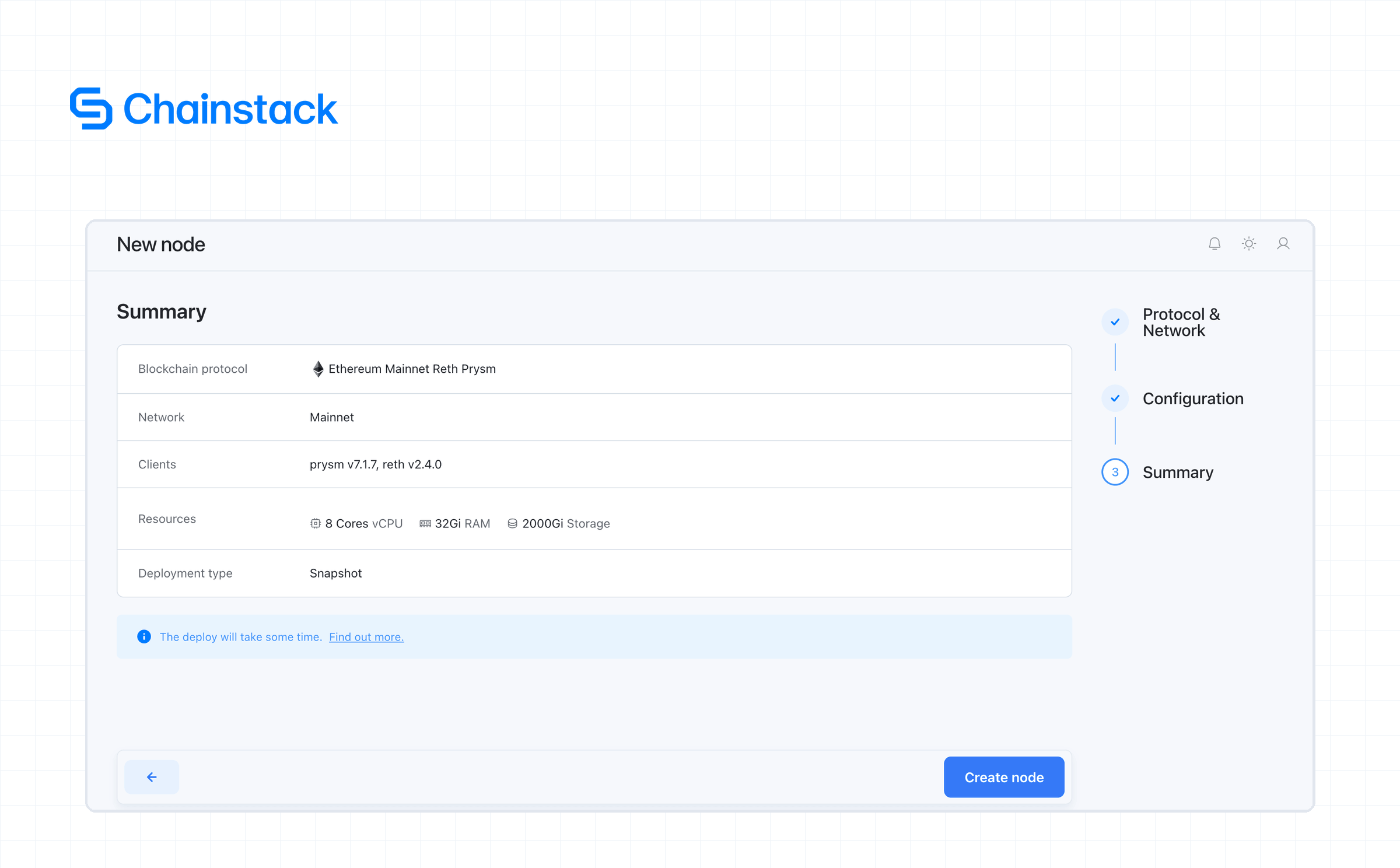
Migrating from DIY to Chainstack Self-Hosted is not a rebuild either: you keep your infrastructure, your clients (Reth, Prysm), and your endpoints — what changes is the operational layer sitting above them.
If you’d rather not source hardware yourself, Chainstack Self-Hosted ships pre-installed or one-click with Velia, Vultr, HOSTKEY, Serverside.com, and BreezeHost — each with its own promo, region mix, and hardware profile.
FAQ
For teams with sustained volume, custom execution needs, or compliance requirements, yes — provided the operational layer is a product, not a pile of scripts. See the DIY vs Chainstack Self-Hosted comparison.
At low volume, often yes. At sustained high volume, self-hosted usually wins on TCO, because managed pricing scales with requests while hardware cost is fixed.
With mature clients like Reth and Prysm on a Kubernetes control plane, materially easier than in 2021. Chainstack Self-Hosted reports roughly 4 hours/week for a DIY setup versus notification-driven review with a control plane.
Only if you upgrade in place. Rolling upgrades on Kubernetes plus staged rollouts eliminate the downtime pattern; see how the June 2026 release surfaces upgrade coordination in the Control Panel.
Yes — StatefulSets, PVCs, and readiness probes cover the essentials. Chainstack Self-Hosted uses enterprise-grade Kubernetes under the hood.
Not with modern tooling. The Chainstack Self-Hosted installer handles Kubernetes setup automatically; one platform engineer can operate a fleet.
Dedicated means the provider runs single-tenant hardware for you. Self-hosted means you own the hardware and the runtime.
Neither is universally more reliable. Self-hosted done well matches or exceeds managed on the metrics that matter most (chain-tip freshness, data control), while managed wins on operational simplicity for smaller teams.
Chainstack Self-Hosted monitors nodes continuously and recovers from failures automatically, with configurable failover to Chainstack Cloud RPC as a backstop when needed.
When the workload no longer justifies the operational commitment — small teams, prototypes, bursty traffic, or organizations without infra expertise. See “When dedicated infrastructure is the right call” above.
Yes. Chainstack documents a hybrid pattern using eRPC that routes hot-path traffic to a self-hosted node and archive queries to Chainstack Cloud.
Currently Reth for execution and Prysm for consensus on Ethereum, with additional protocols — Bitcoin, TRON, Starknet, OP Stack (Optimism, Base, Unichain, Zora), and Robinhood Chain — per the supported deployments catalog.
Related reading
- Introducing Chainstack Self-Hosted
- Chainstack Self-Hosted documentation
- Self-Hosted Blockchain Node: DIY vs Managed
- Self-Hosted Blockchain Node: Challenges and Solutions
- Blockchain Node Hosting: How to Choose the Right Setup (2026)
- How Chainstack uses Chainstack for Chainstack
- Cut RPC costs with a hybrid setup
- Self-Hosted on Velia and HOSTKEY