AI-ready infrastructure
 Refer and earn


 Ethereum
 Hyperliquid
 Solana
 Arbitrum
 BNB Smart Chain
 Base
Base Polygon
 TRON
TRON Sui
Sui Robinhood


Self-Hosted blockchain node: challenges and solutions

Running a self-hosted blockchain node, which validates transactions and provides blockchain data to dapps, wallets, and exchanges, is a key way to participate in and help secure a decentralized network. But self-hosted blockchain node challenges often emerge after deployment, not during setup.
Jameson Lopp, Co-Founder of Casa, a leading Bitcoin self-custody solution, highlights that he runs his own Bitcoin node to help ensure Bitcoin remains online:
“I run my own Bitcoin node. You can strike down my machines, but others will rise to take their place.”
While more individuals and organizations operating their own nodes enhances decentralization and network security, managing nodes remains challenging. The true difficulty arises after deployment, as nodes need to stay synchronized with the network, store increasing amounts of blockchain data, and remain compatible with protocol upgrades.
Most teams choose between running nodes themselves, which creates significant operational burdens, or using a third-party provider, which reduces control over data and infrastructure.
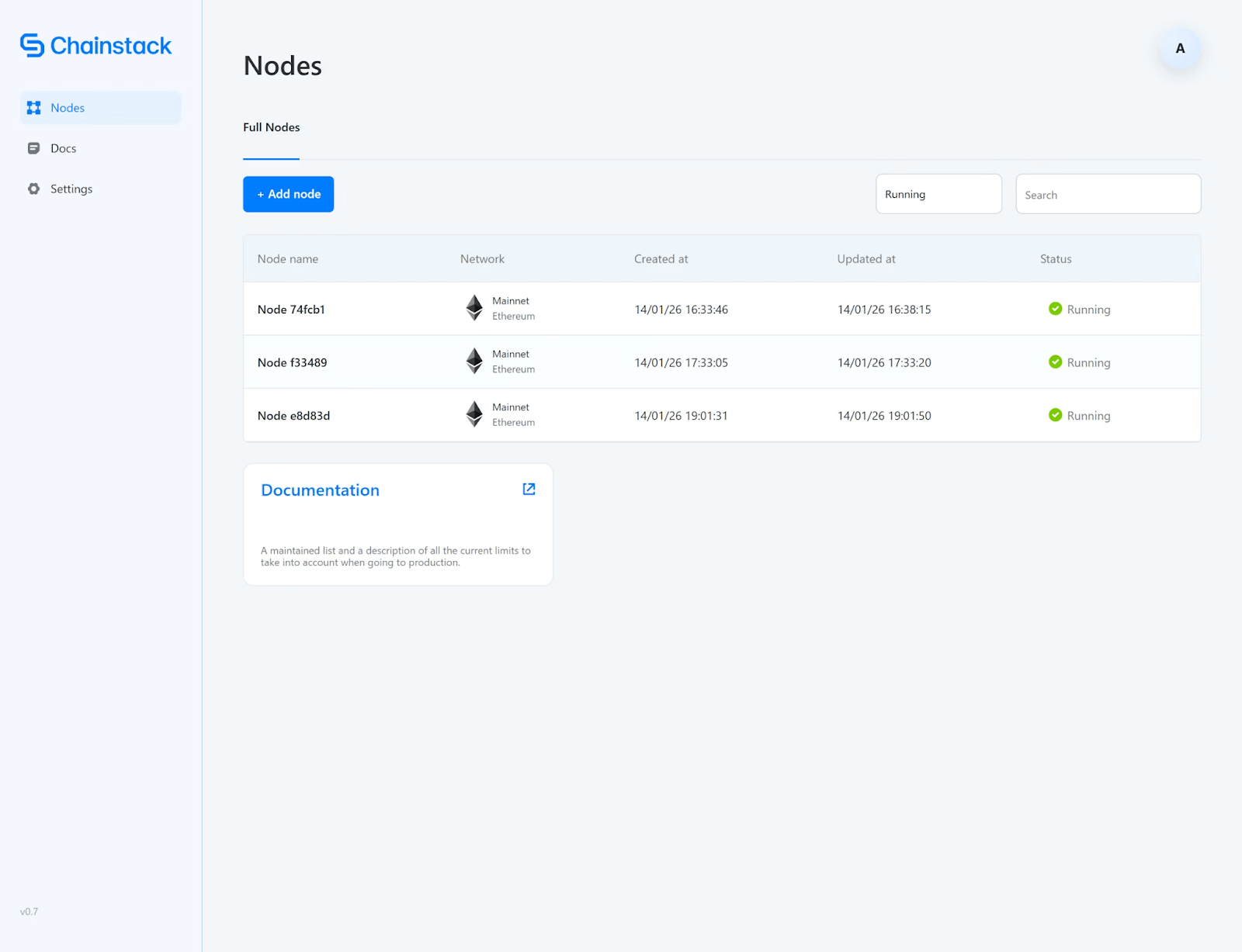
Chainstack Self-Hosted offers the best third option. It provides an easy-to-use control panel for deploying and managing full blockchain nodes, currently supporting Ethereum and the testnets Sepolia and Hoodi, on your own infrastructure, whether a private cloud, dedicated servers, or on-premises systems, without needing to develop custom management tools. With Chainstack Self-Hosted, node deployment takes minutes to hours instead of days or weeks.
This article outlines the operational challenges of running a fully self-managed, self-hosted blockchain node and explains how solutions like Chainstack Self-Hosted can address them.
Why self-host a blockchain node
Many organizations prefer to set up and run blockchain nodes on infrastructure they control.
Institutions such as exchanges, wallets, infrastructure providers, and financial organizations rely on direct access to blockchain data as part of their core systems. Operating nodes within their own environments enables these teams to interact directly with the network, independently verify transactions and blocks, and avoid reliance on third-party APIs.
Many institutions operate their own nodes, including:
Despite wide adoption, self-hosted blockchain node challenges remain significant for most teams.
Setting up a self-hosted node is relatively straightforward, but organizations often underestimate the operational challenges of running fully self-managed, do-it-yourself (DIY) nodes in production environments.
Ethereum founder Vitalik Buterin acknowledged that managing a node has become a complex DevOps task that is handled by professionals, despite this not being the original intention.
“I feel like at every level we’ve implicitly made this decision that running a node is this oh so scary devops task that it is okay to leave to professionals.”
Here are what teams should expect when self-hosting a node, and the solutions to handle them:
Challenges of running a self-hosted blockchain node
Here are the key self-hosted blockchain node challenges teams should expect, and the solutions to handle them:
Challenge 1: Time to sync nodes
Even after deployment, a node is not immediately ready to use. Before it can serve applications, it must download the blockchain data and synchronize with the latest block and global state.
Teams already spend significant time securing and setting up the initial required hardware and software. Then, they must wait days to weeks for the node to fully run by downloading blockchain data and syncing their node to the latest Ethereum block and the current global state.
For example, according to Besu, a popular software for Ethereum nodes, a fast sync, which downloads block headers and transaction receipts and verifies blocks from the genesis (first) block, takes 1.5 days, while a full sync, which downloads the entire blockchain state, takes weeks.
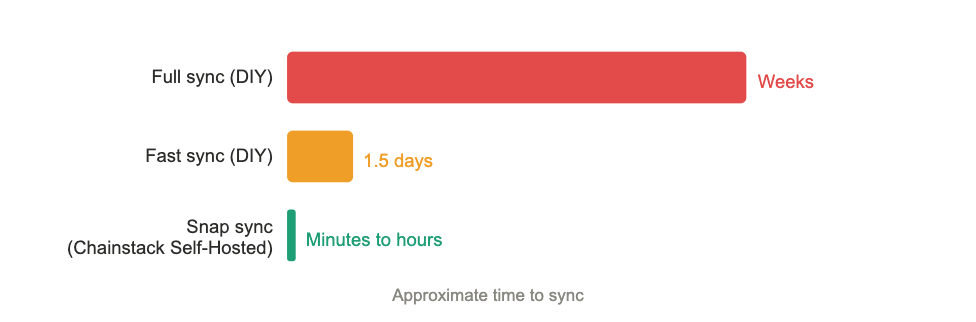
Teams can greatly reduce sync time by using node snapshots or starting from a recent, verified state instead of all historical data when setting up Chainstack Self-Hosted. While teams can still always choose a full sync, many protocols, including Polygon, Celestia, Base, and Optimism, now recommend snap sync to bring nodes online more quickly.
Challenge 2: Using enterprise-grade architecture
Institutional teams require enterprise-grade node infrastructure that is reliable and scalable from setup through maintenance.
Under the hood, Chainstack Self-Hosted runs on enterprise-grade Kubernetes, delivering reliability, scalability, and operational ease without requiring operators to build or maintain the underlying architecture. Node runs in secure environments with encryption and strict access control.
When any self-hosted node fails, operations can choose to fallback to Chainstack’s production-level RPCs, with 99.99% uptime, 24/7 SLA-backed operations, and low-latency global endpoints, trusted by more than 1,000 customers. Currently, Self-Hosted supports Ethereum and the testnets Sepolia and Hoodi, with plans to expand to support over 70 other protocols via Chainstack’s RPCs.
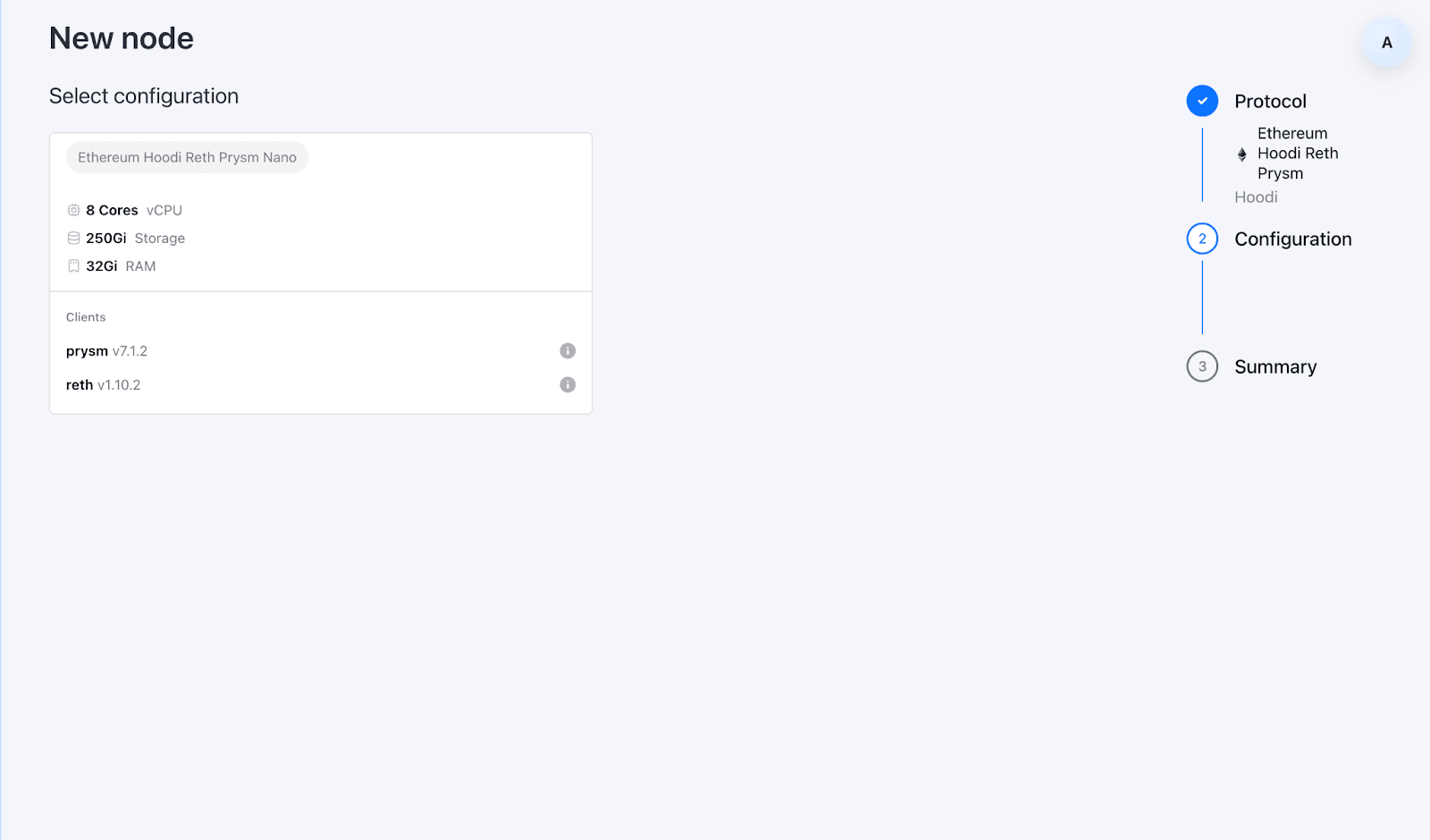
Chainstack Self-Hosted collaborates with top industry infrastructure, using two of the most well-established and popular clients for its Ethereum nodes: Reth as the execution client and Prysm as the consensus client. It features predefined configurations that coordinate components and reduce the risk of misconfiguration.
Challenge 3: Node monitoring
Even once the setup is complete, fully self-hosted node operations face much overhead in maintaining nodes. Fully self-hosted node operators are fully responsible for monitoring their status, tracking synchronization, and diagnosing failures when nodes become unresponsive or fall behind the network.
Without a centralized management system, operators frequently spend considerable time developing and maintaining custom monitoring tools and scripts to track node infrastructure, or they might not even realize when their nodes fall out of sync.
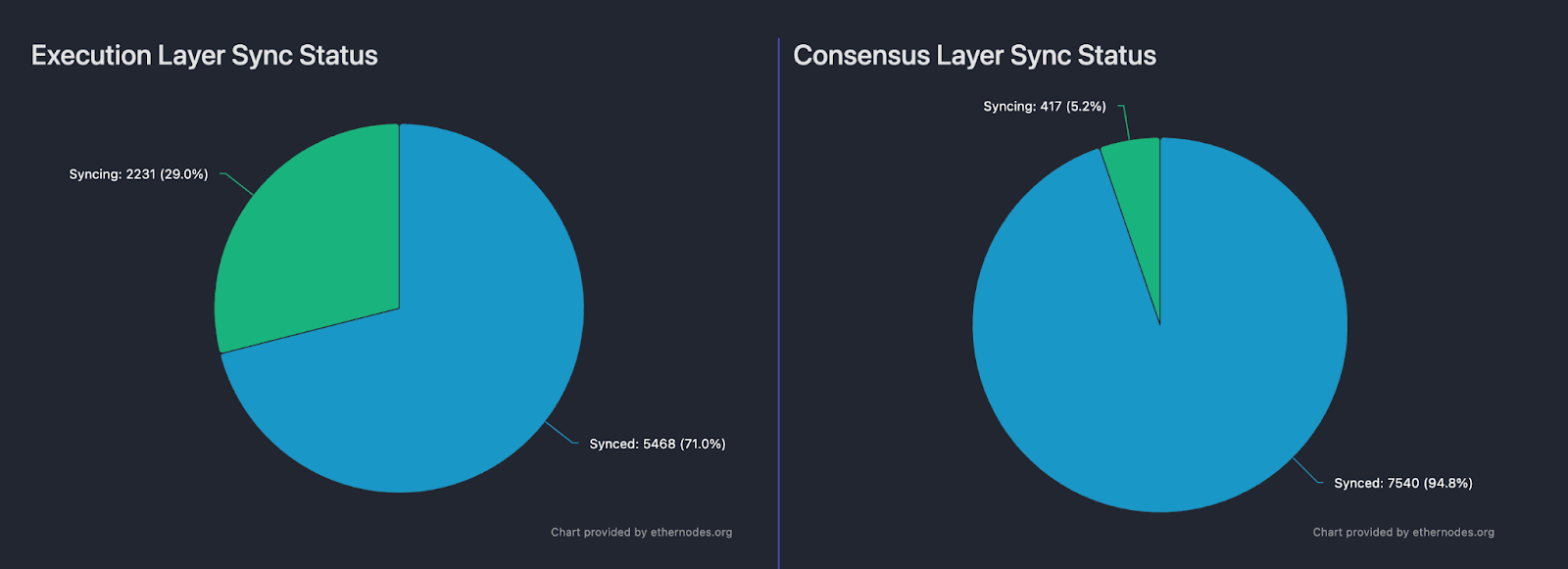
Nodes falling out of sync are common for various reasons, making reliable monitoring and visibility essential. As of March 24, 2026, Ethernodes estimates that 29 percent of nodes are out of sync at the execution layer, and 6.2 percent at the consensus layer.
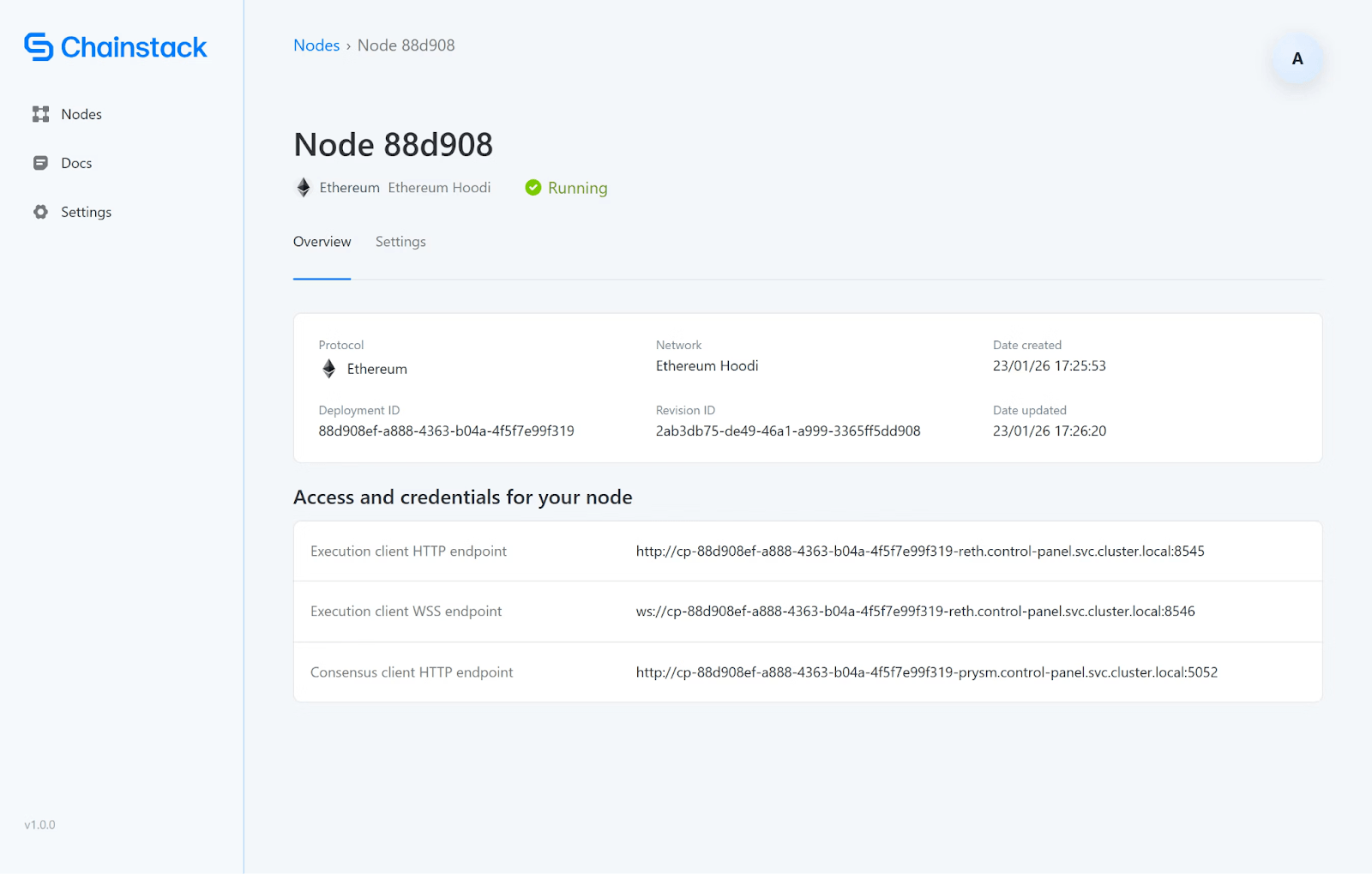
Chainstack Self-Hosted gives teams full visibility through an initiative UI control panel, with access to deployed nodes, their status, and configuration details, while still allowing teams to retain full control of their nodes.
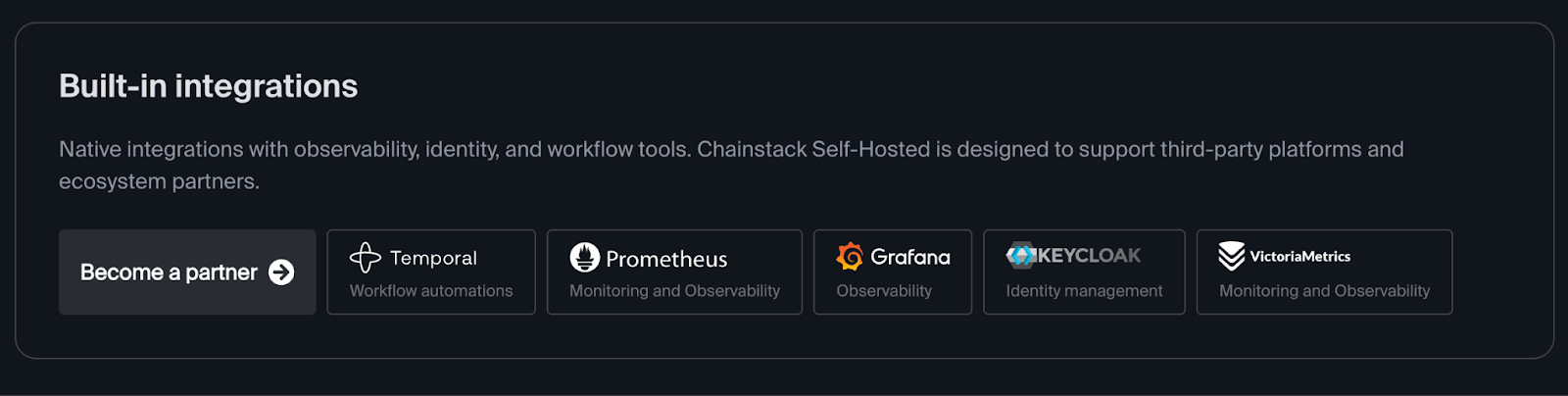
Chainstack Self-Hosted includes built-in integrations with popular third-party tools, such as Prometheus (Monitoring and Observability), Grafana (Observability), VictoriaMetrics (Monitoring and Observability), Keycloak (Identity Management), and Temporal (Workflow maintenance).
In addition to monitoring, Chainstack Self-Hosted will offer options for handling failed nodes. It can automatically recover them through self-healing, eliminating the need for manual intervention or custom recovery tools. Configurable failover enables operators to define where traffic is routed when a node is unavailable, using a secondary node, a production-grade, Chainstack high-performance RPC endpoint, or an endpoint you specify.
Challenge 4: Updating nodes
Node operators must consistently update their software to remain compatible with the network, as blockchain networks regularly update their protocols and client software, making it challenging to stay current.
Ethereum currently follows a twice-yearly hard fork schedule that requires nodes to update before each hard fork or risk incompatibility with the chain.
While node operators do not need to upgrade each time a new client version is released, they are encouraged to update periodically. As of 2026, Reth, the execution layer client, has released 8 updates, and Prysm, the consensus layer client, has released 2. In 2025, Reth published 33 releases, and Prysm published 18.
Client release frequency
| Client | Layer | 2025 Releases | 2026 Releases (YTD, as of March) |
| Reth | Execution | 33 | 8 |
| Prysm | Consensus | 18 | 2 |
| Total | 51 | 10 |
Following and managing updates across multiple nodes requires built-in processes, time, and risks of inconsistencies and misconfigurations.
Instead of following community-run channels or client release logs, self-hosted node operators save time and operational hassle by using Chainstack Self-Hosted to manage updates and configure node upgrades. Operators can update multiple nodes simultaneously through the centralized orchestration system, rather than updating them one by one.
It also includes self-healing and high-availability features, notifying operators when updates are available, and allows them to control when to apply updates.
Fully self-managed (DIY) vs Chainstack Self-Hosted
| Capability | Fully Self-Managed (DIY) | Chainstack Self-Hosted |
| Node deployment time | Days to weeks | Minutes to hours |
| Sync method | Full sync only (manual) | Fully sync, Snap sync supported |
| Client configuration | Manual, error-prone | Pre-configured Reth + Prysm |
| Monitoring | Custom scripts required | Built-in UI control panel |
| Observability integrations | Build yourself | Prometheus, Grafana, Temporal, KeyCloak, VictoriaMetrics (planned) |
| Software updates | Node-by-node, manual | Centralized orchestration |
| Failed node recovery | Manual intervention | Self-healing (planned) |
| Failover routing | Custom setup required | Configurable |
| Archive node support | Build yourself | Planned Q2 2026 |
| Multi-endpoint load balancing | Build yourself | Planned |
| Infrastructure control | Full | Full (your infrastructure) |
📖 Learn more about DIY vs Chainstack Self-Hosted.
Future of self-hosted blockchain node infrastructure
Chainstack Self-Hosted is currently in beta, with a roadmap extending through 2026.
Future releases include solving the following operational challenges:
- Connecting multiple applications to a single node: Teams running multiple services against the same node currently manage endpoint routing themselves. Chainstack Self-Hosted plans to introduce support for multiple RPC endpoints per node and load balancing across nodes, allowing operators to manage this directly through the control plane.
- Running archive nodes: Applications that require access to the full historical chain state, such as analytics platforms, block explorers, and compliance tools, depend on archive nodes that store the entire network history and require 15 TB or more of storage on Ethereum. Chainstack Self-Hosted plans to introduce archive node support in Q2 2026, deployable through the same control plane as full nodes.
Conclusion
Running a self-hosted blockchain node is essential for decentralized networks and valuable for institutions and developers who want full control over their infrastructure.
Deploying a node is relatively straightforward, but operating it reliably over time introduces significant operational complexity. Nodes must stay synchronized with the network, remain compatible with client updates, provide clear monitoring and diagnostics, and recover from failures without disrupting applications.
DIY self-hosting gives teams full control over their infrastructure, but maintaining node reliability often requires significant operational effort.
Chainstack Self-Hosted directly addresses the most common self-hosted blockchain node challenges — deployment time, monitoring, updates, and recovery — letting teams fully own their infrastructure while using an enterprise-grade platform to manage it faster and easier than a DIY setup.
It offers a control plane for deploying and managing blockchain nodes within an organization’s own infrastructure. It standardizes deployment and management workflows, allowing teams to self-host confidently while maintaining full control over their infrastructure and significantly reducing operational complexity.
To learn how to join the beta, contact the Chainstack Team. For more resources, review the Chainstack Self-Hosted docs and tutorial guide to set up a self-hosted node on Ethereum Hoodi testnet.
FAQ
A self-hosted blockchain node is a server that validates transactions, verifies blocks, and provides blockchain data directly to applications, running on infrastructure under the operator’s control.
Chainstack Self-Hosted currently supports full nodes that provide blockchain data and validator nodes that validate transactions and blocks are on the roadmap for late 2026.
Organizations run their own nodes to directly verify blockchain data, maintain control over their infrastructure, and avoid relying on third-party APIs for critical systems.
Running a self-hosted node requires managing synchronization, monitoring node health, synchronizing client software, and keeping client software up to date with protocol changes.
Chainstack Self-Hosted brings the power of Chainstack’s blockchain infrastructure platform to your own infrastructure. Deploy, manage, and monitor blockchain nodes on your own hardware or cloud environment while maintaining complete control over your data and infrastructure.
Chainstack Self-Hosted simplifies node operations by providing preconfigured clients, orchestration for updates, and built-in visibility into node status, while maintaining full infrastructure control.
Related Reading