


 AI-ready infrastructure
 Refer and earn


 Ethereum
 Hyperliquid
 Solana
 Arbitrum
 BNB Smart Chain
 Base
 Polygon
 TRON
 Sui
 Robinhood


 SOC 2 Type II
 ISO 27001
 99.99%+ uptime
Optimized submission
Send Robinhood Chain mainnet transactions through a private, optimized path to reduce inclusion delays. Works with your existing HTTPS and WebSocket endpoints.
Available on every plan
 Learn more
Free
Build trading apps, track wallet activity, and query tokenized assets with reliable, high-performance Robinhood Chain RPC infrastructure.





Connect to Robinhood Chain through one geo-balanced endpoint. Read contract state, follow token transfers, and submit transactions through the nearest available region. Use standard Ethereum JSON-RPC over HTTPS and WebSocket for mainnet or testnet.

Submit transactions, stream wallet and contract activity, query historical state, and inspect Nitro execution with one Robinhood Chain development stack.
Send Robinhood Chain mainnet transactions through a private, optimized path to reduce inclusion delays. Works with your existing HTTPS and WebSocket endpoints.
Scale high-volume RPC workloads with consistent performance, unlimited requests within your RPS tier, and predictable monthly costs.

Query past ETH and token balances, contract storage, and pool state. Backfill Robinhood Chain history for portfolio reporting, tokenized-asset analytics, and reconciliation.

Inspect transaction execution with debug_traceTransaction and debug_traceCall. Diagnose reverted trades, inspect internal calls, and investigate smart contract behavior.

Read liquidity pools, simulate swaps with eth_call, and submit signed transactions. Follow new blocks and contract logs to keep trading interfaces and launchpad indexers current.
Explore Robinhood Chain tooling (opens in a new tab)
Read ETH and ERC-20 balances, verify transaction receipts, and follow Transfer logs. Build wallet monitors and portfolio tools with ethers.js, viem, or web3.py.
Build a wallet monitor (opens in a new tab)
Read token balances, inspect transfers, and reconstruct historical contract state for tokenized-asset dashboards and reporting. Connect your application to the contracts and assets it supports.
Explore tokenized-asset infrastructure (opens in a new tab)
Backfill events with eth_getLogs and trace contract execution on a paid plan. Combine historical and live data for trading analytics, treasury tools, and transaction reconciliation.
Explore Robinhood Chain methods (opens in a new tab)
Deploy a Robinhood Chain endpoint through Chainstack MCP. Give agents access to contract reads, transaction simulations, and signed transaction submission using standard EVM tools.
Explore Chainstack AI tools (opens in a new tab)Run trading backends, tokenized-asset applications, and indexers on isolated Robinhood Chain infrastructure. Choose full or archive mode, reserve compute and storage for your workload, and let Chainstack manage Nitro deployment, upgrades, and node maintenance.
Select Robinhood Chain mainnet or testnet and choose full or archive mode to see current monthly infrastructure pricing.

Save over 50% on our elite pay as you go plan
 Chat on Telegram (opens in a new tab)
Robinhood Chain feedback and customer stories from teams building wallets, blockchain analytics, security, and multichain applications.
 They were quick to add support for the Robinhood chain, so we were able to scale our infrastructure by adding one more endpoint.We’ve gone from weekly incidents to zero incidents.Chainstack has been crucial in enhancing Brave Wallet’s multi-chain functionality and UX.Chainstack’s robust infrastructure has significantly enhanced our ability to secure Web3 environments effectively.The Unlimited Node flat-fee model gives us cost predictability, and the performance is rock-solid
Compare Chainstack’s Robinhood Chain RPC response times and request success rates against other providers across Europe, the US, and Asia. Explore P50, P95, and P99 latency in Chainstack Compare.
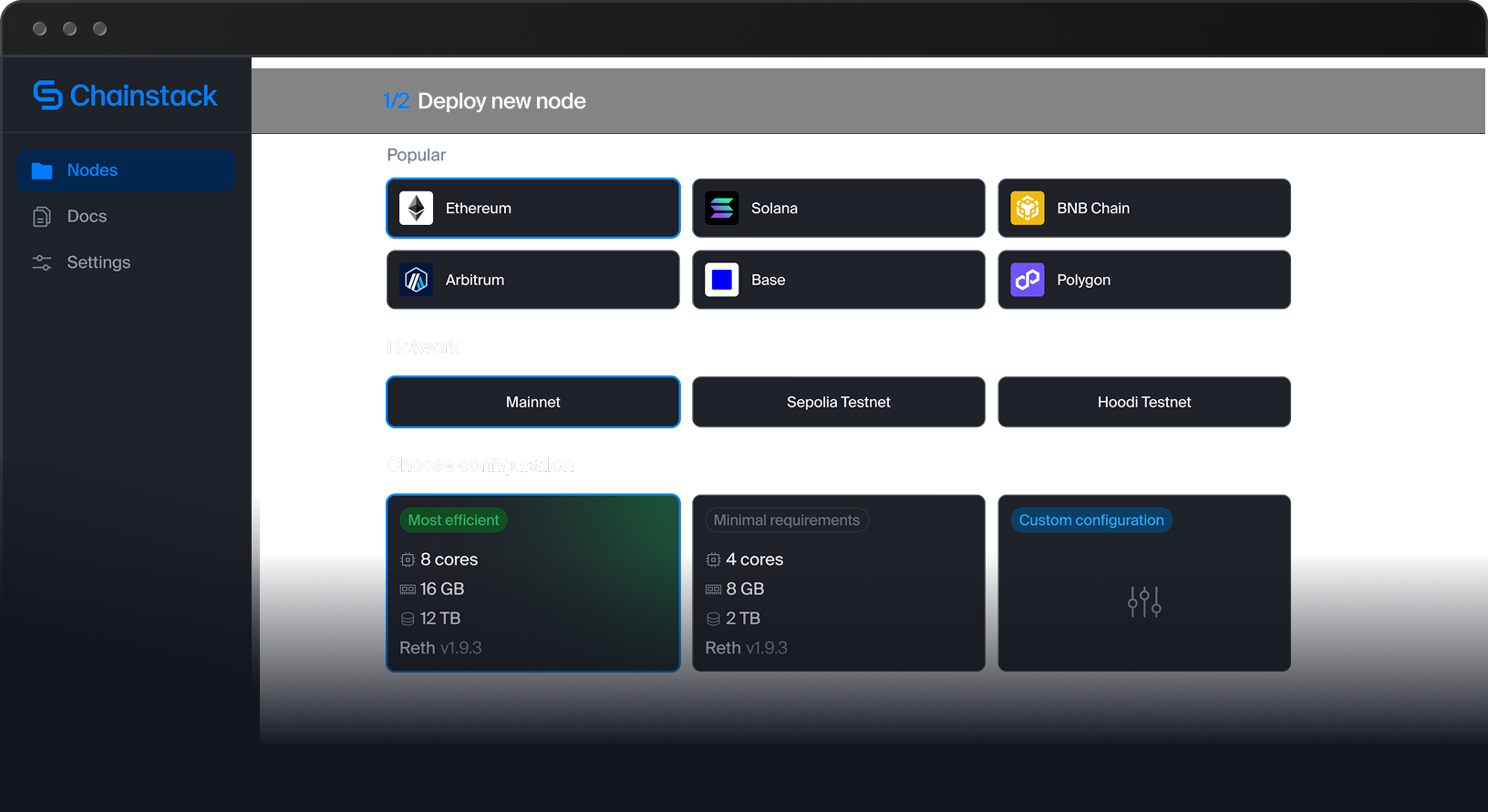
Compare Robinhood Chain RPC providers (opens in a new tab)Run Robinhood Chain mainnet or testnet nodes on infrastructure you control. Deploy Nitro through Chainstack Self-Hosted, with monitoring, automated updates, and self-healing operations. Connect Ethereum execution and beacon endpoints for the matching parent network.


Get free testnet ETH from the Chainstack Robinhood Chain faucet. Connect your testnet RPC endpoint to deploy contracts, simulate transactions, and test wallet or trading integrations with ethers.js, viem, Hardhat, or Foundry.
The faucet tops up eligible wallets to 1 testnet ETH every 24 hours. Use Robinhood Chain testnet, chain ID 46630, when testing your application.
Simulate a contract call through your Robinhood Chain RPC endpoint with eth_call.
https://robinhood-mainnet.core.chainstack.com/YOUR_ENDPOINT_IDwss://robinhood-mainnet.core.chainstack.com/YOUR_ENDPOINT_IDCreate a Robinhood Chain node on mainnet or testnet. Copy your HTTPS URL from Access and credentials and replace YOUR_ENDPOINT_ID. This read-only example uses a temporary state override to return 42 without deploying a contract or sending a transaction.
curl --request POST \
  --url https://robinhood-mainnet.core.chainstack.com/YOUR_ENDPOINT_ID \
  --header 'Content-Type: application/json' \
  --data '
{
  "jsonrpc": "2.0",
  "id": 1,
  "method": "eth_call",
  "params": [
    {"to": "0x00000000000000000000000000000000c0ffee42", "data": "0x"},
    "latest",
    {
      "0x00000000000000000000000000000000c0ffee42": {
        "code": "0x602a60005260206000f3"
      }
    }
  ]
}
'
The result ends in 002a, the hexadecimal encoding of 42. The state override applies only to this call.
Start with free Robinhood Chain RPC for mainnet and testnet. Scale trading and tokenized-asset workloads with archive data, transaction tracing, and dedicated infrastructure.
Includes:
All Developer features, plus:
Add-ons and Dedicated Node infrastructure are billed separately.
 Exceptional support on every paid plan
Explore Robinhood Chain RPC providers, migration, trading data, and wallet development.
Move your RPC endpoint and claim the Robinhood Chain Growth offer.
Read article
Follow onchain trades with sequencer-feed tooling for Robinhood Chain and Solana.
Read article
Compare Robinhood Chain RPC providers, pricing, and production capabilities.
Read article
Build a wallet monitor and verify indexed activity against transaction receipts.
Read article
Robinhood Chain RPC is the interface an application uses to read blockchain data, call contracts, and submit signed transactions. Robinhood Chain runs Arbitrum Nitro and supports Ethereum JSON-RPC over HTTPS and WebSocket. It is a blockchain endpoint, separate from Robinhood brokerage, market-data, or order-placement APIs. See the Robinhood Chain API reference for supported methods.
Create a free Chainstack account, open a project, and deploy a Robinhood Chain Global Node on mainnet or testnet. Copy the HTTPS or WebSocket URL from the node’s access details into your application. Set the matching chain ID and verify the connection with eth_chainId and eth_blockNumber. Follow the Robinhood Chain tooling guide for integration examples.
Yes. The Developer plan includes 3 million request units per month, one node, and an overall limit of 25 requests per second, with no credit card required. WebSocket access is included, and Optimized submission is available for mainnet Global Nodes on every plan. Archive state and Debug & Trace APIs require a paid plan. Network gas fees are separate from RPC usage.
Robinhood Chain mainnet uses chain ID 4663 (0x1237), and testnet uses 46630 (0xb626). Both use ETH for gas. A testnet endpoint connects to a different network from mainnet, so match your RPC URL, wallet configuration, and contracts to the selected network. See the official network configuration.
Yes. Robinhood Chain is EVM-compatible and works with standard Ethereum wallets, libraries, and frameworks. Add your Chainstack RPC URL and chain ID to MetaMask, or use the endpoint with ethers.js, viem, web3.py, Hardhat, Foundry, or Remix. The Robinhood Chain tooling guide includes connection and deployment examples.
Yes. Use your node’s WebSocket endpoint with eth_subscribe to receive new block headers and contract logs. Store the last processed block, reconnect after interruptions, and backfill missing events with eth_getLogs. A subscription is a live transport, so your application still needs recovery logic for gaps. See the supported Robinhood Chain methods.
Robinhood Chain uses sequencer-based transaction ordering rather than Ethereum’s public mempool model. Do not treat pending-transaction subscriptions as a public feed of all transactions awaiting inclusion. Use block and log subscriptions for application activity, and the official sequencer feed when building compatible node or feed tooling. See the official node and feed documentation.
Optimized submission routes eth_sendRawTransaction through a private, optimized path designed to reduce inclusion delays on Robinhood Chain mainnet Global Nodes. It works with the node’s existing HTTPS and WebSocket endpoints and is available on every plan. It is enabled by default on a new node. If private routing fails, submission falls back to the standard node route. See Optimized submission for configuration details.
Use archive access when your application needs contract state at a historical block, such as past ETH or token balances, pool state, or storage. Archive data is available from the Growth plan. A full request costs 1 RU, while an archive request costs 2 RUs; classification depends on the method and block age. See request-unit rules and the Robinhood Chain methods reference.
Yes. On a paid plan, Robinhood Chain Global Nodes expose Nitro debug_* methods, including debug_traceTransaction and debug_traceCall. Use these to inspect internal calls, diagnose reverts, and investigate execution. The trace_* and arbtrace_* namespaces are not exposed. Check the Robinhood Chain methods table for per-method and tracer availability.
Yes. Your Robinhood Chain endpoint can read token contracts, balances, transfer logs, and transaction receipts, with historical state and tracing available on a paid plan. These methods support reporting, portfolio tools, and transaction reconciliation. Access to particular Stock Tokens and related services depends on Robinhood’s product rules; RPC access does not grant brokerage or trading permissions. Consult Building with Stock Tokens for those interfaces and requirements.
Use the Chainstack Robinhood Chain faucet with a testnet wallet address and Chainstack API key. It tops up eligible wallets to 1 testnet ETH every 24 hours. The faucet currently requires at least 0.08 ETH on Ethereum mainnet and a history of holding ETH there. Testnet ETH has no monetary value and cannot pay mainnet gas fees. Follow the faucet’s current eligibility checks.
The Unlimited Node add-on is available from the Growth plan. It replaces per-request billing for the attached node with a fixed fee for a selected RPS tier. That node consumes no plan request quota and incurs no per-request overage, while requests above its throughput tier remain rate-limited. Use it for sustained polling, indexing, or high-volume application reads.
Yes. Chainstack Self-Hosted supports Robinhood Chain Nitro deployments on mainnet and testnet. You provide the infrastructure and matching Ethereum execution and beacon endpoints for synchronization. The software is free, while infrastructure costs remain yours. Follow the Robinhood Chain AWS setup guide and verify synchronization before serving application traffic.
Choose Dedicated Nodes when a trading backend, indexer, or tokenized-asset application needs isolated compute and storage or a deployment-specific configuration. Dedicated Nodes are available from the Pro plan, with infrastructure billed separately. Use the page’s live calculator to select mainnet or testnet and full or archive mode, then estimate the current infrastructure price.
Connect your application to a Chainstack Robinhood Chain HTTPS endpoint to read account data, query contracts, simulate calls, and submit signed transactions. Standard methods include eth_getBalance, eth_call, eth_getLogs, eth_getTransactionReceipt, and eth_sendRawTransaction. Mainnet uses chain ID 4663; testnet uses 46630. Both use ETH for gas. See the Robinhood Chain API reference.
Use ethers.js, viem, web3.py, Hardhat, or Foundry with your node URL. WebSocket subscriptions provide live block and contract-log updates; reconnect and backfill missed logs after interruptions. Robinhood Chain uses sequencer ordering rather than a public Ethereum-style mempool. Optimized submission is available for mainnet Global Nodes on every plan. Follow the tooling guide and Optimized submission documentation.
Archive data and Nitro debug_* methods are available on a paid plan. Full requests cost 1 RU and archive requests cost 2 RUs. Use debug_traceTransaction or debug_traceCall to inspect execution; the trace_* and arbtrace_* namespaces are not exposed. Check the method availability table for supported calls and tracer limitations.




 View installation guide