AI-ready infrastructure
 Refer and earn


 Ethereum
 Hyperliquid
 Solana
 Arbitrum
 BNB Smart Chain
 Base
Base Polygon
 TRON
TRON Sui
Sui Robinhood


Chainstack vs QuickNode vs Alchemy: Which blockchain API is most cost-effective in 2026

Intro
Choosing a blockchain API provider often comes down to pricing mechanics, request limits, and how usage scales under real workloads.
In this comparison, we break down how Chainstack, QuickNode, and Alchemy price API usage across EVM and Solana, with a focus on request unit models, method-based multipliers, and cost predictability.
By looking at common production workloads and real pricing structures, this article highlights where costs diverge and what developers should account for when selecting a blockchain API provider.
How blockchain API pricing models affect costs
Blockchain API providers calculate usage in distinct ways:
- Chainstack: Employs a 1:1 Request Unit (RU) model, ensuring costs align directly with usage, free of multipliers.
- QuickNode: Uses API Credits, with multipliers from 20x to 120x depending on the method.
- Alchemy: Relies on Compute Units (CUs), with multipliers between 10x and 60x.
- Helius: Applies its own request model, with multipliers ranging from 1x to 10x.
A single request costing 1 RU on Chainstack could translate to 20–120 API Credits on QuickNode, 10–60 CUs on Alchemy, or 1–10 units on Helius, amplifying expenses significantly for demanding applications.
EVM API cost: Method multiplier impact
The table below outlines the method multipliers applied by Chainstack, QuickNode, and Alchemy for various EVM RPC methods—key factors that determine the true cost of API usage. Each multiplier reflects how many request units (or equivalent) a single call consumes, significantly influencing expenses for high-throughput applications.
While Chainstack maintains a flat multiplier of 1 across all methods, QuickNode and Alchemy apply higher multipliers—ranging from 10 to 60—depending on the method’s complexity. This comparison sets the stage for understanding how these differences translate into real-world pricing.
| Method | Chainstack | QuickNode | Alchemy |
|---|---|---|---|
| eth_call | 1 | 20 | 26 |
| eth_getTransactionReceipt | 1 | 20 | 20 |
| eth_getBalance | 1 | 20 | 20 |
| eth_getLogs | 1 | 20 | 60 |
| eth_blockNumber | 1 | 20 | 10 |
| eth_getBlockByNumber | 1 | 20 | 20 |
| eth_chainId | 1 | 20 | – |
| eth_getTransactionCount | 1 | 20 | 20 |
| eth_getTransactionByHash | 1 | 20 | 20 |
| eth_getStorageAt | 1 | 20 | 20 |
| eth_getFilterChanges | 1 | 20 | 20 |
| eth_getBlockReceipts | 1 | 20 | 20 |
| eth_getUncleByBlockNumberAndIndex | 1 | 20 | 20 |
| eth_getCode | 1 | 20 | 20 |
| eth_gasPrice | 1 | 20 | 20 |
| eth_estimateGas | 1 | 20 | 20 |
| eth_feeHistory | 1 | 20 | 10 |
| eth_sendRawTransaction | 1 | 20 | 40 |
| eth_maxPriorityFeePerGas | 1 | 20 | 10 |
| eth_getBlockByHash | 1 | 20 | 20 |
| net_version | 1 | 20 | – |
| web3_clientVersion | 1 | 20 | 20 |
| eth_syncing | 1 | 20 | – |
| eth_accounts | 1 | 20 | 10 |
| trace_block | 2 | 40 | 20 |
| trace_transaction | 2 | 40 | 40 |
| debug_traceTransaction | 2 | 40 | 40 |
| debug_traceBlockByNumber | 2 | 40 | 40 |
| debug_traceCall | 2 | 40 | 40 |
| debug_traceBlockbyHash | 2 | 40 | 40 |
To assess cost efficiency, we’ll look at a typical EVM workload—a balanced set of common RPC methods used in high-demand applications. This includes contract calls, transaction lookups, event indexing, and gas estimation, all essential for DeFi platforms, NFT marketplaces, and blockchain analytics tools.
By comparing how Chainstack, QuickNode, and Alchemy manage this usage, we can observe how their pricing adjusts in real-world situations. This analysis reveals how method-based multipliers affect overall expenses and shows why Chainstack’s Pro plan provides the most consistent and budget-friendly option for EVM developers.
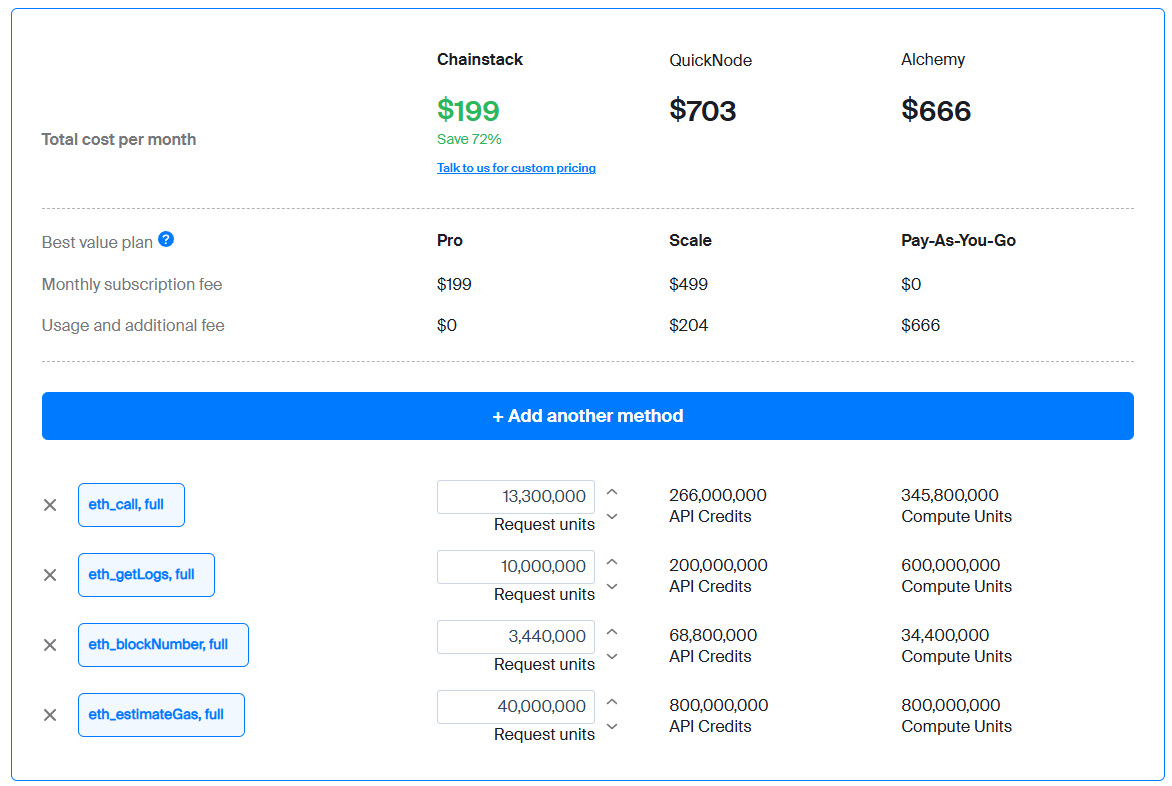
Chainstack Pro is priced at $199/month for 80M request units, including an additional 25M units at no extra cost and no hidden multipliers. Additional usage is available at $12.5 per 1M RU.
In comparison, QuickNode’s Scale plan costs $703/month, consisting of a $499 base fee plus $204 in usage charges. Alchemy’s PAYG model comes in at $666/month, with pricing determined entirely by usage.
Solana API cost: Method multiplier impact
The table below compares the method multipliers for Solana RPC methods across Chainstack, QuickNode, and Helius, revealing how each provider weights API calls in terms of resource usage. These multipliers—indicating the request units (or equivalent) per method—play a pivotal role in shaping costs, especially for applications with heavy demands.
Chainstack keeps it simple with a uniform multiplier of 1, while QuickNode’s range spans 30 to 120, and Helius fluctuates between 1 and 10 based on method type. This sets up a clear lens for assessing their pricing in action.
| Method | Chainstack | QuickNode | Helius |
|---|---|---|---|
| getProgramAccounts | 1 | 60 | 10 |
| getTokenAccountsByOwner | 1 | 30 | 1 |
| getSignatureStatuses | 1 | 30 | 1 |
| getAccountInfo | 1 | 30 | 1 |
| getBalance | 1 | 30 | 1 |
| getTokenAccountBalance | 1 | 30 | 1 |
| getStakeActivation | 1 | 30 | 1 |
| getLatestBlockhash | 1 | 30 | 1 |
| getFeeForMessage | 1 | 30 | 1 |
| getConfirmedTransaction | 1 | 30 | 1 |
| getSignaturesForAddress | 1 | 30 | 1 |
| getInflationRate | 1 | 30 | 1 |
| getVoteAccounts | 1 | 30 | 1 |
| getEpochInfo | 1 | 30 | 1 |
| getMultipleAccounts | 1 | 30 | 1 |
| getBlock | 1 | 30 | 1 |
| getTokenSupply | 1 | 120 | 1 |
| logsSubscribe | 1 | 30 | 1 |
| getBlockHeight | 1 | 30 | 1 |
| getSlot | 1 | 30 | 1 |
| getMinimumBalanceForRentExemption | 1 | 30 | 1 |
| simulateTransaction | 1 | 30 | 1 |
| getRecentBlockhash | 1 | 30 | 1 |
| getTransaction | 1 | 30 | 1 |
| sendTransaction | 1 | 30 | 1 |
To gauge cost efficiency, we’ll explore a standard Solana workload—a realistic combination of frequent RPC methods key to high-performance applications. This encompasses account lookups, transaction status queries, and token ownership checks, all integral to DeFi platforms, NFT marketplaces, and blockchain analytics tools.
By examining how Chainstack, QuickNode, and Helius process this demand, we can understand how their pricing plays out in practical settings. This comparison highlights the effect of method-based multipliers on overall expenses and illustrates why Chainstack’s Pro plan delivers the most dependable and economical solution for Solana developers.
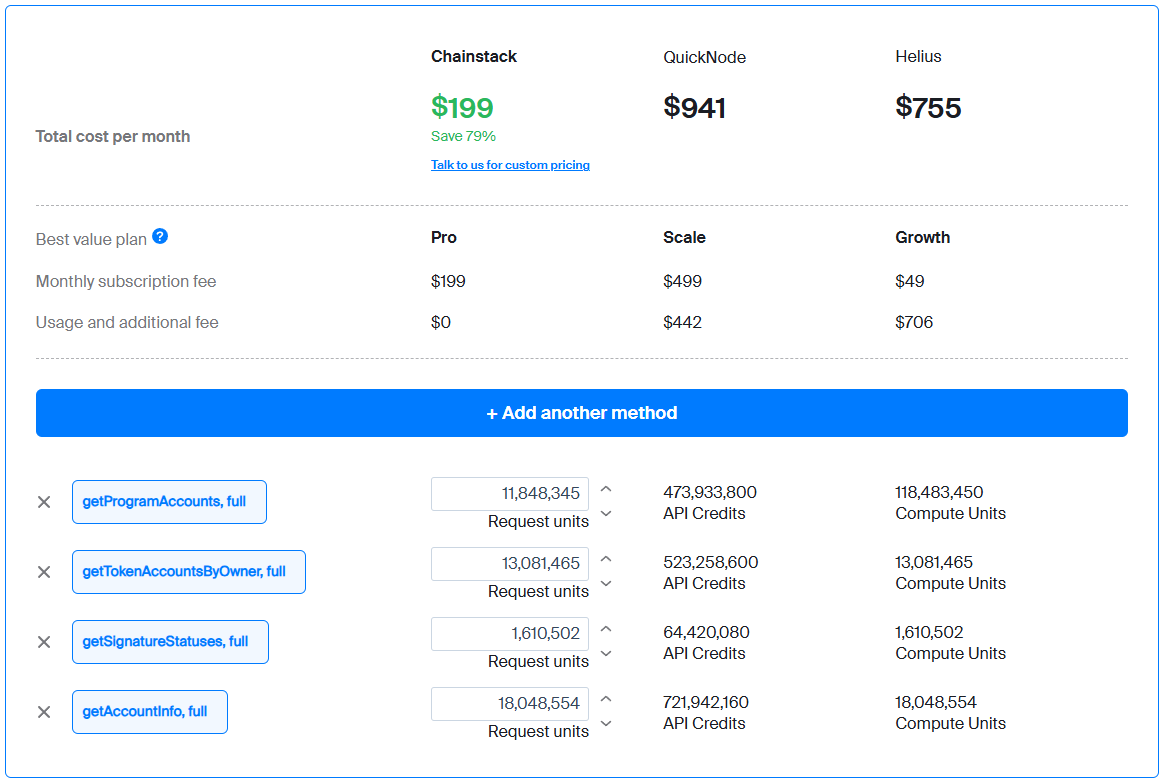
Our Pro plan costs $199/month for 80M request units, free of extra usage fees or concealed multipliers, with additional usage at $12.5 per 1M RU.
Meanwhile, QuickNode’s Scale plan reaches $941/month, combining a $499 base fee with $442 in usage costs. Helius’s Growth plan totals $755/month, featuring a $49 subscription fee plus $706 in added usage charges.
Further reading
- Introducing the new Pro plan: Power, Performance, Simplicity
- Nexo: 5X lower Debug & Trace costs
- Trust: 400% ROI with custom gateways
- CertiK: 70% lower Ethereum archive costs
Bringing it all together
When comparing blockchain API providers, cost efficiency is ultimately determined by how pricing behaves under real, sustained workloads—not by headline prices or advertised limits.
Across both EVM and Solana, Chainstack consistently delivers the lowest and most predictable costs thanks to its flat 1:1 Request Unit pricing model. In contrast, QuickNode, Alchemy, and Helius rely on method-based multipliers that cause costs to scale disproportionately as request volume and workload complexity increase.
Why Chainstack stands out in practice:
- No multipliers: A flat 1:1 RU model keeps costs directly aligned with actual request volume, unlike the variable and often high multipliers used by competitors.
- Lower total cost at scale: For production EVM and Solana workloads, Chainstack results in hundreds to thousands of dollars in monthly savings compared to QuickNode, Alchemy, and Helius.
- Predictable scaling: Additional usage at $12.5 per 1M RU enables straightforward capacity planning without unexpected cost spikes.
- Production-proven: trusted by DeFi protocols, stablecoin infrastructure providers, enterprise teams, and analytics platforms operating high-throughput workloads.
For teams running production-grade Web3 applications where cost predictability and scalability matter, Chainstack is the most cost-effective blockchain API provider across both EVM and Solana ecosystems — start for free and spin up production-ready RPC endpoints with predictable pricing and no multipliers.
Power-boost your project on Chainstack
- Discover how you can save thousands in infra costs every month with our unbeatable pricing on the most complete Web3 development platform.
- Input your workload and see how affordable Chainstack is compared to other RPC providers.
- Connect to Ethereum, Solana, BNB Smart Chain, Polygon, Arbitrum, Base, Hyperliquid, Robinhood Chain, Arc, Tempo, MegaETH, Monad, Plasma, Avalanche, Optimism, Aptos, Cronos, Gnosis Chain, Moonbeam, Celo, Aurora, TON, Ronin, and Bitcoin mainnet or testnets through an interface designed to help you get the job done.
- Fast access to blockchain archive data and gRPC streaming on Solana.
- To learn more about Chainstack, visit our Developer Portal or join our Telegram group.
- Connect your AI agent to Chainstack in seconds using Chainstack MCP — give Claude, Cursor, Codex, Gemini, and Windsurf live access to blockchain data, node management, and docs.
- Are you in need of testnet tokens? Request some from our faucets. Sepolia faucet, Base Sepolia faucet, Solana devnet faucet, Hoodi faucet, BNB faucet, zkSync faucet, Robinhood Chain faucet, Hyperliquid faucet, Monad faucet, Amoy faucet, Plasma faucet, TON faucet.
Have you already explored what you can achieve with Chainstack? Get started for free today.