AI-ready infrastructure
 Refer and earn


 Ethereum
 Hyperliquid
 Solana
 Arbitrum
 BNB Smart Chain
 Base
Base Polygon
 TRON
TRON Sui
Sui Robinhood


Running your own Base node: stablecoins and AI agents

Running a Base node yourself has historically been a commitment. The client stack itself wasn’t the exotic part — Base is EVM, and until recently it was standard OP Stack: op-node for consensus, op-geth or op-reth for execution, both well-understood. The commitment was everything around them: hardware provisioning at OP Stack sizing, a synced Ethereum L1 endpoint feeding derivation, days of initial sync, monitoring, updates every time OP Stack or Base shipped a hard fork. Teams running USDC settlement, Coinbase-adjacent wallet infrastructure, DeFi on Aerodrome or Morpho, or the wave of AI-agent platforms building on Base did this because they had to — the value of full control over broadcast, mempool visibility, and independent read-side latency outweighed the DevOps cost. Teams without those requirements didn’t.
Two things have changed since. First, Base itself is now moving off the distributed OP Stack layout onto a unified base/base client stack — base-consensus and base-reth-node, shipped as one release channel from one repo — which collapses the coordination overhead that used to sit between Base engineers and OP Labs / Flashbots / Paradigm on every upgrade. Second, Chainstack Self-Hosted now supports Base Mainnet on that same base/base stack, which means the operational layer around the node — deployment, monitoring, self-healing — becomes software you consume rather than a stack you build.
This piece is about who actually benefits from a Base node on their own infrastructure, what running one looks like day-to-day, and how the newer answer compares to the older one.
Why running a Base node used to be a project
Base is Coinbase‘s Ethereum L2 and, by mid-2026, the largest chain in the OP Superchain by TVL (~$4.5B). It settles the majority of onchain USDC transfer volume, hosts the majority of x402 agentic-payment traffic, and processes roughly 12–13 million daily transactions. When you run your own Base node, you get the same feature set every serious operator in that flow does:
- Full JSON-RPC and WebSocket surface — HTTP RPC on port 8545, WS on port 8546. All standard Ethereum methods work unchanged, plus the
optimism_*namespace for rollup-specific queries likeoptimism_syncStatus. - Rollup RPC access — the consensus client (
base-node/base-consensus) exposes rollup HTTP RPC on port 9545 for derivation state and sync introspection that shared providers rarely expose. - Flashblocks preconfirmations — Base ships 200 ms sub-block ordering via Flashblocks. Applications reading
eth_getBlockByNumberwith the"pending"tag get inclusion signals ~10× faster than waiting for a sealed 2-second block. Latency-sensitive workloads (liquidations, arbitrage, agent payments) care about which endpoint surfaces this and how quickly. - Direct transaction broadcasting with propagation control — your
eth_sendRawTransactioncalls hit the sequencer from your own peer set rather than queueing behind an unknown shared-endpoint tenant. - Independent read finality — for an app that resolves settlement against Base state, “we ran the query against our own node” is a materially different answer to auditors and to internal risk than “we called someone’s RPC.”
Unlocking that on your own infrastructure historically meant assembling the ops layer around the client stack yourself: provisioning ~3.5 TB of NVMe, wiring in an Ethereum L1 RPC and a Beacon API endpoint for derivation, waiting for the sync, setting up monitoring, tracking OP Stack releases, and — as of 2026 — planning the migration from op-node + op-geth to base-consensus + base-reth-node before Base V1 activates on mainnet. Legacy op-node + op-geth and Nethermind configurations stop syncing with the canonical chain after that boundary. The teams that took all that on did so for very specific reasons — worth naming, because that’s where the case for a self-hosted Base node actually lives.
Who actually runs their own Base node, and why
- Stablecoin payment processors and Base Pay merchants. USDC on Base is native (issued directly by Circle, no bridge assumption), and Base has become the highest-velocity chain for USDC by a wide margin. USDC’s annualized velocity now sits at 741x, ten times USDT’s 74x, according to Coin Metrics’ State of the Network Issue 376 (Aug 2026). As of August 2026, USDC has settled $32T in transfer volume in 2026 alone — 77% of total stablecoin market volume. On Base specifically, more than 90% of USDC transfer volume traces to just three contracts: DEX liquidity provision on Aerodrome (69%) and flashloan activity through Morpho (23%), with a single day in June seeing flashloan volume exceed $500B. Base Pay’s Shopify integration runs on USDC. Circle launched native EURC on Base in July 2026, adding a MiCA-compliant euro rail alongside the USDC one. When your business is confirming and settling stablecoin payments in seconds, watching the mempool from your own node isn’t a nice-to-have — it’s how you actually know whether a payment landed before you release goods.
- AI agent platforms and x402 operators. Coinbase and Cloudflare’s x402 protocol turns HTTP status code 402 into an actual payment negotiation layer — an agent hits a paid endpoint, gets back a payment challenge, pays in USDC, gets the resource. As of April 2026, x402 had settled over 167 million transactions with 85% on Base, per Base team data (the mix has shifted since — Solana emerged as a large share of x402 volume by mid-2026, when the x402 Foundation moved under Linux Foundation governance — but Base remains a primary settlement layer). Foundation members now include Coinbase, Cloudflare, Google, Visa, AWS, Anthropic, Circle, Stripe, Shopify, and Mastercard. Platforms like Virtuals Protocol (Base-native, launched in October 2024) run AI agents that hold their own wallets, transact autonomously, and settle in USDC on Base in ~2 seconds. Agent workloads are bursty and highly parallel — see Chainstack’s guide on blockchain RPC for AI agents — and they break shared-RPC rate-limit envelopes fast. Teams operating agent fleets at any scale run their own nodes.
- Consumer wallets and smart-wallet infrastructure. Coinbase Smart Wallet — rebranded as the Base App in July 2025 as Coinbase’s “everything” app for onchain — passed 1 million Smart Wallet accounts by August 2025, with roughly 270K accounts created in a single day at peak. That’s a lot of ERC-4337 UserOperation traffic,
eth_estimateGascalls, and paymaster interactions — none of it cheap on a shared endpoint. Wallet infrastructure teams that used to run one Ethereum node now typically also run their own Base node to keep smart-wallet UX responsive. - DeFi protocols on Base. Aerodrome Finance — Base’s dominant DEX, historically the majority of the chain’s DeFi TVL — plus Morpho lending on Base, Aave v3 on Base, and dozens of perp and options protocols. Coin Metrics’ Issue 351 found that roughly half of the January 2026 USDC transfer surge on Base traced to DeFi infrastructure activity — LP rebalancing on Aerodrome, Morpho flows, flash-loan arbitrage — rather than end-user payments. Either way, that’s DeFi infrastructure generating stablecoin traffic in its own right. Application logic that depends on chain state can’t tolerate a shared provider’s latency envelope, and any Base DeFi protocol at scale — see Chainstack’s guide on Base RPC for DeFi — needs
eth_getLogs, WebSocket subscriptions, anddebug_traceTransactionaccess that shared tiers rate-limit hard. - Coinbase-adjacent custody and institutional operations. Base is Coinbase’s own L2. Coinbase Custody via Coinbase Prime, the Coinbase International Exchange, and every institutional integration that touches Base assets runs the associated infrastructure at Coinbase-internal scale. Beyond Coinbase itself, prime brokers and custodians serving clients with Base-native positions (BitGo, Fireblocks integrations) do the same — auditors don’t accept “we trust a third-party RPC” as a control for customer asset movement.
- Analytics, compliance, and indexing platforms. Chainalysis, Elliptic, and specialist Base indexers all run their own Base nodes at scale for transaction tracing, compliance monitoring, and pre-built analytics. Any platform in the business of serving Base data as a product needs full and direct access to the chain, typically across multiple nodes for redundancy plus indexed databases on top.
At a glance:
| Audience | Use case | What running your own unlocks | Examples |
|---|---|---|---|
| Stablecoin payment processors | Accept USDC on Base at scale, run merchant checkout | Controllable broadcast, real-time confirmation, mempool-accurate gas estimation | Base Pay, Shopify integration, merchant processors |
| AI agent platforms and x402 operators | Autonomous agents transacting in USDC via x402 | Direct RPC for burst workloads, no shared rate-limit envelope, Flashblocks preconfirmations | Virtuals Protocol, Coinbase AgentKit apps, x402 services |
| Consumer wallets and smart-wallet infra | Serve Coinbase Smart Wallet / ERC-4337 traffic | Dedicated bandwidth for UserOp / paymaster / bundler workloads, low-latency eth_estimateGas | Coinbase Smart Wallet, Base App, wallet SDKs |
| DeFi protocols on Base | DEX, lending, perps, options | Full log subscriptions, debug_traceTransaction, WebSocket event streams | Aerodrome, Morpho, Aave, Uniswap on Base |
| Coinbase-adjacent custody & institutions | Institutional custody of Base assets | Audit-defensible chain of trust, rate limits that hold at institutional scale | Coinbase Custody, BitGo, Fireblocks integrations |
| Analytics, compliance, indexers | Serve Base data as a product | Multi-node redundancy, archive access, custom indexer feeds | Chainalysis, Elliptic, specialist Base indexers |
The pattern across all of these: when Base data is load-bearing for your business — stablecoin settlement, agentic payments, wallet UX, DeFi state, custody — you don’t rent it.
What running your own actually costs
The operational reality of a Base node is more pragmatic than the “sovereign L2” version. It’s heavier than a Bitcoin node, comparable to Optimism, and lighter than a Polygon PoS full node. Costs are predictable enough to plan around, but there are a few Base-specific twists.
- The OP Stack twist: you need an L1 endpoint. This is the fact of life that separates Base from a standalone L1 like Bitcoin or TRON.
base-consensusderives Base state from Ethereum by reading batches posted to L1 — so you need an Ethereum Mainnet RPC endpoint and a Beacon API endpoint feeding the node continuously. Either you run your own Ethereum L1 alongside your Base node (in which case you’re now operating two chains’ worth of infrastructure), or you point Base at a managed Ethereum RPC. Chainstack’s Self-Hosted Ethereum Mainnet or a managed Ethereum endpoint both work — the point is it’s not optional and it’s not free. - Initial sync. Base processes roughly 12–13 million transactions per day and has been running since August 2023. A clean sync from genesis takes days on good hardware — the execution client replays every transaction and rebuilds state as it goes. Unlike Chainstack Self-Hosted Ethereum Mainnet and Optimism Mainnet, which bootstrap from pre-built snapshots, Base currently syncs without a snapshot preset, so plan for a multi-day initial sync window. That’s the honest read as of mid-2026; snapshot bootstrap for Base is the kind of thing that could land in a future Self-Hosted release, but it’s not there today.
- Storage growth. ~3.5 TB steady-state for a Base full node, growing steadily as the chain processes ~12M tx/day. Plan for 5+ TB of storage headroom if you want to avoid resizing within the first year. NVMe strongly preferred over SATA SSD — Base’s 2-second block cadence (200 ms with Flashblocks) generates enough write pressure that slower disks become a bottleneck.
- Updates and the base/base migration. Base historically shipped ~3 hard forks per year on the OP Stack schedule. Under the new base/base architecture it’s targeting 6 upgrades per year in smaller batches. That’s a faster cadence, and the immediate operational implication is real: Base V1 is the hard migration boundary. After V1 activates on mainnet, legacy
op-node + op-gethand Nethermind configurations no longer sync with the canonical chain. Sepolia already activated V1 on 2026-04-20 at 18:00 UTC; Base V1 / Azul activated on mainnet May 13, 2026, and Beryl followed. The base/base stack is what all production nodes run today. If you’re running a Base node yourself, this is the migration you’re planning right now — or the reason you’re reading this piece. - Monitoring and reliability. Sync drift happens. Peer connections degrade. The L1 endpoint you’re depending on for derivation can throttle or fall behind, which quietly stalls your Base node’s rollup sync without anything obvious in the execution client logs. Disk fills up. Without monitoring, you find out something is wrong because a USDC transfer failed to confirm or a wallet timed out on
eth_estimateGas. With monitoring, you find out because an alert fires before customers notice. - The “run it and forget it” myth. Plenty of Base nodes do run for weeks without intervention. They also drift out of sync silently, fall behind on hard forks, and become slowly less useful without anyone noticing — and now, with the base/base migration underway, they can silently fork off the canonical chain. For personal use, that’s fine. For production stablecoin settlement or agent traffic, it’s a quiet path to a broken Saturday.
What changed: Chainstack Self-Hosted now supports Base
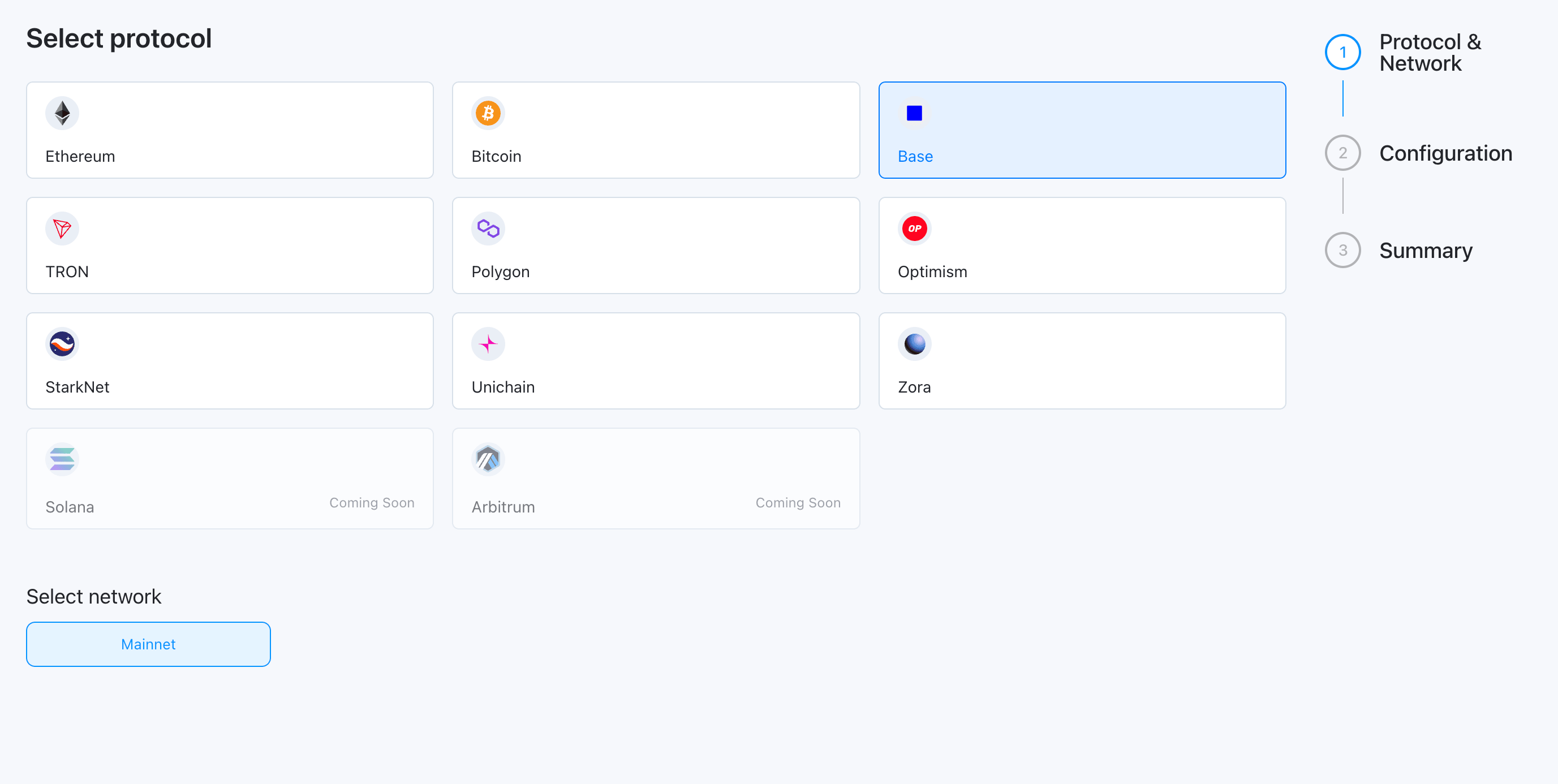
The historical reason teams reached for shared RPC over self-hosting wasn’t that they wanted shared RPC — it was that the operational overhead of self-hosting a Base node, including the L1 dependency, was too high to justify unless you were already operating multiple chains’ worth of infrastructure. And even then, tracking the OP Stack release cadence across three upstream teams was its own tax.
Chainstack Self-Hosted is what happens when you separate “own the node” from “build the operational stack around it.” Self-Hosted now supports Base Mainnet on Base-Reth v1.1.0 + Base-Node v1.1.0 — the post-migration base/base stack — with the same deployment workflow as the rest of the platform: pick the protocol, pick the network, deploy.
Control Panel install is one command (cpctl install) that finishes in 5–10 minutes on a fresh Ubuntu host — the operational layer that used to take a quarter to build lands in an afternoon. The Base node itself still needs its multi-day genesis sync, since Base doesn’t ship a snapshot preset yet.
See the supported clients and protocols page for the current sizing matrix.
A Base full node fits on 12 vCPU, 48 GiB RAM, and ~3.5 TB of NVMe storage. Same sizing as Optimism, Unichain, and Zora on the platform — that’s the OP Stack family baseline. See system requirements for the full matrix. The exposed endpoints are base-reth‘s HTTP JSON-RPC on port 8545, WebSocket on 8546, and base-node‘s rollup HTTP RPC on 9545. That’s the standard Ethereum JSON-RPC every SDK speaks, plus the rollup RPC for consensus/derivation introspection.
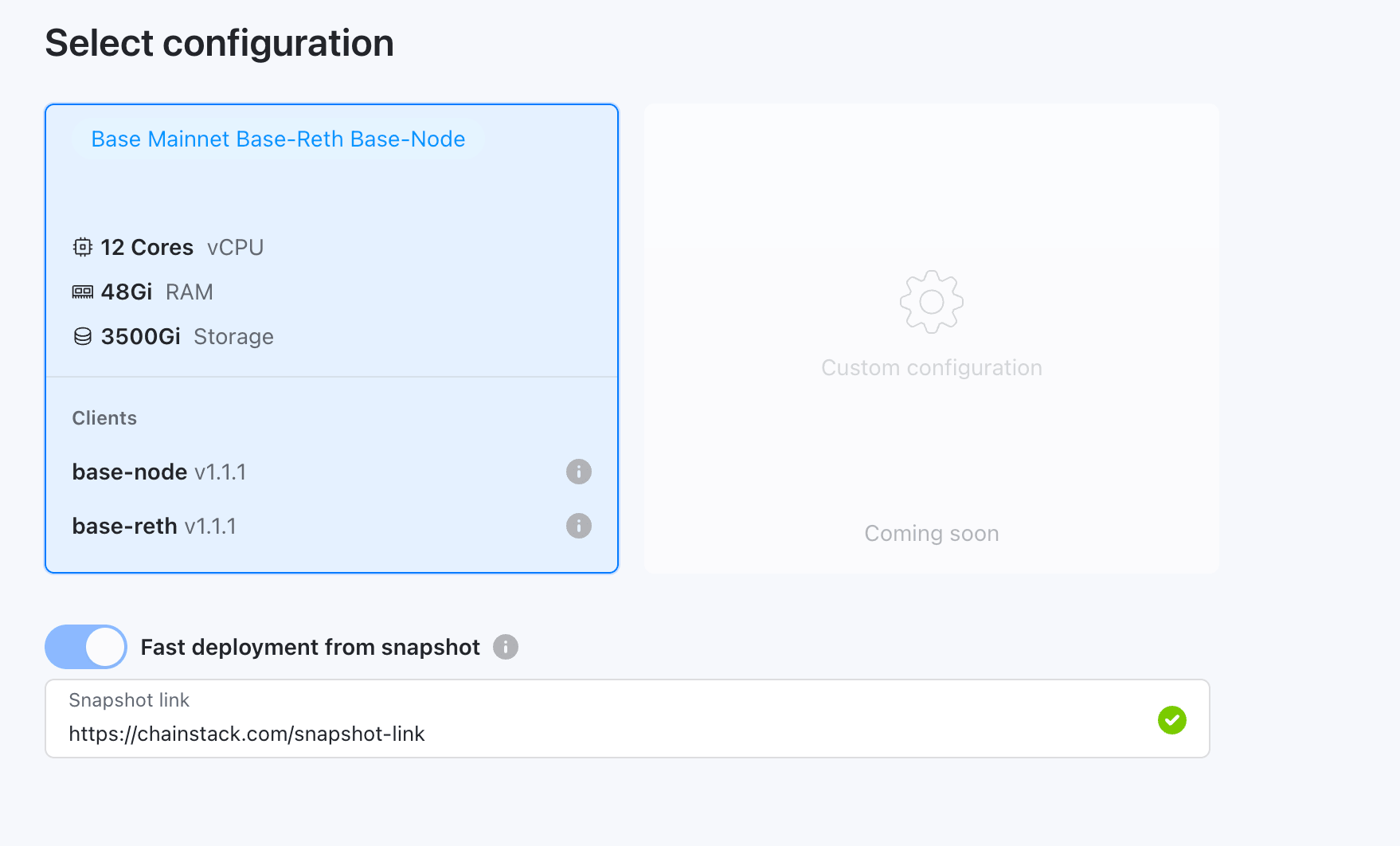
Because Base is an OP Stack chain, the deployment requires you to supply an Ethereum L1 RPC endpoint and a Beacon API endpoint — the node uses them to derive Base state from L1. If you’re already running Ethereum Mainnet on Chainstack Self-Hosted, that’s the natural pairing. If not, a managed Chainstack Ethereum endpoint works. This isn’t a Chainstack quirk — it’s an OP Stack architectural fact — but it’s worth flagging upfront so you don’t spec out a Base deployment and discover the L1 dependency at deploy time.
A few Base-specific caveats worth naming honestly, in the same spirit as the TRON write-up:
- Base doesn’t currently ship with a snapshot-bootstrap preset on Chainstack Self-Hosted. Only Ethereum L1 (Mainnet, Sepolia, Hoodi) and Optimism Mainnet in the OP Stack family have snapshot bootstrap out of the box. Base, Unichain, and Zora sync conventionally. Multi-day initial sync applies here. Check the supported deployments page for the current snapshot availability list.
- What you do get is Kubernetes-level self-healing: if a node pod crashes, the deployment automatically restarts it and resumes from the last state on the persistent volume.
- Client version updates through Base’s hard fork cycle currently require you to redeploy the node on the new base/base version yourself — Self-Hosted doesn’t auto-update client versions.
- Multi-endpoint failover to a Chainstack-managed Base node is on the roadmap but not yet shipped.
- You still own the node. The data never leaves your perimeter. You can SSH into the box and run standard
eth_*calls,optimism_*calls, orcurlagainst the rollup RPC exactly like any other base/base install. The difference is you didn’t build the deployment stack around it yourself.
For managed Base endpoints — with Flashblocks-aware routing and geo-balanced global nodes — the counterpart is Chainstack’s managed Base offering, and the two coexist naturally: managed for the failover / bursty read path, Self-Hosted for the load-bearing hot path.
When to self-host Base, and when not to
The decision isn’t religious. It’s a workload question.
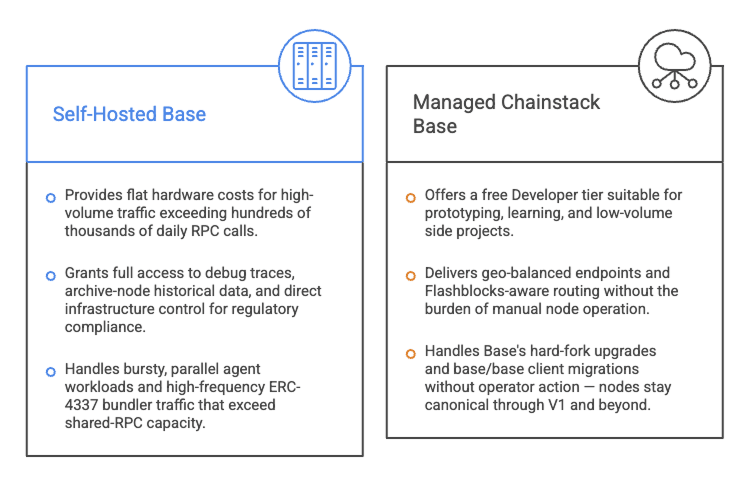
Run your own Base node if:
- You’re settling USDC payments in production. Broadcast reliability, mempool visibility, and confirmation-timing arguments compound until they’re decisive.
- You operate an AI agent platform, x402 service provider, or agent fleet at any meaningful scale. Bursty, parallel agent workloads break shared-RPC assumptions faster than any human-driven traffic.
- You run wallet infrastructure serving Coinbase Smart Wallet / ERC-4337 traffic, a smart-wallet SDK, or an Account Abstraction bundler at scale.
- Your application makes more than a few hundred thousand RPC calls per day. Managed RPC pricing scales with call volume; your own node runs at a flat hardware cost regardless of throughput.
- You need Flashblocks preconfirmations, full log subscriptions,
debug_traceTransaction, or archive-node-like historical access. - Compliance, audit, or regulatory frameworks require infrastructure control over customer asset movements.
Reach for a managed Chainstack Base endpoint if:
- You’re learning, prototyping, or running a low-volume side project. Chainstack Base nodes with a free Developer tier cover most of that scale without the setup. The Chainstack Base faucet covers testnet ETH for the dev loop.
- You only need occasional historical lookups or read-only analytics on Base data.
- You’re integrating a wallet or app that needs basic ERC-20 balance queries and transaction submission, without the burst profile of an agent fleet.
- You want Flashblocks-aware routing and geo-balanced endpoints without operating the node yourself
The middle ground — production workloads that wanted their own Base node without committing to the full DIY stack including the L1 dependency — used to have no clean answer. DIY worked, but the setup and monitoring layer around base-reth and base-consensus was itself a quarter of DevOps work, and the OP Stack → base/base migration adds one more scheduled interruption on top. Chainstack Self-Hosted is what removes that barrier: your infrastructure, none of the setup marathon. And if you’re still weighing managed vs self-hosted more broadly, the Best Base RPC providers 2026 comparison covers the managed landscape across Chainstack, Alchemy, QuickNode, dRPC, and Ankr — including the same three workload profiles (stablecoins, DeFi, AI agents) this piece opened with.
If your Base workload is heading toward “load-bearing for the business” — and given Base is now the largest OP Superchain member by TVL, the #1 chain by daily stablecoin transfer volume, and the settlement layer for the majority of x402 agent traffic, that threshold arrives faster than most teams expect — running your own node was always the right answer. What’s new is that the path from “I should probably do this” to “it’s deployed and monitored” doesn’t have to take a quarter anymore.
FAQ
From genesis, several days on good hardware — the execution client has to replay every transaction Base has processed since August 2023 and rebuild state as it goes. Unlike Ethereum Mainnet and Optimism Mainnet on Chainstack Self-Hosted, Base doesn’t currently ship with a snapshot-bootstrap preset, so the multi-day sync from genesis is what to plan for today. Check the supported clients and protocols page for the current list of snapshot-enabled networks.
~3.5 TB steady-state, growing as the network processes ~12–13 million transactions per day. Plan for 5+ TB if you want to avoid resizing within the first year. NVMe is strongly preferred — Base’s 2-second block cadence (200 ms with Flashblocks) generates enough write pressure that SATA SSDs become a bottleneck, and rotational drives simply won’t keep up.
Yes. Base is an OP Stack chain, and base-consensus derives Base state from Ethereum L1 by reading batches posted there. The deployment requires you to supply both an Ethereum L1 RPC endpoint and a Beacon API endpoint. Either point at your own Ethereum Mainnet node (Self-Hosted Ethereum Mainnet is a natural pairing), or use a managed Chainstack Ethereum endpoint. This is an OP Stack architectural requirement, not a Chainstack quirk.
The post-migration stack — Base-Reth v1.1.0 + Base-Node v1.1.0, sourced from github.com/base/base. No op-node + op-geth legacy configuration; you’re on the client stack Base will require after V1 mainnet activation. See the Base migration guide for the full context on the OP Stack → base/base transition.
Not directly — the proof-system change is an L1 verification concern, not a node-operator one. But it does change the risk math for any application that touches Base ↔ Ethereum withdrawals. Today, withdrawing assets from Base to L1 requires a 7-day challenge period during which fraud proofs can invalidate the state. Base V1 introduces TEE and ZK proofs alongside the optimistic proof, compressing that window substantially — exact finality times will be published by the Base engineering team closer to mainnet activation. If you’re building a bridge, a cross-chain settlement layer, or a treasury flow that assumes 7-day finality, that’s the assumption to revisit. Your self-hosted node itself doesn’t need any configuration change for this. See the Base migration guide for the full proof-system context.
Yes. Flashblocks is part of the Base protocol, not a Chainstack feature — the node ships with it enabled. Applications get 200 ms sub-block inclusion signals by reading eth_getBlockByNumber with the "pending" tag. For a deeper walkthrough of Flashblocks and how it changes latency-sensitive workflows on Base, see the Flashblocks explainer.
The deployment exposes base-reth‘s HTTP JSON-RPC on port 8545 and WebSocket on port 8546 — the standard Ethereum interface every SDK speaks, including the optimism_* namespace methods like optimism_syncStatus. The base-node rollup HTTP RPC is exposed on port 9545 for derivation and sync introspection. The execution client’s auth RPC port (8551) is used internally between clients and is not exposed. See the supported clients and protocols page for the current port matrix.
Currently Base Mainnet only on Chainstack Self-Hosted. For testnet development, the Chainstack Base faucet and managed Base Sepolia endpoints cover the dev loop. Additional networks may be added — check the supported clients and protocols page for the current list.
Chainstack Self-Hosted ships with Kubernetes-level self-healing: if a node pod crashes, the deployment automatically restarts it and resumes from the last state on the persistent volume. Multi-endpoint failover to a Chainstack-managed Base endpoint is on the roadmap but isn’t available yet, so for now you’re on your own for diagnosing anything beyond a simple pod restart.
Read more
Chainstack Self-Hosted documentation:
- Introduction to Chainstack Self-Hosted
- Supported clients and protocols
- System requirements
- Quick start
- Installation
- Deploying nodes
- Managing nodes
- Monitoring
- Self-Hosted FAQ
Chainstack Base products and guides:
- Base tooling docs
- Base chain migration: from OP Stack to base/base
- Best Base RPC providers for onchain applications in 2026
- Flashblocks on Base: 200 ms preconfirmations
- How to get a Base RPC endpoint (2026 guide)
- Chainstack Base faucet
Related reading: