AI-ready infrastructure
 Refer and earn


 Ethereum
 Hyperliquid
 Solana
 Arbitrum
 BNB Smart Chain
 Base
Base Polygon
 TRON
TRON Sui
Sui Robinhood


Chainstack introduces support for Polkadot

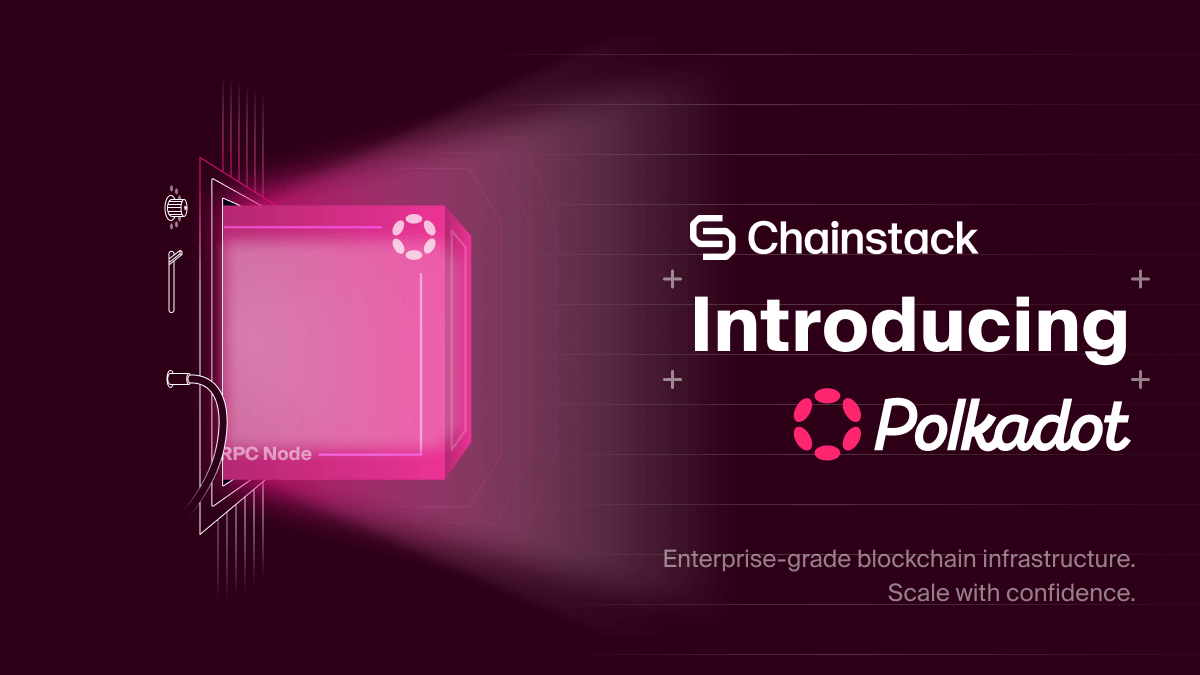
We’re excited to announce that Chainstack now supports the Polkadot network, a top-tier, developer-centric multichain platform known for its interoperability, shared security, and parachain architecture.
With this integration, Web3 developers can now leverage battle-tested Chainstack infrastructure to deploy, test, and scale their applications on Polkadot faster than ever—without worrying about costly infrastructure overhead.
Why build on Polkadot?
Polkadot is a layer 0 blockchain protocol designed to enable secure, scalable, and interoperable multi-chain applications. Built for DeFi, governance, and cross-chain services, it offers:
- Parachains for specialization: Run application-specific chains that scale independently.
- Interoperability through the relay chain: Connect and secure multiple blockchains in one network.
- Shared security: Parachains inherit Polkadot’s robust relay chain consensus, reducing attack risk.
For developers, it means greater flexibility, faster time to market, and a growing ecosystem that rewards innovation and performance.
Build better with Polkadot on Chainstack
Running Polkadot nodes is now limitless with Chainstack Dedicated Node. Whether you’re building high-throughput DApps, scaling infrastructure, or running analytics, Chainstack offers:
- Dedicated, high-performance Polkadot node infrastructure
- No per-request billing—pay only for compute and storage
- Global deployment on the cloud and location of your choice
Get started: Build better with Polkadot
How to get started with Polkadot on Chainstack
Getting up and running takes just a few minutes:
- Spin up a node: Request a Polkadot node from the Chainstack console or our Sales team.
- Connect with tools: Use Polkadot’s JSON-RPC, gRPC, or SDKs to integrate seamlessly.
- Build and deploy: From parachain tooling to DeFi protocols, focus on development—not infrastructure management.
Bringing it all together
With our support for Polkadot, we’re continuing our mission to enable scalable, reliable, and fast Web3 development across the most exciting networks in the space.
Whether you’re pushing the limits of DeFi, innovating in the NFT world, or building the next killer DApp, Chainstack Polkadot infrastructure is here to support you every step of the way.
Start building with Polkadot today
Power-boost your project on Chainstack
- Discover how you can save thousands in infra costs every month with our unbeatable pricing on the most complete Web3 development platform.
- Input your workload and see how affordable Chainstack is compared to other RPC providers.
- Connect to Ethereum, Solana, BNB Smart Chain, Polygon, Arbitrum, Base, Hyperliquid, Robinhood Chain, Arc, Tempo, MegaETH, Monad, Plasma, Avalanche, Optimism, Aptos, Cronos, Gnosis Chain, Moonbeam, Celo, Aurora, TON, Ronin, and Bitcoin mainnet or testnets through an interface designed to help you get the job done.
- Fast access to blockchain archive data and gRPC streaming on Solana.
- To learn more about Chainstack, visit our Developer Portal or join our Telegram group.
- Connect your AI agent to Chainstack in seconds using Chainstack MCP — give Claude, Cursor, Codex, Gemini, and Windsurf live access to blockchain data, node management, and docs.
- Are you in need of testnet tokens? Request some from our faucets. Sepolia faucet, Base Sepolia faucet, Solana devnet faucet, Hoodi faucet, BNB faucet, zkSync faucet, Robinhood Chain faucet, Hyperliquid faucet, Monad faucet, Amoy faucet, Plasma faucet, TON faucet.
Have you already explored what you can achieve with Chainstack? Get started for free today.