AI-ready infrastructure
 Refer and earn


 Ethereum
 Hyperliquid
 Solana
 Arbitrum
 BNB Smart Chain
 Base
Base Polygon
 TRON
TRON Sui
Sui Robinhood


What is Robinhood Chain? A full builder’s guide (2026)

TL;DR
Robinhood Chain is an Arbitrum Orbit L2 for finance and tokenized real world assets, extending Robinhood’s ecosystem onto Ethereum with support for tokenized stocks, DeFi, and AI-powered financial products. For developers, it offers standard EVM compatibility, low-latency execution, ERC-4337 account abstraction, and production-ready infrastructure for building wallets, trading platforms, AI agents, and other financial applications.
This guide covers Robinhood Chain’s architecture, infrastructure, performance, developer tooling, and practical use cases so you can understand how the network works and start building on it.
Prerequisites
- Basic familiarity with Ethereum and how layer-2 rollups work
- Understanding of Arbitrum and its architecture
📖 Related read: If you want to learn more about Arbitrum and its architecture, see the Optimism vs Arbitrum overview.
What is Robinhood Chain?
Robinhood Chain is a permissionless, EVM-compatible L2 for finance and tokenized real world assets, built with the Arbitrum platform using the Nitro client under the Arbitrum Orbit framework.
The chain’s purpose is slightly different than a general-purpose L2. Robinhood built it around tokenized real-world assets — tokenized U.S. stocks and ETFs to be represented and traded onchain — with infrastructure tuned to the performance, security, and regulatory requirements that come with regulated finance. Fundamentally, Robinhood envisions a financial ecosystem built to be traded programmatically with self-custody wallets, available 24/7.
It settles to Ethereum, posts transaction data to Ethereum blobs, and inherits Ethereum’s base layer security rather than running an independent validator set.
The network runs as a customized rollup with configurable block times that target very low latency — around 100 milliseconds in practice — and a single Robinhood-operated sequencer currently orders transactions on a first-come, first-served basis.
⏭ Skip ahead: If you want to learn more about how to build on Robinhood Chain, jump to the Infrastructure section below.
Robinhood Chain sits at the center of a broader ecosystem of financial products. Many of these products are built on or directly integrated with Robinhood Chain — the overview below focuses on the chain-relevant ones before we dive into the technical architecture:
- Stock Tokens: Tokenized representations of U.S. stocks and ETFs available through Robinhood Wallet in more than 120 countries. Supports 24/7 trading, lending, collateralization, and participation across the DeFi ecosystem.
- Tokenized Real World Assets: Blockchain infrastructure supporting tokenized real-world assets and tokenized U.S. stocks and ETFs, enabling regulated financial assets to participate across decentralized finance.
- Perpetual Futures: Eligible users can trade decentralized crypto perpetual futures directly from Robinhood Wallet — perpetual contracts for cryptocurrencies with up to 10x leverage.
- Agentic Trading: AI-powered trading framework that enables users to connect third-party AI models to dedicated Agentic Accounts using Robinhood’s Trading MCP. AI agents can monitor market signals, execute strategies within user-defined guardrails, and automate trading decisions.
- DeFi Infrastructure: Native integration with decentralized finance protocols supporting trading, lending, borrowing, liquidity provision, and collateral management — optimized for AI-native financial applications.
- Robinhood Wallet: Self-custody crypto wallet that enables users to hold assets, access Robinhood Chain, trade Stock Tokens, interact with decentralized exchanges, participate in DeFi, and access perpetual futures while maintaining full control over their private keys.
- Robinhood Earn: Onchain lending product that allows eligible U.S. users to lend USDG through Morpho directly from the Robinhood app while maintaining self-custody. USDG serves as the dollar-backed stablecoin powering lending and yield generation across the Robinhood Chain ecosystem.
Architecture
Rollup layer
Robinhood Chain is an Arbitrum Orbit chain running the Nitro client, which means it inherits the same execution engine, fraud-proof design, and EVM compatibility that Arbitrum One and Arbitrum Nova use. Contracts written for Ethereum or Arbitrum deploy on Robinhood Chain without modification, and standard Ethereum JSON-RPC calls carry over unchanged. Arbitrum frames the launch as evidence of a repeatable pattern for large consumer platforms building dedicated infrastructure that uses a launch-and-migrate model: validate usage on Arbitrum One first, then migrate to a dedicated chain once the product needs deeper, granular control over onchain operations.
Sequencing model
A single sequencer, operated by Robinhood, currently orders transactions. Ordering follows arrival time rather than a priority-fee auction, so paying a higher gas price does not move a transaction ahead of ones already queued. This is a meaningful design detail for anyone building trading logic on the chain: MEV extraction through fee bidding is not the relevant lever here the way it is on chains with public mempools and priority ordering.
Settlement and finality
The chain posts compressed transaction batches to Ethereum as blob data and settles there. Soft confirmations arrive in roughly 100 milliseconds through Nitro’s preconfirmation mechanism, while full Ethereum finality follows once the batch posts and finalizes on L1.
Gas token
ETH is the native gas token. There is no separate Robinhood Chain token for paying fees, which keeps the gas model identical to what developers already know from Ethereum and Arbitrum One.
Account abstraction
Robinhood Chain supports ERC-4337 account abstraction, including sponsored gas, batched transactions, programmable wallets, and session keys. This matters directly for the agentic use cases discussed later: session keys and sponsored gas are the primitives that let an AI agent transact within defined limits without holding a user’s primary private key.
Infrastructure
Robinhood Chain speaks the standard Ethereum JSON-RPC interface, so tooling built for Ethereum or Arbitrum works with a Robinhood Chain endpoint with no protocol-level changes. Production RPC through Chainstack provides access to Robinhood Chain Mainnet and Testnet with JSON-RPC methods, debug and trace methods, and archive infrastructure — with sub-second preconfirmations.
Chain ID: 4663
Mainnet endpoint: https://robinhood-mainnet.core.chainstack.com/<KEY>
Network name: Robinhood Chain Mainnet
Testnet Chain ID: 46630
Testnet endpoint: https://robinhood-testnet.core.chainstack.com/<KEY>
Network name: Robinhood Chain Testnet
Currency symbol: ETH
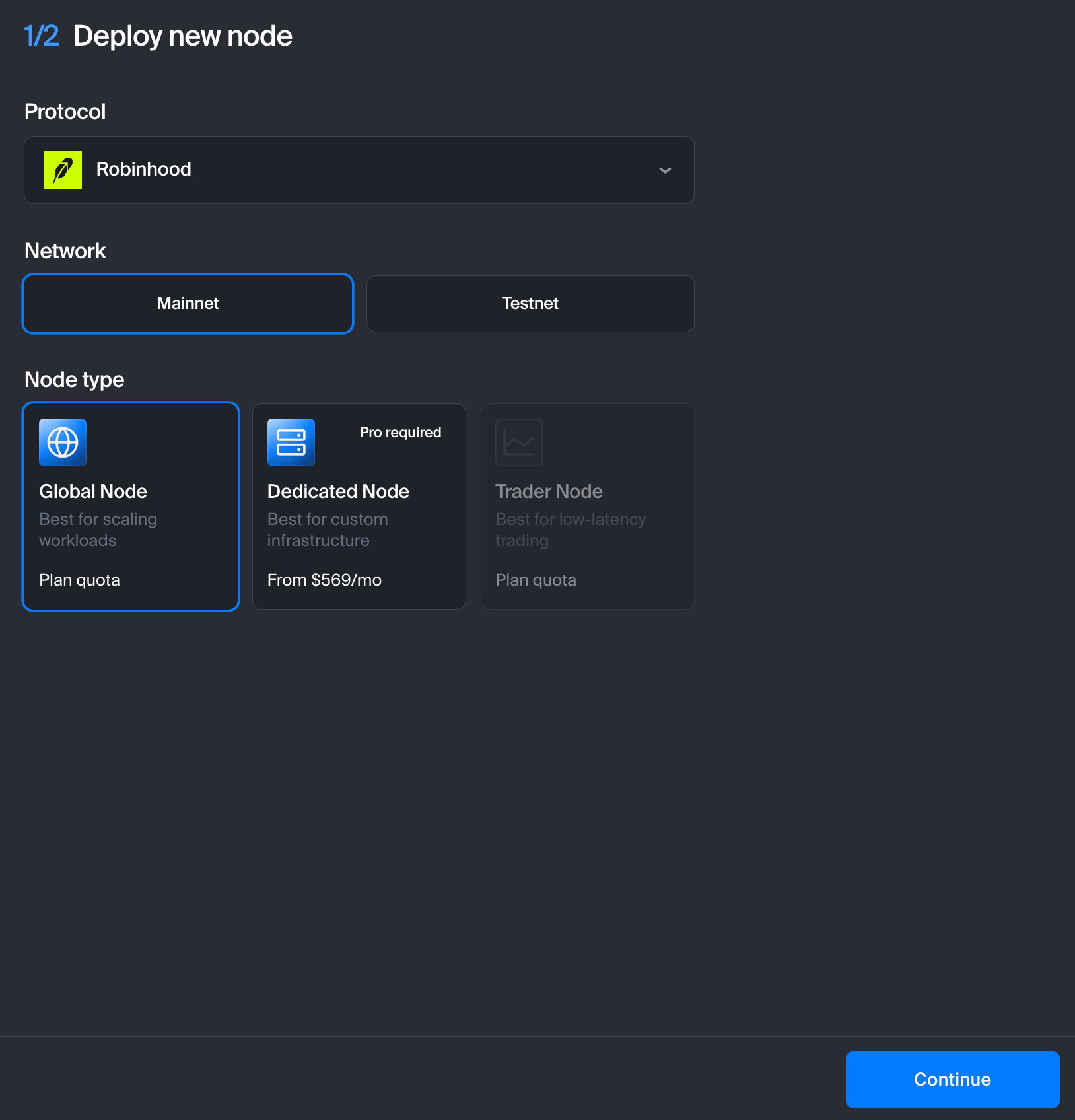
Deploy your node in two simple steps:
Select Robinhood by searching through the 70+ protocols. Then choose the type of node that fits your requirements — Global Node for shared geo-balanced access or Dedicated Node for isolated resources. Click Continue:
Give the node a name, review the deployment details, and click Deploy Node:
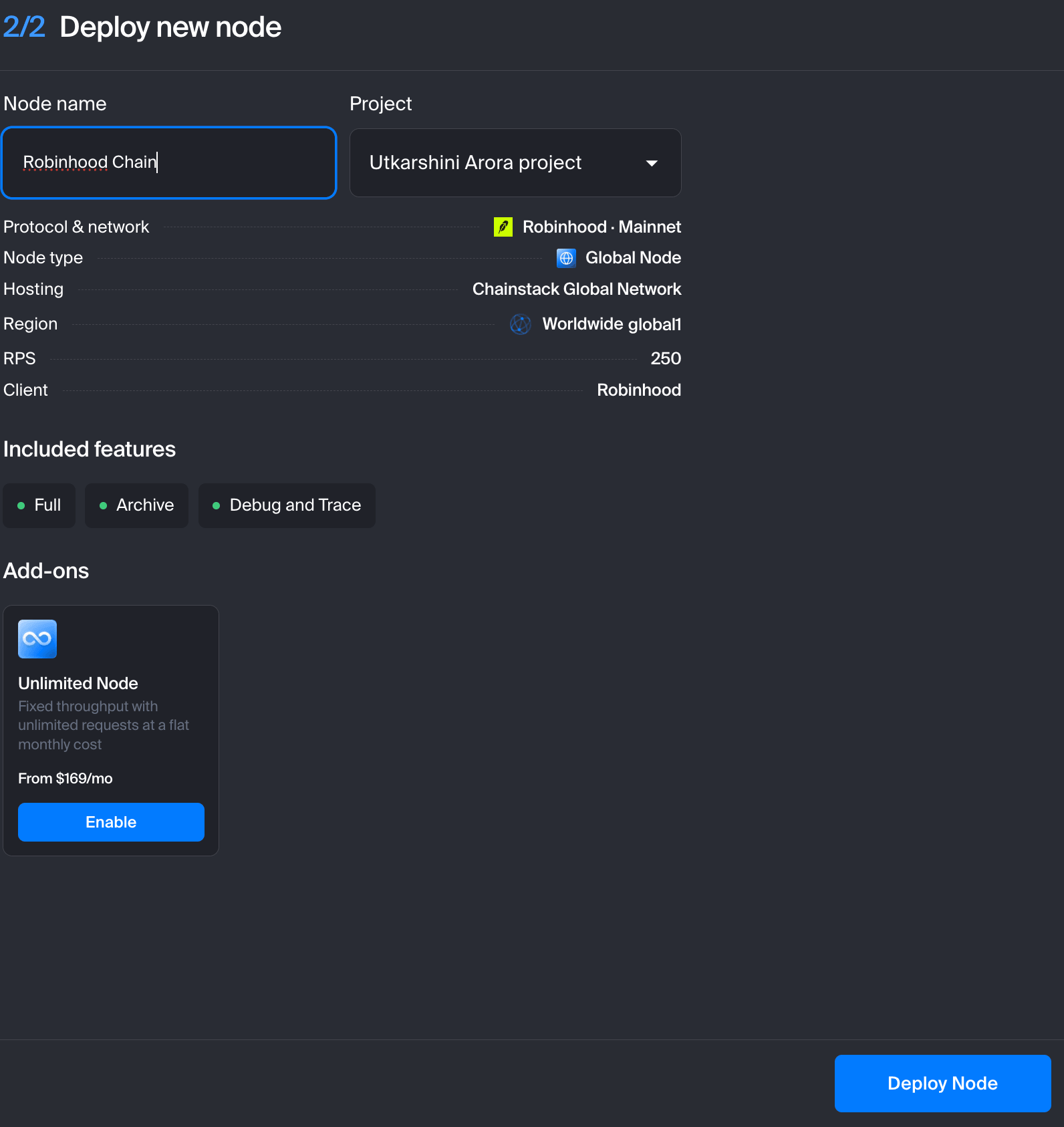
That’s it. The node is deployed and ready to use.
Common methods work exactly as they do on Ethereum. For example, retrieve the latest block number using eth_blockNumber:
const options = {
  method: 'POST',
  headers: {'Content-Type': 'application/json'},
  body: JSON.stringify({jsonrpc: '2.0', method: 'eth_blockNumber', id: 1})
};
fetch('https://robinhood-mainnet.core.chainstack.com/<KEY>', options)
  .then(res => res.json())
  .then(res => console.log(res))
  .catch(err => console.error(err));
Since Robinhood Chain is built on Arbitrum Nitro, use the arb namespace to access Arbitrum Nitro-specific RPC methods, such as arb_getRawBlockMetadata, which returns raw metadata for L2 blocks.
const options = {
  method: 'POST',
  headers: {'Content-Type': 'application/json'},
  body: JSON.stringify({
    id: 1,
    jsonrpc: '2.0',
    method: 'arb_getRawBlockMetadata',
    params: ['0xc3007d', '0xc3007d']
  })
};
fetch('https://robinhood-mainnet.core.chainstack.com/<KEY>', options)
  .then(res => res.json())
  .then(res => console.log(res))
  .catch(err => console.error(err));
For a complete reference covering all supported endpoints, see the Chainstack Robinhood Chain API reference.
Robinhood Chain nodes on Chainstack serve the Geth-style debug_* namespace for transaction and block tracing. This requires a paid plan and a node deployed as a Global Node. It’s the method to reach for when reconstructing exactly how a transaction executed — useful for debugging failed agent transactions.
const options = {
  method: 'POST',
  headers: {'Content-Type': 'application/json'},
  body: JSON.stringify({
    jsonrpc: '2.0',
    method: 'debug_traceTransaction',
    id: 1,
    params: ['0xTRANSACTION_HASH']
  })
};
fetch('https://robinhood-mainnet.core.chainstack.com/<KEY>', options)
  .then(res => res.json())
  .then(res => console.log(res))
  .catch(err => console.error(err));
Full documentation on enabling this namespace is available in the Chainstack debug and trace APIs reference.
A full node retains recent state — the latest 128 blocks — which covers live application reads and transaction submission. An archive node retains all historical state from genesis, needed for querying balances or contract storage at any past block and for tracing older transactions. Chainstack runs both modes on Robinhood Chain Mainnet and Testnet, deployable across multiple regions and clouds.
Performance
The rollout followed a conventional testnet-to-mainnet path, but at an unusually fast pace. Robinhood Chain’s testnet launched on February 10, 2026 and processed more than 200 million transactions. The chain went live on public mainnet on July 1, 2026 and surpassed $250M TVL and a total of 17M transactions in just one week. As of July 23, the protocol has accumulated over $540M in TVL.
Three weeks after launch, onchain asset growth had outpaced the TVL figure alone. Robinhood Chain surpassed $700 million in onchain assets, with $440+ million of that in stablecoins as of July 23, 2026.
Beyond the headline TVL numbers:
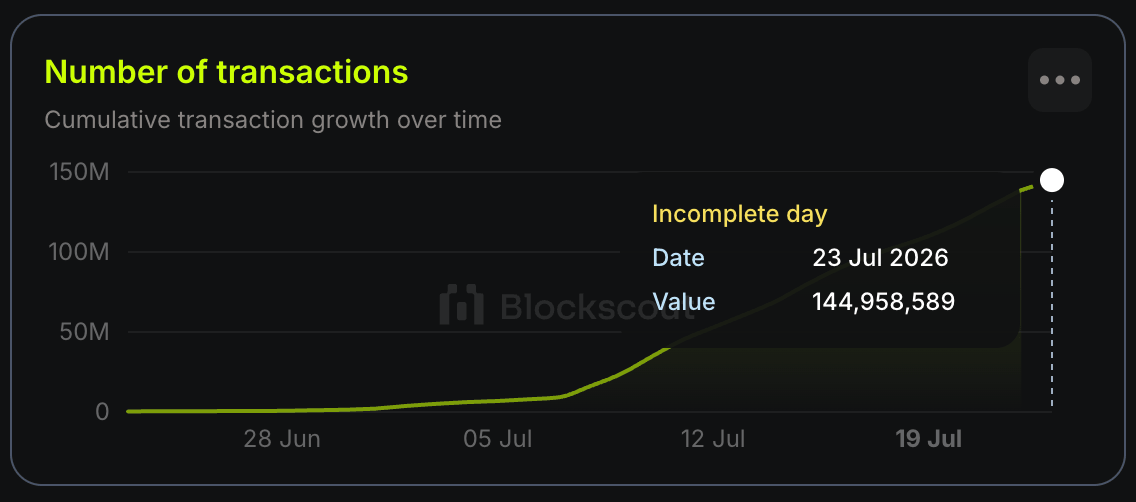
The chain has processed over 144M+ total transactions since testnet:
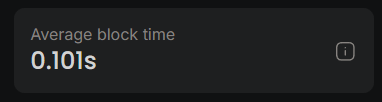
Average block time sits at roughly 0.1 seconds:
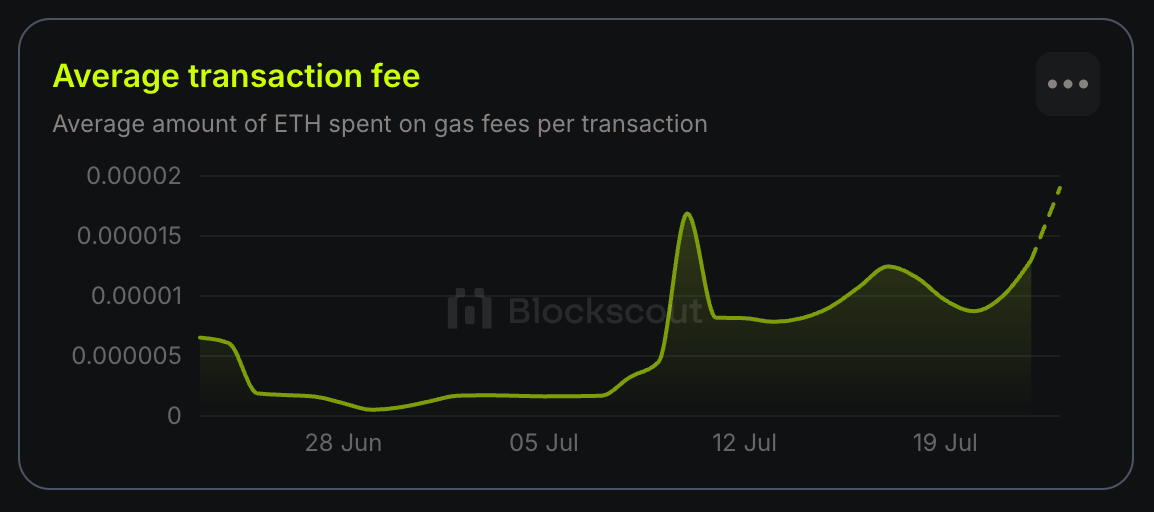
Average transaction fees are approximately 0.00002 ETH, making Robinhood Chain cost-efficient for building AI agents, trading applications, wallets, and other high-throughput onchain services.
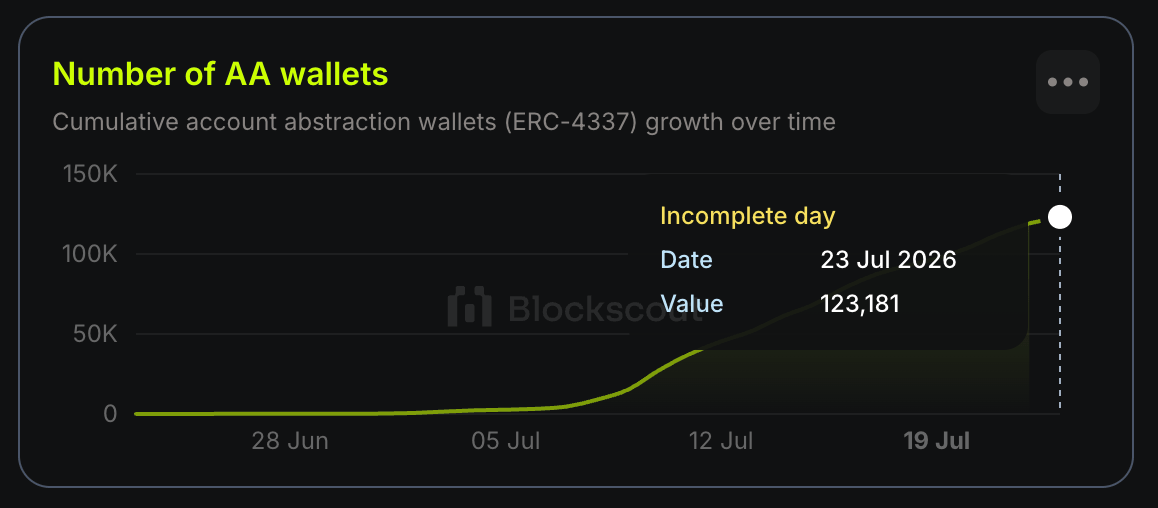
Robinhood Chain has recorded 123,181 ERC-4337 smart accounts and 1.6M user operations, providing builders with a production-scale account abstraction ecosystem. This creates a strong foundation for AI agents, smart wallets, sponsored gas, batched transactions, and other programmable user experiences.
Use Cases
Robinhood Chain is designed to bring tokenized real-world assets, onchain trading, and AI-powered financial services to a mainstream audience. Built on Arbitrum Orbit, it combines Ethereum compatibility with Robinhood’s existing retail distribution, giving developers access to familiar EVM tooling while targeting millions of existing brokerage users.
Rather than competing as another general-purpose L2, Robinhood Chain focuses on regulated financial applications, tokenized assets, and consumer-friendly onchain experiences.
Tokenized stocks and real-world assets (RWA)
Robinhood Chain’s primary use case is tokenized equities and other real-world assets, enabling users in supported jurisdictions to gain economic exposure to publicly traded stocks through blockchain-based assets.
- Stock Tokens: Tokenized debt securities representing economic exposure to underlying equities.
- Robinhood Earn: Morpho-powered lending product targeting competitive yields for eligible users.
- Institutional RWA infrastructure: Built for compliant issuance, settlement, and management of tokenized financial assets.
Developers building wallets, analytics platforms, or portfolio management tools should account for regional availability and regulatory restrictions from the outset.
DeFi
Robinhood Chain launched with core DeFi infrastructure, making it straightforward to deploy existing Ethereum applications.
- Uniswap: Native AMM providing onchain liquidity.
- Pleiades: Decentralized exchange for spot trading.
- Morpho: Lending infrastructure powering Robinhood Earn.
Because Robinhood Chain is fully EVM-compatible and built on Arbitrum Nitro, existing Ethereum and Arbitrum applications can be deployed with minimal modifications.
AI-powered trading and banking
Robinhood is integrating AI agents directly into its financial products, making Robinhood Chain one of the first ecosystems designed around agent-assisted finance.
- Agentic Trading: AI agents can analyze portfolios, monitor markets, and execute trades within user-defined permissions.
- Agentic Credit Card: AI agents can make purchases through a dedicated virtual card while remaining within configurable spending limits.
- Account abstraction: Session keys and sponsored transactions enable delegated execution without exposing users’ primary private keys.
This architecture enables automated financial workflows while maintaining user control over permissions and spending.
Prediction markets and financial products
Robinhood continues expanding beyond traditional brokerage services into blockchain-native financial markets.
Potential applications include:
- Prediction markets and event contracts
- Tokenized derivatives
- Crypto trading
- Unified onchain financial products
These services extend Robinhood’s vision of consolidating multiple financial markets onto a single blockchain infrastructure.
Consumer applications
Robinhood Chain’s strongest differentiator is its distribution.
Unlike many new Layer 2 networks that first target crypto-native users, Robinhood Chain is positioned to onboard millions of existing Robinhood customers into onchain finance through familiar products and user experiences.
For developers, this creates opportunities to build:
- Consumer wallets and portfolio trackers
- Trading analytics platforms
- Financial dashboards
- Payment and banking applications
- Tokenized asset infrastructure
As the ecosystem expands, developers can leverage standard Ethereum tooling alongside Arbitrum Nitro’s scalability to build applications for both crypto-native users and mainstream financial markets.
Beyond the Chain
Long before launching Robinhood Chain, Robinhood established itself as one of the largest retail financial platforms — serving tens of millions of funded customers with hundreds of billions in total platform assets. Robinhood Chain extends this ecosystem onto blockchain infrastructure, while Robinhood continues to offer a broad range of traditional financial products and services that operate independently of the chain. These include:
- Brokerage services: Commission-free investing across U.S. stocks, ETFs, options, retirement accounts, and private markets
- Robinhood Banking: Digital banking services with spending, saving, cash management, and integrated financial tools
- Robinhood Gold: Premium membership providing professional research, margin investing, higher interest on cash, and additional investing benefits
- Robinhood Legend: Professional desktop trading platform built for active traders with advanced charting, customizable layouts, watchlists, and trading tools
- Retirement accounts: Traditional and Roth IRA products with automated investing features and contribution matching for eligible users
- Credit and spending: Consumer financial products including the Robinhood Gold Card, offering cashback rewards and integrated spending tools
- Institutional and advisory services: Wealth management, investment advisory, and institutional products supporting long-term investing and broader financial services
- Trump Accounts: Tax-advantaged investment accounts administered under the U.S. Department of the Treasury. Robinhood serves as the broker and sole initial trustee, enabling eligible U.S. children born between 2025 and 2028 to receive a $1,000 government contribution and begin long-term investing.
For developers, Robinhood Chain represents more than a new Layer 2. It’s part of a much larger financial ecosystem spanning investing, banking, wealth management, and blockchain infrastructure. Developers have an opportunity to build on top of one of the world’s most recognizable financial platforms as it brings millions of users, regulated financial products, and blockchain infrastructure into a single ecosystem.
Tools
Build wallets, trading tools, and AI agents on Robinhood Chain using the builder tools below:
- AgentKit-style tooling and MCP support: Robinhood documentation for building against Robinhood’s trading and banking MCP servers
- Arbitrum Orbit: the chain framework Robinhood Chain is built on, for teams evaluating a similar dedicated chain path
- Chainstack MCP server: provision Robinhood Chain nodes, query onchain data, and search documentation directly from Claude, Cursor, Codex, Gemini CLI, or any MCP-compatible assistant
- Robinhood Chain tooling guide: MetaMask, ethers.js, viem, web3.py, Hardhat, Foundry, and Remix setup
- Robinhood Chain API reference: full method reference, request unit pricing, and network parameters
- Robinhood Chain block explorer: mainnet explorer
- Robinhood Chain testnet explorer: for testnet contract verification and transaction inspection
- Chainstack Faucet Portal: free testnet tokens for early development
Conclusion
Robinhood Chain compresses a pattern that used to take new L2s years into a matter of months: a testnet processing hundreds of millions of transactions, a mainnet launch bundled with real financial products, and adoption metrics that outpace most first-month L2 launches on record. The Arbitrum Orbit foundation means none of this required inventing new execution or settlement primitives — standard Ethereum tooling, standard EVM bytecode, and a familiar JSON-RPC surface all carry over unchanged.
What’s genuinely new is the product layer sitting on top: tokenized stocks connected to a live brokerage user base, lending products routed through traditional financial-market mechanisms, and AI agents transacting through MCP servers with scoped, revocable permissions. Building reliably against any of this starts with infrastructure that can absorb Robinhood Chain’s event-driven traffic pattern without becoming the bottleneck itself.
Chainstack provides that infrastructure layer for Robinhood Chain — mainnet and testnet, full and archive nodes, debug and trace APIs, and MCP-based provisioning that lets an AI coding assistant deploy a production endpoint from a single prompt. Get a Robinhood Chain RPC endpoint to start building.
🚀 Start building on Robinhood Chain with 50% off the Growth plan for 3 months — use
ROBINHOOD50at signup.
FAQs
Mainnet is chain ID 4663. Testnet is chain ID 46630. Set this value in your wallet, SDK, or framework configuration alongside your RPC endpoint.
ETH. There is no separate Robinhood Chain token, so gas is paid in ETH the same way it is on Ethereum or Arbitrum One.
Yes. It’s fully EVM-compatible and exposes the standard Ethereum JSON-RPC interface. Solidity contracts deploy without modification, and ethers.js, viem, web3.py, Hardhat, Foundry, and Remix all work against a Robinhood Chain endpoint unchanged.
The chain supports ERC-4337 account abstraction, including session keys and sponsored gas, which are the underlying primitives Robinhood’s Agentic Trading and Agentic Credit Card products use to let AI agents transact within scoped, revocable limits.
Additional resources
- Chainstack introduces Robinhood Chain support
- How to get a Robinhood Chain RPC endpoint for RWA
- Top 6 Robinhood Chain RPC providers for tokenized assets in 2026
- Blockchain infrastructure for RWA
- Robinhood Chain vs Solana: two paths to tokenized RWAs?
- Robinhood Chain API reference
- Robinhood Chain tooling documentation