AI-ready infrastructure
 Refer and earn


 Ethereum
 Hyperliquid
 Solana
 Arbitrum
 BNB Smart Chain
 Base
Base Polygon
 TRON
TRON Sui
Sui Robinhood


How to get a Robinhood Chain RPC endpoint for RWA (2026 guide)

TL;DR
A tokenized-stock transfer on Robinhood Chain isn’t one write — it fires an on-chain compliance check, a settlement event, and an oracle read, and if your RPC endpoint drops any of them the trade looks confirmed to the user while the compliance record silently breaks. Robinhood Chain runs 100 ms blocks and orders transactions first-come, first-served by arrival time at the sequencer — you can’t buy priority with gas — so your endpoint’s latency and throughput are part of your execution quality, and its rate limit and missing archive collapse exactly when a real-world-asset workload needs them most. This guide shows how to get a production-grade Robinhood Chain RPC endpoint and what RWA infrastructure actually requires.
What is a Robinhood Chain RPC endpoint
A Robinhood Chain RPC endpoint is the JSON-RPC interface your application uses to read from and write to Robinhood Chain — the permissionless, Ethereum-compatible Layer 2 that Robinhood built on Arbitrum Orbit to run tokenized RWAs.
Because the chain is fully EVM-compatible, the endpoint speaks the same eth_* methods you already know from Ethereum:
eth_call— read a stock token’s balance or simulate a compliance-gated transfereth_getLogs— pullTransferand settlement eventseth_sendRawTransaction— broadcast a signed tradeeth_getStorageAt— read contract storage at a specific past block
Three things set it apart from a standard Ethereum endpoint:
- ~100 ms blocks — state updates at very high cadence
- First-come, first-served ordering — transactions are sequenced by arrival time at the sequencer, not by fee
- First-class ERC-4337 account abstraction — assets often move through gas-sponsored, programmable wallets rather than plain EOAs
Put together, the state behind the endpoint isn’t generic tokens on plain accounts — it’s tokenized equities, ETFs, and private assets, updated at high cadence and moved through programmable smart-contract wallets.
On Robinhood Chain, the concrete user-facing actions that depend on this endpoint include:
- Reading stock-token and ETF-token balances for a wallet across 120+ markets
- Simulating and submitting compliance-gated transfers (identity/eligibility checks run on-chain before a token moves)
- Broadcasting 24/7 tokenized-equity trades and settling them against Ethereum
- Submitting ERC-4337 UserOperations for gas-sponsored, batched, or session-key wallet transactions
- Querying
Transfer, settlement, and oracle-update events for portfolio and reporting views - Reconstructing net asset value (NAV) and proof-of-reserve state at historical blocks
- Monitoring the sequencer feed for early visibility into pending trades
You can review the connection parameters, chain IDs, and supported tooling in the Robinhood Chain developer documentation. Endpoint quality is not a background concern here: on a chain where a single market open can multiply request volume in seconds and every equity transfer carries a compliance obligation, a dropped or throttled call doesn’t just degrade UX — it can leave a settlement half-recorded and a compliance check unverifiable.
These numbers are not hypothetical. Robinhood Chain launched its mainnet on 1 July 2026 with 200-plus tokenized stock tokens available in over 120 countries, and within two weeks it held around $257 million in total value locked, was clearing roughly 3.6 million transactions a day across nearly 800,000 addresses, and posted a 24-hour DEX volume near $838 million (CoinDesk, mid-July 2026). It is worth being honest about the mix: tokenized RWAs were only about $12.8 million on-chain — roughly 4.1% of value, versus asset-management, lending, and memecoin activity — even though the chain was purpose-built for equities. For infrastructure the distinction barely matters (the endpoint absorbs the same load either way), and the RWA side is where the chain is built to grow.
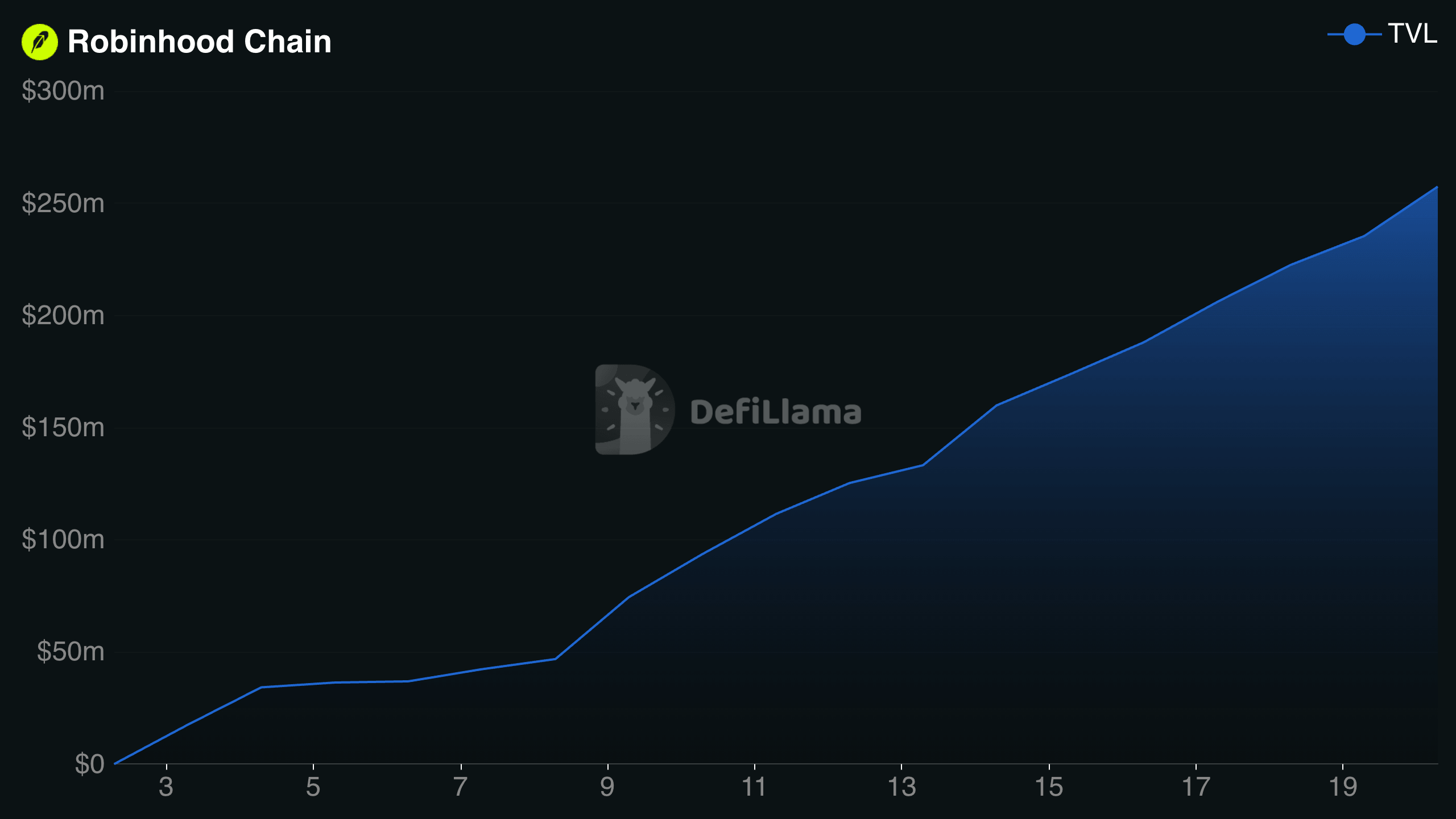
That growth is the real reason to get infrastructure right early. The broader on-chain RWA market, excluding stablecoins, reached roughly $33.5 billion by mid-2026 per rwa.xyz — nearly triple a year earlier — with tokenized US Treasuries alone above $8.7 billion, and McKinsey and BCG projecting somewhere between $2 trillion and $16 trillion of tokenized assets by 2030. An RWA workload that loses compliance or settlement events at that scale is a regulatory problem, not just an ops one.
How Robinhood Chain RPC differs from Ethereum RPC
Robinhood Chain is EVM-compatible, so your Solidity contracts and tooling port over unchanged — but the operational profile behind the endpoint is very different from Ethereum L1. These are the differences that actually change how you select and size an RPC provider.
| Property | Ethereum L1 | Robinhood Chain |
|---|---|---|
| Architecture | Base-layer PoS | Arbitrum Orbit (Nitro client) |
| Block time | ~12 seconds | ~100 ms (about 10 blocks/second) |
| Data availability | Native L1 | Ethereum blobs |
| Transaction ordering | Fee-priority (priority-fee auction) | First-come, first-served by arrival at the sequencer — no fee priority |
| Finality model | Single-layer finality | Fast local confirmation, settles to Ethereum |
| Dominant workload | General-purpose | Tokenized RWA with on-chain compliance and ERC-4337 wallets |
The ordering model is the difference that catches Ethereum developers off guard: on Robinhood Chain you cannot pay to jump the queue, so the way to land a time-sensitive trade ahead of the crowd is to get it to the sequencer first — which makes RPC latency and reliability part of your execution quality, not just an ops metric. The 100 ms block time compounds this on the read side: an indexer that polls “every block” issues roughly ten times the requests the same code would on Ethereum, so a rate limit that feels generous on L1 is exhausted quickly here, and a trade that confirms fast locally still isn’t final until its batch settles to Ethereum.
Robinhood Chain RPC endpoint options
Public vs private Robinhood Chain RPC endpoints
The public vs private decision on Robinhood Chain comes down to a simple question: can the endpoint submit trades with low, consistent latency and never lose a compliance or settlement event? On a chain that orders by arrival time and carries compliance-gated equity transfers, both halves of that question matter — and the public endpoint, built for wallet connectivity and testing, is designed for neither the latency nor the sustained, event-complete read load an RWA application generates.
Official public endpoints:
- Mainnet:
https://rpc.mainnet.chain.robinhood.com - Testnet:
https://rpc.testnet.chain.robinhood.com
⚠️ The public Robinhood Chain endpoints are rate-limited and intended for wallet connectivity and testing only — they do not provide archive data or production throughput. Robinhood’s own connection documentation recommends using a professional RPC provider for production access, higher limits, and uptime guarantees.
| Public endpoint | Private endpoint | |
|---|---|---|
| Access | Free and open | Restricted access |
| Resources | Shared infrastructure | Dedicated resources |
| Best use case | Development & testing | Production workloads |
| Rate limit | Aggressively rate-limited | No aggressive throttling |
| Archive access | Not available | Available |
| Sequencer feed / WebSocket | Basic public feed | Managed, production-grade |
For a workload where a missed ComplianceCheck event can turn a valid trade into an audit gap, the public endpoint’s shared, throttled, archive-less profile is disqualifying the moment you go live — which is exactly why a managed endpoint is the baseline for real-world-asset applications, not an upgrade you reach for later.
Full node vs archive Robinhood Chain node
For a tokenized-equity chain, historical data access is not an analytics luxury — NAV reconstruction, proof-of-reserve verification, and regulatory audit trails all require reading state as it existed at specific past blocks, which only an archive node can serve.
| Full node access | Archive node access |
|---|---|
| Real-time stock-token and ETF balances | NAV reconstruction via eth_getStorageAt at historical blocks |
Live compliance-check simulation (eth_call) | Proof-of-reserve verification across past batches |
| Current settlement and holder state | Historical Transfer and ComplianceCheck log backfills |
| Sequencer feed monitoring for pending trades | Regulatory audit trails via debug_traceTransaction |
Chainstack ships Robinhood Chain nodes with debug and trace enabled from day one, so historical Robinhood Chain state — dividend and corporate-action history, past compliance events, and reserve snapshots — can be reconstructed from a single archive node rather than stitched together from third-party exports. For RWA issuers who have to answer “what was the on-chain reserve backing this token at block N,” that historical completeness is the difference between a defensible audit and a reconstruction exercise.
HTTPS vs WebSockets
At ~100 ms blocks — roughly ten per second — the connection model you choose has a direct cost: polling for new blocks over HTTPS means thousands of requests per minute just to stay current, while a persistent WebSocket subscription pushes each new block and matching log to you as it happens. For a settlement indexer or a trade-status feed on Robinhood Chain, that difference compounds quickly.
| Feature | HTTPS | WebSocket |
|---|---|---|
| Model | Request/response | Persistent connection |
| Complexity | Simple operationally | Requires reconnect/heartbeat logic |
| Best for | Balance reads, compliance-check simulation, tx broadcasting | Live settlement/Transfer subscriptions, sequencer feed, pending-trade tracking |
| Latency | Standard | Lower for frequent updates |
| Connection overhead | Per request | One-time handshake |
Robinhood Chain also exposes a sequencer feed (wss://feed.mainnet.chain.robinhood.com) for sub-second visibility into pending transactions before they land in a block. It is useful for low-latency trade UX, but it is not a substitute for a production WebSocket endpoint with reconnect and backfill guarantees — treat it as an accelerator, not your source of truth.
How to get a private Robinhood Chain RPC endpoint with Chainstack
Chainstack supports Robinhood Chain as a first-class protocol — with debug and trace methods enabled from day one — so you can deploy a private Robinhood Chain RPC node on Chainstack as either a shared Global Node or an isolated Dedicated Node:
- Log in to the Chainstack console (or create an account).
- Create a new project
- Select Robinhood Chain as your blockchain protocol
- Choose network: Robinhood Chain Mainnet or Robinhood Chain Testnet
- Deploy the node
- Open Access/Credentials and copy your HTTPS and WebSocket endpoints
- Run a quick connectivity check before wiring it into production code
Once you have the endpoint, connecting is standard EVM tooling. Using ethers.js:
const { ethers } = require("ethers");

// Robinhood Chain mainnet — chain ID 4663 (use 46630 for Testnet)
// Standard Ethereum JSON-RPC over Arbitrum Nitro; native gas token is ETH
const provider = new ethers.JsonRpcProvider("YOUR_CHAINSTACK_ENDPOINT");

// At ~100 ms blocks, getBlockNumber advances ~10x faster than Ethereum L1 — subscribe rather than tight-poll in production
provider.getBlockNumber().then(console.log);
📖 For the full integration guide and examples in viem, web3.py, Hardhat, and Foundry, see the Chainstack Robinhood Chain tooling documentation.
You can also access Chainstack Robinhood Chain RPC directly from Claude, Cursor, Codex, Gemini, or Windsurf using Chainstack MCP. Learn more about Chainstack MCP.
Using Chainlist
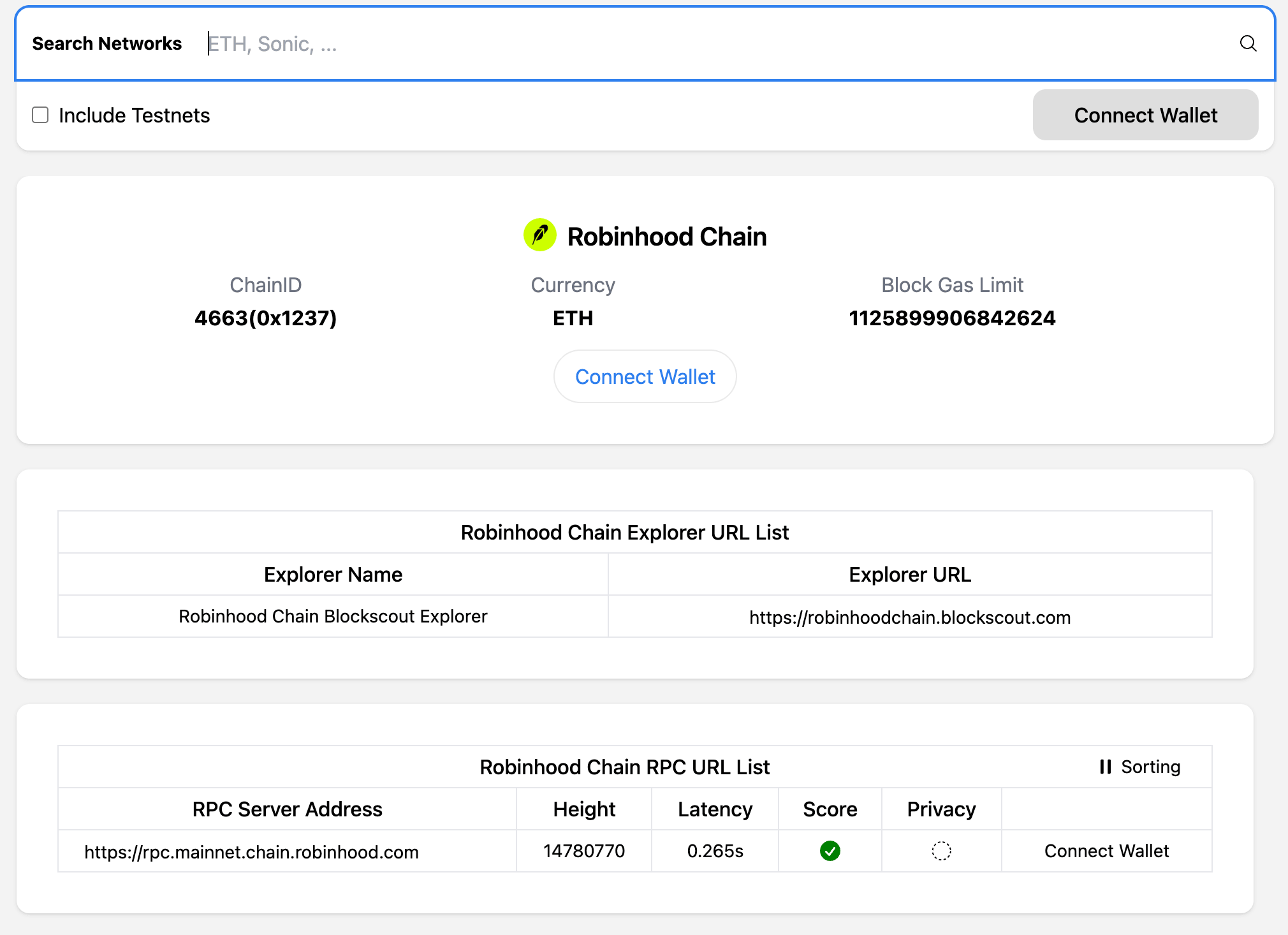
Robinhood Chain is listed on Chainlist (chain ID 4663), which makes it convenient to add the network to a wallet like MetaMask with one click. Chainlist is a network directory, though — not an infrastructure provider. Any public RPC URL you pick up there carries the same rate limits and lack of archive as the native public endpoint, so replace it with a managed endpoint before moving anything to production.
Chainstack pricing for Robinhood Chain RPC
Chainstack bills on request units with flat monthly plans, which makes forecasting an RWA workload’s cost far more predictable than compute-unit models that vary per method. See the full Chainstack pricing page for plan details and overage rates.
| Plan | Cost | Requests/Month | RPS | Overage (per 1M extra) |
|---|---|---|---|---|
| Developer | $0 | 3M | 25 | $20 |
| Growth | $49 | 20M | 250 | $15 |
| Pro | $199 | 80M | 400 | $12.50 |
| Business | $499 | 200M | 600 | $10 |
| Enterprise | from $990 | 400M+ | Unlimited | $5 |
Options relevant to a Robinhood Chain RWA workload:
- Archive requests are billed at 2 request units each (versus 1 for full-node calls) — budget for this if you run frequent NAV or proof-of-reserve reconstructions.
- The Unlimited Node add-on removes per-request billing at a fixed RPS ceiling (25 to 500 RPS) — a strong fit for high-cadence indexers that would otherwise churn quota against Robinhood Chain’s 100 ms blocks.
- Dedicated Nodes start from $0.50/hour per node plus storage, giving you isolated infrastructure for compliance and settlement workloads.
How to estimate monthly cost
- Estimate your average requests per second across reads, writes, and subscriptions.
- Multiply by seconds in a month to get baseline request volume.
- Add your indexing and event-subscription load separately from user-facing traffic.
- Map the total against a plan’s included request units and RPS ceiling.
- Because Robinhood Chain produces ~10 blocks per second, a single indexer polling every block can burn through a lower plan’s RPS limit fast — size for the block cadence, not just user count, and consider the Unlimited Node add-on if your indexer dominates the request mix.
Production readiness checklist
- Primary + fallback RPC provider configured
- Request timeout policy set
- Retry logic with exponential backoff implemented
- Credentials stored in env/secret manager (never hardcoded)
- Monitoring for latency, error rate, and throttling
- Alerts for sustained degradation
- Archive access confirmed for NAV, proof-of-reserve, and historical compliance-event backfills
- Ethereum settlement lag accounted for in settlement and withdrawal UX (fast local confirmation is not L1 finality)
- Low submission latency prioritized — ordering is first-come, first-served at the sequencer, so a slow endpoint costs you queue position
- RPS budget sized for Robinhood Chain’s ~100 ms block cadence so indexer polling doesn’t self-throttle
You can benchmark endpoint latency before committing with the Chainstack performance dashboard.
Troubleshooting common Robinhood Chain RPC issues
| Issue | Cause | How to fix |
|---|---|---|
429 Too Many Requests | Public endpoint rate limit hit at high block cadence | Move to a managed endpoint; add a client-side rate limiter sized to your plan’s RPS |
| WebSocket / sequencer feed disconnects | Idle timeout or network drop | Implement reconnect with heartbeat and backfill missed blocks via eth_getLogs on reconnect |
| Indexer falling behind | ~100 ms blocks (about 10/second) outpace a single polling loop | Switch to WebSocket subscriptions; scale RPS or move to a Dedicated Node / Unlimited Node |
| Trades losing queue position despite higher gas | Ordering is first-come, first-served by arrival at the sequencer — fees don’t buy priority | Reduce submission latency with a low-latency dedicated endpoint; don’t rely on gas bumping |
eth_getLogs returns empty or errors on historical range | No archive data on public endpoint; block range too wide | Use an archive node; chunk queries into smaller block ranges |
| Trade confirmed on Robinhood Chain but not final | Fast local confirmation vs Ethereum settlement | Track L1 settlement status separately; gate irreversible actions on settled finality |
Compliance-check eth_call reverts unexpectedly | Reading against inconsistent or stale state | Pin reads to a consistent block tag; use an archive node for point-in-time compliance simulation |
Conclusion
The failure mode on Robinhood Chain is quiet, and that’s what makes it dangerous. A tokenized-equity trade can show as confirmed to a user in milliseconds off the sequencer while the underlying compliance event never made it into your index because a throttled public endpoint dropped the call — or a NAV report comes back wrong because the endpoint has no archive and silently served the latest state instead of the block you asked for. Neither error throws in your face. You find them in an audit, or when an institutional counterparty does.
The pattern that works is not complicated. Run a managed endpoint with archive access from the first line of production code, subscribe over WebSocket instead of tight-polling a 100 ms chain, and treat Ethereum settlement — not the fast local confirmation — as the point where a trade is final. Because ordering is decided by arrival time and not by fee, treat endpoint latency as an execution concern, configure a fallback provider, and size your RPS to the block cadence rather than your user count. For a real-world-asset workload, event completeness and historical accuracy are the product.
Start on the free tier and move to Dedicated Nodes when compliance and settlement traffic demands isolation.
FAQ
Is the public Robinhood Chain endpoint enough for production? No. The public endpoints at rpc.mainnet.chain.robinhood.com are rate-limited and carry no archive data — they exist for wallet connectivity and testing. For an RWA workload, the throttling breaks your indexer during market events and the missing archive makes NAV and proof-of-reserve reconstruction impossible, so a managed endpoint is required before launch.
Is Robinhood Chain actually used for real-world assets, or mostly memecoins? Both, and the split matters for capacity planning. The chain was purpose-built for tokenized RWAs — equities, ETFs, and private assets — and its catalog passed 2,000 stock tokens across 120+ countries within weeks of the July 2026 launch. But early on-chain activity was dominated by memecoins, asset-management, and lending, with tokenized RWAs only about $12.8 million on-chain — roughly 4.1% of the chain’s ~$312 million TVL as of mid-2026, per CoinDesk. For infrastructure planning the distinction is minor: whether the load is RWA settlement or memecoin trading, your endpoint still has to absorb roughly 3.6 million transactions a day at 100 ms blocks — and if you are on the RWA side, it also has to keep every compliance and settlement event.
How does first-come, first-served sequencing affect how I submit transactions? Robinhood Chain orders transactions strictly by arrival time at the sequencer, and no transaction can bypass others by paying higher fees. That removes priority-fee auctions and MEV-style reordering, but it also means the way to land a time-sensitive trade first is to reach the sequencer first — so a low-latency, reliable RPC endpoint directly affects your execution, and gas bumping does not help you jump the queue.
How does Ethereum settlement affect finality on Robinhood Chain? The chain confirms transactions locally very quickly, but a trade is only truly final once its batch settles to Ethereum. Your application should track both states and gate irreversible actions — payouts, external settlement, compliance sign-off — on settled finality, not on the fast local confirmation.
Do I need an archive node for a Robinhood Chain RWA application? If you compute NAV, verify proof-of-reserve, produce audit trails, or backfill historical compliance events, yes. Those all require reading state at specific past blocks via methods like eth_getStorageAt and debug_traceTransaction, which only an archive node serves. Chainstack enables debug and trace on Robinhood Chain nodes from day one, so those calls work without a separate tier.
Does my existing Ethereum and Arbitrum tooling work on Robinhood Chain? Yes. Robinhood Chain is fully EVM-compatible and runs Arbitrum Nitro, so Solidity contracts deploy unchanged and ethers.js, viem, Hardhat, Foundry, and MetaMask all work without modification. You point them at a Robinhood Chain RPC endpoint and set the chain ID to 4663 for mainnet or 46630 for testnet. Because the chain has first-class ERC-4337 support, confirm your provider also handles the account-abstraction methods (eth_sendUserOperation and related bundler calls) if you use gas-sponsored or programmable wallets.
What should I monitor on a Robinhood Chain endpoint? Track request latency, error and throttling rates, WebSocket disconnect frequency, and how far your indexer lags behind the chain head — the last one matters more here than on slower chains because at ~100 ms blocks (about ten per second) a small stall compounds fast. Alert on sustained degradation and on any gap between locally confirmed and Ethereum-settled trade counts.
Additional resources