Ethereum
 Solana
 Hyperliquid
 Arbitrum
 Base
Base BNB Smart Chain
 Tempo
Tempo Monad
Monad Avalanche
 Aptos
Aptos TRON
TRON Ronin
Ronin zkSync Era
 Optimism
 Sonic
Sonic Polygon
 Unichain
 Fantom
 Gnosis Chain
 Sui
Sui Avalanche Subnets
 Polygon CDK
 Starknet Appchains
 zkSync Hyperchains




 Refer and earn
 Discord
 Telegram
 X (Twitter)
How to get a Tempo RPC endpoint

Introduction
Tempo is a Layer-1 blockchain designed specifically for payment use cases. It supports an Ethereum-compatible JSON-RPC API and enables payment flows using TIP-20 stablecoins, including features such as payment memos for reconciliation. Developers can use Tempo RPC endpoint to build, test, and validate payment applications before moving to production.
At the moment, only the Tempo Moderato Testnet is available. Tempo mainnet support is expected in the near future, and we’ll share full details as soon as official information becomes available.
As an official Tempo ecosystem partner, Chainstack is listed on the Tempo ecosystem page as a recommended infrastructure provider for teams building payment applications.
Tempo RPC endpoint options
Public RPC vs Private RPC
Developers typically choose between public RPC endpoints for quick testing and private RPC endpoints for higher reliability, performance, and production use cases.
The next sections provide a comparison of the benefits and limitations involved.
| Public RPC endpoints | Private RPC endpoints |
|---|---|
| Free and community-operated | Dedicated infrastructure |
| Rate-limited and shared infrastructure | Higher throughput and reliability |
| No guarantees on monitoring or request visibility | Usage metrics, monitoring, and request visibility |
| Suitable for testing and development | SLA-backed uptime |
| Unreliable for production workloads | Suitable for production applications |
Private RPC is preferred for production use.
A private RPC endpoint provides better reliability and consistency for applications with sustained traffic or availability requirements.
Public RPC endpoints (with limitations)
- Testnet: https://rpc.moderato.tempo.xyz (Moderato testnet)
- WebSocket availability: wss://rpc.moderato.tempo.xyz
These public endpoints are foundation-provided and run on shared infrastructure. As a result, they commonly enforce rate limiting and request throttling, and they do not provide uptime or performance guarantees. Public RPC endpoints are suitable for testing and development, but production applications typically require a managed or private RPC endpoint.
Note for payment applications: Tempo’s public endpoints support payment memo queries via standard eth_getLogs calls, but production payment processors typically require dedicated RPC infrastructure to ensure memo data availability and reconciliation reliability.
Full node vs archive Tempo node
Tempo nodes can be configured to store different amounts of historical blockchain data. Full nodes typically store recent blockchain state, while archive nodes retain complete historical data from genesis.
| Full node | Archive node |
|---|---|
| Stores recent blockchain state (recent blocks and transactions) | Stores complete historical blockchain data from genesis |
| Suitable for: sending transactions, querying current state, real-time monitoring | Suitable for: analytics, explorers, historical queries, compliance |
HTTPS vs WebSockets
Transport protocol choice affects connection behavior, latency characteristics, and suitability for different application patterns. HTTPS uses a request–response model with per-request connections, while WebSockets provide a persistent connection better suited for frequent or real-time interactions.
| HTTPS | WebSockets |
|---|---|
| Request-response model | Persistent connection |
| Each query requires a new connection | Lower latency for frequent queries |
| Suitable for: intermittent queries, simple integrations | Supports real-time subscriptions (if available) |
| Suitable for: real-time monitoring, event-driven applications |
How to get private Tempo RPC endpoint using Chainstack
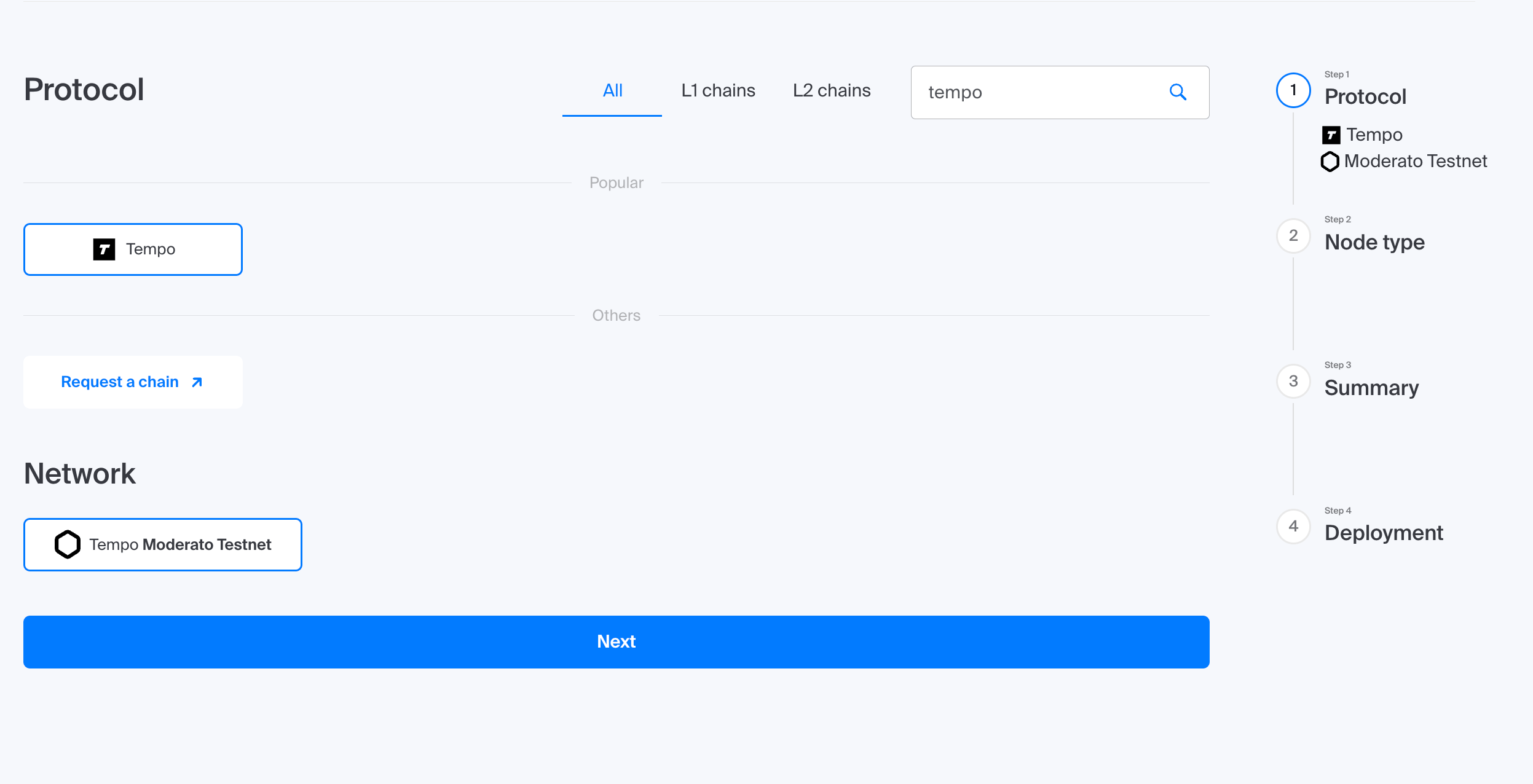
- Log in to the Chainstack console (or sign up if needed).
- Create a new project.
- Select Tempo as the blockchain.
- Choose the Moderato Testnet:
- Deploy a managed RPC node.
- Open the project dashboard and copy the generated HTTPS and WebSocket RPC endpoints.
Using Chainlist
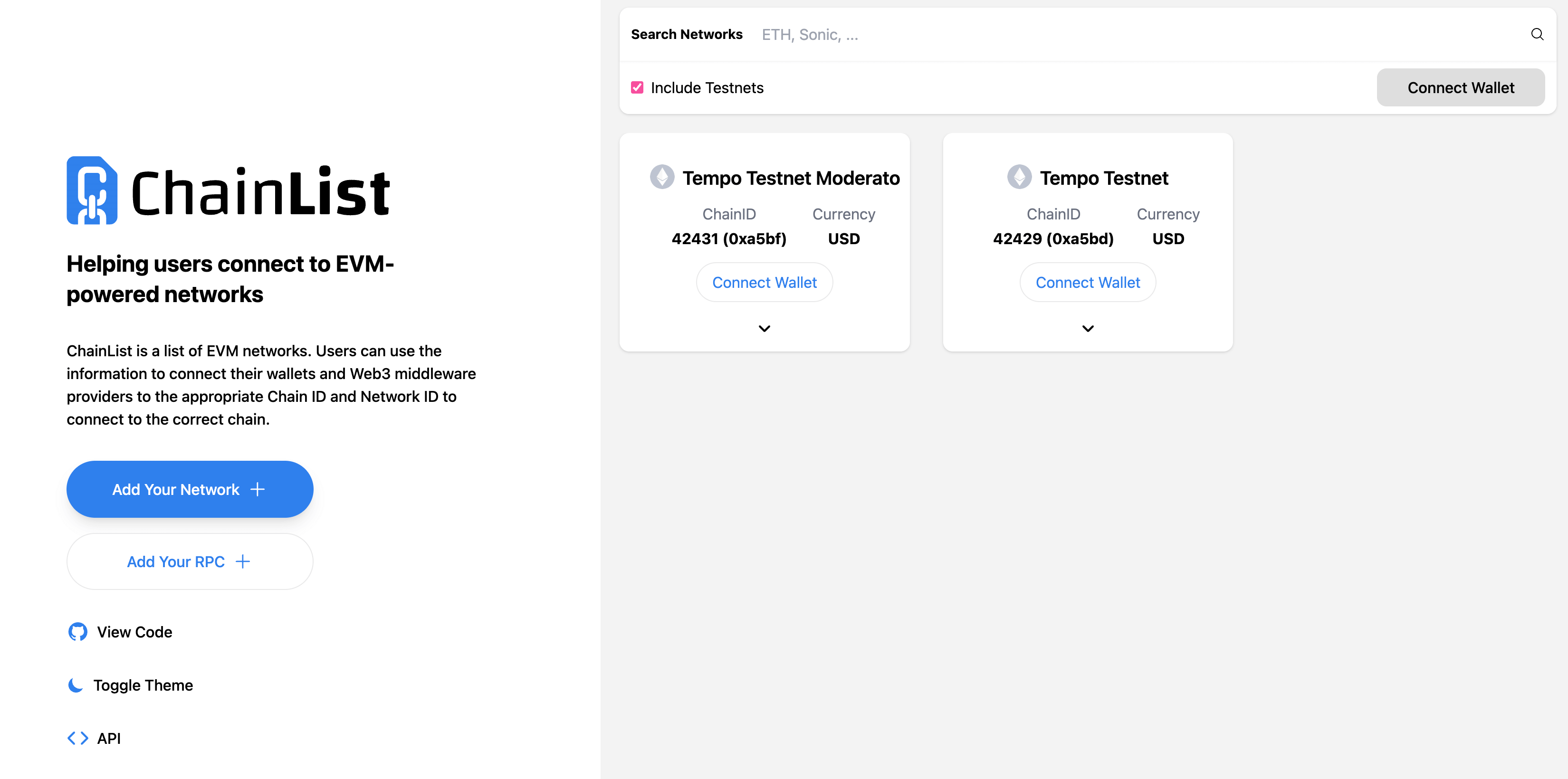
Chainlist can be used to add Tempo to wallets (for example, MetaMask or Rabby Wallet), but it does not provide RPC infrastructure. It typically relies on public or community RPC endpoints, so for production usage any RPC URL obtained via Chainlist should be replaced with a managed RPC endpoint such as Chainstack.
Tempo vs Standard EVM chains: RPC differences
| Feature | Standard EVM L1 | Tempo |
|---|---|---|
| Gas token | Native token (ETH, MATIC, etc.) | TIP-20 stablecoin |
| Token standard | ERC-20 (contract-based) | TIP-20 (protocol-enshrined) |
| Payment memos | Not supported | ISO 20022-compliant, queryable via RPC |
| Balance queries | Contract call (balanceOf) | Native operation (optimized) |
| Use case focus | General-purpose | Payment-specific |
These architectural differences affect RPC integration patterns. Payment applications benefit from Tempo’s optimized native operations for TIP-20 queries and memo-based reconciliation, while general-purpose dApps may require adjustments to account for stablecoin gas mechanics and enshrined token infrastructure.
Tempo RPC considerations for 2026
- Payment-oriented traffic patterns — Payment apps generate frequent, latency-sensitive RPC calls for balances, receipts, and confirmations.
- Stablecoin-based gas model — Transactions use TIP-20 stablecoins for gas, affecting fee estimation and balance checks via RPC.
- Payment memos and reconciliation — Reliable access to logs and transaction data is required for memo-based reconciliation workflows.
- WebSocket stability — Persistent connections are important for monitoring incoming payments in near real time.
- Archive data availability — Historical data is needed for audits, analytics, and payment history queries.
- Tooling compatibility — Standard EVM tooling support simplifies integration with existing payment stacks.
- ISO 20022 memo compatibility — RPC access to payment memos follows banking standards, enabling seamless integration with traditional payment reconciliation systems.
- Enshrined stablecoin infrastructure — TIP-20 tokens are protocol-native, not external contracts, affecting how balance queries and gas estimations work via RPC.
- Consensus + execution layer separation — Built on Commonware consensus and Reth execution, which may affect finality timing and RPC query patterns compared to monolithic L1s.
Conclusion
Public RPC endpoints are suitable for testing and early development, while managed RPC endpoints are the recommended option for production payment applications. As RPC traffic grows, reliability, throughput, and observability become critical.
Chainstack makes it easy to deploy Tempo RPC infrastructure without managing hardware or node configuration. Developers can spin up production-ready RPC endpoints in minutes and scale as application traffic increases.
With globally distributed infrastructure, Chainstack provides low-latency access to Tempo RPC endpoints, ensuring consistent performance for building, testing, and operating payment-centric applications.
Key features:
- Fast deployment through an intuitive console
- Low-latency access via global infrastructure
- Stable performance under sustained load
- Support for shared and dedicated RPC nodes
- Secure access with API keys and role-based permissions
Start for free, connect your application to a production-grade Tempo RPC endpoint, and scale with infrastructure built for real-world payment workloads.
More additional resources
- Connect to Tempo testnet via the JSON-RPC API
- Build a payment app using TIP-20 stablecoins
- Explore the complete Tempo tooling guide
- Tempo methods
- Build a basic DEX swap with Foundry
FAQ
A Tempo RPC endpoint provides access to the Tempo network via an Ethereum-compatible JSON-RPC API. It allows applications to send transactions, query blockchain state, and monitor payment activity on Tempo testnet or mainnet.
Yes. Tempo is EVM-compatible and works with common Ethereum tools such as ethers.js, web3.js, Hardhat, Foundry, and web3.py. Existing Solidity contracts and deployment workflows can be reused without modification.
TIP-20 tokens are enshrined at the protocol level rather than deployed as smart contracts. This means balance queries and transfers use optimized native operations instead of contract calls. Standard Ethereum tooling works, but developers should be aware that TIP-20 operations have different gas characteristics and faster execution than external ERC-20 contracts.
Yes. Tempo provides public RPC endpoints for testnet use. These endpoints run on shared infrastructure and are suitable for testing and development, but they typically enforce rate limits and do not provide uptime or performance guarantees.
Private RPC endpoints are recommended for production applications or any workload that requires consistent performance, higher throughput, monitoring, and reliability. Payment applications in particular benefit from dedicated RPC infrastructure.
Tempo mainnet is expected to launch in the near future. We’ll share updates and detailed information as soon as they are officially announced. To stay informed, follow Chainstack on X or subscribe to our newsletter below