AI-ready infrastructure
 Refer and earn


 Ethereum
 Hyperliquid
 Solana
 Arbitrum
 BNB Smart Chain
 Base
Base Polygon
 TRON
TRON Sui
Sui Robinhood


How much does it cost to self-host a blockchain node in 2026

Self-hosting a blockchain node gets sold as the free alternative to managed RPC. It isn’t free — it’s hardware, bandwidth, and engineering time, and all three scale wildly differently depending on which chain you’re running. A Raspberry Pi will keep up with Bitcoin. Nothing under five figures will keep up with Solana.
This piece breaks down the real cost of self-hosting across three network archetypes: a lightweight self-validating L1 (Bitcoin), an Arbitrum Orbit L2 (Robinhood Chain), and a high-throughput L1 where the node itself is the bottleneck (Solana). The gap between the cheapest and the most expensive is two to three orders of magnitude — and the biggest cost of all doesn’t show up on a spec sheet.
Why cost depends on network architecture
“Blockchain node” hides three very different jobs:
- Bitcoin is a self-validating L1 that was deliberately kept light — Bitcoin Core still runs on a Raspberry Pi 5. There’s no execution layer to speak of; a node downloads blocks, validates signatures, and updates the UTXO set.
- Robinhood Chain is an Arbitrum Orbit L2. You don’t run a sequencer — Offchain Labs‘ stack does that — you run a full or archive Nitro node that derives L2 state from an Ethereum L1 RPC endpoint and a Beacon API you supply. The hardware bar is EVM-standard; the catch is a young, fast-growing chain with numbers that go stale within months.
- Solana is a high-throughput L1 where “node” is ambiguous. A voting validator and a non-voting RPC node run the same Agave client but have different cost structures — a validator pays vote fees every slot regardless of profitability, an RPC node doesn’t vote but needs the same (or bigger) hardware to keep up with 400ms slots and gossip/turbine/repair traffic that saturates a home connection immediately.
Three architectures, three cost curves. Here’s each one broken down.

Bitcoin: the cheapest option
Bitcoin Core’s own hardware bar is low by design: 4 cores, 4–8 GB RAM, and enough disk for the chain. The blockchain itself is around 760 GB as of September 2026 and grows roughly 5–7 GB a month (estimates vary by source) — at that rate it crosses 800 GB by 2027. Budget 1 TB of NVMe and you’re covered for a couple of years.
The one decision that actually changes the hardware bill: pruned vs. archival. A pruned node validates every rule and keeps the full UTXO set but discards old block data after processing it — storage drops to single-digit GB. An archival node keeps everything, which is what you need if you’re serving historical blocks to other peers or running block-explorer-style queries. For most self-hosting use cases (a wallet backend, a payment processor, a Lightning node), pruned is enough.
The tooling here is mature: Umbrel, myNode, RaspiBlitz, and Start9 (embassyOS) all package Bitcoin Core into a plug-and-play box with a web dashboard, Lightning, and one-click apps on top — you’re not compiling anything or writing systemd units by hand. Plain Bitcoin Core on a VPS works just as well if a terminal doesn’t scare you.
- One-time hardware — $250–600 for a Raspberry Pi 5 kit, a mini-PC, or a plug-and-play node box (Umbrel, myNode, RaspiBlitz, Start9).
- Monthly, self-hosted — $3–15 in electricity for a low-power box running at home.
- Monthly, rented — $7.50–28 on a small VPS, comfortably inside the free tier of most cloud providers’ entry instances.
- Lightning — running a Lightning node alongside Bitcoin Core adds negligible hardware cost; the constraint is channel liquidity, not compute.
Bitcoin is the chain where “just run it on hardware you already own” is a genuinely reasonable answer. If that still doesn’t appeal, Chainstack’s managed Bitcoin RPC skips the hardware question entirely.

Robinhood Chain: an L2 with its own quirks
Robinhood Chain went live on mainnet on July 1, 2026 — an Arbitrum Orbit L2 (chain ID 4663) built for tokenized equities and stablecoin rails, with 100ms block times. Self-hosting it means running a full or archive Nitro node, not a sequencer — the sequencer is Robinhood/Offchain Labs infrastructure you don’t control. Your node derives L2 state from an Ethereum L1 RPC endpoint and Beacon API that you have to supply yourself.
Hardware sits at the standard Arbitrum Nitro bar: 8+ cores, 64–128 GB RAM, NVMe storage. Chain data is still light today — Chainstack’s own Self-Hosted deployment specs allocate 200 GB steady-state for a full Robinhood Chain node, and a managed archive package runs closer to 1.4 TB — but this is a two-and-a-half-month-old chain growing under real trading volume. Whatever number you read today, including the ones in this article, will be stale within a quarter. Size for growth, not for the chain as it is the day you provision.
Tooling here is thin, and that’s the real cost most people miss. There’s a community Arbitrum Nitro package for DappNode, but its maintainer has stepped back, arguing Arbitrum should be officially supported the way DappNode supports other major chains — it’s not a path you can rely on long-term. In practice, self-hosting an Orbit L2 today means running Offchain Labs’ official Nitro node via Docker yourself. There’s no Umbrel-style box for this yet.
Monthly, rented bare metal/VPS — $100–300 for an 8-core / 64 GB config — and that’s before the Ethereum L1 RPC endpoint and Beacon API your node needs upstream. Self-host those too and you’re paying Ethereum’s own hardware bill on top; use a managed Ethereum RPC endpoint instead and it’s a usage-based add-on, not a second server.
Robinhood Chain is the middle tier for a reason that has nothing to do with the hardware spec sheet: it’s the only one of the three where “self-host” doesn’t mean “self-contained.” You’re still depending on someone else’s sequencer and your own L1 endpoint — or Chainstack’s managed Robinhood Chain RPC skips both dependencies for you.
One clarification worth making: Chainstack doesn’t run a Robinhood Chain sequencer — there’s exactly one, and it’s Robinhood/Offchain Labs infrastructure, same as every other Orbit chain. What Chainstack maintains is an open-source decoder for that sequencer’s broadcast feed — useful for seeing transactions before they’re confirmed, for copy-trading or flow analytics. It’s a read-only feed reader, not a substitute for running your own node; you still need a node for receipts, logs, and state.
Solana: the most expensive and demanding option
Solana doesn’t degrade gracefully, and the hardware bar reflects that. Anza’s own guidance favors clock speed over core count, sizes RAM for indexing, and splits accounts and ledger across physically separate NVMe drives — put them on one disk and it burns out its write endurance while starving the RPC layer of IOPS. The numbers:
| CPU | 24+ cores, high clock speed (EPYC-class) |
| RAM | 256 GB floor · 512 GB with account indexes |
| Storage | Enterprise NVMe · accounts and ledger on separate drives |
| Bandwidth | 60–100 TB/month |
| One-time hardware | $8,000–15,000 (colocation/ownership) |
| Monthly, rented bare metal | $800–1,900 (bandwidth-included) |
| Vote fees (voting validator only) | ~394 SOL/year (~$50,000 at $130/SOL) |
| Testnet node (voting validator only) | +$200–400/month |
Gossip, turbine, and repair traffic are why Solana-tagged bare-metal configs ship with 50–100 TB bundled in rather than pay-per-GB. That’s not a home-connection number — it rules out most consumer ISPs and a lot of budget VPS plans outright.
The client landscape: Agave (Anza’s fork of the original Solana Labs validator) is what almost everyone runs today. Jito-Solana is the same client with MEV bundling built in, standard for anyone doing block-building or arbitrage. Firedancer, Jump Crypto’s from-scratch rewrite, is live on parts of mainnet but isn’t the default client yet — worth watching, not yet a decision most self-hosting teams need to make.
Listings well under $800/month exist — some bare-metal providers start around $250/month — but check the spec against Anza’s actual RAM and NVMe bar before trusting the price. Most sub-$800 tiers don’t clear it, which is exactly the trap this article opened with. That figure also assumes bandwidth-included bare metal — the same providers bundle 50–100 TB into the price. Price the same spec on AWS or GCP and egress alone can add $500–1,500/month on top of the instance cost, since Solana’s gossip/turbine traffic isn’t optional and cloud providers bill it per GB.
None of that is what actually kills small operators. If you’re running a voting validator, you pay vote transaction fees every slot — roughly 394 SOL a year, which priced around $50,000/year at ~$130/SOL in April 2026. That’s a fixed, SOL-denominated expense that runs whether your validator earns anything or not, and it’s a structurally different cost than anything Bitcoin or Ethereum-family validators face. It’s a big part of why Solana’s validator count has fallen from roughly 2,500 in March 2023 to around 800 in January 2026 — a decline of more than 65%, concentrated among smaller operators who couldn’t cover vote fees during quiet markets.
Voting validators carry costs beyond the ones above, too. To qualify for Solana Foundation delegation, you also need a second, lighter testnet node running in parallel — budget another $200–400/month — and since May 2026 your hosting provider can’t hold more than 25% of network stake by ASN or 15% by data center, which rules out some of the cheapest options outright. None of this applies if you’re only running a non-voting RPC node.
This article only covers costs — a voting validator also earns inflation rewards and, increasingly, Jito MEV tips, which is the other half of whether running one pencils out; that calculation depends on your total stake and is a separate question from what a node costs to run. An RPC-only node (non-voting) skips vote fees entirely — the hardware bill is the whole story there. But whether you’re voting or not, Solana is the chain where self-hosting stops being a weekend project and starts being a capital allocation decision. Chainstack’s managed Solana RPC is the other option if that capital is better spent elsewhere.
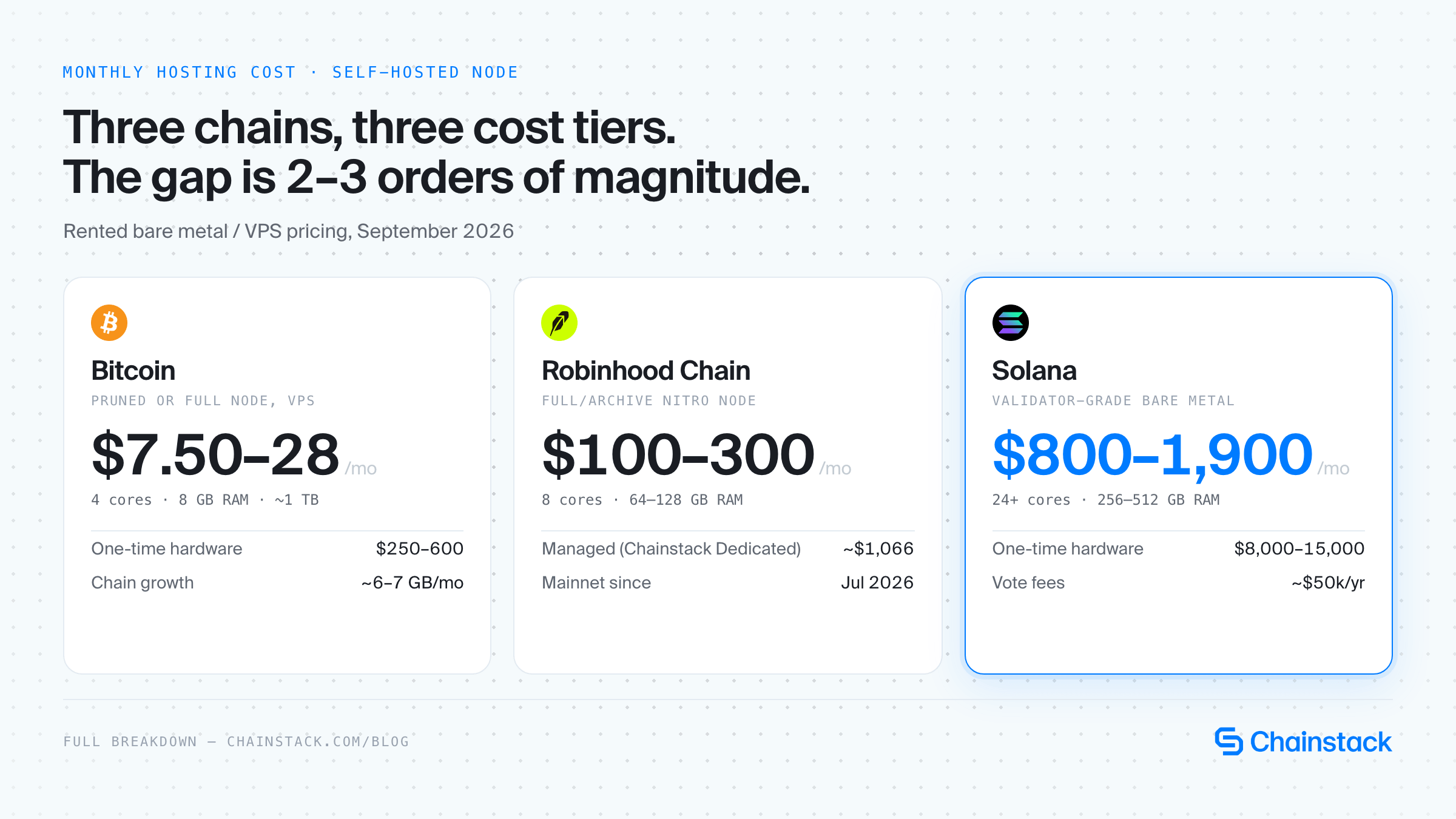
Cost comparison at a glance
| Bitcoin | Robinhood Chain | Solana | |
|---|---|---|---|
| CPU | 4 cores | 8+ cores | 24+ cores (EPYC-class) |
| RAM | 4–8 GB | 64–128 GB | 256–512 GB |
| Storage | ~1 TB (pruned: single-digit GB) | 200 GB–1.4 TB, growing fast | Multi-TB enterprise NVMe |
| Chain growth | ~5–7 GB/month | Young chain, rapidly changing | Multi-GB/day |
| Bandwidth | Modest, home-connection fine | Standard EVM RPC traffic | 60–100 TB/month |
| One-time hardware | $250–600 | — | $8,000–15,000 |
| Self-hosted, monthly | $3–15 (electricity) / $7.50–28 (VPS) | $100–300 (rented) | $800–1,900 (bare metal) |
Figures are hardware and hosting costs only — they don’t include the engineering time to keep any of these running, which is the next section.
The hidden cost: engineering time
Every number above is a server bill. None of it is what a DIY self-hosted node actually costs a team, because a server isn’t a node — it’s a box that needs an execution client, monitoring, snapshot management, coordinated upgrades across a hard fork, and someone on call for when it falls out of sync at 2am.
Chainstack’s own breakdown of DIY vs. managed self-hosting puts real numbers on this: a production-ready DIY setup takes 2+ weeks from someone who already knows Kubernetes and the target blockchain client, plus roughly 4 hours a week afterward to keep it healthy. At typical senior engineer rates, that’s ~$6,000 upfront and $15,000+ a year — for a single protocol. Run three protocols and the number doesn’t triple; it compounds, because you’re now coordinating updates and debugging interactions across systems that don’t share tooling.
That engineering line item is invisible on a hardware spec sheet, and it dwarfs the server bill for every chain in this article except Solana at scale. It’s also the part of the “self-hosting is free” pitch that quietly stopped being true.
Chainstack Self-Hosted: the same control, without the DevOps tax
The hardware math in this article doesn’t change if you run Chainstack Self-Hosted — you’re still buying the same NVMe and the same EPYC cores for Solana, the same VPS for Bitcoin. What changes is the second cost: the control plane that deploys, monitors, and updates the node is free — $0, you only pay for the infrastructure underneath it — and it’s the same control plane whether you’re running Bitcoin, Robinhood Chain, Solana, or any of the 30 protocols it currently supports. One interface instead of three separate DIY stacks.
It also cuts into the hardware side of the equation: Chainstack’s hosting partners run standing discounts specifically for Self-Hosted deployments — 20% off on is*hosting (code CHAINSTACK20), 80% off your first month on velia.net (code ChainstackSH80), and 50% off on BreezeHost (code CHAINSTACK50), on top of a free-to-deploy marketplace app on Vultr and Hostkey.
Self-hosting stays cheaper than managed RPC on the invoice, at every tier in this article. What it stopped being is cheap in engineering hours — and that’s the exact cost Chainstack Self-Hosted is built to remove.
FAQ
Two separate reasons stack on top of each other. Hardware: Solana’s 400ms slots and constant gossip/turbine/repair traffic need high-clock-speed EPYC-class CPUs, 256–512 GB of RAM, and 60–100 TB/month of bandwidth — an order of magnitude past what an EVM L2 needs. Economics: if you’re voting, you pay ~394 SOL/year in vote fees regardless of profitability, a cost Bitcoin and Robinhood Chain nodes simply don’t have.
No. A non-voting RPC node runs the same Agave client and needs comparable hardware, but skips vote fees entirely since it never participates in consensus. If your goal is a private RPC endpoint rather than earning staking rewards, that’s the cheaper of the two.
The count fell from roughly 2,500 in March 2023 to around 800 in January 2026 — a decline of more than 65%. Fixed, SOL-denominated vote fees are a big driver: they run every day regardless of market conditions, and a formal network-quality pruning pass in 2025 removed underperforming validators on top of that. Smaller operators who couldn’t cover the fixed cost during quiet markets left first.
For most applications, yes — a pruned node fully validates every block and rule, it just discards old block data after processing it. The only thing you lose is the ability to serve historical blocks to other peers or run archive-style historical queries. A wallet backend, payment processor, or Lightning node doesn’t need that.
Because it’s true of any chain two and a half months into mainnet. Robinhood Chain launched July 1, 2026; its chain data, transaction volume, and hardware requirements are all still moving. Treat the figures here as a September 2026 snapshot, not a long-term constant, and re-check current requirements before sizing hardware for production.
The software that deploys, monitors, and manages your nodes costs $0 to install on your own infrastructure. You still pay for the servers, storage, and bandwidth underneath it — the same hardware costs broken down in this article — but not for the orchestration layer on top.
Additional resources
- System requirements for Chainstack Self-Hosted
- Supported clients and protocols
- Agave validator requirements (Anza official)
- Chainstack Self-Hosted
Related reading — self-hosted node guides