AI-ready infrastructure
 Refer and earn


 Ethereum
 Hyperliquid
 Solana
 Arbitrum
 BNB Smart Chain
 Base
Base Polygon
 TRON
TRON Sui
Sui Robinhood


Chainstack + Ormi: Powering in TVL with subgraph infrastructure

“Chainstack is what you see, what you get — enterprise-grade, high performance. It’s good to know that Chainstack has got our back.”
— Victor Fei, Founder & CEO of Ormi
The blockchain infrastructure landscape is maturing rapidly. As institutional players enter the space and AI agents begin handling financial transactions, the requirements for reliability, performance, and data accuracy have become non-negotiable. In this environment, two industry leaders — Chainstack, a veteran node provider with 8 years of experience, and Ormi, a specialized real-time blockchain data platform — announced a strategic partnership that reflects how the industry is evolving toward deeper specialization.
The partnership between Chainstack and Ormi centers on subgraph infrastructure built for production-scale blockchain applications, where reliability, performance, and data accuracy are non-negotiable.
Who is Ormi?
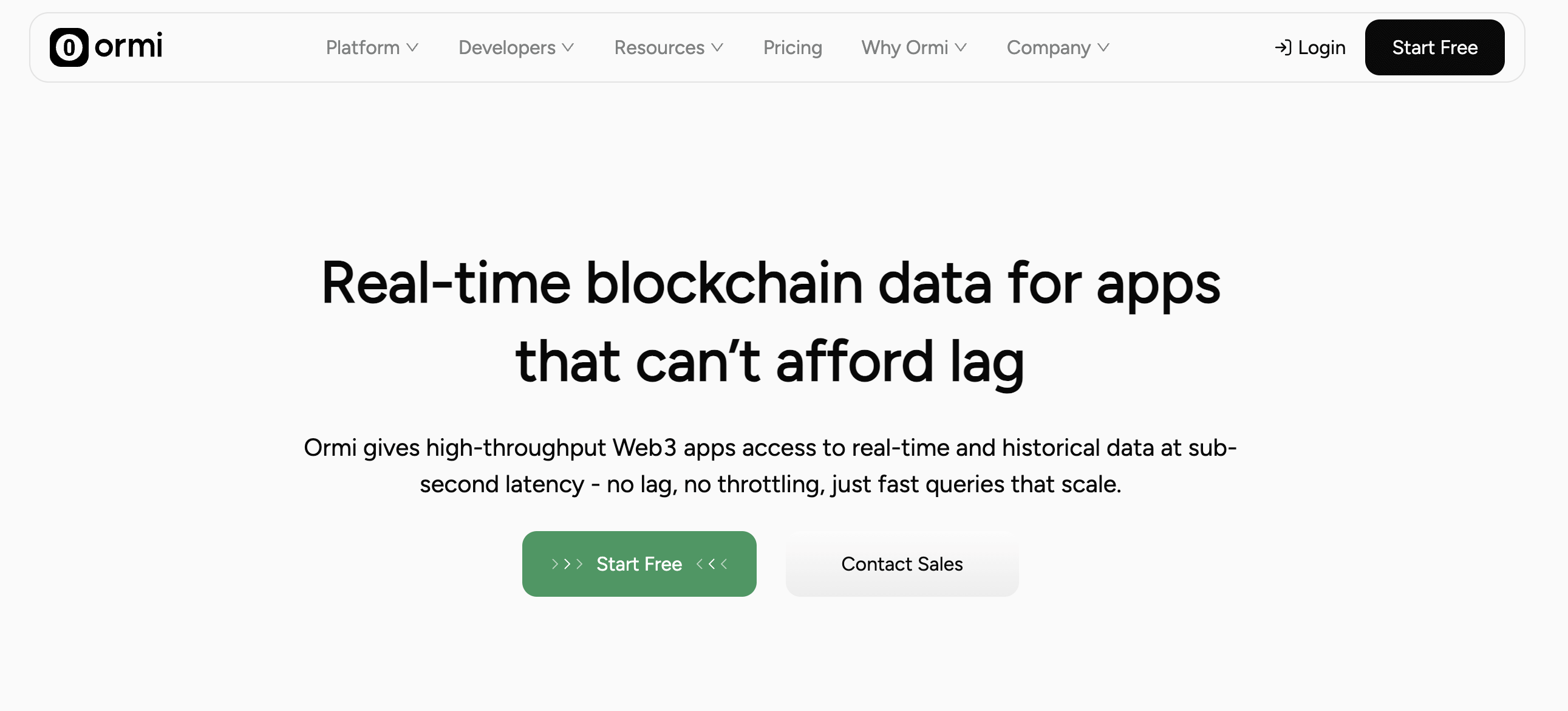
Ormi is a real-time blockchain data platform specializing in subgraph infrastructure for high-throughput blockchain data indexing. The company provides the infrastructure that allows Web3 applications to query blockchain data quickly and reliably — powering everything from DeFi protocols to high-frequency trading platforms.
Founded three years ago by Victor Fei, who previously worked on the Chromium browser kernel at Microsoft and studied semiconductor optimization at Cornell, Ormi focuses on solving one critical problem: extracting and serving blockchain data at scale. The platform currently supports over $50B in TVL across applications, processes$100B+ in transactions annually, and maintains 99.99% uptime across 70+ blockchain networks.

Ormi’s core focus is solving the “read path” problem — extracting data from blockchains efficiently. While much attention in Web3 goes to the “write path” (executing transactions), the reality is that without fast, accurate indexing, applications simply can’t function regardless of transaction speed.
Why Chainstack partnered with Ormi for subgraph infrastructure
After launching Chainstack Subgraphs two years ago and gaining substantial traction, the company made a strategic decision in 2025: go laser-focused on nodes. The goal was clear — become the household name for blockchain node infrastructure, whether elastic, dedicated, cloud, hybrid, or on-premise.
This specialization required finding a partner with deep expertise in subgraph infrastructure, capable of operating reliably at production scale. Ormi fit perfectly.
“We just want to do whatever we do the best. We want to be the household name when you associate with blockchain nodes. Ormi popped up because they are hyper-specialized on subgraphs, and they just do this, and nothing else.”
— Eugene Aseev, Co-Founder & CTO of Chainstack
The migration wasn’t about offloading a product line — it was about ensuring customers received the absolute best service. In an industry where even 5 minutes of downtime can have serious consequences for financial applications, having a specialized partner meant customers would get dedicated expertise rather than divided attention.
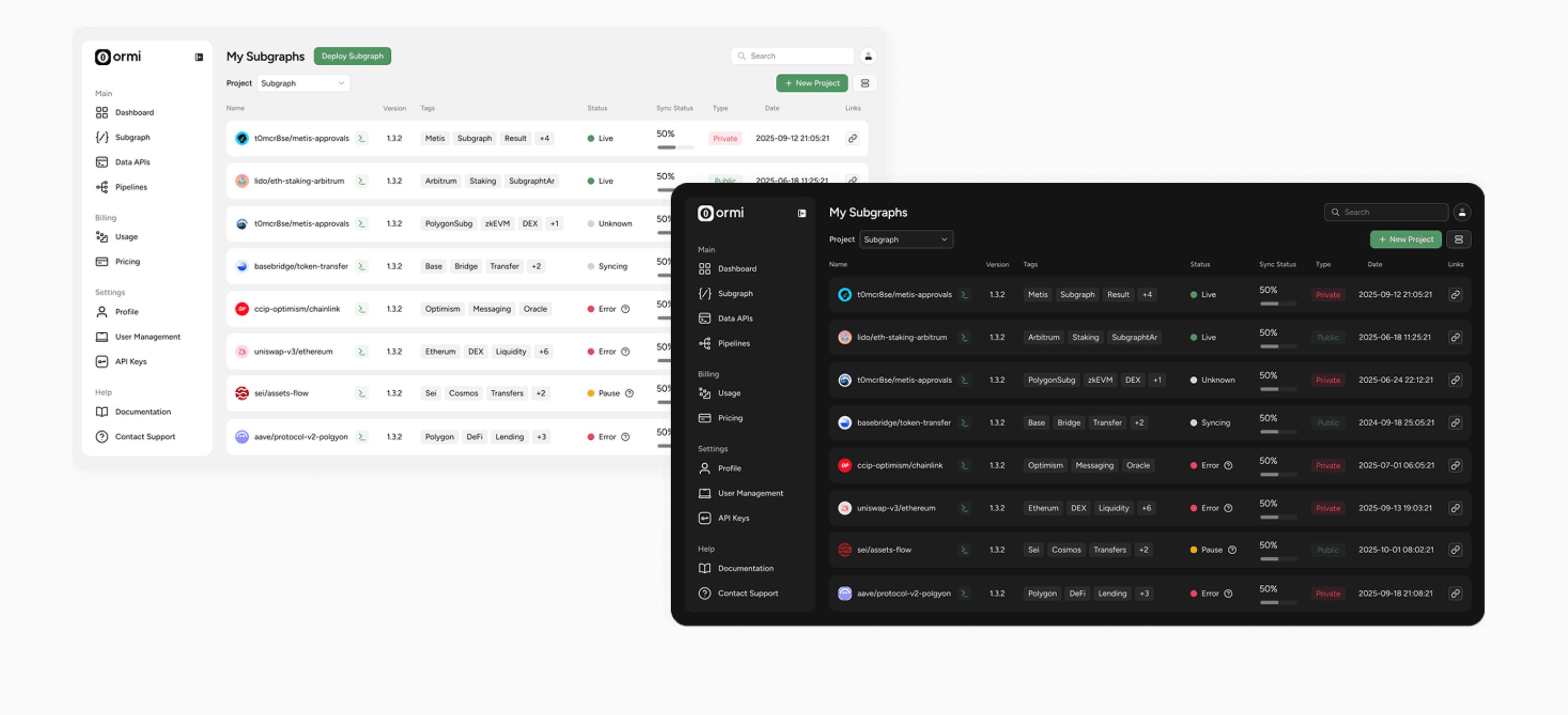
Chainstack’s infrastructure serves as the foundation for Ormi’s indexing, while Ormi handles the complex data extraction and serving layer. It’s a natural division of labor that plays to each company’s core strengths.
How Ormi benefits from Chainstack’s RPC infrastructure
For Ormi, the partnership solved a critical challenge: roughly 80% of subgraph infrastructure uptime depends on RPC performance and accuracy. Building and maintaining production-grade node infrastructure in-house requires a dedicated team to handle constant updates, edge cases, and the operational complexity that comes with supporting multiple blockchain protocols.
“A core component of indexing for subgraph for uptime is actually nearly 80% RPC performance, RPC accuracy. There is no way that we would have not given the primary RPC usage to Chainstack.”
— Victor Fei, Founder & CEO of Ormi
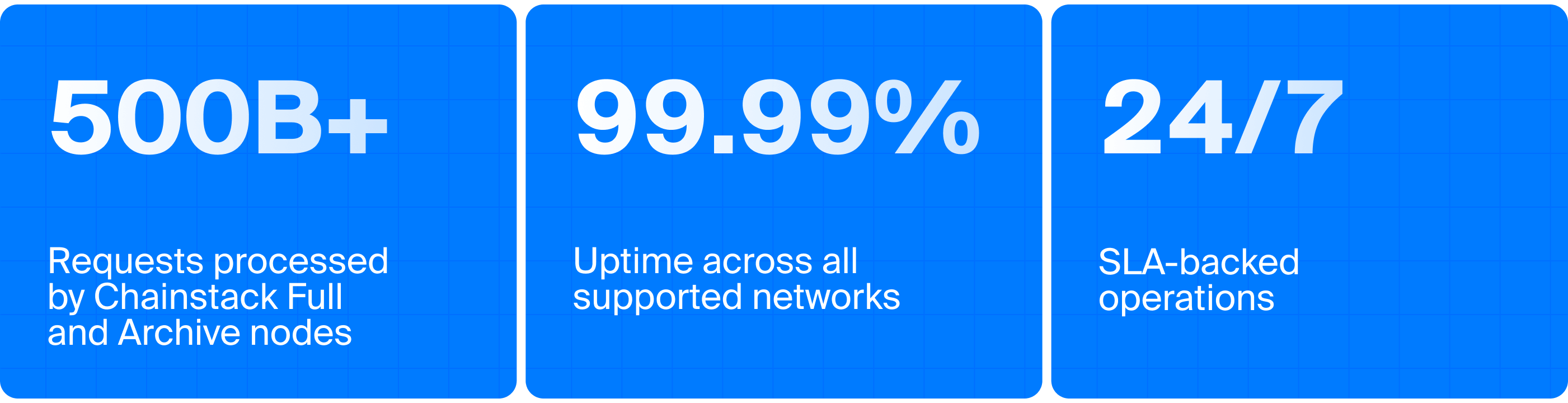
The numbers tell the story of why this partnership works: Chainstack’s infrastructure processes over 500 billion requests through their Full and Archive nodes, maintains 99.99% uptime across all supported networks, and operates with SLA-backed guarantees 24/7. This reliability forms the foundation that allows Ormi to focus on what they do best — transforming blockchain data into queryable formats for applications.
Ormi had run their own nodes initially, but recognized that sustainable growth meant focusing resources on their core competency — real-time blockchain data indexing. Partnering with Chainstack’s battle-tested node infrastructure allowed them to allocate engineering resources toward improving indexing performance rather than maintaining node operations.
The technical synergy is clear: Chainstack provides the reliable data source, while Ormi transforms that raw blockchain data into accessible, queryable formats that applications need. Both companies can innovate faster in their respective domains without being stretched thin across the full infrastructure stack.
Key insights for blockchain developers
- Indexing is Core Infrastructure, Not Optional
Blockchain nodes were designed for consensus, not serving data at scale. They use file-level databases optimized for block generation and peer-to-peer coordination, not high-throughput data queries. Modern applications require specialized indexing infrastructure that can handle thousands of requests per second reliably.
- Production Requirements Have Evolved Dramatically
The industry has moved past the “experimental technology” phase. With real financial assets, institutional players, and AI agents on-chain, infrastructure downtime has concrete consequences. Missing a single transaction can impact user balances, point distributions, or trading outcomes. The tolerance for errors has dropped to near-zero.
- Specialization Beats Generalization
The partnership illustrates a broader trend: successful infrastructure companies are going deep rather than wide. Trying to be excellent at nodes, indexing, analytics, and other layers simultaneously spreads engineering resources thin. Companies that master one layer and partner for others can deliver better outcomes.
- Infrastructure Requires Deep Expertise
Building production-grade blockchain infrastructure isn’t about spinning up a few scripts. It requires handling poorly documented protocols, debugging edge cases in Discord channels, building custom automation, and accumulating years of operational knowledge. This expertise creates a meaningful moat despite surface-level commoditization narratives.
- Real Use Cases Drive Sustainable Growth
The maturation of blockchain infrastructure is tied to genuine applications emerging beyond speculation. Financial use cases — payments, trading, cross-border transfers, and now AI-powered transactions — require the programmable money and immutable ledger properties that blockchain uniquely provides. Infrastructure that serves these applications will see sustained demand.
Conclusion and the future infrastructure plans
Both companies see massive growth driven by two trends: tokenization of traditional finance with regulatory support, and AI-agentic workflows requiring reliable blockchain data. Chainstack is launching a self-hosted version for enterprises, while Ormi continues expanding its real-time indexing capabilities.
The partnership demonstrates that blockchain maturity requires specialization. As Chainstack focuses on delivering enterprise-grade RPC infrastructure with 99.99% uptime, partners like Ormi build specialized data layers that developers rely on for mission-critical applications.
For developers building next-generation blockchain applications, the foundation is ready. Start for free, connect your app to a reliable blockchain RPC endpoint, and build enterprise and stablecoin applications on infrastructure designed for scale, uptime, and compliance with Chainstack.
More ways teams use Chainstack