AI-ready infrastructure
 Refer and earn


 Ethereum
 Hyperliquid
 Solana
 Arbitrum
 BNB Smart Chain
 Base
 Polygon
 TRON
 Sui
 Robinhood


Best RPC providers 2026: 10 options compared

The best RPC providers in 2026 differ in ways that directly affect production applications: which methods they support, how they handle traffic spikes, what historical data they expose, and how they calculate your bill.
Chainstack is our top pick for multichain production infrastructure, combining managed RPC with dedicated and self-hosted deployment options. Tatum stands out for RPC alongside application APIs, Dwellir for response-based billing, and dRPC for routing across multiple upstream providers.
This guide compares ten RPC providers by pricing, capabilities, limitations, and workload fit.
Best RPC providers at a glance
Pricing and plan details checked on Nov 2, 2026. Monthly subscriptions, annual commitments, billing units, and throughput limits appear separately below.
| Rank | Provider | Best for | Pricing and included usage |
| 1 | Chainstack | Multichain production infrastructure | Free: 3M request units/month. Growth: $49/month with 20M request units. Official pricing |
| 2 | Tatum | RPC alongside application APIs | Free: 3 requests/second on Full Nodes and 100K lifetime credits. Dedicated keys from $99/month at 10 requests/second. Official pricing |
| 3 | Dwellir | Response-based RPC billing | Free: 100K responses/day. Developer: 25M responses/month for $500 billed annually, displayed as approximately $42/month. Official pricing |
| 4 | OnFinality | RPC alongside managed node operations | Free: 400K response units/day. Growth: $49/month with 20M response units. Official pricing |
| 5 | dRPC | Managed routing across providers | Free: 210M compute units/month on public nodes. Pay as You Go: $6/million standard requests. Official pricing |
| 6 | NOWNodes | Wallets covering diverse networks | Pro: €20/month with 1M requests. Official plan comparison |
| 7 | RouteMesh | Aggregated RPC routing and billing | Economy routes start at $3/million requests, with prices determined by route, key type, chain, and method. Official pricing |
| 8 | Ankr | Prepaid multichain RPC | Free public access. Premium Pay as You Go starts with a $10 minimum deposit. Official plans |
| 9 | Alchemy | RPC plus indexed data and wallet APIs | Free: 30M compute units/month. Pay as You Go: $0.52/million compute units. Official pricing |
| 10 | Quicknode | RPC alongside blockchain data infrastructure | One-month trial: 10M credits. Build: $49/month on monthly billing, including 80M credits. Official pricing |
How we compared these RPC providers
The comparison prioritizes five practical requirements:
- Coverage: supported chains, networks, methods, historical state, and subscriptions.
- Cost: included usage, billing units, overages, and separately priced services.
- Capacity: sustained throughput, burst limits, and restrictions on expensive methods.
- Deployment options: shared endpoints, dedicated infrastructure, and infrastructure ownership.
- Developer experience: APIs, observability, integration effort, and recovery controls.
Chainstack takes the first position because its product range covers several stages of infrastructure growth: shared RPC, isolated nodes, and deployment on infrastructure a team controls. The remaining providers offer distinct reasons to join a shortlist, from simpler response billing to higher-level application APIs.
Why RPC choice matters in production
An RPC endpoint sits between your application and blockchain state. When that endpoint falls behind, rejects requests, or drops subscriptions, users experience incorrect balances, delayed transaction updates, and gaps in event processing.
Three distinctions matter particularly:
Successful HTTP requests can contain failed RPC calls. Monitor JSON-RPC errors and validate responses alongside HTTP status codes.
Monthly allowances and throughput solve different problems. An application can remain within its monthly quota while exceeding its per-second limit during a launch or market event.
Historical data has several meanings. Access to old blocks and receipts does not automatically establish support for historical state queries, tracing, or every archive method.
The strongest provider for your application supports the exact operations your product depends on, at the concurrency and freshness your users need.
How to choose: supported chains, rate limits, and latency
Check supported chains at the method level
Start with your required mainnets and testnets, then build a method checklist.
An Ethereum Virtual Machine (EVM) wallet might need eth_getBalance, eth_call, eth_estimateGas, and eth_sendRawTransaction. An indexer might also require eth_getLogs, historical state, and transaction tracing.
For Solana, test the specific account queries, transaction reads, subscriptions, and streaming interfaces your application uses. Ethereum compatibility tells you little about Solana behavior.
Separate rate limits from monthly usage
Identify whether the provider limits raw requests, responses, or weighted units per second. Check whether those limits apply across an account, project, endpoint, or network.
Also inspect batch sizes, concurrent connections, log-query ranges, and response-size restrictions. A larger monthly plan may leave a method-specific bottleneck unchanged.
Measure latency alongside freshness
Measure p50, p95, and p99 latency from your production regions using representative requests.
Include chain-head lag and valid-response rate. A fast response containing stale state can be less useful than a slightly slower response from an up-to-date node.
Calculate cost from your method mix
Provider units are different currencies. One million compute units, request units, API credits, and responses can represent very different amounts of application traffic.
Use:
Monthly cost = subscription + billable overages + separately priced services
Convert your methods into each provider’s billing units before comparing the result.
1. Chainstack: best overall for multichain production infrastructure
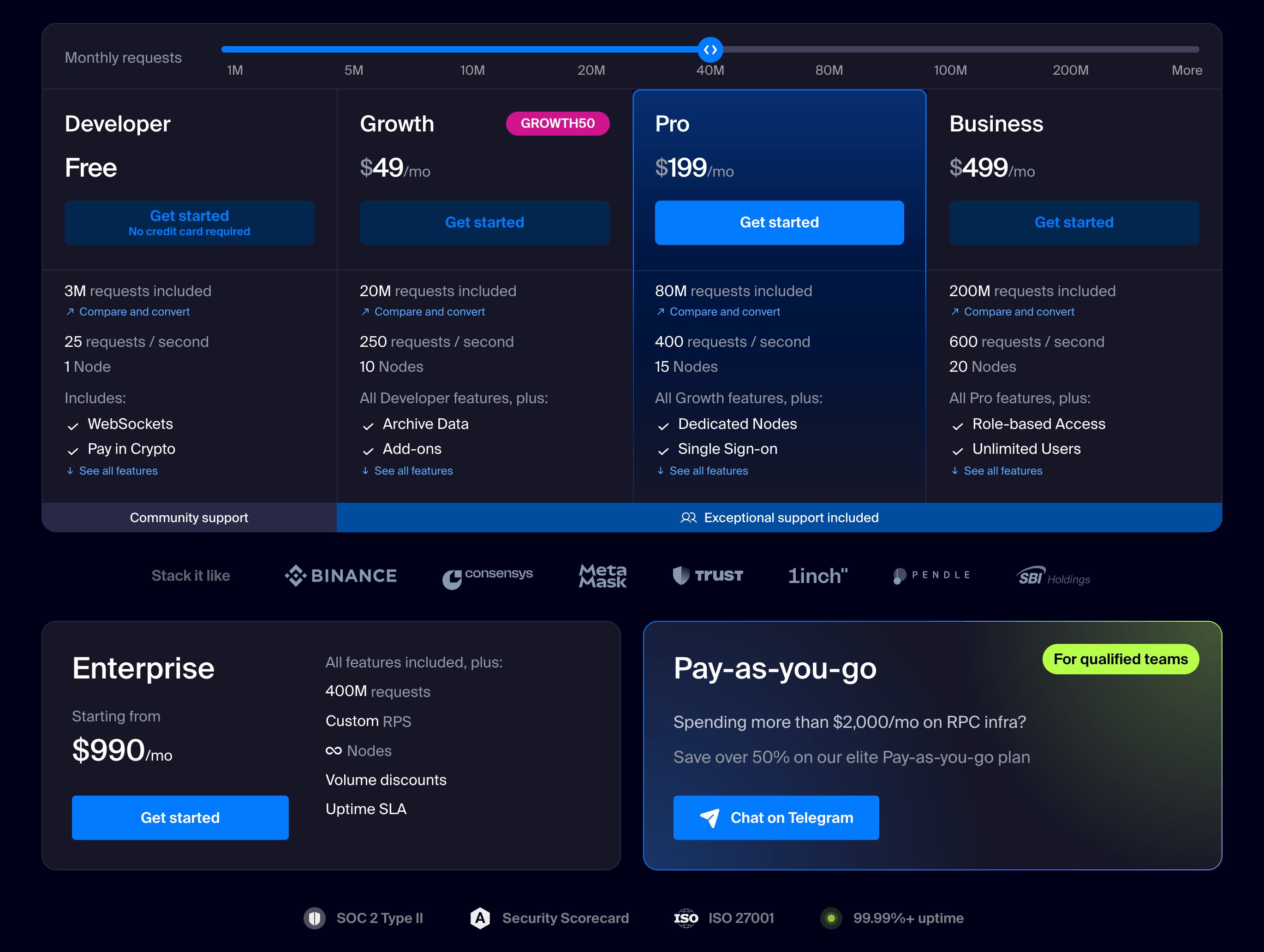
Chainstack suits teams that want managed RPC today and more infrastructure control as their application grows. The product range includes Global Nodes, Dedicated Nodes, and Chainstack Self-Hosted.
Global Nodes provide managed, geographically distributed access. Dedicated Nodes address workloads requiring isolated infrastructure, while Self-Hosted supports deployment on infrastructure the customer controls. Chainstack products
Pricing and free tier: The free Developer plan includes 3M request units per month at 25 requests/second. Growth costs $49/month and includes 20M request units at 250 requests/second. Global Node requests consume one request unit; archive requests consume two. Unlimited Node starts at $149/month for 25 requests/second and requires Growth or above. Chainstack pricing
What stands out: Chainstack’s GEN 2.0 architecture removes an edge proxy hop from Global Node requests and uses DNS for geographic routing. That architecture gives readers a concrete performance mechanism to evaluate. GEN 2.0 architecture
Published benchmark results: Chainstack ranked first against Quicknode, Alchemy, and dRPC in Chainstack Labs’ seven-day benchmarks ending Oct 8, 2026. The reports compare entry paid RPC tiers using probes across three regions, with a composite score combining latency and measured request success.
- Ethereum: Reported P50/P95/P99 latency of 36/78/117 ms, the lowest across all three columns, with 99.98% measured availability. Ethereum benchmark
- BNB Chain: First on composite score and lowest reported P95 at 76 ms. Alchemy recorded a lower median, while Quicknode and Alchemy recorded lower P99 latency. BNB Chain benchmark
- Hyperliquid: Lowest reported P50/P95/P99 latency at 10/22/82 ms, with 99.74% measured availability. Hyperliquid benchmark
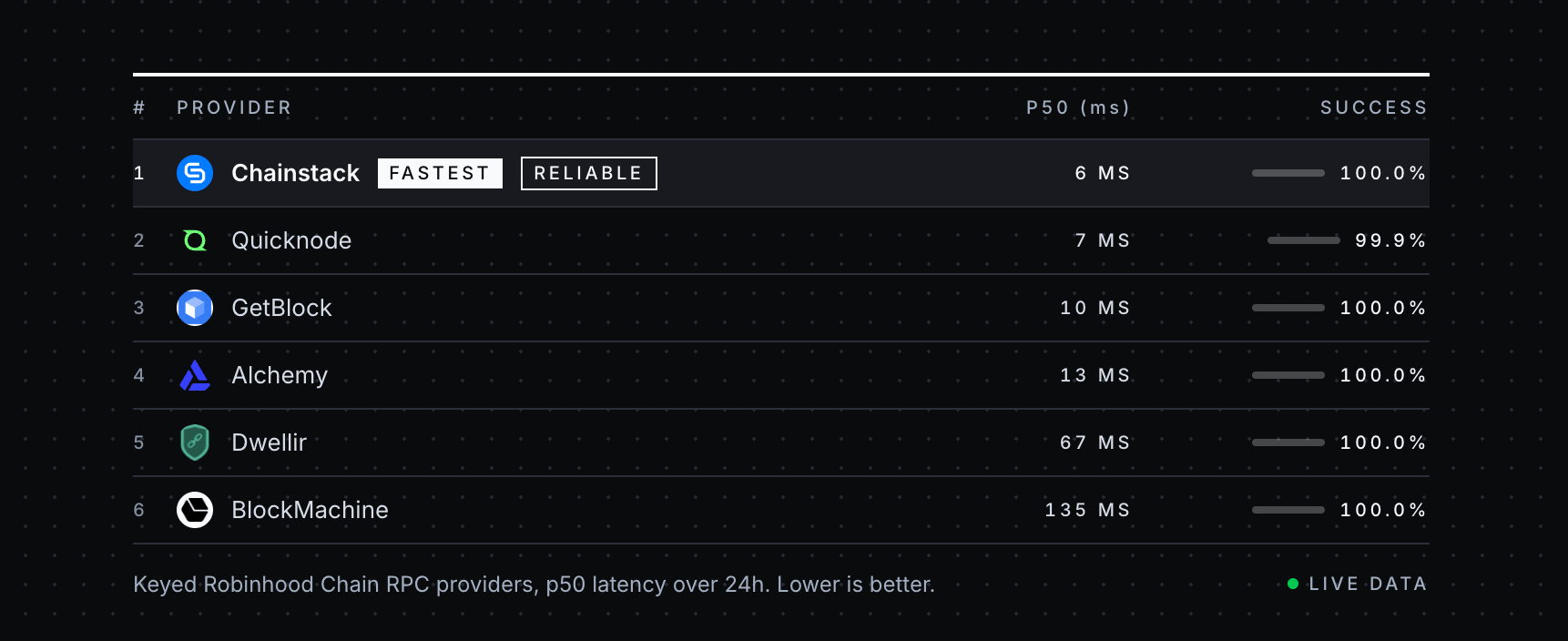
OpenChainBench also ranked Chainstack first for median Robinhood Chain RPC latency from its Singapore probe, testing eth_getBlockByNumber("latest", false) every 60 seconds over a rolling 24-hour window. OpenChainBench report
Tradeoffs: Add-ons and isolated deployments require their own budget. Unlimited Node has a defined throughput ceiling. GEN 2.0 also makes whole-region failover dependent on DNS, which can take seconds. Architecture tradeoffs
Verdict: Choose Chainstack when deployment flexibility, multichain access, and a clear growth path matter together.
2. Tatum: best for RPC alongside application APIs
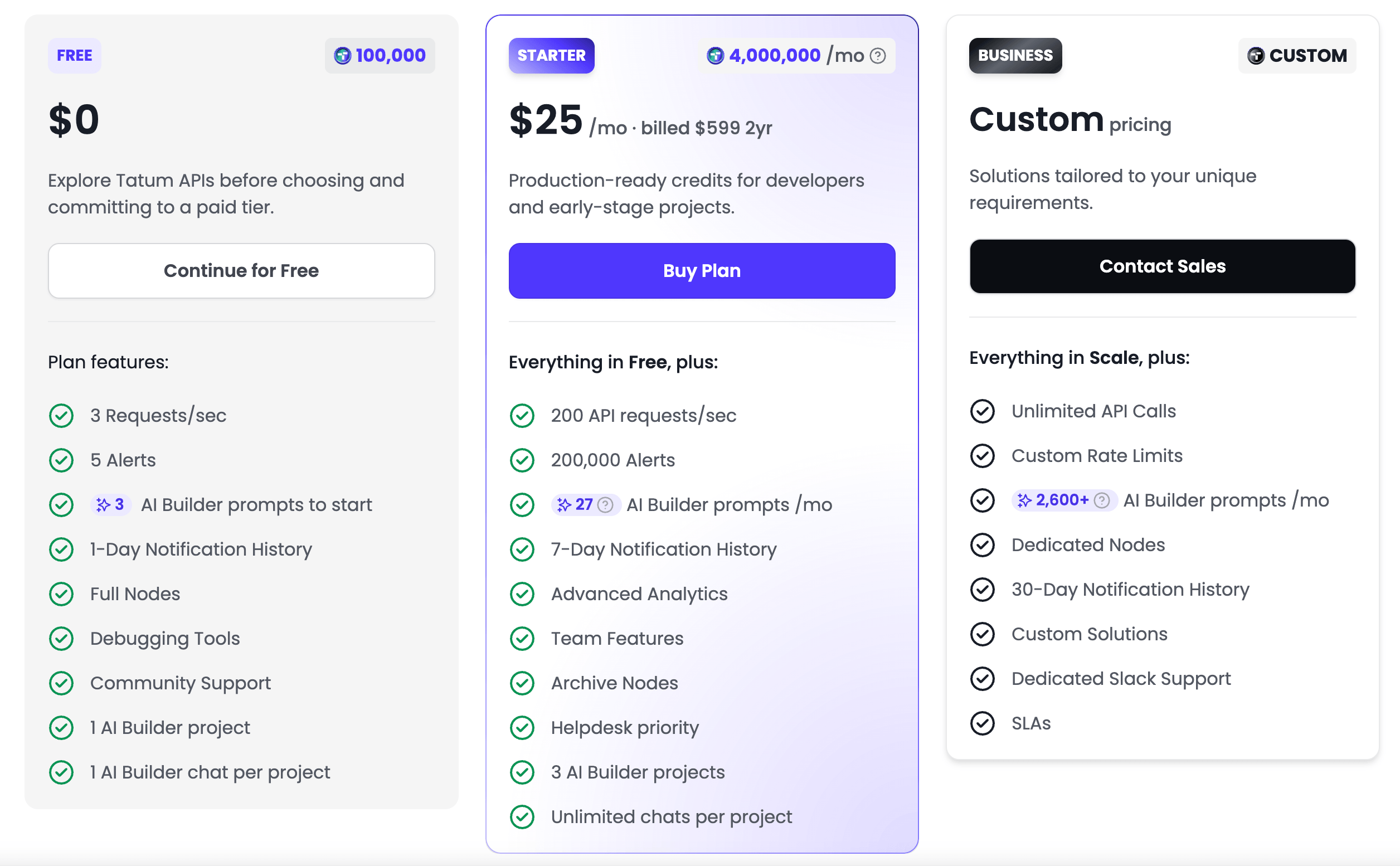
Tatum combines RPC access with data, notifications, and wallet products. That combination suits teams building an application that needs several blockchain services under one account. Tatum products
Pricing and free tier: Tatum’s free account lists 3 requests/second on Full Nodes and 100K lifetime credits. Dedicated API keys start at $99/month for 10 requests/second, with higher throughput tiers available. Dedicated keys do not consume plan credits. Tatum pricing
What stands out: Tatum provides native RPC access across EVM and non-EVM networks, with full and archive access available through its node offering. Teams can combine those endpoints with application APIs where higher-level abstractions save development work. Tatum RPC nodes
Tradeoffs: The free credit allocation is lifetime usage. A dedicated API key reserves throughput, so teams requiring isolated node infrastructure should evaluate that requirement separately. Plan-credit behavior and dedicated-key charges also need separate cost calculations.
Verdict: Choose Tatum when RPC is one part of a broader application integration.
3. Dwellir: best for response-based RPC billing
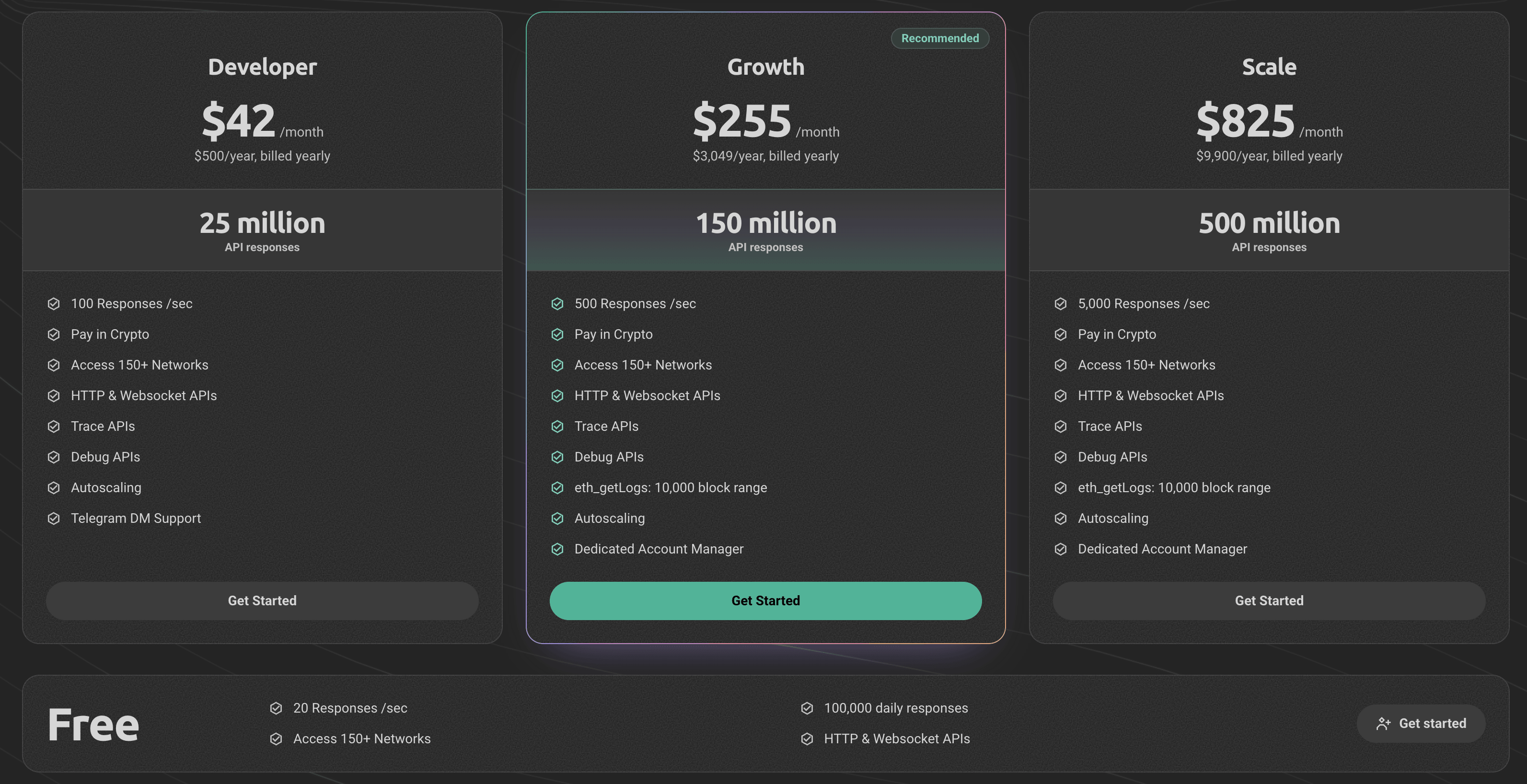
Dwellir’s main distinction is its billing model: one RPC response consumes one API credit, including trace and debug methods. That makes cost modeling straightforward for workloads mixing lightweight reads with heavier operations. Dwellir pricing
Pricing and free tier: Free access includes 100K daily responses at 20 responses/second. Developer includes 25M monthly responses and 100 responses/second for $500 billed annually, displayed as approximately $42/month.
What stands out: Dwellir lists HTTP and WebSocket access, trace and debug APIs, and a separate Unlimited Nodes offering. Response-based billing gives teams a clear starting point for estimating a trace-heavy workload.
Tradeoffs: Response allowances do not remove throughput or query limits. Dwellir lists plan-specific eth_getLogs ranges, and Unlimited Nodes are priced per endpoint. An annual subscription also creates a different commitment from month-to-month billing.
Verdict: Choose Dwellir when response-based pricing fits your workload and the endpoint’s method limits meet your requirements. Plans and limits
4. OnFinality: best for combining RPC with managed node operations
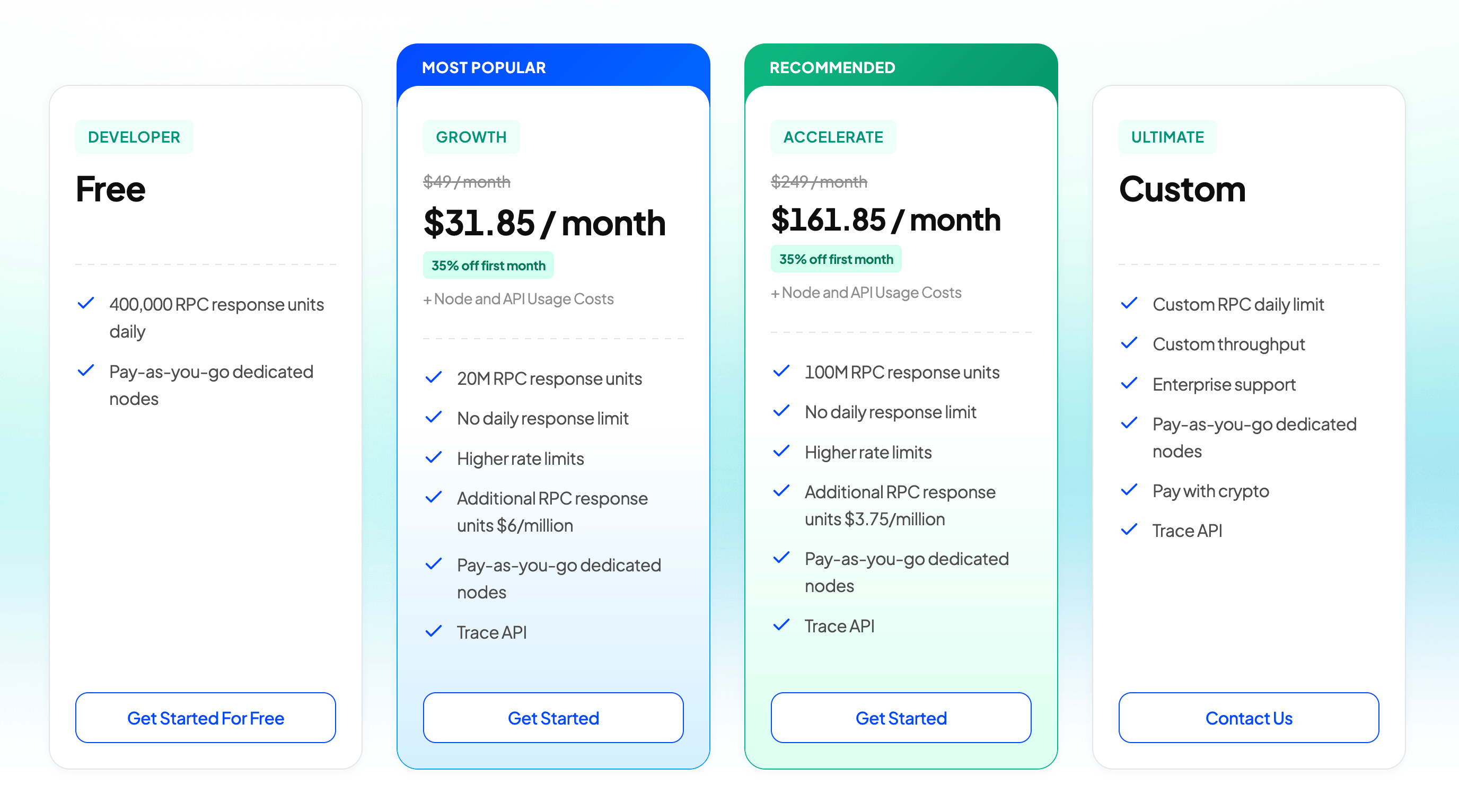
OnFinality combines shared RPC access with dedicated nodes, indexing hosting, and network tooling. That broader operational scope makes OnFinality relevant to teams managing blockchain infrastructure alongside application access. OnFinality services
Pricing and free tier: Developer includes 400K RPC response units daily. Growth costs $49/month with 20M response units and additional usage at $6/million units. Growth lists 200 response units/second per network endpoint.
What stands out: OnFinality includes archive access on supporting APIs across its plans, while paid plans add Trace API access. Dedicated-node usage follows a separate usage-based model.
Tradeoffs: Response units need conversion into your application’s actual traffic. Dedicated-node and additional API usage costs can sit above the subscription price. Archive availability also depends on the particular API.
Verdict: Choose OnFinality when shared RPC and managed node operations belong in the same infrastructure workflow. OnFinality pricing and feature matrix
5. dRPC: best for managed routing across providers
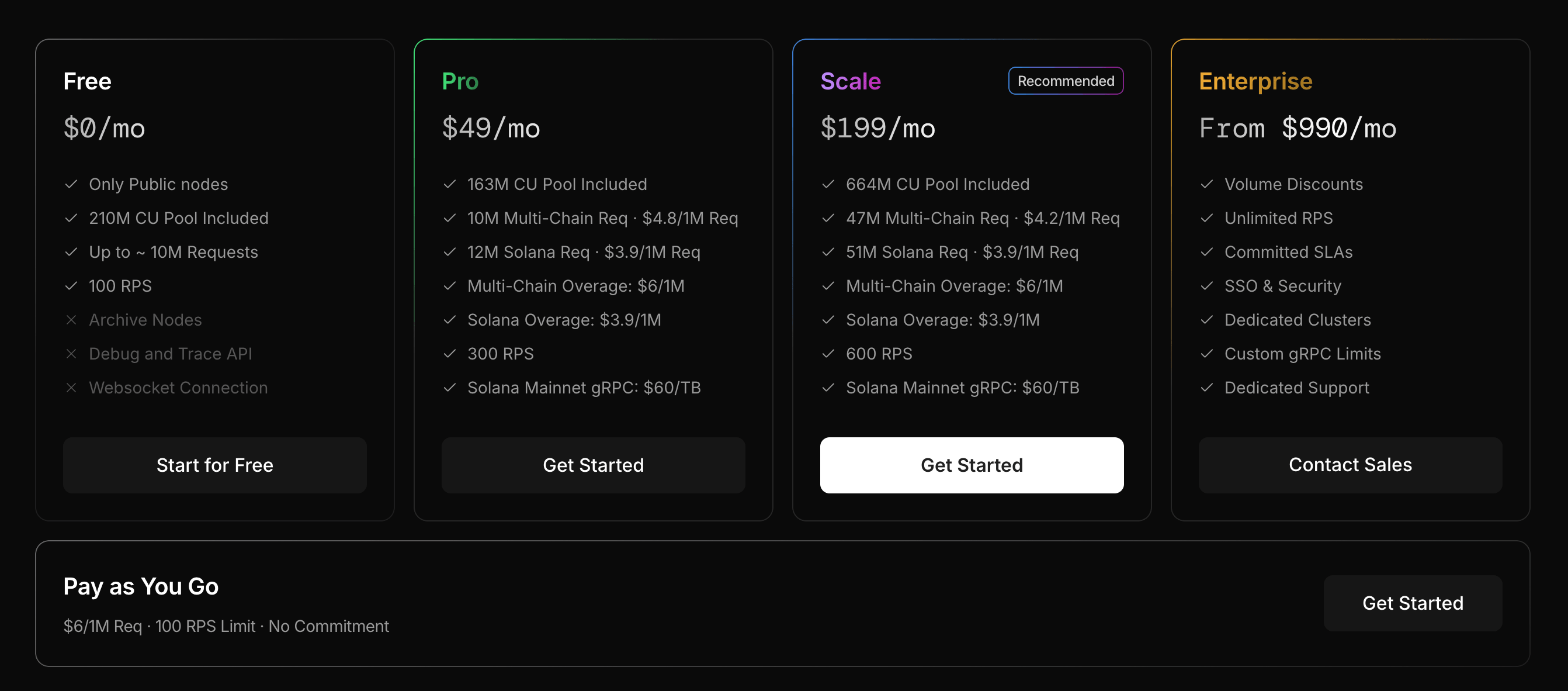
dRPC offers load balancing and fallback across upstream providers. This approach suits teams that want provider diversity without implementing every routing decision in application code. dRPC free and paid access
Pricing and free tier: Free includes 210M compute units per month on public nodes. Pay as You Go prices standard multichain requests at $6/million. Pro costs $49/month with 163M compute units, while Scale costs $199/month with 664M compute units. dRPC plans
What stands out: Paid access combines premium upstream nodes with archive, debug, trace, and WebSocket capabilities. Different paid tiers change the compute-unit cost of standard requests.
Tradeoffs: Free access excludes those paid capabilities. Advertised request rates also need to be read alongside compute-unit throughput, because heavier methods reduce effective requests per second.
Verdict: Choose dRPC when managed upstream diversity is a central infrastructure requirement. Billing and throughput details
6. NOWNodes: best for wallets covering diverse networks
NOWNodes deserves a place on the shortlist for wallet and exchange backends that need access to a varied network catalog. The service combines node access with webhooks, market data, and dedicated options. NOWNodes plans
Pricing and free access: NOWNodes lists Pro at €20/month for 1M requests. Business costs €200/month with 30M requests and 25 API keys. The Start offering lists a 100K-request allowance. NOWNodes published plan comparison
What stands out: NOWNodes provides a request-quota model and a plan structure that expands API keys and included traffic as a backend grows.
Tradeoffs: Start excludes WebSocket connections and access to all nodes. Pro’s 1M monthly requests can be a small allowance for wallets that poll frequently across many accounts and networks. Chain-specific interfaces still need validation.
Verdict: Choose NOWNodes when network coverage and wallet-oriented services match your product. Plan capabilities
7. RouteMesh: best for aggregated RPC routing and billing
RouteMesh aggregates upstream RPC services behind a routing layer with automatic retries and failover. The appeal is operational: teams can consolidate route selection and billing instead of maintaining each upstream integration separately.
Pricing and free access: RouteMesh advertises Economy routes starting at $3/million requests. Pricing depends on the key type, chain, and method, and adjusts with the providers or nodes available for a route. RouteMesh pricing
What stands out: RouteMesh makes routing the core product. That suits applications evaluating several upstream options and seeking a common access layer.
Tradeoffs: The entry rate applies to eligible routes. Budgeting requires the actual route and method prices. Applications using subscriptions, tracing, or specialized methods should test those capabilities through the intended route, including recovery behavior.
Verdict: Choose RouteMesh when consolidating upstream RPC access is more valuable than managing provider relationships individually. RouteMesh routing model
8. Ankr: best for prepaid multichain RPC
Ankr offers Node API access alongside indexed Advanced APIs, with Public, Freemium, Premium, and Enterprise service levels. Ankr service plans
Pricing and free tier: Freemium includes 200M API credits monthly. Premium Pay as You Go requires a $10 minimum deposit. Published HTTPS rates include $0.00002 per EVM request and $0.00005 per Solana request. Ankr pricing
What stands out: Ankr provides a prepaid option for teams that want usage-based access. The published chain-specific request prices also make basic HTTPS cost calculations relatively direct.
Tradeoffs: Public and Freemium access use public rate limits. Premium adds capabilities such as WebSockets and trace/debug access. WebSocket notifications and gRPC have their own billing rules, so streaming workloads need separate estimates.
Verdict: Choose Ankr when prepaid access and its chain-specific pricing fit your traffic. Service capabilities and billing
9. Alchemy: best for RPC plus indexed data and wallet APIs
Alchemy combines Node RPC with token, NFT, transfer, portfolio, webhook, and wallet products. That breadth suits teams seeking both blockchain access and higher-level application data. Alchemy platform
Pricing and free tier: Free includes 30M compute units monthly and a published 15 requests/second rate. Pay as You Go lists $0.52/million compute units. Alchemy also expresses throughput in compute units per second.
What stands out: Alchemy can reduce the amount of indexing and application API infrastructure a team builds. The value depends on which higher-level products the application actually uses.
Tradeoffs: Compute units require method-level conversion before estimating request capacity or cost. Applications adopting vendor-specific data and wallet APIs also take on additional migration work beyond changing an RPC URL.
Verdict: Choose Alchemy when its application APIs save substantial engineering work alongside RPC access. Alchemy pricing and capabilities
10. Quicknode: best for RPC alongside blockchain data infrastructure
Quicknode suits teams evaluating RPC as part of a wider blockchain data stack. The platform offers RPC access, dedicated clusters, and additional data infrastructure products. Quicknode infrastructure
Pricing and free access: The one-month trial includes 10M API credits at 15 requests/second. Build includes 80M credits and 50 requests/second at $49/month on monthly billing. The advertised $34/month equivalent requires annual billing.
What stands out: Quicknode combines endpoint access with a broader platform and a progression toward enterprise infrastructure, custom throughput, and contractual service commitments.
Tradeoffs: API credits require conversion by method. Additional products, metered gRPC data, and overage usage need their own budget. Trial access also has a defined duration.
Verdict: Choose Quicknode when RPC and blockchain data delivery are closely connected requirements. Quicknode plans and limits
RPC pricing compared: convert units before comparing plans
A provider’s headline allowance becomes useful only after translating it into your workload.
Consider these calculations using the published rates above:
| Example workload | Calculation | Result |
| Chainstack Growth using only one-unit Global Node requests | 20M included request units ÷ 1 | 20M included requests |
| Chainstack Growth using only two-unit archive requests | 20M included request units ÷ 2 | 10M included requests |
| Ankr Premium processing 1M EVM HTTPS requests | 1M × $0.00002 | $20 in request charges |
| Ankr Premium processing 1M Solana HTTPS requests | 1M × $0.00005 | $50 in request charges |
These calculations show why request volume alone is insufficient: node mode, chain, and billing definition change the result. Sources: Chainstack request units and Ankr request prices.
For your own comparison, replay a representative method mix and include subscription fees, overages, notifications, retries, and separately priced products.
How to test RPC providers before migrating
Use the same workload and test conditions for each candidate:
- Capture representative methods. Include common reads, large responses, historical queries, and subscriptions.
- Run from production regions. Match your application’s connection reuse, timeouts, and concurrency.
- Test normal and peak traffic. Record throttling and recovery after bursts.
- Validate returned data. Count JSON-RPC failures, stale responses, missing events, and timeouts.
- Measure recovery. Disconnect subscriptions and exercise fallback paths. Check whether the application restores state and fills event gaps.
- Calculate the resulting bill. Convert the observed traffic into each provider’s units.
For trading systems, add transaction submission and inclusion tracking. For indexers, include backfills and historical state. For wallets, test polling alongside user-driven bursts.
Get started with Chainstack
Create a Chainstack account, create a project, and deploy an Ethereum Mainnet Global Node. Copy the HTTPS endpoint from the node’s access details. Deployment guide
Set the endpoint in your local environment, then request the latest block number:
export CHAINSTACK_RPC_URL='YOUR_CHAINSTACK_HTTPS_ENDPOINT'
curl --fail-with-body --silent --show-error \
  "$CHAINSTACK_RPC_URL" \
  --header 'Content-Type: application/json' \  --data '{"jsonrpc":"2.0","id":1,"method":"eth_blockNumber","params":[]}'


A successful response contains the block number as a hexadecimal value. Next, run your application’s actual methods and measure behavior under representative load.
Which RPC provider should you choose?
- Choose Chainstack for multichain production infrastructure with several deployment options.
- Choose Tatum or Alchemy when application APIs are a major part of the buying decision.
- Choose Dwellir when response-based billing suits a mixed or trace-heavy workload.
- Choose OnFinality when RPC sits alongside managed node operations.
- Choose dRPC or RouteMesh when upstream routing is the central requirement.
- Choose NOWNodes or Ankr when network coverage and their billing models fit your backend.
- Choose Quicknode when RPC belongs within a broader data infrastructure stack.
For a general production shortlist, start with Chainstack and compare the alternatives against the methods, throughput, historical coverage, and recovery behavior your application needs.
Frequently asked questions
What is an RPC provider?
A remote procedure call (RPC) provider operates or routes access to blockchain nodes. Applications use those endpoints to read blockchain data, execute read-only contract calls, and submit signed transactions.
Which RPC provider is fastest?
Performance depends on the chain, method, client region, concurrency, and response size. Test p95 and p99 latency alongside valid-response rate and chain-head freshness. A simple block-number request cannot establish performance for historical queries or streaming.
Which RPC providers offer free access?
Chainstack, Tatum, Dwellir, OnFinality, dRPC, Ankr, and Alchemy list free access options. Quicknode lists a one-month trial, while NOWNodes lists a Start allowance. Compare reset periods, method access, and throughput alongside the headline quota in the comparison table above.
Are compute units the same as requests?
Compute units are provider-defined billing measures. A request may consume different numbers of units depending on its method, chain, or service. Convert your method mix into each provider’s units before comparing allowances.
Do I need archive RPC?
Archive RPC is relevant when your application needs historical state beyond a node’s retained state, such as a contract call at an old block. Old blocks, receipts, historical state, and tracing are separate capabilities. Check the methods your workload requires. Archive-node guide
Should I use more than one RPC provider?
Multiple providers can improve resilience when the application handles compatibility, state differences, retries, and subscription recovery correctly. A secondary endpoint helps only when the fallback path works under failure conditions.
Do I need a dedicated node?
Dedicated infrastructure becomes relevant when isolation, customization, or sustained resource demand justifies the operational cost. Evaluate shared RPC first against your actual workload, then compare dedicated options when a measured constraint requires them.