


GEN 2.0 is live on every chain on Chainstack Global Nodes. Every request now takes a shorter path: the extra proxy hop that used to add roughly 15 to 50 ms, depending on location, is gone. On Solana in Frankfurt, for example, median getLatestBlockhash latency dropped from about 17 ms to about 2 ms. Your endpoint URLs and the API stay the same.
At a glance
- One hop fewer, on every chain. Your request goes straight to our regional gateway and the node, with no edge proxy in between.
- Nothing to reconfigure. Same hostnames, same API.
- One deliberate trade-off. Failing over a whole region now relies on DNS, so it takes seconds, not an instant.
What changed?
The first generation of Global Nodes put a Cloudflare Workers edge in front of every node. It did the geo-routing, and it also sat in the path of every single request.
GEN 2.0 moves geo-routing to DNS load balancing. Cloudflare now only resolves your hostname to the nearest healthy region. After that, your request goes straight to our regional gateway and the node. Cloudflare is never in the data path, only in the DNS lookup.

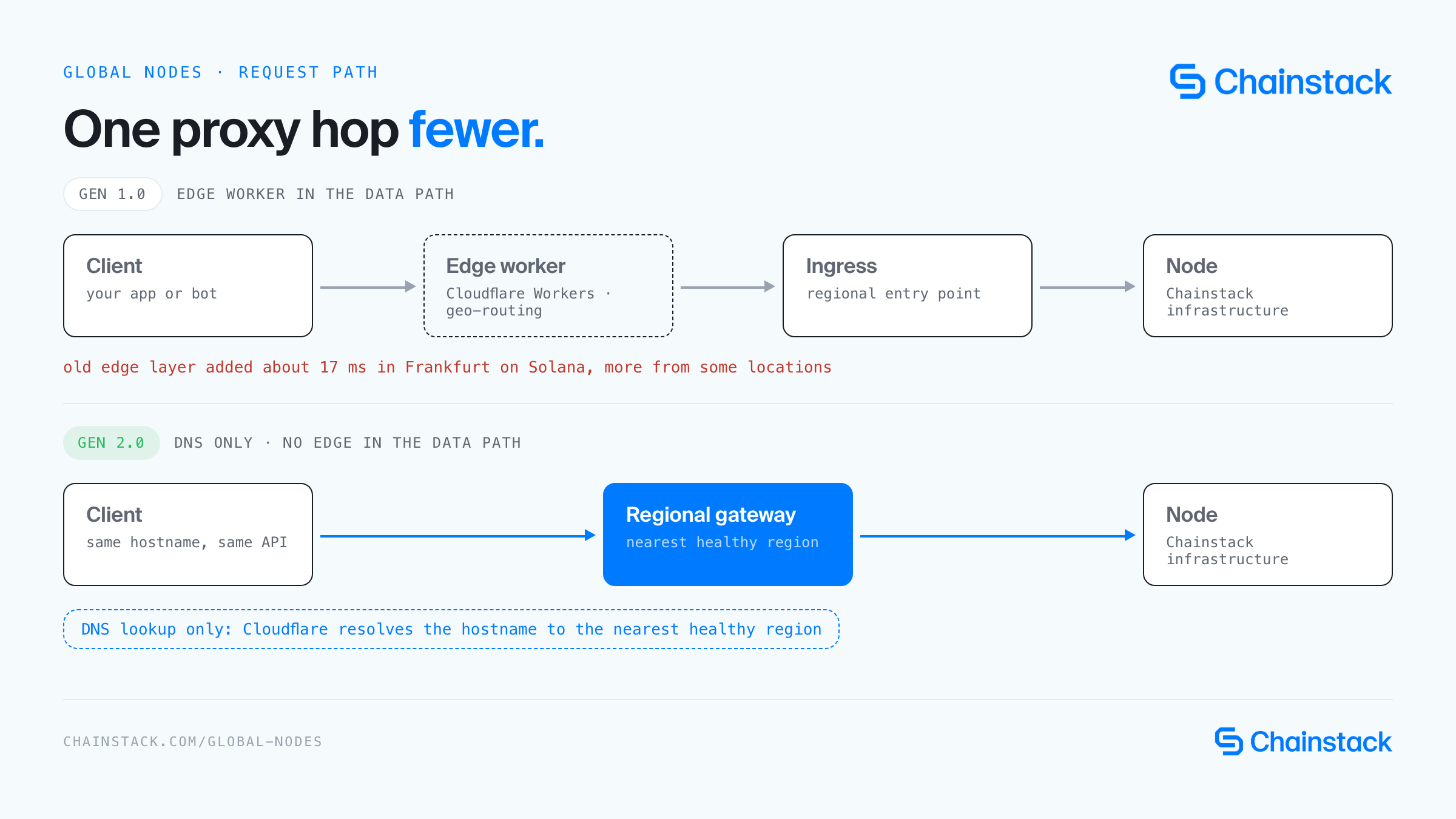
| What changes | GEN 1.0 | GEN 2.0 |
|---|---|---|
| Geo-routing | Cloudflare Workers | Cloudflare DNS load balancing |
| Request path | Client, edge worker, ingress, node | Client, regional gateway, node |
| Extra proxy hop on every request | Yes | No |
| Who sees your RPC traffic | The edge layer, then Chainstack | Only Chainstack |
What does it mean for you?
- Faster responses on every chain. One less hop on every request. The old edge layer added roughly 15 to 50 ms depending on location, and that cost is now gone. On Solana in Frankfurt it was about 17 ms. Your gain depends on where you are and which region is nearest.
- No protocol conversion at the edge. The edge converted gRPC traffic between HTTP/2 and HTTP/1 and back, which could drop or degrade long-lived streams, especially on reconnect. That conversion is gone.
- Better support. We see our own traffic from start to finish, so we find and fix problems sooner.
It is not only Solana. Robinhood Chain and Arc launched on GEN 2.0 from day one, and Base moved over from GEN 1.0 in late August. Every chain on Global Nodes now runs on it.
What does GEN 2.0 look like on Solana?
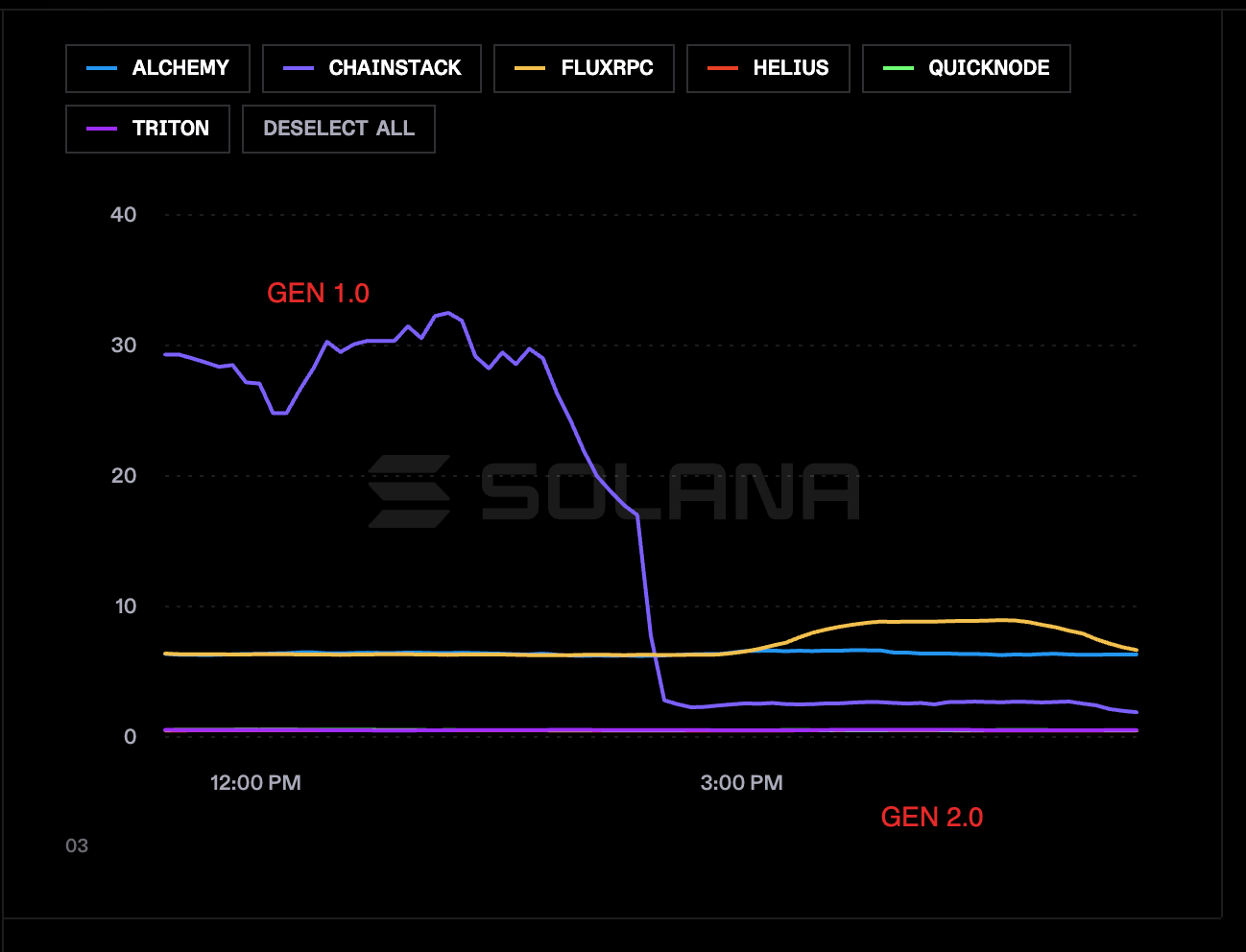
Solana is the example with public data. Solana moved to GEN 2.0 in late August 2026. In Frankfurt, median getLatestBlockhash latency dropped from about 17 ms to about 2 ms after the switch. The public Solana RPC dashboard shows the step.

📖 Going deeper on Solana. GEN 2.0 is one part of a larger Solana rebuild: method-aware routing,
getProgramAccountslimits by program size, a steadier shred feed, and more. Read what changed for Solana RPC on Chainstack in 2026, with the numbers.
What is the trade-off?
One thing changes, and we chose it on purpose: failover between whole regions. With the old edge in the path, a region could be swapped out instantly. With DNS, a full-region failover now takes seconds instead of happening instantly.
Failover between nodes inside a region is unchanged: our smart proxy still routes around a single bad node. Full-region outages are rare, and the latency saved on every request is worth more.
How did we do it?
The team spent several months rebuilding each layer behind the request path: the network, the edge gateway and the Kubernetes platform. Then we moved chains one at a time on live production traffic, checking each one before starting the next. There was no big-bang cutover.
What do you need to do?
If you use Global Nodes, nothing. The hostnames and the API are the same, and there is nothing to reconfigure.
If you use regional Trader Nodes, Chainstack is retiring them on December 1, 2026, and Global Nodes take their place on every chain they support. Global Nodes now take the shorter path described above, so moving off regional nodes no longer costs you an extra proxy hop. We will email affected customers before the switch-off and help with the move.
What is next?
We are rebuilding our uptime and response-time dashboards on the new observability stack and finishing the last of the cleanup, including shutting down the remaining Workers. We will keep publishing improvements the same way, with the numbers.
Ready to try it? Deploy a Global Node in seconds on the free Developer plan.
FAQ
No. The endpoint hostnames and the API are unchanged. There is nothing to reconfigure.
Yes. Global Nodes keep the same hostname as before, for example solana-mainnet.core.chainstack.com.
Every chain on Chainstack Global Nodes, including Ethereum, Solana, Base, Arbitrum, BNB Smart Chain, Polygon, TON, TRON, Bitcoin, Sui and XRP Ledger. See the full list of supported networks.
Only the DNS lookup that points you to the nearest healthy region. After that, your request and its response travel directly between you and our infrastructure.
There is no edge execution layer in the request path anymore. DNS sends you to the nearest healthy region, and the request goes straight to our gateway and the node, removing a proxy hop that used to sit on every call.
DNS steers new connections to another healthy region, which takes seconds rather than happening instantly. If a single node inside a region fails, the smart proxy routes around it.