AI-ready infrastructure
 Refer and earn


 Ethereum
 Hyperliquid
 Solana
 Arbitrum
 BNB Smart Chain
 Base
Base Polygon
 TRON
TRON Sui
Sui Robinhood


Solana RPC for fintech and payments: compliance, latency, and architecture

Why Solana is becoming a payment rail
Solana processed 33 billion non-vote transactions and $11.7 trillion in stablecoin transfers in 2025. For fintech teams evaluating payment infrastructure, those numbers are less a headline and more a signal that the settlement volume is real, the liquidity is deep, and the network is being used at scale.
The harder question is not whether Solana can handle payment volume at all, but whether your access to it can. Every balance query, transaction submission, and confirmation check routes through an RPC node, and while the L1 keeps getting faster through successive protocol upgrades, an underpowered or congested RPC node does not slow down Solana. It slows down your application, and in a payment context that distinction is the difference between a reliable system and one that fails under load.
Latency, reliability, compliance data access, and finality guarantees are not abstract properties of the network. They are properties of the RPC layer you build on, and getting that layer right is what the rest of this guide is about.
How Solana RPC works (primer for fintech builders)
A Solana RPC node is the interface between your application and the network. It handles the full range of read and write operations: querying account balances, submitting transactions, fetching block data, and subscribing to account or program events via WebSocket. All of this runs over JSON-RPC 2.0, a stateless request-response protocol, which means every call is independent and your application is responsible for managing state and retry logic.
For payment systems, two failure modes matter and they require fundamentally different handling:
- Dropped before landing: the transaction is submitted but expires before a validator includes it, either because the blockhash it was built on is no longer valid or because it was dropped during network congestion. These can be safely resubmitted with a fresh blockhash.
- Landed but failed: the transaction reaches the chain and executes, but reverts due to insufficient funds, a slippage breach, or a program error. These cannot be blindly resubmitted without first diagnosing the failure.
Conflating the two is one of the more common sources of bugs in payment logic, and getting the distinction right is foundational to building a reliable retry and reconciliation system.
On the infrastructure side, public RPC endpoints are free but come with hard rate limits, no uptime guarantees, and no SLA of any kind. For internal tooling or low-stakes reads that is acceptable, but any production payment system that requires consistent latency, high availability, and reliable transaction landing needs a private, dedicated node where throughput is guaranteed and capacity is not shared.
Latency: what “fast” actually means in production
Average latency is usually the number that gets compared when evaluating RPC providers. It is also the least useful one. Payment systems do not break at the average; they break at the tail, and the metric that actually reflects production reliability is P95, the latency your system experiences on its worst requests out of every hundred. Before tail latency though, slot lag is the more fundamental issue to understand.
Solana produces a new block roughly every 400 milliseconds, and a node that is 2-3 slots behind the network tip is serving data that is over a second old. In a payment context that means stale balance checks, outdated account states, and blockhashes that may already be close to their ~151 slot (~60 second) expiry window before your transaction is even constructed.
Both problems trace back to the same infrastructure decision, which is node tenancy. When another tenant’s workload saturates shared CPU, memory bandwidth, or network I/O, your requests queue behind theirs with no isolation guarantees. Dedicated bare-metal nodes with NVMe storage eliminate that variable entirely, keeping read latencies under 5ms even during peak network activity.
Chainstack’s dedicated nodes are provisioned on bare-metal infrastructure with NVMe storage, providing guaranteed P95 and P99 latency boundaries that hold under heavy payment load rather than degrading when shared capacity is saturated. For payment systems where a single slow confirmation check can cascade into a failed user-facing transaction, that consistency is not a nice-to-have.
The protocol is moving fast: what Agave 4.0 and Alpenglow mean for fintech
Solana’s core infrastructure is changing significantly in 2026, and fintech teams building payment systems need to architect with that trajectory in mind.
Agave 4.0, recommended for mainnet validators in May 2026, ships three changes that directly affect RPC performance. QUIC-only TPU ingestion removes UDP as a transaction submission path, which tightens delivery guarantees and reduces the surface area for dropped transactions under load. Wincode serialization replaces bincode on hot paths, eliminating a class of small serialization stalls that compound at high throughput. Async PoH and Ed25519 verification moves signature checking off the replay thread entirely, cutting mean replay time from roughly 130ms to around 50ms and improving P95 RPC response by 2-9ms across the board. For payment systems where tail latency is the failure mode that matters, that is a meaningful reduction.
Running alongside Agave 4.0 is SIMD-0286, which raises the per-block compute limit from 60 million to 100 million compute units, a 66% increase in block capacity. More headroom per block means fewer transactions get deferred during congestion spikes, which directly reduces the rate of payment failures during peak load.
The larger shift is Alpenglow, Solana’s full consensus rewrite targeting Q3/Q4 2026. It replaces TowerBFT and Proof of History with two new components: Votor, a lightweight vote aggregation layer that finalizes blocks in one or two rounds, and Rotor, a new block propagation engine. The projected finality time is roughly 150ms, down from the current 12+ seconds, which fundamentally changes the tradeoff between confirmed and finalized commitment levels that payment settlement logic currently depends on.
RPC architecture patterns for payment systems
Streaming over polling
For real-time payment workloads, how your system receives data matters as much as where it gets it from. JSON-RPC polling introduces a request-response cycle on every check, and WebSocket subscriptions, while push-based, still carry 200-400ms of latency in practice. Neither is fast enough for payment-grade event detection.
The production standard is Yellowstone gRPC, Solana’s Geyser-based streaming interface. It delivers account and transaction updates in under 100ms, but the more important property is when those callbacks fire. Geyser callbacks execute before data is written to disk, which means your system receives the earliest possible signal on an incoming transaction, ahead of anything available through standard RPC methods.
Here is what that looks like in practice using Chainstack’s Yellowstone gRPC endpoint, subscribing to a payment program and submitting transactions with explicit commitment levels rather than accepting client defaults.
const { default: Client } = require("@triton-one/yellowstone-grpc");
const { Connection, sendAndConfirmTransaction } = require("@solana/web3.js");

const GEYSER_ENDPOINT = "CHAINSTACK_GEYSER_URL";
const GEYSER_TOKEN = "CHAINSTACK_GEYSER_TOKEN";
const RPC_ENDPOINT = "CHAINSTACK_RPC_URL";
const PAYMENT_PROGRAM_ID = "YOUR_PAYMENT_PROGRAM_ID";

// Subscribe via Geyser at 'confirmed' so your compliance layer
// sees transactions before finalization
const client = new Client(GEYSER_ENDPOINT, GEYSER_TOKEN);
const stream = await client.subscribe();

stream.write({
    transactions: {
        payments: {
            vote: false,
            failed: false,
            accountInclude: [PAYMENT_PROGRAM_ID]
        }
    },
    // Detect early, screen early -- fund release is gated separately
    commitment: "confirmed",
});

stream.on("data", async (data) => {
    if (data.pong) return;
    const { signature } = data.transaction.transaction;
    await screenTransaction(signature);
});
// Gate actual fund disbursement on 'finalized' (31+ slots)
// Never rely on the client default here
async function sendPayment(transaction, signers) {
const connection = new Connection(RPC_ENDPOINT, "finalized");
return sendAndConfirmTransaction(connection, transaction, signers, {
commitment: "finalized",
preflightCommitment: "confirmed",
});
}The subscription uses confirmed so the compliance layer sees transactions as early as possible. sendPayment then explicitly sets commitment: “finalized” to ensure fund release only happens after 31+ slots. That separation between detection commitment and disbursement commitment is what makes the pattern safe for financial workloads. For the full implementation including ping handling and stream error management, see the Chainstack Yellowstone gRPC docs.
Node strategy
Three infrastructure decisions define the reliability floor for any financial workload on Solana:
- Dedicated nodes over shared clusters for the isolation and consistency reasons covered in the latency section
- Geographic co-location near active Solana validators to reduce the physical distance between your node and the network tip and keep slot lag as low as possible
- Multi-region failover because a single node going down during peak hours is an incident in any other payment infrastructure context and should be treated the same way here
Within that setup, routing logic matters. Read requests should go to whichever node has the lowest current slot lag, and write requests should route to the node closest to the current block leader. Getting either wrong means serving stale account state or submitting transactions with unnecessary additional hops before they reach the validator responsible for the next block.
Chainstack provides dedicated bare-metal nodes with global geographic coverage and multi-region deployment to meet all three of those requirements, and natively supports Yellowstone gRPC feeds so the streaming layer required for real-time compliance screening and transaction enrichment is available without additional middleware or custom integration work.
Commitment levels: the finality decision that matters most for fintech
Every RPC response in Solana is scoped to a commitment level, and for payment systems, choosing the wrong one is a silent risk that only surfaces during edge cases.
Solana offers three levels:
- processed: the node has seen the transaction but it has not been voted on; can be rolled back
- confirmed: roughly two-thirds of validators have voted on the block; fast but not final
- finalized: 31+ slots have passed (~12 seconds) and the block is permanently committed to the chain
For large fund movements, finalized is the only safe choice. A confirmed transaction sits on a block that can still be orphaned if the cluster rolls back a fork, which is rare but not impossible and not a risk profile that belongs in a payment disbursement flow.
For high-frequency or low-value flows, confirmed is a reasonable tradeoff, cutting settlement signaling from ~12 seconds down to roughly 400-800ms. But that should be an explicit decision made at the product level, not an inherited RPC default. Most clients default to confirmed without surfacing that choice to the developer, which means many payment systems are operating at a lower finality guarantee than their authors intended.
With Alpenglow targeting ~150ms finality on mainnet in Q3/Q4 2026, this tradeoff compresses significantly. The gap between confirmed and finalized effectively collapses, which will change how settlement confirmation logic needs to be structured once it ships.
Compliance requirements for fintech on Solana
Operating a payment system on Solana does not create a regulatory carve-out. Under the “same risk, same regulation” principle now applied by FATF, FinCEN, and EU regulators, blockchain payment processors carry the same AML/KYC obligations as traditional financial institutions, including BSA compliance in the US, EU Anti-Money Laundering Directive requirements in Europe, and FATF Travel Rule obligations for virtual asset transfers above threshold.
That means AML screening, OFAC and sanctions list checks, and transaction monitoring cannot be treated as an application-layer concern bolted on after the fact. They need to be integrated at the data pipeline level, against live transaction streams, before funds move. Retroactive compliance on a settled, immutable ledger is not compliance.
On the infrastructure side, any RPC provider handling regulated payment data should hold SOC 2 Type II and ISO 27001 certifications at minimum. SOC 2 Type II covers the operational controls around data security and availability over time, while ISO 27001 provides the formal information security management framework that regulators and auditors expect to see. Beyond certifications, the provider needs to support ledger access and historical data retention sufficient for audit trails and transaction dispute resolution, the specifics of which vary by jurisdiction but are non-negotiable in any regulated context.
Transaction monitoring and on-chain data pipelines
Real-time AML monitoring on Solana requires more than periodic batch scans. Payment processors need continuous wallet risk scoring and suspicious activity detection running against live transaction streams, which means the compliance pipeline has to be integrated directly into the data ingestion layer, not sitting downstream of it.
The standard architecture for this is Geyser-based: a Yellowstone gRPC stream feeds raw transaction data into an enrichment layer that parses instruction data, resolves account ownership, and structures the output for downstream processing. The critical property of this architecture is timing. By the time a transaction reaches confirmed status, your compliance layer has already seen it.
One structural advantage Solana provides here is the immutability of on-chain settlement. Every transaction that lands is permanently recorded and independently verifiable, which means compliance teams can reconstruct and audit the full transaction history without depending on a third-party ledger or custodial record. For regulated entities that need to demonstrate a complete, tamper-evident audit trail, that is a meaningful operational property.
Architecture reference: production payment stack on Solana
Core data path
A production payment stack on Solana starts with a private dedicated RPC node feeding a Yellowstone gRPC stream. That stream is the source of truth for incoming transaction events, account state changes, and program activity. From there, data moves through a transaction enrichment layer that parses instruction data and resolves account context, then into compliance screening, and finally into commitment-level gating logic that controls when funds are actually released.
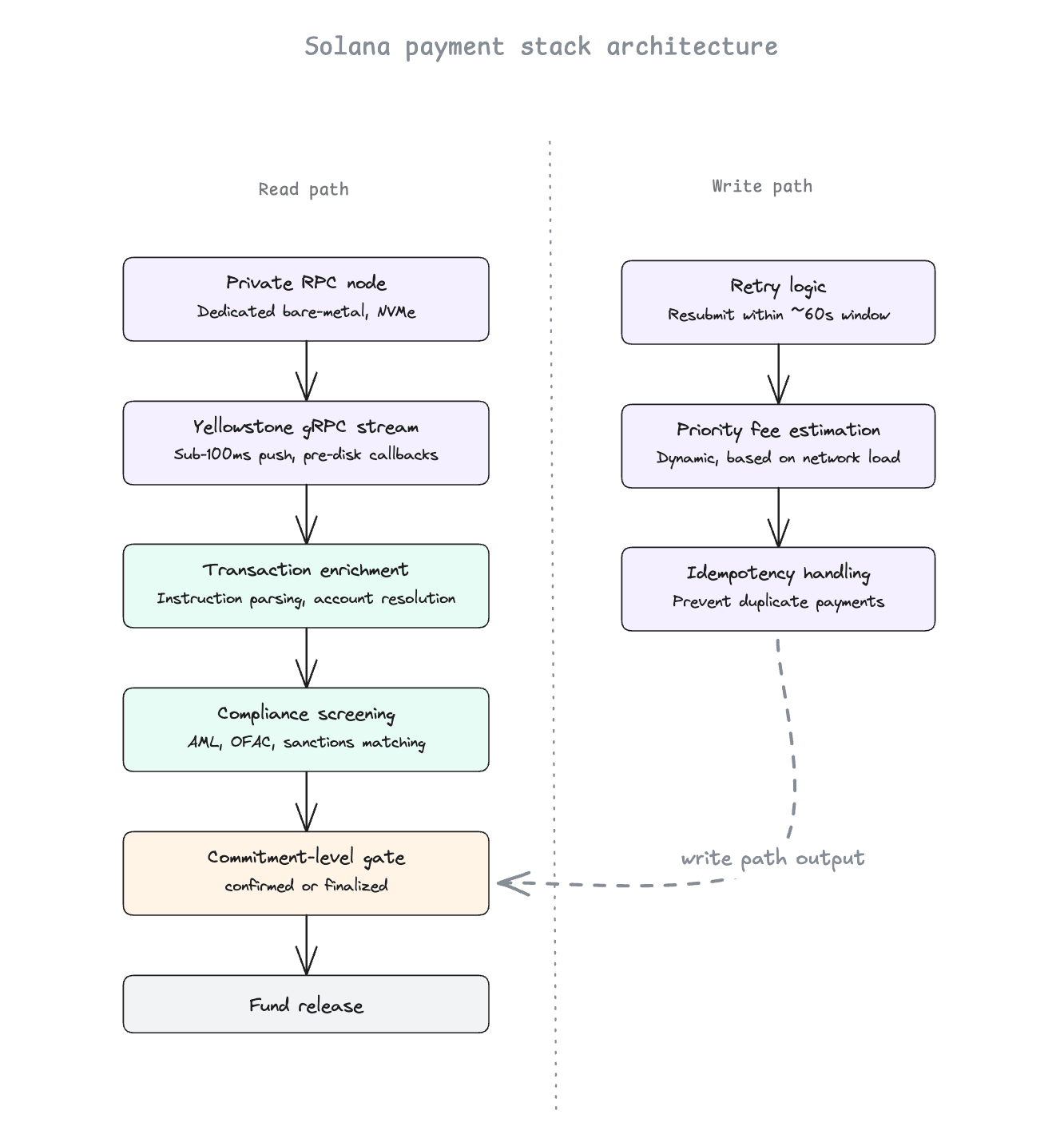
The write path requires equal care. Retry logic must be scoped to the blockhash validity window, where dropped transactions need to be detected and resubmitted with a fresh blockhash within the ~60-second expiry, after which the original is permanently invalid. Priority fees should be estimated dynamically against current network conditions, since underfunded transactions are the first to be dropped during congestion. And idempotency handling is essential to ensure a resubmitted transaction cannot result in a duplicate payment if the original landed without being detected.
Settlement confirmation logic
Commitment-level gating should be explicit in your settlement service, not inherited from RPC client defaults. In practice:
- Gate high-value disbursements on finalized (31+ slots, ~12 seconds) where rollback risk is not acceptable
- Reserve confirmed for flows where settlement speed is the explicit priority and the value at risk justifies the tradeoff
Most RPC clients default to confirmed silently. That default is a product decision with real financial risk implications and should be made deliberately, not by omission.
Choosing an RPC provider
Evaluating RPC providers for a payment context requires different criteria than a standard developer workload, and several of the differences are not obvious from provider documentation alone.
Latency SLAs are the first thing to pressure-test. Most providers publish average response times, which are not meaningful for payment systems. What matters is P95 and P99 latency under realistic transaction load, and whether those figures are contractually guaranteed or just benchmarked under ideal conditions. Uptime guarantees should be 99.99% or higher and written into a contractual SLA. A provider that lists reliability figures on a marketing page without backing them with an SLA is not making a commitment.
On the infrastructure side, the word “dedicated” needs scrutiny. Some providers use it to mean a reserved slice of shared hardware rather than a true bare-metal node, and that distinction matters under payment load. For regulated workloads, also confirm SOC 2 Type II and ISO 27001 certifications upfront, along with ledger access and historical data retention policies, since those are what your compliance and legal teams will ask for first.
| Criteria | What to evaluate |
|---|---|
| Latency SLA | P95/P99 guarantees under load, not average benchmarks |
| Uptime | 99.99%+ with a contractual SLA |
| Streaming | Native gRPC and Yellowstone/Geyser support |
| Node type | Truly dedicated bare-metal vs. partitioned shared hardware |
| Compliance certifications | SOC 2 Type II and ISO 27001 |
| Data retention | Ledger access and historical data for audit trails |
| Pricing | Actual throughput ceiling under realistic payment load |
| Geographic coverage | Co-location proximity to active Solana validator clusters |
Pricing models require careful analysis. Per-request credit systems, compute unit pricing, and flat-rate plans each create different throughput ceilings that only become visible under load. Benchmark against realistic payment traffic before committing to any pricing tier.
Conclusion
The RPC layer has historically been treated as a developer convenience, something you configure once and move on from. For fintech and payment systems built on Solana, that framing no longer holds. The decisions made at the RPC layer, which node infrastructure to run, how to stream and process transaction data, which commitment level gates fund release, and whether compliance screening is integrated or bolted on, are the decisions that determine whether a payment system is reliable, auditable, and defensible under regulatory scrutiny.
The architectural direction is clear: streaming over polling, dedicated nodes over shared clusters, and explicit commitment-level logic over inherited defaults. Those are not optimizations. They are the baseline for any system moving real funds.
What makes the current moment interesting is that the underlying protocol is shifting in ways that will change the calculus. Agave 4.0 is already on mainnet, tightening latency and expanding block capacity. Alpenglow, if it ships on its Q3/Q4 2026 timeline, will compress finality from 12 seconds to roughly 150ms and rewrite the assumptions behind settlement confirmation logic that most teams are building on today. The teams that understand those changes at the infrastructure level, rather than waiting to react to them, will be the ones positioned to build payment systems that hold up as Solana’s role in global finance continues to grow.
Chainstack provides the infrastructure layer that payment-grade Solana workloads require: dedicated bare-metal nodes with P95/P99 latency guarantees, native Yellowstone gRPC streaming for real-time compliance pipelines, SOC 2 Type II and ISO 27001 certification, and a 99.99% uptime SLA — backed contractually, not just listed on a marketing page. If you’re building a payment system on Solana, deploy your node on Chainstack and get the infrastructure right before you need it under load.
FAQ
Use finalized for any fund release. A confirmed transaction can still be orphaned if the cluster forks — rare, but unacceptable for a payment disbursement flow. Use confirmed only for detection and screening, where no funds are moving. Never inherit either level from the RPC client default.
A dropped transaction expired before reaching the chain — usually because the blockhash became invalid or the transaction was deprioritized during congestion. Safe to resubmit with a fresh blockhash. A failed transaction landed on-chain and reverted due to a program error, insufficient funds, or slippage. Resubmitting without diagnosing the cause will produce the same error. Conflating the two is one of the most common bugs in payment retry logic.
WebSockets are push-based but still carry 200–400ms of latency and require stitching account state from multiple calls. Yellowstone gRPC streams events directly from validator memory before data hits disk — sub-50ms, typed, no extra parsing needed. For compliance pipelines that need to screen transactions before finalization, gRPC is the only viable option. See Real-time Solana data: WSS vs Yellowstone gRPC Geyser.
SOC 2 Type II and ISO 27001 at minimum. SOC 2 Type I is a point-in-time snapshot and won’t satisfy most enterprise due diligence processes — confirm Type II specifically. Also request the provider’s data handling attestation and contractual SLA before onboarding.
Today’s settlement logic is built around an ~12-second gap between confirmed and finalized. Alpenglow targets ~150ms finality, which effectively collapses it. Systems with explicit finalized gating benefit automatically. Systems using confirmed as a speed optimization will need to reassess whether that tradeoff is still necessary. Expected on mainnet Q3/Q4 2026.
Core: sendTransaction, getTransaction, getAccountInfo, getSignaturesForAddress, and getLatestBlockhash. For real-time event detection, replace polling with a Yellowstone gRPC subscription. For priority fee estimation during congestion, use getRecentPrioritizationFees — see the Chainstack guide.
Additional resources