AI-ready infrastructure
 Refer and earn


 Ethereum
 Hyperliquid
 Solana
 Arbitrum
 BNB Smart Chain
 Base
Base Polygon
 TRON
TRON Sui
Sui Robinhood


Solana RPC for payment processors: best providers and infrastructure guide 2026

When Visa settled $3.5 billion in annualized USDC volume through Solana by December 2025 and PayPal expanded its PYUSD cross-border remittance pilot in March 2026, choosing the right Solana RPC provider moved from a developer concern to a business-critical decision. USDC transfer volume on Solana surpassed Ethereum’s in late December 2025, and Solana now processes roughly 35% of all on-chain stablecoin transfers globally by transaction count.
The 2026 inflection point for payment processors is compliance and scale converging simultaneously. The GENIUS Act in the US and MiCA in Europe are now in effect, meaning regulated payment processors need audited vendor attestation — not just uptime charts — from their RPC infrastructure. At the same time, stablecoin supply on Solana tripled between end-2024 and early 2026 to over $15 billion, and the transaction volumes that follow demand infrastructure that holds up under load, not just during office-hours demos.
This guide compares six Solana RPC providers evaluated specifically through a payment-processor lens: settlement certainty, infrastructure isolation, compliance posture, and the RPC methods that drive real-time payment flows.
💡 Already using Chainstack? Jump straight to the Solana tooling docs or deploy a dedicated payment endpoint in minutes.
Payment processing on Solana: RPC requirements
Payment workloads on Solana are not like DeFi trading or NFT minting. The latency budget is not sub-50ms. It is the window between a customer clicking “pay” and seeing “confirmed”: 1–3 seconds for acceptable consumer UX. Miss it and you are either holding the payment pending (bad customer experience) or releasing goods before finality (financial risk). The RPC layer is where that budget is spent or burned.
Latency and finality requirements
Solana produces blocks every 400 milliseconds. Transactions reach confirmed status (2/3 validator consensus) in 1–2 seconds and finalized status in approximately 13 seconds. For most consumer payments, confirmed is sufficient and appropriate. For high-value settlement or regulated flows (wire-equivalent transfers, payroll disbursements, any transaction where rollback risk cannot be accepted), finalized is required.
Production latency is not network latency. It is end-to-end RPC latency under load. Shared public endpoints frequently deliver 500ms–2+ seconds of p95 latency during Solana congestion events. A payment processor handling thousands of concurrent settlement requests cannot tolerate that variance. The benchmark that matters is p95 latency under burst traffic from your target deployment region — not the average latency figure that most providers publish in their marketing copy.
Throughput requirements
Payment processors exhibit burst traffic patterns: settlement windows, payroll runs, and reconciliation batches all generate request spikes that can be 10x or more above baseline. A shared endpoint that handles your average load may fail exactly when you need it most. Dedicated infrastructure — isolated RPC nodes or flat-rate throughput tiers — is the only way to guarantee headroom during those peaks without renegotiating capacity in real time.
Key RPC methods for payment processors
The methods below form the core of any Solana payment integration. Understanding their behavior under load determines which provider tier you actually need.
| Method | Purpose | Payment-processor concern |
|---|---|---|
getLatestBlockhash | Obtain a valid blockhash for transaction construction | Blockhashes expire after ~150 slots (~60 seconds). Stale hashes cause “Blockhash not found” failures during high-latency broadcast |
simulateTransaction | Dry-run a transaction without committing | Catch insufficient funds and program errors before paying fees on a doomed transaction |
sendTransaction | Broadcast a signed transaction to the network | With skipPreflight: false, the provider runs simulation first; skip only when you have already simulated |
getSignatureStatuses | Poll confirmation status for one or more signatures | The primary confirmation polling method; must tolerate high call frequency without rate-limit degradation |
getTokenAccountsByOwner | Retrieve all USDC/USDT token accounts for a wallet | Called on every new merchant onboard; can return large payloads for wallets holding many token types |
getAccountInfo | Fetch raw account data including mint address | Critical for USDC mint validation — any token can claim the name “USDC,” so always verify the mint address matches the canonical USDC mint before crediting a merchant |
getBalance | SOL balance lookup for a public key | Verify the payer has enough SOL to cover transaction fees before attempting to send |
WebSocket subscriptions — signatureSubscribe and accountSubscribe — are the preferred alternative to polling getSignatureStatuses at high frequency. A single WebSocket connection surfaces the confirmation event within ~100ms of validator consensus. At 10,000 concurrent payments, switching from 500ms polling intervals to WebSocket subscriptions eliminates millions of redundant RPC calls per hour and removes the thundering-herd effect of synchronized polling bursts.
⚠️ Finality levels matter: A
processedstatus means the transaction was included in a block but can still be dropped if that block is not voted into the canonical chain. Wait forconfirmed(1–2 seconds) before releasing digital goods or reporting success to the customer. For regulated payment flows or wire-equivalent settlement, wait forfinalized(~13 seconds).
Infrastructure requirements: Payment processors should run on dedicated or isolated infrastructure. Shared endpoints introduce noisy-neighbor risk — another application’s batch job can saturate the connection pool exactly when your settlement window opens. Archive access is needed for payment audit trails: fetching a historical transaction requires archive-class storage. Geographic proximity to your RPC endpoint matters: if your payment servers run in Frankfurt and your RPC is routed through a US node, you add 100ms+ of avoidable round-trip to every transaction.
See the full Solana API reference at docs.chainstack.com/reference/solana–overview.
Chainstack for payment processors on Solana
Chainstack’s stablecoin infrastructure platform is purpose-positioned for this workload: SOC 2 Type II and ISO 27001 certified, built for cross-border settlement, and designed for the compliance documentation that regulated payment teams actually need to file. The enterprise infrastructure offering extends this with contractual SLA, dedicated account management, and compliance documentation that regulated payment teams actually need.
- Global Nodes provide geo-balanced routing across multiple regions, directing each request to the lowest-latency available node. For payment processors with distributed customer bases, this removes the operational overhead of maintaining regional endpoint pools manually.
- Dedicated Nodes provide full infrastructure isolation: no shared compute, no noisy neighbors, no per-request billing surprises at month end. Dedicated Nodes use Chainstack’s Bolt fast-sync technology, which cuts bootstrapping time significantly so new capacity comes online fast when you need to scale before a known high-volume period. All Solana mainnet RPC methods are available, including archive access for historical transaction queries.
- Unlimited Node add-on converts RPC pricing to a flat monthly fee with defined RPS tiers from 25 to 500 RPS, starting at $149/month. For settlement workloads where request volume is predictable, this eliminates overage risk and makes cost forecasting straightforward.
- Yellowstone gRPC Geyser plugin streams blocks, transactions, and account changes in real time via Protocol Buffers. For payment processors currently polling
getSignatureStatuseson a loop, switching to Yellowstone typically reduces confirmation notification latency from 500ms polling cycles to sub-100ms event delivery. Available from $49/month for one stream, $149/month for five streams. - SOC 2 Type II and ISO 27001 certification means Chainstack’s security controls were independently audited over an extended period — not merely attested point-in-time. Compliance teams at regulated payment processors can request the SOC 2 report directly; it is the documentation that vendor onboarding processes at banks and fintech companies actually require.
The Enterprise plan includes a contractual 1-hour response SLA and 99.99%+ uptime commitment — the legal paper trail your procurement team needs before routing live settlement volume through any third-party infrastructure provider.
Code example: polling payment confirmation on Chainstack
The snippet below uses @solana/kit to fetch a fresh blockhash, simulate before sending, send the transaction, and poll confirmation status. See the Solana tooling documentation for full SDK setup and modern patterns.
import { createSolanaRpc, commitment } from "@solana/kit";

const rpc = createSolanaRpc(process.env.CHAINSTACK_SOLANA_ENDPOINT!);

// Step 1: Get a fresh blockhash — expires after ~60 seconds
const { value: { blockhash, lastValidBlockHeight } } =
  await rpc.getLatestBlockhash({ commitment: commitment("confirmed") }).send();

// Step 2: Simulate before sending — catch errors before paying fees
const simulation = await rpc
  .simulateTransaction(encodedTransaction, { commitment: commitment("confirmed") })
  .send();

if (simulation.value.err) {
  throw new Error(`Simulation failed: ${JSON.stringify(simulation.value.err)}`);
}

// Step 3: Send (preflight already done in simulation)
const signature = await rpc
  .sendTransaction(signedTransaction, { skipPreflight: true, preflightCommitment: commitment("confirmed") })
  .send();

// Step 4: Poll until confirmed
async function awaitConfirmation(sig: string): Promise<"confirmed" | "failed" | "pending"> {
  const { value } = await rpc
    .getSignatureStatuses([sig], { searchTransactionHistory: false })
    .send();
  const status = value[0];
  if (!status) return "pending";
  if (status.err) return "failed";
  if (status.confirmationStatus === "confirmed" || status.confirmationStatus === "finalized") {
    return "confirmed";
  }
  return "pending";
}🤖 You can also access Chainstack Solana RPC directly from Claude, Cursor, Codex, Gemini, or Windsurf using Chainstack MCP. Learn more about Chainstack MCP.
Provider comparison for Solana payment processors
The table below summarizes public positioning as of May 2026.
| Provider | Pricing model | Free tier | Dedicated nodes | gRPC streaming | SOC 2 |
|---|---|---|---|---|---|
| Chainstack | RU (1 RU/request, method-agnostic) | 3M RU/month, 25 RPS | Yes (from Growth plan) | Yes — Yellowstone ($49/mo add-on) | Type II |
| Quicknode | Credits (30 credits/Solana call) | 1M credits/month | Yes (enterprise pricing) | Yes — Streams add-on | Type II + SOC 1 + ISO 27001 |
| Helius | Credits (method-weighted) | 1M credits/month, 10 RPS | Yes (~$2,900/month) | Yes — LaserStream (Business plan+) | Not published |
| Triton One | Usage-based ($10/M standard calls) | $125 min deposit | Yes (~$2,900/month) | Yes — Fumarole (included) | Not published |
| Alchemy | CU-based (~25 CU/request) | 30M CU/month | No | No (HTTP/WSS only) | Type II |
| dRPC | Per-request ($10/M calls paid) | Public endpoints, no SLA | No | No | Not published |
Chainstack
Chainstack’s method-agnostic RU pricing is the most predictable billing model in this comparison for payment workloads. A getSignatureStatuses confirmation poll costs the same as a getBalance call — 1 RU. Payment processors running high-frequency confirmation loops can model their monthly cost accurately without tracking per-method credit multipliers.
Dedicated Nodes provide the infrastructure isolation that high-value settlement flows require. No shared compute, no noisy neighbors, and Bolt fast-sync for rapid capacity expansion. The Unlimited Node add-on sits above that for teams that want flat-rate unlimited requests within a defined RPS ceiling — the correct model when your confirmation polling volume is predictable but high. The Yellowstone gRPC Geyser plugin is available from $49/month as a marketplace add-on, making real-time settlement streaming accessible at a lower entry cost than Helius’s LaserStream or a dedicated Triton One contract.
SOC 2 Type II and ISO 27001 certification and the contractual enterprise SLA make Chainstack the most defensible infrastructure choice for regulated payment processors going through vendor due diligence. The full pricing range spans Developer (free, 3M RU, 25 RPS) through Enterprise ($990+/month, 400M+ RU).
Limitations: Global Nodes and the Yellowstone gRPC Geyser plugin streaming add-on require Growth plan ($49/month) or above — the free Developer tier does not include streaming. Chainstack does not publish real-time chain-specific latency benchmarks by region independently; use the Chainstack performance dashboard for current data.
Fit for payment processors: Excellent — method-agnostic pricing, SOC 2 Type II and ISO 27001, Dedicated Nodes for isolation, contractual SLA for regulatory compliance, and the most accessible entry point for gRPC streaming in this comparison.
Quicknode

Quicknode is the strongest option for payment processors already operating across Solana and multiple EVM chains simultaneously. A single vendor relationship, unified billing, and shared compliance documentation across Ethereum, Polygon, Solana, and 60+ other chains simplify vendor management for treasury and legal teams. For payments infrastructure that spans stablecoin settlement on Solana and EVM-based fiat on-ramp flows, consolidating on Quicknode reduces the number of vendor security reviews your procurement team must complete.
For Solana specifically, Quicknode provides Transaction Fastlane and Lil’JIT — first-party staked submission paths that improve transaction landing rates during network congestion. For payment processors where a dropped sendTransaction means a failed payment, this infrastructure advantage is meaningful: stake-weighted Quality of Service routes your transactions through validators with preferential processing relationships. Quicknode’s credit-based pricing charges 30 credits per standard Solana RPC call, with paid plans starting at $49/month and overage rates ranging from $0.62/1M credits downward on higher tiers.
Quicknode holds the most complete compliance posture of any provider in this comparison: SOC 2 Type II, SOC 1, and ISO 27001, all audited by Grant Thornton and recertified in Q1 2026. For regulated payment processors going through vendor due diligence, Quicknode’s documentation package is the most complete available.
Limitations: The credit system’s method-weighted cost model requires tracking per-method usage to budget accurately. Dedicated infrastructure is enterprise-tier only with custom pricing — there is no self-serve dedicated node for Solana on standard plans. Archive and enhanced methods consume additional credits above the base 30-credit Solana call rate.
Fit for payment processors: Strong — the best compliance posture in this comparison, staked transaction submission, and multi-chain coverage. Optimal for teams standardized on Quicknode across multiple chains or those requiring ISO 27001 attestation.
Helius
Helius is purpose-built for Solana and has the strongest payment-specific tooling of any Solana-only provider: webhooks for transaction event delivery, the Digital Asset Standard (DAS) API for token account metadata, and LaserStream for sub-millisecond gRPC streaming. For payment processors that need to watch merchant wallets for incoming USDC payments and trigger fulfillment workflows automatically, Helius webhooks are the most developer-friendly event delivery mechanism in this comparison — no polling loop required.
LaserStream gRPC streaming delivers Solana slot data via Protocol Buffers at extremely low latency. Available on mainnet from the Business plan ($499/month, 200 RPS), with the Professional plan ($999/month, 500 RPS) adding direct Slack/Telegram support for latency-critical production workloads. Dedicated nodes are available from approximately $2,900/month with hybrid options combining dedicated backend compute with load-balanced frontend endpoints.
For Solana-only payment processors building consumer-facing flows — wallet lookup, token account management, real-time payment confirmation — Helius’s enriched API layer provides value above raw RPC. The absence of a published SOC 2 certification limits applicability for regulated entities.
Limitations: Helius is Solana-only. Payment processors operating across multiple chains need a separate RPC vendor. No published SOC 2 certification, which blocks vendor onboarding at most regulated financial institutions. The free tier (10 RPS) is insufficient for production load testing.
Fit for payment processors: Strong for Solana-only stacks needing webhook delivery and enriched token data. The compliance gap limits applicability for regulated payment processors or enterprise fintech teams.
Triton One
Triton One’s engineering lineage is directly relevant to Solana payment infrastructure: the team built Project Yellowstone, the Geyser plugin that now powers real-time streaming across the entire Solana ecosystem. That heritage shows in observed latency benchmarks: publicly reported p50 figures around 100ms (as of early 2026 benchmarks) put Triton among the fastest providers in this comparison, and the bare-metal node architecture avoids the hypervisor overhead that affects cloud-hosted providers during burst traffic.
Triton’s usage-based pricing is genuinely transparent: $10/M calls for standard RPC, $25/M for historical ledger access. No rigid tier walls, no credit multipliers. You pay for actual usage. The $125 minimum deposit functions as a commitment threshold rather than a plan tier, making it accessible for early-stage payment integrators who want premium Solana infrastructure without committing to a $499/month plan. Fumarole, Triton’s persistent streaming service, was made free on all plans through June 2026 (verify current terms before relying on this) — a low-risk way to evaluate gRPC-based settlement notifications before committing to streaming infrastructure budget.
Dedicated nodes start at approximately $2,900/month and are built on the same bare-metal infrastructure that handles institutional trading and MEV workloads — the same durability profile that high-value payment settlement requires.
Limitations: No published SOC 2 certification. Support is engineering-led rather than enterprise account management, which creates friction during vendor due diligence processes at regulated institutions. The usage-based pricing model requires active monitoring to avoid unexpected bills during volume spikes.
Fit for payment processors: Strong for technically sophisticated teams prioritizing raw performance, streaming depth, and transparent pricing. Limited for regulated entities requiring compliance documentation during vendor onboarding.
Alchemy
Alchemy supports Solana via standard JSON-RPC over HTTP and WebSocket. The free tier provides 30M CUs per month — approximately 1.2M standard requests — making it accessible for building and testing a full payment integration without upfront cost. Alchemy’s dashboard analytics and debugging tooling are among the best in the industry for rapid iteration during integration development.
For production Solana payment processing, Alchemy’s principal constraint is infrastructure isolation: dedicated node options are not available for Solana as of May 2026, meaning all Solana traffic runs on shared infrastructure. During Solana congestion events, shared endpoint users are disproportionately affected by latency degradation. Alchemy also does not offer Yellowstone gRPC streaming for Solana — payment processors needing real-time settlement event delivery must implement polling or use a separate provider for streaming. SOC 2 Type II and ISO 27001 certification is in place, which supports vendor onboarding at regulated institutions.
Limitations: No dedicated nodes for Solana. No gRPC/Yellowstone streaming. CU pricing requires tracking method-specific credit consumption to forecast costs. Shared-only infrastructure limits applicability for high-value settlement flows that require p95 latency guarantees.
Fit for payment processors: Moderate — well-suited for Solana payment integration development and testing, lower-volume production, or as an additional endpoint in a multi-provider failover setup. The shared infrastructure is a constraint for high-value settlement flows.
dRPC
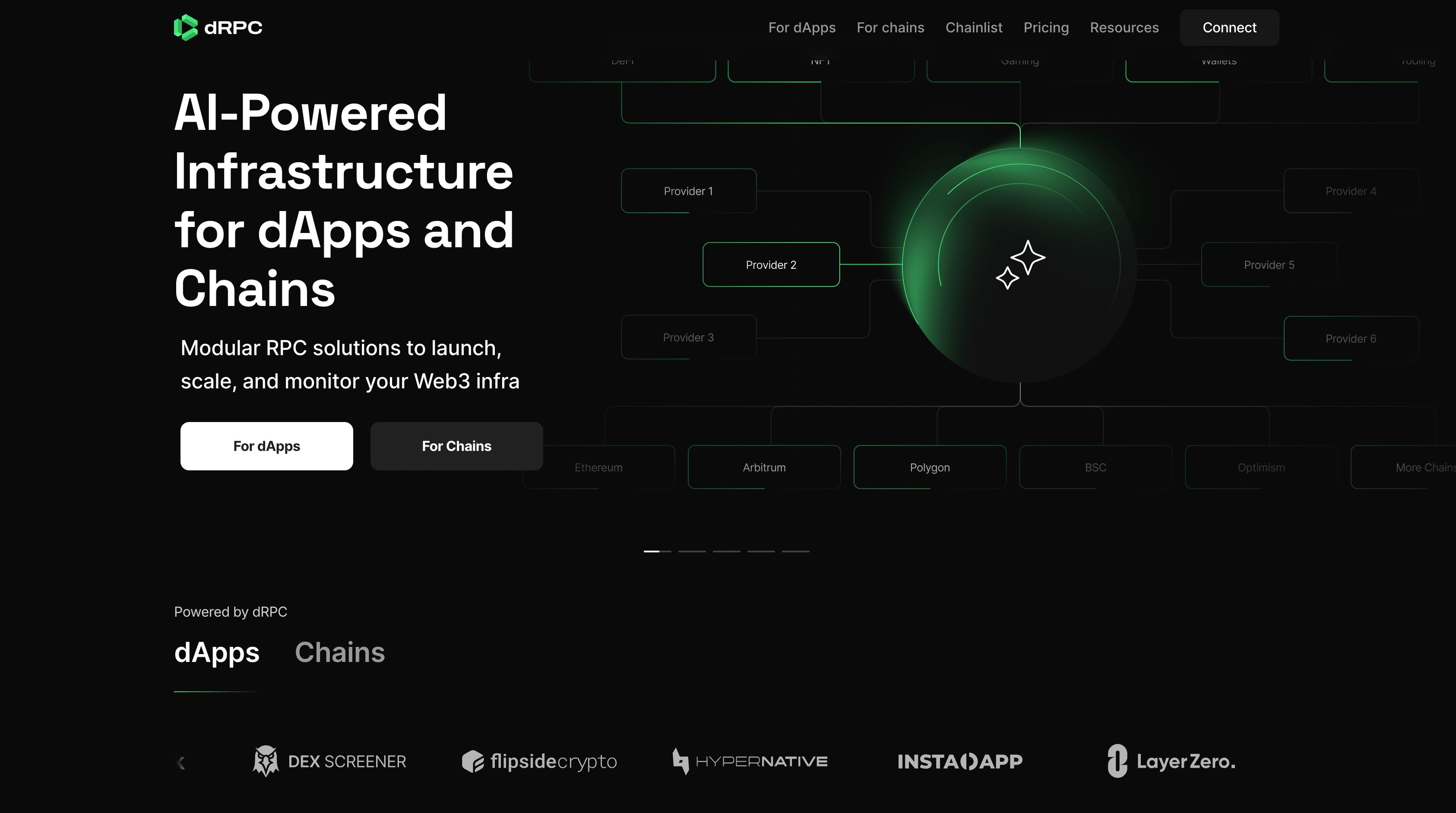
dRPC routes Solana traffic across a network of 50+ independent node operators using an AI-driven load balancer, with support for stake-weighted Quality of Service. The decentralized architecture provides geographic redundancy that pure centralized providers cannot match, and the pricing is among the lowest in the comparison at $10/M requests on paid plans with free public endpoints for development.
For payment processors, dRPC’s most relevant role is as a secondary broadcast path or backup confirmation endpoint in a multi-provider setup. Sending the same signed transaction through both a primary provider (Chainstack or Helius) and dRPC simultaneously increases the probability of a transaction landing during network congestion without adding meaningful cost. As a primary settlement endpoint, the absence of dedicated infrastructure, no published SOC 2, and no contractual uptime SLA present meaningful operational risk for high-value payment flows.
Limitations: No dedicated nodes. No published SOC 2 or contractual SLA. Public endpoints carry no performance guarantees. Best suited as a backup broadcast path rather than a primary settlement endpoint for a production payment processor.
Fit for payment processors: Limited as a primary provider. Genuinely useful as a low-cost redundancy layer or development endpoint.
Scored out of 100 across 5 payment-processor criteria. Click any row to expand the breakdown.
Chainstack
97 / 100
| Settlement reliability & uptime SLA | 25 / 25 |
| Dedicated / isolated throughput | 24 / 25 |
| Latency consistency (p95/p99) | 19 / 20 |
| Compliance certification (SOC 2, SLA) | 20 / 20 |
| Payment-specific tooling (gRPC, webhooks) | 9 / 10 |
Quicknode
90 / 100
| Settlement reliability & uptime SLA | 22 / 25 |
| Dedicated / isolated throughput | 21 / 25 |
| Latency consistency (p95/p99) | 19 / 20 |
| Compliance certification (SOC 2, SLA) | 20 / 20 |
| Payment-specific tooling (gRPC, webhooks) | 8 / 10 |
Helius
82 / 100
| Settlement reliability & uptime SLA | 23 / 25 |
| Dedicated / isolated throughput | 18 / 25 |
| Latency consistency (p95/p99) | 19 / 20 |
| Compliance certification (SOC 2, SLA) | 12 / 20 |
| Payment-specific tooling (gRPC, webhooks) | 10 / 10 |
Triton One
82 / 100
| Settlement reliability & uptime SLA | 22 / 25 |
| Dedicated / isolated throughput | 21 / 25 |
| Latency consistency (p95/p99) | 20 / 20 |
| Compliance certification (SOC 2, SLA) | 12 / 20 |
| Payment-specific tooling (gRPC, webhooks) | 7 / 10 |
Alchemy
77 / 100
| Settlement reliability & uptime SLA | 20 / 25 |
| Dedicated / isolated throughput | 15 / 25 |
| Latency consistency (p95/p99) | 17 / 20 |
| Compliance certification (SOC 2, SLA) | 18 / 20 |
| Payment-specific tooling (gRPC, webhooks) | 7 / 10 |
dRPC
52 / 100
| Settlement reliability & uptime SLA | 17 / 25 |
| Dedicated / isolated throughput | 10 / 25 |
| Latency consistency (p95/p99) | 15 / 20 |
| Compliance certification (SOC 2, SLA) | 5 / 20 |
| Payment-specific tooling (gRPC, webhooks) | 5 / 10 |
Scoring criteria weighted for payment-processor workloads. Data sourced from public provider documentation as of May 2026.
Real-world performance benchmark
Solana is tracked on the Chainstack performance dashboard, which reports live RPC latency across providers and regions. For payment processors, the methods most worth benchmarking are getLatestBlockhash (called on every transaction construction), sendTransaction (broadcast latency), and getSignatureStatuses (your confirmation polling loop).
The dashboard measures p50 and p95 latency across EU, US West, and JP-Asia regions. Payment teams evaluating providers should run benchmarks from their production deployment region during business-hours traffic — not from a developer laptop at 2 AM. The p95 latency under realistic burst load is the number that actually determines whether a customer’s payment shows “confirmed” in 2 seconds or 8 seconds.
⚡ Benchmark before you commit: p95 latency is the metric that matters for payment UX — average latency hides the tail latency that your worst-case customers experience every time there is a congestion event. Check the Chainstack performance dashboard for live data before committing to a provider contract.
Getting started with Solana payment processing on Chainstack
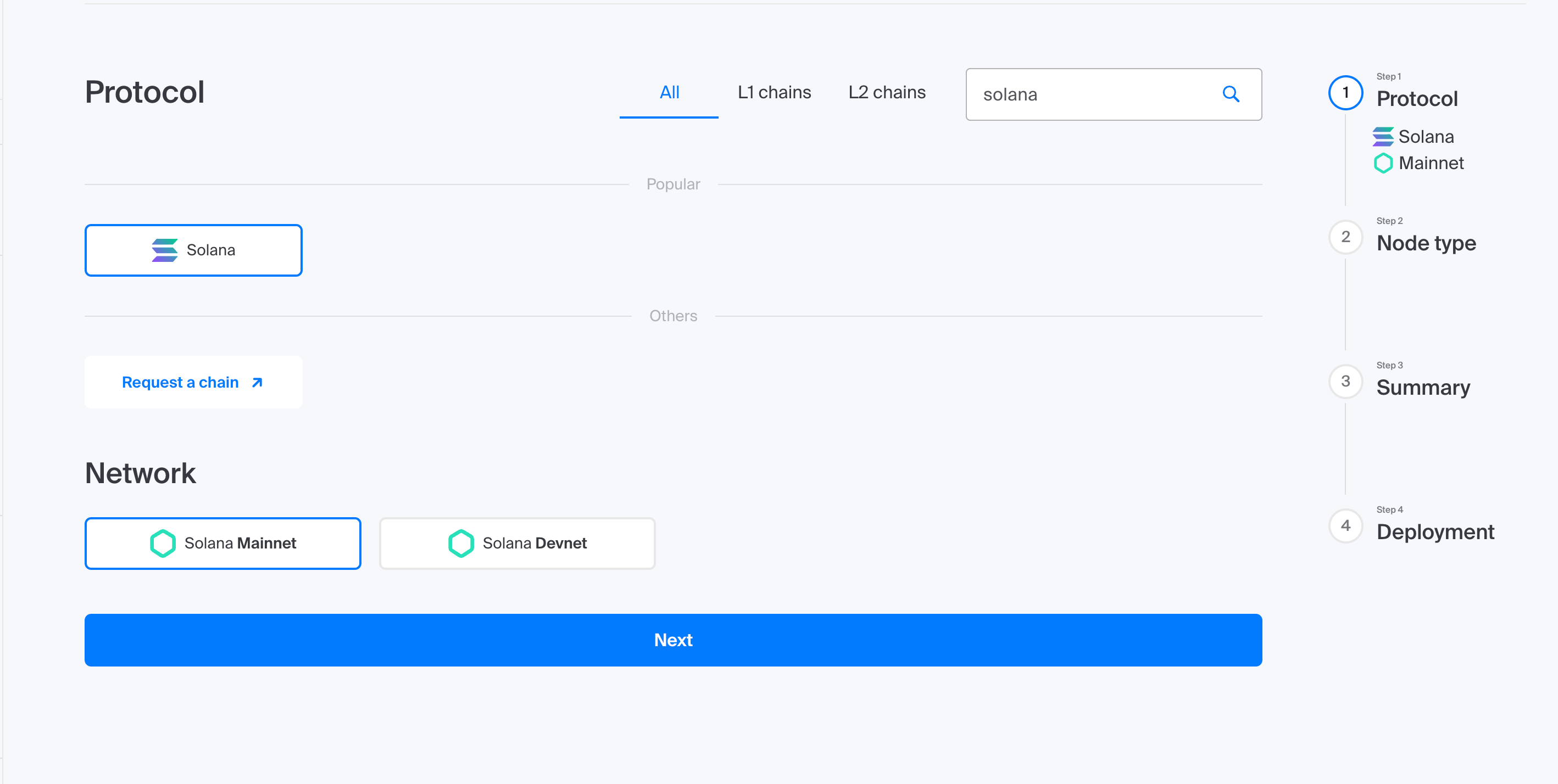
Build better on Solana with Chainstack — deploy an endpoint in under a minute:
- Log in to Chainstack console or create a free account
- Create a new project
- Select Solana Mainnet (or Devnet for integration testing)
- Choose Global Nodes for geo-balanced routing or Dedicated Nodes for isolated production infrastructure
- Copy your HTTP and WebSocket endpoint URLs from the project dashboard
For teams processing high settlement volumes, add the Unlimited Node add-on from the marketplace to convert to flat-rate billing, and add the Yellowstone gRPC Geyser plugin to replace confirmation polling with real-time streaming events.
The Solana tooling documentation covers full SDK setup with @solana/kit, Anchor v1.0.0 integration, LiteSVM for testing, and Backpack wallet configuration against your Chainstack endpoint.
🤖 You can also access Chainstack Solana RPC directly from Claude, Cursor, Codex, Gemini, or Windsurf using Chainstack MCP. Learn more about Chainstack MCP.
What a Solana API adds above the RPC layer
getProgramAccounts returns account bytes for an AMM program. A positions view needs them decoded into pool shares with USD values, and decoders break when a protocol ships a new version. CoinStats Solana API handles that decode layer: pre-priced SPL and SOL balances, staking, lending and LP positions resolved across 10,000+ protocols, and an MCP server for agents. CoinStats API runs no nodes and submits no transactions.
Conclusion
The defining infrastructure decision for Solana payment processors in 2026 is whether your RPC layer can provide the isolation and compliance documentation that high-value settlement flows demand — not just whether it can handle average load.
- Regulated payment processors and fintech companies requiring SOC 2 attestation and contractual SLA: Chainstack (SOC 2 Type II and ISO 27001, Dedicated Nodes, stablecoin infrastructure page) or Quicknode (SOC 2 Type II + SOC 1 + ISO 27001 for multi-chain stacks)
- Solana-only payment processors needing webhook event delivery and enriched token data: Helius (LaserStream, DAS API, webhooks)
- Latency-critical settlement infrastructure where raw performance and transparent pricing matter most: Triton One (bare-metal, Fumarole streaming, ~100ms p50)
- Development, integration testing, or multi-provider failover broadcast: Alchemy (30M CU free tier) or dRPC (free public endpoints, decentralized node pool)
Additional resources
- Stablecoins on Solana in 2026: growth, adoption, and usage
- Enterprise Solana infrastructure: what matters in 2026
- Solana tooling documentation — Chainstack Docs
- Tutorials and guides for Solana on Chainstack
- More Solana tutorials and articles on the Chainstack Blog
- Chainstack pricing
- Chainstack performance dashboard