AI-ready infrastructure
 Refer and earn


 Ethereum
 Hyperliquid
 Solana
 Arbitrum
 BNB Smart Chain
 Base
 Polygon
 TRON
 Sui
 Robinhood


Arc RPC provider scores for trading (November 2026)

Data sources: Compare scorecard and the 7-day dashboard, both read on Nov 10, 2026 (the scorecard page shows no timestamp).
Abstract
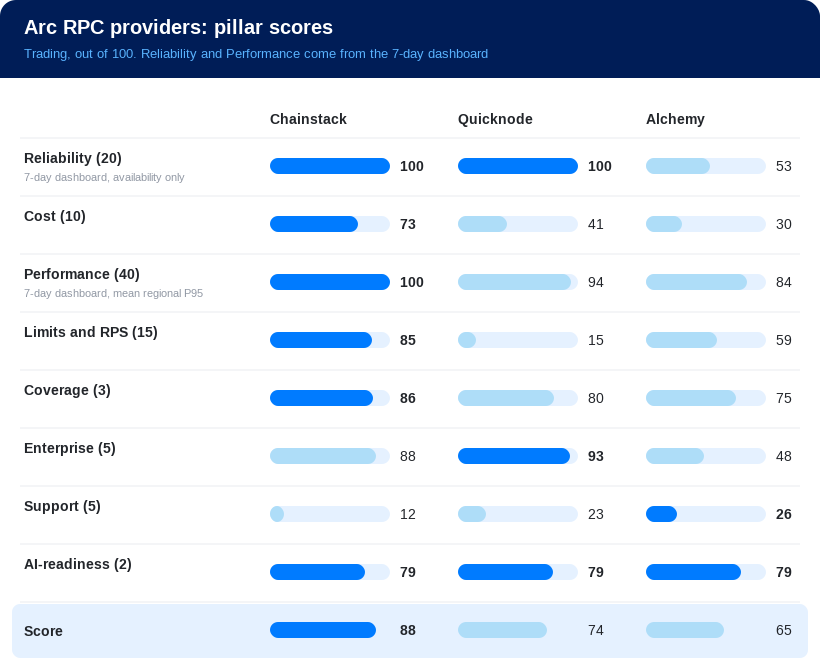
On the Trading weighting, Chainstack scores 88 out of 100 on Arc, Quicknode 74 and Alchemy 65. Performance carries 40% of the weight for trading, and Chainstack has the highest Performance score. The score rests on 82% of the weight, because spike behavior and part of Reliability are not scored.
Key findings
- Chainstack leads the score at 88, 14 points ahead of Quicknode (74) and 23 ahead of Alchemy (65).
- Performance, 40% of the Trading weight, scores 100 for Chainstack, 94 for Quicknode and 84 for Alchemy. Mean P95 is 49.2 ms, 94.7 ms and 126.8 ms.
- Alchemy availability is 99.9132%, which gives a Reliability score of 53 against 100 for Chainstack and Quicknode. Its US West success rate is 99.7805%.
- Chainstack does not lead on single regions: Frankfurt P95 is 48.9 ms against 17.9 ms on Quicknode and 19.5 ms on Alchemy, and US West is 50.1 ms against 18.0 ms on Alchemy.
- Chainstack does not lead on Support (12, against 23 for Quicknode and 26 for Alchemy) or Enterprise (88, against 93 for Quicknode).
Verdict and best for
| Rank | Provider | Score | Best for |
|---|---|---|---|
| 1 | Chainstack | 88 | Highest Performance score, lowest cost per 1M requests, flat-fee RPS |
| 2 | Quicknode | 74 | Enterprise controls, streams, Frankfurt latency |
| 3 | Alchemy | 65 | Support, RPS on a ~$50 plan, US West latency |
Higher is better. Quicknode and Alchemy are 8.7 points apart, so second place is not a tie.
Contents
- How the score is built
- Arc RPC provider scores: pillar table
- Provider summaries
- Arc RPC provider comparison by pillar
- Reliability and Performance from the 7-day dashboard
- Conclusion
- Appendix: weights and rules
- Other RPC providers
How the score is built
The score is the weighted mean of eight pillars, using the weights the scorecard sets for Trading. Each pillar counts for its weight multiplied by the share of the pillar that is scored.
What the scorecard scored
- Chainstack publishes the scorecard and is one of the providers compared.
- Cost, Limits and RPS, Coverage, Enterprise, Support and AI-readiness are compiled by hand from public pages. The page advises confirming prices and limits with each provider.
- The scorecard scored six pillars. Limits and RPS is 60% scored, because behavior under a 2x spike needs a load test the page has not run.
- The six static pillars alone give Chainstack 71, Quicknode 45 and Alchemy 47. This excludes live Reliability and Performance.
What this report adds
- Reliability and Performance were not scored on the page when the evidence panels were read on Nov 10, 2026, so both are computed here from the 7-day dashboard, using the page's published formulas.
- Reliability counts 40% of its pillar, availability alone. Freshness and correctness are not scored. Performance counts 100% of its pillar.
- The score therefore rests on 82% of the weight. The unscored 18% is the rest of Reliability (12%) and spike behavior in Limits and RPS (6%).
What the dashboard measures
- Three probe regions: Frankfurt, US West and Singapore. The first paid plan of each provider (Growth for all three here). No end-user latency and no correctness measurement.
- Availability is request success, averaged over the three regions, from the page's measurements endpoint (window Nov 3, 2026–Nov 10, 2026). Latency is the mean of the three regional P95 values from the dashboard snapshot.
- dRPC appears on the dashboard but is not scored by the scorecard, so it is left out.
How to read the numbers
- Pillar scores are rounded. A gap under 3 points is a tie. Behavior under a spike is a load-test metric the page does not score.
Arc RPC provider scores: pillar table
| Pillar (weight) | Chainstack | Quicknode | Alchemy |
|---|---|---|---|
| Reliability (20) | 100 | 100 | 53 |
| Cost (10) | 73 | 41 | 30 |
| Performance (40) | 100 | 94 | 84 |
| Limits and RPS (15) | 85 | 15 | 59 |
| Coverage (3) | 86 | 80 | 75 |
| Enterprise (5) | 88 | 93 | 48 |
| Support (5) | 12 | 23 | 26 |
| AI-readiness (2) | 79 | 79 | 79 |
| Score | 88 | 74 | 65 |
Reliability and Performance come from the 7-day dashboard. Highest score in each row is in bold.
Provider summaries
| Provider | Strength | Trade-off |
|---|---|---|
| Chainstack | Performance scores 100 at 49.2 ms mean P95; $2.62 per 1M requests; flat-fee RPS scores 100 | Support scores 12; no gRPC or streams product (0); Frankfurt P95 of 48.9 ms is the slowest of the three |
| Quicknode | Enterprise scores 93; streams on all plans; Frankfurt P95 of 17.9 ms | 50 RPS on a ~$50 plan (score 23); $12.37 per 1M requests; Singapore P95 of 170.5 ms |
| Alchemy | 360 RPS on a ~$50 plan (score 89); Support scores 26; US West P95 of 18.0 ms | Availability of 99.9132% (Reliability 53); Singapore P95 of 342.9 ms; $14.46 per 1M requests |
Arc RPC provider comparison by pillar
Cost and pricing (weight 10)
| Metric | Chainstack | Quicknode | Alchemy |
|---|---|---|---|
| $ per 1M requests (70% of pillar) | 72 ($2.62, Growth) | 26 ($12.37, Build) | 21 ($14.46, PAYG) |
| Bill predictability (20%) | 100 | 100 | 70 |
| Archive, trace, history (10%) | 30 ($10.65 per 1M) | 24 ($13.32) | 12 ($19.97) |
Prices are compute only, for an EVM dApp mix of 18.69M calls per month. Lowest price and highest score are in bold.
Limits and RPS: rate limits (weight 15)
| Metric | Chainstack | Quicknode | Alchemy |
|---|---|---|---|
| RPS on ~$50 plan (40%) | 77 (250 RPS, Growth $49) | 23 (50 RPS, Build $49) | 89 (360 RPS, PAYG) |
| Behavior under spike (40%) | not scored | not scored | not scored |
| Flat-fee or unlimited RPS (20%) | 100 (Unlimited Node 25–500 RPS, from $149/mo) | 0 | 0 |
Coverage (weight 3)
| Metric | Chainstack | Quicknode | Alchemy |
|---|---|---|---|
| Listed chain count (30%) | 98 (93) | 91 (77) | 90 (75) |
| Archive, debug and trace, WebSocket, testnets | 100 | 100 | 100 |
| gRPC and streams | 0 | 100 | 50 |
| Dedicated nodes | 100 | 50 | 50 |
| Region selection | 100 | 50 | 50 |
| MEV protection and private transactions | 50 | 0 | 0 |
Enterprise (weight 5)
| Metric | Chainstack | Quicknode | Alchemy |
|---|---|---|---|
| SOC 2 Type II | 100 | 100 | 100 |
| ISO 27001 | 100 | 100 | 0 |
| SLA of 99.9% or more with credits | 100 | 100 | 0 |
| SSO, RBAC, audit log | 67 | 100 | 100 |
| Single-tenant and jurisdiction | 50 | 50 | 50 |
| Status page with 90 days of history | 100 | 100 | 0 |
Support (weight 5)
| Metric | Chainstack | Quicknode | Alchemy |
|---|---|---|---|
| Response time, ~$50 plan (50%) | 0 | 18 | 18 |
| Response time, ~$500 plan (30%) | 0 | 46 | 18 |
| Channels and coverage (20%) | 60 | 0 | 60 |
AI-readiness (weight 2)
| Metric | Chainstack | Quicknode | Alchemy |
|---|---|---|---|
| MCP, 5 reference tasks (35%) | 80 (4 of 5) | 40 (2 of 5) | 40 (2 of 5) |
| Docs for LLMs (25%) | 100 | 100 | 100 |
| Machine-readable pricing (15%) | 100 | 100 | 100 |
| Skills and plugins (10%) | 50 | 100 | 100 |
| Agent self-serve and payments (15%) | 40 | 100 | 100 |
Reliability and Performance from the 7-day dashboard
| Metric | Chainstack | Quicknode | Alchemy |
|---|---|---|---|
| Availability, mean of three regions | 100% | 100% | 99.9132% |
| Reliability score (availability only) | 100 | 100 | 53 |
| P95 Frankfurt | 48.9 ms | 17.9 ms | 19.5 ms |
| P95 US West | 50.1 ms | 95.6 ms | 18.0 ms |
| P95 Singapore | 48.5 ms | 170.5 ms | 342.9 ms |
| Mean P95 | 49.2 ms | 94.7 ms | 126.8 ms |
| Performance score | 100 | 94 | 84 |
Performance scores 100 at a mean P95 of 80 ms or below. Lowest latency and highest score are in bold. Reliability scores 100 at availability of 99.99% or above.
Conclusion
Chainstack has the highest score at 88, 14 points ahead of Quicknode at 74, on 82% of the weight. Alchemy is third at 65. By pillar: Chainstack has the highest score on Reliability (tied with Quicknode), Cost, Performance, Limits and RPS, and Coverage; Quicknode on Enterprise; Alchemy on Support; AI-readiness is a tie. A buyer for whom Frankfurt or US West latency matters more than the three-region mean will find those rows go to Quicknode and Alchemy, and a buyer who weights Support or Enterprise more heavily will find them there too.
Appendix: weights and rules
Weights for Trading are in the pillar table. Performance is 100 at a mean regional P95 of 80 ms or below, 0 at 1,500 ms or above. Reliability is 100 at availability of 99.99% or above and 0 at 99% or below.
Other RPC providers
The scorecard scores only the providers in this report. These Chainstack lists cover others.