AI-ready infrastructure
 Refer and earn


 Ethereum
 Hyperliquid
 Solana
 Arbitrum
 BNB Smart Chain
 Base
Base Polygon
 TRON
TRON Sui
Sui Robinhood


Top 6 XRP Ledger RPC providers for payments in 2026

XRP Ledger is a payments-focused layer-1 blockchain that has been in continuous production since 2012 and is now maintained by an open-source community, with Ripple as a major contributor. In 2026 it’s becoming as well known for tokenized real-world assets as for payments, with represented real-world-asset value reaching $4.06 billion in early August and about $4.55 billion by mid-October (RWA.xyz).
Provider choice on XRPL changed shape in August. The XRP Ledger Foundation partnered with Ankr in August to run free public RPC nodes just ahead of the xrpld 3.3.0 release, which brought confidential tokenization and atomic settlement features aimed squarely at institutional issuers. Since then, Batch and Permission Delegation have activated on mainnet, while Confidential MPT is still collecting validator votes. Chainstack added managed XRP Ledger nodes to its own platform in the same window. The practical implication: an RPC method set built around accounts and a native order book, not an EVM state trie, now has to serve both a decade-old payments use case and a fast-growing institutional tokenization one.
This guide compares the providers actually running XRP Ledger infrastructure today, what each supports, and how to pick one for payments, tokenization, or regulated fintech workloads.
💡 Already using Chainstack? Jump straight to the XRP Ledger tooling docs or deploy your endpoint in minutes.
Why RPC provider choice matters for XRPL
XRP Ledger doesn’t run the JSON-RPC method set most RPC comparisons assume. There’s no eth_call, no EVM state trie, no mempool in the front-running sense — the API surface is native rippled methods (account_info, submit, account_tx, book_offers) built around accounts, ledger versions, and the built-in order book. Consensus closes a new ledger version roughly every 3 to 5 seconds through validator agreement rather than mining, and once a ledger is validated its transactions are final — there’s no reorg risk for a provider to protect against the way there is on a probabilistic-finality chain. That changes what “production-grade” means: a provider needs to expose the right method surface reliably over both JSON-RPC and WebSocket subscriptions, and it needs to retain enough ledger history for the workload — payments apps mostly need current state, but issuers and analytics teams need history depth most shared endpoints don’t advertise clearly.
Ripple operates free public servers (s1.ripple.com and s2.ripple.com), and the xrplcluster.com cluster, operated by InFTF, is another free endpoint that plenty of prototypes still point at. XRPL’s own documentation is explicit that Ripple’s servers are not for sustained or business use and can go down without notice, and it lists every free public cluster as non-commercial — useful as a baseline to test against, not a foundation to build a product on.
The criteria that actually separate providers here:
- Cost predictability and pricing model — flat request-unit pricing (Chainstack) versus per-call or credit-metered billing elsewhere. On a chain without archive/trace-style premium calls, the gap is smaller than on EVM chains, but it still shows up once WebSocket subscriptions and high account-history queries enter the mix.
- Ledger history retention depth — how far back
account_txand historicalledgerqueries actually reach. Chainstack’s Global Nodes retain a rolling window of ledger history; Dedicated Nodes allow deeper retention configuration, and this is the closest XRPL equivalent to “archive access” on an EVM chain. - WebSocket subscription support —
subscribeto ledger closes and transaction streams is how payment and DEX-monitoring apps track state in near real time, and not every provider treats it as a first-class citizen on the free tier. - Mainnet and testnet coverage — a real constraint; not every provider below supports XRPL testnet, which matters for teams that want to test against the same infrastructure they’ll deploy to.
- Native DEX and AMM method support —
book_offers,path_find, andamm_infoare core to trading and liquidity workloads on XRPL and aren’t always documented as clearly as account and transaction methods. - Dedicated Nodes options — for teams that need isolated throughput or configurable history depth beyond what a shared endpoint provides.
- SLA and compliance — uptime guarantees, SOC 2 Type II, ISO 27001 — this matters more here than on most chains, given how much of XRPL’s current growth is institutional and RWA-driven rather than retail-DeFi-driven.
One criterion that doesn’t transfer from EVM comparisons: MEV protection. XRPL has no public mempool in the Ethereum sense and its native DEX settles offers through the consensus process itself rather than a searcher-extractable transaction queue, so “MEV-protected RPC” isn’t a meaningful axis here the way it is for Ethereum or BNB Smart Chain — it’s omitted from the table below rather than forced in.
Comparison table
The table below summarizes public positioning as of October 2026.
| Provider | Pricing model | Free tier | Dedicated nodes | Ledger history retention | Compliance |
|---|---|---|---|---|---|
| Chainstack | Flat request units, 1 RU/call | Permanent, 3M RU/month, no card | Yes, 7 regions | ~33-66 days on Global Nodes; configurable on Dedicated | SOC 2 Type II, ISO 27001 |
| NOWNodes | Request-metered plans; no RPS cap on paid plans (provider-stated) | Free Start plan, 100K requests/month, 15 RPS | Yes, on custom plans | Not published; XRP endpoints marked non-archive | Not documented |
| Blockdaemon | Compute-unit plans (Free, Starter, Growth) + custom enterprise | Free key, self-serve (single test key, 5 RPS) | Dedicated XRP nodes listed in docs (mainnet/testnet); no public price | Not published | SOC 2 Type II, ISO 27001 |
| Ankr | Free public tier | Permanent, free | No | ~2 weeks | SOC 2 Type II at operator level (report under NDA); ISO 27001 in progress |
| GetBlock | Compute-unit metered (XRP chain multiplier 20) | 50,000 CU/day | Dedicated from $1,000/mo; Limitless Node from $150/mo | Not published for shared; Clio option on Dedicated | SOC 2 Type II (Q2 2026); no ISO 27001 published |
| Quicknode | Credit-metered (40 credits per XRPL call) | 1-month trial, no card | Yes | Full archive from ledger 32570 (mainnet) | SOC 2 Type II, ISO 27001 |
⚠️ Note: Alchemy does not currently support XRP Ledger — teams running a multi-chain Alchemy stack will need a separate provider for this network. Infura is in the same position; neither lists XRPL among its supported networks as of this writing.
How to choose an XRPL RPC provider
1. Pricing model — flat vs. metered, and what it means here
Chainstack bills every XRPL call as 1 request unit regardless of method, on the same flat RU model used across its supported chains. Quicknode meters a flat 40 API credits per XRPL call whatever the method and GetBlock meters in compute units with XRP carrying a 20x chain multiplier, so check each provider’s weights for WebSocket subscriptions and large account_tx pulls rather than assuming they cost the same as an account_info lookup. On Chainstack, each WebSocket push also counts as a request, and Dedicated Nodes are not metered per request. True cost per call = (method’s credit/CU weight × price per unit) ÷ total units purchased — multiply by expected monthly call volume to see the real bill, not the sticker price. For a payments app polling account balances and submitting transactions at moderate volume, the gap between models is modest; for an analytics pipeline pulling deep transaction history across many accounts, it compounds quickly. Run the interactive cost calculator against your own request mix before committing to a tier.
2. Ledger history retention
XRPL doesn’t have an EVM-style archive/trace/debug namespace — the equivalent constraint is how many past ledger versions a node retains for account_tx and historical ledger lookups. Chainstack’s XRPL Global Nodes are Extended nodes that keep roughly 33 to 66 days of ledger history (750,000 to 1,500,000 recent ledgers); Dedicated Nodes give teams control over retention depth for compliance, forensics, or backfill workloads that need to reconstruct account history further back. Ankr’s public nodes, by contrast, retain roughly two weeks of transaction history with full archive explicitly on its roadmap rather than live today — fine for current-state payment flows, not sufficient for a compliance team reconstructing six months of transfers.
3. Free tier reality
Chainstack’s Developer plan is a permanent free tier — 3,000,000 RU/month, 25 RPS, no credit card at signup. Ankr’s public XRPL tier is also free with no card required, though without a published SLA. NOWNodes’ Start plan is free at 100,000 requests a month with one API key and a 15 RPS cap, though its own FAQ describes it as a free month, so confirm it renews before relying on it. Quicknode is the outlier: its entry offering is an explicit one-month free trial rather than a standing free plan — worth knowing before building a hackathon prototype you expect to keep running past 30 days. GetBlock caps its free tier at 50,000 compute units a day (XRP calls carry a 20-CU chain multiplier), which is workable for testing but tight for a live payments integration.
4. When dedicated infrastructure matters
Three concrete signals it’s time to move off a shared endpoint: sustained request volume above what a free or entry paid tier’s RPS ceiling supports; a compliance or audit requirement that a specific customer’s traffic not share infrastructure with other tenants; or a need for ledger history retention deeper than a shared node’s default window. Dedicated Nodes address all three on Chainstack’s XRPL offering, currently available in seven regions.
5. Native DEX and AMM method coverage
book_offers (order book depth), path_find (cross-currency payment routing), and amm_info (automated market maker pool state) are what separate an XRPL provider that just proxies basic account and transaction calls from one that supports the chain’s actual differentiator — its native, protocol-level exchange. Verify a provider documents these explicitly rather than assuming full-method coverage from a general “we support XRPL” claim.
6. Support quality — tiered, not “SLA yes/no”
Chainstack pairs its free Developer plan with best-effort community support and moves to a response target under 24 hours (24×5) on paid plans, with 24/7 priority support and custom uptime SLAs on Enterprise. Blockdaemon and Quicknode both position themselves toward institutional buyers with dedicated account contacts on enterprise tiers; Ankr’s public tier is largely self-serve and docs-driven, and GetBlock’s free plan is community-only; its paid plans add ticket and live-chat support, with a dedicated account manager on Enterprise. Name the tier you’re actually on before assuming a provider will have an engineer look at a stuck WebSocket subscription.
7. Latency consistency, not headline latency
A payments flow that submits a transaction and polls for validation cares about p95/p99 latency under load, not a marketing page’s best-case number. XRPL isn’t on Chainstack’s public performance dashboard or compare.chainstack.com yet — it’s a newly added chain as of August 2026, and neither tool covers it.
⚡ Benchmark before you commit: Run a quick latency test against each provider’s endpoint from your target region before committing — a curl loop or k6 script hitting
server_infoand a heavier call likeaccount_txwith a wide range is enough to surface meaningful p95/p99 differences.
Choose by use case
Cross-border payments and remittance
Payments are XRPL’s original and still primary workload — sub-cent fees and 3-5 second finality make it viable for remittance corridors where wire fees and multi-day settlement are the alternative. Ripple’s own RLUSD stablecoin, issued natively on XRPL alongside Ethereum, has grown to roughly $2.4 billion in market cap across both networks (about $1.1 billion of it on XRPL) and adds a second payments rail on the same ledger — settlement and stablecoin transfer traffic increasingly share the same RPC surface. The technical demand here is different from a DeFi chain: apps mostly poll account_info for balance state, submit payment transactions, and subscribe to ledger closes for confirmation — a comparatively light, predictable call pattern rather than a bursty one, but reliability and WebSocket stability matter more than raw throughput.
For this workload, a permanent free tier with no card requirement (Chainstack, Ankr) is worth more than a slightly better headline throughput number, since most payment integrations spend more time on reliability testing than in production at scale. Providers with global points of presence — Chainstack’s Global Nodes, geo-balanced by design — reduce the latency variance that shows up as inconsistent confirmation times for end users in different regions.
RWA tokenization and institutional issuance
XRPL’s tokenization activity has grown fast enough to become a second identity for the chain: represented real-world-asset value on-ledger reached $4.06 billion in early August 2026 and about $4.55 billion by mid-October (RWA.xyz), and the xrpld 3.3.0 release added Confidential MPT — zero-knowledge-shielded balances for Multi-Purpose Tokens — plus atomic batch transactions for delivery-versus-payment settlement. Batch went live on mainnet on October 9; Confidential MPT is still awaiting validator approval (22 of the 35 trusted validators in favor, 29 needed, per xrpldashboard.com on October 14). Both are aimed directly at institutions that need privacy from public view while still supporting an auditor’s access.
This is a workload where ledger history retention and dedicated infrastructure stop being optional: an issuer reconstructing a token’s transfer history for a regulator needs deeper account_tx retention than a two-week public-node window, and needs it on infrastructure it isn’t sharing with anonymous public traffic. Chainstack’s Dedicated Nodes with configurable retention depth, and Blockdaemon’s institutional-grade node access, both fit better here than a free public endpoint — even though the free tier is the right starting point for prototyping against the same MPT and AMM methods before an issuance goes live.
Enterprise and regulated fintech infrastructure
Payments and tokenized-asset issuance both carry compliance weight that most crypto use cases don’t: a regulated remittance corridor or a tokenized fund needs a vendor attestation trail, not just an SLA. Chainstack publishes both SOC 2 Type II and ISO 27001 certifications; so do Blockdaemon and Quicknode among the providers compared here. Ankr states a SOC 2 Type II attestation at the infrastructure-operator level (report under NDA) but no ISO 27001 yet, GetBlock publishes SOC 2 Type II but not ISO 27001, and NOWNodes publishes neither, which is worth knowing before a compliance review rather than after.
For this use case, look past the free-tier pitch entirely: what matters is contractual SLA language, enterprise support response commitments, and whether the vendor can produce an attestation a regulator or auditor will accept. Dedicated infrastructure and audited certifications both matter more than raw pricing at this stage.
Provider-by-provider breakdown
Chainstack
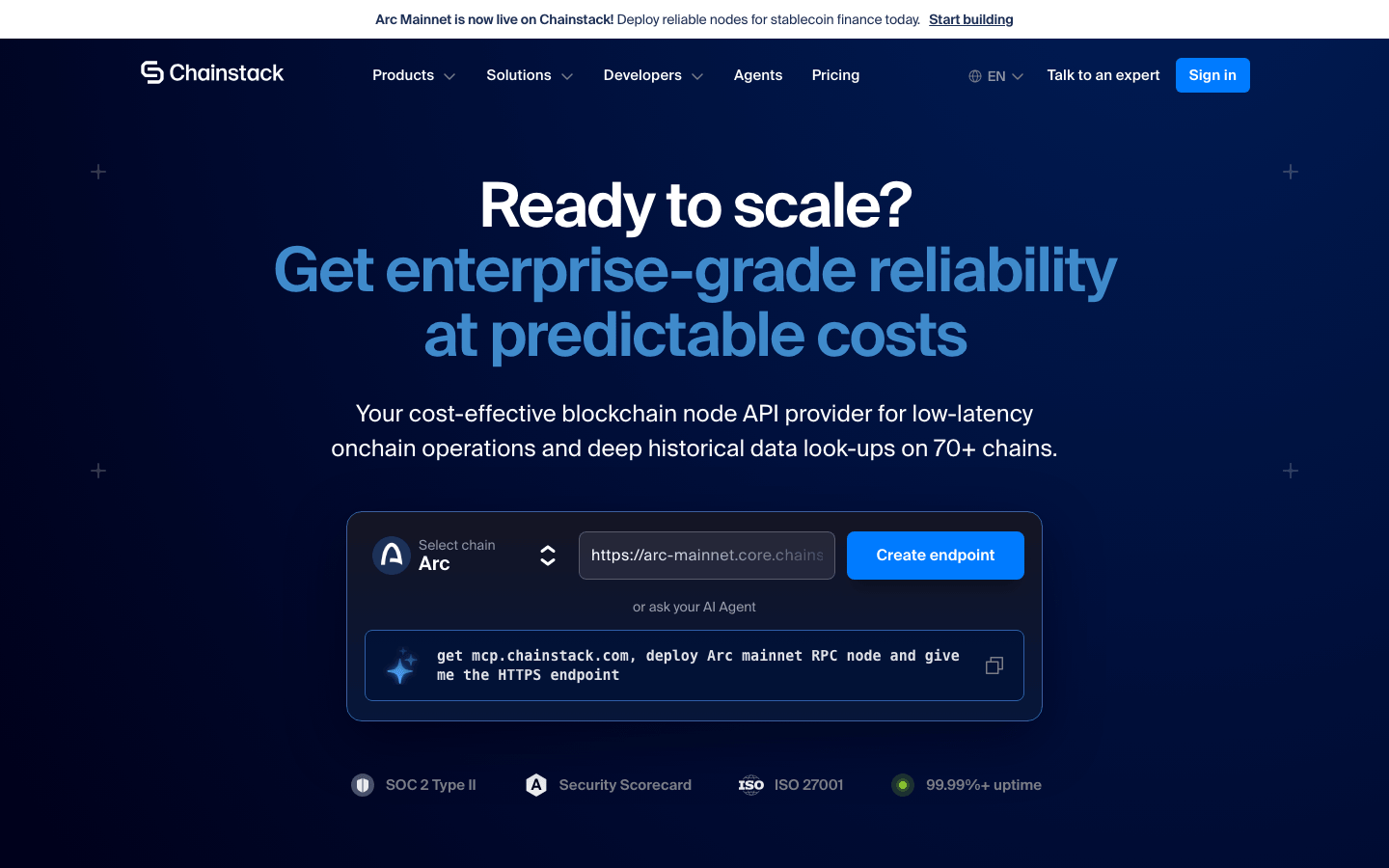
Chainstack added XRP Ledger support in August 2026, running Global Nodes, Dedicated Nodes, and Self-Hosted deployments across XRPL Mainnet and Testnet, with both JSON-RPC and WebSocket access to the full public XRPL method set — account_info, account_tx, submit, book_offers, path_find, amm_info, and server_info among them.
Pricing follows Chainstack’s flat request-unit model rather than method-weighted credits — every XRPL call costs the same 1 RU regardless of whether it’s a balance check or an order-book query, which keeps the bill predictable for payments apps with unpredictable call mixes. The Developer plan is a permanent free tier with no credit card required, and Dedicated Nodes are available across seven regions (Ashburn, Frankfurt, London, Los Angeles, New York, Tokyo, and Singapore) for teams that need isolated infrastructure or deeper ledger history retention than the roughly one-to-two-month window on Global Nodes. Chainstack Self-Hosted also added XRPL Mainnet and Testnet as deployment targets in August, for teams that need the node inside their own environment rather than a managed one (a Self-Hosted XRPL node keeps only the most recent 1,000 ledgers). Chainstack holds both SOC 2 Type II and ISO 27001 certification, relevant given how much of XRPL’s current growth is institutional.
Limitations: XRP Ledger is a new addition to Chainstack’s supported-chain list — there’s no dedicated methods-list or debug/trace documentation page yet, and the platform’s Grafana performance dashboard doesn’t cover XRPL, so teams evaluating latency need to benchmark it themselves rather than pull a pre-computed number.
Fit by workload:
- Payments: Excellent — flat billing and geo-balanced Global Nodes suit a payments app’s steady, unpredictable call mix.
- RWA tokenization: Strong — configurable retention depth on Dedicated Nodes is a real fit for issuers who need to reconstruct transfer history.
- Enterprise/regulated fintech: Strong — both certifications are published, though the chain-specific track record is only weeks old.
NOWNodes
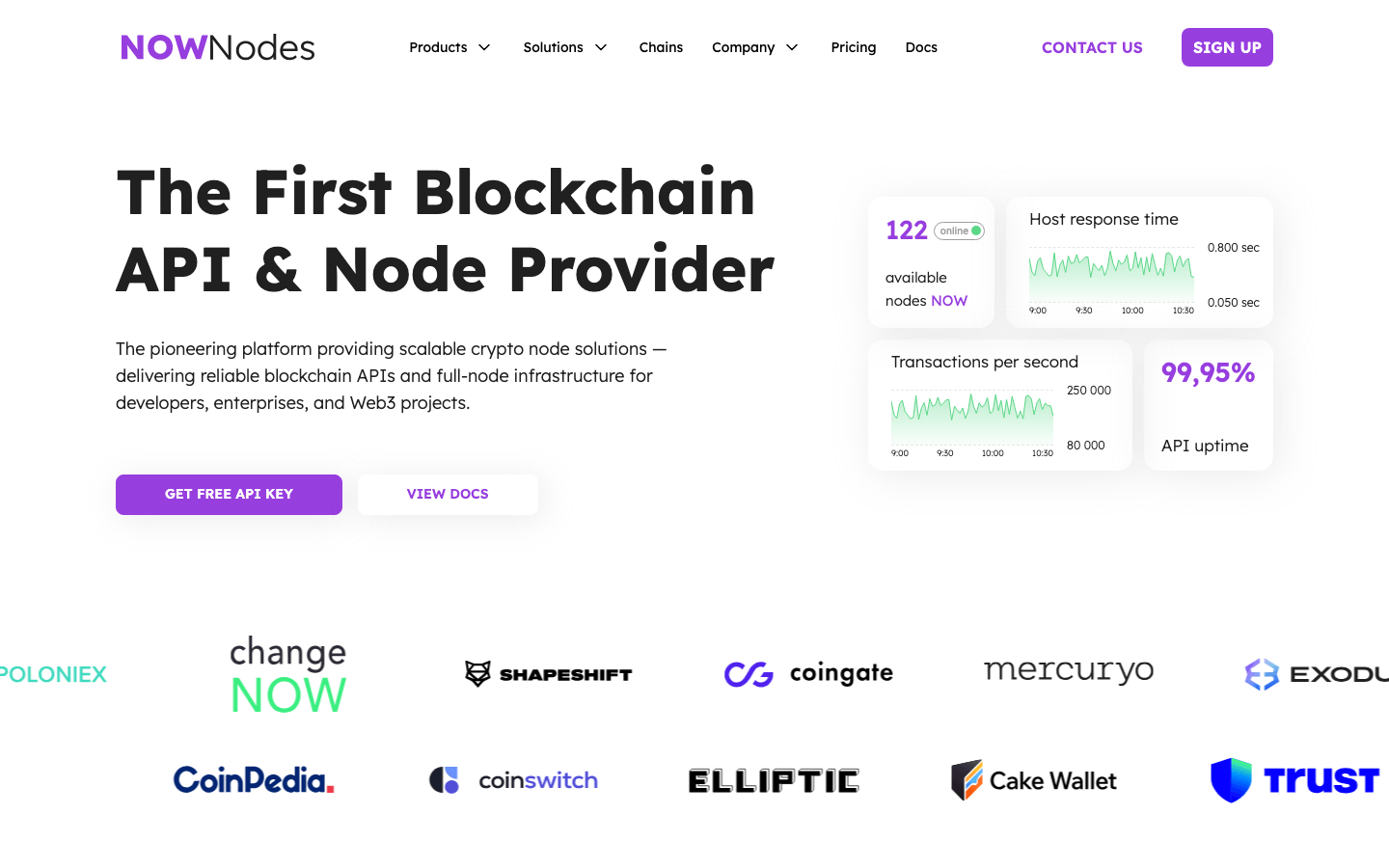
NOWNodes is a multi-chain node provider covering 120+ blockchains under a single API key. For XRP Ledger it offers JSON-RPC and WebSocket endpoints on mainnet, plus gRPC and a separate XRPL EVM endpoint, and its docs cover the native XRPL method set, including account_tx, book_offers, amm_info, ripple_path_find, and subscribe.
Plans are metered in monthly requests: the free Start plan includes 100,000 requests a month with one API key (its FAQ describes it as a free month, so confirm it renews), and paid plans run from 1 million to 100 million requests a month, with per-100K overage pricing (from €5 on Pro Plus down to €0.50 on Enterprise). NOWNodes states there are no predefined RPS limits on paid plans, with throughput scaling to cluster capacity, and quotes 99.95% uptime on its shared-node page (99.99% for dedicated nodes) and a first support response within 3 minutes. Dedicated nodes are available through its custom plans. For a team that already runs several chains through one provider, adding XRPL to the same account avoids a separate integration just for one network.
Limitations: NOWNodes lists only XRPL mainnet, so teams that test against the XRPL testnet need another endpoint. It publishes no SOC 2 or ISO 27001 attestation on its product, pricing, or dedicated-node pages and no XRPL-specific ledger history figure (its Archive Nodes docs mark the XRP endpoints as non-archive), and the “no RPS limits” claim is the provider’s own, so load-test it against your own call pattern before committing.
Fit by workload:
- Payments: Good — a free starting plan and one key across 120+ chains suit a payments app that also touches other networks.
- RWA tokenization: Limited — no published ledger history depth or XRPL-specific retention story.
- Enterprise/regulated fintech: Limited — no published compliance certification to satisfy a vendor security review.
Blockdaemon
Blockdaemon offers institutional-grade XRP node access through a native endpoint, alongside a broader lineup of custody, staking, and validator infrastructure that most of the other providers here don’t touch. Access starts with a free API key through self-serve signup (the Free plan is a single test key capped at 5 RPS and a small monthly compute-unit allowance; Blockdaemon’s docs currently say 1 million, while older pages still say 3 million), with a native method set covering account queries, ledger operations, transaction submission, and path-finding. The method reference does not list amm_info or subscribe.
Blockdaemon holds both SOC 2 Type II and ISO 27001 certifications across its infrastructure, which matters for the institutional and regulated-fintech buyers XRPL’s current growth increasingly represents. Blockdaemon states 99.9% uptime for its validator operations, but publishes no XRPL-specific node uptime figure.
Limitations: Blockdaemon’s docs list dedicated XRP nodes (stock node, mainnet and testnet), but no public price is shown and the docs don’t say whether XRP deploys self-service or with Blockdaemon’s help, so teams needing isolated dedicated infrastructure should confirm availability and pricing directly rather than assume it.
Fit by workload:
- Payments: Good — solid method coverage, though not the first name that comes to mind for a lean payments integration.
- RWA tokenization: Strong — the institutional posture and dual certification are a genuine fit for issuers.
- Enterprise/regulated fintech: Excellent — built for exactly this buyer, custody and compliance included.
Ankr
Ankr became the XRP Ledger Foundation’s public RPC partner in early August 2026, deploying free public JSON-RPC nodes across multiple regions just ahead of the xrpld 3.3.0 release. The free tier covers 43 methods across account queries, ledger data, transaction submission and simulation, path-finding, and payment-channel verification, with no signup friction for basic access.
Being the Foundation’s public RPC partner gives Ankr a credibility signal the other providers here don’t have out of the box, and it’s a legitimate no-cost option for prototyping or low-volume production payments flows.
Limitations: Ankr’s XRPL nodes retain roughly two weeks of transaction history, with full archive explicitly described as on the roadmap rather than available today — a real constraint for any workload needing to look back further, and there’s no XRPL-specific compliance statement. Ankr’s trust page says its infrastructure operator holds a SOC 2 Type II attestation (report under NDA) and that ISO 27001 is still in progress, so ask for the report if a security review is part of your evaluation.
Fit by workload:
- Payments: Strong — free, Foundation-partnered, and sufficient for current-state balance and submission workloads.
- RWA tokenization: Limited — the two-week retention window rules it out for anything needing historical reconstruction.
- Enterprise/regulated fintech: Moderate — SOC 2 Type II is stated at the operator level (report under NDA) and ISO 27001 is still in progress.
GetBlock
GetBlock runs managed XRP Ledger RPC nodes on mainnet (its docs list mainnet only; the product page also mentions testnet, so confirm before relying on it). Shared plans meter usage in Compute Units, with XRP in the 20-CU chain-multiplier group, so a call costs more than one flat request and the cost depends on the method. The free tier allows 50,000 CU a day, enough for active development and testing without immediately requiring a paid plan.
Paid shared plans start at $49/month ($39/month billed annually). For production volume without CU metering, GetBlock sells Limitless Node (a fixed-RPS endpoint, with XRP Ledger among the newer self-serve chains that start from $150/month) and Dedicated Nodes (from $1,000/month, rippled or rippled with Clio).
Limitations: GetBlock completed a SOC 2 Type II attestation in Q2 2026 but doesn’t publish ISO 27001. Ledger history depth on shared endpoints isn’t documented; the Clio configuration is a dedicated-node option.
Fit by workload:
- Payments: Good — straightforward shared endpoints, though CU metering means per-call cost depends on the method.
- RWA tokenization: Limited — no documented retention depth on shared endpoints; Clio is a dedicated-node option.
- Enterprise/regulated fintech: Moderate — SOC 2 Type II attested, but no ISO 27001 and no XRPL-specific SLA on shared plans.
Quicknode
Quicknode supports both XRP Ledger mainnet and testnet through its standard RPC and webhook infrastructure, backed by a stated 99.99% uptime SLA (contractual on Enterprise) and both SOC 2 Type II and ISO 27001 certifications. It’s a recognizable name for teams already running other chains through Quicknode who want to add XRPL under the same account.
Limitations: There’s no permanent free plan — Quicknode’s entry offering is an explicit one-month free trial rather than a standing tier, so a hackathon or long-running prototype needs to budget for a paid plan sooner than on Chainstack or Ankr. Quicknode’s credit-metered pricing burns 40 credits per XRPL call, so a high-volume workload exhausts the 10M-credit trial (roughly 250,000 calls) or a plan’s allotment quickly — worth modeling against your own call pattern before committing to a tier.
Fit by workload:
- Payments: Good — reliable and well-documented, though the trial-only free tier is a real friction point for early-stage teams.
- RWA tokenization: Good — enterprise tiers make it workable for institutional issuers willing to pay for it.
- Enterprise/regulated fintech: Strong — dual certification and a 99.99% uptime SLA check the boxes a compliance review looks for.
Getting started with XRPL on Chainstack
Deploy a production XRP Ledger endpoint in a few steps:
- Log in to the Chainstack console (or create an account).
- Create a new project
- Select XRP Ledger as your blockchain protocol
- Choose network: XRP Ledger Mainnet or Testnet
- Deploy the node
- Open Access and credentials and copy your HTTPS and WebSocket endpoints
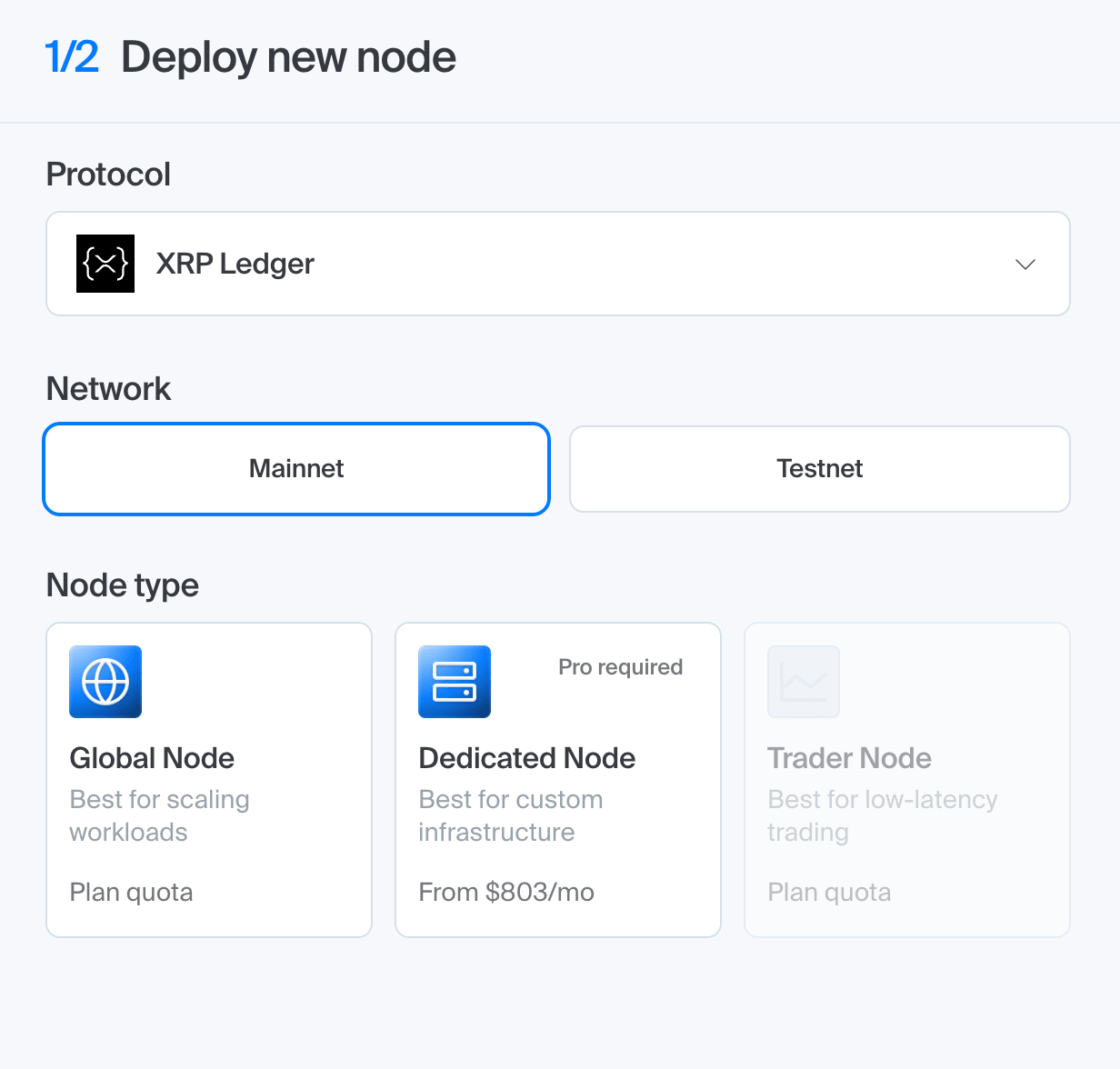
For workloads that need isolated throughput or deeper ledger history retention, Dedicated Nodes and Self-Hosted deployments are both available inside the same project.
from xrpl.clients import JsonRpcClient
from xrpl.models.requests import AccountInfo, ServerInfo

client = JsonRpcClient("YOUR_CHAINSTACK_ENDPOINT")

# Basic node health check
info = client.request(ServerInfo()).result["info"]

# Account balance and sequence lookup
account = client.request(AccountInfo(
    account="YOUR_XRPL_ADDRESS",
    ledger_index="validated",
)).result["account_data"]

print(f"Validated ledger: {info['validated_ledger']['seq']}")
print(f"Account balance (drops): {account['Balance']}")
📖 For the full integration guide, see the Chainstack XRP Ledger tooling documentation.
🤖 You can also access Chainstack XRP Ledger RPC directly from Claude, Cursor, Codex, Windsurf, Gemini CLI, GitHub Copilot, Antigravity, Claude.ai, or ChatGPT using Chainstack MCP. For a fuller agent stack — MCP, the Chainstack skill, llms.txt for context ingestion, and WebMCP for agentic browsers — see the Chainstack Agents page.
Conclusion
XRPL’s provider landscape in 2026 is thinner than an EVM chain’s but genuinely functional, and the decision mostly comes down to what the free public server can’t give you: retention depth, an SLA, or an audited certification.
- Cross-border payments: Chainstack, NOWNodes, or Ankr for a free starting point; Blockdaemon or Quicknode once compliance sign-off is required.
- RWA tokenization and issuance: Chainstack Dedicated Nodes or Blockdaemon, for retention depth and institutional posture.
- Enterprise and regulated fintech: Chainstack, Blockdaemon, or Quicknode — the three with both SOC 2 Type II and ISO 27001 published.
Frequently asked questions
Q: Does XRP Ledger have smart contracts like Ethereum?
No. XRPL doesn’t run an EVM or general-purpose smart contract layer natively — it has a native decentralized exchange, AMM, and increasingly a Multi-Purpose Token standard for tokenized assets, but application logic lives off-chain or in XRPL-adjacent sidechains like XRPL EVM rather than in on-ledger contracts.
Q: Which XRPL RPC providers have a permanent free tier?
Chainstack (3,000,000 RU/month, no card required), Ankr (free public tier, no card), and GetBlock (50,000 compute units/day) all offer standing free plans. NOWNodes’ Start plan (100,000 requests/month, 15 RPS) is free, but its own FAQ describes it as a free month, so confirm it renews. Quicknode’s entry offering is a one-month free trial rather than a permanent tier — plan accordingly if you’re prototyping long-term.
Q: What did the XRPL 3.3.0 release change, and do I need to switch RPC providers for it?
xrpld 3.3.0 shipped on August 6 with a set of new amendments. Batch (BatchV1_1) and Permission Delegation have since activated on mainnet (October 9 and October 8), while Confidential MPT, DynamicMPT and Sponsor are still waiting on validator approval. Upgrade to xrpld 3.4.1 or later to stay in sync. It doesn’t require a provider switch on its own, but confirm your provider exposes any new transaction types and methods rather than assuming existing coverage carries over automatically.
Q: How does latency compare across XRPL RPC providers?
There’s no pre-computed benchmark yet — XRPL isn’t on Chainstack’s performance dashboard or compare.chainstack.com as of this writing, since chain support only went live in August 2026. Run your own server_info and account_tx latency tests from your target region before committing to a provider.
Q: Do XRPL RPC providers support compliance certifications like SOC 2?
Chainstack, Blockdaemon, and Quicknode all publish SOC 2 Type II and ISO 27001 certifications. Ankr states a SOC 2 Type II attestation at the infrastructure-operator level (report under NDA) with ISO 27001 in progress, GetBlock publishes SOC 2 Type II but not ISO 27001, and NOWNodes publishes neither on its product or pricing pages — worth confirming directly if a vendor security review is part of your evaluation.
Q: How does XRPL RPC pricing compare to EVM chain pricing?
XRPL doesn’t have the debug/trace/archive premium-call categories that make EVM pricing hard to predict — most providers here bill per call, per credit, or per compute unit. Chainstack’s flat 1-RU-per-call model still simplifies forecasting for apps with an unpredictable mix of account, transaction, and order-book calls; Quicknode meters a flat 40 credits per XRPL call, while GetBlock meters in compute units that depend on the chain and method.
Additional resources