AI-ready infrastructure
 Refer and earn


 Ethereum
 Hyperliquid
 Solana
 Arbitrum
 BNB Smart Chain
 Base
Base Polygon
 TRON
TRON Sui
Sui Robinhood


How to choose cross-chain UX tools: 10 options compared

Cross-chain UX is not one problem. Sometimes users need to bridge a token. Sometimes they need to swap from one chain into an app on another chain. Sometimes a contract on one network needs to trigger logic on another. Sometimes the product team wants to hide chains almost completely.
That is why “best bridge” is usually the wrong question. A bridge, a messaging protocol, a routing API, a widget, and a stablecoin transfer network can all solve cross-chain problems, but they solve different product problems.
This article compares 10 tools from the Chainstack Marketplace by the type of cross-chain user experience they help you build. The goal is not to declare one universal winner. The goal is to pick the right pattern before your team commits to an integration.
Cross-chain apps also need reliable RPC access on every chain involved in the flow. Chainstack supports networks such as Ethereum, Solana, BNB Smart Chain, Polygon, Arbitrum, Base, Optimism, Avalanche, TRON, Sui, Linea, Mantle, Gnosis Chain, and more on the supported protocols page.
Start with the product decision
| If users need to… | Start by comparing… | Why |
|---|---|---|
| Swap or bridge assets inside your app | LI.FI, Socket, Squid Router, deBridge | Routing layers can aggregate bridges, swaps, chains, and liquidity paths. |
| Move assets quickly between common EVM chains | Across | Intent-based bridges can be a strong fit for fast token movement. |
| Build cross-chain contract logic | LayerZero, Wormhole, Axelar, Hyperlane | Messaging protocols are closer to application architecture than simple bridge UI. |
| Build custom token routes | LayerZero, Wormhole, Hyperlane, Axelar | These tools expose token transfer and messaging primitives for protocol-level design. |
| Focus on stablecoin movement | Allbridge | Allbridge Core focuses on native stablecoin transfers across supported chains. |
1. LI.FI
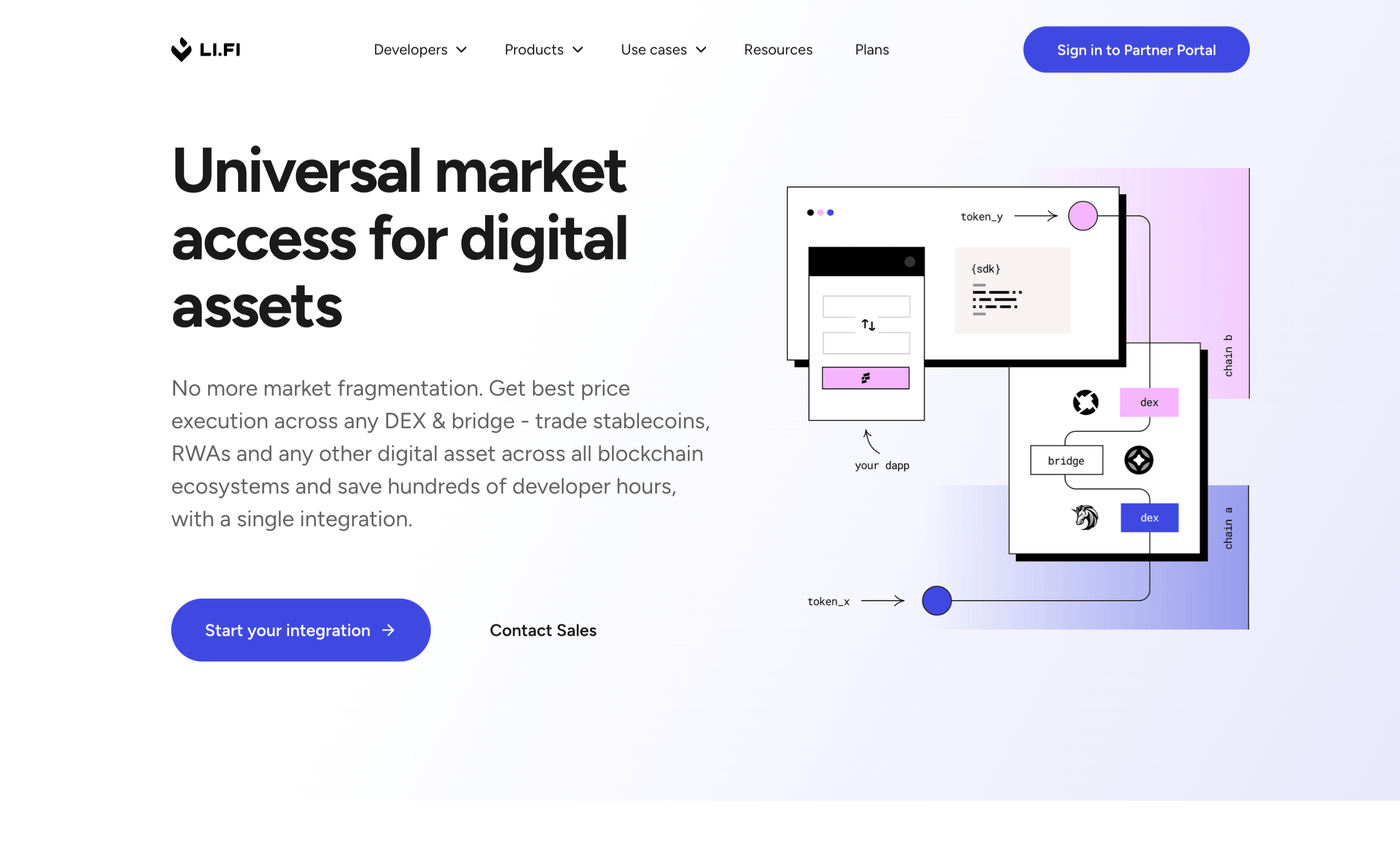
LI.FI is the strongest starting point if the product requirement is “let users move into the right asset on the right chain without leaving the app.” Its docs describe LI.FI as a routing and orchestration layer that connects applications to on-chain liquidity across chains, bridges, decentralized exchanges, solvers, and yield protocols through one integration.
LI.FI is useful when you want a user-facing flow, not just a protocol primitive. It can support swaps, cross-chain swaps, bridge flows, multi-step routes, status tracking, SDK usage, API usage, and a widget.
Choose LI.FI if: you want one integration for cross-chain swaps, bridge routing, route status, and a product-ready widget or SDK.
Think twice if: you need to own the cross-chain security model at the protocol layer or build custom message verification logic. In that case, compare messaging protocols directly.
Product note: LI.FI is a good fit for wallets, DApps, onramps, DeFi frontends, and products where the user should not need to understand every bridge and liquidity source.
2. Socket
Socket focuses on routing. Its docs position Socket as a network for optimizing how money moves across fragmented blockchain markets, with routing APIs, an embeddable widget, trading use cases, payment use cases, and support across many chains and assets.
Socket is worth comparing when your app needs a routing layer but you want a different integration model, route coverage, or product surface from LI.FI. It can be especially relevant for wallets, trading interfaces, checkout flows, and apps that want smart routing rather than a single bridge dependency.
Choose Socket if: you need a routing API or embedded swap and deposit experience for multichain users.
Think twice if: your need is mainly contract-to-contract messaging or custom token infrastructure. Socket is closer to product routing and transaction UX.
Product note: compare route quality, supported chains, widget behavior, route status, API limits, monetization options, and failure handling against LI.FI and Squid.
3. Across
Across is a strong option when the user experience centers on fast bridging and cross-chain execution. Its developer docs describe Across as crosschain infrastructure for builders, with a Swap API, API reference, and chain coverage.
Across is especially relevant for apps moving users between EVM ecosystems where speed, cost, and route simplicity matter. It is not trying to be every cross-chain primitive at once. That focus can be useful if your product needs bridge or swap execution without a heavy protocol integration.
Choose Across if: you need fast token movement or swap-like cross-chain flows between supported chains.
Think twice if: your product needs general-purpose messaging, custom omnichain contracts, or non-EVM-heavy routes that Across does not cover.
Product note: test route availability and received amount for your most common source and destination pairs. Do not evaluate a bridge only on a generic landing page claim.
4. deBridge
deBridge is an execution layer for same-chain and cross-chain actions. Its docs describe non-custodial, 0-TVL execution where competitive solvers provide liquidity on demand, with support for swaps, user onboarding, chain abstraction, hooks, workflows, and cross-chain messaging.
deBridge is useful when the product needs execution outcomes rather than only asset movement. For example, a user may want to enter an app on Base from SOL on Solana, or trigger a DeFi action as part of the cross-chain path.
Choose deBridge if: you want solver-based execution, hooks, cross-chain swaps, onboarding flows, or chain abstraction-oriented UX.
Think twice if: you need a simpler bridge widget and do not need execution hooks or solver-based routing.
Product note: review refund behavior, order tracking, supported routes, fees, and how failures are surfaced to users.
5. LayerZero
LayerZero is for teams building omnichain applications at the protocol layer. Its docs describe cross-chain interoperability and application standards such as Omnichain Applications (OApps), Omnichain Fungible Tokens (OFTs), and messaging through LayerZero endpoints.
LayerZero is not just a bridge widget. It is closer to the architecture layer for applications that need contracts on different chains to communicate.
Choose LayerZero if: you need cross-chain messaging, omnichain token standards, or custom application logic across multiple chains.
Think twice if: you only need a ready-made bridge or swap flow. A routing layer or widget may ship faster.
Product note: define trusted peers, security configuration, message handling, fee quoting, and operational ownership before production.
6. Wormhole
Wormhole offers multiple products around multichain applications. Its docs cover Native Token Transfers, wrapped token transfers, Wormhole Connect, settlement, messaging, TypeScript SDKs, Wormholescan, and protocol components such as guardians and verified action approvals.
Wormhole is a strong candidate when the product needs mature multichain primitives and developer tooling. It can support token transfer flows, a bridging widget through Connect, messaging contracts, and protocol-level integrations.
Choose Wormhole if: you need token transfer tooling, a bridge UI option, messaging, SDK support, and broad multichain infrastructure.
Think twice if: your product wants a single route-aggregation API that abstracts many bridges. In that case, compare LI.FI, Socket, Squid, and deBridge.
Product note: choose the Wormhole product carefully. Native Token Transfers, Connect, Messaging, and the TypeScript SDK solve different implementation problems.
7. Axelar
Axelar provides cross-chain communication for Web3 applications. Its docs describe building interchain DApps with Solidity or JavaScript, sending tokens, interacting with smart contracts across chains, and using resources such as cross-chain message flow and live addresses.
Axelar is useful when a team wants interoperability primitives backed by a network model and developer tooling. It also matters indirectly because products such as Squid build cross-chain user experiences on top of Axelar.
Choose Axelar if: you need interchain smart contract calls, token movement, or an interoperability layer with developer tools around cross-chain message flow.
Think twice if: the product requirement is a simple embedded bridge widget. Axelar may be more infrastructure than you need for that first version.
Product note: evaluate the chain pairs, contract addresses, message flow, and route design your app depends on.
8. Hyperlane
Hyperlane is a permissionless interoperability protocol for cross-chain communication. Its docs highlight general message passing, Hyperlane Warp Routes for asset transfers, interchain accounts, and customizable security through Interchain Security Modules.
Hyperlane is interesting when teams want flexibility and control over interoperability assumptions. It is especially relevant for teams building around appchains, custom routes, or modular security needs.
Choose Hyperlane if: you want permissionless cross-chain messaging, custom Warp Routes, interchain accounts, or configurable security modules.
Think twice if: your users simply need a polished bridge or swap widget. Hyperlane is more attractive when you are designing the cross-chain architecture.
Product note: the security model is part of the product. Hyperlane docs explicitly call out customizable security, so teams need to define and explain those assumptions clearly.
9. Squid Router
Squid Router is a cross-chain liquidity router. Its developer docs describe a single integration for cross-chain swaps, bridges, and contract calls, with widget, API, and SDK options.
Squid is a practical choice for teams that want user-facing cross-chain flows without wiring individual bridges and chain-specific liquidity sources themselves. It can sit in the same evaluation set as LI.FI, Socket, and deBridge.
Choose Squid Router if: you need a widget, API, or SDK for cross-chain swaps and contract calls across many chains.
Think twice if: your product needs to define its own messaging verification layer or launch a custom token transfer standard.
Product note: Squid is built around Axelar, so include Axelar assumptions in the integration review.
10. Allbridge
Allbridge should be evaluated through Allbridge Core, not Allbridge Classic. The Allbridge docs state that Classic is deprecated, while Allbridge Core focuses on native stablecoin transfers across EVM and non-EVM ecosystems using liquidity pools and supported messaging protocols.
Allbridge Core is narrower than some tools in this list, but that can be useful. If the product is mostly about moving USDC or USDT between supported chains, a stablecoin-focused bridge can be easier to reason about than a general cross-chain execution layer.
Choose Allbridge if: your main use case is stablecoin movement across supported chains.
Think twice if: your product needs arbitrary message passing, broad token routing, NFT movement, or custom cross-chain contract calls.
Product note: use the current Allbridge Core docs and app when evaluating routes. Do not base a new integration on Classic docs.
A decision flow for product teams
Use this shortcut before choosing a vendor:
- If the user needs a cross-chain swap or bridge inside the app, compare LI.FI, Socket, Squid Router, deBridge, and Across.
- If the app needs contract logic across chains, compare LayerZero, Wormhole, Axelar, and Hyperlane.
- If the app needs custom token movement, compare LayerZero OFT, Wormhole Native Token Transfers, Hyperlane Warp Routes, and Axelar-based options.
- If the app is stablecoin-focused, compare Allbridge Core with other route aggregators.
- If the app wants to hide chains from users, start with routing and execution tools, then inspect what protocol primitives they depend on.
What to test before shipping
Cross-chain UX breaks in the details. Before production, test:
- Quote accuracy across real source and destination pairs.
- Route availability during normal and volatile market conditions.
- User cancellation, refunds, and failed route recovery.
- Destination gas handling.
- Wallet signing flow on desktop and mobile.
- Transaction status tracking across source and destination chains.
- RPC behavior on every chain in the path.
- Chain-specific edge cases, such as token variants, finality assumptions, and explorer links.
- Support ownership when a bridge, solver, relayer, or liquidity source fails.
The user does not care which protocol had the issue. If the app says the transaction should move funds from one chain to another, the whole path becomes part of your product.
How Chainstack fits into the stack
Cross-chain tools handle routing, messaging, bridging, execution, or token transfer logic. Your application still needs chain access around those flows.
For example, a frontend may need to read balances before quoting a route, simulate contract calls, submit transactions, listen for confirmations, update status screens, or reconcile destination-chain state. A backend may need to watch contracts, track route status, or verify settlement.
That means RPC quality matters on each supported chain. If your app supports Ethereum, Base, Arbitrum, Polygon, Solana, BNB Smart Chain, Avalanche, TRON, or other Chainstack-supported networks, connect those reads and writes to reliable endpoints instead of relying on shared public RPC.