Ethereum
 Hyperliquid
 Solana
 Arbitrum
 BNB Smart Chain
 Base
Base Polygon
 TRON
TRON Sui
Sui MegaETH
 Tempo
Tempo Monad
Monad Avalanche
 Aptos
Aptos Ronin
Ronin zkSync Era
 Optimism
 Sonic
Sonic Unichain
 Fantom
 Gnosis Chain



 Refer and earn
 Discord
 Telegram
 X (Twitter)
How to get an Arbitrum RPC endpoint in 2026

TL;DR
Developers need Arbitrum RPC access to read chain state, monitor activity, and submit transactions against Arbitrum networks such as Arbitrum One and Arbitrum Sepolia. Choosing the right RPC infrastructure affects reliability, operational overhead, and integration with developer tooling. Public endpoints are convenient for experimentation, while private managed endpoints provide stronger reliability and operational guarantees for production. Consider your workload, SLAs, and integration needs before selecting an endpoint.
Arbitrum RPC options
Choosing an RPC endpoint requires balancing cost, reliability, and operational control.
The next sections provide a comparison of the benefits and limitations involved.
| Public RPC endpoints | Private RPC endpoints |
| Free and community-operated | Dedicated infrastructure |
| Rate-limited and shared infrastructure | Higher throughput and reliability |
| Suitable for testing and development | SLA-backed uptime |
| Unreliable for production workloads | Suitable for production applications |
Private RPC is preferred for production use.
Transitioning to access a private RPC endpoint can enhance your application’s performance and reliability.
Public endpoints (with limitations)
- Mainnet: https://arb1.arbitrum.io/rpc (Offchain Labs)
- Testnet: https://sepolia-rollup.arbitrum.io/rpc (Arbitrum Sepolia testnet)
- WebSocket availability: wss://arb1.arbitrum.io/ws (mainnet); Nitro Devnet uses Goerli ETH
The listed public endpoints are community or foundation-provided resources and are shared infrastructure. Public endpoints commonly implement rate limiting and request throttling to protect service availability. Uptime and performance characteristics are not guaranteed for production workloads. For production applications, a managed or private RPC endpoint is generally recommended.
Full node vs archive Arbitrum node
Arbitrum nodes can be configured as full or archive nodes, depending on how much historical data they retain. Full nodes serve recent state and real-time queries, while archive nodes store complete history from genesis for deep analytics and long-range historical queries.
| Full node | Archive node |
|---|---|
| Stores recent blockchain state (recent blocks and transactions) | Stores complete historical blockchain data from genesis |
| Suitable for: sending transactions, querying current state, real-time monitoring | Suitable for: analytics, explorers, historical queries, compliance |
HTTPS vs WebSockets
Transport protocol choice influences connection behavior and integration patterns. HTTPS and WebSockets each have trade-offs for connection lifecycle, latency, and suitability for different application models.
| HTTPS | WebSockets |
|---|---|
| Request-response model | Persistent connection |
| Each query requires a new connection | Lower latency for frequent queries |
| Suitable for: intermittent queries, simple integrations | Supports real-time subscriptions (if available) |
| Suitable for: real-time monitoring, event-driven applications |
For details on using Arbitrum RPC with wallets, development frameworks, client libraries, and HTTP or WebSocket connections, refer to the Arbitrum documentation tooling.
How to get private Arbitrum RPC using Chainstack
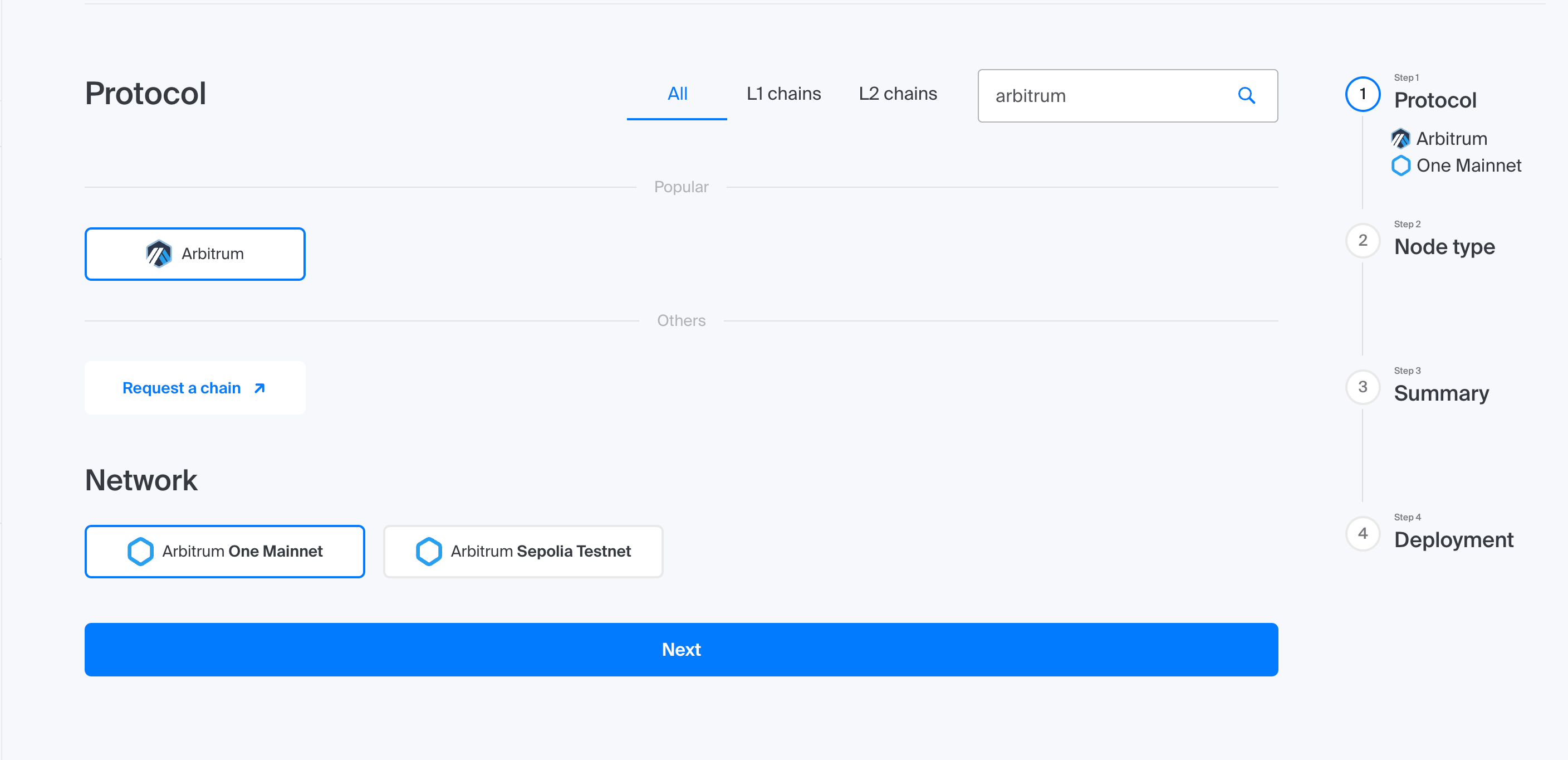
- Log in to the Chainstack console (or sign up if needed).
- Create a new project.
- Select Arbitrum as the blockchain.
- Choose the network:
- Arbitrum One Mainnet for production
- Arbitrum Sepolia for testing
- Deploy a managed RPC node.
- Open the project dashboard and copy the generated HTTPS and WebSocket RPC endpoints.
In addition to managed RPC nodes, Arbitrum provides community-operated endpoints with notable limitations.
Using Chainlist
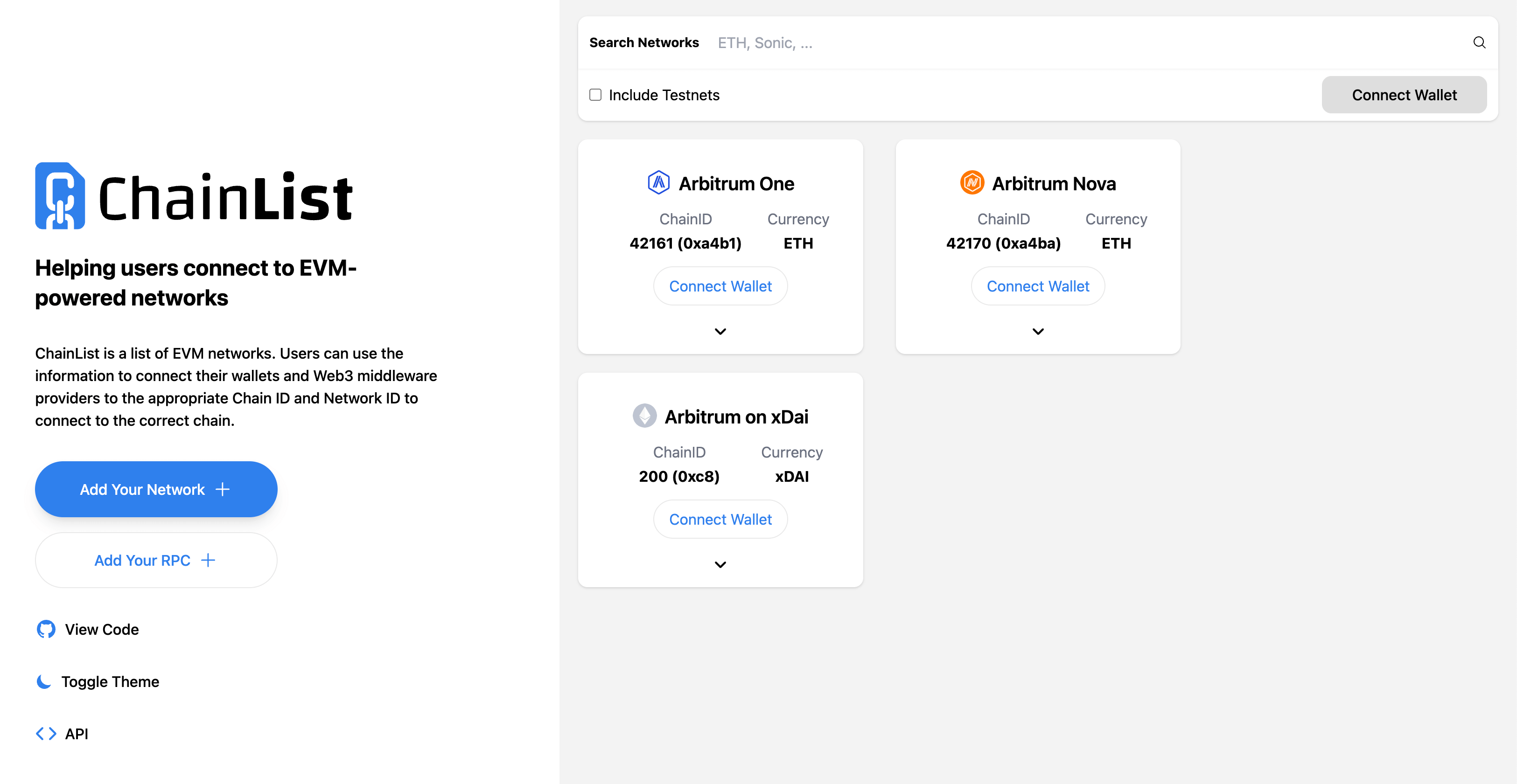
Chainlist can be used to add Arbitrum to wallets (for example, MetaMask), but it does not provide RPC infrastructure. It typically relies on public or community RPC endpoints, so for production usage any RPC URL obtained via Chainlist should be replaced with a managed RPC endpoint such as Chainstack.
Arbitrum RPC considerations for 2026
- Throughput and request limits — Ability to sustain high request volumes without aggressive throttling or degraded performance.
- Latency and regional availability — Impact of geographic routing and infrastructure distribution on response times.
- Reliability and uptime behavior — Consistency under load, failover mechanisms, and resilience during network instability.
- Archive data availability — Access to complete historical state for long-range queries and analytics.
- Dependency on L1 for finality — RPC behavior can be influenced by settlement and confirmation patterns on the underlying L1, affecting how applications observe final state.
- Cross-chain RPC traffic — Increased load from monitoring inter-network activity and cross-chain coordination can affect endpoint capacity.
- Nitro execution efficiency — Optimized execution environment affecting RPC performance characteristics.
Conclusion
In summary, public RPC endpoints are suitable for testing and development, while managed RPC providers are the recommended production option. Chainstack is the fastest and most reliable way to get started with Arbitrum RPC infrastructure in 2026.
Getting started with Arbitrum on Chainstack is fast and straightforward. Developers can deploy a reliable RPC node for mainnet access in seconds—no complex setup or hardware provisioning required.
Chainstack provides low-latency Arbitrum RPC endpoints powered by globally distributed infrastructure. This ensures consistent performance for building, testing, and scaling real-world applications, including DeFi, trading, and stablecoin infrastructure.
Key features:
- Fast deployment through an intuitive console
- Low-latency access via global infrastructure
- High throughput and stable performance under load
- Support for dedicated and shared RPC nodes
- Secure access with API keys and role-based permissions
Start for free, connect your application to a production-grade Arbitrum RPC endpoint, and scale with dedicated infrastructure built for performance.
FAQ
L1 and Arbitrum endpoints represent access to different networks with separate state and operational characteristics. Applications choose between them based on where activity needs to be performed and which network’s state must be read.
Common SDKs used with Arbitrum include @arbitrum/sdk (TypeScript SDK) and ethers.js. These SDKs typically configure an HTTP or WebSocket endpoint and handle request serialization, connection management, and higher-level developer primitives.
Use Arbitrum RPC when you need to interact with or observe activity on Arbitrum-specific networks such as Arbitrum One or Arbitrum Sepolia. For workflows that require data or operations on L1, use the corresponding L1 RPC endpoints.
Tooling support varies across blockchain ecosystems, and network-specific considerations apply. Consult Arbitrum documentation for protocol details and to verify compatibility with specific client tooling.
Arbitrum Nitro improves execution efficiency on L2, but RPC latency still depends on sequencer behavior, node configuration, and infrastructure load rather than execution alone. Learn more about how Arbitrum Nitro works here.