AI-ready infrastructure
 Refer and earn


 Ethereum
 Hyperliquid
 Solana
 Arbitrum
 BNB Smart Chain
 Base
Base Polygon
 TRON
TRON Sui
Sui Robinhood


Top 6 Robinhood Chain RPC providers for memecoin trading and NFTs in 2026

Robinhood Chain is the Arbitrum Orbit Layer 2 that Robinhood Markets launched on July 1, 2026, built on Nitro and marketed around tokenized equities. Two and a half months later, the chain that was supposed to run stock tokens is running memecoins and NFTs: from launch through early September it logged $34.6 billion in cumulative DEX volume, 576 million transactions, and 12.3 million addresses, while its ~190 Stock Tokens accounted for only about $3 billion of that volume.
Daily DEX volume hit a then-record $1.595 billion on September 1, up 61% from the previous record of $989 million four days earlier, and a single memecoin launchpad, Pons, generated $5.95 million in fees over 24 hours — enough to rank fourth on DeFiLlama’s fee leaderboard, ahead of the chain itself. On the NFT side, OpenSea went live on Robinhood Chain in mid-July and the chain briefly posted more 24-hour NFT trading volume than Ethereum mainnet. None of that activity looks like the tokenized-brokerage pitch the chain launched with, and it puts very different demands on an RPC endpoint than a slow-moving equities settlement layer would.
This guide is a deep dive on RPC infrastructure for exactly that workload: memecoin trading bots, launchpads, and NFT minting and marketplace apps on Robinhood Chain. It covers the RPC methods that matter, the infrastructure requirements the chain’s no-public-mempool design creates, and how the six most relevant providers stack up.
💡 Already using Chainstack? Jump straight to the Robinhood Chain tooling docs or deploy your endpoint in minutes.
Memecoin trading and NFTs on Robinhood Chain: RPC requirements
Robinhood Chain produces blocks roughly every 100 milliseconds with sub-second soft confirmations, and it sequences transactions first-come-first-served with no priority-fee auction. There’s no gas bidding war to win, only a race to get your transaction included in the next 100ms window. That changes what “fast” means for a memecoin sniping bot: instead of outbidding other traders on gas, you’re racing on transaction submission latency and, critically, on how quickly you can detect a new pool, a new mint, or a new launchpad token in the first place.
That detection problem is harder here than on most EVM chains because Robinhood Chain has no public mempool. RPC endpoints, explorers, and indexers only see a transaction after the sequencer has already committed an ordering and built the block; there is no pending-transaction pool to watch for an incoming buy, mint, or liquidity add. The chain does broadcast a lower-level sequencer feed over WebSocket (wss://feed.mainnet.chain.robinhood.com), which Chainstack Labs has open-sourced a Python decoder for. It gets you visibility into calldata and ordering slightly before full block propagation, but the sequencer has already decided the ordering by the time it broadcasts, so this is soft-confirmation visibility, not mempool front-running. Transactions can still revert, and Robinhood Chain’s ArbOS 61 compliance filtering layer can void a transaction after the fact: it still lands in a block, but with status 0x0, no logs, and gas fully burned. A sniping bot or launchpad indexer needs to handle that outcome explicitly, not assume every included transaction succeeded.
Memecoin activity on Robinhood Chain is also increasingly cross-chain rather than same-chain: FOMO, an experimental social trading app, settles one leg of a trade on Solana and the other on Robinhood Chain, joined only by a shared Relay order ID — no shared contract state ties the two halves together. Chainstack Labs published a reference listener for exactly this pattern, watching Robinhood Chain event logs over WebSocket alongside Solana’s Yellowstone gRPC feed to reconstruct a single cross-chain trade in real time. Any indexer or bot tracking memecoin flow across Robinhood Chain today has to at least consider that a trade’s other half may be happening on a different chain entirely.
Against that backdrop, the RPC methods that matter most for this workload:
| Method | What it does here |
|---|---|
eth_getLogs | Scans Transfer, Mint, Swap, and marketplace-listing events — the core signal for tracking new tokens, NFT mints, and DEX activity |
eth_call | Reads pool reserves, token metadata, and NFT ownerOf/floor-adjacent state without sending a transaction |
eth_sendRawTransaction | Submits the signed buy, mint, or listing transaction into the FCFS sequencing queue |
eth_subscribe (newHeads / logs) | WebSocket push for new blocks and matching logs — the practical substitute for mempool-watching on a chain with no public mempool |
eth_getTransactionReceipt | Confirms whether a submitted trade or mint actually succeeded — status 0x1 versus a compliance-filtered 0x0 |
debug_traceTransaction | Replays a failed or filtered transaction after the fact to understand slippage, revert reason, or filtering |
eth_blockNumber | Basic chain-tip check for health monitoring and reconciliation loops |
Note that Robinhood Chain’s txpool_* namespace is disabled outright — confirmed in Chainstack’s Robinhood Chain methods reference — which is the RPC-level expression of the no-public-mempool design; don’t build tooling that assumes it will come back. The same reference lists full eth_* (60+ methods), all standard Geth debug_* tracers, and confirms arbtrace_* is not exposed (use debug_* tracers instead).
On infrastructure: a memecoin sniping bot or NFT mint-tracker lives or dies on WebSocket subscription stability under burst load — a launchpad token going viral or an NFT mint opening produces a traffic spike measured in seconds, and a shared endpoint throttling or dropping a subscription at that moment is the whole ballgame. A dedicated connection with reserved throughput, rather than a shared multi-tenant endpoint, is the right call once a bot or indexer is running in production rather than backtesting. For the full method catalog and current enabled/disabled namespace list, see the Robinhood Chain API reference.
Robinhood Chain RPC provider comparison
The table below summarizes public positioning as of October 2026.
| Provider | Pricing model | Free tier | Dedicated nodes | Archive & trace | Why it matters for memecoin trading & NFTs |
|---|---|---|---|---|---|
| Chainstack | Flat request units (RU) | Yes — 3M RU/mo, 25 RPS, no card required | Yes (Pro plan and up) | Yes — archive and debug/trace from the Growth plan | Flat pricing keeps high-frequency eth_getLogs/eth_call polling forecastable; open-source sequencer-feed tooling for the no-mempool problem |
| RouteMesh | Per-request (key/chain/method-based) | Not applicable — routing layer | Routes to upstream dedicated/shared nodes | Depends on upstream provider | Sub-10ms multi-provider failover during a launchpad-token traffic spike |
| Dwellir | 1 credit per response, method-agnostic | Yes — 100,000 responses/day, 20 RPS | Yes (dedicated cluster $4,200/mo) | Archive endpoints with Nitro debug methods | Flat billing, WebSocket on every plan, and Unlimited Nodes from $119/mo for always-on bots; no NFT/token API layer |
| Blockdaemon | Custom / enterprise | No | Yes | Yes | Institutional isolation for a regulated marketplace or launchpad operator |
| Alchemy | Compute units (CU, method-weighted) | Yes — permanent | No standard dedicated nodes | No — Debug and Trace APIs not supported on Robinhood Chain | NFT API, Bundler API, and Gas Manager API suit ERC-4337 wallets and NFT marketplaces directly |
| Quicknode | Credit-based (method-weighted) | Trial only — no permanent tier | Yes (clusters) | Yes | Streams/Webhooks and full archive for a production sniping or analytics bot |
Provider-by-provider breakdown
Chainstack
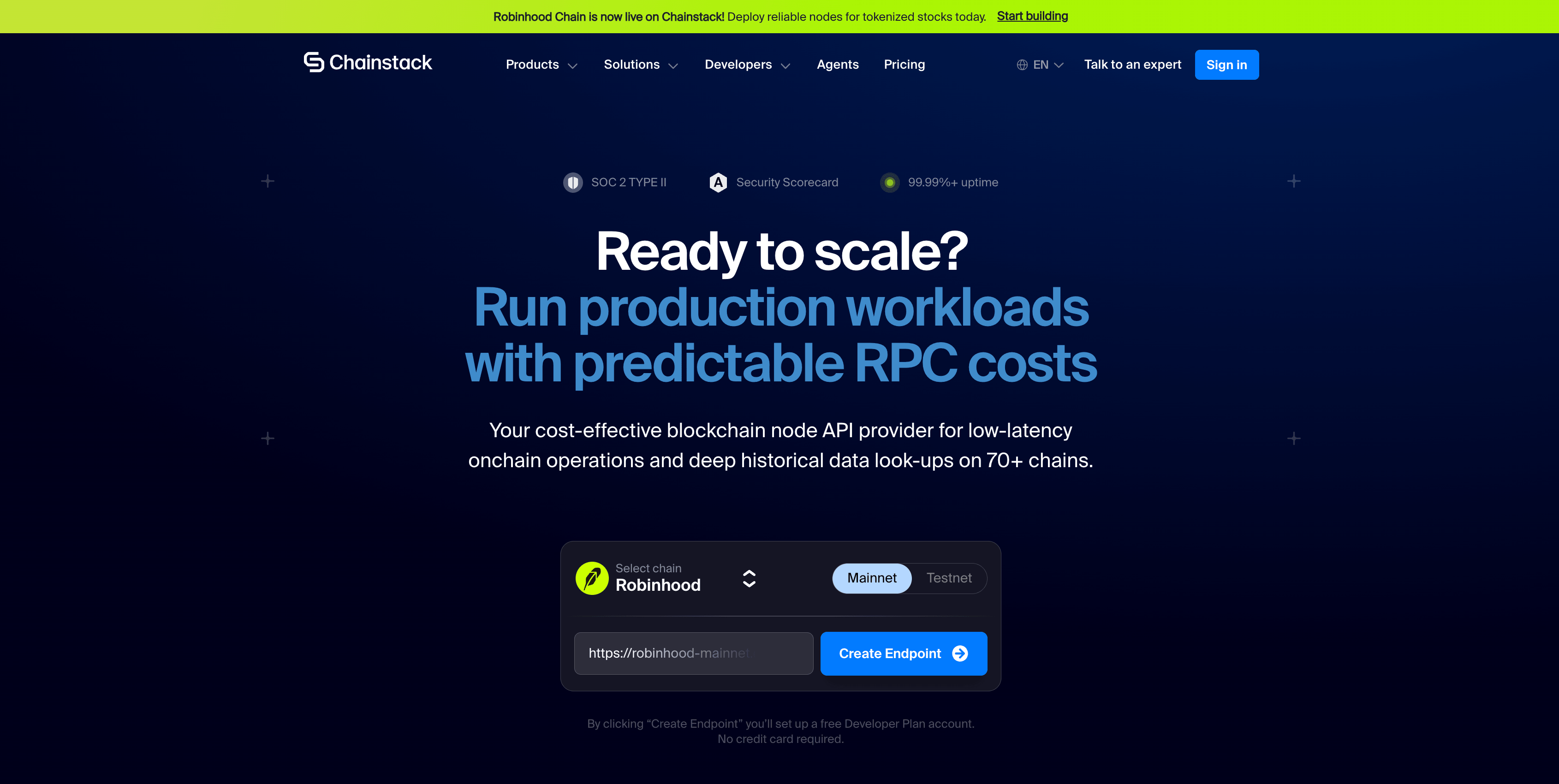
Chainstack runs Robinhood Chain RPC infrastructure across mainnet (chain ID 4663) and testnet (46630) with full debug_* tracing and archive access enabled from day one, flat request-unit pricing with no method-weighted multipliers, and a permanent free Developer plan that requires no credit card.
The no-public-mempool problem this article opens with is exactly what Chainstack Labs, the engineering team behind Chainstack’s protocol integrations, has built open-source tooling for. Beyond the sequencer-feed decoder described above, Chainstack Labs also published a reference listener for FOMO’s cross-chain Solana/Robinhood Chain trade flow: genuine, inspectable engineering work on this exact workload, not a marketing claim. A minimal filtered feed looks like this:
from rhfeed import FeedConsumer, addr, selector_of

async for msg in FeedConsumer().live():
    for tx in msg.txs:
        if tx.to_bytes == addr("YOUR_LAUNCHPAD_CONTRACT"):
            print(msg.seq, tx.hash, tx.selector)
On pricing: the free Developer plan includes 3M RU/month at 25 RPS; Growth is $49/month for 20M RU at 250 RPS; Pro is $199/month for 80M RU at 400 RPS; Business is $499/month for 200M RU at 600 RPS; Enterprise starts from $990/month with unlimited RPS. Archive requests (anything 127+ blocks behind the chain tip, or any debug_/trace_ call) bill at 2 RU versus 1 RU for a full request. For predictable high-volume polling, the Unlimited Node add-on offers flat-fee, RPS-tiered access from $149/month (25 RPS) to $3,199/month (500 RPS) with no per-request billing. Deployment options run from Global Nodes through Dedicated Nodes to Self-Hosted (Robinhood Chain mainnet is a supported Self-Hosted deployment, running Arbitrum Nitro). Chainstack holds SOC 2 Type II and ISO 27001, with 99.99%+ uptime. Robinhood Chain Global Nodes also support Optimized Submission, which routes eth_sendRawTransaction through a private, optimized path designed to reduce inclusion delays; it is off on a new node until you enable it from the node’s Add-ons tab.
Limitations: Chainstack doesn’t ship a prebuilt NFT-metadata or token-data API the way Alchemy does — teams get raw RPC plus the open-source tooling above rather than a managed indexing layer, so a marketplace still needs to build or pair with an indexer for rich metadata.
Fit by workload:
- Memecoin trading and sniping: Excellent — flat RU pricing keeps a high-frequency polling pattern forecastable, and archive/trace access lets you reconstruct a compliance-filtered transaction after the fact.
- NFT minting and marketplaces: Strong — Global Nodes and dedicated throughput absorb mint-moment traffic spikes, though you’re building the metadata layer yourself.
RouteMesh
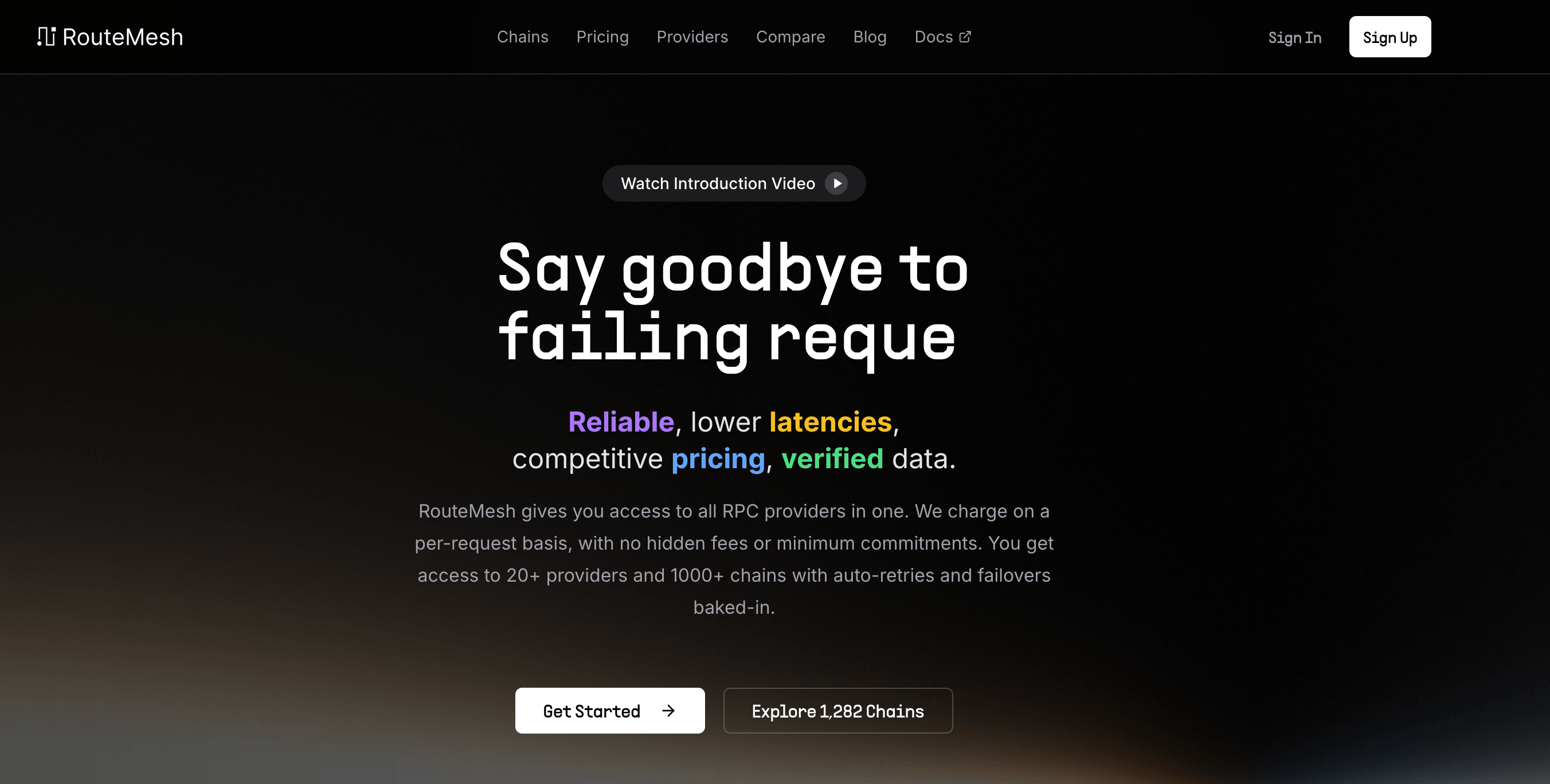
RouteMesh is an intelligent RPC routing layer spanning 1,000+ EVM networks, including Robinhood Chain, that aggregates multiple upstream providers behind sub-10ms routing decisions, real-time health scoring, and automatic failover.
Pricing is per-request, based on key type, chain, and method. Customers include LI.FI (routing 97% of its EVM RPC calls through RouteMesh across 60+ chains), Vaults.fyi, and DAMM Capital, and the platform ships an MCP server plus Cursor integration for agent-driven workflows.
Limitations: RouteMesh isn’t a node operator itself — it routes to upstream providers (Chainstack among them), so its behavior during an incident depends on which upstream it’s currently favoring, and it has no NFT-specific metadata tooling of its own.
Fit by workload:
- Memecoin trading and sniping: Excellent — sub-10ms routing and automatic failover matter most exactly when a launchpad token spikes and one upstream provider starts throttling.
- NFT minting and marketplaces: Good — the same failover benefit applies during a high-traffic mint, but there’s no NFT metadata API layered on top.
Dwellir
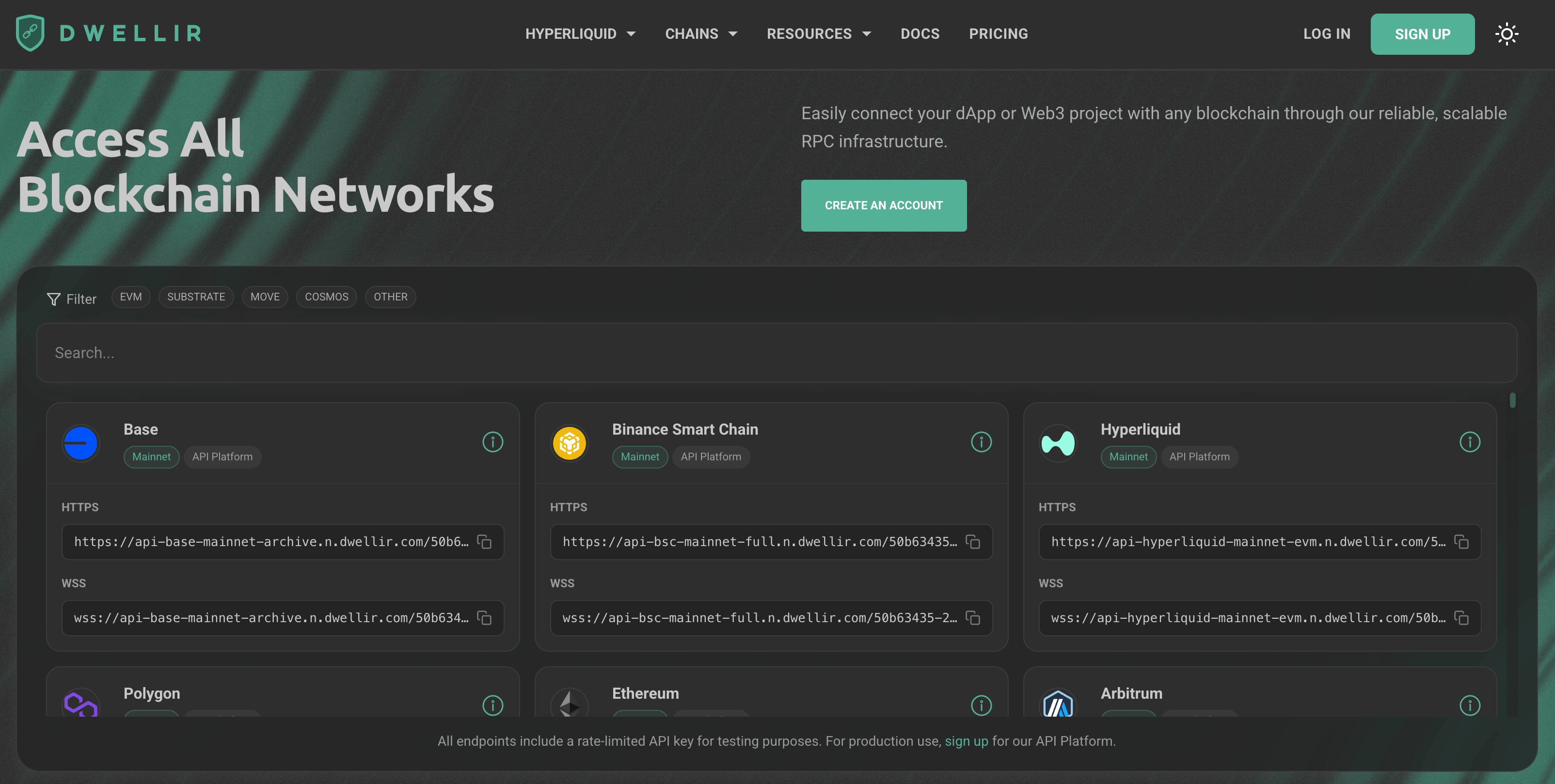
Dwellir is a Swedish RPC provider with a long Polkadot track record that now serves 150+ networks, Robinhood Chain mainnet among them, through a managed API and dedicated node clusters. Shared plans bill one credit per response regardless of method, so a bot that scans eth_getLogs continuously pays the same per call as one that only reads balances. WebSocket is available on every plan, which matters at Robinhood Chain’s 100 ms block time, and payment in crypto is accepted. Its Robinhood Chain endpoints are archive nodes, and a Robinhood Sequencer Feed add-on ($100/month plus usage, with a three-day trial) streams ordered messages through its Nitro relay, an alternative to running a feed decoder yourself.
Free covers 20 responses/second and 100,000 responses per day (without eth_getLogs); Developer is $49/month (25M responses, 100/second, eth_getLogs over up to 500 blocks), Growth $299/month (150M, 500/second, eth_getLogs over up to 10,000 blocks), and Scale $999/month (500M, 5,000/second). Unlimited Nodes start at $119/month flat (25–1,000 RPS), a fit for always-on sniping or indexing bots. A Robinhood Chain dedicated cluster is listed at $4,200/month with no rate limits.
Limitations: Dwellir offers raw RPC only: there is no NFT or token metadata API, bundler, or gas-sponsorship layer on top. We found no SOC 2 or ISO 27001 attestation on its public pages, and it is not part of the Chainstack performance dashboard’s Robinhood Chain benchmark below, so we have no comparative latency figures for it.
Fit by workload:
- Memecoin trading and sniping: Good — flat per-response billing, WebSocket on every plan, and a flat-rate Unlimited Node option suit continuous log scanning; measure latency from your own region first.
- NFT minting and marketplaces: Moderate — fine as the RPC layer under your own indexer, but metadata and mint-tracking APIs have to be built or sourced elsewhere.
Blockdaemon
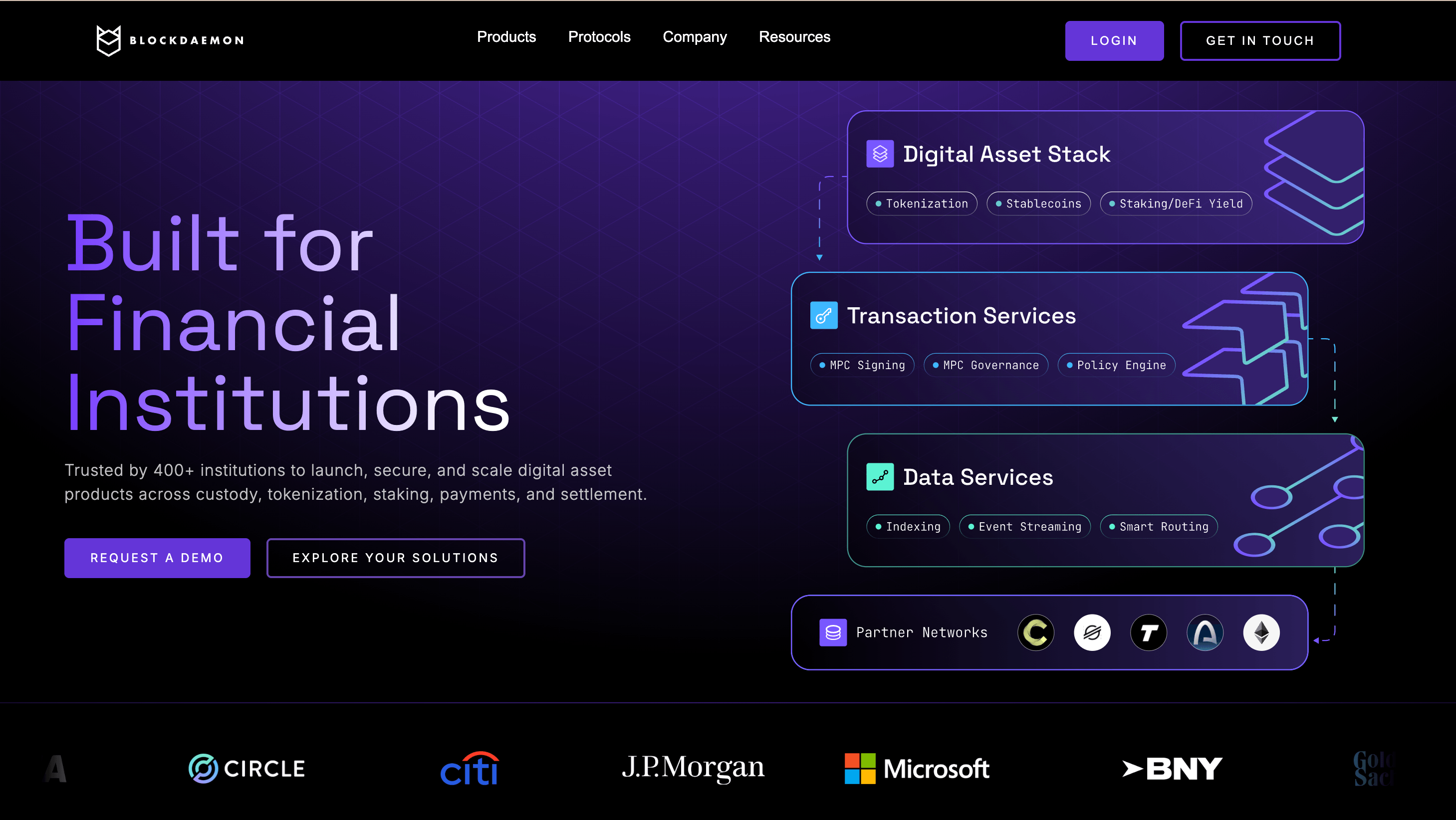
Blockdaemon offers institutional-grade RPC API access and dedicated node deployments for Robinhood Chain, aimed at banks, custodians, and funds that need isolated infrastructure and a security posture a procurement team can sign off on.
Infrastructure spans six continents in Tier 3 data centers with 24/7 support and a 99.9% uptime target, backed by SOC 2 and ISO 27001 certifications and custom, quote-based pricing rather than a self-service plan.
Limitations: there’s no self-serve free tier or transparent per-request pricing, which is a poor fit for an indie memecoin-sniping bot or a weekend NFT-mint script, and the product’s institutional custody/RWA focus doesn’t map cleanly onto retail-speed memecoin and NFT trading.
Fit by workload:
- Memecoin trading and sniping: Limited — enterprise-only engagement and no published free tier don’t match how fast-moving retail trading bots evaluate and ship.
- NFT minting and marketplaces: Moderate — dedicated, isolated infrastructure suits a regulated marketplace operator, but the procurement overhead is heavy for an independent NFT project.
Alchemy
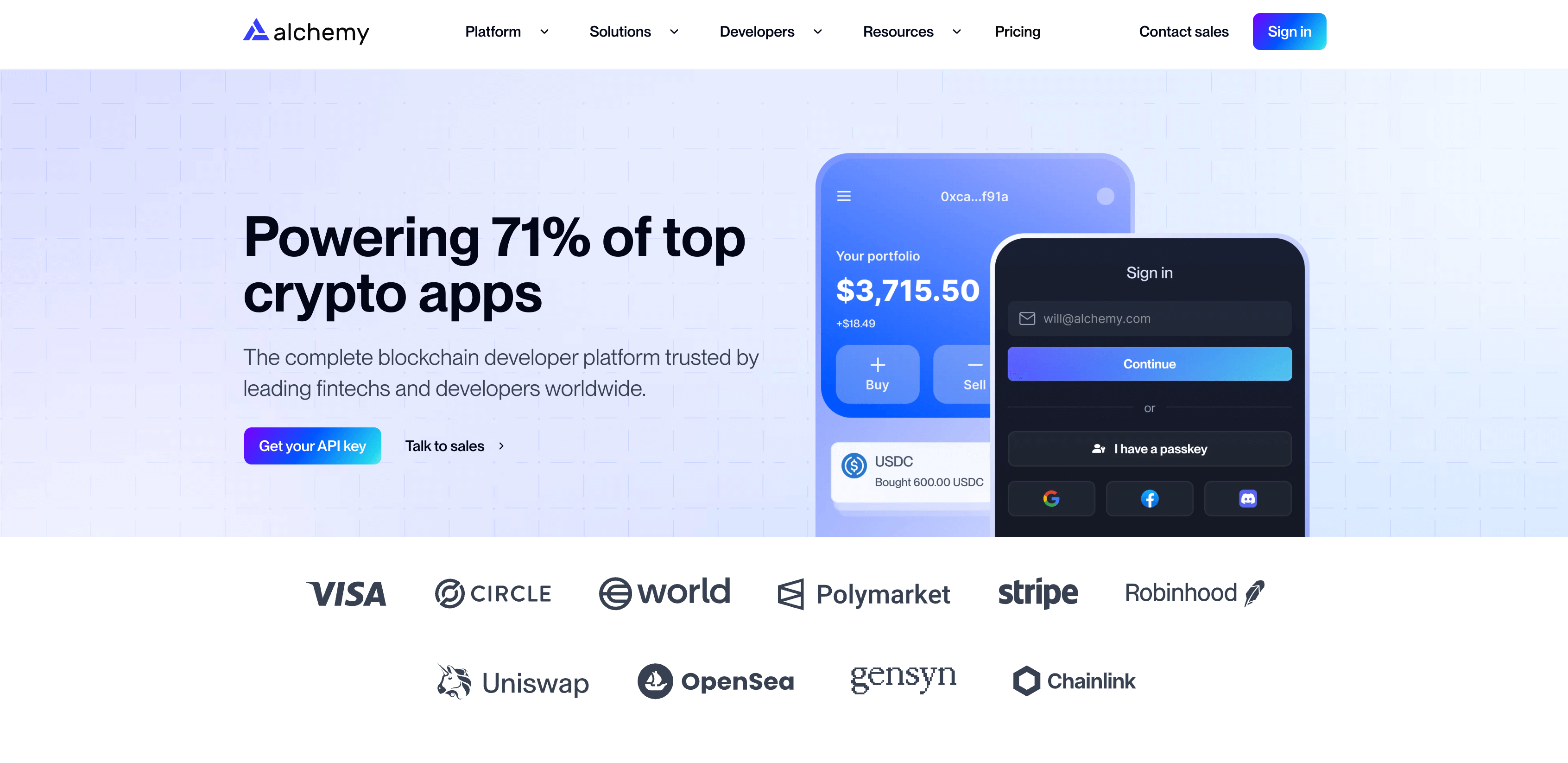
Alchemy serves Robinhood Chain mainnet and testnet over HTTPS and WebSocket, layering its NFT API, Token API, Transfers API, Bundler API, and Gas Manager API on top of standard JSON-RPC (its Robinhood Chain page lists the Debug and Trace APIs as not currently supported) — a genuinely strong fit for NFT marketplaces and ERC-4337 wallet-based memecoin trading apps.
Pricing is compute-unit (CU) based and method-weighted, with a permanent free tier that comfortably covers development and small production apps, a real advantage over a trial-only competitor. Alchemy holds SOC 2 Type II; it does not publish an ISO 27001 certification. Budget-conscious teams scaling past the free tier should model Alchemy’s CU costs carefully, since the sticker price understates what heavy trace or NFT-metadata usage actually costs once volume grows.
Limitations: Alchemy doesn’t offer standard dedicated nodes, which is a real gap for a launch-day traffic spike that needs isolated, contention-free throughput, and its CU-weighted pricing makes cost forecasting harder for trace- and metadata-heavy workloads than a flat-rate model.
Fit by workload:
- Memecoin trading and sniping: Good — Bundler and Gas Manager APIs suit ERC-4337 trading wallets, but no dedicated nodes is a real gap once volume is sustained.
- NFT minting and marketplaces: Excellent — the NFT API and Transfers API cover metadata and mint tracking that most teams would otherwise build themselves.
Quicknode

Quicknode runs Robinhood Chain mainnet infrastructure from 17+ global regions and states 99.99% uptime, with full archive access, debug/trace methods, and Streams and Webhooks for event-driven indexing — a mature, broadly capable option for teams already standardized on Quicknode elsewhere.
Pricing is credit-based and method-weighted, and there’s no permanent free tier: access is a time-limited trial rather than a standing plan. Quicknode holds both SOC 2 Type II and ISO 27001, and dedicated clusters are available for isolated throughput. Quicknode’s credit-based pricing can surprise teams once trace calls or NFT-metadata polling enter the mix, so it’s worth modeling before committing to a tier.
Limitations: the absence of a standing free tier makes a long-running low-volume monitoring bot or a hobbyist NFT-mint script awkward to host past the trial window, and method-weighted credits can spike unpredictably for a log-heavy sniping bot scanning eth_getLogs continuously.
Fit by workload:
- Memecoin trading and sniping: Strong — Streams/Webhooks and full archive suit a production sniping or analytics bot once you’re past the free-trial stage.
- NFT minting and marketplaces: Strong — solid infrastructure for a marketplace backend, though there’s no standing free tier for early prototyping.
Real-world performance benchmark
Robinhood Chain is one of the chains tracked on the Chainstack performance dashboard, alongside Ethereum, Solana, BNB Smart Chain, Arbitrum, Base, and Hyperliquid. For a quick top-level ranking, compare.chainstack.com refreshes every 3 minutes and is the faster read; the Grafana dashboard is the drill-down when you need method-level detail — eth_call, eth_getLogs, and eth_subscribe latency by provider and region — which matters most for a sniping bot or mint-tracker deciding where to route.
As of September 16, 2026, compare.chainstack.com ranked Chainstack #1 for Robinhood Chain over the trailing 24 hours, with 99.98% availability and a 71ms global P95. At that date the dashboard benchmarked four providers directly for this chain: three of the six compared in this article (Chainstack, Quicknode, Alchemy) plus dRPC. Dwellir is not part of that benchmark.
| Provider | Score (lower is better) | Availability | P50 / P95 / P99 | DE P95 | US P95 | SG P95 |
|---|---|---|---|---|---|---|
| Chainstack | 0.071 | 99.98% | 16ms / 71ms / 288ms | 46ms | 113ms | 55ms |
| Quicknode | 0.073 | 100.00% | 55ms / 73ms / 94ms | 29ms | 101ms | 88ms |
| Alchemy | 0.080 | 100.00% | 21ms / 80ms / 156ms | 30ms | 44ms | 167ms |
| dRPC | 0.091 | 99.99% | 21ms / 91ms / 197ms | 56ms | 86ms | 132ms |
The regional split matters more than the headline number for a sniping bot: Alchemy edges out Chainstack on US P95 (44ms vs 113ms) but falls badly behind in Singapore (167ms vs 55ms), while Chainstack holds the tightest P50 (16ms) but trails Quicknode on the tail (P99 of 288ms against Quicknode’s 94ms). Route to the region your bot actually runs from, not the global average.
An independent benchmarking project, OpenChainBench, separately spot-checked keyed Robinhood Chain RPC providers on X in September 2026 and also found Chainstack fastest of the three it tested, with Quicknode trailing well behind — directionally consistent with the dashboard above, even though its absolute millisecond figures (a single spot-check from a different vantage point and methodology) don’t need to match the dashboard’s continuous averages exactly.
Because these tools update continuously, treat any specific millisecond figure as a snapshot rather than something to hardcode into your own decision. Before committing a sniping bot or mint-tracker to a provider, pull the current numbers for your target region and the methods your bot actually calls, rather than relying on a headline average latency figure that may not reflect your traffic pattern.
Getting started with memecoin trading and NFT infrastructure on Chainstack
Deploy a Robinhood Chain endpoint in a few steps:
- Log in to the Chainstack console (or create an account).
- Create a new project
- Select Robinhood Chain as your blockchain protocol
- Choose network: Robinhood Chain Mainnet or Testnet
- Deploy the node
- Open Access and credentials and copy your HTTPS and WebSocket endpoints
For a sniping bot or mint-tracker that needs isolated throughput once it’s past prototyping, evaluate Dedicated Nodes after the initial deploy — it’s available inside the same project.
A minimal connection and balance check, matching the style in the Robinhood Chain tooling documentation:
const { ethers } = require("ethers");

const provider = new ethers.JsonRpcProvider("YOUR_CHAINSTACK_ENDPOINT");

// Minimal ERC-20 ABI for reading a memecoin balance
const ABI = ["function balanceOf(address owner) view returns (uint256)"];
const TOKEN = "YOUR_TOKEN_CONTRACT_ADDRESS";

const token = new ethers.Contract(TOKEN, ABI, provider);
const balance = await token.balanceOf("YOUR_WALLET_ADDRESS");

console.log(`Balance: ${ethers.formatUnits(balance, 18)}`);
📖 For the full integration guide, see the Chainstack Robinhood Chain tooling documentation.
Need testnet ETH to test a bot or mint flow before going live? Grab some from the Chainstack Robinhood Chain faucet.
🤖 You can also access Chainstack Robinhood Chain RPC directly from Claude, Cursor, Codex, Windsurf, Gemini CLI, GitHub Copilot, Antigravity, Claude.ai, or ChatGPT using Chainstack MCP. For a fuller agent stack — MCP, the Chainstack skill, llms.txt for context ingestion, and WebMCP for agentic browsers — see the Chainstack Agents page.
Moving a sniping bot or NFT indexer off an existing Alchemy or Quicknode setup rather than starting fresh? The Robinhood Chain RPC migration guide walks through both an AI-agent-assisted path (paste a prompt into Claude, Cursor, or a compatible coding agent to assess and swap endpoints) and the manual route: inventory existing endpoints, estimate usage, deploy, swap URLs, smoke test, cut over.
💰 Promo: New to Robinhood Chain on Chainstack, or expanding an existing account to it? Apply code
ROBINHOOD50for 50% off the Growth plan — $24.50/month instead of $49/month — for the first 3 months.
Conclusion
The single most important thing to design around on Robinhood Chain in 2026 is the absence of a public mempool. Every other decision — which methods you poll, whether you need a dedicated node, how you handle a filtered transaction — flows from the fact that you’re reacting to soft-confirmed sequencer output, not watching a pending-transaction pool.
- Memecoin sniping bots and launchpad indexers: Chainstack, Dwellir, or RouteMesh for flat/forecastable pricing and failover under launch-spike load; Quicknode once you’re past prototyping and need Streams for production analytics.
- NFT marketplaces and mint-tracking apps: Alchemy for prebuilt NFT and token metadata APIs; Chainstack or Dwellir if you’re pairing raw RPC with your own indexer.
- Regulated marketplace or launchpad operators: Blockdaemon or Chainstack for audited SOC 2 Type II and ISO 27001 attestation with dedicated infrastructure.
- Cross-chain memecoin flow (Solana + Robinhood Chain): pair a Robinhood Chain endpoint with a Solana Yellowstone gRPC feed — see Chainstack Labs’ open-source FOMO listener referenced above for a working example.
Frequently asked questions
Q: Does Robinhood Chain have a public mempool for spotting pending memecoin trades or NFT mints?
No. RPC endpoints, explorers, and indexers only see a transaction after the sequencer has already committed its ordering. The closest available signal is the sequencer broadcast feed over WebSocket, which offers soft-confirmation visibility slightly ahead of full block propagation — not a mempool, and not front-running opportunity.
Q: Which Robinhood Chain RPC providers have a permanent free tier?
Chainstack (3M RU/month, 25 RPS, no card required) and Alchemy both offer a standing free plan. Quicknode’s free access is a time-limited trial rather than a permanent tier. RouteMesh is a per-request routing layer rather than a standalone free/paid plan, and Dwellir also offers a free plan (100,000 responses per day).
Q: What happens to Robinhood Chain RPC and gas costs after the wallet gas subsidy ends?
Robinhood’s 90-day gas subsidy for transactions made inside the Robinhood Wallet ended September 29, 2026. It only ever covered wallet-originated transactions, not RPC provider costs, but the chain’s daily revenue had already dropped sharply ahead of the deadline — worth watching for how memecoin and NFT trading volume responds once users start paying their own gas.
Q: What RPC latency do memecoin sniping bots need on Robinhood Chain?
Robinhood Chain produces blocks roughly every 100 milliseconds with no priority-fee auction, so the practical race is on detection and submission speed rather than gas bidding. Prioritize stable WebSocket subscriptions (eth_subscribe) over polling, and check current p95/p99 figures for your target region on the Chainstack performance dashboard rather than relying on a headline average.
Q: Which providers meet compliance requirements for building a regulated NFT marketplace or launchpad on Robinhood Chain?
Chainstack holds audited SOC 2 Type II and ISO 27001 certifications. Blockdaemon and Quicknode also publish their own SOC 2 and ISO 27001 attestations, and Alchemy holds SOC 2 Type II but not ISO 27001. RouteMesh is a routing layer whose compliance posture depends on which upstream provider it routes to at a given moment, and Dwellir publishes no SOC 2 or ISO 27001 attestation on its public pages.
Q: Which pricing model is easiest to forecast for high-volume memecoin or NFT indexing?
Flat, non-method-weighted pricing is the most predictable. Chainstack bills every request at 1 RU (2 RU for archive/trace), and its Unlimited Node add-on gives flat-fee access with no per-request billing at all. Alchemy’s compute units and Quicknode’s credits are both method-weighted, meaning a log-heavy sniping bot or a metadata-heavy NFT indexer pays a multiple of a simple read on every call.
Additional resources