AI-ready infrastructure
 Refer and earn


 Ethereum
 Hyperliquid
 Solana
 Arbitrum
 BNB Smart Chain
 Base
Base Polygon
 TRON
TRON Sui
Sui Robinhood


What’s behind Robinhood Chain’s growth: TVL, revenue and RPC

Robinhood Chain: nearly three months in. And it still hasn’t slowed down. As of DefiLlama’s live numbers, the Arbitrum Orbit layer-2 is running $992M in total value locked and $1.05B in daily DEX volume — both higher than a month ago. Daily chain revenue tells a different story: after peaking near $4.01M around the September 1 ARB rally, it’s cooled to $186K in the most recent 24 hours, even though the trailing 30-day total is still up more than 12x on the 30 days before. Real-world-asset value on the chain has gone from roughly $14M in July to $170.6M today.
That sustained growth is what pulled Arbitrum into the story. Robinhood Chain runs on Arbitrum’s stack and pays a cut of its revenue directly to the Arbitrum DAO under an arrangement called the Arbitrum Expansion Program — and on September 1, 2026, a $1.92M revenue day was enough to send ARB, Arbitrum’s governance token, up roughly 30%. It wasn’t a one-off: a smaller version of the same thing happened back in July, too.
This piece covers where that growth is actually coming from, how the Arbitrum payout mechanism works, whether the trajectory holds up under scrutiny, and — because a chain moving this much money is also an infrastructure story — what it demands from the RPC layer underneath it.
The growth, in numbers
Robinhood Chain’s headline metrics, per Arbitrum’s own ecosystem dashboard (built with Entropy Advisors): total asset market cap $2.19B (+72.01% 30d), stablecoin market cap $1.06B (+49.32% 30d), total tokenized value $170.6M (+342.16% 30d), and protocol TVL $1.6B (+58.29% 30d). By protocol type, that TVL splits lending (32.2%), asset management (30.6%), spot DEXs (19.2%), RWAs (10.7%), and perp DEXs (7.4%).
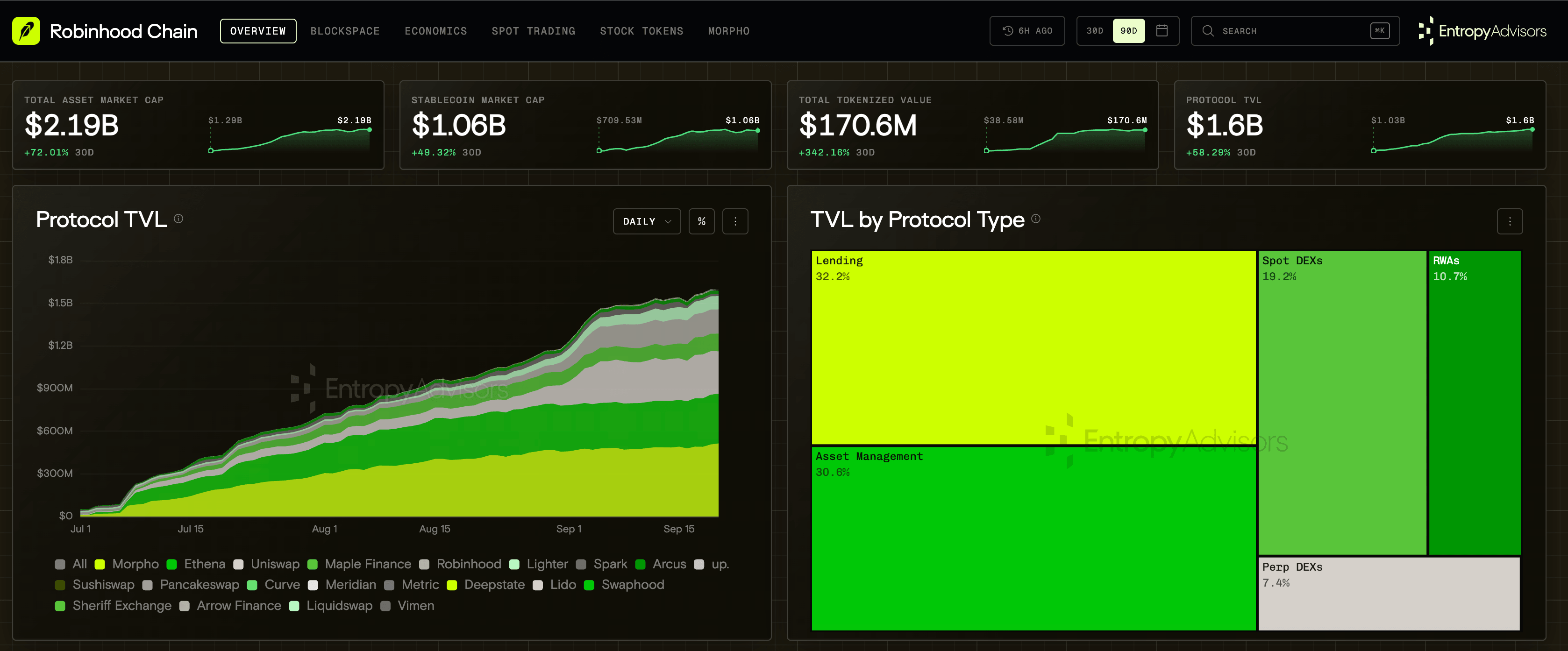
DefiLlama tracks a few metrics the dashboard above doesn’t break out, using its own DeFi-only TVL definition:
| Metric (DefiLlama) | Current value |
|---|---|
| DeFi TVL | $992M |
| DEX volume (24h) | $1.05B |
| Perps volume (24h) | $443.7M |
| Chain revenue (24h) | $186K |
| Bridged TVL | $3.31B |
The picture is more mixed than it was on Sep 3. DeFi TVL and DEX volume have both kept climbing — up from $796M to $992M, and from a $1.4B pace to $1.05B in the most recent 24-hour window — daily perps volume has climbed to $443.7M, and bridged TVL now sits at $3.31B. Chain revenue has moved the other way day to day: after peaking near the $1.92M that triggered ARB’s rally on September 1, it’s pulled back to $186K in the latest 24 hours — even though the trailing 30-day total is still up more than 12x versus the 30 days before, and the trailing 12-month pace annualizes to roughly $104.9M/year. The tokenized-value figure tells a cleaner growth story: Robinhood Chain’s own dashboard now puts it at $170.6M, up more than 12x since FalconX estimated it at roughly $14M in July — even as RWAs’ share of overall TVL has shrunk to about 11%, per the current protocol-type breakdown, as lending and asset management grew faster around it.
How Robinhood Chain got here
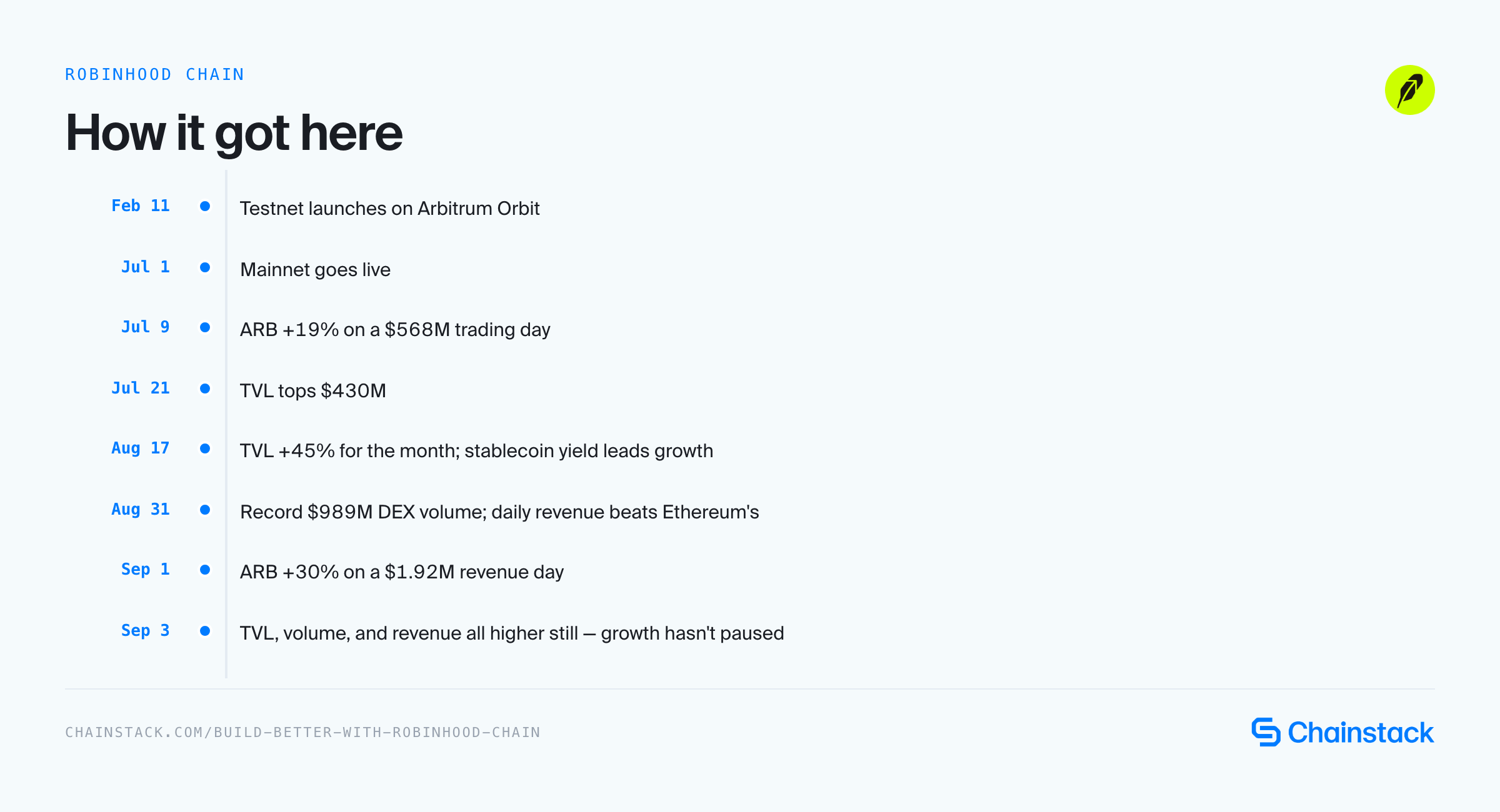
Sourced in detail:
- Feb 11, 2026 — Testnet launches on Arbitrum Orbit, with $1M committed to jumpstart the developer ecosystem; the testnet goes on to process over 200 million transactions.
- Jul 1, 2026 — Mainnet goes live, “built with the Arbitrum Platform,” with two day-one AMMs — Uniswap’s dedicated deployment as the public liquidity venue, and Pleiades’ proprietary AMM as a private prop-trading venue — plus 24/7 tokenized stocks and Lighter perps.
- Jul 9, 2026 — ARB jumps 19% on a $568M Robinhood Chain trading frenzy — the first sign the revenue-share mechanic moves the token.
- Jul 21, 2026 — TVL passes $430M; FalconX names RWAs the chain’s key differentiator. Separately, FalconX forecast transaction revenue could reach $60M/year by 2030.
- Aug 17, 2026 — TVL up 45% for the month, with stablecoin market cap growth (led by USDe) outpacing tokenized RWAs as the main growth driver.
- Aug 31, 2026 — Daily app revenue beats Ethereum’s; The Block confirms a record $989M single-day DEX volume, TVL at $708M.
- Sep 1, 2026 — ARB rallies 30% on a $1.92M revenue day, per CoinDesk.
- Sep 3, 2026 — TVL, DEX volume, and chain revenue all sit above their Aug 31 levels — the growth hasn’t paused since the headline day.
- Sep 21, 2026 — Protocol TVL passes $1.6B and total asset market cap tops $2.19B, per Arbitrum’s ecosystem dashboard, even as daily chain revenue pulls back sharply from its September 1 peak — the trailing 30-day total is still up more than 12x versus the prior month, per DefiLlama.
You can follow the raw activity behind most of these milestones directly on Robinscan, Robinhood Chain’s block explorer.
What’s actually driving the growth
The composition has kept shifting since launch. By TVL, the two largest protocols on Robinhood Chain remain lending-and-yield venues — Morpho Blue (now $555M, up from $489M on Sep 3) and Steakhouse Financial (now $511.5M, up from $476M) — not the memecoin trading apps that made headlines in August. Uniswap‘s combined deployments run the chain’s public liquidity venue at $273.3M TVL, up from $192M; Lighter handles perps at $94.3M, up from $56M; and Arcus, the dYdX-team DEX backing 95+ tokenized stocks and perps, now holds about $25M, up from $21M.
The trading side hasn’t gone away, though. On Aug 30, 2026, three apps — GMGN, Pons, and Uniswap — produced 88% of all app revenue (a different measure from TVL) on the chain, per CoinDesk. GMGN is a memecoin trading terminal; Pons is a launchpad that shipped 22,600 new tokens that single day. A second launchpad, LONG, specializes in tokens paired against tokenized stocks rather than ETH — a token called “AI” ran from a $1.5M to a $135M market cap in August trading against tokenized NVDA, and stock-paired memecoins now account for roughly a quarter of all stock-linked trading volume on the chain. That concentration has held up: over the trailing 30 days, the same three apps remain the top app-revenue earners on Robinhood Chain, per DefiLlama — GMGN ($25.89M), Pons ($24.55M combined across its two versions), and Uniswap ($9.1M).
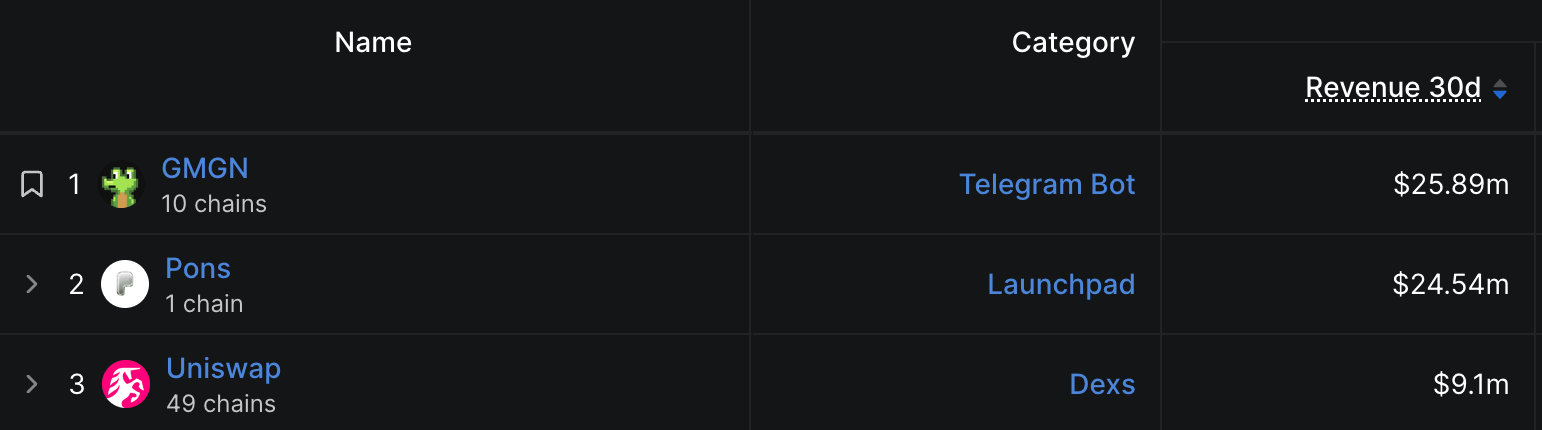
Put together, that’s two growth stories running in parallel: a fast-rotating trading and launchpad layer that drives the biggest single-day revenue numbers, and a steadier lending, yield, and RWA layer that’s been compounding underneath it since launch. Pleiades, the chain’s other day-one AMM, runs a separate, private prop-trading venue alongside Uniswap’s public one — it doesn’t appear to have a public site to link to, being built for permissioned prop-trading access rather than retail users.
The Arbitrum angle: how the revenue-share works
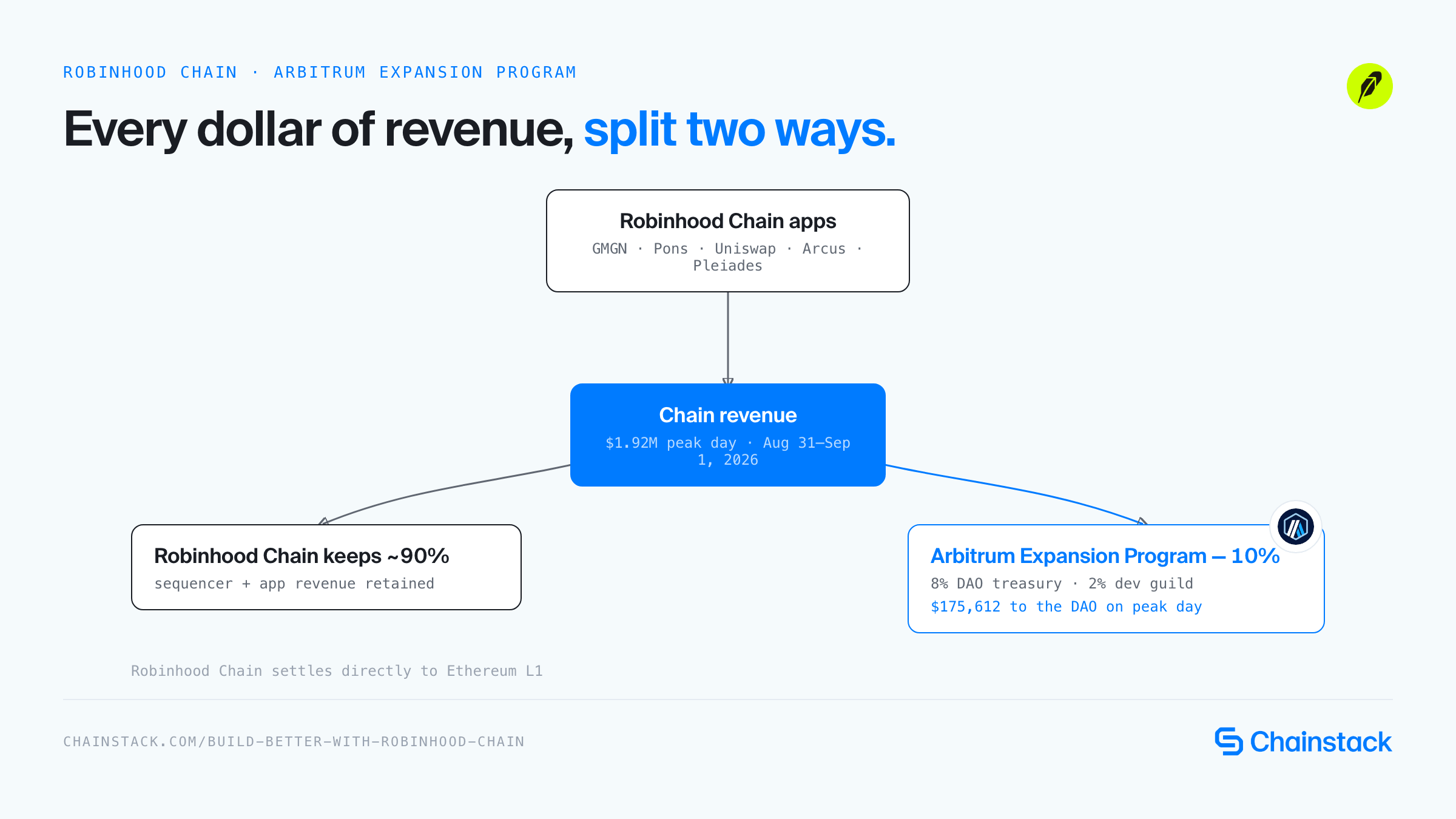
The arrangement has an official name: the Arbitrum Expansion Program. Under it, chains built on Arbitrum’s stack — historically branded Orbit, now the Arbitrum Platform — that settle to a parent chain other than Arbitrum One or Nova pay 10% of chain profit: 8% to the Arbitrum DAO treasury, 2% to a protocol developer guild. On the $1.92M revenue day, the DAO’s take was $175,612 over 24 hours — a figure that scales directly with whatever Robinhood Chain earns. Ethereum’s side of the ledger looks nothing like that. An earlier snapshot from July, cited by Ethereum Daily, found Robinhood Chain collecting about $843,000 in user fees on a given day while paying Ethereum roughly $1,600 for L1 data availability and settlement — Arbitrum’s cut moves with the chain’s revenue; Ethereum’s is closer to a fixed shipping cost.
“Ethereum’s cut is a fixed-ish L1 data-posting cost, not a revenue share. Arbitrum’s cut is a true percentage-of-revenue license. So on a spike day, Arbitrum scales up with revenue but Ethereum barely moves in dollar terms.” — Lorenzo Valente, ARK Invest, via CoinDesk
The closest comparison outside Arbitrum is Optimism’s Superchain, where OP Stack chains pay the Optimism Collective the greater of a small percentage of gross sequencer revenue or a share of onchain profit — with Base, run by Coinbase, as the model’s biggest payer. In both ecosystems the logic is the same: the stack provider licenses out a franchise of chains, and one breakout chain can dominate the economics. Base did that for Optimism years ago. Robinhood Chain, still growing nearly three months in, is doing it for Arbitrum now.
| Model | Stack provider | Flagship payer | Revenue share |
|---|---|---|---|
| Arbitrum Expansion Program | Arbitrum DAO | Robinhood Chain | 10% of chain profit (8% treasury / 2% dev guild) |
| OP Stack / Superchain | Optimism Collective | Base | Greater of ~2.5% of gross sequencer revenue or 15% of net profit |
Does the growth hold up?
So far, mostly yes, on the metrics that matter most: TVL and DEX volume are both higher today than on the day the chain first made headlines. Chain revenue is the exception — it’s pulled back sharply from its September 1 peak on a daily basis, even though the trailing 30-day total is still up more than 12x versus the month before. That’s a meaningfully different pattern than a single viral spike that fades outright — CoinDesk’s own 30-day data from early September showed roughly two-thirds of that month’s chain revenue arriving in just the final week, and the cumulative total has kept climbing since, even as the daily pace has cooled.
The open question is composition, not direction. Launchpads on the chain rotate fast — Pons and LONG lead today, and neither is guaranteed to hold that spot, based on how quickly volume moved between apps earlier in the summer. But the fact that Morpho and Steakhouse Financial — lending and yield protocols, not trading terminals — now sit at the top of the TVL leaderboard suggests the base is broadening past the launchpad cycle, not just riding it. FalconX’s July forecast of $60M/year in transaction revenue by 2030 already looks conservative against a chain running a $104.9M/year annualized revenue pace, per trailing 12-month DefiLlama data — even after daily revenue cooled from its September 1 peak.
The infrastructure side of sustained growth
Strip away the token price action and Robinhood Chain’s numbers describe an infrastructure event that’s still ongoing: a chain running roughly $1B in daily DEX volume, with activity concentrated in apps that can’t tolerate a slow or flaky RPC endpoint — memecoin terminals and launchpads on one side, lending and perps protocols moving real size on the other.
GMGN– and Pons-style trading interfaces, the LONG launchpad, Arcus’s tokenized-stock and perp markets, and Morpho– and Steakhouse-style lending all depend on execution-layer access that doesn’t fall over during a burst. Robinhood Chain also sequences transactions first-come-first-served, with no priority-fee auction — which puts more of the burden on the reliability of the endpoint submitting the transaction, and less on outbidding other users for inclusion.
The right node type depends on which side of that activity an app sits on:
- A launchpad or trading bot hammering the same few methods at high, spiky RPS — a flat-fee Unlimited Node beats metered billing that spikes with the chain’s own volume.
- A lending protocol or market maker that needs isolated capacity and predictable latency — Dedicated Nodes, instead of sharing capacity on a shared endpoint.
- A team that wants to run infrastructure on its own hardware, for compliance reasons or to sit as close as possible to its own matching engine — Self-Hosted rather than a managed node.
- Everything else — most indexers, dashboards, and app backends reading chain state — a standard Global Node covers it, and it’s what carries the
debug_*tracing this chain needs.
Teams migrating an existing Robinhood Chain RPC setup can currently do it at a discount: Chainstack’s migration guide lists 50% off the Growth plan for the first three months with code ROBINHOOD50. For testnet work, Chainstack also runs a Robinhood Chain testnet faucet, topping addresses up to 1 ETH every 24 hours.
Debug and trace access matters more here than on a quieter chain, too. A launchpad shipping tens of thousands of tokens a month needs debug_traceTransaction and debug_traceCall to diagnose a broken deploy fast, before the next rotation makes the question moot. And getting a clean read on the chain’s own growth — the real TVL split, the actual daily volume — is ultimately a question an archive node can answer directly: historical state and traces from genesis, queryable on demand instead of waiting on the next dashboard refresh.
Chainstack has run Robinhood Chain RPC infrastructure since the mainnet’s early days:
- Full and archive nodes on both Mainnet (chain ID
4663) and Testnet (chain ID46630) - The standard
eth_*,net_*, andweb3_*namespaces - Geth-style
debug_*tracing on a Global Node - WebSocket subscriptions for
newHeads,logs, andnewPendingTransactions— the feed a trading bot or perp interface needs to react to a chain moving this fast in real time
How to get a Robinhood Chain RPC endpoint on Chainstack
- Log in to the Chainstack console (or create an account)
- Create a new project
- Select Robinhood Chain as your blockchain protocol
- Choose network: Mainnet (chain ID 4663) or Testnet (chain ID 46630)
- Deploy the node
- Open Access and credentials and copy your HTTPS and WebSocket endpoints
Full details, including SDK setup and wallet configuration, are in the Robinhood Chain tooling docs and the Robinhood Chain API reference.
Conclusion
Robinhood Chain’s Aug 31 headline made it look like a one-day story: a memecoin surge, a revenue record, a 30% pop in a token that isn’t even Robinhood’s own. Nearly three months in, the more interesting story is that it hasn’t stopped since — TVL and DEX volume are both higher today than they were on the day everyone started paying attention, and the composition has broadened from launchpads and trading terminals toward lending and yield protocols carrying real size. Daily chain revenue has cooled from its September 1 peak, but the trailing 30-day total is still up more than 12x on the month before.
Arbitrum’s Expansion Program means that growth isn’t contained to one chain — every dollar Robinhood Chain adds to its run-rate is a dollar that scales Arbitrum’s own treasury with it, which is exactly why the market has now repriced ARB twice off the same mechanism in three months. And underneath both the growth story and the token story is an infrastructure one: a chain running roughly $1B in daily volume across memecoin terminals, launchpads, lending markets, and perp venues is a burst-traffic problem that somebody has to actually serve.
FAQs
Robinhood Chain is an Arbitrum Orbit layer-2 that Robinhood launched on July 1, 2026, for tokenized stocks and other real-world assets. It settles to Ethereum, uses ETH as its native gas token, and runs the same Nitro client as Arbitrum One.
Mainnet is chain ID 4663 and testnet is chain ID 46630.
Yes, though not evenly. As of Sep 21, 2026, TVL ($991M) and daily DEX volume (roughly $1B) are both higher than they were on Aug 31, 2026 — the day the chain first made headlines for beating Ethereum’s daily revenue. Daily chain revenue has pulled back sharply from its September 1 peak of $1.92M to about $186K, even though the trailing 30-day total is still up more than 12x versus the month before.
Both, in different ways. By revenue, memecoin and launchpad apps like GMGN and Pons dominate single peak days. By TVL, lending and yield protocols — Morpho Blue and Steakhouse Financial — are now the two largest apps on the chain, and RWA market cap has grown more than 12x since July even as its share of overall TVL has shrunk.
Under the Arbitrum Expansion Program, chains built on Arbitrum’s stack that settle outside Arbitrum One or Nova pay 10% of chain profit — 8% to the Arbitrum DAO treasury, 2% to a protocol developer guild. On Robinhood Chain’s Sep 1 revenue day, that came to $175,612 in 24 hours.
Yes, twice. ARB jumped 19% on July 9, 2026 after a $568M Robinhood Chain trading day, then 30% on September 1, 2026 after a $1.92M revenue day.
The trend so far says yes on direction, unresolved on composition. Every headline metric has kept climbing past the initial spike, but a meaningful share of the revenue still comes from fast-rotating launchpads rather than the lending and RWA protocols the chain was originally built around.
Additional resources