AI-ready infrastructure
 Refer and earn


 Ethereum
 Hyperliquid
 Solana
 Arbitrum
 BNB Smart Chain
 Base
Base Polygon
 TRON
TRON Sui
Sui Robinhood


Best crypto market intelligence tools

Best crypto market intelligence tools for developers
Crypto products rarely need only a price feed. A trading agent may need technical indicators and live signals. A portfolio application needs wallet balances, DeFi positions, and transaction histories. An institutional research platform may need on-chain cost-basis data, while a protocol dashboard needs standardized revenue and user metrics.
The best crypto market intelligence tool therefore depends on the layer of intelligence your product needs. This guide compares seven developer-focused platforms across analytics, market data, portfolio intelligence, on-chain metrics, protocol fundamentals, social signals, and custom blockchain queries.
The best crypto market intelligence tools at a glance
| Rank | Tool | Best for | API pricing |
|---|---|---|---|
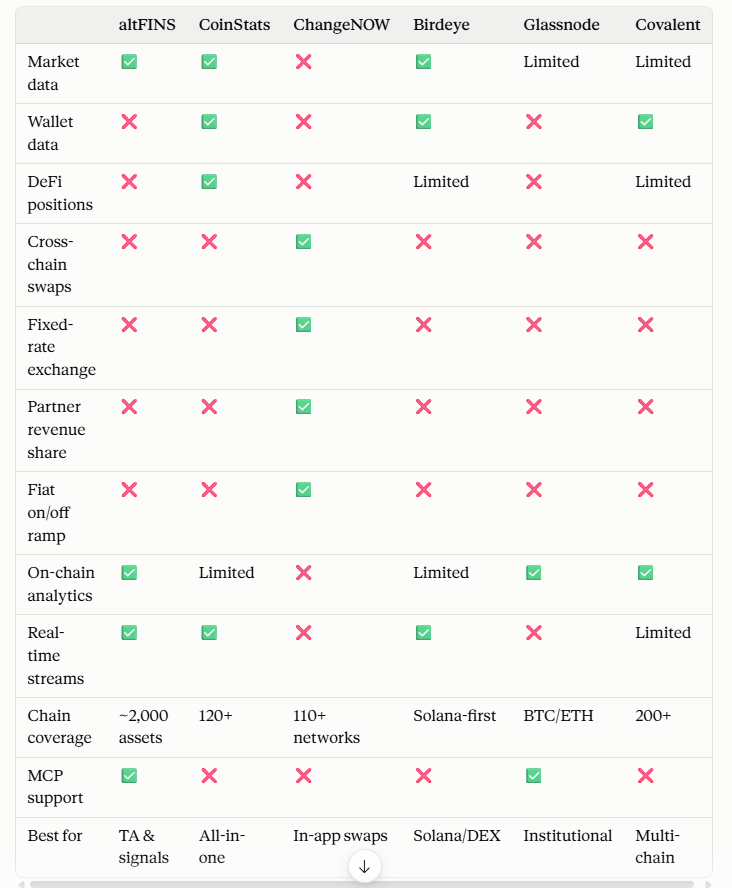
| 1 | altFINS API | Pre-computed indicators, patterns, scans, and trading signals | Free; paid plans from $39 per month |
| 2 | CoinStats API | Wallet, portfolio, exchange, and DeFi aggregation | Free; paid plans from approximately $49 per month |
| 3 | CoinGecko API | Broad cryptocurrency market and DEX data | Free; paid plans from $35 per month |
| 4 | Glassnode API | Institutional on-chain and crypto-financial metrics | Configurable Professional plan |
| 5 | Token Terminal API | Standardized protocol fundamentals | Custom API pricing |
| 6 | Santiment SanAPI | Social, developer, and behavioral signals | Free with delayed data; unrestricted real-time access from $249 per month |
| 7 | Dune API | Custom SQL-based on-chain intelligence | Credit-based; paid plans from $75 per month |
How we evaluated the tools
We compared each platform across six practical criteria:
- Data layer: The type of intelligence the platform provides.
- Developer access: REST, GraphQL, SDK, Model Context Protocol (MCP), command-line interface, or SQL access.
- Coverage: Supported assets, exchanges, blockchains, and protocols.
- Freshness and history: Update frequency, available timeframes, and historical depth.
- Pricing: Free access, commercial-use requirements, and usage limits.
- Product fit: The applications and workflows where the platform provides the most value.
1. altFINS API
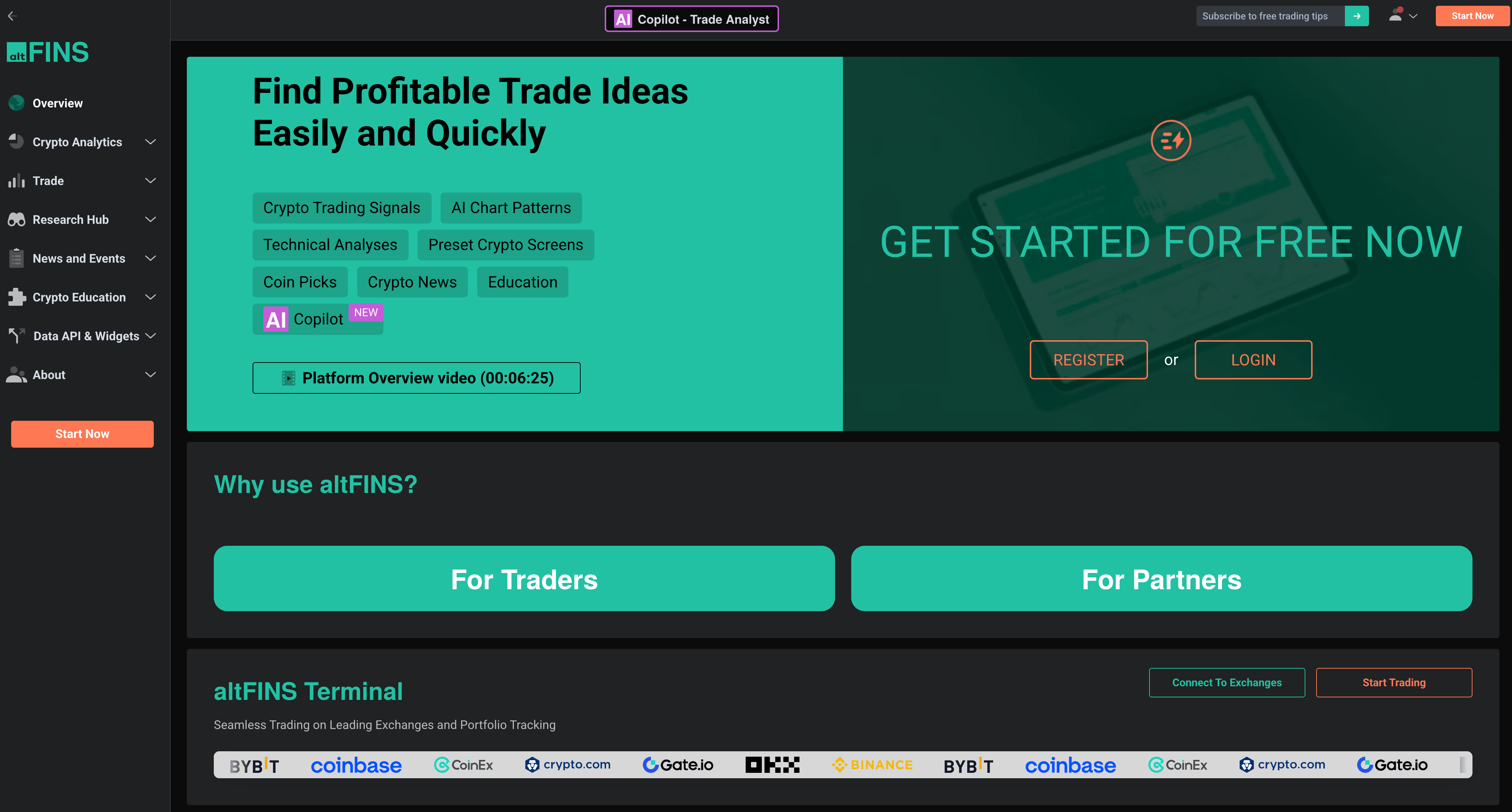
altFINS API ships pre-computed: indicators, analytics, patterns, and signals ready to consume, so teams move straight from data ingestion to decision-making.
The platform covers five layers in one integration:
- Market data: almost real-time and historical OHLC across ~2,000 assets, aggregated from 30+ exchanges, on 15m, 1h, 4h, 12h, and 1d intervals with 7 years of history
- Technical analytics: 150+ pre-calculated indicators including RSI, MACD, SMA, EMA, Bollinger Bands, Stochastic, ADX, and Williams %R, plus trend ratings, no indicator logic to build or maintain
- Chart & candlestick patterns: automated detection of 35 candlestick patterns (1-, 2-, and 3-candle) alongside classic chart patterns and crossover events
- Trading signals and preset market scans: 130+ signals streamed through a live feed that surfaces new trade opportunities as they appear, without scanning the market manually. And 160+ preset market scans
- On-chain fundamentals & news: fundamental metrics (TVL, revenue, market-cap ratios) and condensed crypto news summaries via dedicated endpoints
This matters most for products that need actionable intelligence rather than raw inputs, AI trading agents, algorithmic and quant systems, screeners, alerting tools, and backtesting engines that reason over structured setups instead of computing everything from scratch.
Coverage spans ~2,000 digital assets, 300+ combined market and analytical values per coin, and up to 7 years of historical data. altFINS also runs an MCP (Model Context Protocol) server, giving AI agents and LLM-native applications direct, structured access across all indicators and signals, no custom integration required. A terminal-native CLI (af) exposes the same data for scripts and agent pipelines.
On pricing: consolidating indicators, patterns, and signals into one pre-computed API removes the cost of building and maintaining your own analytics infrastructure, from a free plan to paid plans starting at $39/mo.
Strengths
- Pre-computed analytics: 150+ indicators and 130+ signals, 160+ preset scans,no pipeline to build
- Automated charts and 35 candlestick pattern detection
- 7 years of history across 5 timeframes for backtesting and AI training
- MCP support plus a CLI for AI agent and LLM workflows
- Transparent, published pricing with a free tier to start
Tradeoffs
- Focused on analytics and signals, not a wallet, swap/exchange, or RPC layer
- ~2,000 exchange-listed assets rather than every long-tail on-chain token
- Portfolio and multi-chain accounting depth is thinner than aggregated data providers
Best for: AI trading agents, algorithmic and quant trading systems, screeners and alerting tools, and backtesting platforms that need analyst-grade indicators, patterns, and signals through a single API and MCP.
2. CoinStats API
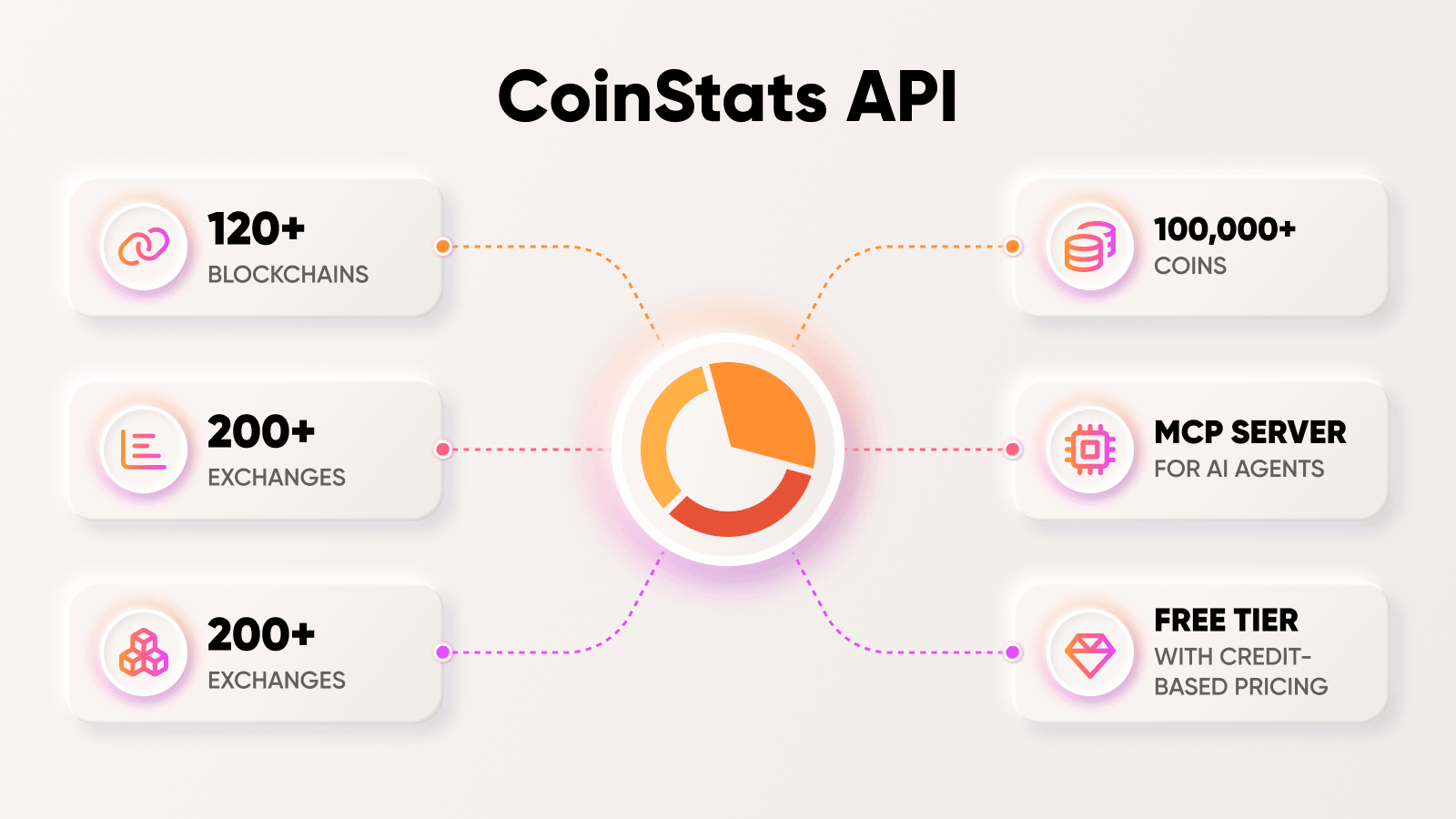
CoinStats API combines market prices with wallet, exchange, portfolio, and DeFi data. Instead of integrating separate services for prices, transaction histories, portfolio performance, and protocol positions, developers can retrieve the data through one API and a consistent schema.
Coverage includes market data for 100,000+ coins, wallet data across 120+ blockchains, tickers from 200+ exchanges, and positions across 10,000+ DeFi protocols. Available datasets include:
- Real-time prices, market capitalization, volume, and OHLCV charts.
- Wallet balances and transaction histories.
- Centralized exchange account balances.
- Staking, lending, liquidity-provider, and yield positions.
- Portfolio allocation, performance, and profit and loss.
- NFT holdings.
- Aggregated news, sentiment, and trending topics.
- Token risk information.
This makes CoinStats especially useful for applications that need to explain what a user owns, where those assets are held, and how the portfolio is performing. Examples include portfolio trackers, wallet dashboards, tax tools, DeFi interfaces, and AI assistants that analyze user holdings.
The API uses REST and JSON. CoinStats also provides an MCP server through which AI applications can access market, wallet, DeFi, exchange, portfolio, and news data.
The free tier currently includes 20,000 credits per month at two requests per second. Paid plans start at approximately $49 per month. Credit consumption varies by endpoint complexity, so aggregated wallet and DeFi requests cost more than basic market-data calls.
Strengths
- Wallet, exchange, DeFi, and market data through one integration.
- Coverage across 120+ blockchains and 10,000+ DeFi protocols.
- Portfolio performance and profit-and-loss analytics.
- Support for centralized exchange accounts and self-custody wallets.
- MCP support for AI agents.
- Free tier for development and testing.
Tradeoffs
- Focuses on portfolio intelligence rather than technical trading signals.
- Complex wallet and DeFi requests consume substantially more credits than price calls.
- Some portfolio endpoints require a CoinStats share token or connected portfolio.
- Does not replace direct RPC access for custom contract calls or transaction execution.
Best for: Portfolio trackers, wallets, tax applications, DeFi dashboards, and AI assistants that need normalized multi-chain holdings and performance data.
3. CoinGecko API
CoinGecko API is a strong general-purpose market-data layer for products that need broad asset and exchange coverage.
It provides:
- Real-time cryptocurrency prices.
- Market capitalization, volume, and supply.
- Coin and token metadata.
- Historical market charts and OHLCV data.
- Exchange tickers and trading pairs.
- Trending assets and market categories.
- Token data by contract address.
- On-chain liquidity-pool and DEX activity.
Paid plans support data across 240+ blockchain networks and 1,900+ exchanges. Through GeckoTerminal, the API also covers liquidity pools, transactions, trading volume, and OHLCV data from more than 1,000 decentralized exchanges across 200 networks.
Historical price, market-cap, and volume data extends beyond 12 years for supported assets, although the available range and resolution depend on the subscription. REST, WebSocket, and webhook delivery options are available for different application architectures.
The Demo plan includes 10,000 monthly calls and a rate limit of 100 calls per minute. Paid plans currently start at $35 per month on monthly billing, with commercial use included subject to CoinGecko’s attribution and licensing requirements. See current CoinGecko API pricing.
Strengths
- Broad coin, exchange, and blockchain coverage.
- Centralized and decentralized exchange data in one API.
- More than 12 years of historical market data for supported assets.
- REST, WebSocket, and webhook delivery.
- Contract-address lookups and on-chain liquidity-pool data.
- Free tier and published self-service pricing.
Tradeoffs
- Primarily supplies market inputs rather than pre-computed trading strategies.
- Wallet balances, transaction histories, and portfolio accounting are not its core use case.
- Commercial products must follow attribution and redistribution terms.
- Longer history and faster data freshness require higher-tier plans.
Best for: Price trackers, market dashboards, token-discovery products, exchange interfaces, and applications that need broad centralized and on-chain DEX coverage.
4. Glassnode API
Glassnode focuses on institutional-grade on-chain and crypto-financial intelligence. Its metrics help developers analyze investor behavior, capital flows, cost basis, realized profit and loss, supply distribution, exchange activity, derivatives, and market structure.
The Professional offering includes more than 1,500 metrics across:
- On-chain network activity.
- Asset supply and distribution.
- Long-term and short-term holder behavior.
- Realized capitalization and cost basis.
- Exchange balances and flows.
- Spot-market activity.
- Futures, options, and open interest.
- Exchange-traded funds.
- Digital asset treasuries.
- Macro and traditional financial markets.
Glassnode’s cohort and entity-adjusted metrics are particularly useful when raw address activity could produce a misleading view of market behavior. Its point-in-time metrics provide immutable historical observations for backtests that should not change when data models are updated.
Glassnode runs its own blockchain nodes, processes data internally, and applies quality-assurance procedures before publishing metrics. Professional access can include up to 15+ years of history, resolutions as low as ten minutes, bulk endpoints, MCP, a command-line interface, and external data-warehouse delivery.
The $49-per-month Advanced plan is intended for personal research and limited data access. Full production and commercial API use requires a configurable Professional subscription and API credit package. See current Glassnode plans.
Strengths
- Deep on-chain, cohort, exchange, and cost-basis metrics.
- Spot, derivatives, ETF, macro, and on-chain data in one model.
- Point-in-time metrics for reproducible historical analysis.
- API, MCP, CLI, bulk endpoints, and warehouse delivery.
- Long historical coverage on Professional plans.
- Internally processed and quality-checked data.
Tradeoffs
- Full production API access is not a low-cost self-service purchase.
- Native on-chain ingestion covers fewer networks than broad multi-chain aggregators.
- The greatest metric depth is concentrated around major assets.
- Designed for market research rather than wallet or portfolio aggregation.
Best for: Institutional research platforms, trading firms, quantitative models, risk systems, and market reports that need curated on-chain and crypto-financial metrics.
5. Token Terminal API
Token Terminal standardizes blockchain and protocol activity into financial and business metrics.
It lets developers compare blockchains and decentralized applications using familiar measures such as:
- Fees and protocol revenue.
- Token incentives.
- Active users.
- Transaction activity.
- Tokenholders.
- Total value locked.
- Market capitalization.
- Core developer activity.
- Project and token financial statements.
Standardization is the main advantage. Instead of interpreting a different contract architecture and accounting model for every protocol, developers can query comparable metrics across projects, chains, products, and market sectors.
The API can return historical project metrics, cross-project aggregations, chain-level breakdowns, and financial statements organized by week, month, quarter, or year. Token Terminal currently organizes projects into 19 market sectors, making it useful for direct comparisons between similar protocols.
The platform works particularly well for products that evaluate operating performance rather than short-term token-price movements. It can power research terminals, protocol-comparison tools, valuation models, sector dashboards, and automated fundamental reports.
The web-based Pro plan currently costs $350 per month. REST API access uses custom pricing and includes all platform data, Python and TypeScript SDKs, startup discounts, and a published allowance of up to 250,000 requests per day. See current Token Terminal pricing.
Strengths
- Standardized financial and operational metrics.
- Direct comparisons across protocols, chains, products, and sectors.
- Historical metrics and ready-made financial statements.
- Project-specific metric definitions and data sources.
- Python and TypeScript SDKs.
- High published daily request allowance on the API plan.
Tradeoffs
- API pricing requires a sales conversation.
- Focuses on protocol fundamentals rather than intraday technical analysis.
- Not designed for wallet balances, order books, or transaction execution.
- Available metrics and breakdowns vary by project.
Best for: Fundamental research tools, protocol dashboards, valuation models, investment research, and applications that compare the business performance of crypto networks.
6. Santiment SanAPI
Santiment combines on-chain activity with social, developer, exchange, and market data. This makes it useful for products that need behavioral signals unavailable from price feeds alone.
Through its GraphQL-based SanAPI, developers can retrieve metrics such as:
- Active addresses and network growth.
- Exchange inflows and outflows.
- Whale and large-holder activity.
- Social volume and social dominance.
- Sentiment and trending topics.
- Development activity and contributor counts.
- Token age and circulation.
- Price, volume, and market data.
GraphQL lets applications request specific fields, batch several assets, and combine metric types without collecting unnecessary response data.
Santiment currently covers the top 3,000 crypto assets for market and social analysis. Full on-chain availability varies by blockchain and metric. Its development data can help research products evaluate whether project repositories remain active, while social metrics can identify changes in attention and emerging market narratives.
The free tier includes 1,000 API calls per month, one year of history, and a 30-day delay on restricted real-time metrics. The $49-per-month Pro plan raises the allowance to 5,000 calls but retains the API delay. Unrestricted real-time API access starts with the $249-per-month Max plan, which includes 80,000 calls per month and two years of API history. See current Santiment pricing.
Strengths
- Combines social, on-chain, exchange, market, and developer data.
- Useful metrics for narrative and sentiment monitoring.
- GraphQL supports precise queries and batching.
- Free API access for experimentation.
- Development-activity metrics offer an additional view of project health.
- Screener, charts, alerts, and Google Sheets integrations are also available.
Tradeoffs
- Free and Pro API access includes a 30-day delay on restricted metrics.
- Real-time API access requires the $249-per-month Max plan.
- API history is shorter than that of several market-data providers.
- On-chain metric availability varies by network and asset.
Best for: Sentiment systems, narrative trackers, research dashboards, token screeners, and models that combine market activity with social and developer behavior.
7. Dune API
Dune provides direct SQL access to decoded on-chain data across more than 100 blockchains.
Rather than accepting a provider’s fixed metric catalog, developers can define their own logic over:
- Transactions and blocks.
- Smart contract events.
- Token transfers.
- DEX trades and liquidity.
- Lending and borrowing activity.
- NFT transactions.
- Protocol usage.
- Wallet cohorts.
- Custom uploaded datasets.
Queries created on Dune can be executed programmatically, with their results retrieved through the API. Official Python, TypeScript, and Go SDKs handle execution, polling, pagination, and result delivery.
Teams can also build dashboards, schedule queries, create alerts, upload supplementary data, and expose custom analysis to downstream applications. This flexibility makes Dune valuable when a product requires a metric that a packaged API does not offer.
For example, a developer can define a protocol-specific revenue calculation, monitor interactions with a newly deployed contract, compare DEX activity, or build a custom wallet cohort without operating a complete blockchain indexing pipeline.
Dune uses compute-based credits. The free plan includes 2,500 monthly credits for exploration. Analyst currently costs $75 per month, while Plus costs $399 per month. Programmatic executions and result exports consume credits, and free query-engine executions are limited to manual use. See how Dune credits work.
Strengths
- Custom SQL analysis across 100+ blockchains.
- Decoded blockchain tables and protocol-specific datasets.
- Python, TypeScript, and Go SDKs.
- Dashboards, schedules, alerts, uploads, and API access.
- Suitable for metrics that packaged APIs do not expose.
- Avoids operating a complete in-house indexing pipeline.
Tradeoffs
- Requires SQL knowledge and familiarity with blockchain schemas.
- Query cost and latency depend on data volume and complexity.
- Community queries still require methodological review.
- Does not provide the same standardized metric definitions as a curated analytics API.
- Limited coverage of off-chain order books, news, and social data.
Best for: Custom on-chain research, protocol analytics, internal data pipelines, contract monitoring, and products with metrics that cannot be sourced from a standard API.
How Chainstack fits the stack
Market intelligence APIs tell your product what is happening across prices, portfolios, protocols, and market participants. Chainstack provides the infrastructure layer your application needs to verify that intelligence on-chain and act on it. Developers can deploy managed RPC endpoints across 70+ chains for custom contract reads, transaction submission, WebSocket event streams, complete historical state, and Debug and Trace APIs. Use platforms such as altFINS, CoinStats, or Glassnode for structured intelligence, then use Chainstack Global Nodes or Dedicated Nodes for direct, production-ready blockchain access without operating the underlying node infrastructure.
Which crypto market intelligence API should you choose?
Choose altFINS if you need pre-computed indicators, patterns, market scans, and trading signals for automated strategies, AI agents, or backtesting.
Choose CoinStats if your product needs wallet balances, transaction histories, exchange accounts, DeFi positions, and portfolio performance through one integration.
Choose CoinGecko if you need broad asset, price, exchange, historical, and DEX market coverage.
Choose Glassnode if you need institutional-grade on-chain, cohort, cost-basis, exchange-flow, spot, and derivatives metrics.
Choose Token Terminal if you need standardized financial and operating metrics for comparing blockchains and decentralized applications.
Choose Santiment if social attention, sentiment, whale behavior, or developer activity forms part of your signal model.
Choose Dune if you need to define custom on-chain metrics in SQL rather than relying on a fixed catalog.
Choose Chainstack alongside any of these tools when your product also needs reliable RPC access, custom blockchain queries, live event subscriptions, or transaction execution.
Final thoughts
Crypto APIs have become increasingly specialized. The right choice depends less on which platform is “biggest” and more on which data layer your product actually needs. Define that layer first, and the API selection follows logically from there, whether that’s aggregated portfolio intelligence from CoinStats, pre-computed indicators and signals from altFINS, or institutional on-chain metrics from Glassnode.
One thing worth keeping in mind: the six APIs above operate at the data layer — market prices, analytics and signals, wallet balances, DeFi positions. Products that also interact with the blockchain directly will need an infrastructure layer underneath. That’s where Chainstack fits — managed RPC infrastructure across 70+ chains, so teams can focus on application logic rather than node operations.
FAQ
What is a crypto market intelligence API?
A crypto market intelligence API gives applications programmatic access to cryptocurrency market, portfolio, on-chain, protocol, or behavioral data.
Depending on the provider, this can include prices, wallet balances, technical indicators, trading signals, exchange flows, social sentiment, protocol revenue, or custom blockchain metrics.
What is the difference between a raw data API and an analytics API?
Raw data APIs return inputs like prices, balances, and order books, leaving your team to compute indicators and detect patterns. Analytics APIs deliver that layer pre-computed, technical indicators, chart and candlestick patterns, and trading signals ready to consume. Providers like altFINS sit in this second group, which suits teams building AI-driven trading or research tools that need to reason over structured signals rather than build the analytics pipeline themselves.
Which crypto API is best for an AI trading agent?
altFINS is the strongest fit when the agent needs pre-computed technical indicators, patterns, scans, and signals. Its MCP server also gives compatible AI applications structured access without requiring a custom REST client.
An agent that also evaluates wallet positions could add CoinStats. One that needs direct blockchain reads or transaction execution can use Chainstack as its RPC infrastructure layer.
Which API is best for crypto portfolio data?
CoinStats is the strongest option in this list for portfolio products. It combines wallet balances, centralized exchange accounts, transaction histories, DeFi positions, historical performance, and profit-and-loss data across multiple chains.
Which API is best for on-chain analysis?
Glassnode is best suited to curated institutional metrics such as holder cohorts, realized capitalization, cost basis, and exchange flows.
Dune is better when developers want to write custom SQL and define their own protocol or contract-level metrics. Token Terminal is better for standardized comparisons of protocol financial performance.
Can one crypto API cover every data requirement?
Usually not. A trading application might use altFINS for signals, CoinGecko for long-tail market coverage, and Chainstack for direct blockchain reads and transaction execution.
A portfolio product might combine CoinStats with Chainstack for custom smart contract state or unsupported assets. A research platform might use Glassnode or Token Terminal for standardized metrics and Dune for custom queries.
The practical approach is to identify the minimum data layers the product needs and select one primary provider for each layer.
Do market intelligence APIs replace RPC infrastructure?
No. Market intelligence APIs provide normalized or derived information. RPC infrastructure provides direct access to blockchain nodes.
Applications still need RPC endpoints when they must call smart contracts, retrieve blocks and transaction receipts, listen for events, access archive state, run debug or trace methods, or submit transactions. The two layers complement each other.