AI-ready infrastructure
 Refer and earn


 Ethereum
 Hyperliquid
 Solana
 Arbitrum
 BNB Smart Chain
 Base
Base Polygon
 TRON
TRON Sui
Sui Robinhood


Best crypto APIs for developers in 2026

Building a crypto product means making infrastructure decisions early — and the API layer is usually where those decisions matter most.
Different crypto APIs solve very different problems. Some aggregate market data and portfolio context into one feed. Others focus on decentralized indexing, real-time DEX data, institutional analytics, or multi-chain querying. Choosing the wrong layer means rebuilding later.
Crypto exchange APIs sit next to the data layer, but solve a different job: adding swaps and exchange flows directly inside a product. Wallets, payment gateways, and fintech apps use this layer when they need users to exchange assets without leaving the interface.
This guide covers five of the best crypto APIs for developers in 2026 — CoinStats API, ChangeNOW, Birdeye, Glassnode, and Covalent — plus the infrastructure layer that most of them quietly depend on.
What to look for in a crypto API
Before choosing, it helps to know which data layer your product actually needs:
- Market data — prices, OHLCV, exchange coverage, trading pairs
- Wallet and portfolio data — balances, PnL, transaction history, multi-chain holdings
- DeFi and on-chain data — protocol positions, liquidity pools, smart contract state
- Developer experience — SDK quality, documentation, rate limits, pricing model
- Exchange and swap layer — cross-chain swaps, fiat on-ramps, partner monetization flows
Most crypto products end up needing at least two of these layers. Knowing which ones upfront saves significant integration time.
The infrastructure layer: Chainstack
Most crypto APIs deliver data — prices, wallet balances, DeFi positions. But before that data reaches your product, something has to connect to the blockchain and read it. That’s the infrastructure layer.
Chainstack provides managed blockchain node infrastructure and RPC endpoints across 70+ chains, including Ethereum, Solana, BNB Smart Chain, Arbitrum, Base, and Avalanche. Trading bots, DeFi apps, and AI agents that need to read on-chain state, monitor mempool activity, or submit transactions directly depend on this layer — not the data APIs below.
For latency-sensitive workloads, Chainstack offers dedicated nodes and Yellowstone gRPC for Solana — relevant for HFT bots and MEV operations requiring sub-second data streams. An MCP server is also available for AI agent integrations.
If your product consumes market data and portfolio analytics only, the five APIs below cover everything you need. If it interacts with the blockchain directly — reading contract state, monitoring the mempool, executing on-chain transactions — pair your data API with Chainstack’s RPC infrastructure.
The 5 best crypto APIs
1. CoinStats API
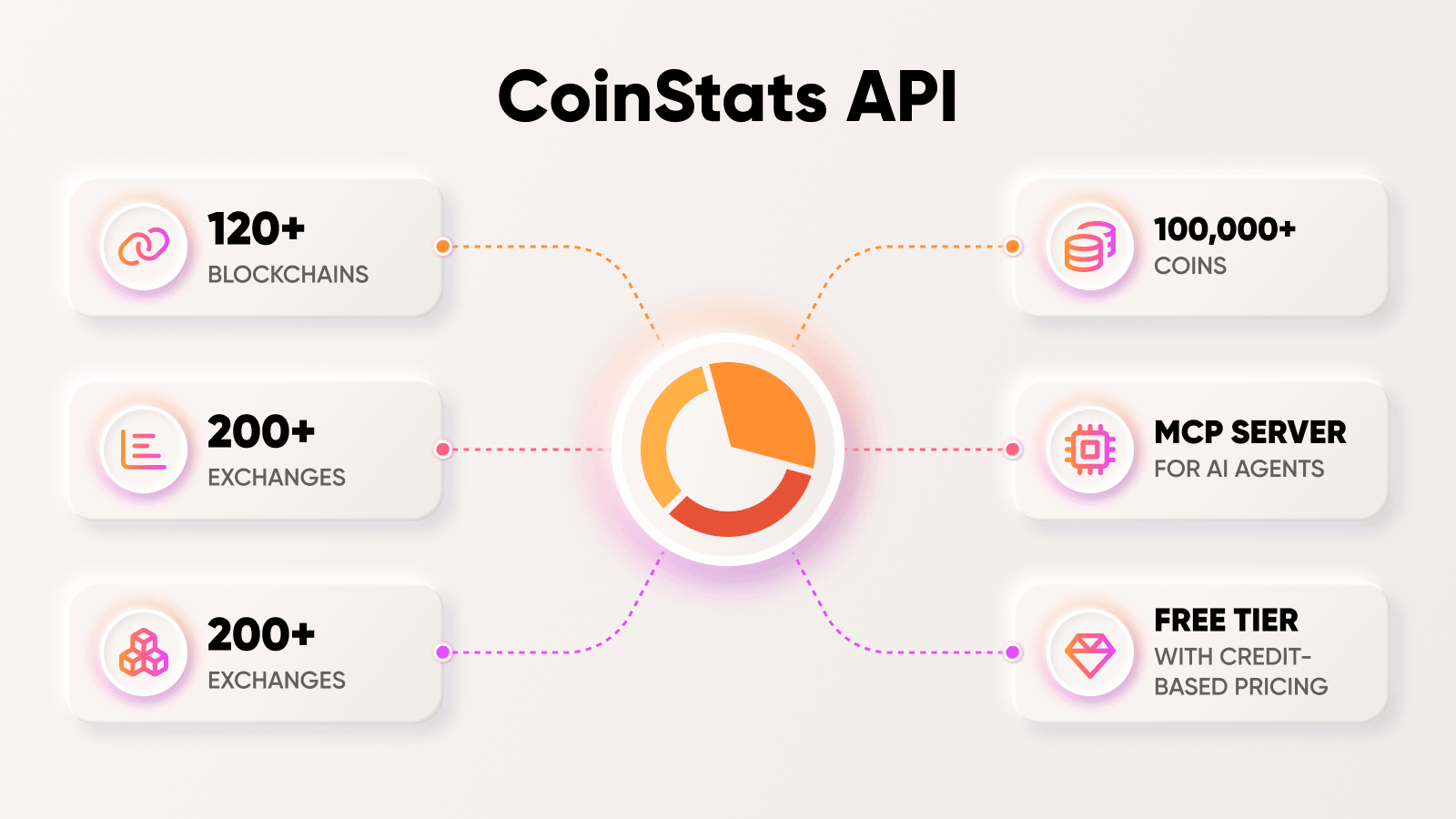
CoinStats API is built around a simple premise: most crypto products end up stitching together three or four separate data providers. CoinStats replaces that stack with a single API that’s often a couple of times cheaper than the multi-provider equivalent.
The platform covers five layers in one integration:
- Market data — real-time prices, OHLCV, and exchange data across 100,000+ assets
- Wallet data — multi-chain balances and transaction history
- DeFi positions — live positions across 10,000+ DeFi protocols
- Portfolio analytics — realized and unrealized PnL, performance metrics, average buy/sell prices
- Token security — on-chain risk analysis covering contract verification, ownership concentration, and liquidity health
This matters most for products that need context beyond price feeds — AI trading assistants, portfolio dashboards, crypto copilots, and multi-chain tracking tools that need to reason about a user’s actual holdings rather than just market movements.
Coverage includes 120+ blockchains, 200+ exchanges and wallets, and 10,000+ DeFi protocols. CoinStats also supports MCP, making it compatible with AI agent workflows and LLM-based systems out of the box.
On pricing: consolidating market data, wallet tracking, and DeFi analytics into one API is typically cheaper than maintaining separate subscriptions for each layer — which matters at the early stages of product development.
Strengths
- Single API replacing multiple data providers
- 120+ chains, 200+ exchanges, 10,000+ DeFi protocols
- Built-in portfolio analytics and PnL tracking
- MCP support for AI integrations
- More cost-effective than multi-provider stacks
Tradeoffs
- Broader scope means less depth than specialized providers in any single category
- Not optimized for ultra-low-latency execution
Best for Portfolio dashboards, AI crypto assistants, multi-chain tracking tools, and products that need aggregated crypto intelligence without managing multiple data subscriptions.
2. ChangeNOW
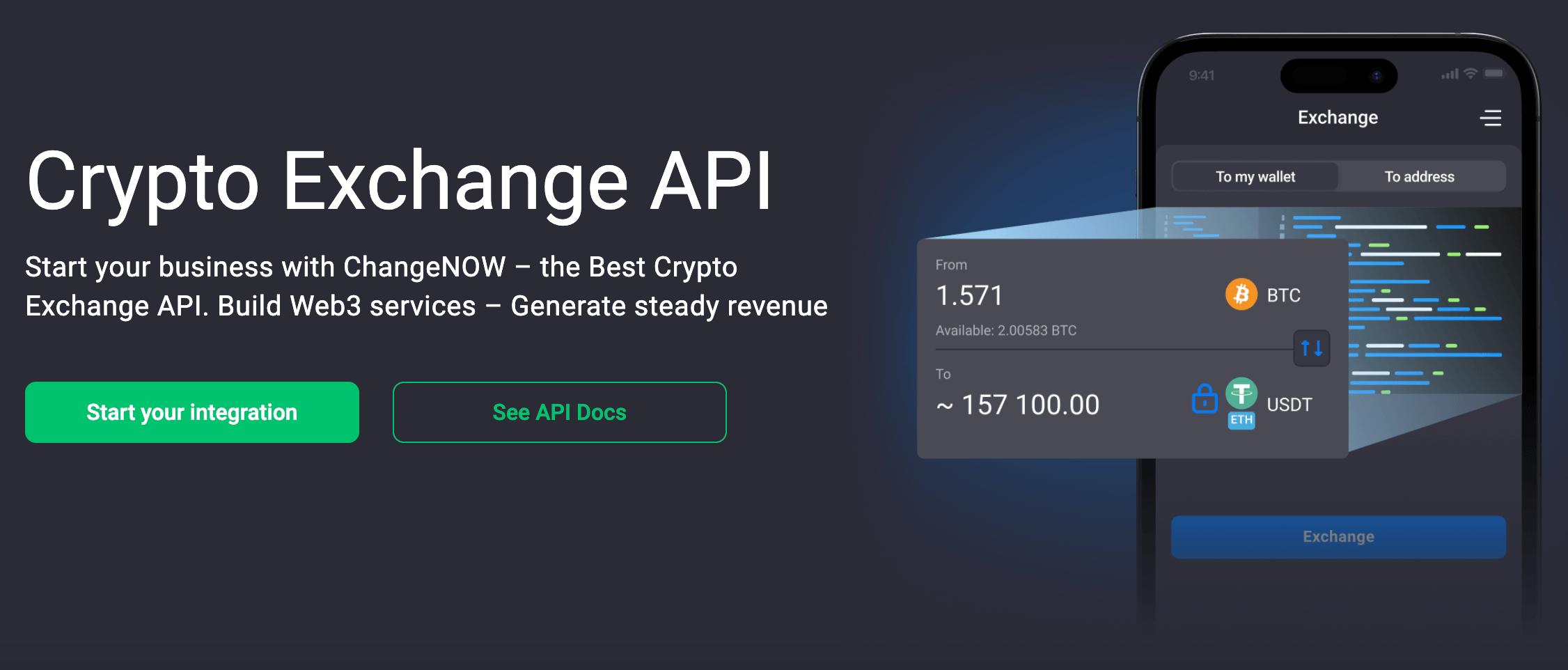
ChangeNOW offers a crypto exchange API for products that need swaps inside their own interface. It sits in the execution layer: users select assets, choose a fixed-rate or standard flow, and complete a cross-chain exchange without being redirected to a separate exchange product.
ChangeNOW API supports 1,500+ coins across 110+ networks, with liquidity sourced from centralized and decentralized exchanges. It is used by wallets, payment gateways, exchange products, and fintech apps that want a ready exchange flow rather than a custom swap backend.
Partner monetization is built into the integration. Teams can start with revenue share from 0.4% per transaction and customize commissions by asset, trading pair, or swap size. ChangeNOW also provides API documentation, 24/7 support, post-integration maintenance, and fiat on- and off-ramp options upon request.
Strengths
- 1,500+ coins across 110+ supported networks
- Fixed-rate and standard exchange flows
- Cross-chain swaps between supported assets
- Partner revenue starting from 0.4% per transaction
- 99.99% availability and 350 ms response time
Tradeoffs
- Not a market data or portfolio analytics API
- Fiat on- and off-ramp features are available upon request
- Products that need custom on-chain analytics will still need a separate data provider
Best for wallets, payment gateways, exchange products, and fintech apps that need in-app swaps, cross-chain exchange flows, and partner monetization.
3. Birdeye
Birdeye started as a Solana-native data platform and has since expanded across EVM chains — but Solana remains where it runs deepest. The platform reads token prices directly from DEX liquidity pools in real time, which makes it strong on assets that centralized exchanges don’t list: new launches, memecoins, and low-cap tokens that exist only on-chain.
Coverage includes wallet balances, transaction history, token security checks, trending token feeds, and WebSocket streams for live price updates. For Solana specifically, Birdeye aggregates liquidity across Raydium, Orca, Jupiter, and other major DEXs into a single price feed.
The combination of real-time DEX pricing, wallet data, and token security in one API makes it practical for products where freshness and Solana coverage matter more than institutional depth.
Strengths
- Real-time DEX-native pricing across Solana liquidity venues
- Strong coverage of new and low-cap tokens
- Wallet data and transaction history included
- Token security screening built in
- WebSocket support for live price streams
Tradeoffs
- Primarily Solana-focused — thinner coverage on EVM chains
- Less suitable for institutional reference rates or compliance workflows
- Not designed for portfolio analytics at CoinStats depth
Best for Solana trading tools, DEX analytics dashboards, memecoin trackers, and any product where real-time on-chain pricing for new tokens matters.
4. Glassnode
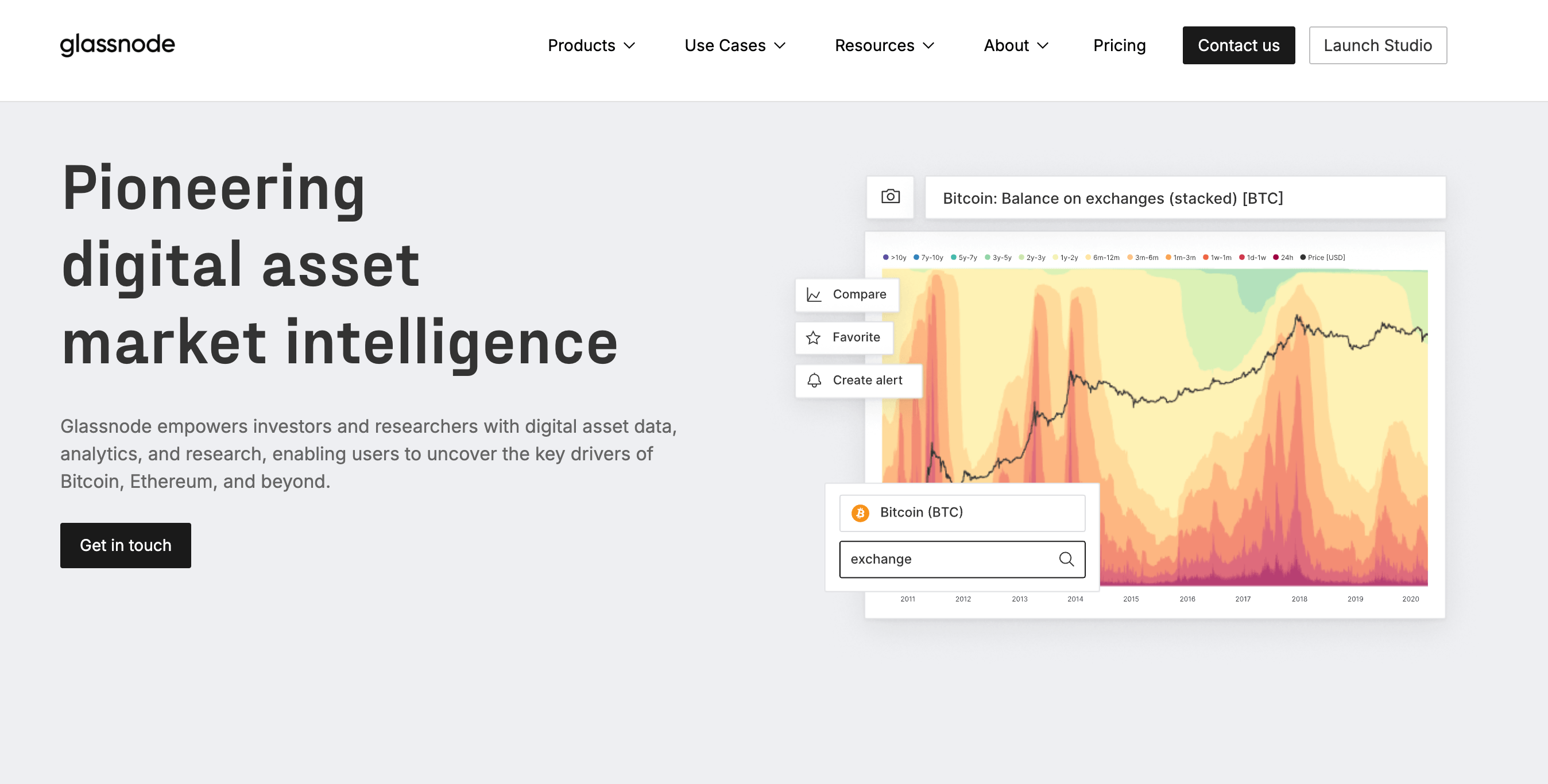
Glassnode is the institutional benchmark for on-chain analytics. Where most APIs return raw balances and transactions, Glassnode surfaces derived metrics: entity-adjusted holdings, realized cap, long-term holder behavior, exchange inflows, miner revenue, and macro overlays across Bitcoin, Ethereum, and 1,200+ assets.
Two features set it apart for serious research. Entity-adjusted metrics cluster addresses controlled by the same actor — exchanges, miners, large holders — so raw address counts become meaningful economic signals. Point-in-Time data delivers immutable historical snapshots, eliminating look-ahead bias in backtests and model validation.
Delivery options include REST, Snowflake, BigQuery, and Parquet or CSV exports. A Glassnode MCP server is also available for AI-assisted research workflows.
Strengths
- 7,500+ on-chain metrics across Bitcoin, Ethereum, and major assets
- Entity-adjusted data for cleaner economic signals
- Point-in-Time historical snapshots for bias-free backtesting
- Institutional delivery options including Snowflake and BigQuery
- MCP server for AI research workflows
Tradeoffs
- Pricing reflects an institutional buyer profile — not suited for indie projects
- Limited wallet-level or portfolio aggregation features
- Narrower asset coverage compared to multi-chain data providers
Best for Quant desks, asset managers, macro research teams, and any workflow where audit-grade on-chain history and entity-adjusted metrics matter.
5. Covalent
Covalent covers more blockchains in a unified API than any other provider on this list — over 200 networks through a single consistent interface.
The same API call structure works across Ethereum, Solana, Avalanche, Fantom, and hundreds of other chains. For teams building on less common networks, Covalent often provides data where other APIs don’t. For teams building cross-chain analytics pipelines, the unified schema saves significant engineering work.
Covalent covers wallet balances, token transfers, NFT metadata, log events, and DEX data. The historical data depth is strong, making it well-suited for analytics workloads and products that need to reconstruct historical on-chain state.
Strengths
- Broadest chain coverage — 200+ networks
- Unified API schema across all supported chains
- Strong historical data for analytics workloads
- DEX and liquidity data included
Tradeoffs
- Can be slower than chain-native APIs for real-time use cases
- Less focused on DeFi position parsing than CoinStats
- Pricing complexity at scale
Best for Multi-chain analytics platforms, blockchain data pipelines, products targeting niche or emerging chains, and data science workloads that need consistent historical data across many networks.
Comparison
| CoinStats | ChangeNOW | Birdeye | Glassnode | Covalent | |
|---|---|---|---|---|---|
| Market data | ✅ | ❌ | ✅ | Limited | Limited |
| Wallet data | ✅ | ❌ | ✅ | ❌ | ✅ |
| DeFi positions | ✅ | ❌ | Limited | ❌ | Limited |
| Cross-chain swaps | ❌ | ✅ | ❌ | ❌ | ❌ |
| Fixed-rate exchange | ❌ | ✅ | ❌ | ❌ | ❌ |
| Partner revenue share | ❌ | ✅ | ❌ | ❌ | ❌ |
| Fiat on/off ramp | ❌ | ✅ | ❌ | ❌ | ❌ |
| On-chain analytics | Limited | ❌ | Limited | ✅ | ✅ |
| Real-time streams | ✅ | ❌ | ✅ | ❌ | Limited |
| Chain coverage | 120+ | 110+ networks | Solana-first | BTC/ETH | 200+ |
| MCP support | ✅ | ❌ | ❌ | ✅ | ❌ |
| Best for | All-in-one | In-app swaps | Solana/DEX | Institutional | Multi-chain |
Which crypto API should you choose?
- Choose CoinStats if you need market data, wallet intelligence, DeFi positions, and portfolio analytics in one integration — particularly for AI-powered products.
- Choose ChangeNOW if your product needs in-app cross-chain swaps, a ready exchange flow, and partner monetization without building a custom swap backend.
- Choose Birdeye if you’re building on Solana or need real-time DEX-native pricing for new and low-cap tokens.
- Choose Glassnode if your workflow requires institutional-grade on-chain analytics, entity-adjusted metrics, or bias-free historical data for backtesting.
- Choose Covalent if you’re targeting multiple chains — especially niche ones — or building analytics pipelines that need consistent historical data across networks.
Final thoughts
Crypto APIs have become increasingly specialized. The right choice depends less on which platform is “biggest” and more on which data layer your product actually needs. Define that layer first, and the API selection follows logically from there.
One thing worth keeping in mind: the five APIs above operate at the data layer — market prices, wallet balances, DeFi positions. Products that also interact with the blockchain directly will need an infrastructure layer underneath. That’s where Chainstack fits — managed RPC infrastructure across 70+ chains, so teams can focus on application logic rather than node operations.
FAQ
Data APIs return information — prices, balances, on-chain positions, analytics. Your product reads this data and displays or processes it. Exchange APIs do something different: they execute asset swaps directly inside your interface. A wallet using a data API shows a user their portfolio; a wallet using an exchange API lets them swap tokens without leaving the app. Most products that handle both reading and trading need one of each.
Crypto APIs provide processed data such as prices, wallet balances, DeFi positions, or analytics. RPC infrastructure connects directly to blockchains, allowing applications to read on-chain state, monitor mempool activity, and submit transactions.
If your application only consumes aggregated market or portfolio data, a crypto API may be enough. If your product interacts directly with blockchains — reading smart contract state or executing transactions — you’ll also need RPC infrastructure such as Chainstack.