AI-ready infrastructure
 Refer and earn


 Ethereum
 Hyperliquid
 Solana
 Arbitrum
 BNB Smart Chain
 Base
Base Polygon
 TRON
TRON Sui
Sui Robinhood


Best blockchain infrastructure providers in 2026


The blockchain infrastructure market in 2026 is more fragmented than the marketing suggests. “Bare metal”, “Web3 servers”, “managed validator”, “dedicated for blockchain” — these phrases get used interchangeably even when the products underneath them are completely different categories. Buyers pick by brand recognition or pricing, then find six months in that they bought the wrong category and need to migrate.
This guide ranks nine providers across four distinct infrastructure categories. For each, we cover what they actually deliver, who they’re built for, and where they fit in the broader 2026 landscape. We end with how Chainstack Self-Hosted plugs in as the node operations layer that works on top of most of them.
The blockchain infrastructure landscape in 2026
Pick the category first, then the provider inside that category. Mixing categories is where most teams lose money.
- Bare-metal hosts — physical, single-tenant servers. You own the OS, the node software, the monitoring, the recovery. Maximum performance and control, maximum operational burden. Latitude.sh, Hetzner, OVHcloud, Cherry Servers.
- Pre-installed managed servers — bare metal that ships with a node operations platform already running. You log in to a control panel, deploy nodes, and the operational layer (deployment, self-healing, monitoring, updates) is handled. HOSTKEY, Velia, BreezeHost, serverside.com, and Vultr through Chainstack Self-Hosted.
- Cloud / VM platforms — virtualized infrastructure with general-purpose marketplaces. Easier to spin up and tear down, but with virtualization overhead that matters for heavy validator and archive workloads. DigitalOcean.
- Managed node and validator services — they run nodes on their infrastructure, you keep custody of keys or just delegate stake. Zero operational burden, but you don’t own the hardware. Allnodes.
The categories aren’t ranked against each other — they answer different questions. The question is which question matches your team’s reality.
Most providers sell in more than one category — the matrix below shows where each operates and where they’re placed in this guide.
| Provider | Bare metal | Cloud VM | Managed K8s | Pre-installed SH | Managed service |
|---|---|---|---|---|---|
| Latitude.sh | Primary | — | — | — | — |
| OVHcloud | Primary | Secondary | Secondary | — | — |
| Cherry Servers | Primary | — | — | — | — |
| Hetzner | Primary | Secondary | — | — | — |
| HOSTKEY | Secondary | — | — | Primary | — |
| Velia | Secondary | — | — | Primary | — |
| BreezeHost | Secondary | Secondary | — | Primary | — |
| serverside.com | Secondary | — | — | Primary | — |
| DigitalOcean | Secondary | Primary | Secondary | — | — |
| Vultr | — | Secondary | — | Primary | — |
| Allnodes | — | — | — | — | Primary |
Primary = the category we cover for this provider below. Secondary = they sell it, but it’s not why they’re in this guide. If you came here looking for managed Kubernetes specifically, OVHcloud and DigitalOcean cover it even though we discuss them under other primary categories.
How we evaluated each provider
| Criterion | Weight | What we looked at |
|---|---|---|
| Blockchain workload fit | 25% | Hardware specs matched to node requirements, NVMe capacity, network throughput |
| Operations layer | 25% | What runs above the OS — managed services, monitoring, recovery, updates |
| Pricing transparency | 20% | Flat-rate vs metered, egress costs, sustained-use economics |
| Geographic coverage | 15% | Datacenter locations relevant to validator decentralization and latency |
| Provisioning experience | 15% | Time from order to usable server, API access |
Operations layer carries the same weight as workload fit because it determines what your team actually has to build versus what comes with the server. Two providers with identical hardware specs can have a 10x difference in the operational work required to keep nodes running.
Bare-metal hosts
1. Latitude.sh — the largest Web3-focused bare-metal host
Latitude.sh hosts roughly 19% of Solana validators by stake, making it the second-largest Solana infrastructure provider after Teraswitch — per independent measurement from Helius (epoch 685, August 2025). That single number tells you more about their Web3 positioning than any marketing page. They operate 20 global locations, run Gen4 instances tuned for Solana RPC and validator workloads, and have a formal partnership with Jito Labs for MEV-enabled Solana validator deployments.
What you get: Single-tenant bare-metal servers with API-first provisioning, NVMe storage at meaningful capacities, high-clock CPUs, generous network. Crypto payments accepted. Free 20TB egress per server with pooling.
Strengths: Genuine track record in Solana infrastructure. Strong hardware specs. Clean Terraform-friendly API for fleet automation. Geographic depth in regions other hosts ignore — including South America.
Limitations: No first-party operations layer — out of the box you handle deployment, monitoring, failover, and updates yourself. Chainstack Self-Hosted installs cleanly on top to close that gap. Pricing sits in the mid-to-upper range for European-equivalent specs.
Best for: Solana validator and RPC operators, teams that want raw bare metal with API automation, organizations that value supply-side decentralization (Latitude.sh’s geographic spread genuinely contributes to it).
Why #1: Of every independent host in this comparison, Latitude.sh is the only one whose market position in a major blockchain ecosystem is measurable and significant. That’s a stronger signal than any positioning page.
2. OVHcloud — European hyperscaler with serious Web3 commitment
OVHcloud hosts approximately 8.65% of Solana validators (Helius, August 2025), placing them third globally behind Teraswitch and Latitude.sh. Their blockchain product line is a real investment, not a marketing landing — they have an official Web3 product page, dedicated blockchain documentation, a global blockchain director (Omar ABI ISSA), and case studies with organizations like EthStaker for Ethereum validator deployment.
What you get: Bare-metal servers, cloud instances, managed Kubernetes, up to 10 Gbps public bandwidth with zero ingress/egress fees on Dedicated Servers. Multiple European and global datacenter regions. ISO/IEC 27001, SOC certifications. Sustainability metrics with carbon tracking.
Strengths: Genuine Solana validator footprint. Service breadth — when you need managed K8s for orchestration plus bare metal for nodes plus block storage for archive data, you can get it from one provider with one bill. Up to 99.99% SLA. Active in EthStaker, Hoodi, and Ethereum staking communities.
Limitations: Console UX is built for enterprise workloads, not node operators specifically — there’s a learning curve. Pricing varies by datacenter region.
Best for: Mid-to-large teams that need a hyperscaler’s service depth (managed K8s, networking, storage tiers, compliance) alongside bare metal, and want a single vendor relationship.
Why #2: OVHcloud is the closest thing to “enterprise-grade Web3 infrastructure as a service” in 2026 without being a hyperscaler that bans crypto. Trade-off versus Latitude.sh is breadth vs depth.
3. Cherry Servers — Solana-heavy bare metal with crypto-friendly billing
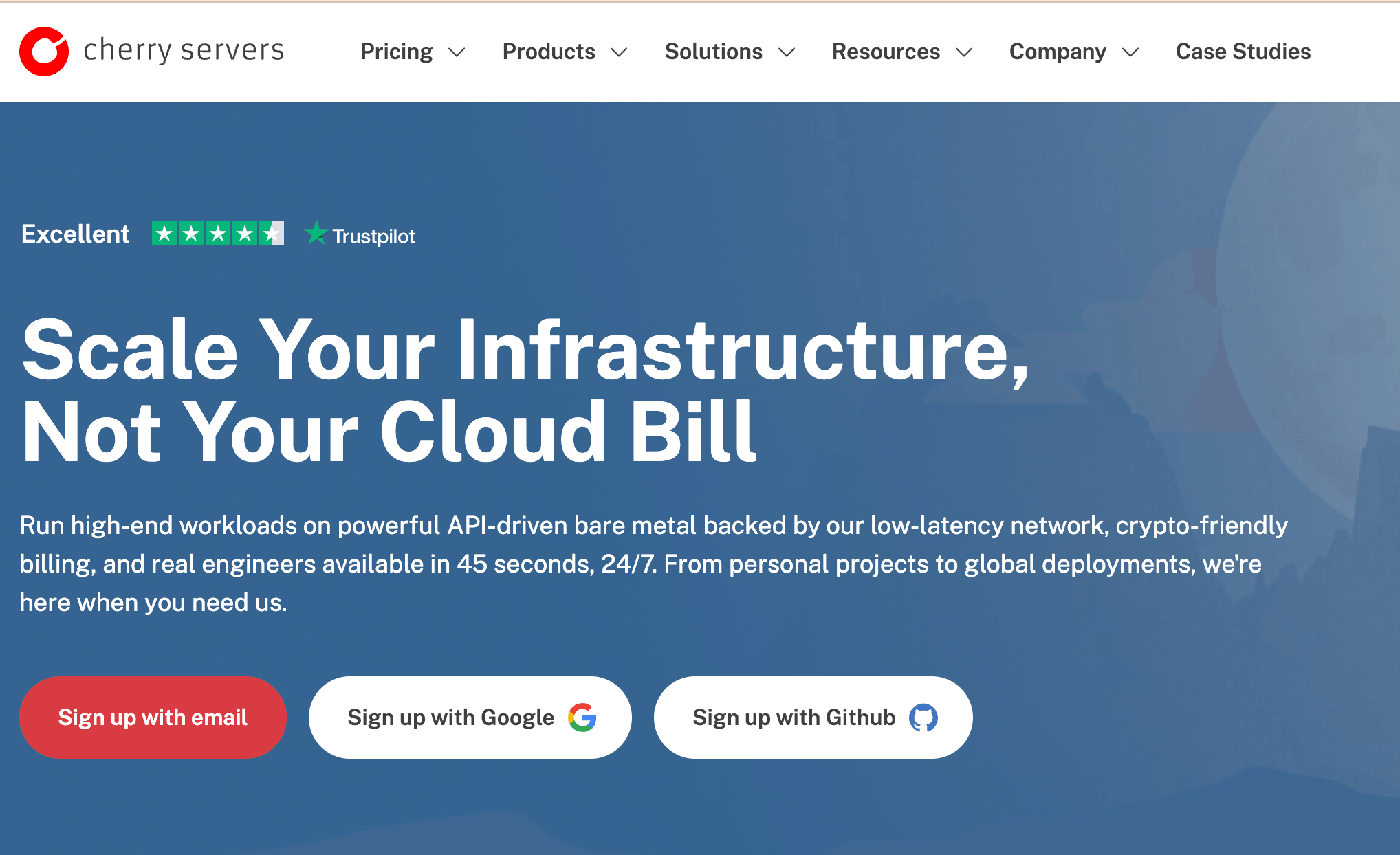
Cherry Servers hosts approximately 8.45% of Solana validators (Helius, August 2025) — fourth-largest globally. They’re a Lithuanian bare-metal host that has invested heavily in Solana-specific positioning, including a partnership with DoubleZero for ultra-low-latency network routing between validator nodes. Cherry Servers accepts 15+ cryptocurrencies for billing, which makes them a default choice for teams that want to pay infrastructure costs from their treasury directly. Solana validator operators like Everstake, StableLab, and ELSOUL LABO publicly run on Cherry hardware.
What you get: Single-tenant bare metal with AMD EPYC and Ryzen CPUs, up to 768GB DDR5 RAM, enterprise NVMe storage, 3 Gbps network with 100TB free egress per server. Crypto payment support including BTC, ETH, USDC, SOL, USDT. EU-based data centers (Amsterdam, Frankfurt, Lithuania, Stockholm) connected to DoubleZero.
Strengths: Real Solana validator market share with public reference customers. Crypto-native billing without third-party processor friction. 24/7 Web3-aware support including Telegram. DoubleZero connectivity for latency-critical workloads.
Limitations: Cherry is pure hardware — everything above the OS is on you out of the box. “Web3-ready” in their marketing means hardware tuned for blockchain workloads, not a node management platform; Chainstack Self-Hosted installs on top to provide that layer. Self-claimed “second-largest” and “third-largest” Solana provider position depending on which Cherry page you read — independent Helius data places them fourth.
Best for: Teams that want crypto-friendly billing without going through a payment processor, Solana validator operators willing to build their own operational stack, anyone whose primary constraint is “don’t lose access to your servers because the host doesn’t like crypto.”
Why #3: Real Solana traction, real Web3 commitment in the product. Ranks below OVHcloud because the operations gap is wider — OVH gives you managed K8s and storage tiers to build on, Cherry gives you only the box.
4. Hetzner — best value bare metal in Europe, with a crypto warning
Hetzner sells the cheapest serious bare-metal hardware in Europe. AX-series machines with high-clock CPUs and multi-TB NVMe storage cost meaningfully less here than at any provider above. For solo Ethereum stakers and small validator teams, it’s the default cost benchmark.
There’s one critical caveat: in November 2022, Hetzner blocked all Solana validator activity on their network, forcing 1,000+ nodes offline overnight and taking roughly 20% of Solana’s network stake delinquent. Hetzner’s terms of service prohibit cryptocurrency activity. The 2022 enforcement against Solana wasn’t an isolated incident — it was the policy being applied. Operators report account verification friction for accounts flagged as crypto-related, and the same enforcement risk remains in 2026.
What you get: Bare-metal or cloud servers via Hetzner Robot and Hetzner Cloud. OS images, no first-party blockchain templates. Mature network, reliable hardware, broad community knowledge base for node setup.
Strengths: Lowest cost-per-spec in Europe. Hardware specs well-matched to Ethereum, Polygon, and similar full-node requirements. AX-series machines are popular among solo stakers.
Limitations: Cryptocurrency activity violates Hetzner’s terms of service. Running validators here means accepting the risk that the provider can terminate your servers at any time. Geographic coverage limited to Germany and Finland.
Best for: Cost-sensitive solo Ethereum operators on full (non-validator) nodes, where the workload is read-heavy and a sudden termination is recoverable. Not recommended for production validator deployments without a documented exit plan.
Why #4: Pure economics keep Hetzner in the conversation. Risk profile keeps them at the bottom of the bare-metal category for serious workloads.
Pre-installed managed servers (Chainstack SH partners)
Five hosting providers ship their servers with Chainstack Self-Hosted already installed. Pick any of them, finish checkout, and you land directly in the SH control panel — no install step, no Kubernetes setup, no monitoring stack to build. Each partner brings a different strength. There is no “best” inside this group — they cover different geographies, price points, and customer profiles.
- HOSTKEY — broadest geographic reach. Servers with Chainstack Self-Hosted pre-installed across the Netherlands, UK, Germany, Finland, Iceland, Turkey, and the US. Good fit for teams that need nodes in regions where hyperscalers are expensive or absent. Deploy on HOSTKEY.
- Velia — steepest first-month discount. 80% off your first month with code ChainstackSH80. Useful for evaluating Self-Hosted on a real workload before committing to a long-term contract. Get 80% off on Velia.
- BreezeHost — Web3-focused host. 50% off your first month with code CHAINSTACK50. Peering, network configuration, and hardware questions get handled by people who already know what a node operator is asking for. Get 50% off on BreezeHost.
- serverside.com — UK/EU coverage with long-running managed-services maturity. 10% off on servers with Self-Hosted pre-installed. Get 10% off on serverside.com.
- Vultr — global cloud marketplace. Chainstack Self-Hosted available as an app in the Vultr marketplace at checkout, across Vultr’s global datacenter footprint. Deploy on Vultr.
Cloud / VM platforms
DigitalOcean — best developer UX, virtualization-first
DigitalOcean wins on developer experience. The console is clean, the API is well-documented, the Marketplace catalog is broad, and the community of tutorials is the largest of any provider here. None of those one-click apps cover production blockchain nodes — DO’s Marketplace is general-purpose — but everything around the box (provisioning, networking, snapshots, managed Kubernetes) is faster to navigate than at the hyperscalers.
What you get: Droplets (cloud VMs), bare-metal options via DigitalOcean dedicated, managed Kubernetes (DOKS), block storage. Global datacenter coverage. No blockchain-specific templates.
Strengths: Best developer UX in this comparison. Mature managed Kubernetes that pairs naturally with Chainstack SH. Clean API. Transparent pricing.
Limitations: Virtualization-first compute is less efficient per dollar than dedicated bare metal for sustained validator and archive workloads. Egress bandwidth costs add up at scale.
Best for: Developer teams already using DO for application infrastructure who want to add node operations on top — typically by deploying Chainstack SH on a DOKS cluster.
Managed node and validator services
Allnodes — managed validator service (different category, included for clarity)
Allnodes is on this list because search intent overlaps with the others, not because they’re in the same category. Allnodes runs blockchain nodes and validators on their infrastructure — you don’t get a server, you get a managed node. They support Ethereum, Solana, Polygon, Cosmos ecosystem, and many others. You keep custody of your validator keys, they handle the operations.
Strengths: Truly zero-config compared to anything else in this list. Strong protocol coverage. Reasonable pricing for the convenience.
Limitations: You don’t own the infrastructure. You can’t customize the node software stack, you can’t run an archive node tuned to your application, you can’t peer the node into your private network. Chainstack Self-Hosted doesn’t apply — there’s no server to install it on.
Best for: Home stakers and small operators who want a managed validator and don’t care about owning the underlying hardware.
Comparison table
| Provider | Category | Solana validator share (Helius 2025) | Crypto-friendly billing | Operations layer |
|---|---|---|---|---|
| Latitude.sh | Bare metal | 19% (#2) | Yes | None — BYO |
| OVHcloud | Bare metal + cloud | 8.65% (#3) | No (standard payments) | Optional managed K8s |
| Cherry Servers | Bare metal | 8.45% (#4) | Yes (15+ cryptos) | None — BYO |
| Hetzner | Bare metal | Banned 2022 | No | None — BYO |
| HOSTKEY | Pre-installed | Not measured | Standard | Chainstack SH pre-installed |
| Velia | Pre-installed | Not measured | Standard | Chainstack SH pre-installed |
| BreezeHost | Pre-installed | Not measured | Standard | Chainstack SH pre-installed |
| serverside.com | Pre-installed | Not measured | Standard | Chainstack SH pre-installed |
| Vultr | Pre-installed | Not measured | Standard | Chainstack SH pre-installed |
| DigitalOcean | Cloud VM | Not measured | No | Optional managed K8s |
| Allnodes | Managed service | N/A (runs nodes for you) | Yes | Managed service is the product |
Chainstack Self-Hosted layer
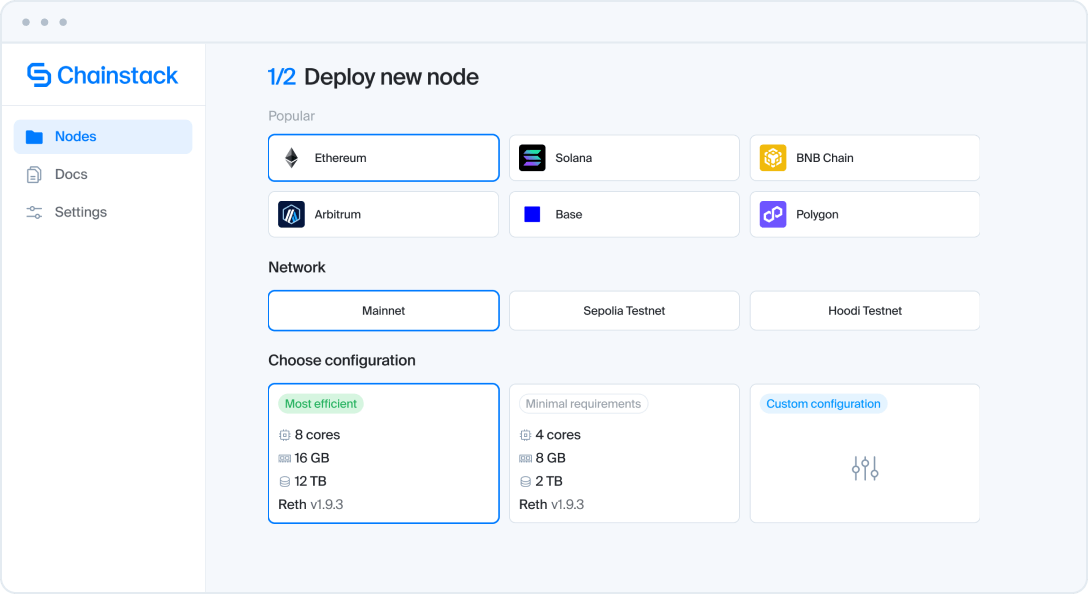
Most of the bare-metal providers above sell you a great box and leave the rest to you. That gap is what Chainstack Self-Hosted fills. SH is a Kubernetes-native control plane for blockchain nodes that runs on infrastructure you control. Currently supported deployments:
- Available now: Ethereum mainnet, Sepolia, Hoodi (Reth + Prysm clients), Bitcoin, Base, TRON, Optimism, StarkNet, Unichain, Zora
- Coming soon: Solana, Arbitrum
What SH delivers on top of any compatible host:
- One-click node deployment with right-sized configurations applied automatically
- Self-healing — nodes that crash or fall behind recover without manual intervention
- Automated update workflows — get notified when client updates are available, control when they’re applied
- Zero-downtime failover to a secondary node, a Chainstack managed RPC endpoint, or any endpoint you specify
- Integrated monitoring — Grafana, VictoriaMetrics, and a blockchain node exporter, ready from day one
SH installs cleanly on Latitude.sh, OVHcloud, Cherry Servers, DigitalOcean (via DOKS), and any other Kubernetes-capable host. Hetzner technically supports the install, but the policy risk above applies. For teams that don’t want to install it themselves, five partners ship it already running on their servers.
The architectural takeaway: the hosting provider choice becomes a question of geography, pricing, and ecosystem fit — not a question of whether you can run production-grade nodes on it. The operations layer stays constant; only the hardware varies.
How to choose
| If you are… | Use this |
|---|---|
| A Solana validator operator wanting Web3-aware bare metal with API automation | Latitude.sh |
| A team needing a European hyperscaler’s service breadth alongside bare metal | OVHcloud |
| Running validators on crypto-treasury billing with DoubleZero connectivity | Cherry Servers |
| A solo Ethereum (non-validator) operator focused on absolute cost | Hetzner (with the policy risk understood) |
| No team or time to manage DIY node operations | HOSTKEY, Velia, BreezeHost, serverside.com, or Vultr |
| Already on DigitalOcean for other workloads | DigitalOcean + Chainstack SH on DOKS |
| Wanting a managed validator, not a server | Allnodes |
Get started
Chainstack Self-Hosted is available now across five pre-installed partners — and free to install yourself on any infrastructure that meets the requirements.
- Deploy on HOSTKEY — pre-installed Chainstack Self-Hosted across European, US, and Turkish data centers
- Get 80% off first month on Velia — code ChainstackSH80 on pre-installed Web3 servers
- Get 50% off first month on BreezeHost — code CHAINSTACK50 on pre-installed servers
- Get 10% off on serverside.com — pre-installed Chainstack Self-Hosted in UK/EU
- Deploy on Vultr — Chainstack Self-Hosted is available as an app in the Vultr marketplace across their global datacenter footprint
- Install on your own infrastructure — the SH installation guide covers Latitude.sh, OVHcloud, DigitalOcean, Cherry Servers, and any Kubernetes-capable environment
Conclusion
The 2026 blockchain infrastructure market splits into two practical questions. The first: which category fits your workload — bare metal, pre-installed managed, cloud VM, or managed service? Get the category wrong and no provider inside it will save you. The second: which provider inside that category matches your geography, budget, and ecosystem? That’s where the comparison numbers in this guide do their work — Latitude.sh and OVHcloud for serious Solana operators, HOSTKEY through serverside.com for teams skipping the install step, Cherry Servers for crypto-treasury billing.
What stays constant across all of them is the operations layer. Whether you choose Latitude.sh and install Chainstack SH yourself, or pick HOSTKEY where it’s pre-installed, the node management experience is the same: deployment in minutes, self-healing, automated updates, integrated monitoring. The provider choice becomes a hardware swap, not a re-architecture.
FAQ
Bare metal is a physical server with an OS — Latitude.sh, OVHcloud, Cherry Servers, Hetzner. You install your node software, build your monitoring, write your failover logic. Pre-installed managed servers (HOSTKEY, Velia, BreezeHost, serverside.com, Vultr with Chainstack SH) ship with a node operations platform already running on top of the bare metal — you skip directly to deploying nodes from a control panel.
Their own marketing varies between “second” and “third” largest depending on the page. Independent measurement from Helius (epoch 685, August 2025) places them fourth at 8.45% of Solana validators, behind Teraswitch (24%), Latitude.sh (19%), and OVHcloud (8.65%). The “fourth-largest” framing is what the public validator data supports.
You can, but Hetzner’s terms of service prohibit cryptocurrency activity, and they enforced the policy against Solana validators in November 2022, taking 1,000+ nodes offline overnight. The risk remains in 2026. For production validators, choose a host with explicit Web3 support — Latitude.sh, OVHcloud, or Cherry Servers — or run pre-installed SH on a partner host where the relationship is contractually aligned with blockchain workloads.
Yes. Chainstack Self-Hosted is infrastructure-agnostic. If your server can run Kubernetes with the required storage and networking — that covers Latitude.sh, OVHcloud, Cherry Servers, DigitalOcean, the major hyperscalers, and on-prem hardware — SH installs on top. The installation guide walks through the setup.
They’re complementary, not competing. Cherry Servers is a hardware provider — they sell you a bare-metal box. Chainstack Self-Hosted is a node operations platform — it runs on the box. Teams running on Cherry Servers can install Chainstack SH on top to get automated deployment, self-healing, monitoring, and failover. The combination — Cherry hardware with crypto billing + SH operations — is a legitimate stack for crypto-native teams.
No. Allnodes is a managed node and validator service — they run nodes on their infrastructure, you don’t get a server. Latitude.sh and Cherry Servers sell you a server you control end-to-end. If your reason for running a node is “I want to own my infrastructure,” Allnodes is the wrong category. If your reason is “I want a validator running with minimal effort,” it’s a reasonable choice.
Available now: Ethereum (mainnet, Sepolia, Hoodi). Available in the SH control plane: Bitcoin, Base, TRON, Optimism, StarkNet, Unichain, and Zora. Coming soon: Solana and Arbitrum. Additional protocols are added regularly — check the Chainstack SH documentation for the current list.
Additional resources