AI-ready infrastructure
 Refer and earn


 Ethereum
 Hyperliquid
 Solana
 Arbitrum
 BNB Smart Chain
 Base
 Polygon
 TRON
 Sui
 Robinhood


Top 7 Ethereum RPC providers for fintech in 2026

Ethereum secures the largest share of the stablecoin market of any chain — $146.6 billion of the roughly $300 billion in circulating stablecoin supply sits on Ethereum, a 48.8% share, as institutional issuance and real-world asset infrastructure keep landing there first. For fintech teams building payments, settlement, or treasury tooling on top of that supply, Ethereum is the default chain to get right.
That dominance is also a compliance pressure point. Regulators in major economies — including the US, EU, UK, and Singapore — have moved stablecoins under banking-style prudential regimes, requiring full reserve backing, licensed issuers, and guaranteed redemption rights. Audit trails, reconciliation pipelines, and on-chain compliance forensics are no longer optional, and the RPC layer connecting an application to the chain is now infrastructure a regulator can ask about. A provider with opaque pricing, no compliance certifications, and unpredictable uptime is a business risk, not just a technical one.
This guide covers the RPC methods a fintech workload actually calls, how the leading providers perform against those specific requirements, and which infrastructure setup fits stablecoin settlement, on-chain compliance tooling, or multi-chain payment rails.
Quick verdict: best Ethereum RPC providers for fintech in 2026
Chainstack is our top pick for regulated fintech on Ethereum (an editorial judgment, not a benchmark result), based on audited SOC 2 Type II and ISO 27001 certification, full archive and trace access from the Growth plan, and flat RU billing that does not weight eth_getLogs. Chainstack publishes this page, runs the benchmark cited below and is one of the 7 listed providers, so see how we compared and the benchmark limits before relying on the ranking. In that benchmark Chainstack had the lowest overall P50, P95 and P99 of the three listed providers measured, but its US P95 trailed Alchemy and Quicknode. Last updated October 29, 2026. The best fit by need:
- Best for regulated fintech needing certified compliance and full trace access: Chainstack (flat billing, SOC 2 Type II and ISO 27001); Quicknode is the other dual-certified option with Dedicated nodes.
- Best for stablecoin deposit detection at scale: Chainstack (flat 1 RU on
eth_getLogs, WebSocket subscriptions); RouteMesh for multi-provider failover. - Best for on-chain compliance forensics: Chainstack (archive at 2 RU flat, full debug and trace); Blockdaemon for an institutional bundle with contractual SLA.
- Best for developer tooling and early-stage prototyping: Alchemy (30M CU/month free tier, Notify webhooks, Transact API; fastest US P95 of the three providers measured in the October 2026 benchmark, 80 ms).
- Best for multi-chain aggregation without per-chain integration work: Uniblock (Unified APIs across 300+ chains).
- Best for teams in the ConsenSys ecosystem that want archive on the free tier: Infura (no published SOC 2 or ISO 27001; verify before regulated use).
Provider comparison: 7 Ethereum RPC providers for fintech (2026)
The table below summarizes public positioning as of August 2026. The rank is the editorial order used in this article (see how we compared), not a benchmark result. The last column shows the overall P95 from Chainstack’s October 2026 Ethereum benchmark, which measured only three of the seven providers (lower is better).
| Rank | Provider | Best for | Pricing model | Free tier | Dedicated nodes | Archive & trace | Compliance certs | Overall P95 in Oct 2026 benchmark (Chainstack-run) |
|---|---|---|---|---|---|---|---|---|
| 1 | Chainstack | Audited compliance, full archive/trace from Growth, flat RU billing | Flat RU (1 RU/call, 2 RU archive/debug/trace) | Yes — 3M RU/25 RPS, no card required | Yes (Pro plan+) | Full — included from Growth ($49/mo) | SOC 2 Type II + ISO 27001 | 78 ms |
| 2 | RouteMesh | Multi-provider failover and multi-chain routing | Per-request, from $3/1M calls | Yes — free community routing endpoint | No (routing layer, not node infra) | Depends on the upstream provider it routes to | Not published | Not measured |
| 3 | Uniblock | Multi-chain aggregation and Unified APIs for reconciliation | Per-request, pooled across 55+ providers | Not published on the public site | No (routing layer) | Depends on the upstream provider it routes to | Not published | Not measured |
| 4 | Blockdaemon | Institutional buyers needing custody and contractual SLA | Custom/contractual | No | Yes — Dedicated Node clusters | Full, contractual SLA | SOC 2 Type II + ISO 27001 | Not measured |
| 5 | Infura | ConsenSys ecosystem, archive on the free tier | Daily credit allowance, method-weighted | Yes — 3M credits/day, 40+ networks | No | Full archive on free tier | Not published | Not measured |
| 6 | Alchemy | Developer tooling and a generous free tier | Compute Unit (CU) based, method-weighted | Yes — 30M CU/month, 15 RPS | No standard option | Full archive; trace support varies by chain | SOC 2 Type II (no ISO 27001 published) | 103 ms |
| 7 | Quicknode | Dual certification with dedicated nodes and add-ons | Credit-based (chain + method multipliers) | No — 1-month free trial only | Yes | Yes, add-on pricing | SOC 2 Type II + ISO 27001 | 92 ms |
How we compared Ethereum RPC providers for fintech
Disclosure: this comparison is published by Chainstack. Chainstack is one of the 7 listed providers and is ranked first, so read the ranking as a vendor perspective and check the figures against the official pricing pages linked in each provider section.
Criteria. Each provider is compared on the same attributes: pricing model, free tier, dedicated nodes, archive and trace access, published compliance certifications (SOC 2 Type II and ISO 27001), and fit for three fintech workloads (stablecoin deposit detection, on-chain compliance forensics and multi-chain payment rails). The order is editorial judgment for fintech workloads. It is not a benchmark result. The latency benchmark below covers only 3 of the 7 listed providers (Chainstack, Alchemy and Quicknode), so it informs the latency discussion for those three and does not determine the order.
Sources. Prices, limits and certifications come from each provider’s public pricing, documentation and security pages, as summarized on this page as of August 2026 unless a section says otherwise. Latency figures for Chainstack, Alchemy and Quicknode come from the Chainstack Labs Research Team’s October 2026 Ethereum benchmark. Chainstack’s platform uptime is shown as 99.99%+ platform uptime (status.chainstack.com, Ethereum Mainnet, 99.99%+ over the 90 days to October 29, 2026). That figure is platform uptime from the status page, which covers the Mainnet component of each chain (testnet and devnet components are tracked separately) and Chainstack only; it is separate from the benchmark’s probe success rate and from contractual SLAs, and it is not a guarantee.
Not covered. Other Ethereum RPC providers may also exist beyond these 7. They are not part of this comparison. dRPC appears in the benchmark table because the report measured it, but it is not one of the 7 listed providers. RouteMesh, Uniblock, Blockdaemon and Infura were not measured by the benchmark.
Latency data. See the Ethereum latency benchmark section for the figures, the method and what the benchmark does not show. For your own workload, measure from the region where your application runs; see how to measure RPC latency (P50, P95, P99).
Already using Chainstack? Jump straight to the Ethereum tooling documentation or deploy your endpoint in minutes.
Ethereum RPC for fintech: what the workload actually requires
Fintech is not one thing on Ethereum. A stablecoin payments processor calling eth_getLogs tens of thousands of times a day to detect incoming USDC deposits has different infrastructure needs than a compliance team running debug_traceTransaction to reconstruct transaction flows for a regulator. What both share: an RPC layer that returns 429s, times out silently, or bills unpredictably has real financial and regulatory consequences.
Latency and throughput requirements
Fintech workloads on Ethereum are usually not latency-critical in the way MEV or trading bots are. The window is wider than sub-10ms, but reliability and throughput consistency are non-negotiable. A payment processor polling eth_getLogs for deposits needs consistent response times at its polling interval — a p99 spike that doubles response time can cause missed confirmations and broken webhook pipelines.
Throughput needs vary by workload:
- Stablecoin deposit detection: sustained low-to-medium RPS with bursts during high-volume periods (end of day, market events)
- On-chain compliance: high volume of archive reads — balance-at-block, trace replays — often run in batch
- Multi-chain payment rails: fan-out across chains simultaneously; burst tolerance matters more than sustained RPS
For most fintech teams the metric that matters isn’t average latency, it’s p95 and p99 latency under sustained load. A provider averaging 50ms but spiking to 800ms at p99 is worse for payment infrastructure than one averaging 80ms with a 150ms p99.
The 7 Ethereum RPC methods that fintech teams actually call
| Method | What it does | Why it matters for fintech |
|---|---|---|
eth_getLogs |
Queries event logs, most often ERC-20 Transfer events |
Primary method for detecting incoming USDC, USDT, PYUSD, and EURC deposits. Wide historical ranges can require archive access depending on retention. |
eth_getTransactionReceipt |
Returns confirmation status, gas used, and emitted logs for a transaction | Closes the confirmation loop after a payment or settlement transaction is sent |
eth_call |
Executes a read-only contract call without broadcasting a transaction | Checks ERC-20 balanceOf, allowance, and compliance state (blacklist/freeze status). Needs archive access for point-in-time queries at a past block. |
eth_getBalance |
Returns the native ETH balance of an address | Treasury reconciliation depends on this working against arbitrary past blocks, which requires archive access |
debug_traceTransaction |
Replays a transaction and returns the full execution trace | The method compliance forensics runs when a regulator asks why a stablecoin transfer failed or what internal calls it made. Not every provider exposes this on every plan. |
eth_subscribe (WebSocket) |
Subscribes to new blocks, pending transactions, or filtered logs in real time | The alternative to polling eth_getLogs — a persistent logs subscription for USDC Transfer events is far more efficient than polling every 12 seconds |
eth_getTransactionByHash |
Fetches a transaction by its hash | Used alongside the receipt call to reconstruct the full payment record for audit trails |
Archive access matters for more of this list than it looks: eth_getLogs over a wide but recent block range runs fine on a full node, but eth_call or eth_getBalance pinned to a historical block number, and every debug_/trace_ call, need archive. For the full method surface, see the Ethereum API reference.
Infrastructure requirements
- Archive access — required for reconciliation, audit, and historical balance queries. Full nodes prune state older than roughly 128 blocks (about 25 minutes on Ethereum), which makes “what did this address hold at block 18,200,000?” unanswerable without it — a question every treasury team eventually asks.
- Dedicated vs shared nodes — production fintech environments cannot share RPC quota with thousands of other users. A single 429 error disrupting a payment flow makes the economics of dedicated infrastructure obvious. Dedicated nodes also give data isolation, which matters when transaction patterns are commercially sensitive.
- Geographic routing — a neobank serving European customers needs EU endpoints; a remittance platform serving Southeast Asia needs APAC nodes. A round trip from Singapore to a US-only endpoint adds 150–200ms to every call.
- MEV protection — for settlement transactions moving meaningful value, protection against front-running and sandwich attacks is worth having on by default rather than bolted on later.
- Security certifications — for teams operating under MiCA, the GENIUS Act, or equivalent frameworks, vendor SOC 2 Type II and ISO 27001 are the baseline. They signal that a provider’s security, availability, and confidentiality controls have been independently audited.
Ethereum RPC rate limits and free tiers compared
Rate limits and billing units differ between providers, so the same number of calls can cost different amounts. This table uses only the figures given elsewhere on this page, as of August 2026; “Not stated here” means this article gives no figure.
| Provider | Free tier | Free-tier rate limit | Paid tiers or throughput | Billing unit |
|---|---|---|---|---|
| Chainstack | Permanent Developer plan, 3M RU, no card required | 25 RPS | Growth $49/month (20M RU, 250 RPS); Pro $199/month (80M RU, 400 RPS); Business $499/month (200M RU, 600 RPS); Enterprise $990+/month (400M+ RU, unlimited RPS) | Request Units: 1 RU per call, 2 RU for archive, debug and trace |
| RouteMesh | Free community routing endpoint for read traffic | Not stated here | Entry pricing from $3 per million calls | Per request |
| Uniblock | Not published on the public site | Not stated here | Not stated here | Per request, pooled across 55+ providers |
| Blockdaemon | No free tier | Not applicable | Custom/contractual; Dedicated Node clusters | Quote-based |
| Infura | Core plan, 3M credits/day across 40+ networks, full archive | Not stated here | Developer $50/month (15M credits/day); Team $225/month (75M credits/day); custom Enterprise | Credits (method-weighted) |
| Alchemy | 30M CU/month | 15 RPS | Pay-as-you-go $0.52 per million CU (the docs show $0.525), no volume tiers; no standard dedicated option | Compute units (method-weighted) |
| Quicknode | One-month free trial only | Not stated here | Build $49/month; Accelerate $249/month; Scale $499/month; Business $999/month; Business+ $1,499-$2,999/month; custom Enterprise | Credits (chain and method multipliers) |
Chainstack alternatives for Ethereum fintech infrastructure
If Chainstack is not the right fit, these are the head-to-head differences between Chainstack and each alternative, using the facts in the sections below:
- Chainstack vs RouteMesh: RouteMesh adds automatic failover across 21 upstream providers on Ethereum (Chainstack is in its pool) and covers 1,000+ EVM networks, but operates no archive or dedicated nodes of its own and publishes no SOC 2 or ISO 27001; Chainstack runs its own archive, Dedicated Nodes and holds both certifications.
- Chainstack vs Uniblock: Uniblock offers Unified APIs and webhooks pooled across 55+ providers and 300+ chains, but offers no dedicated nodes, publishes no certification and depends on the upstream provider for archive and trace depth; Chainstack bills archive and trace at a flat 2 RU and offers Dedicated Nodes.
- Chainstack vs Blockdaemon: Blockdaemon holds SOC 2 Type II and ISO 27001 and bundles Dedicated Node clusters with custody and staking for institutions, but publishes no self-serve pricing and has no free tier; Chainstack publishes its plan ladder and has a permanent free Developer plan.
- Chainstack vs Infura: Infura has a permanent free plan with full archive (3M credits/day) and is the default RPC backend for MetaMask, but publishes no SOC 2 or ISO 27001 and has no standard dedicated node product; Chainstack publishes both certifications and offers Dedicated Nodes from the Pro plan.
- Chainstack vs Alchemy: Alchemy has a larger free tier (30M CU/month), Notify webhooks, the Transact API and a faster US P95 (80 ms against 143 ms) in the October 2026 benchmark, but weights methods by compute unit (60 CU for
eth_getLogs), has no standard dedicated option and publishes no ISO 27001. Chainstack had the lower overall P50, P95 and P99 in that benchmark. - Chainstack vs Quicknode: Quicknode holds both certifications, offers Hybrid Dedicated nodes and Marketplace add-ons, and had faster Germany (40 ms against 47 ms) and US (98 ms against 143 ms) P95 in the October 2026 benchmark, but its free offering is a one-month trial and its credit multipliers make costs harder to model. Chainstack had the lower overall P50, P95 and P99.
In-depth reviews: 7 Ethereum RPC providers for fintech (2026)
1. Chainstack: best for regulated fintech needing certified compliance and full trace access
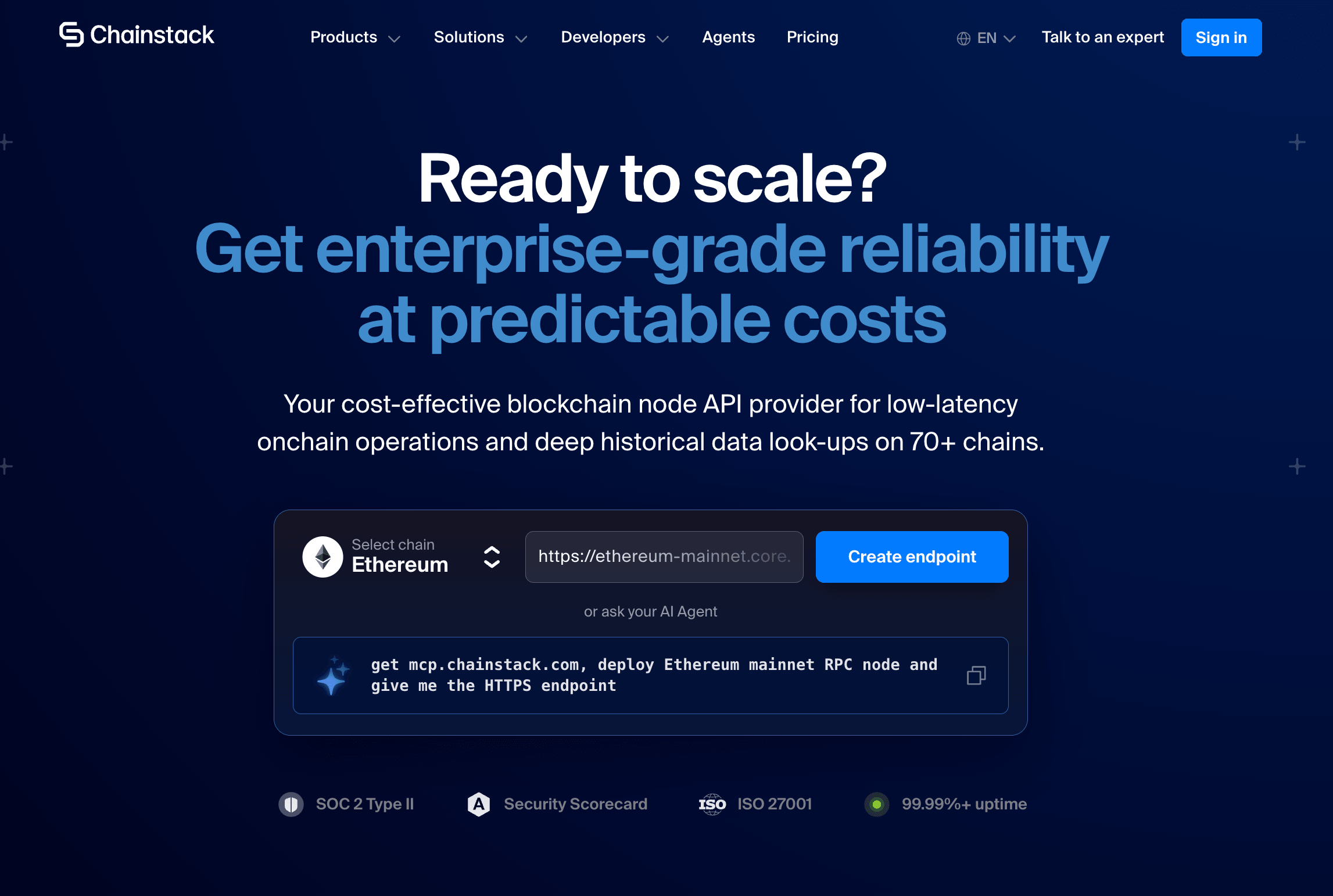
Verdict: SOC 2 Type II and ISO 27001, full archive and trace from Growth at a flat 2 RU, flat RU billing and Dedicated Nodes from Pro. Trade-off: the free Developer tier (25 RPS) is tight for production deposit detection, and its US P95 (143 ms) trailed Alchemy and Quicknode in its own October 2026 benchmark. Official pricing.
Chainstack runs Ethereum RPC infrastructure built around the constraints fintech teams actually hit: flat, predictable billing regardless of method mix, full archive and trace access from a low-cost paid tier, and audited compliance documentation that a vendor-review process can actually use. Global Nodes geo-route automatically across US, EU, and APAC regions, and Dedicated Nodes are available starting from the Pro plan for workloads needing isolated throughput or a specific cloud placement. For teams that need the node inside their own environment for data-sovereignty reasons, Self-Hosted supports Ethereum Mainnet, Sepolia, and Hoodi on a Reth + Prysm client stack.
The debug and trace surface is complete on Ethereum — debug_traceTransaction, trace_block, and related methods are billed at a flat 2 RU regardless of how computationally heavy the trace is. SOC 2 Type II (certified December 2025) and ISO 27001 (certified July 2026) cover security, availability, and confidentiality, and the Enterprise-plan uptime SLA (99.9% quarterly) is backed by service credits. MEV protection for Ethereum and BNB Smart Chain ships by default on Global Nodes at deployment (it can be turned off from the node’s Add-ons tab) for settlement transactions that need front-running protection. See Chainstack’s blockchain infrastructure for fintech for the full compliance stack, or the plan ladder on pricing: Developer (free, 3M RU/25 RPS), Growth ($49/mo, 20M RU/250 RPS), Pro ($199/mo, 80M RU/400 RPS), Business ($499/mo, 200M RU/600 RPS), Enterprise ($990+/mo, 400M+ RU/unlimited RPS).
Chainstack limitations: the free Developer tier (3M RU/25 RPS) is tight for production deposit-detection polling — budget for at least Growth once you’re past prototyping. The Unlimited Node add-on requires a paid base plan. In Chainstack’s own October 2026 Ethereum benchmark, Chainstack had the lowest overall P50, P95 and P99 of the three listed providers measured, but its US P95 (143 ms) was slower than Alchemy (80 ms) and Quicknode (98 ms), which matters for US-hosted payment systems.
Chainstack fit by workload:
- Stablecoin deposit detection: Excellent — WebSocket subscriptions plus flat-RU billing mean high-volume
eth_getLogspolling doesn’t inflate the bill (an editorial rating, not a measured result) - On-chain compliance forensics: Excellent — full
debug_traceTransactionsupport, archive at 2 RU flat, dual-certified audit trail for vendor review - Multi-chain payment rails: Strong, with 70+ chains on one console and one invoice — archive billing stays predictable as chain count grows
2. RouteMesh: best for multi-provider failover across EVM chains
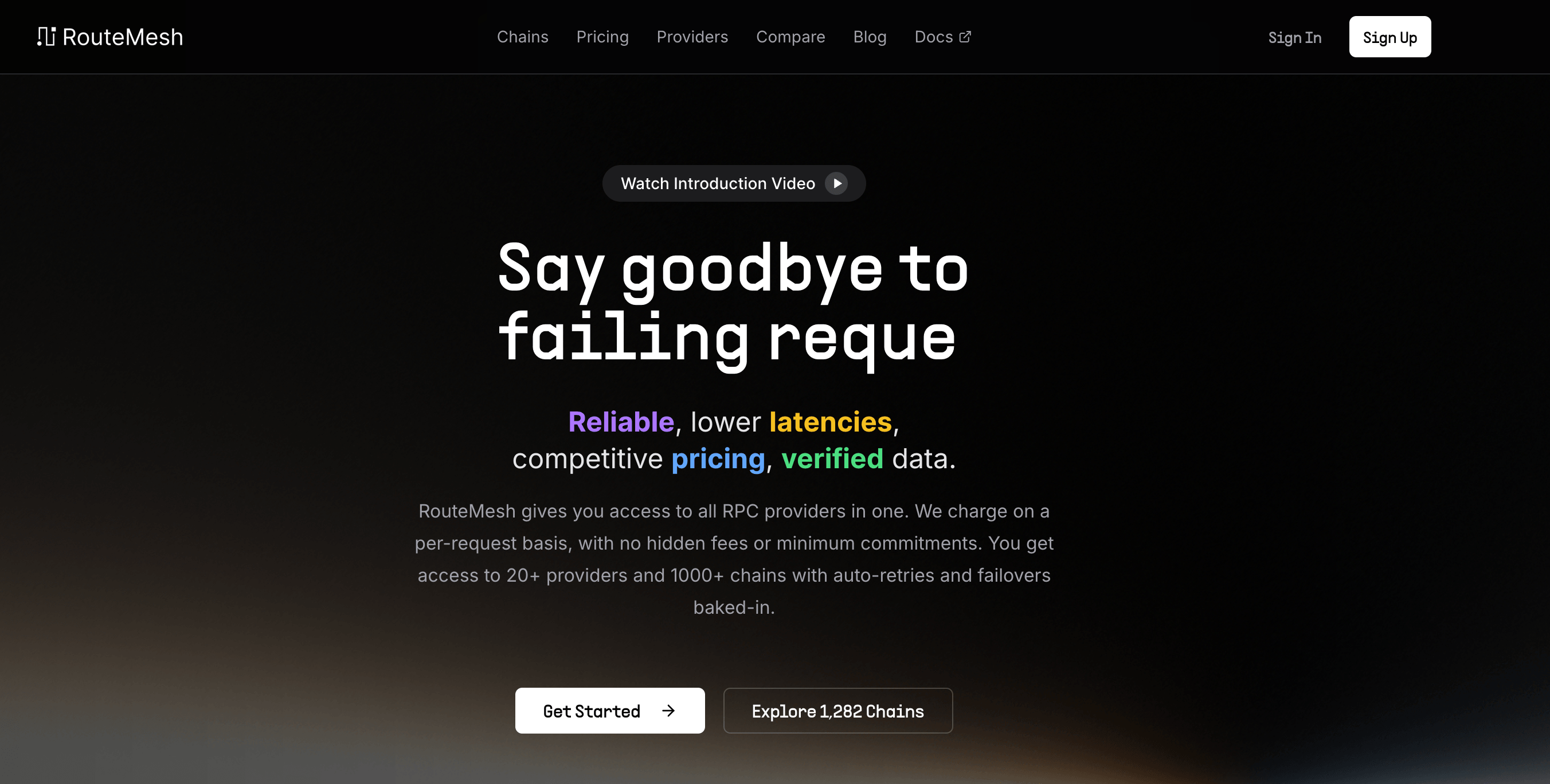
Verdict: Routing layer with automatic failover across 21 upstream providers on Ethereum. Trade-off: no archive or dedicated nodes of its own, no published SOC 2 or ISO 27001, and archive and trace depend on the upstream that answers. Pricing: entry pricing from $3 per million calls as stated above; no official pricing link has been verified for this page.
RouteMesh is an intelligent RPC routing layer covering 1,000+ EVM networks, including Ethereum Mainnet, with sub-10ms routing decisions and real-time health scoring across the upstream providers it connects to. On Ethereum specifically RouteMesh exposes 85 RPC methods through 21 underlying providers, with entry pricing from $3 per million calls and a free community routing endpoint for read traffic.
For fintech payment flows, the pitch is failover: if one upstream provider degrades or goes down, RouteMesh’s health scoring reroutes traffic automatically, which matters when a stuck deposit-detection pipeline has a real financial cost. RouteMesh routes a portion of its Ethereum traffic to a pool of providers that includes Chainstack alongside others. Customers publicly named include cross-chain infrastructure like LI.FI, which reports routing 97% of its EVM RPC calls through the platform.
RouteMesh limitations: RouteMesh doesn’t operate its own archive or dedicated node infrastructure — depth and trace coverage depend entirely on which upstream provider a given request lands on, which is opaque from the caller’s side. No published SOC 2 or ISO 27001 certification of its own, since it isn’t a node operator.
RouteMesh fit by workload:
- Stablecoin deposit detection: Strong for redundancy — automatic failover across 21 providers reduces the chance a single outage breaks a polling loop
- On-chain compliance forensics: Limited — archive depth isn’t something RouteMesh controls or guarantees directly
- Multi-chain payment rails: Excellent fit, since the product is built specifically for multi-provider, multi-chain routing at scale
3. Uniblock: best for multi-chain aggregation and reconciliation APIs
Verdict: Unified APIs and webhooks pooled across 55+ providers and 300+ chains. Trade-off: no published certification, no dedicated node option, and archive and trace depend on the upstream provider. Official pricing.
Uniblock is a managed multi-chain infrastructure layer spanning 300+ blockchains, including Ethereum, through 55+ underlying RPC providers pooled behind one API. Uniblock ships three product tiers: Unified JSON-RPC for raw RPC access, Unified APIs for higher-level token, NFT, market-data, and webhook queries, and Direct Provider APIs for pass-through access to a specific upstream provider. The company reports 4,000+ developers and 3,000+ projects using the platform, with customers including Plume Network, Stellar, and Oku Trade, and raised $5.2M in March 2026.
For a fintech reconciliation pipeline, the Unified APIs layer is the differentiator: instead of hand-rolling a second service to resolve token balances and prices from raw logs, a Unified API call returns pre-resolved token and market data alongside plain RPC, which cuts a build step out of a payment reconciliation stack. Pooling 55+ providers also gives rate-limit headroom that a single-provider setup doesn’t have.
Uniblock limitations: no published SOC 2 or ISO 27001 certification, and no dedicated node option — it’s an aggregation and API layer, not node infrastructure. Archive and trace depth depend on which upstream provider a request routes to.
Uniblock fit by workload:
- Stablecoin deposit detection: Good — webhooks reduce polling overhead, though log-detection reliability still depends on the upstream provider behind a given request
- On-chain compliance forensics: Moderate — no certified compliance documentation of its own to hand a vendor-review team
- Multi-chain payment rails: Strong — Unified APIs simplify a stack that needs balance and market data across many chains without separate integrations per chain
4. Blockdaemon: best for institutional buyers needing custody and a contractual SLA
Verdict: SOC 2 Type II and ISO 27001, Dedicated Node clusters and a bundle with MPC custody and staking. Trade-off: no published self-serve pricing, no free tier and a sales-led onboarding. Official site (pricing on request).
Blockdaemon is institutional-grade blockchain infrastructure built for regulated financial institutions rather than self-serve developer teams, reporting more than 400 institutional customers. Blockdaemon’s RPC API and Dedicated Node clusters run alongside MPC custody wallets, a policy engine, and staking services, all bundled for banks, exchanges, and asset managers building tokenization, stablecoin, or custody products. Blockdaemon holds SOC 2 Type II and ISO 27001 certification, matching Chainstack and Quicknode as the certified providers in this comparison.
For a fintech team that’s already an institutional buyer — a bank’s digital assets desk, an exchange’s custody arm — Blockdaemon’s bundled compliance and custody stack removes integration work a smaller team would otherwise assemble from separate vendors. That bundling is also the trade-off: it’s built for a different buyer than a self-serve fintech startup.
Blockdaemon limitations: no published self-serve pricing and no free tier — onboarding runs through a sales process, which is a mismatch for early-stage or mid-size fintech teams that want to start building today. Not the right fit outside the institutional buyer it’s built for.
Blockdaemon fit by workload:
- Stablecoin deposit detection: Good for institutional buyers already on the platform; a heavy lift to onboard for a lighter-weight deposit-detection use case alone
- On-chain compliance forensics: Excellent — dual certification and contractual SLA are exactly what a regulated institution’s vendor review is looking for
- Multi-chain payment rails: Good — broad chain coverage bundled with custody and staking, aimed at institutions consolidating multiple vendors into one
5. Infura: best for ConsenSys-ecosystem teams that want archive on the free tier
Verdict: Long track record since 2016, 3M credits/day free with full archive. Trade-off: no published SOC 2 or ISO 27001, no standard dedicated node product, and per-method credit weights are not published on the pricing page. Official pricing.
Infura has run Ethereum infrastructure since 2016 and is widely used in the ecosystem, serving as the default RPC backend for MetaMask. For fintech teams standardized on ConsenSys tooling, that ecosystem alignment carries real weight. Current pricing: a permanent free Core plan (3M credits/day across 40+ networks, full archive access included), Developer at $50/month (15M credits/day), Team at $225/month (75M credits/day), and custom Enterprise. Infura’s Decentralized Infrastructure Network (DIN), backed by Microsoft and Tencent among others — with Chainstack as one of the DIN partners — adds failover redundancy at the infrastructure level, though DIN failover is an enterprise-tier feature.
Infura’s credit model weights methods differently depending on load and namespace; the current per-method weighting isn’t published on the pricing page itself, so a fintech team with a heavy eth_getLogs or debug_traceTransaction mix should model their expected credit consumption against Infura’s own credit-cost documentation before committing to a tier, rather than assume the daily allowance covers it.
Infura limitations: no published SOC 2 or ISO 27001 certification as of this writing, which is a real gap for fintech vendor reviews that treat certification as a baseline filter. No standard dedicated node product.
Infura fit by workload:
- Stablecoin deposit detection: Good — reliable and MetaMask-aligned, but model credit consumption for a polling-heavy pattern before committing to a tier
- On-chain compliance forensics: Moderate — archive is included even on the free tier, but the lack of published compliance certification limits fit for regulated environments
- Multi-chain payment rails: Good — broad chain support and DIN redundancy, though the credit model adds modeling overhead as chain count grows
6. Alchemy: best for developer tooling and a generous free tier
Verdict: 30M CU/month free tier, Notify webhooks, Transact API and SOC 2 Type II; fastest US P95 (80 ms) of the three providers measured in the October 2026 benchmark. Trade-off: method-weighted CUs raise the cost of log-heavy workloads, no standard dedicated option and no published ISO 27001. Official pricing.
In our assessment, Alchemy is the most developer-friendly platform in this comparison, with the broadest tooling surface beyond raw RPC among the providers listed here — Notify webhooks for event-driven deposit detection, the Transact API for transaction simulation and retry logic, and a free tier of 30M CU/month at 15 RPS that covers a meaningful amount of development and staging traffic before a team commits to a paid plan.
Alchemy’s Compute Unit model weights methods individually: eth_getLogs costs 60 CU, eth_call costs 26 CU, and eth_getTransactionReceipt costs 20 CU, billed at $0.52 per million CU on the pay-as-you-go tier (no volume tiers; the docs show $0.525). For a log-heavy deposit-detection workload, that per-method weighting means the effective cost per actual API call runs meaningfully higher than a flat-rate alternative — worth modeling against your specific call mix before committing to volume. Alchemy’s pay-as-you-go cost depends heavily on the method mix once you’re past the free tier — see the cost table in the pricing section below before committing to volume.
Alchemy limitations: no standard dedicated node product, a real gap for fintech teams needing isolated throughput. No published ISO 27001 certification (SOC 2 Type II only). Trace API support varies by chain — confirm availability on Ethereum mainnet specifically for your account tier before relying on it for compliance forensics.
Alchemy fit by workload:
- Stablecoin deposit detection: Good — Notify webhooks cut polling overhead, but CU costs on
eth_getLogsat production volume need validating against your own mix - On-chain compliance forensics: Good — archive access is solid, but no dedicated node option and no ISO 27001 limit fit for the most compliance-sensitive teams
- Multi-chain payment rails: Moderate — broad chain coverage, but CU weighting varies per chain and needs separate modeling for each
7. Quicknode: best for dual certification with dedicated nodes and add-ons

Verdict: SOC 2 Type II and ISO 27001, Hybrid Dedicated nodes, and the fastest Germany P95 (40 ms) of the three providers measured in the October 2026 benchmark. Trade-off: no permanent free tier and credit multipliers (up to 4x on large calls) make cost modeling harder. Official pricing.
Quicknode pairs low measured latency (92 ms overall P95 and the fastest Germany P95, 40 ms, of the three providers in the October 2026 benchmark) with SOC 2 Type II and ISO 27001 certification, both confirmed on its current security documentation. Pricing runs from a one-month free trial (no paid commitment, but no permanent free tier once it ends) through Build ($49/mo), Accelerate ($249/mo), Scale ($499/mo), Business ($999/mo), three Business+ tiers ($1,499–$2,999/mo), and custom Enterprise. Hybrid Dedicated nodes and Marketplace add-ons extend the base platform for teams that need dedicated throughput or specialized APIs.
Credits are chain-based rather than purely method-based: Ethereum calls carry a 20-credit base rate, with a 2x multiplier on advanced APIs (trace and debug namespaces) and up to 4x on calls classified as “large” — a bracket that broad-range eth_getLogs queries can fall into depending on result size. Teams scaling past the free trial often find credit consumption outpaces what the headline per-credit rate suggested, so it’s worth running your own numbers through a cost calculator before committing to a tier.
Quicknode limitations: no permanent free tier — the trial converts to a paid plan or the account goes inactive. Credit multipliers on advanced and large calls make cost modeling for an archive- or trace-heavy fintech workload harder to pin down from the pricing page alone.
Quicknode fit by workload:
- Stablecoin deposit detection: Strong — second-lowest overall P95 (92 ms) of the three listed providers measured in the October 2026 benchmark, though credit costs on large-range
eth_getLogscalls are worth checking against your polling pattern - On-chain compliance forensics: Strong — full trace support and dual certification make it viable for regulated environments, at a materially higher credit cost per trace call
- Multi-chain payment rails: Good — wide chain coverage and Marketplace add-ons, but per-chain credit consumption needs monitoring as volume grows
Ethereum RPC latency benchmark (October 2026): Chainstack, Alchemy and Quicknode
Disclosure: Chainstack operates the monitoring service, the public Grafana dashboard and the scoring formula behind this benchmark, and is one of the four providers measured. The figures below come from the Ethereum RPC provider benchmark (Research Note No. 050, published October 8, 2026) by the Chainstack Labs Research Team. Live data is on Chainstack Compare and the Chainstack performance dashboard. Compare labels the success-rate column “availability”; here it is called probe success rate because it is not platform uptime.
Method in brief: a 7-day window ending October 8, 2026; probes every 1 to 3 minutes from three cloud regions (Germany, US and Singapore) using a Python service on Vercel serverless functions; each provider on its first paid plan; a request counts as failed if it takes longer than 55 seconds. The score is response time divided by success rate cubed per region (lower is better), averaged equally across the three regions. The latency term is the mean of each method’s P95 and excludes eth_subscribe. The collection code is open source (compare-dashboard-functions).
| Provider | Listed in this article | Score (lower is better) | Probe success rate | P50 (ms) | P95 (ms) | P99 (ms) | Germany P95 (ms) | US P95 (ms) | Singapore P95 (ms) |
|---|---|---|---|---|---|---|---|---|---|
| Chainstack | Yes | 0.079 | 99.98% | 36 | 78 | 117 | 47 | 143 | 42 |
| Quicknode | Yes | 0.097 | 99.98% | 40 | 92 | 142 | 40 | 98 | 138 |
| Alchemy | Yes | 0.114 | 99.98% | 38 | 103 | 188 | 64 | 80 | 164 |
| dRPC | No (measured, not listed here) | 0.670 | 99.96% | 56 | 641 | 1,950 | 153 | 875 | 895 |
Source: Chainstack Labs Research Team, Ethereum RPC provider benchmark, October 2026 (7-day window ending October 8, 2026).
What the benchmark shows:
- Among the three listed providers it measured, Chainstack has the lowest P50 (36 ms), P95 (78 ms) and P99 (117 ms) and the best overall score (0.079). The report puts second-place Quicknode’s score 23% higher.
- Chainstack is not fastest everywhere. In the US, Alchemy (80 ms P95) and Quicknode (98 ms) beat Chainstack (143 ms). In Germany, Quicknode (40 ms) beats Chainstack (47 ms). Chainstack is lowest in Singapore (42 ms), and its best-to-worst region ratio is 3.4x (42 ms in Singapore against 143 ms in the US).
- Chainstack, Quicknode and Alchemy tie on probe success rate at 99.98% (dRPC is 99.96%). This is the share of benchmark probe requests that succeeded over 7 days; it is not platform uptime and not an SLA.
- For a payment pipeline the tail matters more than the average, as discussed earlier in this article: overall P99 was 117 ms for Chainstack, 142 ms for Quicknode and 188 ms for Alchemy. Regional tails differ, so compare the region where your deposit-detection or settlement service runs rather than the global figure.
- dRPC, which is not one of the 7 listed providers, is degraded in the US (875 ms P95) and Singapore (895 ms P95).
What this benchmark does not show: RouteMesh, Uniblock, Blockdaemon and Infura were not measured, so this page does not claim Chainstack is the fastest of the 7 listed providers. The report covers a single 7-day window, each provider on its first paid plan only (free, higher and dedicated plans can behave differently), and synthetic probes from three cloud regions rather than end-user latency. It excludes eth_subscribe, so it says nothing about WebSocket subscription latency or stability, and this article cites no per-method latency ranges. It does not measure throughput under load, cost or correctness, and because Chainstack chose the scoring formula, a different formula could reorder close pairs.
Chainstack Compare 24-hour snapshot for Ethereum (captured October 29, 2026)
Chainstack Compare also tracks Ethereum live. The table below is a rolling 24-hour view of compare.chainstack.com captured on October 29, 2026 at about 14:21 UTC, with the same method and regions as above. It is a snapshot, not a dated report: the dashboard refreshes every 3 minutes, so live figures will differ, and it can differ from the 7-day report. Chainstack operates Compare.
| Provider | Listed in this article | Score (lower is better) | Probe success rate | P50 (ms) | P95 (ms) | P99 (ms) | Germany P95 (ms) | US P95 (ms) | Singapore P95 (ms) |
|---|---|---|---|---|---|---|---|---|---|
| Chainstack | Yes | 0.054 | 100.00% | 33 | 54 | 81 | 30 | 101 | 31 |
| Alchemy | Yes | 0.089 | 99.99% | 33 | 90 | 136 | 72 | 80 | 118 |
| Quicknode | Yes | 0.096 | 100.00% | 42 | 96 | 146 | 33 | 101 | 153 |
| dRPC | No (measured, not listed here) | 0.202 | 100.00% | 74 | 202 | 410 | 163 | 258 | 185 |
In this snapshot Chainstack again ranks first on score, but Alchemy has the lowest US P95 (80 ms against 101 ms for both Chainstack and Quicknode) and the same providers (RouteMesh, Uniblock, Blockdaemon and Infura) remain unmeasured.
What to benchmark yourself before committing
For a fintech workload, the methods worth benchmarking before committing to a provider are:
eth_getLogsover a realistic block range for your deposit-detection windoweth_getTransactionReceipt— the confirmation call after payment submissioneth_callat the current block, for balance and allowance checks- WebSocket
logssubscription stability over 24+ hours — a dropped subscription is a missed deposit
Method-weighted providers look cheaper per credit or CU on paper; the number that actually matters is cost per real call against your specific method mix, not the sticker rate. Run the four checks above from your production region before committing — compare.chainstack.com gives a fast top-level read, and the Grafana dashboard breaks it down by method and region if you need that level of detail.
How to choose an Ethereum RPC provider for fintech
1. Pricing model — flat vs weighted, and what that means at scale
True cost per call = (method’s CU/credit weight × price per million units) ÷ 1,000,000 — multiply by monthly call volume for the real bill. That single formula is the difference between a provider’s sticker price and what a fintech team actually pays once eth_getLogs and debug_traceTransaction dominate the request mix.
| Provider | Unit weight (eth_getLogs) |
Effective cost per 1M calls |
|---|---|---|
| Chainstack | 1 RU (flat) | ~$2.45 at Growth plan base rate; $15 at overage |
| Alchemy | 60 CU | ~$31 at $0.52/1M CU (PAYG) |
| Quicknode | 20 credits base, up to 4× on large-range calls | Not published per method — model your own range before committing |
| Infura | Weighted, not published per method | Check Infura’s current credit-cost documentation for your call mix |
For workloads with an unpredictable method mix — the normal case for a compliance team — flat-rate billing removes a variable a CFO otherwise has to model manually. See the cost comparison article for worked examples, or run your own numbers through the interactive cost calculator.
2. Archive, trace, and debug method access
This is where reconciliation, audit trails, and compliance forensics live. Confirm archive is included in your target plan rather than a paid add-on layered on top — on Chainstack it’s included from Growth ($49/month) at a flat 2 RU per call, whatever the trace depth. Check whether debug_* and trace_* namespaces are exposed at all, since not every provider enables them by default, and whether eth_call at a historical block number works on your plan tier before you build a reconciliation pipeline that assumes it does.
3. Free tier reality
A permanent, standalone free plan (Chainstack, Infura, Alchemy) is a materially different offer than a time-limited trial that requires a paid plan or goes inactive afterward (Quicknode). For a team prototyping before a compliance sign-off, or evaluating multiple providers side by side, a no-card-required permanent tier removes friction a trial doesn’t.
4. When dedicated infrastructure matters
Three concrete signals it’s time to move off a shared endpoint: sustained throughput above roughly 100 RPS on a single workload, a compliance requirement for data isolation from other tenants, or a need for custom node configuration (specific tracers, gas caps, or connection pooling) that a shared endpoint can’t offer.
5. Compliance posture and regulatory fit
If the application operates under MiCA, the GENIUS Act, or an equivalent regime, vendor compliance documentation isn’t optional. SOC 2 Type II and ISO 27001 together are the baseline most vendor-security reviews expect — Chainstack holds both (see its SOC 2 Type II and ISO 27001 certifications), and so do Quicknode and Blockdaemon among the providers here. Alchemy holds SOC 2 Type II only; Infura, RouteMesh, and Uniblock have not published either. For a team where vendor audits are part of an annual compliance cycle, this alone should narrow the shortlist before pricing enters the conversation.
6. Support quality — tiered, not “SLA yes/no”
What matters is what a provider offers at your specific tier, not whether an SLA exists somewhere on the pricing page. Chainstack’s support runs Community on the free Developer plan, Standard (under 24 hours, 24×5) from Growth through Business, a Professional add-on at $100/month (under 6 hours, 24×7), and a Premium add-on at $1,000/month (under 1 hour, 24×7). Getting an actual engineer to answer an eth_getLogs timeout question quickly is the difference between shipping and stalling — check what each provider actually names at the tier you’ll be paying for, not the enterprise tier’s marketing copy.
7. Latency consistency vs. average latency — the p95/p99 argument
Average latency is the wrong number to optimize for a payment pipeline. A provider’s p95 and p99 under sustained load determine whether a webhook pipeline misses confirmations during a traffic spike, which is a more useful benchmark than a headline “fastest” claim. Ethereum is tracked on both compare.chainstack.com and the Grafana performance dashboard — use either to check tail latency against your own call pattern rather than relying on a provider’s own benchmark page. The dated October 2026 benchmark above reports P99 of 117 ms for Chainstack, 142 ms for Quicknode and 188 ms for Alchemy (overall, across Germany, US and Singapore); the other four listed providers were not measured.
Getting started with Ethereum fintech infrastructure on Chainstack
Deploy a production Ethereum endpoint for fintech infrastructure in a few steps and build better with Ethereum on Chainstack:
- Log in to the Chainstack console (or create an account).
- Create a new project
- Select Ethereum as your blockchain protocol
- Choose network: Ethereum Mainnet or Sepolia / Hoodi testnet
- Deploy the node
- Open Access and credentials and copy your HTTPS and WebSocket endpoints
For latency-sensitive settlement flows or compliance workloads that need isolated throughput, evaluate Dedicated Nodes after the initial deploy — available inside the same project without a separate contract.
import { ethers } from "ethers";

// WebSocket connection — real-time subscription instead of polling
const provider = new ethers.WebSocketProvider("YOUR_CHAINSTACK_WSS_ENDPOINT");

// Minimal ERC-20 Transfer event ABI
const TRANSFER_ABI = ["event Transfer(address indexed from, address indexed to, uint256 value)"];
const token = new ethers.Contract("YOUR_TOKEN_CONTRACT_ADDRESS", TRANSFER_ABI, provider);

// Detect incoming stablecoin transfers to a deposit address
token.on("Transfer", (from, to, value, event) => {
  if (to.toLowerCase() === "YOUR_DEPOSIT_ADDRESS".toLowerCase()) {
    console.log(`Deposit: ${ethers.formatUnits(value, 6)} tokens from ${from}`);
    console.log(`Tx hash: ${event.log.transactionHash}`);
  }
});
📖 For the full integration guide, see the Chainstack Ethereum tooling documentation.
Need testnet ETH? Grab some from the Chainstack Sepolia faucet — up to 0.5 Sepolia ETH every 24 hours, directly from the console.
🤖 You can also access Chainstack Ethereum RPC directly from Claude, Cursor, Codex, Windsurf, Gemini CLI, GitHub Copilot, Antigravity, Claude.ai, or ChatGPT using Chainstack MCP. For a fuller agent stack — MCP, the Chainstack skill, llms.txt for context ingestion, and WebMCP for agentic browsers — see the Chainstack Agents page.
Conclusion
Ethereum’s stablecoin dominance and the regulatory frameworks now treating stablecoins as payment instruments mean the RPC provider decision carries compliance weight in a way it didn’t a few years ago. The method mix that actually drives cost — eth_getLogs, eth_call, eth_getTransactionReceipt, debug_traceTransaction — varies enough between providers that the cheapest headline rate is rarely the cheapest production rate.
- For regulated fintech needing certified compliance and full trace access: in our assessment, Chainstack (published by Chainstack, see how we compared; flat billing, dual certification) or Quicknode (dual certification, second-lowest overall P95 of the three providers measured in the October 2026 benchmark)
- For stablecoin deposit detection at scale: Chainstack (flat RU on
eth_getLogs, WebSocket subscriptions) or RouteMesh (multi-provider failover) - For on-chain compliance forensics: Chainstack (archive at 2 RU flat, full debug/trace) or Blockdaemon (institutional bundle with contractual SLA)
- For developer tooling and early-stage prototyping: Alchemy (30M CU free tier, Notify webhooks, Transact API)
- For multi-chain aggregation without per-chain integration work: Uniblock (Unified APIs across 300+ chains)
Frequently asked questions
Q: What RPC methods do I need for stablecoin deposit detection on Ethereum?
The core pattern uses either eth_getLogs (HTTP polling every 12 seconds with an ERC-20 Transfer topic filter) or a WebSocket logs subscription for real-time detection, then eth_getTransactionReceipt to confirm the deposit. Confirm your provider doesn’t apply a high method multiplier to eth_getLogs specifically — on Chainstack it’s a flat 1 RU; on CU/credit-weighted providers it typically costs more than a simple read.
Q: Do I need archive node access for my Ethereum fintech application?
Yes, eventually. Live deposit detection and current balance checks work on full nodes, but treasury reconciliation, audit trails, and historical balance-at-block queries all need archive access. On Chainstack, archive is included from the Growth plan ($49/month) at 2 RU per call — confirm archive is included in your target plan on any provider before going to production, since some gate it behind a separate add-on.
Q: How do I migrate from a public Ethereum RPC to a production provider without downtime?
Run a fallback provider pattern: set your production provider (e.g., Chainstack) as primary and keep the existing endpoint as secondary for 24–48 hours while monitoring latency and error rates. Once performance is stable, drop the fallback. Modern libraries support this natively — ethers.js FallbackProvider, viem’s fallback transport.
Q: What is the latency difference between providers for eth_getLogs?
It varies by region and provider tier, and published averages rarely reflect your actual geographic and method mix. The most reliable check is running your own comparison from your production region — compare.chainstack.com gives a fast top-level view, and the Grafana performance dashboard breaks results down by method and region for a deeper look. In Chainstack’s October 2026 Ethereum benchmark (7 days to October 8, 2026, measuring Chainstack, Quicknode, Alchemy and dRPC), overall P95 was 78 ms for Chainstack, 92 ms for Quicknode and 103 ms for Alchemy, but Alchemy (80 ms) and Quicknode (98 ms) were faster than Chainstack (143 ms) from the US. The other listed providers were not measured.
Q: Which providers are suitable for regulated fintech under MiCA or the GENIUS Act?
SOC 2 Type II and ISO 27001 together are the baseline most regulated fintech vendor reviews expect. Chainstack holds both — see its SOC 2 Type II and ISO 27001 certifications — and so do Quicknode and Blockdaemon. Alchemy holds SOC 2 Type II only; Infura has not published either as of this writing. Teams with a formal vendor-attestation requirement should verify each vendor’s current security documentation and, in our assessment, can shortlist the dual-certified providers first.
Q: How does Chainstack’s pricing compare to Alchemy for a stablecoin-heavy workload?
Using Alchemy’s published per-method CU weights (eth_getLogs 60 CU, eth_call 26 CU, eth_getTransactionReceipt 20 CU) against a representative mix of 50/30/20% at 80M calls/month works out to roughly $1,740/month on Alchemy’s pay-as-you-go tier at $0.52 per million CU (41.8 CU per call on average, 3,344M CU). The same 80M calls on Chainstack’s Pro plan (80M RU included) is a flat $199/month — a difference once method weighting is priced in, not just the headline per-unit rate. This is Chainstack’s own arithmetic from the figures on this page (as of August 2026); check the official pricing pages before relying on it.
Additional resources
- How to get an Ethereum RPC endpoint in 2026
- Ethereum available methods — Chainstack Docs
- Ethereum on the Chainstack blog
- Ethereum official developer documentation
- Chainstack pricing
Changelog
We review this comparison regularly so that the information stays accurate, clear, and easy to verify. This page was reviewed to improve how the comparison is structured and sourced.
- October 29, 2026: Added a quick verdict, a Rank and Best for column and a benchmark column in the provider comparison table (moved up), a methodology and disclosure section, an Ethereum latency benchmark section (October 2026 report covering Chainstack, Alchemy and Quicknode, plus a dated Compare snapshot), a rate limits and free tiers comparison, alternatives guidance, numbered provider sections with one-line verdicts and official pricing links, heading anchors, corrected vendor pricing, limits and certification details, and wording clarifications.
- May 13, 2026: Original publication.