AI-ready infrastructure
 Refer and earn


 Ethereum
 Hyperliquid
 Solana
 Arbitrum
 BNB Smart Chain
 Base
Base Polygon
 TRON
TRON Sui
Sui Robinhood


Top 7 RWA token data tools for developers in 2026

Real-world asset tokens look like ordinary ERC-20s until you try to query them in bulk. Pull totalSupply and balanceOf and you get raw numbers. But the actual question — what’s the NAV right now, what yield pattern does this token use, can this wallet even hold it — requires contract-specific ABI calls that differ across Ondo, BUIDL, Maple, and Backed.
There’s no standard oracle interface for tokenized treasuries. Compliance checks use four different models across the five largest RWA issuers. Price sources range from on-chain oracles to constant $1 NAVs to ERC-4626 vault math. Tools built for generic ERC-20 data return incomplete or misleading results when pointed at these tokens.
This guide ranks the best tools for querying RWA tokens in 2026 — from purpose-built Python SDKs to analytics APIs to raw RPC access. Each entry covers what it actually queries, what it misses, and what infrastructure it needs to run reliably.
Why querying RWA tokens is harder than it looks
A developer building on top of tokenized finance runs into the same problem across every project: there’s no unified data layer.
Consider querying the price of five common RWA tokens:
- USDY (Ondo) — read
getPriceData()from a customRWADynamicOraclecontract - OUSG (Ondo) — read
getAssetPrice()from a different Ondo oracle - bIB01 (Backed) — query a Chainlink aggregator feed
- syrupUSDC (Maple) — call
convertToAssets(1e6)on an ERC-4626 vault - BUIDL (BlackRock via Securitize) — the NAV is always $1.00; it’s enforced at the contract level, not read from an oracle
Same question, five different call signatures, four different contract types. Now add compliance checks: Ondo USDY uses a blocklist, OUSG uses a KYC registry, Backed uses Chainalysis sanctions screening, Maple’s syrupUSDC uses a bitmap permission manager, and BUIDL uses Securitize’s DS Protocol preTransferCheck. Every implementation is different.
This is the actual problem the tools below solve — or don’t.
The tools, ranked
1. Chainstack rwa-sdk — best for on-chain querying without an indexer
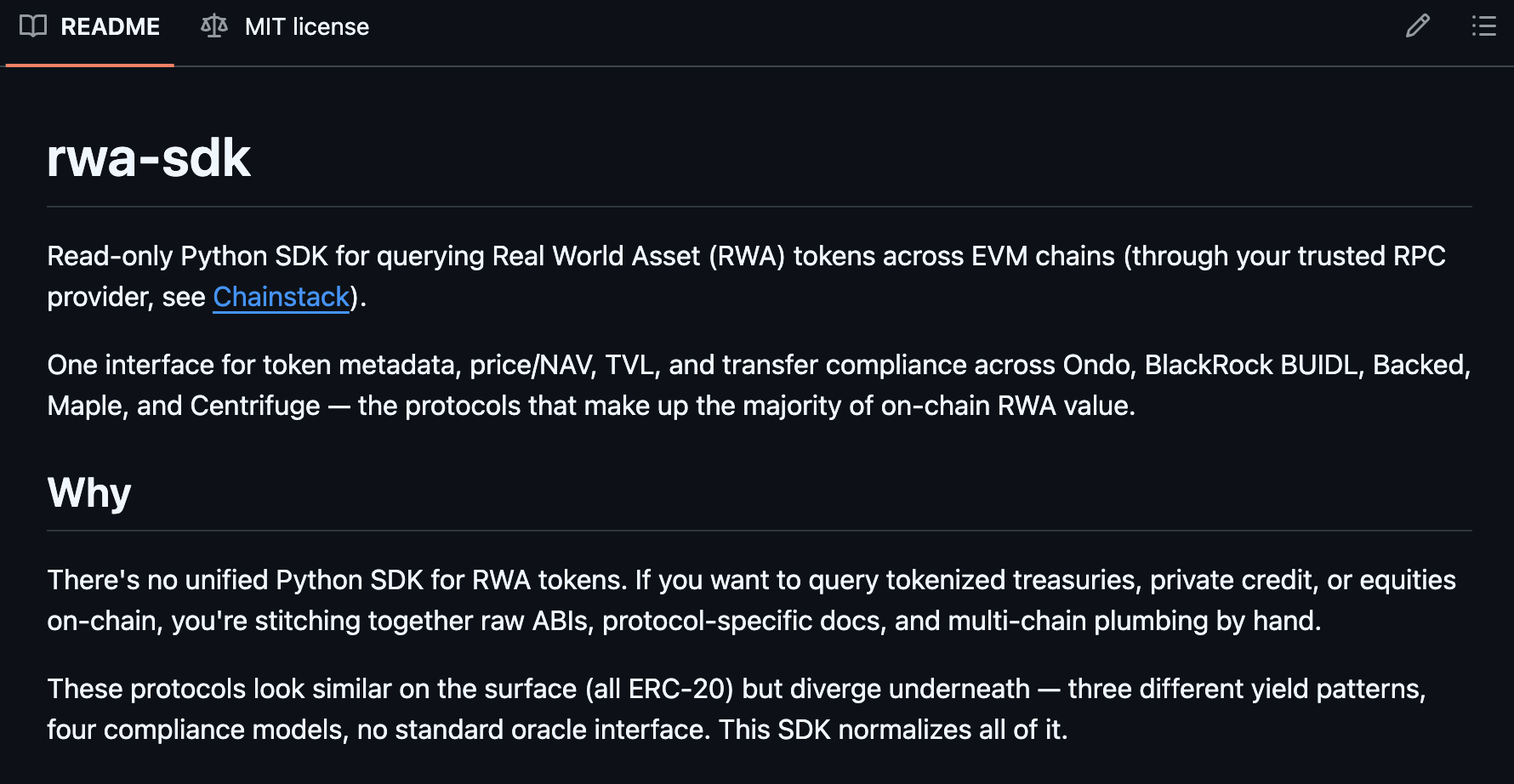
Type: On-chain token querying (read-only) · Language: Python · License: MIT · Link: github.com/chainstacklabs/rwa-sdk
What it is: An open-source Python SDK for querying RWA token data directly on EVM chains via eth_call. No database, no indexer, no API keys beyond an RPC endpoint.
The SDK covers Ondo Finance (USDY, OUSG, rUSDY, rOUSG), BlackRock BUIDL via Securitize (BUIDL, BUIDL-I), Backed Finance (bIB01, bCSPX, bNVDA), Maple Finance (syrupUSDC, syrupUSDT), and Centrifuge (JTRSY) — the protocols that account for the majority of on-chain RWA value. Tokens are returned as typed Pydantic models with normalized fields: price, tvl, yield_type, compliance_method.
from rwa_sdk import RWAChain

rwa = RWAChain(rpc_url="https://ethereum-mainnet.core.chainstack.com/YOUR_KEY")

# Query all supported tokens in one pass
for t in rwa.all_tokens():
    price = f"${t.price:.4f}" if t.price else "N/A"
    print(f"{t.symbol:12s} | {t.protocol:10s} | {price:>12s} | ${t.tvl:,.0f}")
Output against mainnet:
USDY         | ondo       |      $1.1290 | $587,132,506
OUSG         | ondo       |    $114.8500 | $388,964,385
BUIDL        | securitize |      $1.0000 | $168,501,226
syrupUSDC    | maple      |      $1.1590 | $1,786,175,587
The compliance layer is especially useful for builders. A single can_transfer() call handles all five compliance models behind a unified interface:
check = rwa.can_transfer("USDY", sender_address, receiver_address)
print(check.can_transfer)           # True / False
print(check.method)                 # ComplianceMethod.BLOCKLIST
print(check.restriction_message)    # "sender is on the blocklist"
What it gets right: Everything is a direct eth_call. No intermediary, no stale cache, no rate limits beyond what your RPC endpoint enforces. The bundled JSON ABIs mean you don’t need to fetch them from Etherscan at runtime. Multi-chain works by instantiating one RWAChain per network — BUIDL is deployed on Ethereum, Arbitrum, Polygon, and Avalanche, and the SDK handles each instance independently.
What it misses: Protocol coverage is limited to the five major issuers. If you’re querying Goldfinch, Centrifuge pools beyond JTRSY, or emerging issuers on Ondo Chain, you’ll need to write a custom adapter. The custom adapter interface is clean — the ProtocolAdapter protocol requires only protocol, chain_id, all_tokens(), and can_transfer() — but you’re still writing it yourself.
Infrastructure requirement: A reliable Ethereum mainnet RPC endpoint. Public endpoints cap at 100 requests per minute. Any production workload — periodic NAV polling, compliance screening at scale, multi-chain token aggregation — will exhaust that quota quickly. Use a Chainstack Ethereum node to remove the rate limit ceiling and get archive access for historical queries.
Install:
pip install git+https://github.com/chainstacklabs/rwa-sdk
2. RWA.xyz API — best for market-level analytics and issuer data
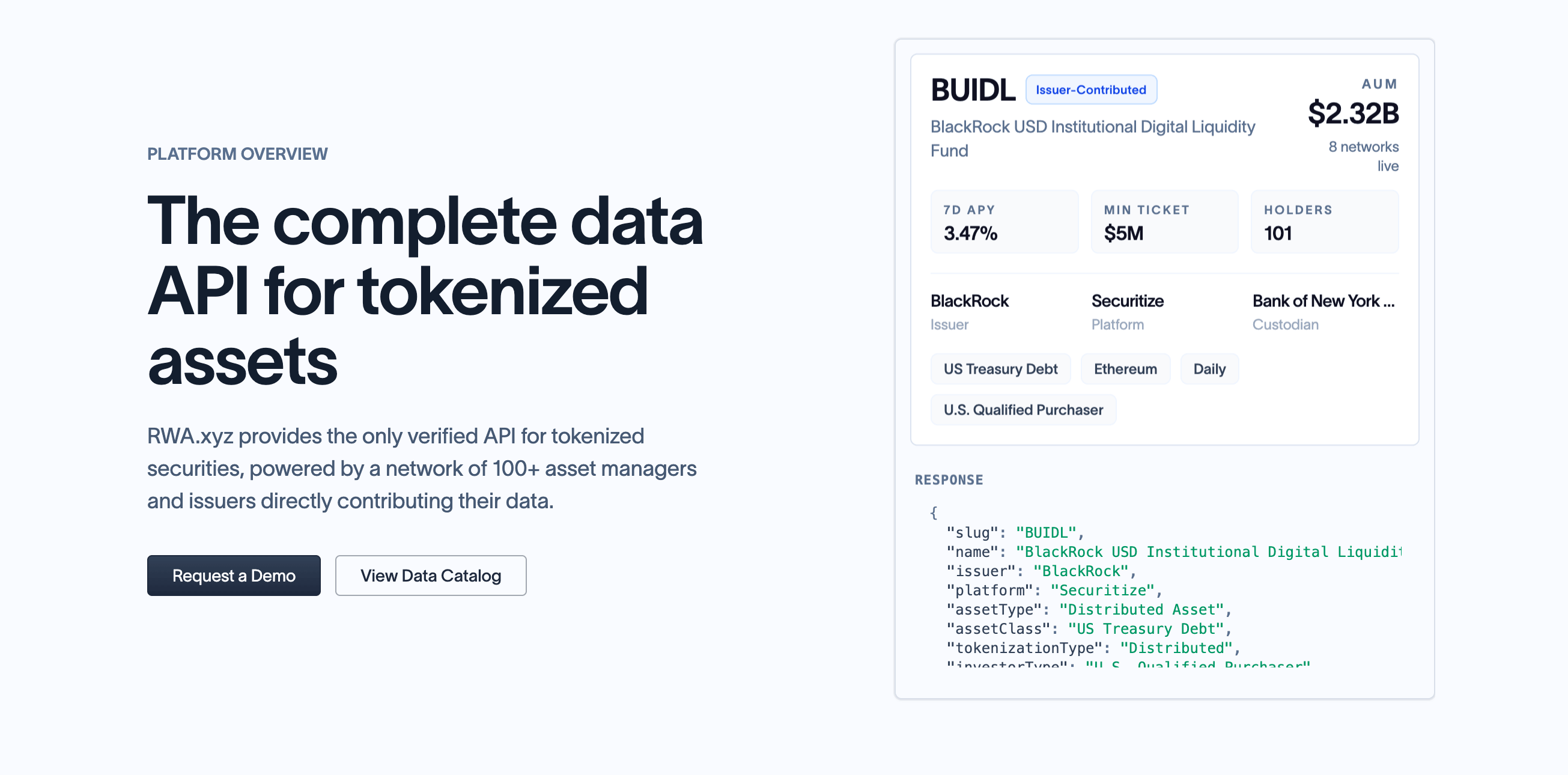
Type: Analytics & market data API · Language: REST / JSON · License: Proprietary · Link: app.rwa.xyz/platform-overview
What it is: A purpose-built analytics platform for tokenized real-world assets, with a data API for institutional and developer use. The platform tracks tokenized assets across categories (U.S. Treasuries, private credit, commodities, equities, real estate), issuers, chains, and platforms.
The public dashboard gives a fast market overview. The API layer — accessible after registration — adds data exports, visual query building, historical time-series, and structured JSON responses. A sample response looks like this:
{
  "entity": {
    "issuer_name": "BlackRock",
    "issuer_domicile": "British Virgin Islands",
    "custodian": "Bank of New York Mellon Corporation",
    "auditor": "PricewaterhouseCoopers"
  }
}
Beyond token-level data, RWA.xyz tracks issuer metadata (custodian, auditor, regulatory framework, domicile), network distribution, and category-level flows. Their November 2025 framework update introduced a “Distributed vs. Represented” classification — distributed assets can move to external wallets, represented assets cannot — which is practically important for developers building custody integrations.
As of 2026, the platform covers 400+ tokenized assets across 70+ chains and connects to Snowflake, BigQuery, and S3 for data warehouse delivery.
What it gets right: Market-wide coverage that no on-chain query tool can match. If you need issuer due diligence data, historical TVL trends, or a structured securities master for a fintech product, this is the right layer. The visual query builder generates code snippets for notebooks and dashboards.
What it misses: It’s a data layer, not a querying SDK. You’re querying RWA.xyz’s database, not the blockchain directly. For real-time price reads or compliance checks that must be on-chain verifiable, the SDK approach (above) is more appropriate. API access tiers are gated — deep features require a professional subscription.
Best for: Research applications, institutional dashboards, market intelligence tools, fintech apps that need issuer metadata alongside token data.
3. Centrifuge API — best for private credit pool data
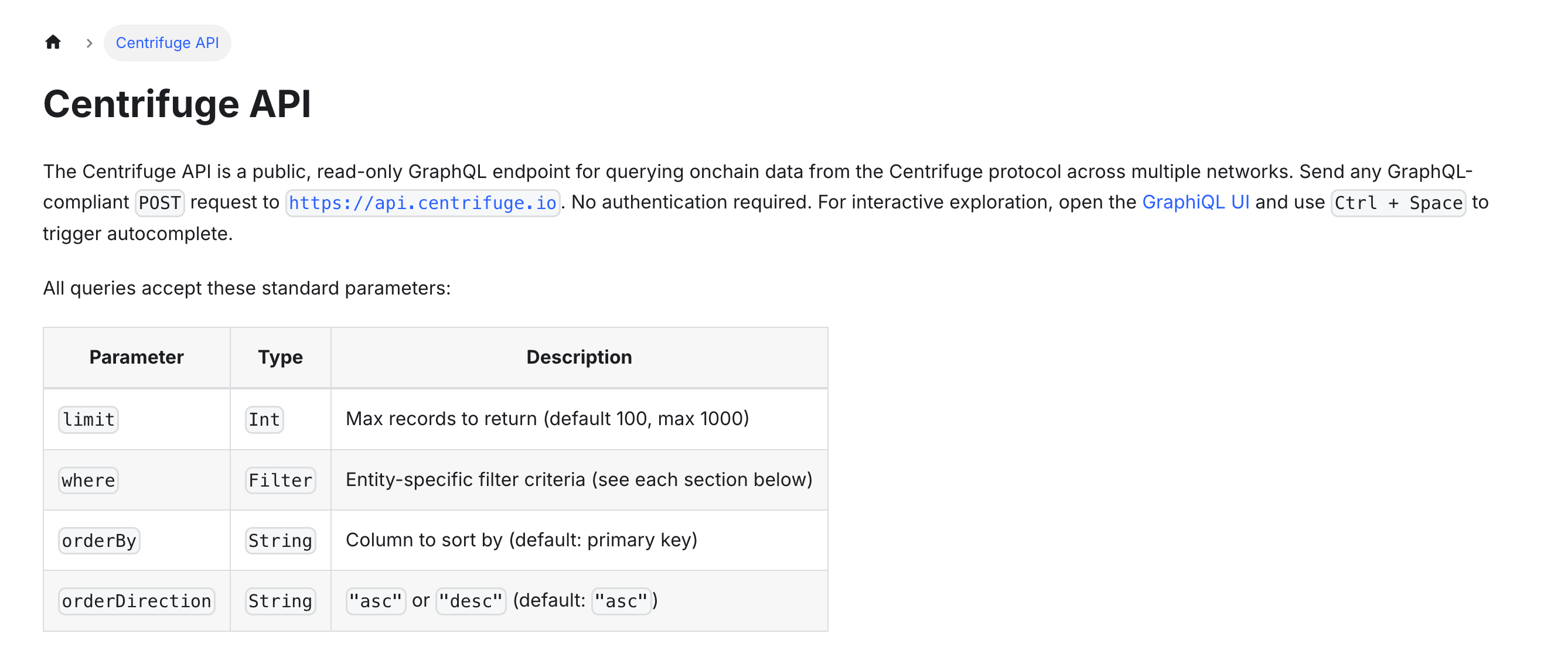
Type: Private credit pool data (GraphQL) · Language: GraphQL / TypeScript SDK · License: Apache 2.0 · Link: docs.centrifuge.io/developer/centrifuge-api
What it is: A public, read-only GraphQL endpoint for querying on-chain data from the Centrifuge protocol — the largest private credit RWA platform by origination volume, with over $2B in tokenized assets across 9 chains. The API is available at https://api.centrifuge.io with no authentication required.
Centrifuge’s data model is richer than most RWA APIs. A pool is the top-level entity, grouping share class tokens, vaults, and asset holdings across multiple networks. Each pool can issue several tokens, deploy vaults on different chains, and manage assets through a unified on-chain structure. The API exposes all of this: pool metadata, token prices, vault positions, investor transactions, and historical snapshots.
{
  pools(first: 10, orderBy: "totalIssuance", orderDirection: "desc") {
    id
    currency { symbol }
    tokens {
      tokenPrice
      totalIssuance
    }
  }
}
TVL per token is calculated as totalIssuance * tokenPrice, adjusted for decimals. Snapshots capture entity state at specific points in time — available for pools, tokens, token instances, and holdings — making historical NAV queries straightforward without needing an archive node.
Beyond the GraphQL API, Centrifuge also ships @centrifuge/sdk, a TypeScript/JavaScript client that covers the full investment lifecycle: quotes, deposits, redemptions, claims, and reporting. It runs client-side and server-side, and supports Centrifuge’s hub-and-spoke architecture where a single pool issues tokens across Ethereum, Base, Arbitrum, Avalanche, Plume, BNB Chain, Optimism, HyperEVM, and Monad.
What it gets right: Depth of private credit data. No other tool in this list gives you pool-level tranche structure, investor transaction history, and cross-chain vault positions for private credit instruments in a single query. The API is free, public, and actively maintained by the Centrifuge team — unlike third-party subgraphs that can fall behind on indexing.
What it misses: Centrifuge-only coverage. If you’re querying Maple, Goldfinch, or Ondo alongside Centrifuge pools, you need additional tools. The API is also an indexing layer, not a real-time on-chain read — there’s indexing lag, and compliance checks still require direct eth_call.
Best for: Applications built on Centrifuge pools, private credit portfolio dashboards, any workflow that needs historical NAV data or investor transaction history for Centrifuge-issued tokens.
4. RedStone — best for NAV oracles in DeFi protocols using RWA collateral
Type: NAV oracle (pull-based) · Language: Solidity / multi-chain · License: BSL 1.1 · Link: docs.redstone.finance
What it is: A blockchain oracle network specializing in real-world asset pricing, and the official oracle partner of Securitize — the transfer agent behind BlackRock’s BUIDL and Apollo’s ACRED. Where DIA provides general-purpose oracle feeds, RedStone has built pricing infrastructure specifically for tokenized assets: NAV calculations, illiquidity adjustments, and regulatory compliance requirements that standard oracle designs weren’t built to handle.
RedStone’s RWA oracle currently powers price feeds for BUIDL, ACRED (Apollo Diversified Credit), VBILL (VanEck), and tokenized sovereign debt instruments. These feeds are live on Ethereum, Solana, Polygon, and more recently Stellar — where RedStone implemented SEP-40, a unified high-frequency pricing interface for on-chain RWA assets.
The key architectural difference from DIA: RedStone uses a pull-based model where price data is delivered on demand alongside the transaction that needs it, rather than being pushed to the chain on a fixed schedule. For RWA tokens, this matters because NAV updates are infrequent (daily or weekly) — you don’t need a continuously updated on-chain feed, you need accurate data available exactly when a user interacts with the protocol.
For developers integrating RWA collateral into lending protocols, RedStone’s feeds are the correct layer. The ACRED feed, for example, was successfully deployed in a Morpho vault on Polygon — one of the first live DeFi vaults to use a major RWA as collateral — and on Solana via Drift Institutional.
What it gets right: NAV accuracy for institutional-grade assets. RedStone explicitly handles the complexity that generic oracle networks skip: pricing mechanisms that account for NAV calculations, regulatory compliance, and illiquidity adjustments for thinly traded assets. The Securitize partnership gives them direct data access rather than inferring prices from secondary markets.
What it misses: RedStone is an oracle for DeFi protocol developers, not a data querying tool for analytics applications. It doesn’t return compliance check results, TVL figures, or token metadata. If your use case is building a dashboard or querying token state for reporting, you need a different layer. RedStone is the right answer to one specific question: “how do I price this RWA token correctly inside a smart contract?”
Best for: DeFi protocols using RWA tokens as collateral (lending markets, vaults, derivatives), any on-chain use case that needs NAV-accurate pricing for institutional tokenized assets.
5. Ondo Finance API — best for integrating directly with the largest tokenized treasury issuer
Type: Issuer REST API · Language: REST / OpenAPI · License: Proprietary · Link: docs.ondo.finance/api-reference/overview
What it is: The official developer API from Ondo Finance — the largest tokenized treasury issuer by TVL, with over $1B in USDY and OUSG combined. The API covers pricing, quote generation, token lifecycle, and token contract metadata for Ondo’s full product line, including Global Markets (tokenized US stocks and ETFs).
The full OpenAPI specification is available at docs.ondo.finance/openapi.json for use with code generators. A typical pricing call returns authoritative NAV data directly from Ondo’s system — not inferred from DEX pools.
What it gets right: This is the authoritative source for Ondo token data. Where the rwa-sdk queries Ondo’s on-chain oracle contracts directly via eth_call, the Ondo API gives you the same NAV data via REST with additional context: quote generation for mint/redeem flows, token metadata, and round information. For any application that needs to integrate mint or redemption flows — not just read token state — the API is the required layer.
What it misses: Ondo-only coverage. The API doesn’t know about Maple, Backed, BUIDL, or Centrifuge. If your use case spans multiple issuers, you still need a multi-protocol tool alongside it.
Best for: Applications building directly on top of Ondo tokens — mint/redeem integrations, portfolio apps focused on USDY/OUSG, fintech products that need authoritative NAV data from the source.
6. The Graph — best for event-indexed historical data from private credit protocols
Type: On-chain event indexing (GraphQL) · Language: GraphQL / AssemblyScript · License: MIT · Link: thegraph.com
What it is: A decentralized indexing protocol that allows developers to query blockchain data via GraphQL using protocol-specific “subgraphs.” Several major RWA protocols have published and maintained subgraphs on The Graph network.
Centrifuge’s subgraph indexes pool-level data: asset originators, tranche structures, NAV updates, and loan performance. Maple Finance’s subgraph covers pool deposits, withdrawals, loan originations, and repayments. Goldfinch has a similar subgraph for its credit pools. For private credit protocols where the interesting data is in events rather than current state, subgraphs are the right query layer.
A basic Centrifuge query:
{
  pools(first: 10, orderBy: totalReserve, orderDirection: desc) {
    id
    name
    totalReserve
    totalBorrowed
    currency {
      symbol
    }
  }
}
What it gets right: Historical event data at any granularity. If you need to know how a Centrifuge pool’s NAV evolved over the past six months, or track Maple withdrawal requests over time, subgraphs are the most efficient access layer. The GraphQL interface is clean and composable.
What it misses: Subgraph coverage is uneven. Ondo Finance does not have a maintained subgraph on The Graph network — its oracle data requires direct eth_call. Securitize BUIDL data is similarly not indexed. For the tokenized treasury segment (which dominates RWA TVL), The Graph provides limited coverage.
Subgraph data is also indexed, not real-time. There’s indexing lag — typically seconds to minutes — which matters for compliance checks or live pricing.
Best for: Historical analysis of private credit protocols, portfolio performance reporting on Centrifuge and Maple pools, event-driven data pipelines for Goldfinch.
7. DeFiLlama API — best for TVL aggregation and protocol-level benchmarking
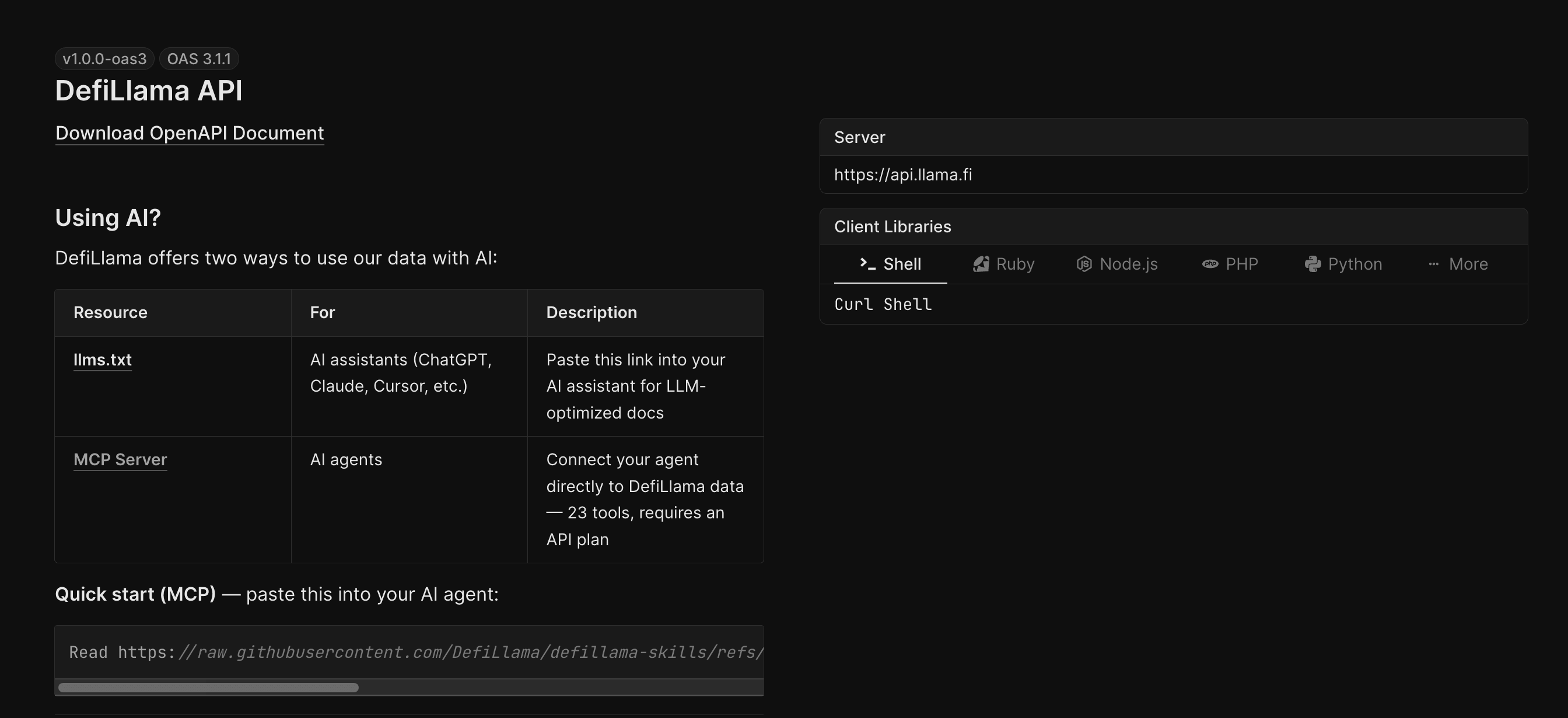
Type: Protocol TVL aggregation · Language: REST / JSON · License: MIT · Link: defillama.com/docs/api
What it is: An open, free API for protocol TVL data across DeFi and RWA. DeFiLlama tracks tokenized treasury products, private credit protocols, and gold tokens, aggregating TVL from on-chain data into clean REST endpoints.
For a developer who needs market context — which protocols are growing, how Maple’s TVL compares to Centrifuge’s, where BUIDL sits relative to USDY — DeFiLlama is the fastest free option. The API requires no authentication and returns structured JSON.
curl "https://api.llama.fi/protocol/ondo-finance"
What it gets right: Zero cost, zero auth, clean API. For market context, competitive benchmarking, or populating a dashboard with protocol-level TVL data, DeFiLlama is unmatched in terms of access friction. Coverage extends to 8,000+ protocols; RWA-specific filtering works via category and chain parameters.
What it misses: TVL is DeFiLlama’s output — everything else (token price, compliance data, yield type, holder counts) requires another tool. Protocol-level TVL is also a coarser metric than token-level NAV. DeFiLlama’s BUIDL TVL includes all BUIDL variants across chains; the rwa-sdk lets you query each deployment independently.
Best for: Market research, protocol comparison, dashboard widgets showing RWA market size, any use case where TVL context is the primary requirement.
How to choose the right tool
The decision tree is simpler than the tool count suggests.
- If you need protocol-accurate, on-chain data (NAV, yield, compliance): Start with the Chainstack rwa-sdk. It covers 90%+ of on-chain RWA value with normalized output and a clean compliance interface. Add a custom adapter for any protocol not yet supported.
- If you need market-wide issuer and analytics data: RWA.xyz API sits above the chain layer and provides coverage and context that on-chain tools can’t match — 400+ assets, historical flows, issuer metadata.
- If you’re pricing RWA tokens inside smart contracts: RedStone or DIA. Both are oracle networks, but RedStone is the official Securitize partner and purpose-built for NAV-accurate pricing of institutional assets like BUIDL and ACRED. DIA covers a broader range of RWA protocols. If your collateral includes Securitize-issued assets, RedStone is the more reliable feed source.
- If you’re building directly on Ondo tokens: The Ondo Finance API is the authoritative source for NAV, quotes, and mint/redeem flows — use it instead of inferring prices from DEX data or third-party aggregators.
- If you need private credit pool data (Centrifuge): The Centrifuge API is the right first stop — free, public, no auth, with pool-level tranche data and historical snapshots that no other tool provides. For Maple or Goldfinch, The Graph subgraphs are the fallback.
- If you need TVL benchmarks and market context: DeFiLlama for free, RWA.xyz for depth.
Comparison at a glance
| Tool | Data source | RWA-specific | Compliance checks | Historical data | Cost |
|---|---|---|---|---|---|
| Chainstack rwa-sdk | On-chain (eth_call) | Yes | Yes | With archive node | Free (OSS) |
| RWA.xyz API | Indexed/off-chain | Yes | No | Yes | Freemium |
| Centrifuge API | Indexed/off-chain | Yes (private credit) | No | Yes | Free |
| RedStone | Oracle network | Yes (NAV-focused) | No | Yes | Freemium |
| Ondo Finance API | Issuer (off-chain) | Yes (Ondo only) | No | No | Proprietary |
| The Graph | On-chain (indexed) | Partial | No | Yes | Freemium |
| DeFiLlama API | Aggregated | No | No | Yes | Free |
Infrastructure requirements for production RWA querying
The tools above share a dependency: any workflow making on-chain calls needs a reliable RPC endpoint.
Public Ethereum endpoints cap at 100 requests per minute and are shared across all users. A production app polling NAV for 20 RWA tokens every 30 seconds makes 40 requests per minute on the read side alone — before compliance checks, balance queries, or any additional chain state. Two users will start competing for quota immediately.
For RWA-specific workloads, infrastructure requirements are somewhat different from DeFi trading bots. NAV updates for tokenized treasuries and private credit instruments are typically pushed once daily or weekly — not continuously. The requirement is not high frequency; it is guaranteed delivery during a narrow window. If an RPC connection drops during the one window a custodian attempts to push a NAV update, the fund can become untradable until the state is corrected.
Archive node access is also relevant. Historical NAV reads — needed for performance reporting, audit trails, and reconciliation — require querying state at specific historical block numbers. Full nodes only store recent state; archive nodes store everything from genesis.
Chainstack provides both full and archive Ethereum nodes with geo-balanced global endpoints, no shared rate limits on dedicated plans, and SOC 2 Type II and ISO 27001 certification for teams operating in regulated environments.
from rwa_sdk import RWAChain

# Production setup with Chainstack
rwa = RWAChain(
    rpc_url="https://ethereum-mainnet.core.chainstack.com/YOUR_KEY"
)

# All tokens, live prices, compliance-ready
for token in rwa.all_tokens():
    print(f"{token.symbol}: ${token.price:.4f} | TVL ${token.tvl:,.0f}")
Conclusion
Querying RWA tokens requires navigating a fragmented landscape: four compliance models, three yield patterns, and no standard oracle interface across the five largest issuers. General-purpose ERC-20 tools return partial data; building protocol-specific logic from scratch means maintaining five separate ABI files and parsing five different response formats.
The Chainstack rwa-sdk exists because this problem keeps appearing in every project that touches tokenized finance. A single rwa.all_tokens() call returns normalized data for the protocols that hold the majority of on-chain RWA value, with a unified compliance interface across all of them.
For market context and research, pair it with RWA.xyz. For private credit pool data, the Centrifuge API. For on-chain pricing in smart contracts, RedStone for institutional assets, The Graph for Maple and Goldfinch event history. These tools cover different layers of the same stack — use the right one for each layer.
FAQ
All data reads use eth_call — the standard EVM method for calling view functions without creating a transaction. No indexer, no API key beyond the RPC endpoint, no database. The SDK ships bundled JSON ABIs for every contract it queries, so there’s no runtime ABI fetching.
Yes. BlackRock BUIDL via Securitize is deployed on Ethereum, Arbitrum, Polygon, and Avalanche. With the rwa-sdk, instantiate a separate RWAChain per network and pass the appropriate RPC URL for each chain. Chainstack provides nodes for all four networks.
NAV (Net Asset Value) is the authoritative price set by the protocol’s oracle or pricing mechanism — what the token is worth for redemption. Market price is what someone will pay for it on a DEX, which can deviate due to thin liquidity. For compliance-sensitive applications (audits, regulatory reporting, fund accounting), always use NAV from the protocol’s oracle. The rwa-sdk queries NAV by default.
Not for current-state queries. rwa.all_tokens() and can_transfer() query current blockchain state and work with any full node. For historical queries — what was OUSG’s price at block 19,000,000, or what was BUIDL’s TVL three months ago — you need an archive node. Chainstack offers archive access on dedicated node plans.
Five: blocklist (Ondo USDY/rUSDY), KYC registry (Ondo OUSG/rOUSG), Chainalysis sanctions screening (Backed), bitmap permission manager (Maple syrupUSDC), and DS Protocol pre-transfer check (Securitize BUIDL). All are exposed through the same can_transfer() interface, returning a ComplianceCheck object with can_transfer, method, restriction_message, and blocking_party.
The rwa-sdk is entirely RPC-based. “Chainstack” in this context is the RPC node provider, not a data layer. You can use the SDK with any Ethereum-compatible RPC endpoint — public or private. The Chainstack RPC is recommended for production because it removes rate limit constraints and adds archive access, but the SDK itself works with any provider.