Ethereum
 Solana
 Hyperliquid
 Arbitrum
 Base
Base BNB Smart Chain
 MegaETH
 Tempo
Tempo Avalanche
 Aptos
Aptos TRON
TRON Ronin
Ronin zkSync Era
 Optimism
 Sonic
Sonic Polygon
 Unichain
 Fantom
 Gnosis Chain
 Sui
Sui Avalanche Subnets
 Polygon CDK
 Starknet Appchains
 zkSync Hyperchains




 Refer and earn
 Discord
 Telegram
 X (Twitter)
Self-hosted blockchain node: DIY vs Chainstack Self-Hosted

Getting a blockchain node running isn’t the hard part. The hard part is everything that comes after — keeping it synchronized, updated, monitored, and available, day after day.
Most teams underestimate this. Deployment goes smoothly. Then a node falls out of sync at 2am. A protocol hard fork requires coordinated updates across every node you run. A client crashes and nobody gets alerted. This is where DIY self-hosting gets expensive — not in servers, but in engineering time.
Running a self-hosted blockchain node gives full infrastructure control, but maintaining it reliably is where most teams struggle.
The good news: you don’t have to choose between control and operational sanity. But you do need to be deliberate about which path you take.
Why organizations run a self-hosted blockchain node
Organizations choose a self-hosted blockchain node for compliance, control over data, and predictable infrastructure costs at scale. For many teams, self-hosting isn’t optional — it’s a requirement:
- Compliance: Certain industries mandate on-premises or jurisdiction-specific infrastructure. Third-party RPC providers aren’t on the table.
- Control: Direct access to blockchain data without rate limits or dependency on external APIs is critical for exchanges, wallets, and high-volume applications.
- Cost: At scale, self-hosting is significantly more cost-effective than paying for managed node services.
The question isn’t whether to self-host. It’s how much of your team’s time you want to spend on infrastructure versus building your actual product.
Two paths: build it yourself or use a control plane
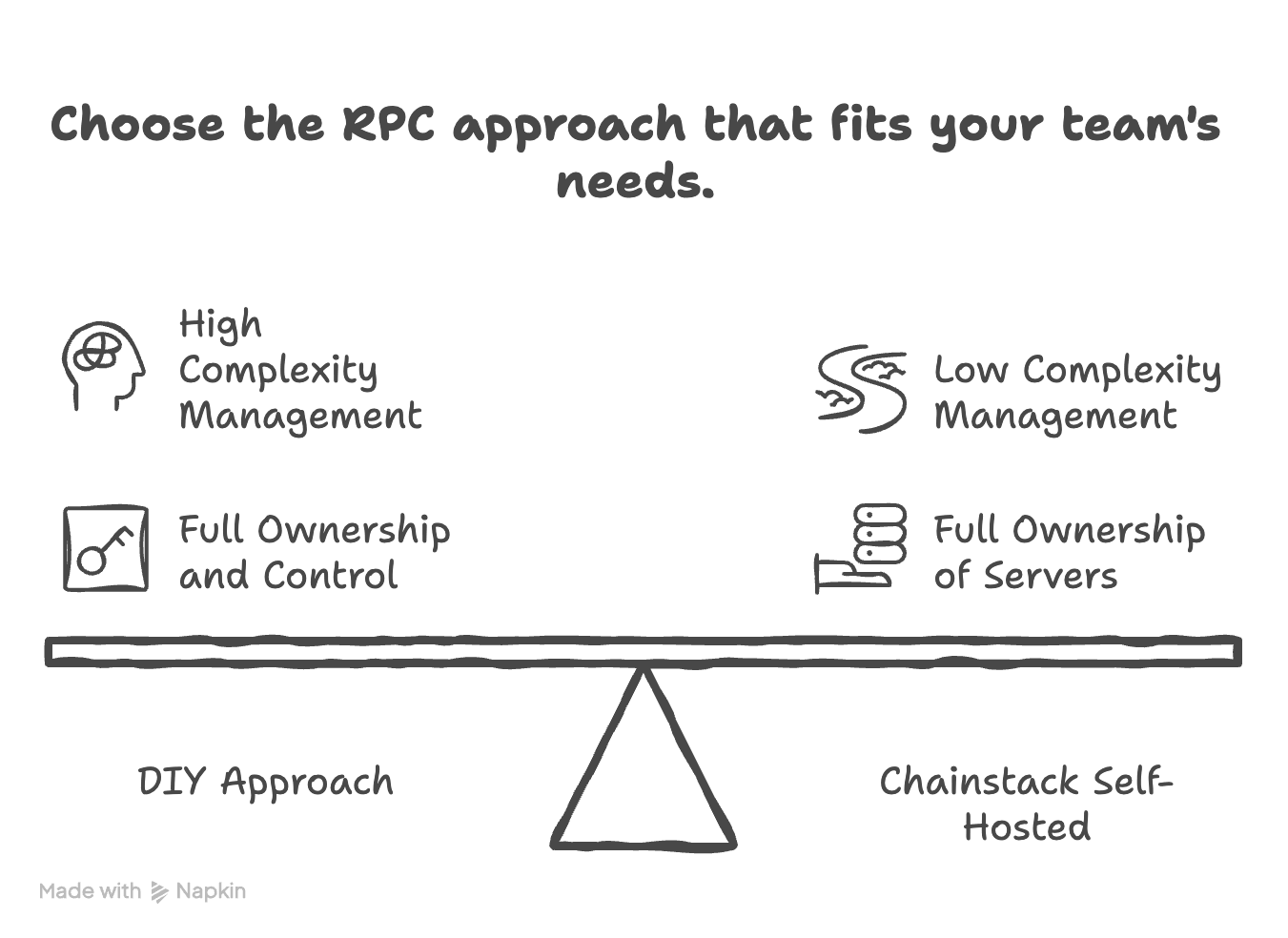
Teams that self-host typically choose one of two approaches:
- Build it yourself (DIY): Assemble open-source components, write your own deployment configs, set up monitoring, and maintain everything in-house.
- Chainstack Self-Hosted: Deploy a control plane on your own infrastructure that handles the complexity — while you retain full ownership of the underlying servers and data.
Both give you full infrastructure control. The difference is how much of your engineering time goes into building and maintaining the plumbing versus building your product.
The reality of running a self-hosted blockchain node yourself
Setup and installation
A production blockchain setup requires multiple systems working together: container orchestration, storage provisioning, networking configuration, and monitoring — each with its own dependencies. Storage provisioning alone involves several components that need to coordinate correctly; a misconfiguration at any layer can prevent nodes from starting or corrupt existing data.
For a single Ethereum node, this is manageable for someone with the right expertise. The challenge compounds when you add more nodes or additional protocols. Each new protocol means rebuilding the deployment system from scratch.
Expect 2+ weeks to get a production-ready setup running for the first time.
Node deployment
An Ethereum node requires two separate clients — an execution client and a consensus client — that must communicate continuously. Configure them incorrectly and they won’t connect. Choose the wrong sync mode or miscalculate storage requirements and you’re troubleshooting days later.

Every deployment decision — resource allocation, storage sizing, sync strategy — requires deep familiarity with both Kubernetes and the specific blockchain clients you’re running. And every decision becomes a configuration artifact that someone on your team needs to maintain.
Ongoing operations
Running nodes is an ongoing job. Client updates, security patches, sync issues, and failed nodes all need attention. Without a centralized management layer, this knowledge lives in runbooks and whoever originally built the system.
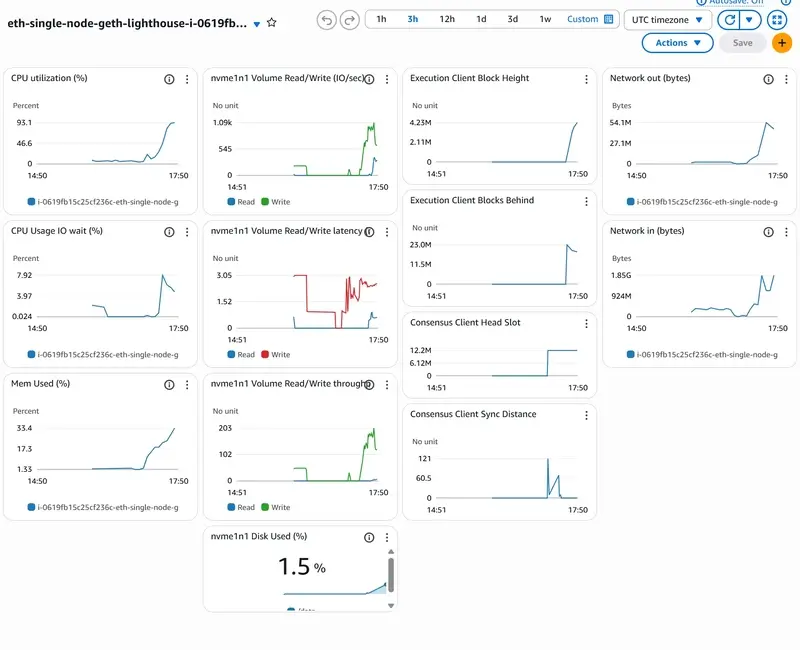
Expect roughly 4 hours per week per engineer to keep a DIY setup healthy — more when something breaks or a protocol hard fork requires a coordinated upgrade across all your nodes.
Chainstack Self-Hosted: the same control, less overhead
Chainstack Self-Hosted runs on your infrastructure — your servers, your cloud, your data. The difference is that deployment, configuration, monitoring, and updates are managed through a control plane rather than custom scripts and runbooks.
Setup in minutes, not weeks
Installation runs in 5–10 minutes. The platform bundles production-ready configurations for authentication, workflow orchestration, state management, and the control panel itself. The components are tested together — you’re not assembling them from scratch.
Deploy nodes through a web interface
Select your protocol and click deploy. Chainstack Self-Hosted provisions Reth and Prysm with configurations that have been tested in production. Resource allocation, storage sizing, and sync modes are predetermined based on real-world requirements — not your best guess.
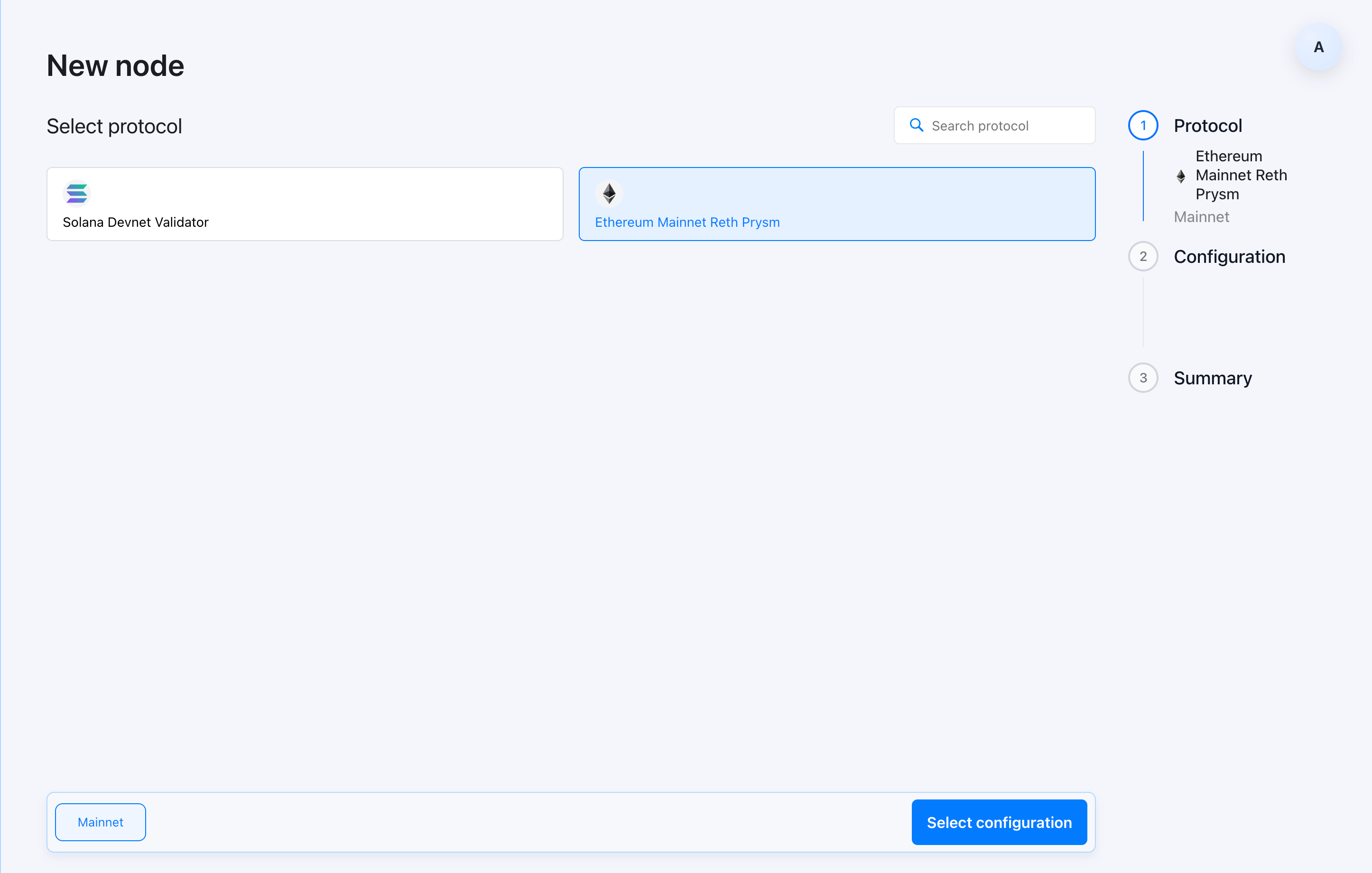
As the platform adds protocols, they deploy through the same interface with the same tested approach. One node or twenty, the process is the same.
Centralized operations
Updates, monitoring, and recovery all happen through the control panel. When nodes fail, self-healing kicks in automatically (planned). Failover routing lets you define where traffic goes — a secondary node, a Chainstack RPC endpoint, or one you specify. You’re not maintaining separate tooling for each blockchain you support.
The trade-off: you’re working within supported configurations rather than customizing every component. For the vast majority of teams, the tested defaults are faster and more reliable than custom setups. If you have genuinely specialized requirements, DIY may still be the right call.
The real cost: engineering time
Infrastructure hardware costs are easy to calculate. Engineering time is less visible but often larger.
Building a production-ready DIY setup requires approximately two weeks from someone experienced with Kubernetes and blockchain infrastructure. Ongoing maintenance runs around 4 hours per week. At typical senior engineer rates, that’s roughly $6,000 upfront and $15,000+ annually — for a single protocol.
The math gets worse at scale. Three protocols don’t cost three times as much in engineering time; they cost more, because you’re coordinating updates and troubleshooting interactions across multiple systems.
Chainstack Self-Hosted has a licensing cost. But the infrastructure maintenance burden drops significantly, and the compounding value increases as you scale. More importantly, engineering hours spent on infrastructure are hours not spent on the product that differentiates your business.
For teams with 1–2 nodes and in-house expertise, DIY can work fine. For teams running 10+ nodes across multiple protocols, or teams that need to move fast, the calculation shifts quickly.
DIY vs Chainstack Self-Hosted comparison
| Aspect | Build It Yourself | Chainstack Self-Hosted |
| Setup time | 2+ weeks of config and testing | 5–10 minutes with automated installer |
| Required expertise | Deep K8s and blockchain client knowledge | Basic Linux and command-line familiarity |
| Node deployment | Custom config per protocol | Web UI with pre-configured clients |
| Client configuration | Manual, error-prone | Pre-configured Reth + Prysm (more clients coming) |
| Monitoring | Build your own scripts and dashboards | Built-in UI control panel |
| Observability integrations | Build yourself | Prometheus, Grafana, VictoriaMetrics (planned) |
| Software updates | Node-by-node, manual | Centralized orchestration |
| Failed node recovery | Manual intervention | Self-healing (planned) |
| Failover routing | Custom setup required | Configurable |
| Multi-protocol support | Rebuild everything per protocol | Expanding roadmap (Ethereum now, more coming) |
| Infrastructure control | Full | Full (your infrastructure) |
Which path is right for you?
Choose DIY if:
- Your team has deep Kubernetes and blockchain infrastructure expertise
- You have highly specialized requirements that go beyond standard configurations
- You’re running 1–2 nodes on a single protocol with no plans to expand
Choose Chainstack Self-Hosted if:
- Getting to production quickly matters more than maximum customization
- Your roadmap includes multiple protocols — complexity multiplies with every new one
- You want enterprise features (auth, monitoring, orchestration) without building them
- Your team’s time is better spent on your product than on infrastructure maintenance
Conclusion
Both paths give you the same thing: blockchain nodes running on infrastructure you own and control. The difference is what it costs to get there and keep them running.
Building from scratch means your team is in the infrastructure business. You own every component, which gives you maximum flexibility — and maximum maintenance responsibility.
Chainstack Self-Hosted provides production-ready infrastructure in minutes. The control plane, authentication, monitoring, and orchestration are included and tested. As the platform adds protocols and clients, your infrastructure scales without additional engineering work.
If your value is in your application or protocol, not in custom infrastructure tooling, Chainstack Self-Hosted is the faster path to production — and keeps staying faster as you scale.
FAQ
Yes. Your infrastructure, your servers, your data. Chainstack provides the control plane software — the actual nodes run on hardware you own and control.
A Linux server with basic command-line familiarity. No Kubernetes expertise required — the installer handles the underlying infrastructure automatically.
Currently Chainstack Self-Hosted runs Reth as the execution client and Prysm as the consensus client. Support for additional clients is on the roadmap.
Your nodes keep running — they’re on your infrastructure. You can also configure failover to route traffic to a secondary node or a Chainstack RPC endpoint if your self-hosted node becomes unavailable.
With managed RPC, your nodes run on Chainstack’s infrastructure. With Self-Hosted, the nodes run on yours — you get the same control plane but retain full ownership of the underlying servers and data.
Build with Chainstack
- Discover how you can save thousands in infra costs every month with our unbeatable pricing on the most complete Web3 development platform.
- Input your workload and see how affordable Chainstack is compared to other RPC providers.
- Connect to Ethereum, Solana, BNB Smart Chain, Polygon, Arbitrum, Base, Hyperliquid, Tempo, MegaETH, Monad, Plasma, Avalanche, Optimism, Scroll, Aptos, Cronos, Gnosis Chain, Kaia, Moonbeam, Celo, Aurora, TON, Ronin, and Bitcoin mainnet or testnets through an interface designed to help you get the job done.
- Fast access to blockchain archive data and gRPC streaming on Solana.
- To learn more about Chainstack, visit our Developer Portal or join our Telegram group.
- Are you in need of testnet tokens? Request some from our faucets. Sepolia faucet, Base Sepolia faucet, Solana devnet faucet, Hoodi faucet, BNB faucet, zkSync faucet, Scroll faucet, Hyperliquid faucet, Monad faucet, Amoy faucet, Plasma faucet, TON faucet.
Have you already explored what you can achieve with Chainstack? Get started for free today.
Resources