Ethereum
 Solana
 Hyperliquid
 Arbitrum
 Base
Base BNB Smart Chain
 MegaETH
 Tempo
Tempo Avalanche
 Aptos
Aptos TRON
TRON Ronin
Ronin zkSync Era
 Optimism
 Sonic
Sonic Polygon
 Unichain
 Fantom
 Gnosis Chain
 Sui
Sui Avalanche Subnets
 Polygon CDK
 Starknet Appchains
 zkSync Hyperchains




 Refer and earn
 Discord
 Telegram
 X (Twitter)
QuickNode RPC provider overview (2026)

QuickNode is a popular blockchain RPC provider that lets developers interact with blockchains without running their own nodes. A Quicknode RPC provider offers API endpoints to read data and send transactions on networks like Ethereum and Solana, making it an essential for decentralized applications that require fast and reliable blockchain access.

TL;DR
QuickNode known for solid performance, low latency, high throughput, and 99.9% uptime. Key tools include Streams for real-time data, Webhooks for instant on-chain alerts, and dedicated clusters for enterprise users.
Its credit-based pricing can make costs unpredictable. Chainstack offers a strong alternative with similar performance and uptime, but with flat, transparent pricing, no hidden throttling, and flexible multi-cloud deployment.
Brief history of QuickNode
QuickNode was founded in 2017 and has grown into a leading Web3 infrastructure platform. It now supports dozens of networks and powers many high-traffic decentralized apps. QuickNode’s infrastructure handles billions of RPC calls per day for clients including major exchanges, DeFi platforms, and NFT marketplaces. The company’s rapid growth underscores the rising demand for scalable blockchain connectivity.
QuickNode core RPC products and services
QuickNode offers a suite of services to help developers build and scale on blockchain networks. Its Core RPC API provides globally distributed endpoints for 70+ blockchains, allowing connections to Ethereum, Solana, and many others over HTTP or WebSocket. Key offerings include:
- Streams: real-time blockchain data feeds and backfilling tools for streaming events or indexing chain data. Link
- Webhooks: instant notifications of on-chain events, so applications can react to new blocks, transactions, or contract triggers in real time. Link
- Dedicated clusters: isolated node instances for enterprise users who need maximum performance with no shared resources. Link
- Additional APIs and tools: specialized APIs and a marketplace of add-ons for extended functionality.
QuickNode performance profile
QuickNode platform is engineered for speed and reliability across key metrics:
- Latency: QuickNode delivers very fast response times. In one benchmark it achieved ~86 ms average latency for Ethereum. For Solana, QuickNode’s p95 latency is around 50 ms, versus ~187 ms on some other providers.
- Reliability: The network’s automatic regional failover and load balancing keep requests flowing even during outages or spikes. QuickNode also had one of the lowest error rates in independent tests, reflecting a very stable service.
- Throughput: QuickNode can handle heavy workloads. Entry tiers support 15–50 RPS, while higher plans scale to 250+ RPS. The infrastructure automatically expands to absorb traffic bursts without performance loss.
- Uptime: QuickNode targets 99.9% availability on paid plans. Its globally distributed, multi-region architecture maintains enterprise-grade uptime, meaning developers can count on the service around the clock.
| Area | QuickNode strengths | Potential weaknesses |
|---|---|---|
| Performance | Very low latency on major chains | Not uniquely faster than top peers in all regions |
| Reliability | Global footprint, failover, 99.9% uptime on paid tiers | Higher SLAs usually on higher tiers |
| Scale | Handles heavy bursts; high RPS on upper plans | Plan limits if credits are exceeded |
| Features | Streams, webhooks, marketplace, dedicated clusters | Higher SLAs are usually on higher tiers |
| Pricing | Flexible credit model as you grow | Method-weighted billing can be hard to predict |
QuickNode pricing: what to watch
The difference becomes clear when the same high-volume workload is priced under request-based billing versus credit-based billing.
| Metric | Chainstack | QuickNode |
|---|---|---|
| Plan used in example | Pro | Scale |
| Included usage | 80M Request Units | 950M API Credits |
| Workload equivalent | 73.5M method calls | 73.5M method calls |
| Overage needed | None | 520M API Credits |
| Plan price | $199 | $499 |
| Overage charges | $0 | $276 |
| Total monthly cost | $199 | $775 |
QuickNode uses a credit-based model, which means effective cost depends on the exact mix of methods your application calls. For low-volume projects this can be manageable, but for production workloads with heavy reads, subscriptions, traces, or burst traffic, forecasting can become harder.
Chainstack uses request-based pricing, which is usually easier to model operationally because standard RPC usage maps more directly to monthly traffic. For teams that care about cost predictability as much as raw performance, this difference becomes meaningful quickly.
Final thoughts: QuickNode vs Chainstack
Both QuickNode and Chainstack deliver high-performance RPC infrastructure, but there are notable differences. Chainstack often matches QuickNode on raw speed and offers more flexibility and cost predictability.
Chainstack runs a similarly low-latency global network – in one test its EU latency was the same as QuickNode and it provides a 99.99%+ uptime SLA on a multi-cloud infrastructure.
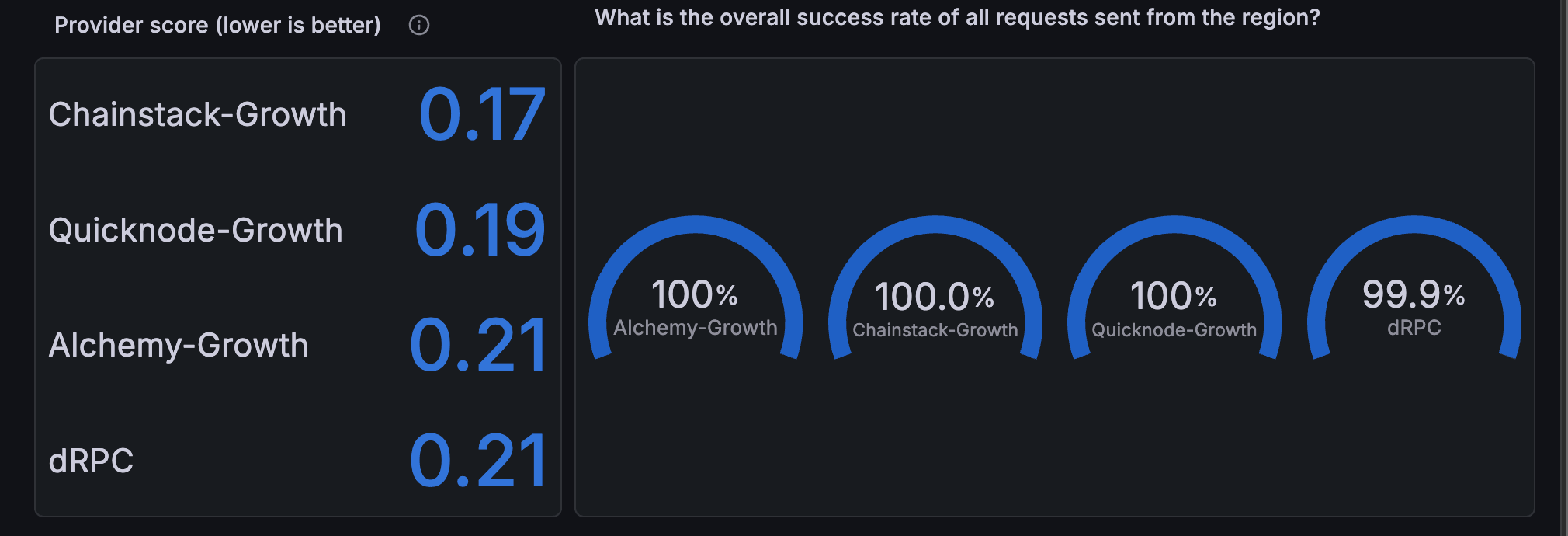
Where Chainstack excels is pricing and scalability. QuickNode uses a credit-based model that can incur surprise overage fees when certain calls consume more credits, whereas Chainstack uses transparent request-based plans with flat rates and no hidden throttling. Almost every RPC call counts equally on Chainstack, so costs stay predictable and high volumes won’t trigger performance caps or extra fees.
QuickNode is renowned for its speed and broad multi-chain support, making it a strong choice for performance-sensitive applications.
However, Chainstack offers comparable performance with more predictable pricing, greater deployment flexibility, and equally robust uptime – a combination that makes it a compelling alternative to QuickNode for many blockchain projects.
FAQ
QuickNode is highly reliable. It operates on a globally distributed infrastructure with automatic failover and regional load balancing to minimize downtime. Independent performance tests show that QuickNode consistently handles high request volumes with over 99.9% success rates. Paid plans come with a 99.9% uptime guarantee, making it suitable for production-grade Web3 applications.
QuickNode implements several security measures to protect infrastructure and customer data. It offers TLS-encrypted endpoints, role-based access controls, and private endpoints for sensitive use cases. While security practices are not always disclosed in full detail, QuickNode is used by major DeFi protocols, exchanges, and enterprises, which indicates a high standard of operational security. For mission-critical workloads, users can opt for dedicated clusters to isolate traffic and improve data privacy.
QuickNode delivers low-latency performance, high throughput, and a 99.9% uptime guarantee across paid tiers.
QuickNode emphasizes speed and multi-chain access, while Chainstack offers similarly fast RPC performance with predictable pricing, no hidden request throttling, and more control over node deployment.
Yes. QuickNode uses a credit-based pricing model where some requests consume more credits. In contrast, Chainstack uses a flat request-based model, making costs more predictable.
Related Reading