AI-ready infrastructure
 Refer and earn


 Ethereum
 Hyperliquid
 Solana
 Arbitrum
 BNB Smart Chain
 Base
 Polygon
 TRON
 Sui
 Robinhood


Top 5 GetBlock alternatives in 2026: compute units vs flat meters, free plans and dedicated prices


Teams comparing GetBlock alternatives usually check these points: compute-unit billing where a BNB Smart Chain call costs 20 CU and an archive endpoint doubles it, a free plan of 50,000 CU a day, archive as a separate endpoint mode, and dedicated nodes from $1,000 a month. GetBlock also lists 130+ networks and a free plan. This guide compares it with Chainstack, Dwellir, OnFinality, NOWNodes, and Quicknode, checked against provider pages and docs in October 2026.
We publish this on the Chainstack blog, so Chainstack is first and you should weigh that. Every price comes from a live provider page, and the performance section uses the public Chainstack RPC benchmark reports, which do not cover GetBlock. Moving off GetBlock? Jump to the migration steps.
💡 Already using Chainstack? Jump straight to the BNB Smart Chain tooling docs or deploy your endpoint from the console.
Why teams look for GetBlock alternatives
GetBlock lists 130+ networks, a free plan it says is usable indefinitely, self-serve dedicated nodes with public prices, fixed-RPS Limitless Node plans and a SOC 2 Type II attestation. Teams weigh these against the points below.
- Compute units with chain, method and archive multipliers. A call costs the chain multiplier times the method multiplier times an archive modifier. BNB Smart Chain, Ethereum, Base, Arbitrum and Polygon sit at 20, Solana at 50, Sui at 100 and Moonbeam and Sei at 300, and debug and trace methods are mostly 40 CU on BNB Smart Chain. Starter’s 90M CU cover about 4.5M BNB Smart Chain calls, and 20M calls (400M CU) fit the 700M CU Scale plan at $349, where Chainstack Growth includes 20M RU for $49.
- A free plan sized in CU per day. It gives 50,000 CU a day (about 2,500 BNB Smart Chain calls), 20 RPS and 2 access tokens, with no top-ups and no rollover of unused CU.
- Archive is a separate mode. Archive endpoints are available on Starter and above for selected networks, and every request sent to one costs double for default methods, even when the method needs no historical state, and its CU page lists archive debug and trace higher still (80 CU against 40 on a full node on BNB Smart Chain).
- A gap between shared plans and dedicated nodes. Shared plans run from $49 to $699 a month, and dedicated nodes start at $1,000 for most mainnet full nodes (BNB Smart Chain from $1,200 full and $1,500 archive). Limitless Node fills part of the gap from $150 for 25 RPS, but one subscription covers one chain.
- Compliance, support and benchmarks. GetBlock states a SOC 2 Type II attestation completed in Q2 2026, and its homepage lists an ISO 27001 badge while its FAQ says certification is in progress. Its 24/7 support with a response under 5 minutes is listed for Pro and Premium. Chainstack’s benchmark reports do not include GetBlock (all editions checked, including Arc), so there are no latency figures for it.
GetBlock alternatives compared: compute units, free plan, and dedicated nodes (2026)
The table summarizes public positioning as of October 2026. Plans and prices change often, so check each provider’s page before you decide.
| Rank | Provider | Best for | Pricing model | Free tier | Dedicated nodes | Archive & trace | Standout |
|---|---|---|---|---|---|---|---|
| — | GetBlock (for reference) | — | Compute units, 20 CU per BNB Smart Chain call; shared plans $49 (90M CU) to $699 (1.6B CU) | Yes, 50,000 CU a day, 20 RPS | From $1,000 a month; Limitless Node (fixed RPS) from $150 | Archive mode on paid plans (2x CU); debug and trace 2x on full nodes, 4x on archive | 130+ networks, SOC 2 Type II attestation |
| 1 | Chainstack | Archive, trace, and indexing on flat RU billing instead of chain and method weights | Flat request units, 1 RU full, 2 RU archive, debug and trace | Yes, Developer plan, 3M RU, 25 RPS, no card | Yes, from the Pro plan; Unlimited Node from $149 | Archive and debug and trace from Growth ($49) | Best score in its own October 2026 benchmarks (disclosed below), SOC 2 Type II and ISO 27001 |
| 2 | Dwellir | A single credit per response for heavy methods, with 150+ networks on one account | 1 credit per response, no compute units | Yes, 100,000 daily responses, 20 RPS, no eth_getLogs | Dedicated Node Clusters from $2,400 a month; Unlimited Nodes from $119 | Trace and debug from the $49 Developer plan | 150+ networks |
| 3 | OnFinality | Dedicated nodes and indexing next to RPC, on a free plan of 400,000 units a day | Response units, 1 for most methods, 3 for eth_getLogs on BNB Smart Chain | Yes, 400,000 response units daily | Dedicated nodes, pay-as-you-go | Archive on every plan, Trace API from Growth | Substrate coverage, indexer hosting |
| 4 | NOWNodes | Request-count plans from 100,000 up to 100M a month, with Blockbook and gRPC | Plans sized by monthly requests, 100,000 (Start) to 100M (Enterprise) | Yes, Start plan for one month, 100,000 requests, no card | Custom plans, quoted by sales | Archive on 45+ networks at no extra charge; trace and debug on 24 networks | 120+ networks, Blockbook, gRPC, webhooks |
| 5 | Quicknode | Streams and Webhooks next to RPC, billed in credits weighted per chain | Credits with a per-chain multiplier, 20 per call on BNB Smart Chain | 1-month trial, 10M credits, 15 RPS | Dedicated Clusters on Enterprise | Archive on every plan; trace and debug from Build | 75+ chains, Streams, Webhooks, SOC 2 and ISO 27001 |
Official pricing pages: GetBlock, Chainstack, Dwellir, OnFinality, NOWNodes, Quicknode.
True cost per call = (method’s unit weight x price per million units) / 1,000,000. Here it is for eth_getLogs on BNB Smart Chain at each provider’s entry paid plan, using the included allowance in full.
| Provider | Unit weight for eth_getLogs | Entry paid plan | Cost per 1M calls |
|---|---|---|---|
| GetBlock (for reference) | 20 CU (40 CU on an archive endpoint) | Starter, $49 with 90M CU ($39 annual) | $10.89 in allowance ($8.67 annual; archive $21.78), $8.00 at the Pro plan ($499) top-up rate |
| Chainstack | 1 RU, 2 RU if fromBlock is 127 or more blocks behind | Growth, $49 with 20M RU, $15 per extra 1M RU | $2.45 in allowance ($2.00 annual; archive $4.90 and $4.00), $15 at overage ($30 archive) |
| Dwellir | 1 credit, 500-block range per call | Developer, $49 with 25M responses, $5 per extra 1M | $1.96 in allowance, $5.00 at overage |
| OnFinality | 3 response units on BNB Smart Chain | Growth, $49 plus node and API usage costs, 20M units, $6 per extra 1M | $7.35 in allowance, $18.00 at overage |
| NOWNodes | Not found on its pricing page | Pro, 1M requests; euro prices not in the page text | Not computed; overage EUR 50 per 1M on Pro Plus, EUR 10 on Business |
| Quicknode | 20 credits on BNB Smart Chain | Build, $49 with 80M credits, $0.62 per extra 1M | $12.25 in allowance, $12.40 at overage |
For this one method, Dwellir has the lowest figure both inside the allowance ($1.96) and at overage ($5.00), and Chainstack is second inside the allowance ($2.45). GetBlock’s $10.89 sits above OnFinality’s $7.35 and below Quicknode’s $12.25. The table does not price GetBlock’s higher RPS tiers or its Limitless Node.
Sources: each provider’s pricing and method-cost pages (GetBlock’s pricing page was last updated September 17, 2026) and Chainstack request units. GetBlock’s BNB Smart Chain CU table has no separate eth_getLogs row, so the table uses its default of 20 CU, although its pricing text calls eth_getLogs heavier than a balance lookup. eth_getLogs block-range caps on BNB Smart Chain: Chainstack 100 on Developer and 10,000 on Growth and above, Dwellir 500 and 10,000, Quicknode 5 on the trial and 10,000 on paid plans, GetBlock none stated on its BSC page (1,500 on its Ethereum page), none found for OnFinality or NOWNodes. At BNB Smart Chain’s 0.45-second blocks since the Fermi hard fork (BNB Chain), 100 blocks is 45 seconds. To model your own mix, use the interactive cost calculator.
Performance proof: Chainstack RPC benchmark reports
Chainstack publishes RPC benchmark reports for Ethereum, BNB Chain, Hyperliquid and Arc (September and October 2026) that rank Chainstack, Quicknode, Alchemy and dRPC. Disclosure: Chainstack runs the monitoring service, the dashboard and the scoring formula, and is one of the four ranked providers. Data comes from Chainstack Compare: a rolling 7-day window, probes from DE, US and SG (JP instead of SG for Hyperliquid), each provider on its first paid plan. Score is p95 response time divided by the success rate cubed, averaged across regions, so lower is better.
GetBlock, Dwellir, OnFinality and NOWNodes are not in any of the Chainstack benchmark reports, so there are no figures for them here. Quicknode is the only alternative that appears; Alchemy and dRPC are in the images below but are not among the five alternatives. The images are the October 2026 editions, published October 8, 2026, each linking to its report: BNB Chain, Ethereum and Hyperliquid.
BNB Chain, the example chain in this guide, 7-day window ending October 8, 2026:
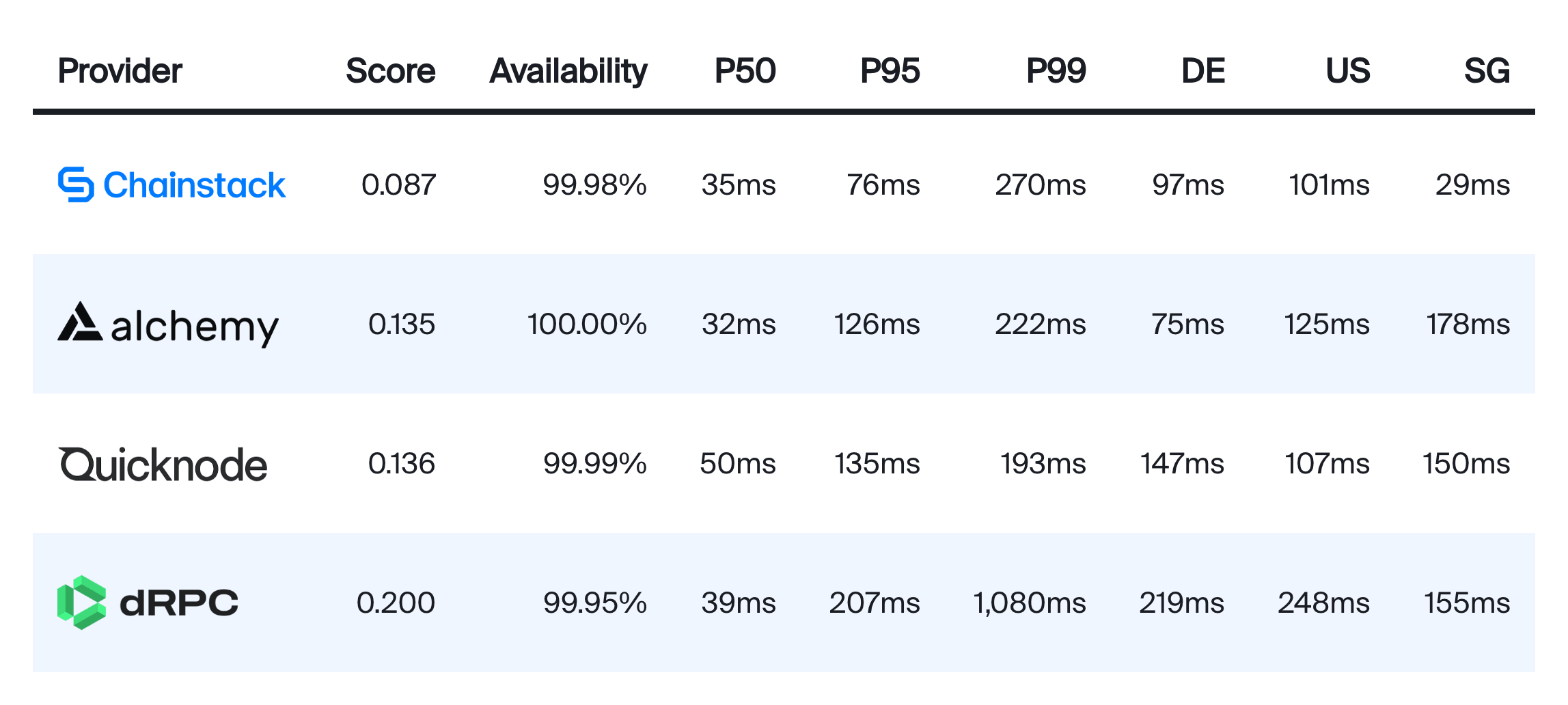
BNB Chain scores: Chainstack 0.087 (P95 76 ms), Alchemy 0.135 (126 ms), Quicknode 0.136 (135 ms), dRPC 0.200 (207 ms).
Ethereum, 7-day window ending October 8, 2026:
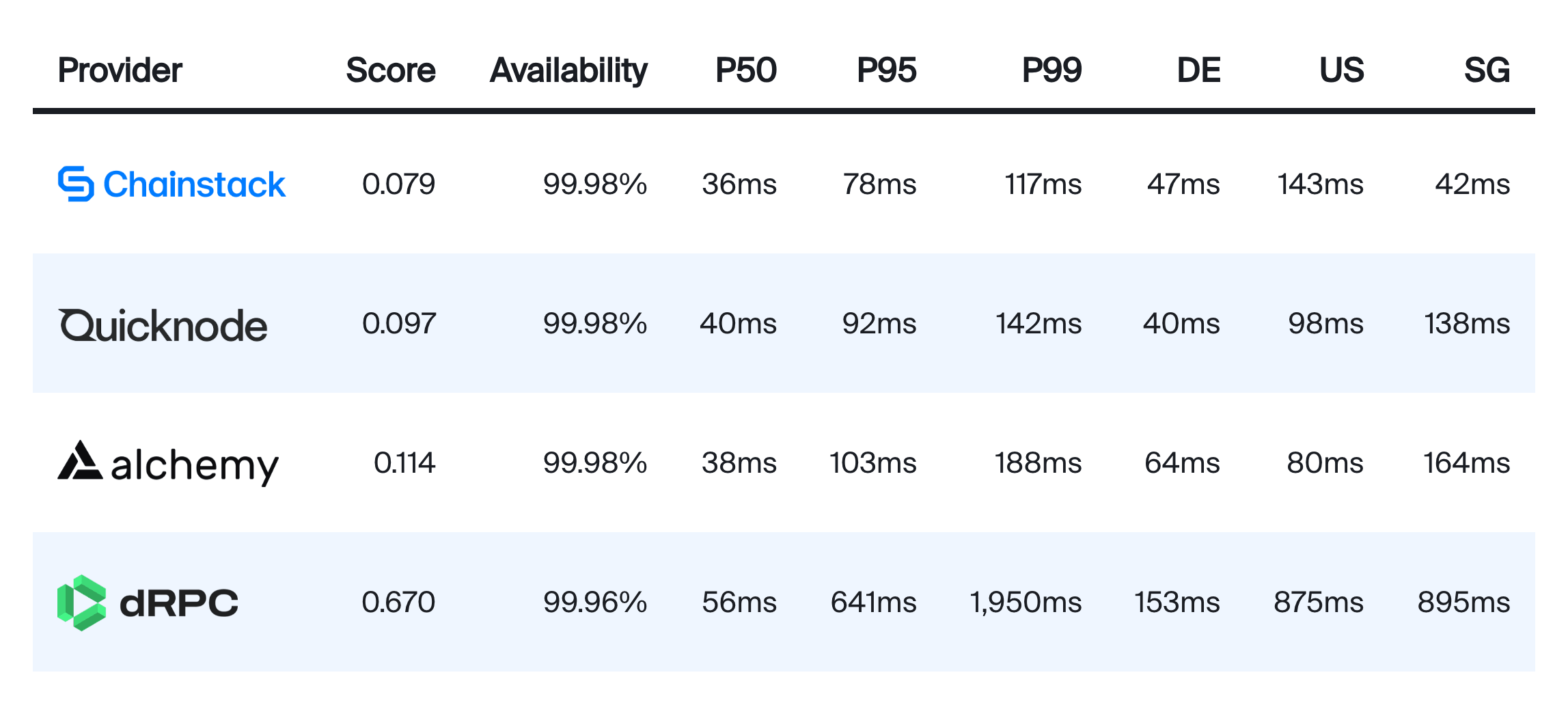
Ethereum scores: Chainstack 0.079, Quicknode 0.097, Alchemy 0.114, dRPC 0.670.
Hyperliquid, 7-day window ending October 8, 2026:
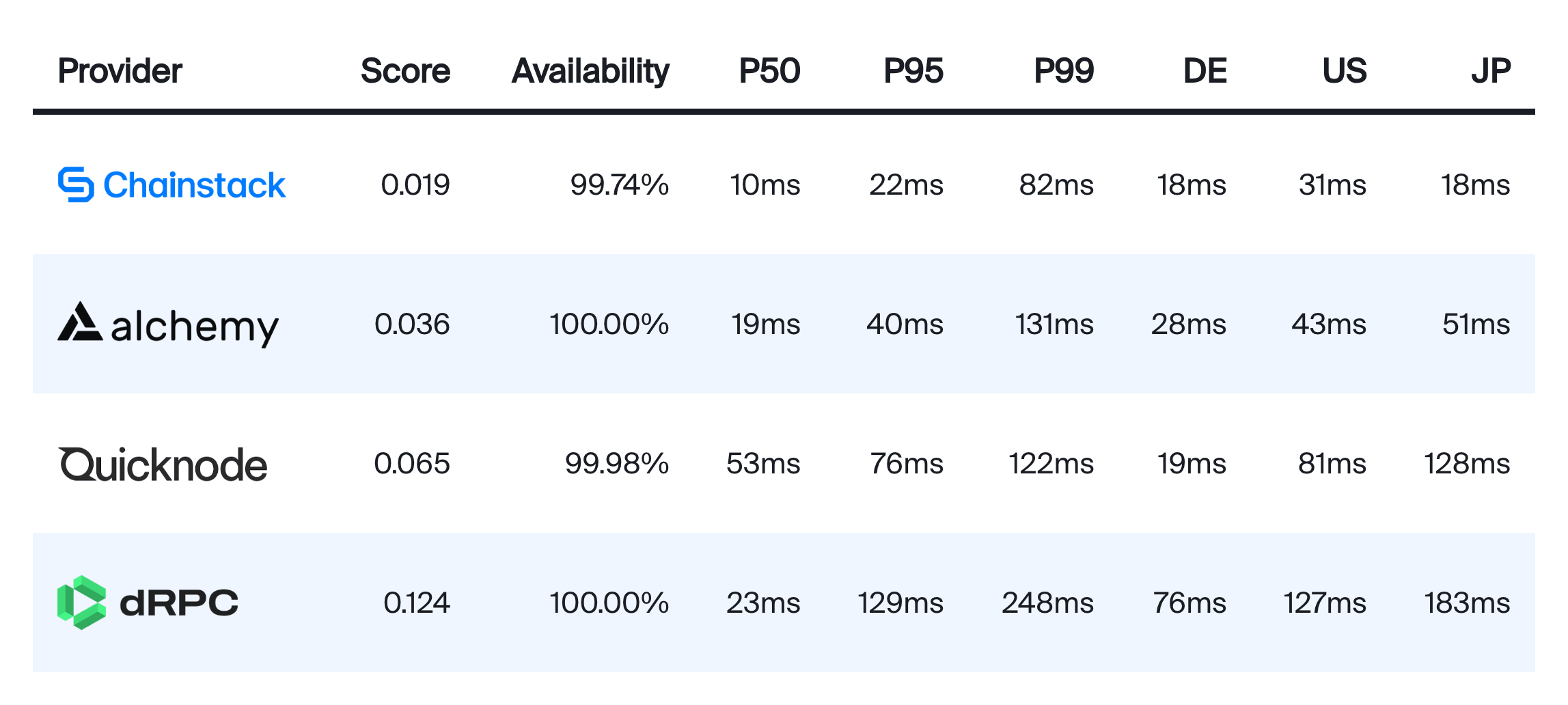
Hyperliquid scores: Chainstack 0.019, Alchemy 0.036, Quicknode 0.065, dRPC 0.124.
Chainstack has the best score on all three chains, and the reports show where it does not lead:
- BNB Chain, median and tail. Alchemy has the lowest P50 (32 ms), and Quicknode (193 ms) and Alchemy (222 ms) have a lower P99 than Chainstack (270 ms).
- Ethereum, DE and US traffic. Quicknode has the lowest DE P95 (40 ms against 47 ms) and Alchemy the lowest US P95 (80 ms against 143 ms for Chainstack).
- Hyperliquid, availability. Chainstack’s 99.74% is the lowest in the set (Alchemy and dRPC 100.00%, Quicknode 99.98%), which the report says costs about 0.8% of score and does not change the ranking.
The September 2026 editions (Ethereum, BNB Chain, Hyperliquid) ranked the same four providers with Chainstack first. The October reports state their limits: one 7-day window, the entry paid plan only, synthetic probes from three cloud regions, and no measurement of throughput under load, correctness or cost. Chainstack chose the formula and operates the probes, so another formula could reorder close pairs.
Top 5 GetBlock alternatives and what each is best for
1. Chainstack
Best for: Archive, trace, and indexing on flat RU billing instead of chain and method weights.
Chainstack is a managed node provider across 70+ blockchains that bills flat request units: 1 RU for a full request and 2 RU for archive, debug and trace requests on Global Nodes, with no per-method multipliers. The free Developer plan includes 3M RU and 25 RPS with no card required, and Growth is $49 a month ($40 billed annually) with 20M RU, 250 RPS, archive data and debug and trace APIs, per the pricing page.
Archive is not a separate endpoint: on Global Nodes each request is classified on its own, so a call within 126 blocks of the tip is 1 RU and an older block is 2 RU (about 57 seconds on BNB Smart Chain’s 0.45-second blocks). WebSocket comes on every plan. Dedicated Nodes start at the Pro plan ($199 a month) plus compute (from $0.50 an hour) and storage; the catalog lists a BNB Smart Chain mainnet geth full node at $4,482.20 a month (compute $1.50 and storage $4.64 an hour, 730 hours). The Unlimited Node add-on is the fixed-RPS option, from $149 a month at 25 RPS on top of the Growth plan or higher, with 100 RPS at $649 and 250 RPS at $1,649 on the pricing page. MEV protection is on by default at deployment, free on every plan on Global Nodes, and can be turned off from the node’s Add-ons tab (Ethereum and BNB Smart Chain); Arbitrum, Base, Arc and Robinhood Chain use optimized submission. Chainstack holds SOC 2 Type II and ISO 27001, and its Enterprise SLA page states a 99.9% quarterly uptime commitment with service credits. Paid plans get email support under 24 hours (24×5), with under 6 hour and under 1 hour targets on Professional ($100 a month) and Premium ($1,000 a month).
Limitations: The free plan includes 3M RU a month (extra usage is optional at $20 per 1M RU, otherwise services stop at the quota), has no archive or debug and trace, and limits eth_getLogs to 100 blocks, and Dedicated Nodes need the Pro plan or higher. Chainstack lists 70+ chains against GetBlock’s 130+ by their own counts. On BNB Smart Chain, GetBlock publishes dedicated nodes from $1,200 (full, geth or reth) and $1,500 (archive) against $4,482.20 for a full node (geth, 9,288 GB of storage) and $7,110.20 for an archive node (reth, 17,475 GB) in Chainstack’s catalog (mostly storage), plus the plan fee, and its Limitless Node lists 150 RPS for $500 and 300 RPS for $1,000 on a full EVM node, so compare specs and node types for your chain. GetBlock’s under 5 minute 24/7 support on Pro and Premium is faster than Chainstack’s under 1 hour on Premium. Growth overage is $15 per 1M RU, above the $8.00 that GetBlock’s Pro plan ($499) top-up works out to for a million 20-CU calls, so very high volume suits a custom Pay As You Go plan (from $2.5 per 1M RU, arranged with sales) or an Unlimited Node.
Fit by workload:
- Archive-heavy analytics and indexers: Excellent, since debug and trace calls cost a flat 2 RU on a fixed monthly plan.
- Compliance paperwork or isolated nodes: Strong, with SOC 2 Type II and ISO 27001 published and Dedicated Nodes from Pro.
- BNB Chain and Hyperliquid trading infrastructure: Strong on the scores above (BNB Chain 0.087 against 0.135 for the next provider), with the BNB Chain P99 and Hyperliquid availability caveats (99.74%).
2. Dwellir

Best for: A single credit per response for heavy methods, with 150+ networks on one account.
Dwellir is a multi-chain RPC provider covering 150+ networks across EVM, Substrate, Move and Cosmos, billed at one credit per response with no compute units, even for trace and debug. Its pricing page lists Developer at $49 a month with 25M responses and 100 RPS, Growth at $299 with 150M and 500 RPS, and Scale at $999 with 500M and 5,000 RPS, plus a Free plan (100,000 daily responses, 20 RPS).
Trace and debug are included from Developer, and extra responses cost $5, $3 and $2 per 1M on Developer, Growth and Scale. Unlimited Nodes are the fixed-RPS option on its shared pool, from $119 a month at 25 RPS to $4,799 at 1,000 RPS. Dedicated Node Clusters are redundant archive clusters with no request counting and a 99.99% uptime SLA, listed from $2,400 a month (Ink), with Base at $3,366 and BNB Smart Chain at $12,600, quoted by regions and cluster size.
Limitations: The free plan has no eth_getLogs, trace or debug access, the $49 Developer plan limits log queries to 500 blocks (10,000 on Growth), and we found no published SOC 2 Type II or ISO 27001. On BNB Smart Chain its standard endpoints run full nodes, with archive on dedicated clusters. Its dedicated option is a multi-node cluster quoted per chain, and the Chainstack benchmark does not include Dwellir.
Fit by workload:
- A flat per-response meter: Excellent, since a trace call costs the same credit as a balance read.
- Polkadot, Substrate and long-tail chains: Strong, with 150+ networks by its own count.
- Fixed-RPS pricing: Good, with 25 RPS at $119 against $150 for GetBlock’s Limitless Node and $149 for Chainstack’s Unlimited Node (an add-on to Growth or higher).
3. OnFinality
Best for: Dedicated nodes and indexing next to RPC, on a free plan of 400,000 units a day.
OnFinality is a multi-chain node service that its homepage says covers 130+ networks, with RPC APIs, dedicated nodes and indexing. Its pricing page lists a free Developer plan with 400,000 response units a day, Growth at $49 a month with 20M units ($6 per extra million) and Accelerate at $249 with 100M units ($3.75), plus a custom Ultimate plan.
Archive access is listed on every plan, the Trace API starts at Growth, and dedicated nodes are pay-as-you-go. Most methods are 1 response unit, but its BNB Chain docs page lists eth_getLogs at 3 and debug_traceTransaction at 30, and BNB Smart Chain has archive access and trace and debug on paid plans.
Limitations: Response-unit weights make heavy methods cost more than the headline suggests, and paying in crypto is listed only on the Ultimate plan. Growth and Accelerate list node and API usage costs on top of the monthly fee, the pricing page gives no dedicated node prices, we found no published SOC 2 Type II or ISO 27001, and the Chainstack benchmark does not cover OnFinality.
Fit by workload:
- Substrate and Polkadot-ecosystem teams: Strong, since its tooling targets Substrate networks and it hosts indexers.
- Log queries on a $49 budget: Moderate, since eth_getLogs counts 3 response units, or $7.35 per million calls inside the Growth allowance.
4. NOWNodes
Best for: Request-count plans from 100,000 up to 100M a month, with Blockbook and gRPC.
NOWNodes is a multi-chain node provider that lists 120+ networks behind one API key, with shared and dedicated nodes, WebSocket, gRPC, Blockbook, webhooks and a Trace and Debug API. Shared plans are sized by monthly requests: Start with 100,000 (free for one month, no card), Pro 1M, Pro Plus 10M, Business 30M, Business Plus 50M and Enterprise 100M.
Overage per 100,000 requests is EUR 5 on Pro Plus, EUR 1 on Business and Business Plus and EUR 0.5 on Enterprise; Start and Pro have none. Its archive page lists archive access on 45+ networks at no extra charge, and its docs list trace and debug on shared plans for 24 networks, including BNB Smart Chain, and its archive page marks the BSC endpoint as archive. Its FAQ states a 99.95% uptime SLA, 24/7 support, crypto payments through NOWPayments and no rate limits on paid plans, its pricing page lists a 3 minute support response, and dedicated nodes are quoted by sales.
Limitations: The euro plan prices load dynamically and were not readable in the live page text, so we could not compute a per-call cost. Archive is listed per endpoint (the Arbitrum and Solana endpoint pages do not mark it, while its archive page lists Arbitrum and shows Solana as coming soon), WebSocket is not on Start, and the free plan lasts one month. We found no published SOC 2 Type II or ISO 27001, and the Chainstack benchmark does not cover NOWNodes.
Fit by workload:
- Plans sized by request count: Good, since allowances are listed in requests and we found no per-method weights.
- Wallets and exchanges on UTXO and long-tail chains: Strong, with Blockbook and 120+ networks.
5. Quicknode

Best for: Streams and Webhooks next to RPC, billed in credits weighted per chain.
Quicknode lists 75+ chains, bundles Streams and Webhooks with its node product and sells credits weighted per chain. Its pricing page lists a one-month free trial (10M credits, 15 RPS, no card) and Build at $49 a month with 80M credits and 50 RPS.
On BNB Smart Chain, Ethereum and most EVM chains every method is 20 credits, most trace and debug methods carry a 2x multiplier, and specialized calls such as txpool_content and trace_replayTransaction are 4x. Archive data is on every plan, trace and debug are listed from Build, and Dedicated Clusters are listed only on Enterprise.
Limitations: The free entry is a trial, not a standing plan, and during the trial eth_getLogs is limited to 5 blocks per call. A million 20-credit BNB Smart Chain calls cost $12.25 inside Build’s allowance, and at its $0.62 overage rate a 40-credit trace call is about $24.80 per million. In the BNB Chain benchmark, Quicknode scores 0.136 (P95 135 ms) against 0.087 (76 ms) for Chainstack.
Fit by workload:
- RPC plus data streams from one vendor: Strong, with Streams and Webhooks beside the node product.
- BNB Chain tail latency: Strong: Quicknode posted the lowest P99 (193 ms) in the October BNB Chain report, against 270 ms for Chainstack.
How to migrate from GetBlock to Chainstack
Most migrations are an endpoint swap plus a testing pass, and a coding agent can run the assessment from the Chainstack MCP migration runbook.
- Assess endpoints and usage. List every GetBlock endpoint (the access token sits in the URL path), its network, its type (Shared, Limitless, Dedicated or archive mode) and the methods and subscriptions you use. GraphQL, data stream and add-on products need a separate check.
- Deploy a node. Create a project and deploy a node per network, starting with Global Nodes and adding Dedicated Nodes for isolation or an Unlimited Node if you run on a fixed RPS cap.
- Swap the endpoint URL. Replace the GetBlock URLs with your Chainstack endpoints behind a config flag so you can roll back.
- Test methods. Run your real mix:
eth_getLogsranges, historicaleth_call, debug and trace calls and subscriptions, and check block-range caps and error handling. - Compare cost. Export a billing period of CU usage, divide by the chain multiplier (20 on BNB Smart Chain, 40 on archive endpoints) to get calls, and price them on the pricing page at 1 or 2 RU.
- Cut over gradually. Shift a share of traffic, watch errors and latency, then move the rest.
Getting started with Chainstack
Deploy a BNB Smart Chain endpoint in a few steps:
- Log in to the Chainstack console (or create an account).
- Create a new project
- Select BNB Smart Chain as your blockchain protocol
- Choose network: BNB Smart Chain Mainnet or Testnet
- Deploy the node
- Open Access and credentials and copy your HTTPS and WebSocket endpoints
Then connect with ethers.js:
import { ethers } from 'ethers';

// Using HTTP provider
const httpProvider = new ethers.JsonRpcProvider("YOUR_CHAINSTACK_ENDPOINT", 56);
httpProvider.getBlockNumber().then(console.log);

// Using WebSocket provider
const wsProvider = new ethers.WebSocketProvider("YOUR_CHAINSTACK_WSS_ENDPOINT", 56);
wsProvider.getBlockNumber().then((blockNumber) => {
  console.log(blockNumber);
  wsProvider.destroy();
});
📖 For the full integration guide, see the Chainstack BNB Smart Chain tooling documentation.
🤖 You can also access Chainstack BNB Smart Chain RPC directly from Claude, Cursor, Codex, Gemini CLI, GitHub Copilot or ChatGPT using Chainstack MCP, or see the Chainstack Agents page.
Conclusion
The deciding question when you leave GetBlock is whether you want weights by chain, method and archive mode, or a flat meter. GetBlock remains a fit for teams that want 130+ networks, public dedicated prices and Limitless Node in one account.
- Archive, trace and indexing on a fixed monthly plan: Chainstack for flat 2 RU archive and trace billing, or Dwellir for one flat per-response credit.
- Dedicated infrastructure and compliance paperwork: Chainstack Dedicated Nodes with SOC 2 Type II and ISO 27001, or Quicknode Enterprise.
- Substrate, Polkadot and long-tail networks: Dwellir or OnFinality.
- Request-count plans, Blockbook and a one-month free start: NOWNodes.
- RPC plus data streams from one vendor: Quicknode.
Frequently asked questions
Q: What is the cheapest GetBlock alternative?
It depends on the method and your volume. For eth_getLogs on BNB Smart Chain, a million calls cost $2.45 on Chainstack, $1.96 on Dwellir and $7.35 on OnFinality inside the plan allowance, with Quicknode at $12.25, against $10.89 on GetBlock Starter at its default 20 CU weight. NOWNodes could not be computed because its euro plan prices were not readable. Model your own mix with the cost calculator.
Q: Is there a free alternative to GetBlock’s free plan?
Yes. Chainstack’s Developer plan offers 3M RU and 25 RPS, Dwellir 100,000 daily responses and OnFinality 400,000 response units a day, while NOWNodes and Quicknode offer one-month trials. GetBlock’s Free plan gives 50,000 CU a day, about 2,500 BNB Smart Chain calls.
Q: How do I migrate from GetBlock to Chainstack?
Inventory your GetBlock endpoints and methods, deploy a node per network, swap the endpoint, test heavy methods and compare cost before cutting over. The migration runbook lets a coding agent handle the assessment.
Q: Which provider is fastest according to benchmarks?
In the Chainstack October 2026 BNB Chain report, Chainstack scores 0.087 against 0.135 for Alchemy, 0.136 for Quicknode and 0.200 for dRPC, while Quicknode (193 ms) and Alchemy (222 ms) have a lower P99 than Chainstack (270 ms). Chainstack also has the best score on Ethereum and Hyperliquid. Chainstack runs the benchmark and is ranked in it; GetBlock, Dwellir, OnFinality and NOWNodes are not covered.
Q: Which alternatives publish SOC 2 Type II and ISO 27001?
Chainstack publishes SOC 2 Type II and ISO 27001. We found neither for Dwellir, OnFinality or NOWNodes, so request reports from each vendor. Quicknode’s security page states SOC 2 Type 2 and ISO/IEC 27001. GetBlock states a SOC 2 Type II attestation completed in Q2 2026, and its homepage lists an ISO 27001 badge while its FAQ says certification is in progress.
Q: Which alternatives offer a flat monthly price for a fixed RPS?
Chainstack’s Unlimited Node starts at $149 a month for 25 RPS (an add-on to the Growth plan or higher) and Dwellir’s Unlimited Nodes at $119, both with no per-request metering. GetBlock’s Limitless Node lists $150 for 25 RPS on a full EVM node. Check the chain, node type and archive support for each.
Additional resources