AI-ready infrastructure
 Refer and earn


 Ethereum
 Hyperliquid
 Solana
 Arbitrum
 BNB Smart Chain
 Base
Base Polygon
 TRON
TRON Sui
Sui Robinhood


Top 7 trading bots on Hyperliquid in 2026


Most Hyperliquid trading bots fail not because of strategy logic, but because the data pipeline underneath them can’t keep up. The exchange’s fully on-chain CLOB processes 200,000 orders per second, settlement events bunch into millisecond windows, and public endpoints cap at around 100 requests per minute. A bot that works fine in testing starts missing fills, stale-quoting, or throwing rate-limit errors the moment real market activity shows up.
This guide covers the top seven trading bots for Hyperliquid in 2026 — spanning open-source developer frameworks, backtested strategy tools, no-code retail automation, and social/copy trading. For each one, you’ll find what strategy it runs, who it’s actually built for, and what infrastructure it requires to run in production.
Why Hyperliquid bot development is different
Before ranking tools, it helps to understand what makes Hyperliquid an unusual venue for automated trading.
Hyperliquid runs a fully on-chain central limit order book. There’s no off-chain matching engine, no centralized custody, and no API key linked to a custodial account. Orders are signed transactions broadcast to the network — which means every cancel, fill, and price update is a chain event, not a database write.
For bots, this has three concrete consequences:
- Order placement is slower than CEX. On Binance, a REST order placement round-trip takes 10–50 ms. On Hyperliquid, a signed order needs to reach the network and clear consensus, typically 200–500 ms on HyperCore. Strategies that rely on sub-100ms execution need to run close to a Hyperliquid node, not a generic cloud server.
- WebSocket feed quality determines everything. Hyperliquid’s WebSocket API emits real-time order book updates, user fills, and position changes. A bot using HTTP polling misses fills, accumulates stale position data, and risks double-submitting orders. Every production bot in this list uses WebSockets. If yours doesn’t, fix that before anything else.
- The public RPC is a shared resource. At ~100 requests/minute on the public endpoint, two concurrent users with active bots will start competing for quota. The moment you add any volume or complexity — grid rebalancing, HIP-4 settlement tracking, multi-asset positioning — you need a dedicated Hyperliquid RPC node on Chainstack with private rate limits and no noisy neighbors.
With that context established, here are the seven bots worth your attention.
The 7 best Hyperliquid trading bots
1. Finestel — Best for trading across multiple accounts, manual and automated
Type: Multi-account on multi-venue trading infrastructure (execution and automation)
Venues: 10+ exchanges, including Hyperliquid and CEXs like Bybit, OKX, Bitget, Kraken, Binance and more
Link: finestel.com/venues/hyperliquid/
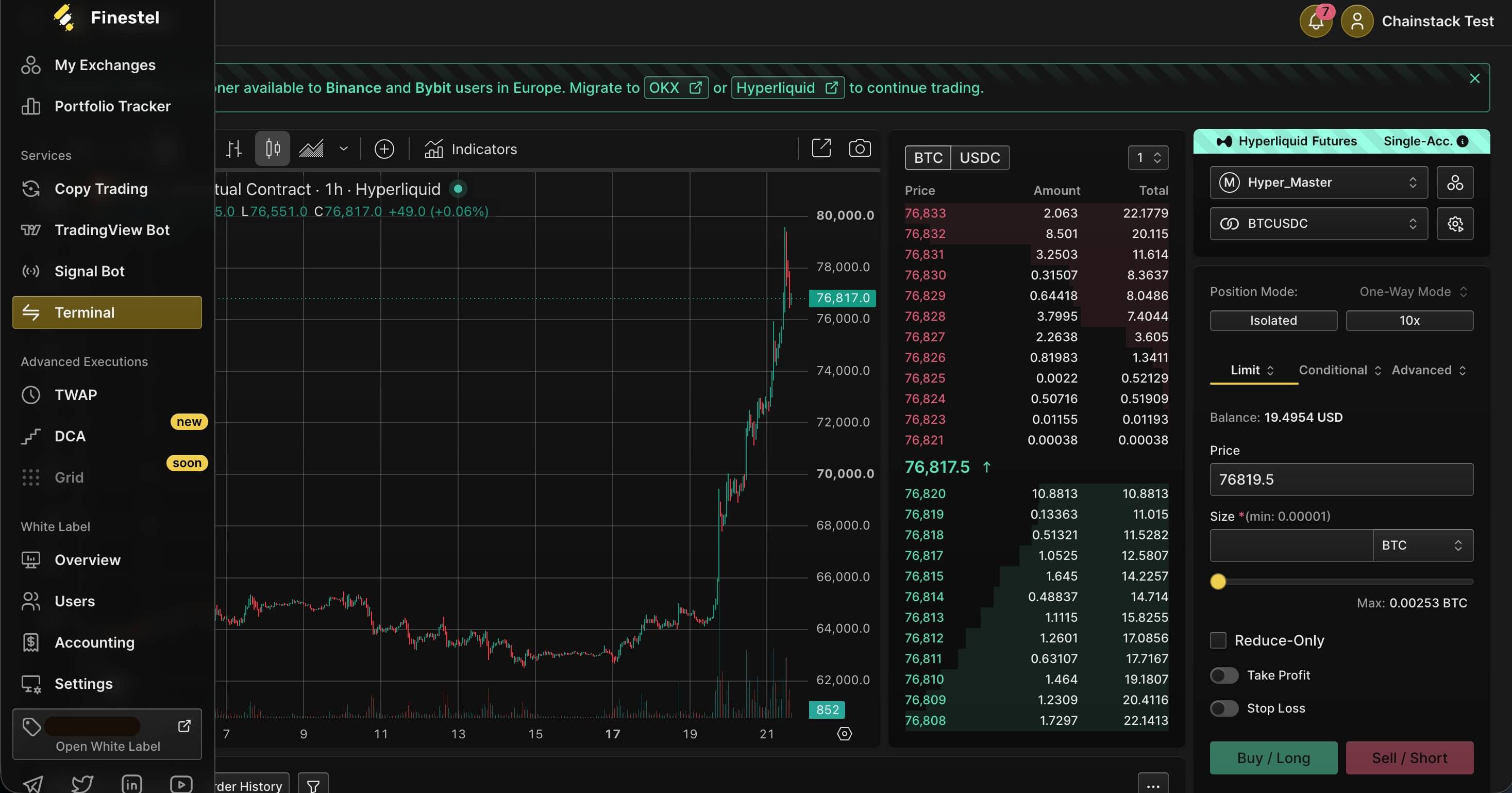
Finestel is an infrastructure provider for executing orders across multiple accounts and multiple venues, spot and perps, at the same time. They have brought all that infrastructure now to Hyperliquid. Its architecture is built around fan-out rather than a single connection: a signal, a TradingView alert, or a manual terminal trade/action can fire simultaneously across a couple of linked accounts or thousands of them. Lots of multiple-account & multiple-order management features and services Finestel offers make it stand out among others.
The same execution layer runs underneath all of Finestel’s products. Basic, advanced and Smart execution algorithms, including DCA, TWAP, are available across the Signal Bot, TradingView Bot, Trade Copier, and the Advanced Trading Terminal, which handles manual single or batch orders.
For asset managers and trading desks, the Trade Copier replicates a master account’s entries, exits, and risk parameters across every copier account, with profit-sharing and performance-fee configuration built in, so managers can monetize a strategy without building their own billing infrastructure. A fully brandable White-Label Solution extends the same system to businesses that want to run and offer their own strategies on a client-facing platform. Beyond crypto, supported venues also carry RWA, stocks, and ETF products on spot and perps.
Services & Features:
- Advanced multi-account terminal
- TradingView bot and signal bot
- Trade copier
- White-label solution
- DCA, TWAP,..
- Multi-account Management
Who it’s for: Professional solo traders, trading desks, and asset managers who need it to execute reliably at scale across every account and every venue
Pricing: a free tier covers 1 CEX account plus 3+ Hyperliquid accounts (limits vary with active promotions); paid tiers scale up to the Scale plan, for managers running hundreds to thousands of accounts with a white-label option, starting at $299/month.
Caveat: It’s not for retailers looking for signals or a social trading marketplace.
2. Chainstack hyperliquid-trading-bot — Best open-source grid bot for builders
Type: Grid trading (perpetuals)
Language: Python
License: Apache 2.0
Link: github.com/chainstacklabs/hyperliquid-trading-bot
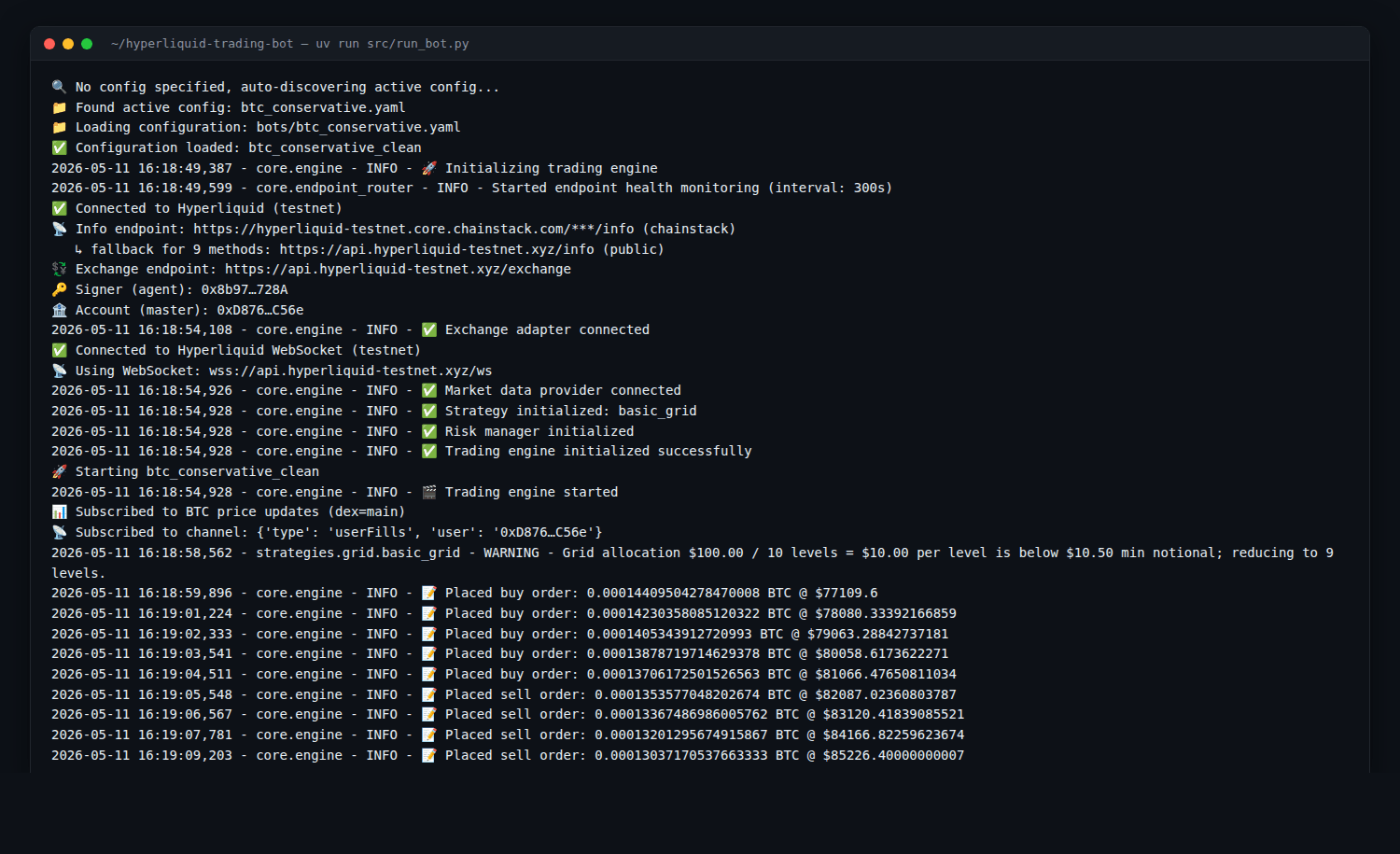
This is the most complete open-source starting point for anyone building on Hyperliquid. The repo ships a working grid bot with real risk controls, a conservative BTC preset, and a learning_examples/ directory that doubles as an unofficial Hyperliquid Python SDK tutorial.
The grid strategy places a ladder of buy and sell orders inside a configurable price band. When price drifts outside the range, the bot rebalances — cancels stale orders and re-centers the grid. The default btc_conservative.yaml config runs 10 grid levels, a ±5% auto-range, and caps at 10% of account allocation. You can clone this config, swap the asset and grid width, and have a working bot on testnet in under an hour.
What makes it production-ready:
- Stop-loss (1–20%), take-profit (5–100%), max drawdown (5–50%), and max position size are all configurable per bot, not hardcoded
--validateflag lets you dry-run config parsing and connection checks before any orders go liveHYPERLIQUID_TESTNET=trueenvironment variable routes all activity to testnet by default — you have to explicitly switch to mainnet- The
learning_examples/tree covers authentication, market data, account state, order placement, cancellation, WebSocket streaming, and copy trading — usable as a standalone reference independent of the bot
Who it’s for: Python developers who want a clean, forkable baseline to extend. Not a SaaS product — you own the code, you control the keys. The learning examples make this the best starting point even if you don’t intend to run a grid strategy.
Infrastructure note: The bot connects to Hyperliquid’s public API by default. For anything beyond testnet experimentation or very low-frequency strategies, you’ll want a private Chainstack Hyperliquid endpoint — the public rate limits are too aggressive for production grid operations.
3. Hummingbot — Best market-making framework
Type: Market making, arbitrage, cross-exchange strategies
Language: Python (Cython hot paths)
License: Apache 2.0
Link: github.com/hummingbot/hummingbot
Hummingbot is the standard framework for professional market making across crypto venues, and Hyperliquid is now a sponsoring exchange of the Hummingbot Foundation. Both hyperliquid and hyperliquid_perpetual connectors are maintained in the core repo, supporting both Arbitrum wallet + private key auth and API-key auth.
The framework’s native Hyperliquid Vault integration is the standout feature. You can run a Hummingbot strategy directly as a Vault leader — your bot’s P&L is automatically shared with depositors, and you earn 10% on profitable withdrawals. It converts a self-contained algorithmic strategy into a structured product without building any additional infrastructure.
Key strategies for Hyperliquid:
- Pure market making (PMM): Place symmetric limit orders around mid-price, collect spread. The most common Hummingbot strategy on Hyperliquid.
- Cross-exchange market making (XEMM): Quote Hyperliquid based on prices from a CEX hedge venue — useful when Hyperliquid spreads lag centralized markets.
- Funding-rate arbitrage: Go long on the venue with negative funding, short on the venue with positive funding. The Foundation has published a Hyperliquid-specific guide for this.
- AMM arbitrage: Profit from divergence between Hyperliquid perp prices and AMM spot prices on the same assets.
Who it’s for: Algo traders and market makers who need a battle-tested framework with proper order-state management, not a hand-rolled script. Hummingbot has a real learning curve — expect 2–4 hours to configure your first strategy from scratch. But the framework depth is unmatched in open source.
4. Freqtrade — Best multi-strategy bot with backtesting
Type: Signal-based directional strategies, backtested
Language: Python
License: GPL-3.0
Link: github.com/freqtrade/freqtrade
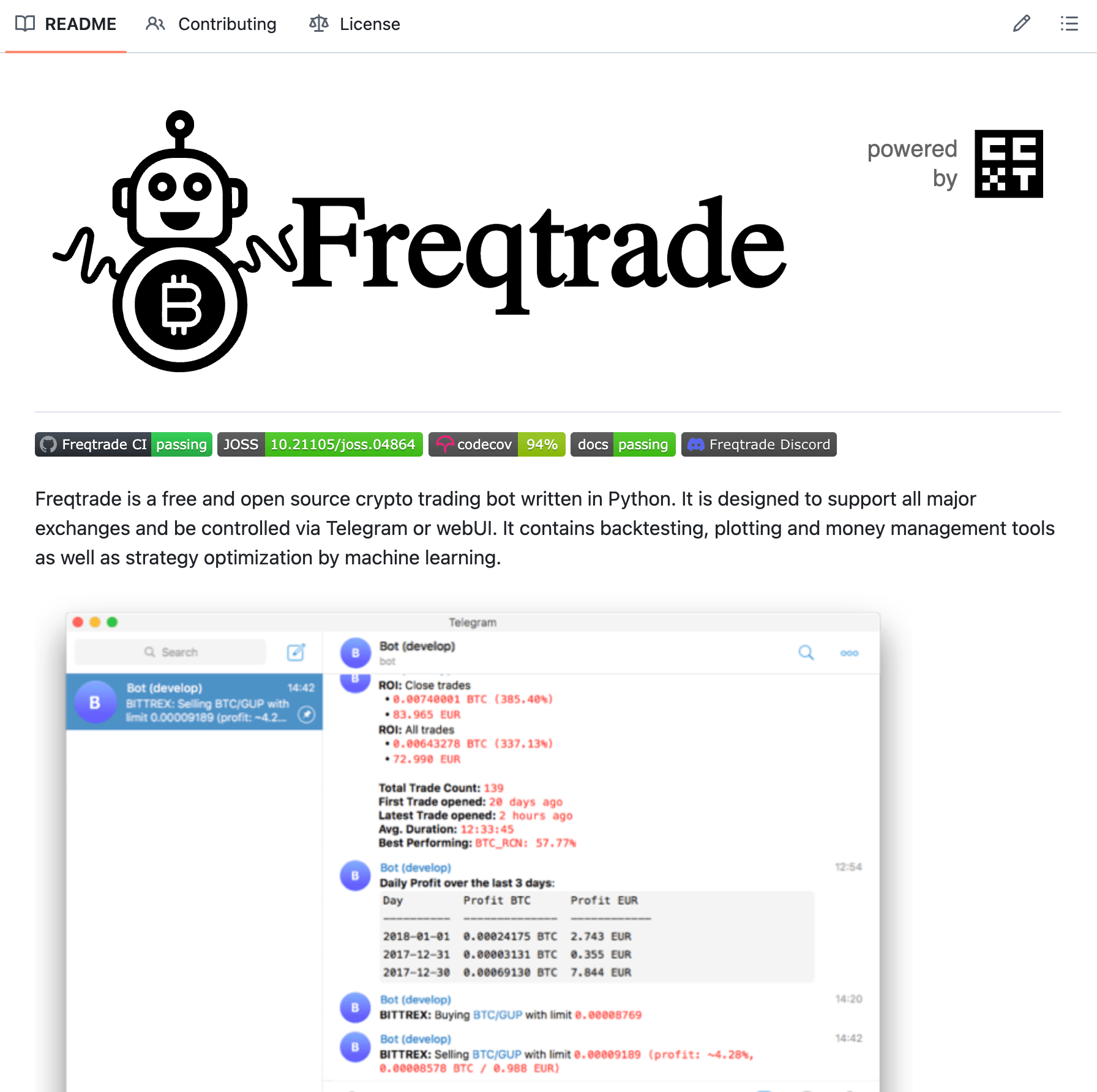
Freqtrade connects to Hyperliquid through CCXT (added in 4.5.20) and is the only bot in this list with a first-class backtesting workflow. You write a Python IStrategy class that defines entry/exit signals, then run freqtrade backtesting against historical data before deploying. That workflow — research, backtest, optimize, deploy — is standard in quantitative trading but rare among Hyperliquid-native bots.
The FreqAI module adds ML-based signal generation. It trains models against historical OHLCV data, feeds predictions into your strategy, and retrains on a rolling basis as new data arrives. For traders who want data-driven edge without building a full ML pipeline from scratch, this is the fastest path.
Key features:
- Dry-run and paper-trading mode before going live
- Telegram and Web UI for monitoring active positions
- Hyperopt for automated parameter search across strategy configs
- Whitelists, blacklists, and dynamic pair lists — useful for filtering Hyperliquid’s growing perp listing
- Supports leverage on Hyperliquid perp positions
Who it’s for: Python-comfortable traders and small quant teams who want to research before risking capital. If you’re the type who wants to see a backtest before trading, Freqtrade is the only Hyperliquid-compatible tool that takes backtesting seriously.
Caveat: HIP-3 builder-deployed equity perps (e.g., XYZ-TSLA/USDC:USDC) use a non-standard ticker format. CCXT support for these is tracked in open issues and partially implemented. Confirm your target instruments work before building a strategy around them.
5. HyperLiquidAlgoBot — Best indicator-based HFT reference in JavaScript
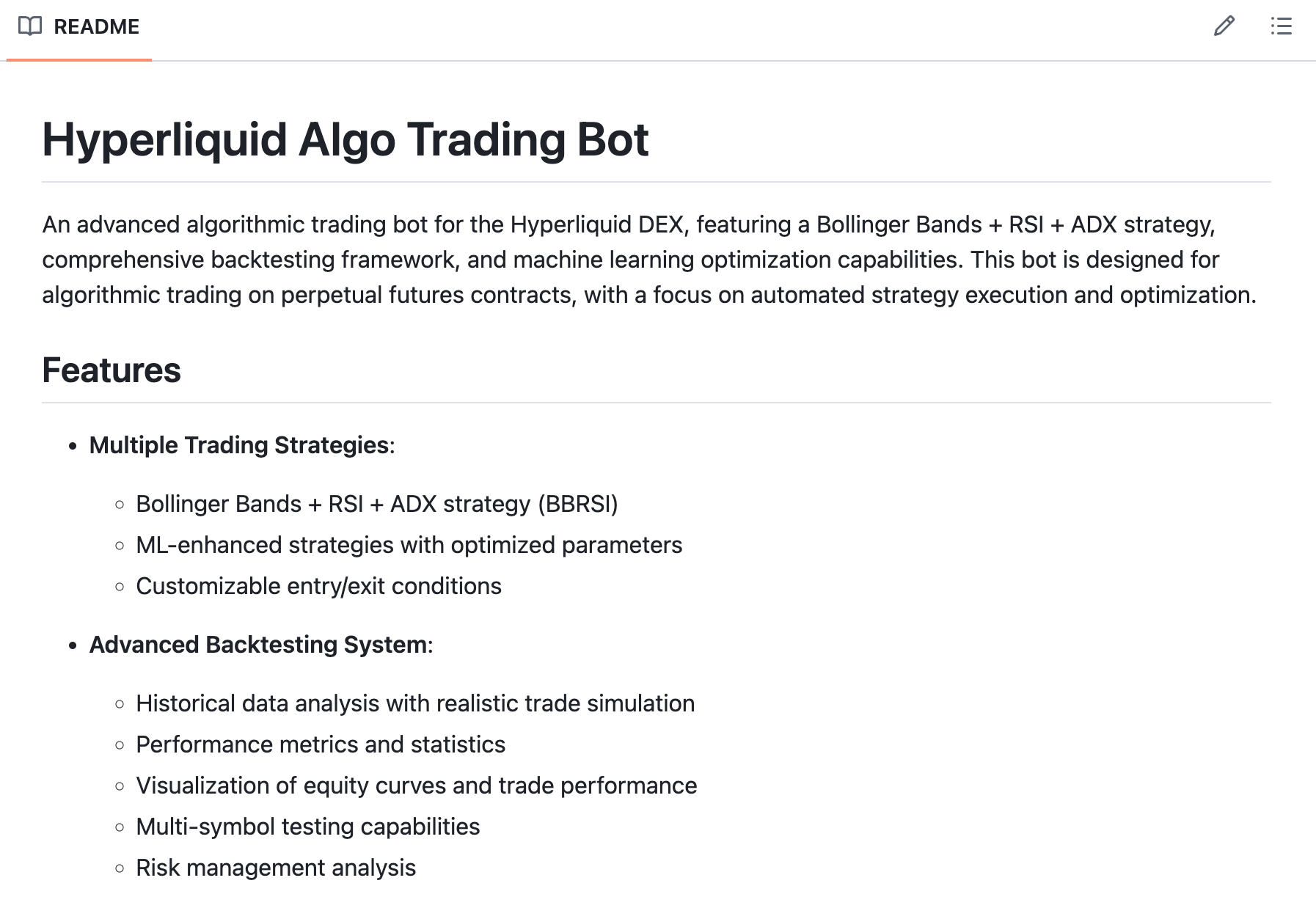
Type: Indicator-driven mean-reversion / momentum
Language: JavaScript (Node.js)
License: MIT
Link: github.com/SimSimButDifferent/HyperLiquidAlgoBot
Nearly every open-source Hyperliquid bot is written in Python. This one isn’t — and that matters if your team runs Node.js services, your infrastructure is JavaScript-native, or you simply don’t want to context-switch between ecosystems.
The core strategy combines Bollinger Bands, RSI, and ADX on 15-minute candles or shorter timeframes. When bands are tight (low volatility), RSI shows oversold/overbought conditions, and ADX confirms trend strength, the bot enters a position in the signal direction. It’s a classic technical-analysis recipe, but the implementation includes real risk management: a RiskManager.js module handles position sizing, stop placement, and drawdown limits.
What makes it worth including:
- Modular architecture —
src/application/,src/backtesting/,src/hyperliquid/,src/strategy/are cleanly separated and forkable independently Backtester.jsengine with a historical data folder — you can run strategy tests before deployingMLEnhancedStrategy.jsmodule adds an ML layer on top of the base indicator signals- Visualization output for reviewing backtest results
Who it’s for: JavaScript developers who want a working HFT-style reference with backtesting built in. Not as mature as Freqtrade or Hummingbot in terms of community and documentation, but the only serious JS option for Hyperliquid.
6. Chainstack hyperliquid-hip-4 — Best reference for HIP-4 prediction-market bots
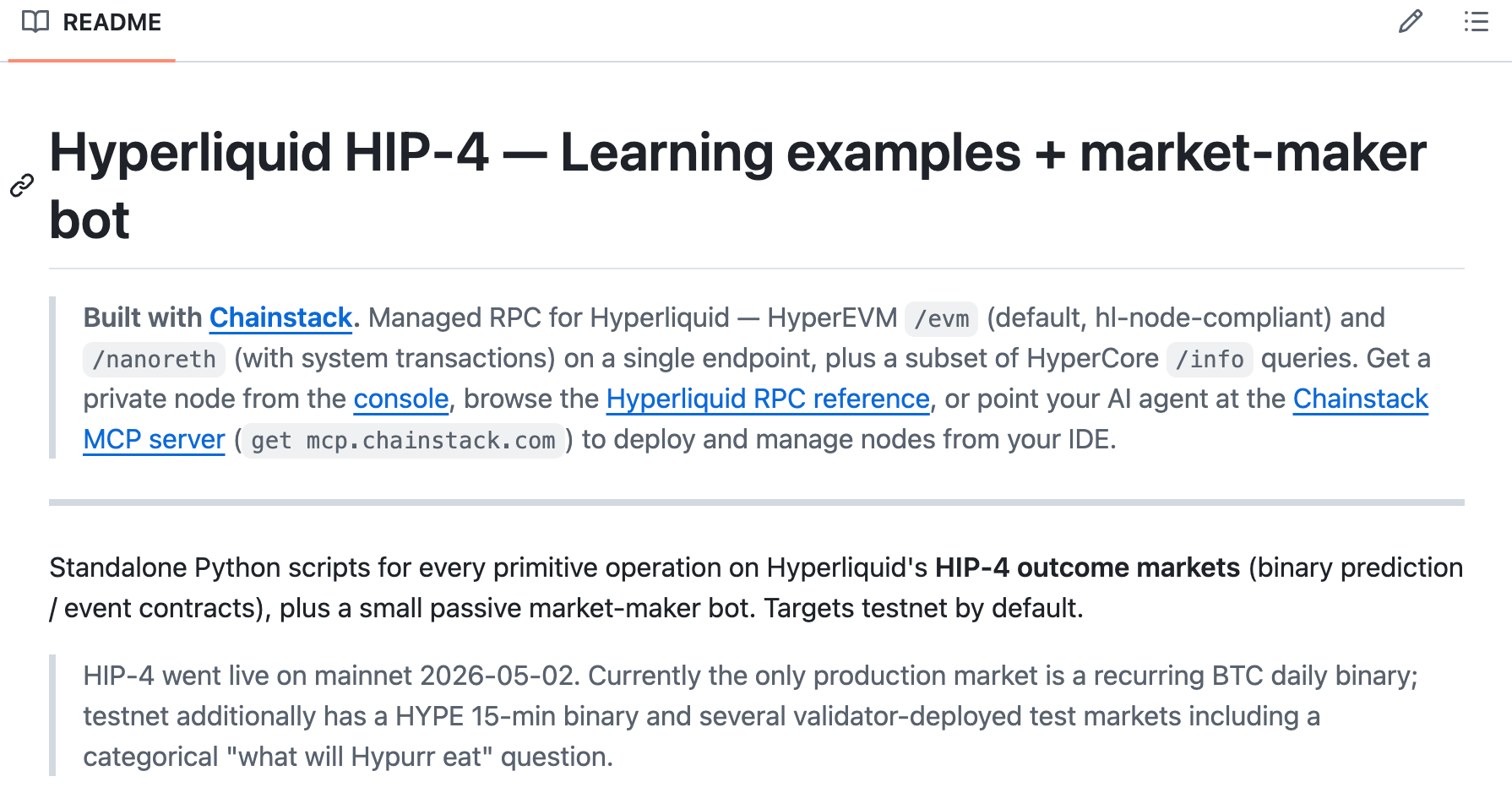
Type: Passive market making on outcome (YES/NO) books
Language: Python
License: Apache 2.0
Link: github.com/chainstacklabs/hyperliquid-hip-4
HIP-4 trading bots: what’s different
HIP-4 is Hyperliquid’s binary prediction-market primitive. It went live on mainnet May 2, 2026, with a daily BTC binary as the inaugural market. Outcome contracts settle to 0 or 1 in USDH, are fully collateralized, charge zero fee to open, and — critically — share the same CLOB and unified margin account as Hyperliquid perps and spot.
That last point is the commercial insight. You can hedge a BTC perp position with a BTC binary in the same margin account. No capital transfer, no separate venue, no additional settlement risk. That cross-product hedge doesn’t exist on Polymarket or Kalshi.
The hyperliquid-hip-4 repo is currently the only public open-source reference for trading these markets. It covers:
#N-style coin notation specific to HIP-4 (outcome contracts use a different ticker format than perps)outcomeMetadiscovery — how to find available markets and parse their description-encoded contract specs- Merged YES/NO order books with price-side-time priority
- USDH collateral routing and settlement-aware position handling
- A passive market-maker bot that quotes both sides of an outcome book
Who it’s for: Advanced developers and prop teams who want to be early on HIP-4 before the market matures. This is a starter kit, not a turnkey product. The HIP-4 ecosystem is still in its first weeks — liquidity is thin and pricing models are unproven. That’s a risk and an opportunity simultaneously.
Infrastructure note: HIP-4 settlement events create concentrated burst load. When a market resolves, the chain emits position closures, USDH transfers, and order-book state updates in a millisecond window. Public endpoints will miss these. A private Chainstack node with WebSocket support is non-negotiable for any real HIP-4 trading operation.
New to Hyperliquid testnet? Grab free HYPE testnet tokens from the Chainstack Hyperliquid faucet to test your HIP-4 bot without risking real funds.
7. Hyperliquid Copy Trader — Best automated copy trading bot
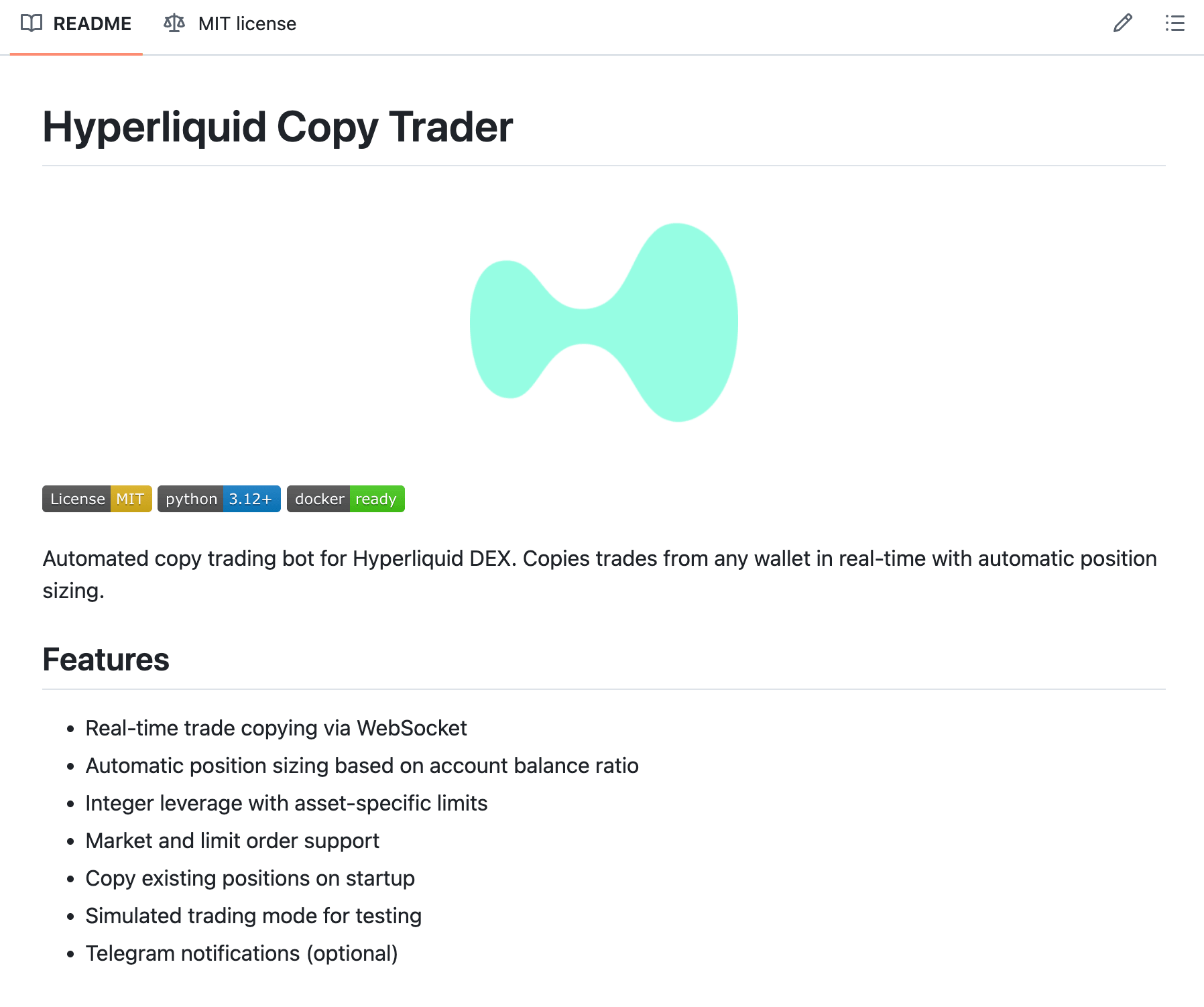
Type: Copy trading (wallet mirroring)
Language: Python
License: MIT
Link: github.com/MaxIsOntoSomething/Hyperliquid_Copy_Trader
Copy trading on Hyperliquid usually means manually watching a wallet and repeating trades by hand. This bot automates the entire loop: it monitors a target wallet via WebSocket in real time, detects position changes the moment they happen, and mirrors them to your account with proportional sizing — no manual intervention required.
The position sizing logic is the key technical detail. The bot calculates your trade size as a ratio of your account balance to the leader’s balance. If the leader has $100k and opens a 1% position, and you have $10k, the bot opens a 0.1 BTC equivalent — not a flat copy. This prevents the most common copy trading failure mode where a large leader’s position size blows out a small follower’s account.
Key features:
- Dry mode (default): Tracks and logs what trades would be executed without placing any real orders — essential for validating the leader wallet before committing capital
- Proportional position sizing — automatically scaled to your account balance vs the leader’s
- Blocked assets list — exclude specific coins from copying, case-insensitive (
BTC,btc,Btcall work) - Leverage cap — automatically rounded to integers and capped at Hyperliquid’s per-asset maximums
- Linux shell scripts —
start.sh,stop.sh,logs.shfor straightforward process management
Who it’s for: Traders who want to follow a specific on-chain wallet programmatically — a known alpha trader, a Hyperliquid Vault leader, or your own second account for strategy mirroring. Requires basic Python setup but no strategy coding. The dry mode makes it safe to evaluate before going live.
Caveat: Hyperliquid enforces a $10 minimum notional per order. If your balance is significantly smaller than the leader’s, small fills will be skipped when the proportional size falls below that threshold. Size your account accordingly or adjust the POSITION_SIZE_MULTIPLIER in config.
Quick comparison table
| Bot | Strategy type | Who it’s for | Open source | Backtesting | Multi-account fan-out |
|---|---|---|---|---|---|
| Finestel | Terminal (manual) / TradingView bot / DCA / TWAP / Trade copier | Pro traders, desks, asset managers | ❌ | ❌ | ✅ |
| Chainstack trading bot | Grid (perps) | Python developers | ✅ | ❌ | ❌ |
| Hummingbot | PMM / XEMM / arbitrage | Pro market makers | ✅ | ✅ | ❌ |
| Freqtrade | Indicator / signal-based | Quant researchers | ✅ | ✅ | ❌ |
| HyperLiquidAlgoBot | Indicator HFT | JS developers | ✅ | ✅ | ❌ |
| Chainstack HIP-4 bot | Market making (outcomes) | Advanced builders | ✅ | ❌ | ❌ |
| Hyperliquid Copy Trader | Copy trading (wallet mirror) | Python traders | ✅ | ❌ | ❌ |
How to choose
- You need to trade on a handful up to thousands of accounts: Finestel’s multi-account trading terminal, trade copier, signal bot, and TradingView bot are the best match for this need. You can also leverage their white-label solution for promoting your trades and strategies (even your own branded Hyperliquid clone) under your own brand.
- You’re a developer who wants to start today: Clone
chainstacklabs/hyperliquid-trading-bot. Runuv run src/run_bot.py --validateon testnet with the defaultbtc_conservative.yamlconfig. Don’t customize strategy logic yet — first confirm your data pipeline is stable for 48 hours with no API errors, no precision rejections, and no missed WebSocket messages. Only then extend. - You want to trade HIP-4 outcome markets: Use
chainstacklabs/hyperliquid-hip-4as your reference. Read theoutcomeMetadiscovery examples before touching the market-maker bot. Phase 1 markets are curated by the Hyperliquid team — you’re trading existing markets, not deploying your own. Plan for burst load on settlement: your endpoint needs to handle the resolution spike cleanly. - You’re a market maker or professional algo trader: Hummingbot is the framework. The Vault integration converts your strategy into a yield product for depositors, which changes the economics significantly — your successful algo generates fee income even at modest capital levels.
- You need to backtest before committing capital: Freqtrade. Nothing else in this list takes historical simulation as seriously. Configure
HYPERLIQUID_TESTNET=truein CCXT, run hyperopt across your strategy parameters, then move to paper trading before going live. - You’re a retail trader who doesn’t code: start with Finestel’s free tier for manual or signal-based execution. For copy trading, run Hyperliquid Copy Trader in dry mode first — evaluate the leader wallet for a week before committing capital.
Getting a Chainstack Hyperliquid endpoint
Sign up at Chainstack, create a project, and deploy a Hyperliquid node in under two minutes:
- Navigate to Add node → Hyperliquid → Mainnet (or Testnet)
- Choose Global Nodes for instant setup or Dedicated Nodes for isolated production throughput
- Copy your HTTPS endpoint and WebSocket URL from the node dashboard
- Replace the public URL in your bot’s
.env— then re-run--validateto confirm
For testnet work, the Chainstack Hyperliquid faucet gives you free HYPE testnet tokens to fund your dev wallet without touching mainnet funds.
Before going live, confirm four things: WebSockets are used for fills (not HTTP polling), your endpoint won’t rate-limit under normal load, a stop-loss and max-drawdown are set and tested, and your API wallet has order-only permissions — no withdrawal access. Run on testnet for 48 hours without errors before touching mainnet funds.
📖 For a full walkthrough of building a Hyperliquid trading bot from scratch — including authenticated order placement, WebSocket integration, and risk-control configuration — see How to build a Hyperliquid trading bot on the Chainstack blog.
Conclusion
Here’s what this list proves that isn’t obvious upfront: on Hyperliquid, your bot category determines your infrastructure tier more than your strategy complexity does.
A Hyperliquid Copy Trader user following one wallet and a Hummingbot market maker quoting 50 pairs can both tolerate the public endpoint — one trades infrequently, the other runs on dedicated hardware anyway. The bots that actually break on public infrastructure are the ones in the middle: grid bots rebalancing every few minutes, and HIP-4 market makers that need to survive settlement spikes. Those two categories have structurally different endpoint requirements not because their strategies are sophisticated, but because their event patterns are — steady high-frequency ticks for grids, burst load for HIP-4 resolution.
That’s the practical framework: social and directional bots are relatively forgiving on infrastructure; grid and outcome-market bots are not. Size your endpoint before you size your position.
Chainstack’s Hyperliquid infrastructure covers all three tiers — shared Global Nodes for getting started, Dedicated Nodes for grid and market-making workloads that need guaranteed throughput, and WebSocket support across both for the real-time fill tracking every production bot depends on.
FAQ
It depends on your profile. Finestel is the top overall pick — its multi-account, multi-venue execution (manual and automated) covers most trading profiles by default. For Python developers who want a clean, forkable foundation: the Chainstack hyperliquid-trading-bot is the best open-source starting point. For professional market makers: Hummingbot with its native Hyperliquid Vault integration. There’s no single “best” — the right answer depends on whether you write code, what strategy you want to run, and how much infrastructure you’re willing to manage.
HIP-4 is Hyperliquid’s binary prediction-market primitive, launched on mainnet May 2, 2026. Outcome contracts settle to 0 or 1 (fully collateralized in USDH), charge zero fee to open, and share Hyperliquid’s CLOB and unified margin with perps and spot. The key insight for bot builders: you can hedge a perps position with a binary event contract in the same margin account, on the same chain. This cross-product hedge doesn’t exist on Polymarket or Kalshi. The Chainstack hyperliquid-hip-4 repo is the only public open-source reference for building HIP-4 trading bots.
Yes. Hyperliquid doesn’t use traditional API keys — bots interact by signing transactions with a private key (or an API wallet derived from your main key). An API wallet can place and cancel orders but cannot withdraw funds, making it safer to use in automated systems. All seven bots in this list support this pattern.
The public endpoint is rate-limited to approximately 100 requests per minute and is shared infrastructure. A private Chainstack node gives you dedicated throughput, no rate-limit competition, WebSocket support, and archive access. For testnet experimentation, the public endpoint is fine. For production bots — especially grid bots that rebalance frequently or market makers that quote continuously — you need a dedicated node. You can get one at chainstack.com/build-better-with-hyperliquid.
No automated trading system is “safe” in the sense of guaranteed profit or zero risk of loss. Specific risks on Hyperliquid include: position liquidation from adverse price moves, API errors causing missed cancel orders, precision-rejection errors that leave stale orders on the book, and strategy logic bugs. Mitigate these by: always setting stop-loss orders, using an API wallet (not your main wallet) for bot operations, testing thoroughly on testnet before mainnet, and starting with a small allocation (10% or less of account) until you’ve validated live performance.
Yes, via CCXT. Standard perps are supported. HIP-3 builder-deployed equity perps (e.g., Tesla, Apple shares tokenized as Hyperliquid perpetuals) use a non-standard ticker format and are partially supported in CCXT — check the CCXT issue tracker before building a strategy that depends on them.
Use the Chainstack Hyperliquid testnet faucet. It dispenses free HYPE testnet tokens to your development wallet. Set HYPERLIQUID_TESTNET=true in your bot’s environment variables, run the --validate flag first, and confirm the testnet connection is stable before writing any strategy logic.
Additional resources