AI-ready infrastructure
 Refer and earn


 Ethereum
 Hyperliquid
 Solana
 Arbitrum
 BNB Smart Chain
 Base
 Polygon
 TRON
 Sui
 Robinhood


Best subgraph hosting providers in 2026: pricing, compatibility, and performance

Subgraphs make blockchain data easier to work with. They index smart contract activity into structured data that applications can query through GraphQL. Instead of fetching and processing contract logs yourself, you can query data such as token transfers, DEX swaps, liquidity positions, and historical protocol activity.
For developers who need application-specific on-chain data without building and maintaining a custom indexer, subgraphs are often a good place to start.
Once you’ve built a subgraph, you’ll need somewhere to run it. Your hosting provider affects:
- how quickly historical data gets indexed,
- how closely the subgraph follows chain head,
- how fast queries return, and
- how much you’ll pay as usage grows.
If you’re moving an existing subgraph, you’ll also want to know whether you can keep your schema, mappings, and queries without rewriting them.
We compared five providers that host Graph-compatible subgraphs: Ormi, Goldsky, The Graph, OnFinality, and Zeeve Traceye.
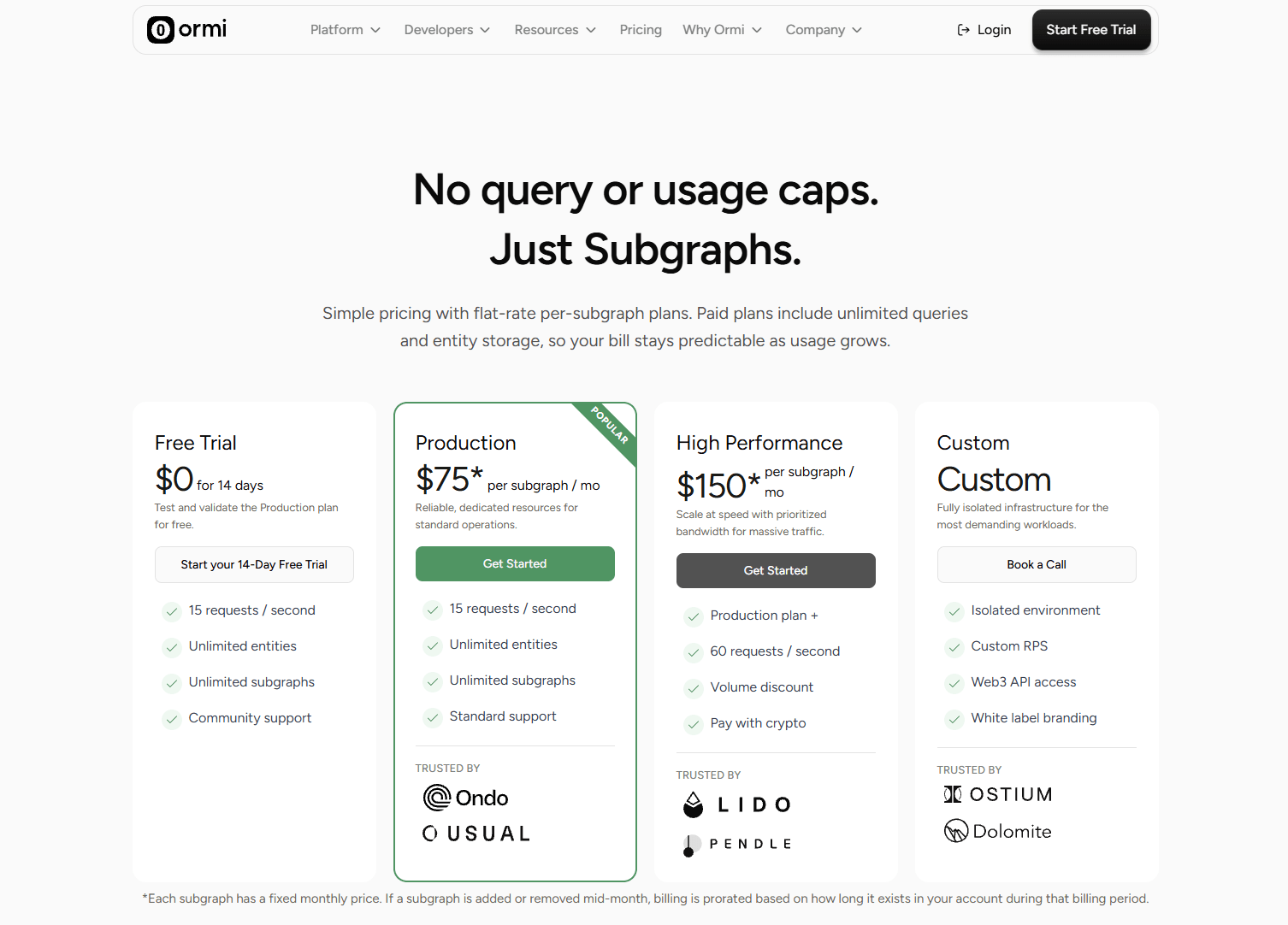
Ormi offers fixed pricing starting at $75 per subgraph per month, with unlimited queries and stored entities. Its Custom infrastructure also supports bursts above 4,000 RPS. Goldsky and The Graph can be cheaper for smaller applications, while OnFinality and Traceye offer other managed and dedicated hosting options.
This comparison covers pricing, compatibility, and published performance information as of November 11, 2026. We haven’t run independent benchmarks across the five providers.
Subgraph hosting providers compared
| Provider | Hosting model | Pricing | Published query capacity |
|---|---|---|---|
| Ormi | Managed Graph-compatible subgraphs | $75/month Production; $150 High Performance | 15 or 60 sustained RPS; 4,000+ burst RPS in custom configurations |
| Goldsky | Managed Graph-compatible subgraphs | Worker-hours and stored entities | 50 requests/10 seconds on Scale; higher Enterprise limits |
| The Graph | Decentralized indexing | 100K free queries/month, then $2/100K | Depends on gateway and Indexers |
| OnFinality | Managed Graph subgraphs | Deployment hours and entity fees | Depends on deployment resources |
| Zeeve Traceye | Shared and dedicated Graph Node hosting | From $69/month | 15 queries/sec on displayed shared plan; dedicated capacity available |
All five support Graph subgraphs, although supported networks, deployment workflows, and advanced Graph Node features vary.
1. Will your existing subgraph work?
Before comparing prices, check whether the provider supports your deployment.
Most standard event-based subgraphs are portable. They use the same subgraph.yaml, schema.graphql, ABIs, and AssemblyScript mappings.
A few things are worth checking before migration.
Chain support
A provider may support Ethereum and Base but not a newer L2 or appchain. Even when a chain is listed, its RPC infrastructure may not support every method your subgraph requires.
For example, call handlers require compatible tracing infrastructure, while historical contract reads need access to past chain state.
Manifest and mapping compatibility
Check your manifest’s specVersion and any advanced features you’re using, including dynamic data sources, declared contract calls, File Data Sources, or grafting.
Custom IPFS gateways and network naming differences can also affect migrations. A subgraph using matic in its manifest, for example, may need to use polygon on another platform.
What happens to existing indexed data?
Deploying the same subgraph code doesn’t necessarily transfer its indexed database.
Some providers can import a deployment using its IPFS deployment hash. Others require you to deploy from source. Depending on the migration process, the subgraph may need to reindex its historical data.
For large deployments, confirm whether existing indexed state can be transferred or reused, and how long any required reindexing is expected to take.
2. What does subgraph hosting cost?
Providers use different billing models.
- Ormi: Fixed monthly price per subgraph.
- Goldsky: Worker-hours and stored entities.
- The Graph: Query volume.
- OnFinality: Deployment hours, stored entities, and additional compute.
- Traceye: Base hosting with storage and API unit allowances.
To compare the pricing, we’ll use a few example workloads.
One million queries per month
Assume one subgraph running continuously for 30 days, with one million stored entities and one million GraphQL queries.
| Provider | Estimated monthly cost | Notes |
|---|---|---|
| The Graph | $18 (approximately $20) | Network query fees |
| Goldsky Scale | ~$37 + entity storage cost | Includes entity charges after free allowances |
| Ormi Production | $75 per subgraph | Fixed monthly hosting |
| Traceye | $69 + entity storage cost | Additional entity capacity required |
| OnFinality | Confirm with provider | Deployment hours and entity charges |
Goldsky includes 2,250 free worker-hours and 100,000 stored entities each month on Scale. A subgraph running for 30 days uses 720 worker-hours. The remaining 900,000 entities cost $36 at $4 per 100,000, assuming the account’s free allowances are available.
The Graph includes 100,000 free monthly queries and charges $2 per additional 100,000. That puts one million queries at $18.
Traceye’s $69 shared configuration includes 550,000 stored entities, so the example would require additional storage capacity.
OnFinality’s published hourly rates are inconsistent across its pricing pages and documentation, so we’ve left its monthly estimate open.
The Graph and Goldsky can cost less for smaller workloads. Note that The Graph’s estimate represents network query fees, while the other providers charge for managed indexing infrastructure.
How much does entity storage cost as a subgraph grows?
Query volume is only part of the hosting bill. On providers that meter stored entities, the cost can increase even if query traffic stays the same.
For example, a DEX subgraph might create a new Swap entity for every swap. As the protocol processes more transactions, the number of stored entities grows.
An entity is a stored record in the subgraph database. Entity count isn’t the same as storage size in GB, and updating an existing entity doesn’t necessarily mean creating another entity.
Here’s how published entity pricing compares.
| Stored entities | Goldsky Scale entity fees/month | OnFinality entity fees/month | Ormi additional entity fees |
|---|---|---|---|
| 100,000 | $0 | $0 | $0 |
| 1 million | $37 | $17.50 | $0 |
| 2 million | $76 | $52.50 | $0 |
| 5 million | $196 | $157.50 | $0 |
| 10 million | $396 | $332.50 | $0 |
These figures assume a constant entity count over a full month and the published free allowances:
- Goldsky: First 100,000 entities free, then $4 per additional 100,000.
- OnFinality: First 500,000 entities free, then $3.50 per additional 100,000 up to 10 million total entities.
- Ormi: No per-entity charges on paid plans.
The table shows entity fees only, not complete hosting costs. Goldsky also meters worker-hours, although one continuously running subgraph fits within its monthly free worker-hour allowance on Scale. OnFinality charges deployment hours and potentially additional compute. Ormi’s Production plan costs $75/month, provided the workload fits its shared-plan capacity.
At five million entities, for example, Goldsky’s entity component alone reaches approximately $196/month. Ormi’s Production price remains $75/month, assuming the subgraph can run within that plan’s resources and throughput.
Traceye also meters entity capacity, but its published configuration doesn’t establish a reliable price for every additional entity tier, so we’ve excluded it from this calculation.
For applications where entity counts grow steadily, it’s worth estimating storage-related costs over the next six to twelve months, not just at launch.
100 million queries per month
Now consider an application serving 100 million GraphQL queries over 30 days.
That’s an average of approximately 38.6 RPS, assuming traffic is evenly distributed.
| Provider | Estimated monthly cost | Notes |
|---|---|---|
| Ormi High Performance | $150 | 60 sustained RPS |
| The Graph | $1,998 | Network query fees |
| Goldsky | Enterprise quote | Scale rate limit is insufficient |
| Traceye | Higher-capacity configuration | Shared plan allows 15 queries/sec |
| OnFinality | Workload-dependent | Confirm compute and query capacity |
Ormi’s $150 plan could accommodate this average request rate if traffic peaks and query complexity fit within the plan’s capacity. Its monthly price doesn’t change with query volume or entity count.
The Graph’s published query fees reach $1,998 at this volume. Goldsky’s Scale plan allows 50 requests per 10 seconds, which isn’t enough for sustained traffic averaging nearly 39 RPS.
For applications with high query volume or large datasets, Ormi’s fixed pricing can provide substantial cost savings.
Monthly volume still needs to be considered alongside peak RPS. An application averaging 39 RPS might see much higher demand during market volatility, protocol launches, or other traffic spikes.
What if you need 1,000+ RPS?
At this scale, you’ll generally need custom or dedicated infrastructure.
Ormi publishes sub-30 ms query latency at 1,000+ RPS and burst capacity above 4,000 RPS in high-performance configurations. Its Custom plan offers isolated infrastructure and configurable throughput.
These are Ormi’s published performance figures, rather than guaranteed sustained throughput and latency for every Custom deployment.
Other providers offer Enterprise or dedicated configurations, although their maximum capacity isn’t always publicly specified.
For workloads requiring thousands of requests per second, benchmark the actual GraphQL queries, expected concurrency, and latency requirements before selecting infrastructure.
3. Free tiers and starting prices
| Provider | Free tier or trial | Starting paid option |
|---|---|---|
| Ormi | 14-day Production trial | $75/subgraph/month |
| Goldsky | $100 introductory credits and recurring Scale allowances | Usage-based Scale |
| The Graph | 100K queries/month | $2 per additional 100K |
| OnFinality | Free Developer plan with resource limits | Hourly deployment billing |
| Traceye | Complimentary development subgraph | $69/month |
Goldsky’s Scale allowances include 2,250 worker-hours and 100,000 stored entities per month, separate from its introductory credits.
Ormi’s trial provides access to the Production configuration with 15 sustained RPS.
For development and testing, a free tier or trial may be enough. For production, estimate costs based on subgraph count, entity growth, monthly query volume, and peak RPS.
4. How do indexing performance and reliability compare?
Published rate limits are straightforward to compare. Indexing speed and query latency depend on the actual workload.
A subgraph processing a few token transfers per block behaves differently from one indexing thousands of events, updating large entities, or making repeated contract calls.
We haven’t run identical benchmarks across all five providers, so there’s no reliable basis for ranking their indexing speed.
Historical indexing speed
Historical indexing matters when deploying a new subgraph or rebuilding one during migration.
Deploy identical source code on both providers, using the same contract addresses, start blocks, mappings, and network.
Measure how long each deployment takes to reach chain head.
Use fresh deployments where possible. Popular public subgraphs may already be indexed or cached by a provider, affecting the results.
Indexing lag
Once the subgraph reaches chain head, monitor how far behind it stays.
For Graph-compatible deployments, query:
{
  _meta {
    block {
      number
      timestamp
    }
  }
}
Compare the result with the chain’s latest block over time.
Pay particular attention during periods of heavy contract activity. A subgraph may stay current when event volume is low but accumulate lag as activity increases.
Query latency and throughput
Test the GraphQL queries your application actually runs.
Include entity lookups, filtered historical queries, and queries that traverse entity relationships.
Increase concurrent requests gradually and measure p50, p95, p99 latency, error rates, and sustained throughput.
Also check whether heavy query traffic affects indexing lag.
Published reliability information
| Provider | Published availability information |
|---|---|
| Ormi | 99.9% uptime listed on plans; custom SLA options |
| Goldsky | Enterprise availability arrangements and plan-dependent support commitments |
| The Graph | Decentralized Indexers; availability depends on deployment and network coverage |
| OnFinality | 99.9% uptime stated for paid indexing plans |
| Traceye | 99.99% uptime claimed |
These aren’t necessarily equivalent contractual guarantees. Check whether an SLA covers endpoint availability, indexing freshness, or both.
For a more detailed testing process, see How to Benchmark Subgraph Performance and Reliability.
How we compared providers
We used public pricing pages and product documentation available on November 11, 2026.
The query-pricing examples use one active subgraph, one million stored entities, and the stated request volume over 30 days.
The entity-pricing examples assume the stated entity count is maintained for a full month. Actual bills can differ as data grows or infrastructure usage changes.
Estimates exclude taxes, introductory credits, negotiated discounts, and custom infrastructure costs.
We included services that host existing Graph subgraphs. General-purpose indexing frameworks requiring developers to adopt a different development model were excluded.
Performance figures are attributed to the providers publishing them. We haven’t independently benchmarked indexing speed, query latency, or uptime across these services.
This comparison is published by Ormi, one of the providers covered.
5. Best subgraph hosting provider by use case
| Use case | Providers to consider |
|---|---|
| Production subgraphs with high query traffic | Ormi, Goldsky Enterprise |
| Large or growing entity datasets | Ormi |
| Smaller subgraphs with low usage | Goldsky, The Graph |
| Decentralized indexing | The Graph |
| Subgraphs alongside streaming pipelines | Goldsky |
| Dedicated Graph Node or custom chains | Ormi, Traceye, OnFinality |
| Thousands of RPS or large traffic bursts | Ormi Custom, other dedicated configurations subject to testing |
For production subgraphs with substantial query traffic or growing entity storage, Ormi is worth benchmarking early. Its fixed pricing removes per-query and per-entity billing, while Custom environments offer higher throughput.
The Graph is a natural choice when decentralized indexing is a requirement. Goldsky is useful when subgraphs are part of a broader streaming and data pipeline setup.
For custom networks, check which provider supports the required RPC infrastructure and Graph Node features.
6. Provider reviews
Ormi
Ormi provides managed Graph-compatible subgraphs through 0xGraph.
Developers can deploy existing manifests, schemas, and AssemblyScript mappings using familiar tooling. Ormi also supports no-code and assisted migrations.
Production costs $75 per subgraph per month for 15 sustained RPS, while High Performance costs $150 for 60 sustained RPS. Both include unlimited queries and stored entities. Monthly charges are prorated for subgraphs created or deleted mid-month.
For larger workloads, Ormi offers isolated Custom environments. Its published benchmarks include sub-30 ms latency at 1,000+ RPS and burst capacity above 4,000 RPS.
Ormi uses hybrid bare-metal and cloud infrastructure, with monitoring, logs, webhooks, and dedicated support options.
Fixed pricing is useful for production applications with sustained traffic or large datasets. Running many small, rarely queried subgraphs may cost less with a usage-based provider.
Goldsky
Goldsky offers managed Graph-compatible subgraphs and blockchain data streaming through Turbo Pipelines.
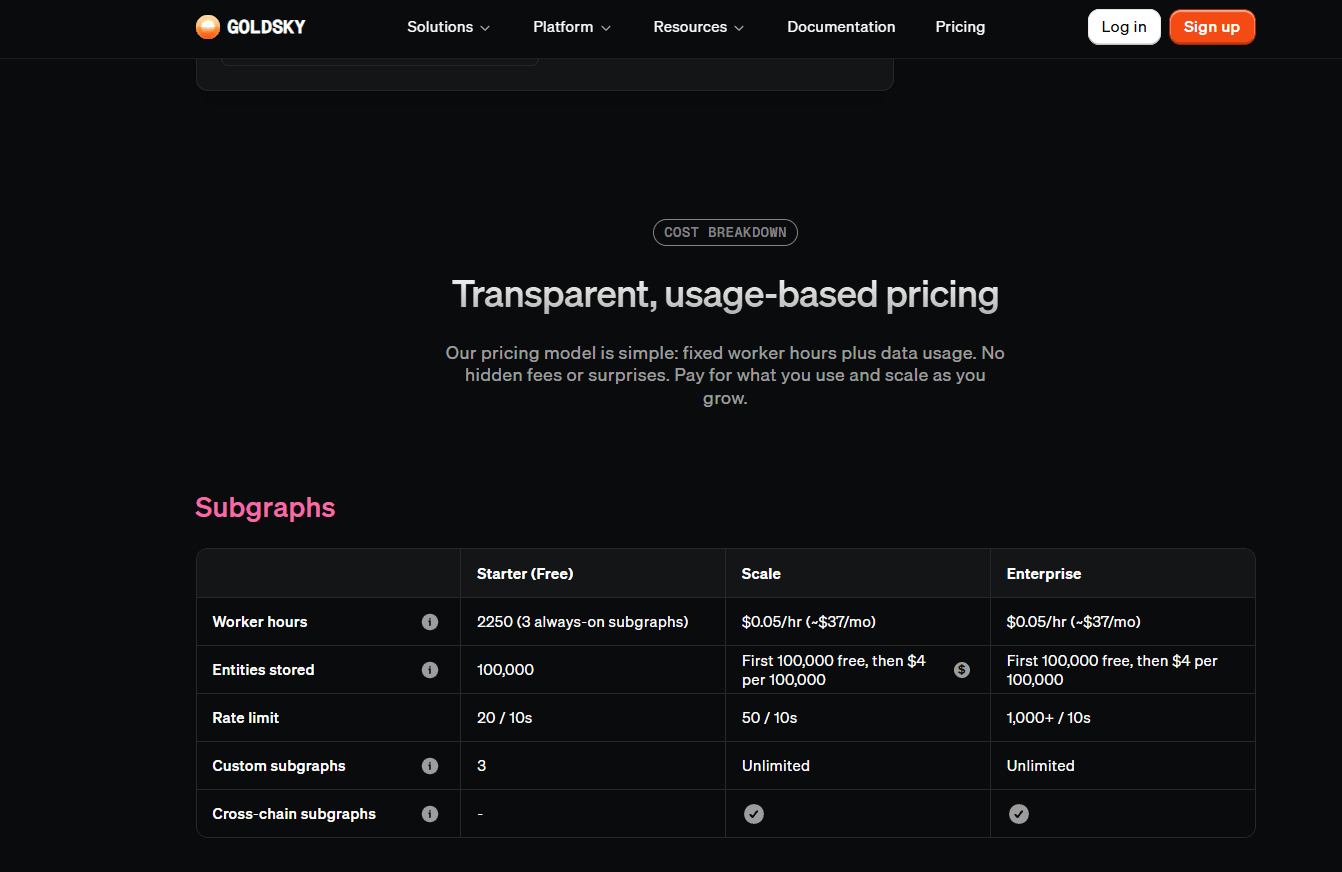
Its Scale plan includes 2,250 worker-hours and 100,000 stored entities free each month. Additional worker-hours cost $0.05, and entities cost $4 per additional 100,000.
Scale allows 50 requests per 10 seconds, with higher query capacity available on Enterprise.
Goldsky also supports streaming blockchain data into databases and warehouses, making it useful for teams that need both hosted subgraphs and downstream data pipelines.
For subgraph-only workloads, estimate how quickly your entity count will grow and whether the published query limit is sufficient.
The Graph
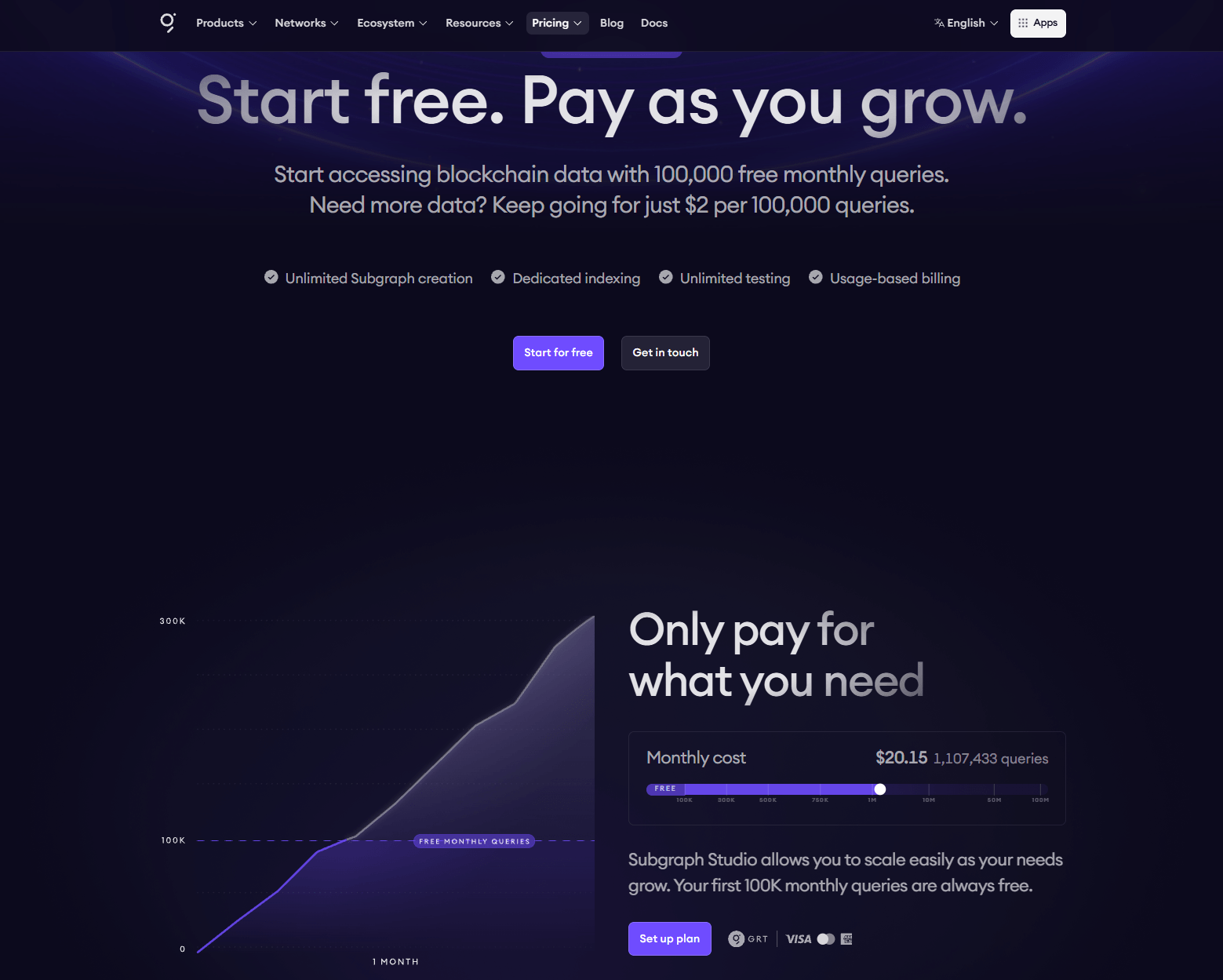
The Graph provides decentralized subgraph indexing through a network of independent Indexers.
Developers publish using The Graph’s standard tooling, with queries served through the network.
Published query pricing includes 100,000 free queries per month, followed by $2 per additional 100,000.
This can be inexpensive for smaller applications, especially when the required subgraph is already available on the network.
For production use, confirm chain support, Indexer coverage, indexing freshness, and query latency for the specific deployment.
OnFinality
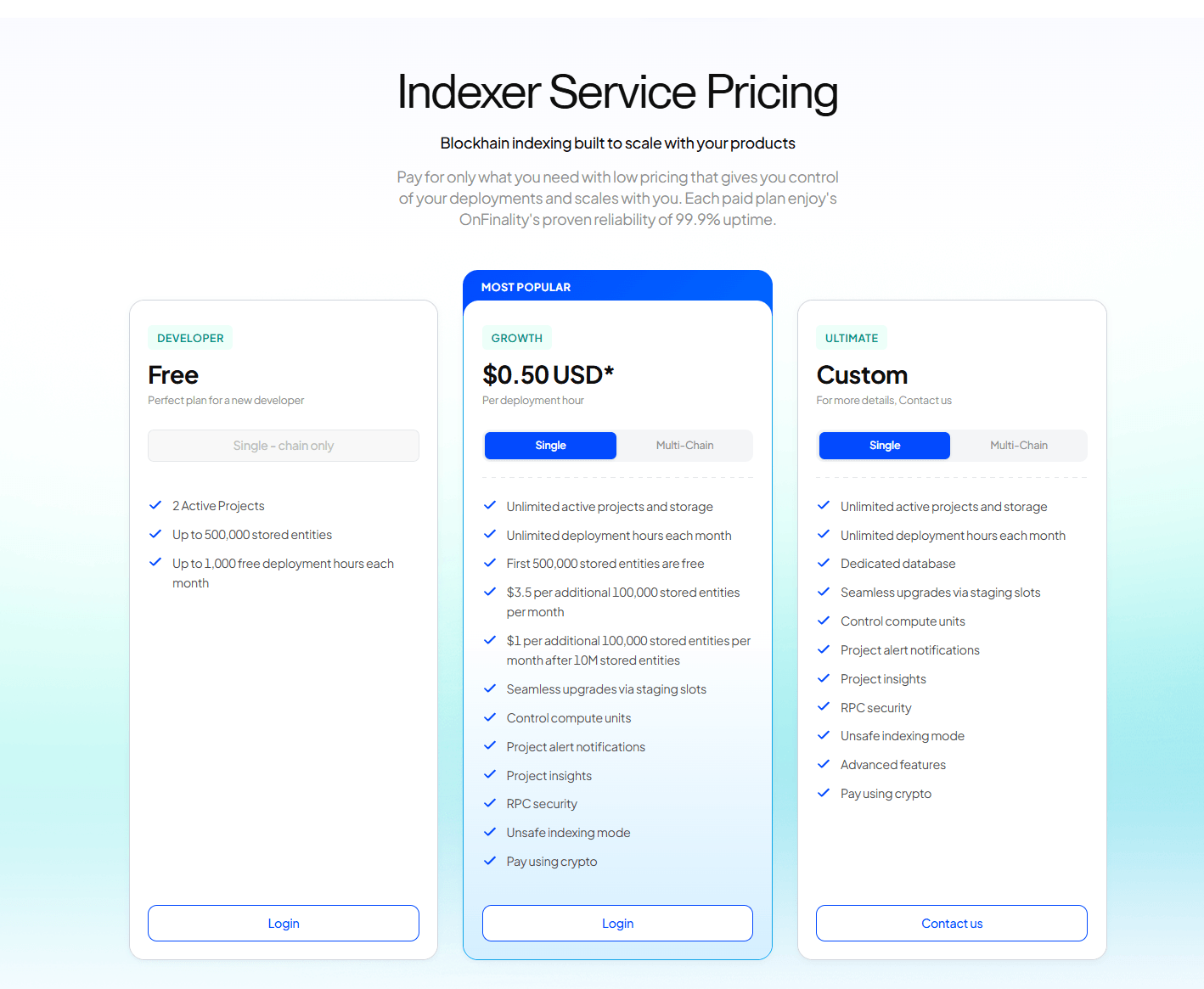
OnFinality offers managed Graph subgraphs alongside SubQuery indexing and RPC infrastructure.
Developers can deploy using an existing subgraph’s IPFS deployment CID and provide RPC endpoints for indexing.
Its free Developer tier includes limits on active projects, deployment hours, and stored entities. Paid plans charge for deployment time, stored entities, and additional compute.
OnFinality publishes an entity charge of $3.50 per additional 100,000 entities per month above its initial 500,000-entity allowance, up to 10 million entities.
Its public hourly deployment rates currently differ between pricing pages, so confirm the applicable rate before calculating a total monthly bill.
OnFinality is worth evaluating if you’re already using its RPC infrastructure or need configurable indexing resources.
Zeeve Traceye
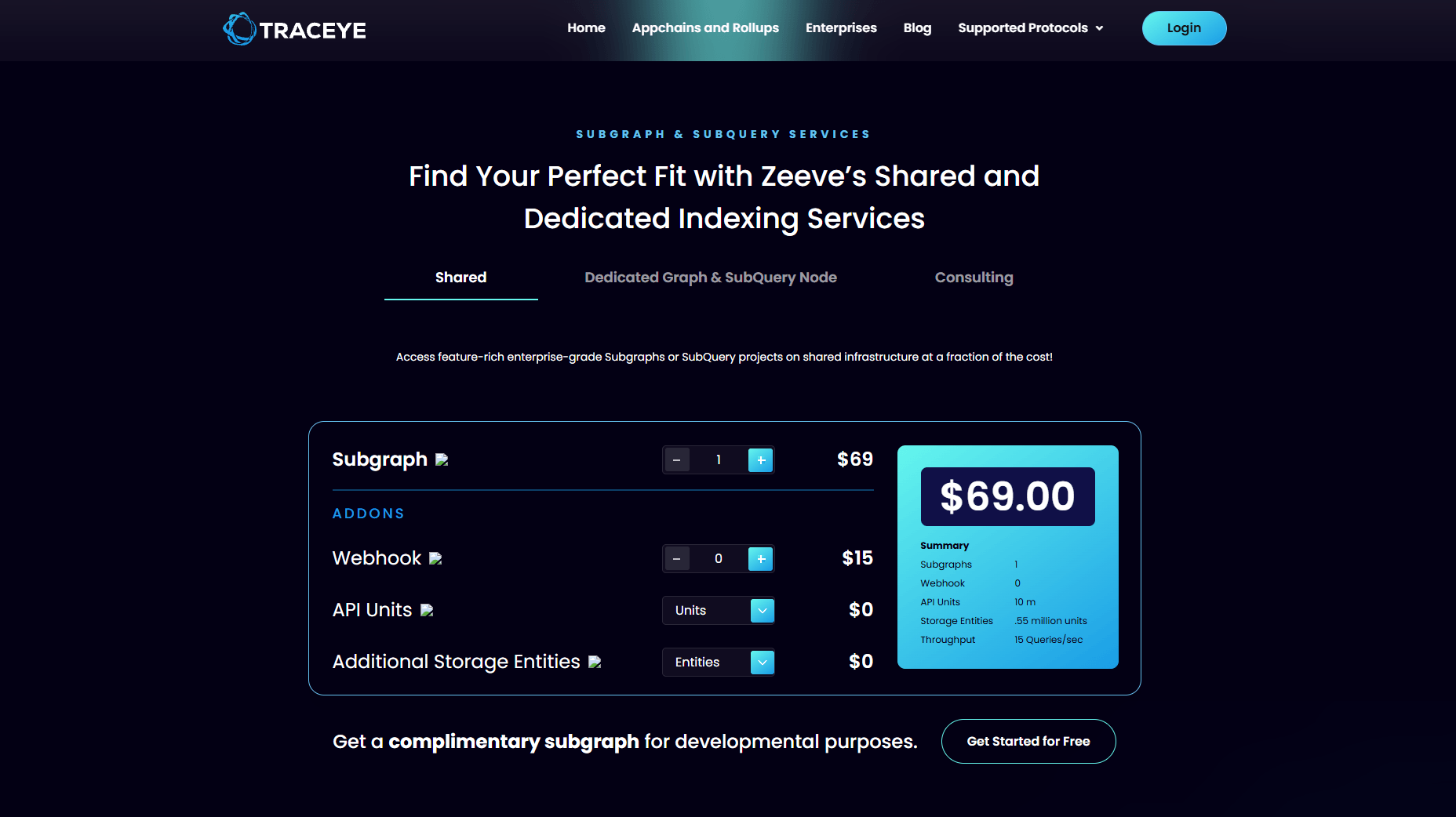
Traceye offers managed subgraph hosting on shared infrastructure and dedicated Graph Node deployments.
Its displayed shared configuration starts at $69 per month, including 550,000 stored entities, 10 million API units, and 15 queries per second.
Larger workloads can use additional storage, API capacity, or dedicated infrastructure.
Traceye also provides indexing infrastructure for appchains and rollups, making it relevant for teams deploying on custom networks.
7. Which subgraph hosting provider should you choose?
For existing Graph-compatible subgraphs, narrow the selection based on chain support, migration requirements, and expected traffic before comparing monthly costs.
Ormi is our recommendation for high-traffic production subgraphs, particularly when predictable pricing and query capacity matter. Its standard plans support up to 60 sustained RPS, with custom environments for higher-throughput workloads.
The lack of per-entity charges is also useful for applications with growing databases. At five million entities, Goldsky’s published entity fees alone reach approximately $196/month, compared with Ormi’s $75 Production plan, assuming the workload fits that tier.
Goldsky and The Graph can cost less for smaller deployments. Goldsky offers a broader streaming platform, while The Graph provides decentralized indexing.
OnFinality and Traceye offer additional managed hosting options, including dedicated or configurable infrastructure.
Before switching providers, deploy the same subgraph on both platforms and compare historical sync time, live indexing lag, and query latency under expected traffic.
Frequently asked questions
Ormi, Goldsky, The Graph, OnFinality, and Traceye support Graph subgraph deployments. Check network support, manifest compatibility, contract calls, and advanced features before migrating.
It depends on whether the provider can transfer or reuse your existing indexed state. Importing a deployment hash or using the same source code doesn’t automatically transfer the database. Ask how historical data is handled during migration.
An entity is a record defined by your subgraph schema and saved to its database, such as a Swap, Transfer, Pool, or Account. For a subgraph that creates a new Swap entity for every swap, the number of stored entities can grow with transaction activity. Providers that charge per entity may therefore become more expensive as the dataset expands.
The Graph and Goldsky can cost less for smaller deployments. Ormi’s fixed pricing becomes more competitive as query traffic or stored entity counts grow.
No. A plan can include unlimited monthly queries while enforcing throughput limits. Ormi’s paid shared plans provide 15 and 60 sustained RPS, while Custom environments provide configurable capacity.
Ormi publishes burst capacity above 4,000 RPS in high-performance configurations. Sustained throughput and latency depend on the specific environment and query workload.
Sources and further reading
Pricing and product information were reviewed against official provider documentation on November 11, 2026.
- Ormi pricing
- Ormi Subgraph
- Goldsky pricing
- The Graph pricing
- OnFinality indexing pricing
- OnFinality pricing documentation
- Zeeve Traceye
- The Graph’s Subgraph Manifest documentation
- How to Benchmark Subgraph Performance and Reliability
About Ormi
Ormi Subgraphs provides managed Graph-compatible subgraph hosting with fixed monthly pricing, monitoring, and custom infrastructure for production workloads.