AI-ready infrastructure
 Refer and earn


 Ethereum
 Hyperliquid
 Solana
 Arbitrum
 BNB Smart Chain
 Base
 Polygon
 TRON
 Sui
 Robinhood


Best Polygon RPC providers for high-throughput apps in 2026

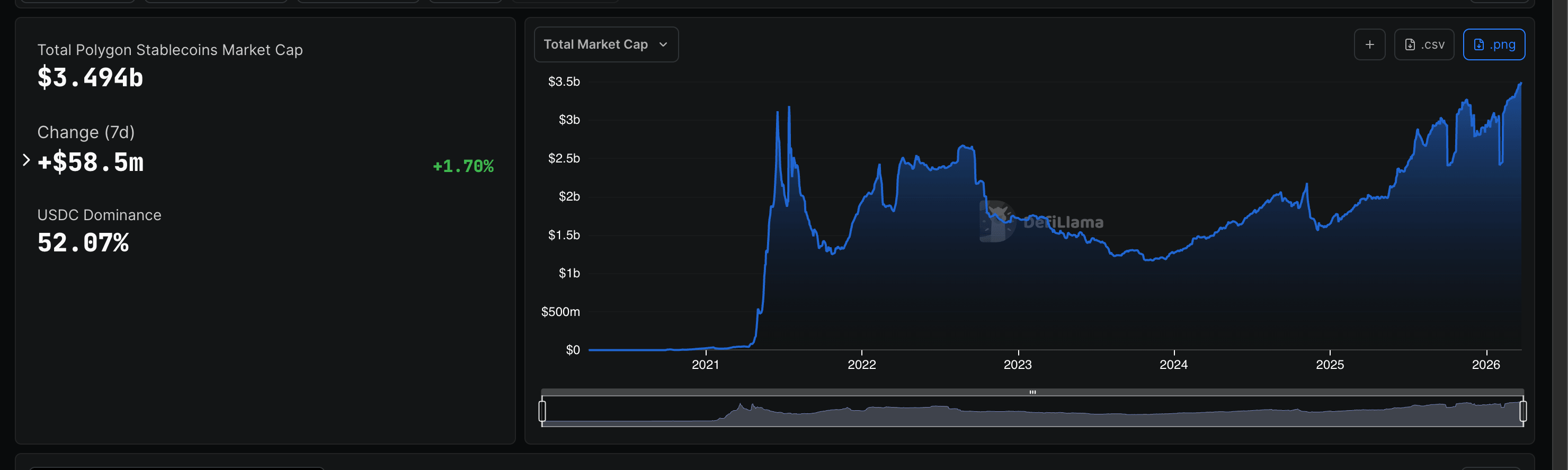
Polygon remains one of the most practical chains for production apps in 2026 not just because it is cheap and EVM-compatible, but because transaction demand is clearly still there. Daily transaction volume on Polygon PoS has climbed sharply, with the network closing Q2 2026 with an all-time-high 743 million transactions, which reinforces its role as a live execution layer for stablecoin transfers, payment rails, gaming backends, consumer apps, and bots. Even as newer L2s compete for attention, Polygon continues to combine real usage, low costs, and mature tooling in a way that makes it operationally relevant for production workloads.
That is exactly why your choice among Polygon RPC providers matters more than most developers initially realize. On Polygon, the bottleneck is almost never “can I get an RPC URL.” The real question is whether that endpoint stays fast and reliable when traffic spikes, when event subscriptions pile up, or when a bot starts backfilling logs at scale.
High-throughput apps do not just need a provider that works in a benchmark demo. They need one that keeps latency stable, exposes the right method surface, and does not become unpredictable under sustained load. This guide breaks down the leading Polygon RPC providers for production workloads in 2026—with a specific focus on stablecoin and payment flows, enterprise deployments, and analytics-heavy or dedicated-node environments.
Quick verdict: best Polygon RPC providers in 2026
Chainstack is our top pick for stablecoin, payment, DeFi and indexer workloads on Polygon, based on request-based pricing, a path from shared to dedicated nodes, and SOC 2 Type II and ISO 27001 certification. Chainstack publishes this page and is one of the six listed providers, so see how we compared before relying on these picks. For enterprise compliance, Quicknode leads on public credentials. The best fit by need:
- Best for stablecoin and payment apps: Chainstack (request-based pricing, WebSocket support, clean upgrade path to dedicated nodes).
- Best for enterprise compliance posture: Quicknode (SOC 1 Type 2, SOC 2 Type 2, ISO 27001, dedicated clusters), with Chainstack close for teams that want dedicated Polygon nodes with simpler cost logic and Alchemy close behind.
- Best for DeFi, analytics and indexers: Chainstack, with Quicknode as the closest alternative (archive, debug and trace).
- Best for flat per-response billing: Dwellir (one credit per response, no compute-unit weighting).
- Best for archive access on every plan: OnFinality (archive included on the free plan, Trace/Debug APIs on paid plans).
- Best for flat-rate request pricing: dRPC ($6/1M requests; pay-as-you-go is limited to 100 RPS, up to 600 RPS on the Scale plan).
- Best for teams already on a broader platform: Alchemy (30M free CUs per month, analytics, webhooks and SDK).
The providers below are not numbered or ranked 1 to 6. The picks above are Chainstack’s editorial judgment per use case, not a benchmark result.
🤔 Already using Chainstack? Jump straight to the Polygon tooling docs or the Polygon getting started reference to deploy your endpoint in minutes. Testing on Amoy? Grab free test tokens from the Chainstack Amoy faucet.
Why Polygon RPC provider choice matters for production
In a development environment, almost any Polygon RPC provider will do. But in production—where a stablecoin payment app sees sharp spikes around balance checks and transaction confirmations, or where a trading bot needs consistent low-latency state access—the difference between providers becomes operationally significant.
The key factors that separate production-grade Polygon RPC providers from basic public endpoints are:
- Throughput stability under load, not just average latency in quiet conditions
- WebSocket support for subscriptions and real-time event tracking
- Archive, debug, and trace access for indexers, analytics pipelines, and historical queries
- Dedicated node options when shared infrastructure introduces too much noise
- Clear SLA commitments for payment systems, regulated products, and enterprise workloads
- Pricing transparency so cost does not become unpredictable as traffic scales
The comparison below focuses on exactly these criteria across six leading Polygon RPC providers—evaluated for real production conditions, not sandbox demos.
Polygon RPC providers comparison table (2026)
The table below summarizes the public positioning of six Polygon RPC providers as of October 2026. Where providers reserve details for enterprise sales, the table reflects only what is publicly documented.
| Provider | Best for | Pricing model | Free tier | Dedicated nodes | Archive / debug / trace | SLA & security |
|---|---|---|---|---|---|---|
| Chainstack | Predictable request-based pricing, dedicated-node upgrade path, SOC 2 Type II and ISO 27001 | Request-based plans with optional flat-rate RPS add-on | 3M RU/month, 25 RPS | Yes, from the Pro plan | Archive and debug/trace from the Growth plan | 99.99%+ platform uptime (status.chainstack.com, Polygon Mainnet, 99.99%+ over the 90 days to October 29, 2026; not an SLA); contractual SLA (99.9% quarterly, service credits) on Enterprise; SOC 2 Type II and ISO 27001 |
| Dwellir | Flat per-response billing and unmetered dedicated archive clusters | One credit per response, no CU weighting; shared plans $49–$999/mo; Unlimited Nodes from $119/mo | 20 responses/s, 100,000 responses/day | Yes, dedicated archive cluster (Polygon price not re-verified; Dwellir lists clusters from $2,400/mo per chain) | Trace/debug on paid plans (shared endpoints are full nodes); archive only on dedicated clusters | 99.99% uptime SLA stated on Dwellir pages (contract terms not verified); no SOC 2 / ISO 27001 found |
| OnFinality | Archive access on every plan, including the free tier | Response-unit based, unified tiers | 400K RU/day, up to 40 RU/sec | Yes, pay-as-you-go | Archive on every plan; trace/debug on paid | No formal SLA published; security certs not documented |
| dRPC | Flat-rate request pricing ($6/1M requests; 100 RPS on pay-as-you-go, 600 RPS on Scale) | Flat-rate request pricing on paid tier | Free public access (public nodes, no SLA) | No clearly documented dedicated Polygon node tier in public materials | Standard methods; paid-tier trace/filter | High-availability positioning; 99.96% uptime listed on paid plans, committed SLAs on Enterprise; no SOC 2 found |
| Alchemy | Teams already using Alchemy’s broader platform and SDK | Compute-unit pricing with free, PAYG, and enterprise scaling | 30M CUs/month | Enterprise/custom infrastructure, but no clearly marketed dedicated Polygon node tier in public docs | Full archive; Debug API on PAYG and Enterprise (Trace API not supported on Polygon) | 99.99% uptime; enterprise custom SLAs; SOC 2 Type II (no published ISO 27001) |
| Quicknode | Enterprise compliance posture and archive, debug and trace depth | Credit-based plans with optional Flat Rate RPS and dedicated enterprise options | Trial only — 10M API credits for 30 days | Yes, Dedicated Clusters available | Archive, Debug API, Trace API, Polygon-specific APIs | 99.99% uptime stated on its security page; premium SLA on Enterprise; SOC 1/2 Type 2, ISO 27001 |
How to choose a Polygon RPC provider
1. Shared RPC is often enough for moderate traffic
If your app has steady but moderate traffic, shared RPC is often sufficient. This applies to dashboards, wallet backends, light bot infrastructure, and consumer apps that read chain state frequently but do not depend on heavy archive queries or strict latency guarantees. In this range, what matters most is a clean pricing model, stable WebSocket support, and reasonable default throughput.
2. Dedicated infrastructure starts to matter when your app becomes operationally sensitive
That threshold is usually crossed in three scenarios:
- Payment or stablecoin traffic with bursty reads and writes
- Bots that depend on consistent low-latency state access, where jitter from shared infrastructure creates operational risk
- Indexers running long backfills or traces, where a noisy shared endpoint can corrupt the consistency of your data pipeline
Once traffic becomes burst-heavy or sustained, shared RPC can become noisy even if average latency still looks fine on a dashboard.
3. Archive, debug, and trace access matters for analytical workloads
If your workload is not just transactional but analytical—replaying historical state, indexing large event ranges, tracing smart contract execution, or supporting internal observability—you need more than a standard full-node endpoint. Archive data access, debug_traceTransaction, trace_block, and long-range eth_getLogs behavior become more important than free-tier size.
4. Latency consistency matters more than average latency for real-time workloads
Average latency is a misleading metric for latency-sensitive applications. What breaks DeFi execution layers, real-time event listeners, keeper networks, and live price feeds is not average response time — it is tail latency and jitter. A provider that averages 40ms but occasionally spikes to 800ms under load will fail production workloads that depend on reacting to chain state within a narrow window.
For these workloads, the relevant criteria are: WebSocket connection stability under sustained subscription load, consistent p95 and p99 latency rather than just p50, and a provider architecture that does not introduce shared-infrastructure noise during peak network activity. Dedicated nodes remove the noise floor entirely, which is why latency-sensitive applications are often the first to outgrow shared RPC — even when average metrics still look acceptable.
5. Enterprise support matters when Polygon is part of a regulated product
Stablecoin apps, payment rails, treasury systems, and institutional middleware usually need more than a performant endpoint. They need a clear SLA, a defined security posture, access controls, and support quality that does not depend on a Discord thread. At this level, your Polygon RPC provider becomes part of your risk model.
How we compared Polygon RPC providers
Disclosure: this comparison is published by Chainstack. Chainstack is one of the six providers listed and is named the top pick for two of the three use cases in Final recommendations, so read the picks as a vendor perspective and check the figures against the official pricing pages linked in each provider section.
Criteria. Each provider is compared on the same attributes: pricing model, free tier, published rate limits (RPS), dedicated-node options, archive, debug and trace access, SLA and security evidence. The picks are editorial judgment for production workloads (payments, enterprise, DeFi and indexers). They are not the output of a benchmark.
Sources. Prices, limits and uptime figures come from each provider’s public pricing, documentation and status pages. Where a provider does not publish a Polygon-specific figure, such as latency, this page says so instead of estimating one. Uptime. Chainstack platform uptime: 99.99%+ (the Polygon Mainnet component over the 90 days to October 29, 2026), as shown on status.chainstack.com. Status-page figures are for the Mainnet component of each chain; testnet and devnet components are tracked separately. This is platform uptime shown on the status page, separate from contractual SLAs and not a guarantee. The status page covers Chainstack only, so uptime figures for other providers on this page are as stated by each provider. Only the Dwellir figures carry a “Pricing checked” date, so confirm current prices on the linked official pricing pages before you buy.
Not covered. Other providers may also support Polygon. They are not part of this comparison.
Latency data. Chainstack Compare did not monitor Polygon when this article was updated (October 29, 2026), and no Chainstack benchmark report covers Polygon, so no latency benchmark is included here. Published latency claims vary by region and method, so test from the region where your application runs. This request returns the total round-trip time for one eth_blockNumber call; run it repeatedly against each endpoint and compare the median and the 95th percentile. See how to measure RPC latency (P50, P95, P99) for the full method.
curl -s -o /dev/null -w "%{time_total}" -X POST https://YOUR_ENDPOINT -H "Content-Type: application/json" -d '{"jsonrpc":"2.0","method":"eth_blockNumber","params":[],"id":1}'Choose the right Polygon RPC provider by use case
For stablecoin and payment apps
Payment applications on Polygon need a different kind of reliability than general-purpose dApps. The core requirement is not exotic RPC methods. It is consistent low-latency reads, clean transaction submission, and stable performance during bursty traffic.
Payment systems create sharp spikes around balance checks, transaction confirmations, webhooks, and reconciliation. A provider that looks inexpensive for casual usage can still become a liability in production—because payments fail operationally long before they fail cryptographically.
The strongest criteria here are: predictable throughput, clear uptime, and pricing that does not become opaque when traffic becomes repetitive but heavy.
Chainstack stands out because its request-based pricing is easier to reason about than CU-heavy alternatives, and because it offers a clear upgrade path from shared Polygon RPC to dedicated infrastructure. Dwellir is credible for cost-sensitive payment applications that want flat per-response billing and a path to a dedicated cluster. Alchemy is strong if the payment stack already depends on its broader platform products, but its compute-based billing model is less intuitive for teams that want straightforward cost forecasting.
For enterprise workloads
Enterprise Polygon workloads are less about raw throughput and more about operational assurance. The questions shift from “does it respond fast?” to “is there a contractual uptime model, do we have clear support paths, and does the provider pass our internal security review?”
For enterprise teams, the critical criteria are:
- Publicly available or negotiable SLA terms
- Clear security posture (SOC 2, ISO certifications)
- Dedicated or isolated infrastructure options
- Multi-region resilience
- Support quality that does not degrade when you escalate a P1 incident
Quicknode is strong here because it combines formal security credentials (SOC 1 Type 2, SOC 2 Type 2, ISO 27001) with dedicated cluster options and a mature platform surface. Alchemy is also compelling for enterprise teams already embedded in its ecosystem. Chainstack is a serious contender for teams that want a direct path to dedicated nodes, transparent pricing logic, and SOC 2 Type II and ISO 27001-backed infrastructure—without navigating a complex enterprise procurement process just to get meaningful throughput.
For DeFi, analytics, and indexers
DeFi and analytics workloads stress a Polygon RPC provider differently from payment or bot traffic. They care less about single-request latency and more about whether the provider can survive long-running historical reads, event backfills, trace calls, and archive-heavy access patterns without collapsing into throttling or returning inconsistent results.
A cheap endpoint can look fine until it has to serve eth_getLogs across large block windows, replay transactions, or support indexing jobs that run continuously for hours.
Chainstack and Quicknode are the strongest fits here based on publicly documented feature sets. Chainstack has the clearest path to a dedicated Polygon RPC node and production-oriented node control. Quicknode is strong on archive, trace, and marketplace-style platform depth. Alchemy remains viable for analytics-heavy teams, especially those already familiar with its Debug API, but method-weighted cost behavior needs closer modeling at scale.
Polygon RPC rate limits and free tiers compared
Rate limits and billing units differ between providers, so the same number of calls can cost different amounts. This table summarizes the figures from the provider sections below.
| Provider | Free tier | Entry paid plan | Published throughput limits | Billing unit |
| Chainstack | 3M RU/month, 25 RPS | Growth, $49/mo (20M RU) | 250 RPS (Growth), 400 RPS (Pro), 600 RPS (Business), unlimited RPS (Enterprise); Unlimited Node add-on 25–500 RPS | Request units (RU); overage from $20/1M RU (Developer) to $5/1M RU (Enterprise) |
| Dwellir | 20 responses/s, 100,000 responses/day | Developer, $49/mo (25M responses) | 100/s (Developer), 500/s (Growth), 5,000/s (Scale); Unlimited Nodes from $119/mo, 25–1,000 RPS | One credit per response, regardless of method |
| OnFinality | 400K RU/day, up to 40 RU/sec | Growth, $49/mo (20M RU) | 200 RU/sec (Growth), 500 RU/sec (Accelerate); public rate limit 5 req/sec; private up to 500 RPS | Response units; $6/1M extra (Growth), $3.75/1M extra (Accelerate) |
| dRPC | Free public nodes, no SLA | Paid tier, $6/1M requests | 100 RPS on pay-as-you-go, 300 RPS (Pro, $49/mo), 600 RPS (Scale, $199/mo); unlimited on Enterprise | 20 CUs per call regardless of method |
| Alchemy | 30M CUs/month | Pay-as-you-go, $0.525/1M CUs | 300 RPS (PAYG), Enterprise from 1,000 RPS | Compute units; eth_call is about 26 CUs |
| Quicknode | No free plan; trial of 10M credits for 30 days | Build, $49/mo (80M credits) | 50 RPS (Build), 125 (Accelerate), 250 (Scale), 500 (Business) | API credits; 20 credits per standard EVM call; overage $0.50–$0.62/1M |
Chainstack alternatives for Polygon RPC
If Chainstack is not the right fit, these are the head-to-head differences between Chainstack and each alternative on Polygon, using the figures in this article:
- Chainstack vs Dwellir: Dwellir bills one credit per response and offers Unlimited Nodes from $119/mo, while Chainstack uses request units with an Unlimited Node add-on (25–500 RPS). Chainstack lists SOC 2 Type II and ISO 27001; we found no such attestation for Dwellir. Dwellir lists dedicated clusters from $2,400/month per chain; the earlier $12,600/month Polygon archive cluster price was not re-verified on October 29, 2026.
- Chainstack vs OnFinality: OnFinality includes archive access on every plan, including Free, while Chainstack archive starts on the Growth plan. OnFinality’s public rate limit is 5 req/sec and its security certifications are not documented; Chainstack lists SOC 2 Type II and ISO 27001.
- Chainstack vs dRPC: dRPC’s pay-as-you-go tier is $6/1M requests at 100 RPS and its Scale plan reaches 600 RPS, the same published ceiling as Chainstack’s 600 RPS on Business; dRPC Enterprise is unlimited. Chainstack documents a path to dedicated Polygon nodes; dRPC does not clearly describe one in public materials, lists 99.96% uptime on paid plans and committed SLAs only on Enterprise.
- Chainstack vs Alchemy: Alchemy prices in compute units (30M free CUs per month, about 26 CUs per eth_call) and lists the Trace API as not supported on Polygon. Chainstack uses request units and offers debug/trace from the Growth plan. Alchemy has more add-on platform products around notifications and indexed APIs.
- Chainstack vs Quicknode: Quicknode has no free plan (30-day trial only) and states SOC 1 Type 2, SOC 2 Type 2 and ISO 27001; it documents archive, Debug API, Trace API and Polygon-specific APIs. Chainstack has a free tier (3M RU/month) and SOC 2 Type II plus ISO 27001. Quicknode Flat Rate RPS runs on shared infrastructure without dedicated isolation or SLA guarantees.
Polygon RPC providers: breakdown by provider
Chainstack: best for predictable pricing, dedicated upgrades and compliance
Verdict: In our assessment Chainstack is the strongest fit for payment, DeFi and indexer workloads on Polygon (Chainstack publishes this page). The main trade-off is fewer add-on platform products around notifications and indexed APIs than Alchemy or Quicknode. Official pricing: Chainstack pricing.
High-throughput apps, bots, and payment systems on Polygon RPC node infrastructure often graduate into dedicated capacity as traffic grows.
In our assessment, Chainstack has the cleanest production path in this comparison. Chainstack offers a free shared tier for entry, request-based billing that is easier to forecast than CU-heavy alternatives, and dedicated Polygon nodes for teams that outgrow shared endpoints. Chainstack also publicly emphasizes archive access, WebSockets, enterprise support, and SOC 2 Type II and ISO 27001 compliance.
🤖 You can also access Chainstack Polygon RPC directly from Claude, Cursor, Codex, Windsurf, Gemini CLI, GitHub Copilot, Antigravity, Claude.ai, or ChatGPT using Chainstack MCP. Learn more about Chainstack MCP.
Pricing & throughput: Developer plan is free (3M RU/month, 25 RPS). Growth starts at $49/mo (20M RU, 250 RPS). Pro at $199/mo (80M RU, 400 RPS). Business at $499/mo (200M RU, 600 RPS). Enterprise at $990/mo (400M RU, unlimited RPS). Overage rates drop from $20/1M RU on Developer to $5/1M RU on Enterprise. The Unlimited Node add-on converts any node to flat-fee, unlimited requests within a chosen RPS tier (25–500 RPS) — no per-request billing, no overage exposure.
For teams that care about predictable cost and a direct move into isolated infrastructure, that is a practical advantage over providers where dedicated nodes are available only through opaque enterprise sales processes.
Limitations: Compared with Alchemy and Quicknode, Chainstack has fewer add-on platform abstractions around notifications, indexed APIs, or broader middleware products. If your team wants a provider that also acts as an application-data platform, that may matter.
Fit by workload:
- Stablecoin and Payment Apps: Excellent — request-based pricing and dedicated-node upgrade paths are straightforward to operationalize
- Enterprise Polygon Workloads: Strong — SOC 2 Type II and ISO 27001, status-page platform uptime, dedicated infrastructure
- Dedicated Nodes, Analytics, and Indexers: Strongest in this comparison — clearest path to dedicated Polygon access without building your own node operations stack
Dwellir: best for flat per-response billing
Verdict: Dwellir suits cost-sensitive teams that want one credit per response and a path to a dedicated archive cluster. The main trade-offs are no SOC 2 or ISO 27001 attestation found and a separately priced dedicated Polygon cluster (Dwellir lists clusters from $2,400/month per chain). Official pricing: Dwellir pricing.
Pricing & throughput: Free covers 20 responses/second and 100,000 responses per day. Developer is $49/mo (25M responses, 100/second), Growth $299/mo (150M, 500/second, eth_getLogs over up to 10,000 blocks), and Scale $999/mo (500M, 5,000/second). Unlimited Nodes start at $119/mo flat (25–1,000 RPS). Every response costs one credit regardless of method, so a trace call is billed like a balance check. Pricing checked October 9, 2026.
Dwellir is a Swedish RPC provider with a long Polkadot track record that now serves 150+ networks, Polygon among them. Dwellir offers a managed API over HTTPS and WebSocket, trace and debug methods on paid plans, and a dedicated archive cluster (Polygon price not re-verified; Dwellir lists clusters from $2,400/month per chain) with full archive state, no rate limits, and a 99.99% uptime SLA stated on Dwellir pages (contract terms not verified). Crypto payments are accepted.
Limitations: We found no SOC 2 or ISO 27001 attestation on Dwellir’s public pricing and dedicated-cluster pages, so regulated teams should request documents before committing. The free tier is capped at 100,000 responses per day, and a dedicated Polygon cluster is a large step up from shared plans.
Fit by workload:
- Stablecoin and Payment Apps: Good for teams that want flat per-response billing and the option to move to an isolated cluster later
- Enterprise Polygon Workloads: Viable, with a stated 99.99% uptime SLA (contract terms not verified) but no public compliance attestation
- Dedicated Nodes, Analytics, and Indexers: Strong, with unmetered dedicated archive clusters and trace/debug on every paid plan
OnFinality: best for archive access on every plan
Verdict: OnFinality includes archive access on every plan, including Free, and offers pay-as-you-go dedicated nodes. The main trade-offs are a 5 req/sec public rate limit and undocumented security certifications. Official pricing: OnFinality pricing.
OnFinality provides EVM-compatible HTTPS and WebSocket RPC access to Polygon PoS Mainnet and the Amoy testnet, with archive access included on every plan and Trace/Debug APIs on paid tiers. Pay-as-you-go dedicated Polygon nodes are available for teams that need isolated infrastructure.
| How much does OnFinality cost? | Developer — free, 400,000 response units/day, up to 40 RU/sec. Growth — $49/month, 20M response units/month, no daily cap, 200 RU/sec, $6/million extra. Accelerate — $249/month, 100M response units/month, 500 RU/sec, $3.75/million extra. Ultimate — custom pricing, custom throughput, crypto payments accepted. |
| OnFinality performance | Public rate limit: 5 req/sec. Private rate limit: up to 500 RPS. Archive: included on every plan, including Free. Region: N. Virginia. Dedicated nodes: pay-as-you-go, for isolated capacity. |
| OnFinality pros | – Archive access on every plan, including Free – Trace/Debug APIs on paid plans – Pay-as-you-go dedicated nodes on all tiers |
| OnFinality cons | – Public free-tier rate limit (5 req/sec) is tight without upgrading – Trace API not available on the Free plan – Security certifications not explicitly documented |
dRPC: best for flat-rate request pricing
Verdict: dRPC offers $6/1M requests flat, with pay-as-you-go limited to 100 RPS and a Scale plan at 600 RPS. The main trade-off is that no Polygon-specific dedicated-node tier is documented and committed SLAs are listed only on Enterprise. Official pricing: dRPC pricing.
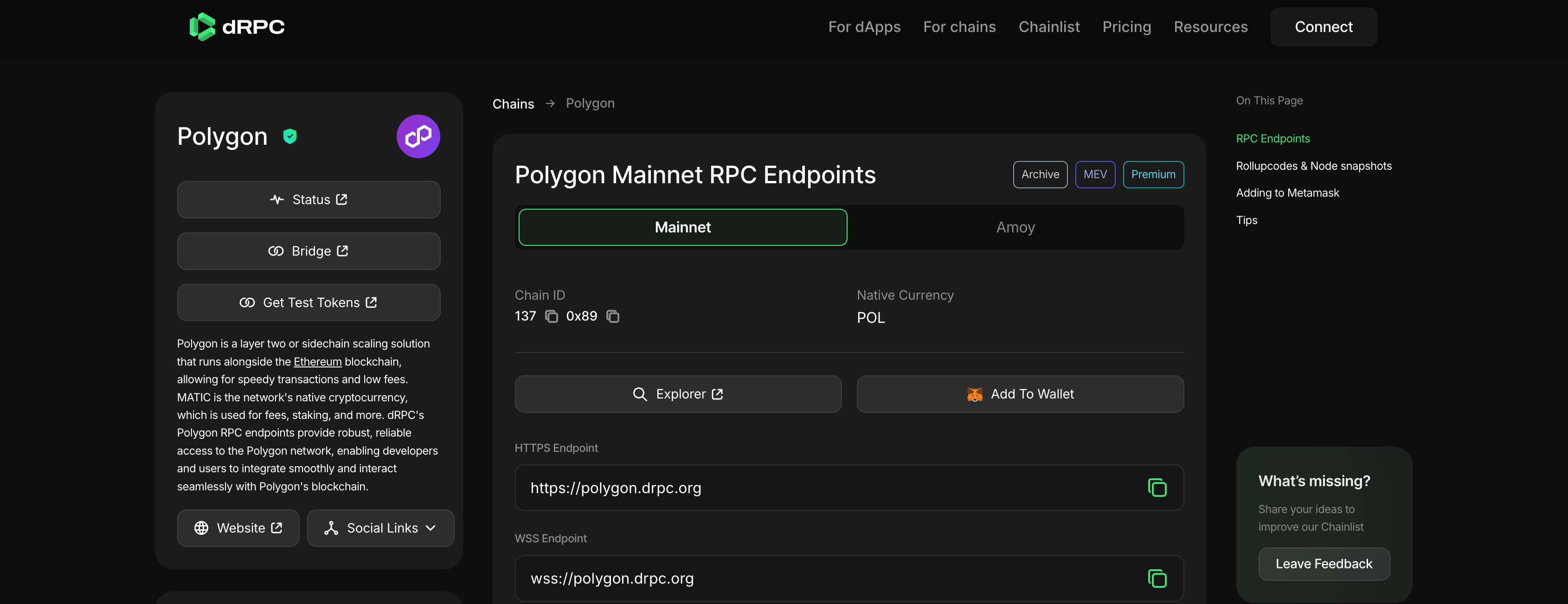
Pricing & throughput: In our assessment, dRPC has the simplest pricing model in this comparison — $6/1M requests flat, with 20 CUs per call regardless of method. No multiplier math, no per-method surprises. Pay-as-you-go is limited to 100 RPS, Pro ($49/mo) reaches 300 RPS and Scale ($199/mo) 600 RPS, which matches Chainstack’s Business plan and sits below Dwellir’s 5,000 RPS Scale plan. The free public tier routes through public nodes with no SLA guarantees, making it unsuitable for production.
dRPC’s value proposition is clear: multi-chain access, WebSocket support, flat-rate request pricing, and distributed routing. Its Polygon documentation exposes standard chain info, subscriptions, and paid-tier trace methods.
Limitations: dRPC is the weakest of the six for dedicated Polygon workloads. Public materials do not clearly describe a Polygon-specific dedicated-node tier. Security and compliance language is also less explicit in public documentation than with most of the other providers.
Fit by workload:
- Stablecoin and Payment Apps: Acceptable for cost-sensitive setups, but weaker when strict support, compliance, or dedicated capacity are required
- Enterprise Polygon Workloads: Weakest fit — limited public enterprise and compliance detail
- Dedicated Nodes, Analytics, and Indexers: Fine for standard workloads, but not the best choice for heavy archive, debug, or indexing requirements.
Alchemy: best for teams already on its broader platform
Verdict: Alchemy fits teams already standardized on its platform and SDK. The main trade-offs are compute-unit billing that is harder to forecast and the Trace API not being supported on Polygon. Official pricing: Alchemy pricing.
Pricing & throughput: Free tier includes 30M CUs/month. Paid tiers start with PAYG at $0.525/1M CUs. The important caveat: each eth_call consumes ~26 CUs, heavier methods more. This means effective cost per actual request is higher than the headline CU rate suggests. Pay-as-you-go starts at 300 RPS, extra capacity can be bought in 5,000 CU/s blocks, and Enterprise starts at 1,000 RPS.
Alchemy supports Polygon with RPC, WebSockets, full archive access, and the Debug API on paid plans (its Polygon page lists the Trace API as not supported). Alchemy’s platform also includes analytics, webhooks, and a familiar SDK environment. For product teams already standardized on Alchemy, the operational convenience can outweigh raw request-cost simplicity.
Limitations: The compute-unit pricing model is workable but less intuitive than request-based billing, especially for workloads that use heavier methods or high-volume subscriptions. Dedicated Polygon infrastructure is also less explicitly positioned in public materials compared to Chainstack or Quicknode.
Fit by workload:
- Stablecoin and Payment Apps: Good when the broader Alchemy platform is already part of the stack
- Enterprise Polygon Workloads: Strong through custom throughput, enterprise support, and SOC 2 Type II
- Dedicated Nodes, Analytics, and Indexers: Viable, but cost predictability needs closer review
Quicknode: best for enterprise compliance and trace depth
Verdict: Quicknode combines SOC 1 Type 2, SOC 2 Type 2 and ISO 27001 with dedicated clusters and documented archive, debug and trace support. The main trade-offs are no free plan (30-day trial only) and credit-based pricing that is harder to forecast. Official pricing: Quicknode pricing.
Pricing & throughput: No free plan — trial only (10M credits, 30 days). Build at $49/mo gives 80M credits and 50 RPS. Accelerate at $249/mo (450M credits, 125 RPS). Scale at $499/mo (950M credits, 250 RPS). Business at $999/mo (2B credits, 500 RPS). Each standard EVM call costs 20 API credits; heavier methods like trace calls consume more. Overage rates range from $0.50–$0.62/1M credits depending on plan.
Quicknode’s Polygon documentation is among the most explicit in this set. It covers archive access, Debug API, Trace API, Polygon-specific methods, HTTP and WebSocket endpoints, and dedicated infrastructure paths. Flat Rate RPS is useful for teams that want more predictable billing without jumping immediately to dedicated clusters. Security posture is strong, with SOC 1 Type 2, SOC 2 Type 2, and ISO 27001 publicly stated.
Limitations: The pricing model can still be harder to forecast than simpler request-based providers, especially for workloads that mix standard methods, traces, subscriptions, and higher-cost calls. Flat Rate RPS runs on shared infrastructure and does not include dedicated isolation or SLA guarantees.
Fit by workload:
- Stablecoin and Payment Apps: Good, especially if predictable RPS billing or enterprise controls matter
- Enterprise Polygon Workloads: One of the strongest — compliance posture and dedicated cluster availability
- Dedicated Nodes, Analytics, and Indexers: Very strong — documented archive, debug, and trace support
Final recommendations
- For stablecoin and payment apps: In our assessment, the best Polygon RPC provider is Chainstack. Chainstack combines predictable request-based pricing, solid WebSocket support, and a clean upgrade path to dedicated infrastructure when payment traffic stops behaving like normal app traffic and starts behaving like production finance.
- For enterprise Polygon infrastructure: In our assessment, the strongest options are Quicknode and Chainstack, with Alchemy close behind for teams already committed to its broader platform. Quicknode leads on public compliance posture and enterprise packaging. Chainstack leads if you want dedicated Polygon nodes with simpler cost logic and a direct path to isolated infrastructure.
- For DeFi, analytics, and indexers: In our assessment, the best Polygon RPC provider is Chainstack, with Quicknode as the closest alternative. Both are well-suited to archive, trace, and higher-intensity Polygon operations. Alchemy is still viable here, but teams should model cost behavior carefully before committing at scale.
Conclusion
For Polygon in 2026, choosing between Polygon RPC providers means selecting the infrastructure layer that will quietly determine your system’s reliability, cost predictability, and operational resilience.
Polygon’s continued relevance as a low-cost EVM execution layer for stablecoin payments, gaming, and consumer apps means the stakes for infrastructure decisions are higher than they appear. Payment platforms need throughput stability and clean billing under bursty traffic. Bot operators need consistent low-latency state access and reliable WebSocket subscriptions. DeFi, analytics, and indexing pipelines need archive depth and trace access that holds up under sustained load.
Chainstack covers all three — predictable request-unit pricing, SOC 2 Type II and ISO 27001, full archive and debug access, dedicated node infrastructure, and a managed environment that does not surprise you at scale. For teams where Polygon RPC is foundational rather than incidental, in our assessment it is the most complete option in this comparison. Chainstack publishes this page, so check the claims against the how we compared section and each provider’s official pricing page.
FAQ
A Polygon RPC provider is a service that gives your application an API endpoint to interact with the Polygon blockchain. Rather than running your own full node—which requires significant infrastructure overhead—you connect your app, bot, or smart contract tooling to the provider’s node infrastructure via JSON-RPC over HTTP or WebSocket. The provider handles node uptime, syncing, and scaling.
A shared Polygon RPC endpoint means your requests are processed on infrastructure shared with other customers. This is cost-effective for most apps. A dedicated node means you get isolated infrastructure—no other customers share your compute or bandwidth. Dedicated nodes matter when traffic is burst-heavy, latency needs to be consistent under load, or you need to run archive or trace calls without competing for resources.
Archive access means the node stores the complete historical state of the blockchain, not just the most recent block. Without it, you cannot query historical account balances, replay transactions, or run eth_getLogs across large ranges. Most production analytics, indexing, and compliance workloads require archive access. Not all Polygon RPC providers include it on their base tier—check before committing.
Yes. Chainstack offers 3M requests/month on its Developer plan. Alchemy offers 30M CUs/month free. Dwellir has a free plan with 100,000 responses per day. Quicknode offers a 30-day trial. For testnet development on Amoy, you can also use the Chainstack Amoy faucet to get test POL without spending mainnet funds.
Yes. Polygon PoS is EVM-compatible, so standard Ethereum libraries like ethers.js, web3.py, viem, and Foundry work with Polygon RPC endpoints with minimal configuration changes—typically just swapping the RPC URL and chain ID. Chainstack’s Polygon tooling docs cover integrations with the most common libraries and frameworks.
HTTP (or HTTPS) is the standard request-response model: your app sends a call and waits for a reply. It works well for most read and write operations. WebSocket provides a persistent, bidirectional connection that is better suited for real-time use cases like subscribing to new blocks, pending transactions, or event logs. For bots, payment listeners, and live dashboards, WebSocket support from your Polygon RPC provider is essential.
Related reading
- Public Polygon RPC: complete endpoint catalogue
- How to get a Polygon RPC Endpoint in 2026
- Polygon’s Second Life as Payments Infrastructure
- Build a Polymarket Trading Bot Using OpenClaw on Chainstack
Changelog
We review this comparison regularly so that the information stays accurate, clear, and easy to verify. This page was reviewed to improve how the comparison is structured and sourced.
- October 29, 2026: Added a quick verdict and a “Best for” column, one-line verdicts and official pricing links for each provider, a methodology and disclosure section, a rate limits and free tiers comparison, alternatives guidance, a latency measurement command, corrected vendor pricing, limits and certification details, and wording clarifications.
- March 25, 2026: Original publication.