Ethereum
 Solana
 Hyperliquid
 Arbitrum
 Base
Base BNB Smart Chain
 MegaETH
 Tempo
Tempo Avalanche
 Aptos
Aptos TRON
TRON Ronin
Ronin zkSync Era
 Optimism
 Sonic
Sonic Polygon
 Unichain
 Fantom
 Gnosis Chain
 Sui
Sui Avalanche Subnets
 Polygon CDK
 Starknet Appchains
 zkSync Hyperchains




 Refer and earn
 Discord
 Telegram
 X (Twitter)
How to get an Optimism RPC endpoint in 2026

TL;DR
Developers need Optimism RPC access to interact programmatically with OP Mainnet and OP Sepolia Testnet for development, testing, and production workloads. Reliable RPC infrastructure affects integration stability, operational cost, and the ability to serve real-time applications. Public endpoints are convenient for quick testing but are shared and may be rate-limited; private or managed endpoints provide dedicated capacity and service-level assurances. Choose the endpoint type that matches your reliability, throughput, and operational requirements.
Before choosing an Optimism RPC endpoint, it’s important to understand what Optimism is and how it differs from Ethereum L1.
Optimism RPC endpoint options
Choosing the right RPC endpoint involves evaluating trade-offs between cost, reliability, and operational control.
The next sections provide a comparison of the benefits and limitations involved.
| Public RPC endpoints | Private RPC endpoints |
| Free and community-operated | Dedicated infrastructure |
| Rate-limited and shared infrastructure | Higher throughput and reliability |
| Suitable for testing and development | SLA-backed uptime |
| Unreliable for production workloads | Suitable for production applications |
Private RPC is preferred for production use.
Transitioning to access a private RPC endpoint can enhance your application’s performance and reliability.
Public Optimism RPC endpoints (with limitations)
- Mainnet: https://mainnet.optimism.io (Optimism Docs)
- Testnet: https://sepolia.optimism.io (Optimism Docs)
The listed public endpoints are community or foundation-provided resources and are shared infrastructure. Public endpoints commonly implement rate limiting and request throttling to protect service availability. Uptime and performance characteristics are not guaranteed for production workloads. For production applications, a managed or private RPC endpoint is generally recommended.
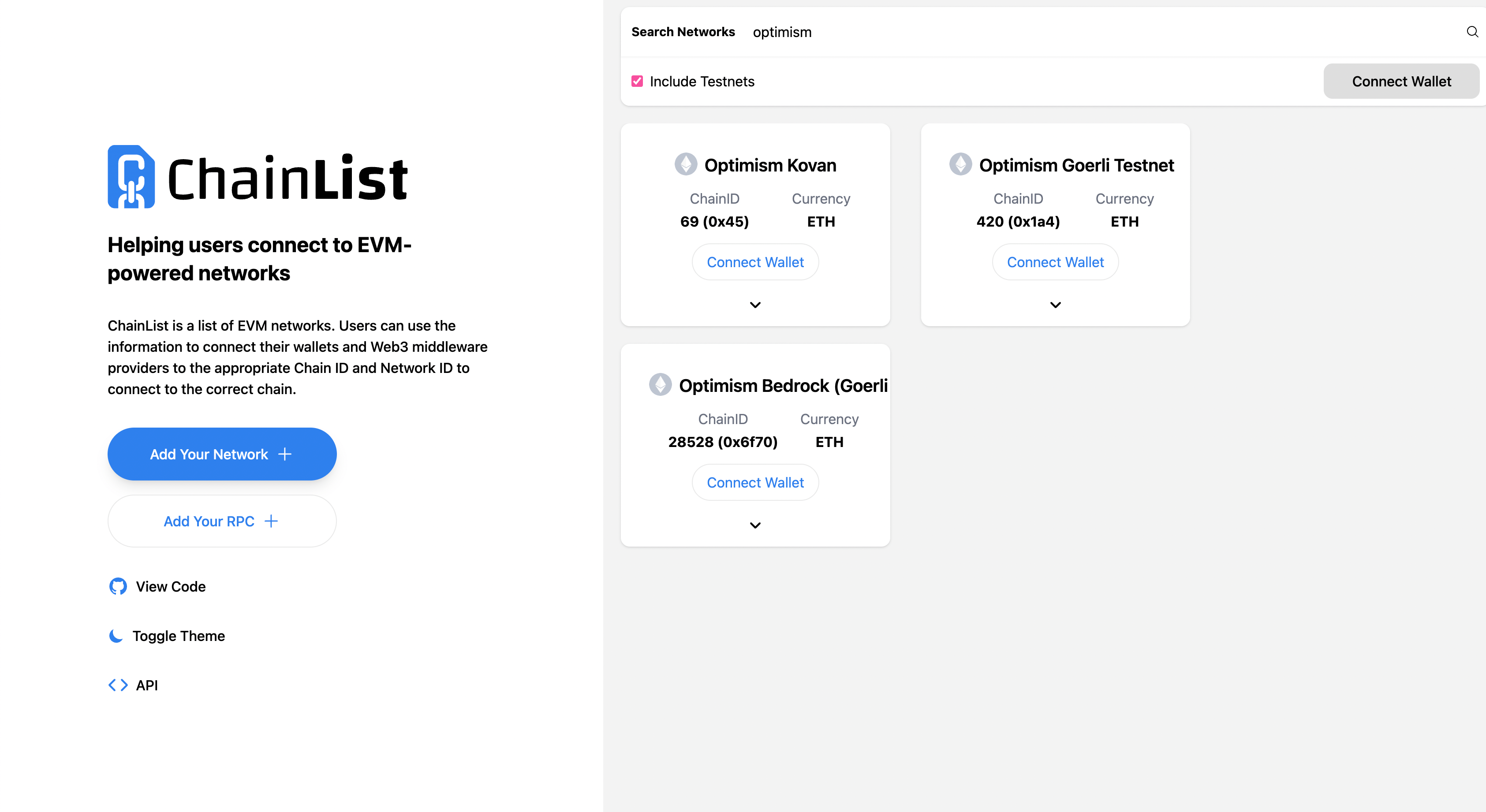
Warning about Chainlist and public endpoints
Chainlist can be used to add Optimism to wallets (for example, MetaMask or Rabby Wallet), but it does not provide RPC infrastructure. It typically relies on public or community RPC endpoints, so for production usage any RPC URL obtained via Chainlist should be replaced with a managed RPC endpoint such as Chainstack.
Full node vs archive Optimism node
Optimism nodes can be configured to store varying amounts of historical data. Full nodes typically store recent blockchain state, while archive nodes retain complete historical data from genesis.
| Full node | Archive node |
|---|---|
| Stores recent blockchain state (recent blocks and transactions) | Stores complete historical blockchain data from genesis |
| Suitable for: sending transactions, querying current state, real-time monitoring | Suitable for: analytics, explorers, historical queries, compliance |
HTTPS vs WebSockets
Transport protocol choice affects connection behavior, latency characteristics, and suitability for different application patterns. HTTPS is a request-response protocol using per-request connections, while WebSockets provide a persistent connection suitable for frequent or realtime interactions.
| HTTPS | WebSockets |
|---|---|
| Request-response model | Persistent connection |
| Each query requires a new connection | Lower latency for frequent queries |
| Suitable for: intermittent queries, simple integrations | Supports real-time subscriptions (if available) |
| Suitable for: real-time monitoring, event-driven applications |
For details on using Optimism RPC with wallets, development frameworks, client libraries, and HTTP or WebSocket connections, refer to the Optimism documentation tooling.
How to get private Optimism RPC endpoint using Chainstack
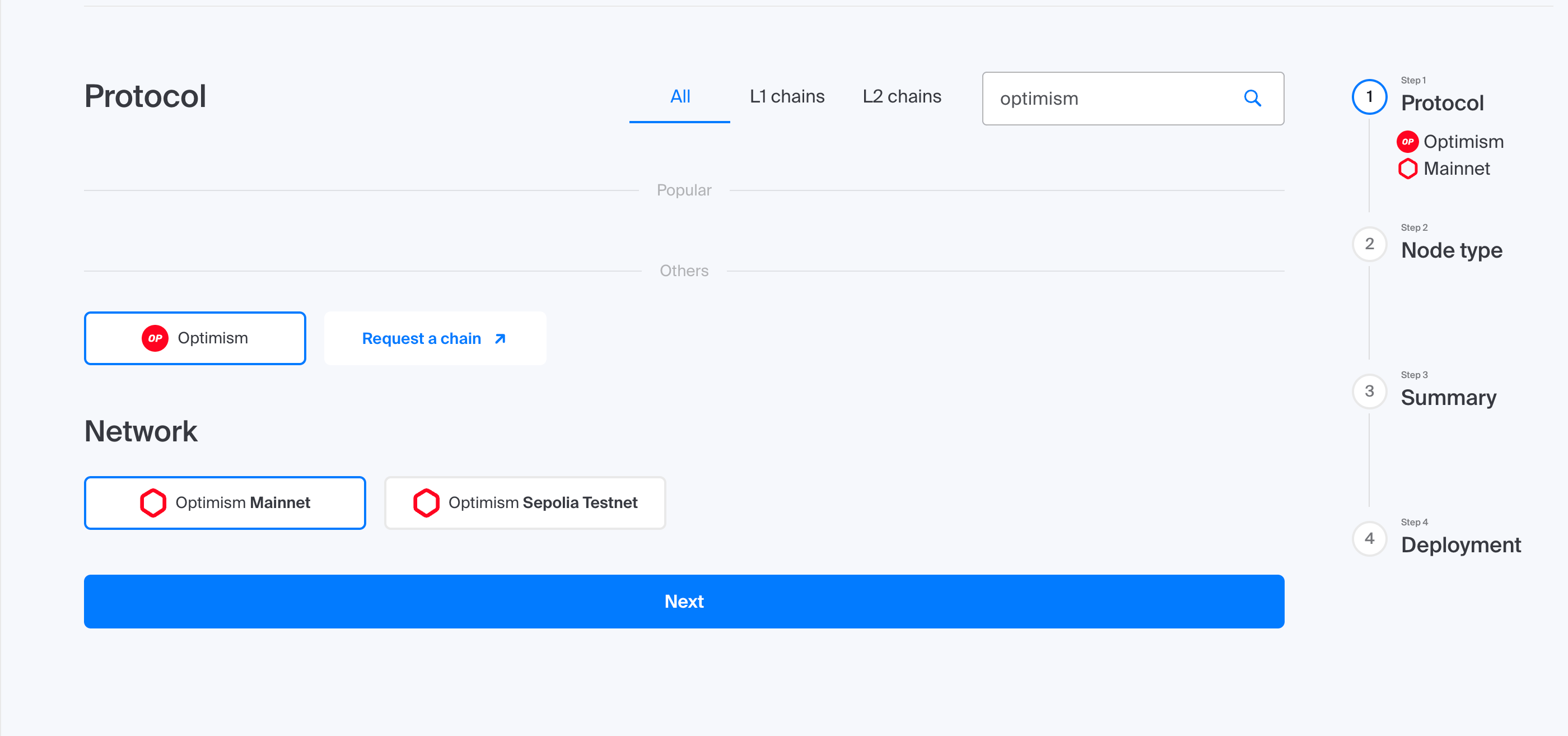
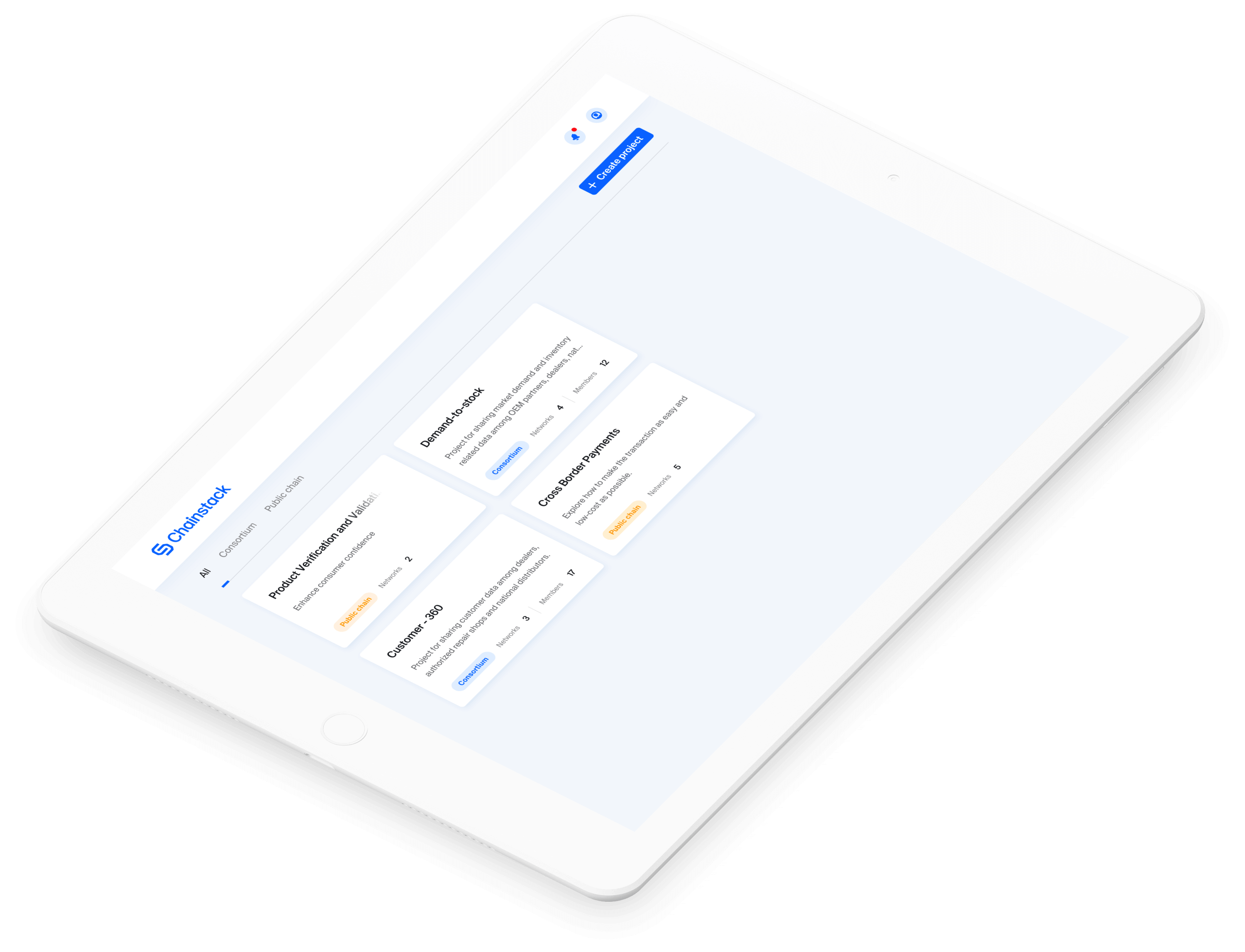
- Log in to the Chainstack console (or sign up if needed).
- Create a new project.
- Select Optimism as the blockchain.
- Choose the network:
- OP Mainnet for production
- OP Sepolia Testnet for testing
- Deploy a managed RPC node.
- Open the project dashboard and copy the generated HTTPS and WebSocket RPC endpoints.
In addition to managed RPC nodes, Optimism provides community-operated endpoints with notable limitations.
After deploying your Optimism RPC endpoint, you can use it for real-world integrations such as cross-layer transfers. Bridge ether from Ethereum L1 to Optimism L2 for a step-by-step example of bridging ETH using a private RPC endpoint.
Chainstack Pricing
Chainstack offers transparent, request-based pricing for Optimism RPC:
- Free tier: 3M requests/month (~25 RPS) – ideal for development and testing
- Growth plan: $49/month for 20M requests (~250 RPS)
- Pro plan: $199/month for 80M requests (~400 RPS)
- Business plan: $349/month for 140M requests (~600 RPS)
- Enterprise plans: Custom RPS configurations with Unlimited Node add-on for flat-rate, unmetered access
Unlike compute-unit-based pricing models, Chainstack’s request-based approach makes costs predictable regardless of which RPC methods you call. This is significantly more cost-effective than running your own Optimism node, which requires dedicated hardware, maintenance, and bandwidth costs.
Optimism RPC considerations for 2026
- Throughput and request limits — Ability to sustain high request volumes without aggressive throttling or degraded performance; choose providers that align with expected traffic patterns.
- Reliability and uptime behavior — Consistency under load and resilience during network instability are critical for production applications and user-facing services.
- WebSocket stability — Stability of persistent connections matters for real-time monitoring and event-driven integrations that rely on lower-latency updates.
- Archive data availability — Access to complete historical state is required for analytics, explorers, and compliance workflows that query historical data.
- Tooling and ecosystem maturity — Tooling support varies; evaluate SDKs, libraries, and integrations that simplify development and operations.
- Cost predictability — Understand how RPC usage costs scale with traffic and whether pricing remains predictable as usage grows.
- Dependency on L1 for finality — As an L2, RPC behavior can be influenced by L1 settlement timing; network-specific considerations apply.
- Cross-chain RPC traffic — Increased load from cross-chain monitoring and coordination can affect RPC capacity planning.
- Superchain interoperability — For deployments on the OP Stack, RPC usage may be influenced by shared infrastructure and cross-domain coordination.
- Provider selection — Multiple providers offer Optimism RPC (Alchemy, QuickNode, Chainstack, Ankr). Evaluate based on pricing model (request-based vs compute-units), uptime SLAs, and integration complexity. Chainstack offers request-based pricing and 99.99%+ uptime.
Conclusion
In summary, public RPC endpoints are suitable for testing and development, while managed RPC providers are the recommended production option.
While several providers support Optimism (Alchemy, QuickNode, Ankr), Chainstack stands out for transparent request-based pricing, 99.99%+ uptime guarantees, and simple deployment.
Getting started with Optimism on Chainstack is quick and easy. Developers can deploy a reliable RPC node for mainnet access in seconds—no complex setup or hardware provisioning required.
Chainstack provides low-latency Optimism RPC endpoints powered by globally distributed infrastructure. This ensures consistent performance for building, testing, and scaling real-world applications, including DeFi, trading, and stablecoin infrastructure.
Key features:
- Fast deployment through an intuitive console
- Low-latency access via global infrastructure
- 99.99%+ uptime with multi-cloud failover
- Free tier (3M requests/month) and scalable paid plans from $49/month
- Support for dedicated and shared RPC nodes
- Secure access with API keys and role-based permissions
Start for free, connect your application to a production-grade Optimism RPC endpoint, and scale with dedicated infrastructure built for performance.
FAQ
Optimism RPC endpoints target the OP Mainnet and OP Sepolia Testnet networks and are intended for interacting with those layers specifically. Network-specific considerations apply when choosing endpoints for L1 versus L2 access.
Chainstack offers a free tier with 3M requests/month (~25 RPS), which is suitable for development and testing. Paid plans start at $49/month for 20M requests (~250 RPS). Pricing is transparent and request-based, so you always know what you’ll pay. For high-volume applications, Enterprise plans offer custom RPS configurations and flat-rate unlimited options.
Tooling support varies across ecosystems, but common JavaScript SDKs and the Optimism SDK (JavaScript utilities) are available for developers working with Optimism. Consult Optimism documentation and provider guidance for integration details.
Use Optimism RPC endpoints when your application needs direct access to OP Mainnet or OP Sepolia Testnet network state and transactions. For workloads tied to those networks, Optimism RPC provides the appropriate connectivity and data scope.
Developers typically use ethers.js, Web3.js; Optimism SDK (JavaScript utilities) when integrating with Optimism RPC endpoints. Tooling support varies across ecosystems, so validate compatibility with your chosen SDKs.
No, most applications don’t. Standard full nodes are sufficient for sending transactions, querying current state, and real-time monitoring.
Archive nodes are only necessary for specific use cases like block explorers, historical analytics, compliance audits, or querying old contract states. Since archive nodes cost more, only use them if you specifically need complete historical blockchain data.