AI-ready infrastructure
 Refer and earn


 Ethereum
 Hyperliquid
 Solana
 Arbitrum
 BNB Smart Chain
 Base
 Polygon
 TRON
 Sui
 Robinhood


Best X Layer RPC providers for DeFi and payments in 2026: pricing, rate limits and docs compared

X Layer is OKX’s Ethereum layer 2, built on an enhanced OP Stack with OKB as its gas token, and DefiLlama shows about $161.9 million of TVL and $1.49 billion of stablecoins on it on October 21, 2026. Chainstack added X Layer Mainnet and Testnet to Global Nodes on October 16, 2026.
X Layer launched on Polygon CDK in April 2024 and moved to the OP Stack, which the Optimism Foundation confirmed in December 2025. A chain with a re-genesis has history on both sides of it, and several providers’ X Layer pages still describe the old Polygon CDK design, so when you compare the best X Layer RPC providers, check that archive, debug_* and trace_* work across the boundary before you pick one.
💡 Already using Chainstack? Jump straight to the X Layer tooling docs or deploy your endpoint in minutes.
TL;DR
- Best overall for low-cost reads near the tip: Chainstack, $2.45 per 1M
eth_getLogscalls inside the Growth allowance (1 RU; archive and trace are 2 RU). - Best free tier in calls, among plans confirmed to serve X Layer: Chainstack, 3M requests a month, no card (no archive, 100-block
eth_getLogscap). - Best for a published dedicated X Layer archive price: GetBlock, X Layer archive listed from $1,100 a month.
- Best for enterprise: Chainstack, SOC 2 Type II, ISO 27001, Dedicated Nodes from Pro.
Why RPC provider choice matters for X Layer
One-second blocks make history large. We measured 1,000 blocks in 1,000 seconds on OKX’s public endpoint on October 21, 2026, and Chainstack’s docs give the same block time, so a 10,000-block eth_getLogs window covers under three hours of chain time and a 100-block cap covers under two minutes. The chain also has a re-genesis at block 42,810,021, timestamped October 27, 2025 on the same endpoint, so a backfill from genesis crosses two node generations. The cost comparison article shows how method weights multiply that bill.
The second concern is OP Stack behavior. Pending transactions stay with the sequencer, so eth_subscribe("newPendingTransactions") returns an ID and delivers nothing, and eth_getProof on Chainstack only serves the latest 256 blocks, about four minutes. Method links point to the Optimism reference, the same OP Stack API. Six criteria separate production endpoints from test ones:
- Cost predictability and pricing model. Flat request units (Chainstack: 1 RU full, 2 RU archive, debug and trace, no per-method weights) against method-weighted credits and compute units where archive, trace and
eth_getLogscost multiples of a simple call. - Archive and historical data. Depth across the October 2025 re-genesis,
debug_*andtrace_*coverage, per-request cost. - Throughput stability and support. RPS or CU per second ceilings per plan, and response times by tier.
- Free-tier reality. A standing plan or a one-month trial, card or no card, what the free plan leaves out.
- WebSocket, dedicated nodes, SLA and compliance. The contractual uptime figure and which providers publish audit reports.
- Pending data and private routing. Standard pending-transaction feeds are empty here, and Chainstack Mainnet endpoints serve Flashblocks, the sequencer’s preconfirmations, and OKX also runs official public Flashblocks endpoints (200 ms preconfirmations). MEV protection exists only on Ethereum and BNB Smart Chain, and we found no optimized submission for X Layer in Chainstack’s docs.
Quick comparison: pricing, free tier and rate limits
The tables below summarize public positioning as of October 2026; prices come from each provider’s official pricing page, checked October 21, 2026.
| Rank | Provider | Best for | Entry price | Free tier | Rate limits | Official pricing / docs |
|---|---|---|---|---|---|---|
| 1 | Chainstack | Low-cost reads near the tip, with archive and trace from Growth | Growth $49/month ($40 annual), 20M RU | Developer: $0, 3M RU, 25 RPS, no card | 25 RPS Developer, 250 Growth, 400 Pro, 600 Business | pricing, docs |
| 2 | NOWNodes | Indexed address and balance data through Blockbook | Pro €20/month, 1M requests (euros, not converted) | Start: 100,000 requests, 15 RPS, 1 month | 15 RPS Start; none predefined on paid plans | pricing, docs |
| 3 | dRPC | Pay as you go with no commitment | Pro $49/month, 163M CU pool; pay as you go $6 per 1M requests | Free: public nodes, 210M CU, 100 RPS | 100 RPS Free and pay as you go, 300 Pro, 600 Scale | pricing, docs |
| 4 | GetBlock | A published dedicated X Layer archive price | Starter $49/month ($39 annual), 90M CU | Free: 50,000 CU/day, 20 RPS | 20 RPS Free, 250 Starter, 800 Pro | pricing, docs |
| 5 | Alchemy | Account abstraction tooling (Bundler and Gas Manager) | Pay as you go $0.525 per 1M CU | 30M CU/month, 15 RPS | 300 CU/s (15 RPS) Free, 10,000 CU/s (300 RPS) pay as you go | pricing, docs |
| 6 | Quicknode | Streaming X Layer data with Streams and Webhooks | Build $49/month ($34 annual), 80M credits | 1-month trial: 10M credits, 15 RPS, no card | 15 RPS trial, 50 Build, 125 Accelerate, 250 Scale | pricing, docs |
| Provider | Pricing model | Supported chains | Dedicated nodes | Archive and trace on X Layer | eth_getLogs block range |
|---|---|---|---|---|---|
| Chainstack | Request units, 1 RU full, 2 RU archive, debug and trace | 70+ by its own count; X Layer Mainnet and Testnet | Yes, from Pro | Archive, debug_*, trace_* from Growth | 100 Developer, 10,000 Growth and up |
| NOWNodes | Flat requests in euros, no per-method weights found | 120+ by its own count; X Layer Mainnet (Testnet in its docs only) | Yes, price on request | Archive listed for Mainnet; debug_traceTransaction from block 42,810,022 | We found no cap |
| dRPC | Flat 20 CU per method, 16 on Pro | 130+ by its own count; X Layer Mainnet and Testnet | Enterprise, from $990/month | Archive, debug and trace on paid plans | 10,000-entry log cap on free tier |
| GetBlock | Compute units, 10 CU per X Layer call | 130+ by its own count; X Layer Mainnet and Testnet | From $1,100/month archive, $1,000 full | Debug methods 20 CU; no archive column on shared | We found no cap |
| Alchemy | Compute units, 60 CU for eth_getLogs | X Layer Mainnet and Testnet | We found none on its pricing page | Archive on all plans; Debug API on pay as you go; Trace API: chain page says no, docs list one | 10 Free, 10,000 pay as you go |
| Quicknode | Credits, 20 per call, 2x for trace and debug | X Layer Mainnet and Testnet, labelled Beta | Enterprise plan | Archive, no pruning; Debug and Trace from Build | 5 trial, 10,000 paid |
⚡ No Chainstack benchmark covers X Layer yet, so these tables have no latency column. Benchmark each endpoint from your region before you commit (curl timing, k6).
How to choose an X Layer RPC provider
- Pricing model: flat or weighted. On a one-second chain the heavy call is
eth_getLogsover a long range, and a method-weighted plan multiplies it by 10 to 60. The pricing explainer below holds the formula and the cost per 1M calls; the cost calculator models your mix. - Archive, trace and debug access. Confirm that
debug_traceTransactionworks on a transaction from before October 27, 2025: NOWNodes documents it only from block 42,810,022. Archive data on Chainstack starts at Growth. - Free-tier reality. Chainstack, Alchemy and GetBlock keep a standing free plan. Quicknode’s 10M credits and NOWNodes’ 100,000 requests last one month, and dRPC’s Free plan is public nodes only with X Layer tagged Premium.
- When dedicated infrastructure matters. Sustained high RPS on one chain, isolated compliance requirements, or custom block ranges.
- X Layer data access. Plan for the re-genesis boundary, empty pending-transaction feeds, the 256-block proof window on Chainstack, and a zero L1 data fee on X Layer transactions.
- Support quality by tier. Chainstack lists Standard support on every paid plan (under 24 hours, 24×5), Professional under 6 hours and Premium under 1 hour, both 24×7. NOWNodes lists a 3-minute support response on every plan and GetBlock under 5 minutes on its paid plans per its comparison table.
- Latency consistency: the p95 and p99 argument. The tail decides whether a payment confirmation lands on time, so test p95 and p99 from your own region.
Choose by use case
For DeFi protocols on X Layer
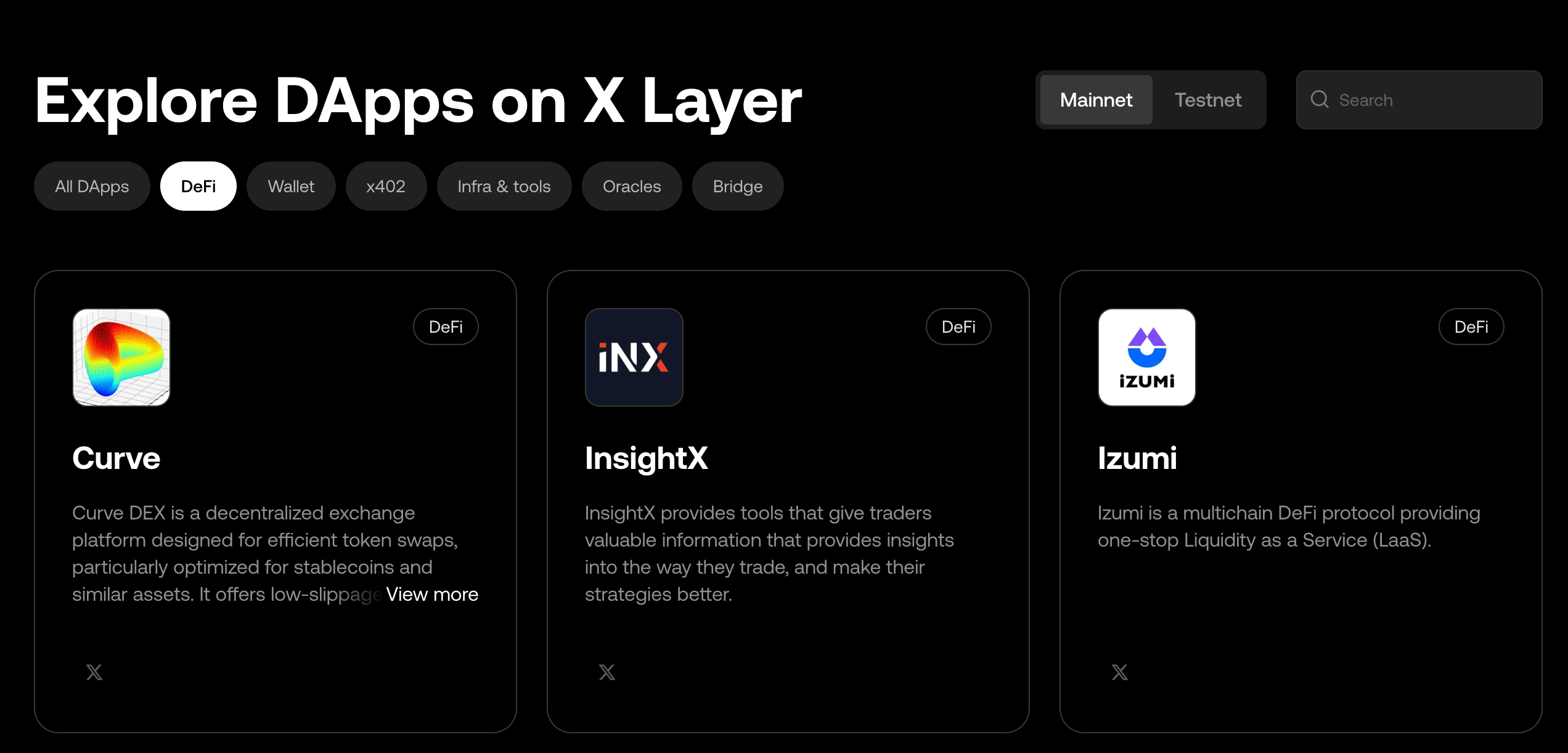
DeFi on X Layer is read-heavy: DefiLlama lists Aave V3 at $94.6 million and about $30.6 million of DEX volume in 24 hours on October 21, 2026, and frontends and keepers depend on eth_call, eth_getLogs and block subscriptions. Searchers cannot watch a public mempool here, so the edge is fast reads and Flashblocks preconfirmations, which Chainstack Mainnet serves next to OKX’s public endpoint.
Chainstack fits near-tip reads and preconfirmed state, dRPC fits bursty traffic on pay as you go, and NOWNodes fits dashboards that read balances per address through Blockbook.
For stablecoin and payments infrastructure
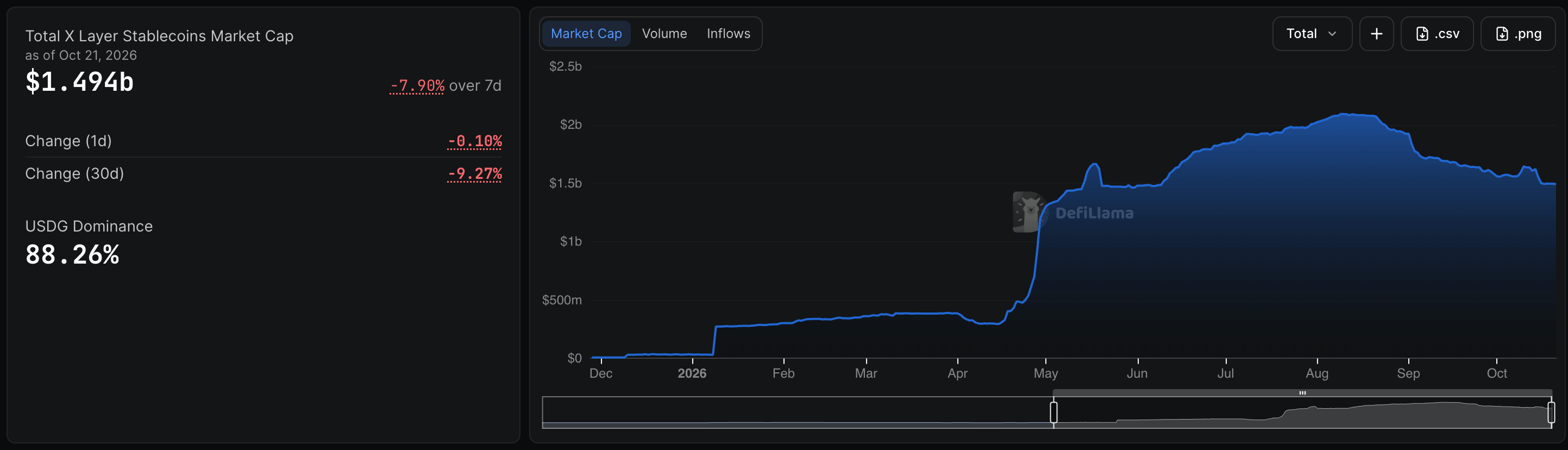
Payments need reliable receipt and log reads, newHeads subscriptions over WebSocket and an audit trail. X Layer carries $1.49 billion of stablecoins on October 21, 2026, and Chainstack’s tooling docs note that X Layer sets the OP Stack L1 data fee to zero, so a transaction costs gasUsed × effectiveGasPrice.
Chainstack fits when audit reports and a contractual SLA matter, Quicknode when payment events arrive through Streams or Webhooks, and Alchemy when sponsored gas through its Bundler and Gas Manager is part of the flow.
For indexers, analytics and data pipelines
An indexer replays one block per second, about 31.5 million blocks a year, and needs archive reads, trace_* or debug_* for internal transfers and predictable cost at high archive-read volume. On Chainstack an archive eth_getLogs call is 2 RU, the Unlimited Node add-on replaces per-request billing with a flat fee per RPS tier from Growth, and Dedicated Nodes for X Layer start at Pro with an archive list price of $1,511.10 per month. Chainstack holds SOC 2 Type II and ISO 27001 certifications, and the contractual 99.9% quarterly SLA with credits is on the Enterprise SLA page.
Among the others, GetBlock lists a SOC 2 Type II attestation and a dedicated X Layer archive price from $1,100 a month, Quicknode and Alchemy list SOC reports on request, and we found no published SOC 2 Type II or ISO 27001 for NOWNodes or dRPC.
1. Chainstack: best for low-cost reads near the tip, with archive and trace from Growth
Chainstack serves X Layer RPC on Mainnet and Testnet through Global Nodes in archive mode, with archive, debug_* and trace_* from Growth. Billing is in request units: 1 RU for a full request and 2 RU for archive, debug and trace, with no per-method weights, so an eth_getLogs call within 127 blocks of the tip costs $2.45 per 1M inside the Growth allowance.
Pricing
Developer is free with 3M RU a month. Growth is $49 a month ($40 billed annually) for 20M RU, Pro $199 for 80M RU, Business $499 for 200M RU, and Enterprise starts at $990. Extra usage on Growth is $15 per 1M RU while extra usage is enabled, and Pay As You Go starts from $2.5 per 1M RU, arranged with sales. The Unlimited Node add-on, from Growth, charges a flat fee per RPS tier instead, with tiers from 25 RPS. See the Chainstack pricing page, checked October 21, 2026.
Supported chains and methods
X Layer runs on xlayer-reth, OKX’s Reth-based OP Stack client, with debug_* and trace_*: callTracer and prestateTracer work, flatCallTracer, muxTracer and erc7562Tracer do not, per the debug and trace page. Chainstack’s launch post says Mainnet reads serve the full chain history, including blocks from before the October 2025 migration. A request 127 or more blocks behind the tip is archive, and for eth_getLogs the fromBlock decides. Mainnet endpoints also serve Flashblocks (eth_getBlockByNumber("pending"), eth_subscribe("flashblocks"), eth_flashblocksEnabled); Testnet does not.
Rate limits and latency
Plans allow 25 RPS on Developer, 250 on Growth, 400 on Pro and 600 on Business, with unlimited on Enterprise. The eth_getLogs cap is 100 blocks on Developer and 10,000 on Growth and above. Chainstack Compare and the benchmark reports do not cover X Layer.
Free tier
Developer is free: 3M RU a month, 25 RPS, no card required. It lists no archive data and no debug or trace, and eth_getLogs is limited to 100 blocks, under two minutes of X Layer history.
Limitations
Past the allowance, Growth’s $15 per 1M RU for full calls and $30 for archive calls is above dRPC at $6, Quicknode at $12.40 and GetBlock Pro at $4, so the low price holds for volume that fits the plan. On archive calls dRPC Pro is $4.80 per 1M inside its allowance against Chainstack’s $4.90. We found no optimized submission for X Layer in Chainstack’s docs. The Dedicated Nodes archive list price of $1,511.10 per month plus the Pro plan is above GetBlock’s $1,100.
2. NOWNodes: best for indexed address and balance data through Blockbook
NOWNodes serves X Layer Mainnet through a JSON-RPC endpoint and a Blockbook API that returns indexed address, balance and transaction history without scanning blocks. Pro is €20 a month for 1M requests, and its X Layer docs list archive, WebSocket and debug_traceTransaction.
Pricing
Start is free for one month. Pro is €20 a month for 1M requests, Pro Plus €90 for 10M with €5 per 100k overage, Business €200 for 30M with €1 per 100k, and Enterprise €500 for 100M with €0.5 per 100k; Pro lists no overage rate, and annual billing is 10% off. Euros are not converted. We found no per-method weights on its pricing page or docs. See the official pricing page.
Supported chains and methods
Its X Layer page lists JSON-RPC, WebSocket, Blockbook, Trace and Debug and archive, and its archive table marks the Mainnet endpoint archive-enabled. Debug coverage is debug_traceCall, debug_traceTransaction and four debug_getRaw* methods, and the docs say tracing works from block 42,810,022, the first block after the re-genesis. Its general WebSocket and Trace & Debug pages do not list X Layer, and its docs mention a Sepolia testnet that the product page omits, so confirm both. The official docs describe the OP Stack migration accurately.
Rate limits and latency
The Start plan allows 15 RPS, and its X Layer page says paid plans have no predefined RPS limits. We found no eth_getLogs block-range cap. Its X Layer page claims 99.95% uptime and its dedicated-node page 99.99%, with a 3-minute support response on the pricing page. NOWNodes is not covered by Chainstack’s benchmark reports.
Free tier
Start is 100,000 requests, 15 RPS and any five networks, for one month only on its pricing page (its docs banner reads “100,000 requests/month”), so we treat it as a trial.
Limitations
Pro lists no overage rate, tracing starts after the re-genesis, and we found no trace_* namespace and no published SOC 2 Type II or ISO 27001.
3. dRPC: best for pay as you go with no commitment
dRPC serves X Layer Mainnet and Testnet with archive data at a flat 20 compute units per method, and its pay-as-you-go plan charges $6 per 1M requests with no commitment and 100 RPS. The chainlist tags X Layer Premium, while its keyless endpoint at xlayer.drpc.org answered eth_chainId in our October 21, 2026 test.
Pricing
One million CU costs $0.30. Pay as you go is $6 per 1M requests; Pro is $49 a month with a 163M CU pool at 16 CU per request, about $4.80 per 1M; Scale is $199 for 664M CU at 14 CU, $4.20 per 1M; overage on both is $6. Its CU table lists eth_getLogs and every debug_trace* and trace_* method at 20 CU. See the official pricing page.
Supported chains and methods
Its chainlist page lists X Layer Mainnet (chain ID 196) and Testnet with archive data, though it still calls the chain a zk-rollup, and the homepage claims 130+ chains across 230+ networks. The pricing page marks archive, debug and trace and WebSocket as not included on Free and included on paid plans.
Rate limits and latency
Pay as you go is 100 RPS for accounts created after October 19, 2026, Pro 300, Scale 600. The free tier gets 120,000 CU a minute per IP, about 100 eth_call per second, and logs are capped at 10,000 entries; we found no block-range cap. dRPC is not covered by Chainstack’s X Layer benchmark reports.
Free tier
Free is $0 with 210M CU (about 10M requests by its figure), public nodes only, 100 RPS, no archive, debug and trace or WebSocket. X Layer is tagged Premium, so we did not count it in the free-tier comparison.
Limitations
The free plan excludes archive and trace, the Premium tag leaves free X Layer access unconfirmed, and we found no published SOC 2 Type II or ISO 27001. Enterprise, from $990 a month, is the route to dedicated clusters, with no X Layer price published.
4. GetBlock: best for a published dedicated X Layer archive price
GetBlock serves X Layer Mainnet and Testnet over JSON-RPC and WebSocket on shared nodes billed in compute units: 10 CU for a standard call and 20 CU for debug_traceTransaction, per its compute-unit page. Its dedicated nodes list X Layer archive from $1,100 a month, public on its pricing page.
Pricing
Free is $0 with 50,000 CU a day. Starter is $49 a month ($39 billed annually) for 90M CU, Growth $99 for 185M, Pro $499 for 1B CU with extra CU at $0.40 per 1M, and Enterprise starts at $999. At 10 CU, an eth_getLogs call costs about $5.44 per 1M inside Starter ($4.33 annual); we found no per-CU price for Starter’s extra CU packages. See the official pricing page.
Supported chains and methods
The official X Layer docs list the core debug_trace* tracers and say eth_getProof is not served. Its compute-unit page lists X Layer (OKB) in the 10 CU tier and shows no archive column for it, and we found no shared X Layer archive; the dedicated archive node is $1,100 a month and the full node $1,000. The docs and the product page still describe X Layer as a zkEVM validium.
Rate limits and latency
Free is 20 RPS, Starter 250, Growth 300, Scale 600 and Pro 800. We found no eth_getLogs block-range cap in its X Layer docs. GetBlock is not covered by Chainstack’s benchmark reports.
Free tier
The Free plan is standing (“usable indefinitely”): 50,000 CU a day, which is 5,000 eth_getLogs calls a day, about 150,000 a month, at 20 RPS.
Limitations
Shared plans have no X Layer archive, and its dedicated X Layer configurator lists cdk-erigon as the client, so confirm coverage after the October 2025 re-genesis. GetBlock lists a SOC 2 Type II attestation (Q2 2026); we used no ISO 27001 claim for it.
5. Alchemy: best for account abstraction tooling (Bundler and Gas Manager)
Alchemy supports X Layer Mainnet (chain ID 196) and Testnet with the RPC API, WebSockets, Debug API, Bundler API and Gas Manager. The Free plan has 30M compute units a month at 15 RPS, and eth_getLogs costs 60 CU, so the allowance is 500,000 calls.
Pricing
Free is 30M CU; pay as you go is $0.525 per 1M CU with no monthly fee, so eth_getLogs costs $31.50 per 1M calls and a Debug API method at 40 CU costs $21.00. Enterprise is custom. See the official pricing page.
Supported chains and methods
Its X Layer docs and chain page list RPC API, Debug API, Bundler API, WebSockets and Gas Manager as supported. The chain page lists Trace API, Token API, NFT API, webhooks and gRPC as not currently supported, while the docs overview lists the Trace API under related APIs, so confirm with Alchemy. Full archive data is listed on all plans, and the Debug API is not on Free. Its X Layer FAQ still describes a ZK layer 2 with 400 ms blocks.
Rate limits and latency
Free allows 300 CU/s (15 RPS) and pay as you go 10,000 CU/s (300 RPS). The X Layer block range is 10 on Free and 10,000 on pay as you go. Alchemy is not covered by Chainstack’s X Layer benchmark reports.
Free tier
The Free plan is standing, 30M CU a month and 15 RPS, with full archive data and no Debug API.
Limitations
Its chain page lists no Trace API on X Layer (its docs overview lists one), the Debug API needs pay as you go, and at 60 CU eth_getLogs costs $31.50 per 1M calls, the highest dollar figure in the cost table. Its Trust Center lists a SOC 2 Type II report, available on request, and we found no ISO 27001.
6. Quicknode: best for streaming X Layer data with Streams and Webhooks
Quicknode supports X Layer Mainnet and Testnet, still labelled Beta in its docs, with archive data, Debug and Trace APIs, Streams and Webhooks. Each X Layer call is 20 API credits, so a 10M-credit trial is 500,000 eth_getLogs calls and the Build plan’s 80M credits are 4M.
Pricing
The free trial lasts one month with 10M credits, no overage and no card. Build is $49 a month ($34 billed annually) for 80M credits with extra credits at $0.62 per 1M, Accelerate $249 ($212) for 450M, Scale $499 ($424) for 950M. X Layer sits in the 20-credit group, and trace and debug carry a 2x multiplier, so 40 credits. See the official pricing page.
Supported chains and methods
Its X Layer docs list Mainnet (196) and Testnet (1952) as archive with no pruning over HTTP and WSS, with Ethereum JSON-RPC, Debug, Erigon, Polygon zkEVM and Trace APIs, plus Streams and Webhooks. Pre-migration data is routed to legacy nodes by block number. The page, last updated July 9, 2026, describes a zkRollup.
Rate limits and latency
The trial allows 15 RPS, Build 50, Accelerate 125 and Scale 250. eth_getLogs is limited to 5 blocks on the free plan and 10,000 on paid plans per its X Layer page. Quicknode is not covered by Chainstack’s X Layer benchmark reports.
Free tier
The free tier is a one-month trial, not a standing plan: 10M credits, 15 RPS, no card, no trace or debug and a 5-block eth_getLogs range.
Limitations
Credits make every X Layer call 20 or 40 units, so a log scan costs $12.25 per 1M calls inside the Build allowance, five times Chainstack’s $2.45.
Quicknode, Alchemy, dRPC and GetBlock credits and compute units vs Chainstack request units: how pricing differs
True cost per call = (method’s unit weight x price per million units) / 1,000,000; multiply by monthly calls for the bill.
The table applies it to eth_getLogs on X Layer at each provider’s entry paid plan, assuming the included allowance is used in full where a plan has one. Chainstack’s figures are for calls within 127 blocks of the tip, with the archive figure beside them.
| Provider | Unit and weight | Entry paid plan | Per 1M calls inside the allowance (annual in parentheses) | Per 1M calls beyond the allowance |
|---|---|---|---|---|
| Chainstack | 1 RU, 2 RU archive | Growth $49/month, 20M RU | $2.45 ($2.00); archive $4.90 ($4.00) | $15.00; archive $30.00 |
| NOWNodes | 1 request, no weights found | Pro €20/month, 1M requests (euros, not converted) | €20.00 (€18.00 annual) | No rate listed on Pro; Pro Plus €50.00 |
| dRPC | 16 CU on Pro, 20 CU beyond | Pro $49/month, 163M CU | $4.80 (no annual price listed) | $6.00 |
| GetBlock | 10 CU | Starter $49/month, 90M CU | $5.44 ($4.33) | Starter: no price found; Pro $4.00 |
| Alchemy | 60 CU | None, pay as you go $0.525 per 1M CU | Not applicable | $31.50 |
| Quicknode | 20 credits | Build $49/month, 80M credits | $12.25 ($8.50) | $12.40 |
Among the dollar plans with an allowance, Chainstack has the lowest figure for calls near the tip. For archive calls, dRPC Pro is $4.80 against Chainstack’s $4.90, and GetBlock offers no X Layer archive on shared plans. For debug_traceTransaction the figures inside the allowance are $4.90 on Chainstack (2 RU), $24.50 on Quicknode (40 credits), $4.80 on dRPC Pro, and $10.89 on GetBlock Starter (20 CU); Alchemy’s pay as you go is $21.00 (40 CU).
Dedicated nodes are priced separately, not per request. Chainstack lists X Layer Dedicated Nodes from Pro: the Mainnet archive node (op-reth) is $1.00 per hour compute plus $1.07 per hour storage for about 2.1 TB, $1,511.10 per month at 730 hours plus the Pro plan, and the Testnet archive node is $547.50, list prices checked October 21, 2026, billed per node with requests not metered. GetBlock lists X Layer archive from $1,100 a month. Quicknode lists dedicated infrastructure on Enterprise, dRPC dedicated clusters from $990 a month and NOWNodes dedicated nodes on request; we found no X Layer price for those three, and none on Alchemy’s pricing page.
How we compared: requirements, methodology and date checked
We picked providers whose own chain page, docs or llms.txt list X Layer and that publish a price. Ankr, Blockdaemon, Tatum and thirdweb also list X Layer. OKX’s docs name Alchemy, Quicknode, Blockdaemon, GetBlock, ZAN, Chainstack, Unifra and BlockPI as infrastructure providers; we did not review ZAN, Unifra or BlockPI and omitted the others to keep the list to six. dRPC and NOWNodes are not on OKX’s list but publish X Layer pages and prices, and we chose GetBlock as the fourth because its X Layer compute-unit weight, plan prices and dedicated archive price are published. We found no X Layer page for Dwellir, OnFinality or Infura.
Every price and limit was read from the provider’s official pricing page or docs on October 21, 2026, units were converted with the formula above, and free tiers are compared in calls.
Chainstack publishes this page and is listed first. The order of the others is editorial, with Alchemy second to last and Quicknode last, not a benchmark score.
Chainstack runs Chainstack Compare and the benchmark reports and is one of the four providers they rank (Chainstack, Quicknode, Alchemy and dRPC), but neither covers X Layer, so we show no latency figures. We could not check Chainstack’s pre-migration archive claim against a second source, and debug_* behavior across the re-genesis is untested on our side. OKX’s official docs, checked October 21, 2026, describe X Layer as an enhanced Optimism Stack chain with an op-node sequencer, op-reth, OKB gas, one-second blocks and a 7-day challenge period.
Getting started with X Layer on Chainstack
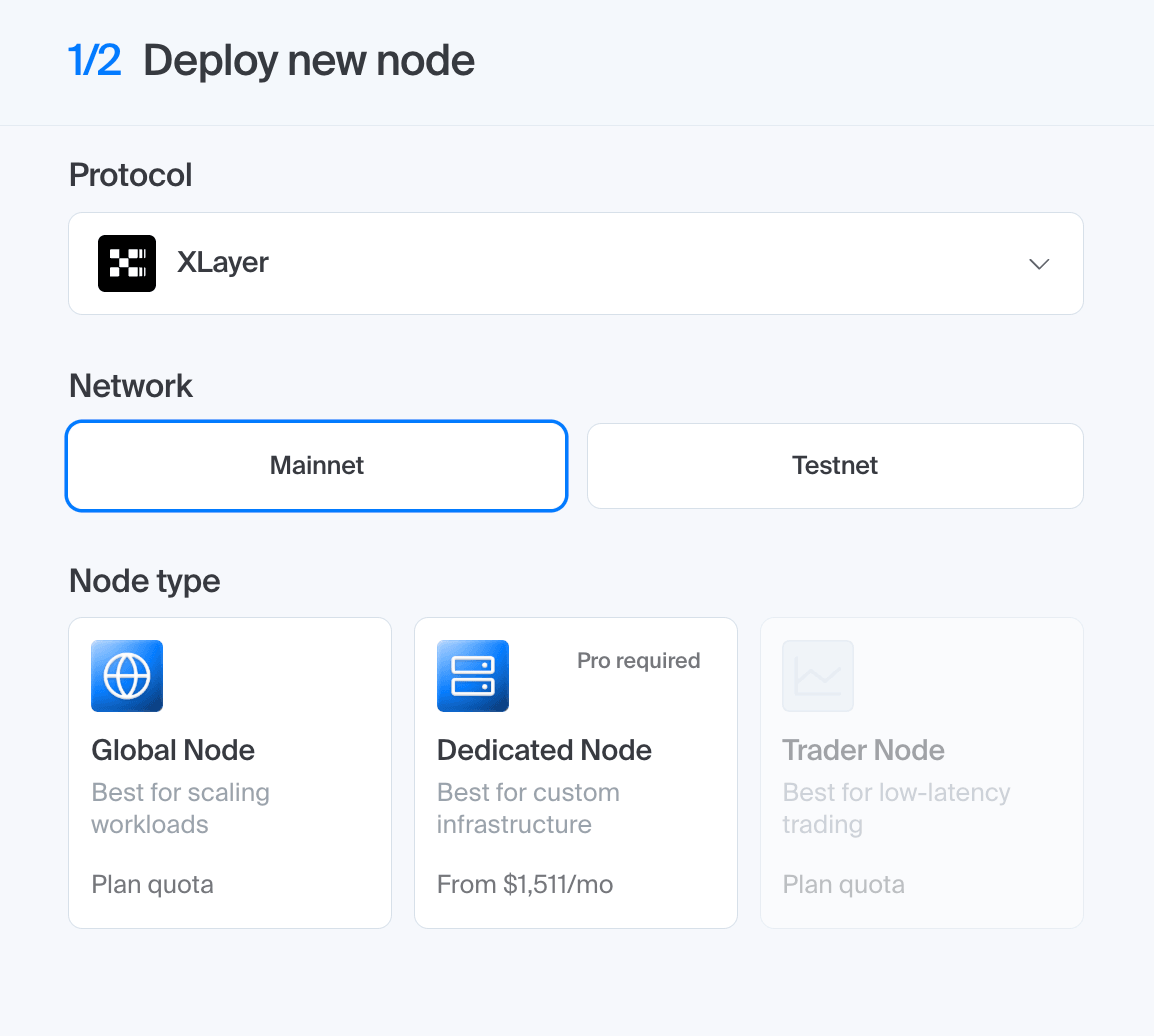
Deploy a production X Layer endpoint in a few steps:
- Log in to the Chainstack console (or create an account).
- Create a new project
- Select X Layer as your blockchain protocol
- Choose network: X Layer Mainnet or X Layer Testnet
- Deploy the node
- Open Access and credentials and copy your HTTPS and WebSocket endpoints
Global Nodes are the shared, load-balanced option on every plan, and Dedicated Nodes give single-tenant resources from Pro. This snippet reads the chain ID and the balance of the wrapped OKB contract.
// Source: Chainstack X Layer tooling docs, checked October 21, 2026
const { JsonRpcProvider, formatEther } = require("ethers");

const provider = new JsonRpcProvider("YOUR_CHAINSTACK_ENDPOINT");

async function main() {
  const network = await provider.getNetwork();
  console.log("Chain ID:", network.chainId.toString()); // 196 on X Layer Mainnet

  // WOKB contract address, copied from the tooling docs example
  const balance = await provider.getBalance("0xe538905cf8410324e03A5A23C1c177a474D59b2b");
  console.log("Balance:", formatEther(balance), "OKB");
}

main();
📖 For the full integration guide, see the Chainstack X Layer tooling documentation.
🤖 You can also access Chainstack X Layer RPC directly from Claude, Cursor, Codex, Windsurf, Gemini CLI, GitHub Copilot, Antigravity or ChatGPT using Chainstack MCP. For a fuller agent stack (MCP, the Chainstack skill, llms.txt, WebMCP), see the Chainstack Agents page.
Conclusion
On a one-second chain with a re-genesis, the deciding question is what history costs and whether archive and trace reach across October 2025. Price a log scan over your real block range, then test a trace on a pre-migration transaction before you commit.
- Low-cost reads near the tip, with archive and trace from Growth: Chainstack, $2.45 per 1M
eth_getLogscalls inside Growth. - Indexed address and balance data: NOWNodes, through its Blockbook API.
- Pay as you go with no commitment: dRPC, $6 per 1M requests on any method.
- A dedicated archive node with a public price: GetBlock, X Layer archive from $1,100 a month.
- Account abstraction: Alchemy, with Bundler and Gas Manager on X Layer.
- Streaming and webhooks: Quicknode, with Streams and Webhooks on X Layer.
Frequently asked questions
Not through the standard feeds. X Layer is an OP Stack chain, so pending transactions stay with the sequencer: on Chainstack eth_subscribe("newPendingTransactions") returns an ID and delivers nothing, and txpool_status always reads empty. Chainstack Mainnet endpoints do serve Flashblocks preconfirmations through eth_getBlockByNumber("pending") and eth_subscribe("flashblocks"). We found no Flashblocks mention on the X Layer pages of Alchemy, Quicknode, dRPC, GetBlock or NOWNodes; OKX also runs official public Flashblocks endpoints (200 ms preconfirmations), so Chainstack is not the only route.
Inside the plan allowance, yes: an eth_getLogs call costs $2.45 per 1M on Chainstack Growth against $12.25 on Quicknode Build, both $49 a month. For archive calls it is $4.90 against $12.25. Beyond the allowance the order flips, $15.00 per 1M for full calls and $30.00 for archive on Chainstack Growth against $12.40 on Quicknode Build.
Among plans confirmed to serve X Layer, Chainstack’s Developer plan has the most calls: 3M requests a month with no card, against 500,000 eth_getLogs calls on Alchemy, about 150,000 on GetBlock’s Free plan and 100,000 on NOWNodes’ one-month Start plan. It has no archive and a 100-block eth_getLogs cap, while Alchemy’s free plan includes archive reads. dRPC’s free plan is about 10M requests, but X Layer is tagged Premium. OKX also publishes free public endpoints with a documented limit of 100 requests per second per IP; in our October 21, 2026 test rpc.xlayer.tech served reads but answered debug_traceTransaction with HTTP 403.
Not from Chainstack: Chainstack Compare and the benchmark reports do not cover X Layer. Test each endpoint from your own region with a loop over eth_blockNumber and eth_getLogs, and compare p95 and p99.
Chainstack holds SOC 2 Type II and ISO 27001. GetBlock lists a SOC 2 Type II attestation, Quicknode lists SOC 1 Type 2, SOC 2 Type 2 and ISO 27001 reports on request under Enterprise, and Alchemy’s Trust Center lists a SOC 2 Type II report available on request. We found no published SOC 2 Type II or ISO 27001 for NOWNodes or dRPC.
Not by itself. Several X Layer docs pages still describe the old Polygon CDK design, so confirm the chain ID (196 Mainnet, 1952 Testnet), the one-second block time and the re-genesis at block 42,810,021. On Chainstack the only code change is the endpoint URL; then test eth_getLogs ranges and a pre-migration trace.
Additional resources