Ethereum
 Solana
 Hyperliquid
 Arbitrum
 Base
Base BNB Smart Chain
 MegaETH
 Tempo
Tempo Avalanche
 Aptos
Aptos TRON
TRON Ronin
Ronin zkSync Era
 Optimism
 Sonic
Sonic Polygon
 Unichain
 Fantom
 Gnosis Chain
 Sui
Sui Avalanche Subnets
 Polygon CDK
 Starknet Appchains
 zkSync Hyperchains




 Refer and earn
 Discord
 Telegram
 X (Twitter)
Best Solana RPC providers for fast and reliable production in 2026


Solana dominated 2025 with 33B transactions — leading ALL blockchains and driving massive demand for high-throughput, low-latency RPC infrastructure.
With record-breaking transaction volume across stablecoin transfers, on-chain finance, and real-time analytics, placing extreme pressure on RPC providers to deliver resilient infrastructure.
Each project has different priorities — some need low latency, others cost efficiency, throughput guarantees, or streaming data access via Yellowstone gRPC. In this benchmark, we compare the best Solana RPC providers in 2026 across speed, uptime, pricing, and data tooling.
We focus on three critical Solana use cases — stablecoin payments, enterprise-grade workloads, and real-time data streaming with Trader Nodes — to see how each provider performs under production conditions.
Top providers comparison
Solana RPC providers differ not just in pricing, but in how they handle latency, throughput, uptime guarantees, and developer tooling. Here’s how the top providers compare in 2026:
| # | Provider | Free plan | Paid plans & pricing | Latency & uptime | Developer Experience |
| 1 | Chainstack | 3M requests/mo, 25 RPS | Starting from 250 RPS and scaling beyond 600 RPS on custom Enterprise plans, with an Unlimited Node add-on for unmetered requests at a flat monthly rate | Low latency global routing with 99.99%+ uptime | Comprehensive docs, dashboard metrics, Access Rules, ShredStream-enabled endpoints, and advanced tooling including Yellowstone gRPC Geyser plugin support |
| 2 | Helius | 1M credits/mo, 10 RPS | $49–$999/mo credit-based tiers, 50–500 RPS; enterprise offers custom RPS | Low-latency Solana routing with staked RPC; no public SLA | Solana-native APIs, webhooks, NFT and token data, clear docs and SDKs |
| 3 | Alchemy | 30M CUs/mo; up to 25 RPS | Pay-as-you-go or monthly; higher CU throughput on paid plans | Low latency routing, uptime available on higher tiers | Webhooks and WebSocket streaming, per method analytics in dashboard, request tracing and alerting, archive access and cross chain SDKs |
| 4 | QuickNode | No free tier; 10M credits trial only | 50–500 RPS; credit-based (method-weighted) monthly plans | Globally distributed, 99.99% uptime on paid tiers | Streams and WebSockets, add ons for transaction handling and MEV protection, multi region endpoint setup and archive access |
| 5 | dRPC | ~210M CUs/mo (~≈10M calls), ~100–250 RPS | ~$6 per 1M requests (Pay-as-you-go). Scales to ~5,000 RPS; enterprise custom beyond that | Latency-aware multi-region routing; 99.99% uptime on paid | Dashboard analytics and request metrics, unlimited keys on paid plans, stake weighted QoS messaging and MEV safe routing |
| 6 | Ankr | 200M credits/month, ~30 RPS | Pay-as-you-go ($10 per 100M credits), goes up to up to 15,000 RPS. | GEO-distributed network, 99.99% SLA on Enterprise tiers | HTTPS and WebSocket access, allowlists, multi chain setup with archive queries |
Key takeaways from the comparison:
- Chainstack offers the best balance of features, transparent pricing, 99.99%+ uptime, and full SOC 2 Type II compliance.
- QuickNode leads on raw performance and global RPS scaling for production apps.
- Helius provides Solana-native APIs for NFTs, metadata, and real-time tracking.
- Alchemy delivers strong tooling, but lacks SOC 2 certification.
- Ankr is simple to start with, but lacks advanced enterprise features.
- dRPC focuses on low-latency and free access, with limited observability.
Before diving into detailed provider reviews, let’s examine how each performs across critical Solana use cases:
Choose by your use case:
Stablecoin & payments infrastructure
Stablecoins now account for over 30% of all crypto transaction volume — surpassing $4 trillion in 2025 — and Solana is increasingly used for real-time payment flows. To support this, Solana RPC providers must offer high availability, low-latency global routing, and predictable performance. Even small delays or regional failures can disrupt thousands of transfers per second.
For teams with strict requirements around gas cost predictability and settlement finality, purpose-built chains like Tempo offer an alternative optimized specifically for payment infrastructure. Tempo delivers sub-second finality with deterministic execution costs, designed for enterprise stablecoin rails.
Top providers like Chainstack and QuickNode deliver robust failover systems and multi-cloud infrastructure, ensuring 99.99%+ uptime and uninterrupted stablecoin settlements.
Enterprise-grade performance
Institutional teams building on Solana need guarantees around throughput, uptime, and security compliance. Whether supporting payments, custody, or analytics, enterprise use cases often require custom RPS setups, global scaling, and strict SLA-backed operations.
Chainstack and QuickNode support enterprise-grade workloads through:
- Custom RPS tiers and dedicated infrastructure
- Multi-region data centers with intelligent routing
- SOC 2 Type II and ISO 27001 certifications for compliance
Real-Time data access with Trader Nodes
Solana’s high-speed architecture demands more than just standard RPC. Trading platforms, explorers, and analytics apps rely on Trader Nodes and Yellowstone gRPC streaming to access live account updates, program events, and transaction states with minimal latency.
Leading RPC providers like Chainstack and Helius offer Trader Nodes with priority routing and gRPC support, unlocking deep real-time blockchain data access—critical for high-frequency DeFi, analytics, and indexing apps.
In-depth provider analysis:
Chainstack
Chainstack is a multi-chain infrastructure platform offering one of the most scalable ways to connect to Solana without running validator-grade hardware yourself. You can choose between reliable Global Nodes, which provide geo-balanced RPC access for predictable performance, or Dedicated Nodes, which offer isolated infrastructure and full configuration control, both backed by 99.99%+ observed uptime.
What makes Chainstack the default choice for teams building on Solana is its alignment with the protocol’s high-speed architecture. Instead of relying on standard pull-based JSON-RPC alone, Chainstack supports ShredStreams and Yellowstone gRPC via the Geyser plugin to enable real-time data streaming at validator speed. On top of that, you get Access Rules for securing endpoints, real-time usage visibility, and an Unlimited Node add-on that gives you flat-fee scaling instead of metered request limits.
What makes it stand out is how much is available from the same console:
- Global Nodes for geo-balanced Solana RPC access.
- Dedicated Nodes for isolated performance and full control over node configuration.
- Access rules to manage allowed domains and IPs directly from the dashboard.
- Unlimited Node add-on for unlimited requests with flat monthly pricing, so you never have to worry about hitting plan limits.
| How much does it cost? | Developer — free, 3M requests/month (~25 RPS), $20 per extra million. Growth — $49/month, 20M requests (~250 RPS), $15 per extra million. Pro — $199/month, 80M requests (~400 RPS), $12.5 per extra million. Business — $349/month, 140M requests (~600 RPS), $10 per extra million. Enterprise — from $990/month, 400M requests (custom RPS), extra from $5 per million. Unlimited Node Add-on — flat monthly price with unmetered Solana RPC traffic, effective ~$2.00 per million requests at scale. Dedicated Nodes — $0.50 / hour plus storage for isolated Solana RPC nodes, working out to ~$0.25 per million requests depending on workload. While others price in shifting compute units, Chainstack keeps it simple with request-based billing and clear RPS tiers, so you always know what you’ll pay. What’s more, on Chainstack, you are able to pay in crypto. |
| Performance | Uptime: 99.99%+ availability backed by a multi-cloud network that reroutes automatically if a region drops. Public status page is also available. Latency: Choose endpoints in the US, EU, or APAC to keep response times tight. Throughput: Plans come with enough RPS capacity to absorb traffic surges without forcing you to throttle the app. Stability: Remains steady under load, including during network-wide surges. Monitoring: Built-in console metrics plus public performance/compare dashboards and a status page. |
| Pros | – High throughput at price point (~250 RPS on Growth, ~600 RPS on Business) – Dedicated Nodes are billed separately on an hourly plus storage – Solana-native streaming support (Yellowstone gRPC, ShredStream) for real-time data – 99.99%+ uptime SLA, SOC 2 Type 2, globally distributed routing for low latency |
| Cons | – Fixed RPS per tier; ultra-low-latency apps may need Dedicated Nodes – Free plan (3M calls, ~25 RPS) can be tight for bots or indexers – Enterprise-grade features like private networking or SLAs are reserved for higher tiers |
Chainstack fits nearly every Solana builder — from early-stage teams on the free tier to production-ready projects needing consistent low latency for trading, analytics, or infrastructure. The combination of predictable pricing, real-time streaming, and multi-cloud routing makes it easy to trust that your RPC will hold when traffic spikes. You still get full control from the console without having to manage hardware or vendor lock-ins. For builders who care about performance as much as uptime, Chainstack is the one provider that keeps pace with how Solana actually runs.
QuickNode

QuickNode runs Solana alongside other chains on a global, multi-region network with load balancing and automatic failover. With this provider, you get standard RPC, WebSocket streaming, and the Streams API for real-time delivery, plus usage analytics, request logs, team dashboards, and a marketplace of add-ons like MEV protection, webhook-style streaming, and transaction handling.
While capable, QuickNode comes with trade-offs around control and cost. Pricing is credit based, so spend can fluctuate depending on method mix, and RPS headroom scales tightly with your tier. There’s also no ongoing free plan (only a time-limited trial), which makes long testing cycles harder to sustain without paying. If you need more precise control over routing, predictable request-based billing, or unmetered options, it’s worth looking into other options.
| How much does it cost? | Build — $49/month, 80M credits plus $0.62 per extra million, up to 50 RPS. Accelerate — $249/month, 450M credits plus $0.55 per extra million, up to 125 RPS. Scale — $499/month, 950M credits plus $0.53 per extra million, up to 250 RPS. Business — $999/month, 2B credits plus $0.50 per extra million, up to 500 RPS. Enterprise — custom pricing + RPS |
| Performance | Uptime: Targets 99.9% availability on paid plans. Latency: Region-routed endpoints optimized for low latency; no official ms target published, so benchmark in your region. Throughput: Initial plans handle 15–25 RPS; advanced tiers scale well past 500 RPS. Reliability: Requests are rerouted automatically. Monitoring: The dashboard gives real-time visibility into request performance and errors. |
| Pros | – Global multi-region routing with automatic failover – Streams and WebSockets for event delivery, plus usage analytics, request logs, and team dashboards – Add-on marketplace (e.g., MEV protection, webhook-style streaming, tx handling) |
| Cons | – No ongoing free plan, only a short trial before paid usage – Method-weighted, credit-based billing makes costs less predictable, – No flat-rate unlimited option for heavy workloads |
QuickNode is a comfortable choice for wallets, analytics surfaces, dashboards, or multi-chain consumer apps that value logs, Streams, WebSockets, and team access controls. However, you’ll need to be okay with the trade-offs: RPS ceilings scale with your tier, pricing is credit-based, and there’s no true free plan beyond the trial.
Helius
Instead of going multi-chain, Helius is built squarely around Solana. Its RPC traffic runs through staked validator nodes that get higher priority in the network, helping transactions land faster during congestion. Average latency sits around 140 ms, and the setup scales well under load thanks to Solana-specific tuning. So, the trade-off with Helius is the focus as you get a strong Solana experience, but no cross-chain flexibility or custom routing control.
Helius adds a few extras that make it feel closer to an indexer than a standard RPC. You get token and transaction parsing APIs, webhook subscriptions, and support for the Digital Asset Standard (DAS) plus Geyser plugin streams. It runs shared clusters for most workloads and dedicated validators for teams that need isolation or performance guarantees. For Solana-only builders who want integrated data and real-time event streams out of the box, it’s a specialized choice, though less customizable than full-stack platforms like Chainstack and other infra providers.
| How much does it cost? | Free — $0/month, 1M credits, 10 RPS. Developer — $49/month, 10M credits, 50 RPS. Business — $499/month, 100M credits, 200 RPS. Professional — $999/month, 200M credits, 500 RPS. Enterprise — custom pricing, up to 1B+ credits, custom RPS. Dedicated nodes — from $2,900/month for isolated gRPC streaming infrastructure with custom optimizations. Data add-on — LaserStream / Enhanced WebSockets plans start at $500/month for fixed-rate streaming tiers. |
| Performance | Availability: Staked RPC designed to keep transactions landing under load. Uptime is positioned as a reliability feature, but there is no public 99.99% SLA on lower tiers. Latency: ~140 ms average Solana RPC response time, with routing that prioritizes proximity to the current leader to reduce slot delay. Scalability: From 10 RPS (free) to 500 RPS (paid) plus dedicated validators. Stability: Holds transaction success rates during mints or fee spikes. Controls: Transaction and account parsing APIs, webhooks for on-chain triggers, DAS support, and Geyser-powered streams. Enterprise tiers layer on higher sendTransaction rates, private validator access, and direct engineering support. |
| Pros | – Staked RPC routing aims to improve inclusion during congestion and keep transactions landing under load – Low reported latency (~140 ms average response time) and routing that follows leader proximity – Credit-based plans scale from ~10 RPS (free) to ~500 RPS (paid), plus dedicated validator options for isolation – Built-in parsing APIs, webhooks, DAS support, and Geyser streams reduce the need to run your own indexer |
| Cons | – Solana-only focus, so no cross-chain flexibility if you want the same setup on other networks – No public 99.99% uptime SLA on lower tiers, stronger guarantees sit in higher plans – Credit/CPU-style billing can be harder to forecast for bursty workflows compared to straight request-based pricing – Some advanced features and higher sendTransaction rates sit behind Business / Professional / Enterprise tiers |
If you or your team builds only on Solana and wants data depth out of the box, Helius as a choice makes sense. You get staked RPC routing, parsed transactions, webhooks, DAS, and Geyser streams without wiring your own indexer. It’s a good match for products that tie backend logic to real-time account changes and want to move fast on one chain.
Yet, if you need broader control, predictable request-based pricing, multi-cloud routing, and streaming in the same stack, or just multi-chain support, other providers like Chainstack are the safer all-around choice.
Alchemy
Alchemy runs Solana RPC on top of its supernode architecture, which is designed for correctness, high uptime, and consistent routing under load. With this infra provider, you get global routing, 99.99% uptime targets, and latency around 170 ms, fast enough for most use cases but not optimized for Solana’s validator layer.
However, where Alchemy leans hardest is the developer layer. Alchemy’s dashboard shows per-method latency, request tracing, and error tracking, along with APIs for tokens and balances. Still, it’s a generalist setup, great if you’re shipping across multiple chains, but less tuned to Solana’s unique speed and streaming requirements than Solana-native or infra-focused providers.
| How much does it cost? | Free — 30M compute units per month (~25 RPS). Pay-as-you-go — $5 per 11M CUs, no base fee, scaling to ~300 RPS. Enterprise — Custom SLAs, routing, support. Platinum — Uncapped throughput, advanced analytics. |
| Performance | Availability: Multi-region routing and 99.99 % uptime targets. Latency: ~170 ms average across US, EU, APAC. Scalability: 25 RPS on free, ~300 RPS paid, custom enterprise. Stability: Supernode architecture absorbs traffic spikes and method-heavy bursts without performance drops. Controls: Per-method metrics, WebSockets, webhooks, API keys, and SDKs. |
| Pros | – Covers Solana plus 40+ chains – Global routing with auto-failover – Support for Solana-specific tooling including Yellowstone gRPC |
| Cons | – CU pricing isn’t intuitive – Hard to verify real performance without public benchmarks – Throughput caps by plan, very high RPS needs enterprise plan |
Alchemy performs reliably under heavy load, and latency stays tight across regions. Its compute-based pricing gives you flexibility in how you use the service, but it also means your bill depends on call mix, not just volume, which can make it harder to model at scale. If you’re building with features like Notify or Mempool streaming, Alchemy is fine option, but less ideal if you want predictable scaling.
Ankr
Ankr runs Solana on a decentralized network of independent node operators, routing requests through Anycast to the nearest healthy endpoint. You get quick access to Solana RPC without managing your own servers, plus reach across multiple regions by default.
Performance is generally fast enough for most dApps because traffic is sent to a geographically close node, and paid tiers can burst into high RPS ranges, but behavior can vary because you’re effectively talking to different operators over time. WebSocket access, higher throughput, and SLA-style guarantees sit behind paid plans, while the free tier is HTTP only. So Ankr tends to fit teams that want inexpensive access to Solana (and a bunch of other chains) with minimal ceremony, and are comfortable trading some consistency for reach and price.
| How much does it cost? | Freemium — $0/month. Includes a monthly free quota, ~30 requests/sec on the standard Node API, ~30 requests/min on the Advanced API. Pay-as-you-go — Starts at $10 per 100M API credits (≈500K requests). Up to 1,500 requests/sec on the Node API and 1,000 requests/min on the Advanced API. Deal — Monthly subscription starting around $500 for 6B API credits (≈30M requests). Enterprise — Custom terms |
| Performance | Availability: Global routing that shifts traffic automatically when one operator slows down. Latency: Usually under 200 ms when the route is clear, though times vary by operator. Scalability: Up to ~1,500 RPS on paid tiers with higher concurrency at the top end. Stability: Handles Solana surges well thanks to distributed routing, though regional results differ slightly. Controls: Paid plans include HTTPS / WSS, allowlists, usage stats, and support; the free tier stays minimal for testing. |
| Pros | – Freemium with 200M credits/month – Supports HTTP, WebSocket, and archive queries – Multi-chain support |
| Cons | – Advanced visibility/support gated to paid – No fixed monthly plan – Fewer built-in analytics |
If you don’t mind variable performance across regions, Ankr could be a way to go when testing or for the smaller projects. Yet, if you need need steady throughput and predictable billing, platforms with fixed RPS tiers and dedicated routing tend to offer a more stable path for production workloads.
dRPC
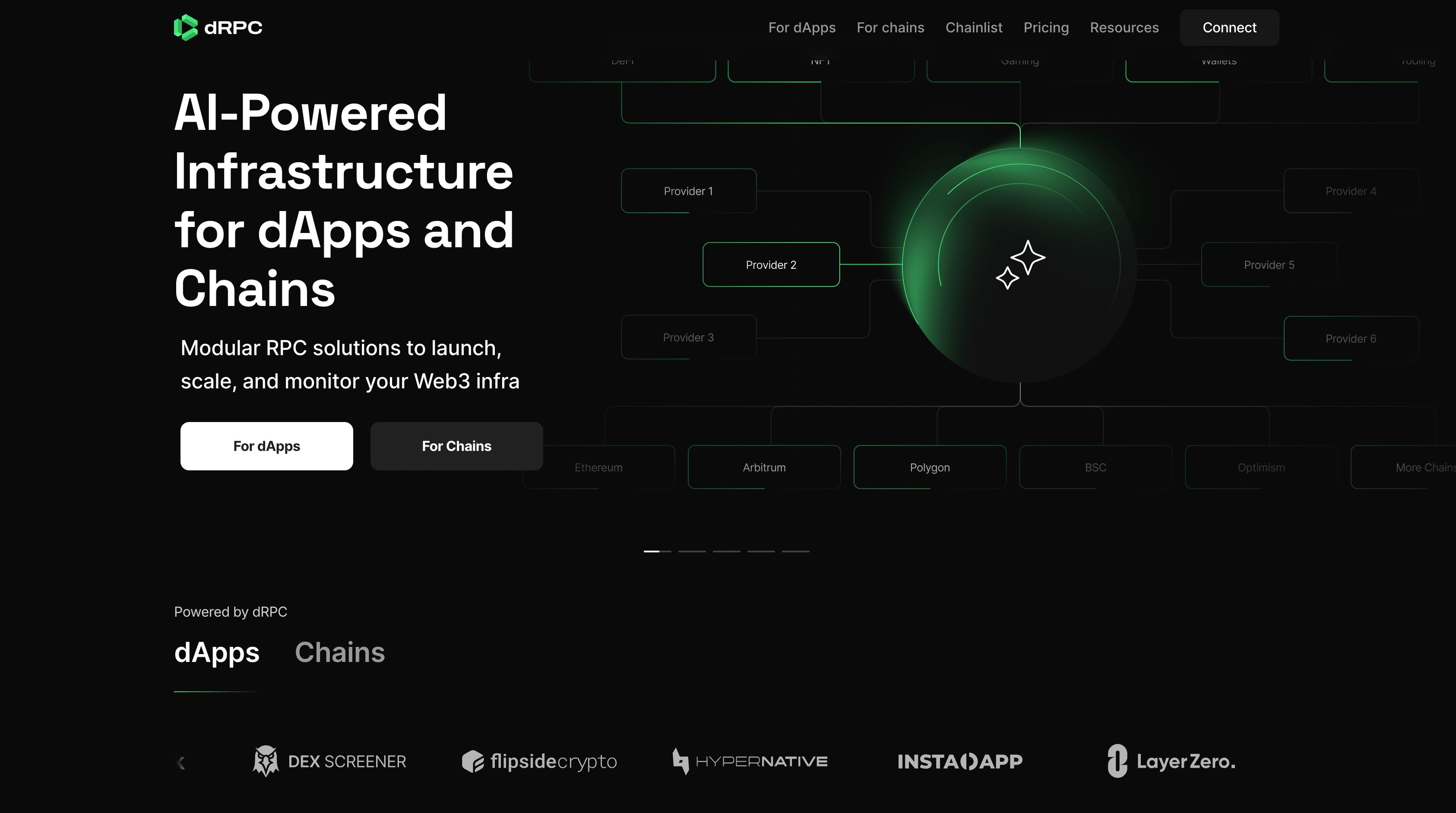
dRPC, instead of running its own single cluster, routes traffic across a network of 50+ independent node operators and uses an AI-driven load balancer to select the fastest, healthiest endpoint for each request. The goal is to eliminate single points of failure, reduce latency by steering calls to the nearest region, and deliver production-level throughput without tying you to a single provider’s hardware profile.
That design comes with a clear trade-off: you’re not getting one tightly controlled Solana stack. Speed and redundancy are achieved by sitting on top of multiple operators, so performance depends on a rotating pool of providers. As a result, you don’t always get the same level of deterministic routing, regional pinning, or operational visibility that other providers provide.
| How much does it cost? | dRPC prices Solana access on a pay-as-you-go model. Costs are structured around compute units and per-million-request pricing: higher tiers get you more RPS capacity, priority routing, uptime SLAs, and dedicated support. Free — $0. Includes 210M compute units per month (roughly ~10M calls). Growth / Pay-as-you-go — $6 per 1M requests. Includes high-performance nodes behind an AI-driven load balancer, up to 5,000 requests per second class throughput. Enterprise — Custom pricing starting from ~300M+ requests/month. |
| Performance | Availability: 99.99 % uptime goal with automatic fallback across 50 + operators and 7 regions. Latency: Region-aware routing keeps calls close; speeds can fluctuate slightly. Scalability: Pay-as-you-go throughput up to ≈ 5,000е RPS, expandable for enterprise. Stability: Automatic retries and smart rotation maintain flow during mints or heavy network load. Controls: Unlimited API keys, request analytics, and MEV-safe routing included. |
| Pros | – Decentralized aggregator with AI routing across 50+ operators for low latency and no single point of failure – High headroom on paid plans – Built-in MEV-safe routing and automatic fallback under congestion |
| Cons | – Less predictable than a single-provider stack; routing and performance can vary between upstream operators – Finer controls like strict regional pinning or per-cluster visibility are limited compared to infra-first providers – Debugging edge cases can take longer because issues may originate from different upstream node operators |
dRPC is a good fit for teams that want high RPS fast and are fine with smart routing deciding where traffic goes. The pay-as-you-go model and high burst capacity work for bots, liquidators, and monitoring systems that just need throughput right now. If you need strict region pinning, predictable billing, or deep visibility into a single stack, something more infra-directed like Chainstack will feel safer long term.
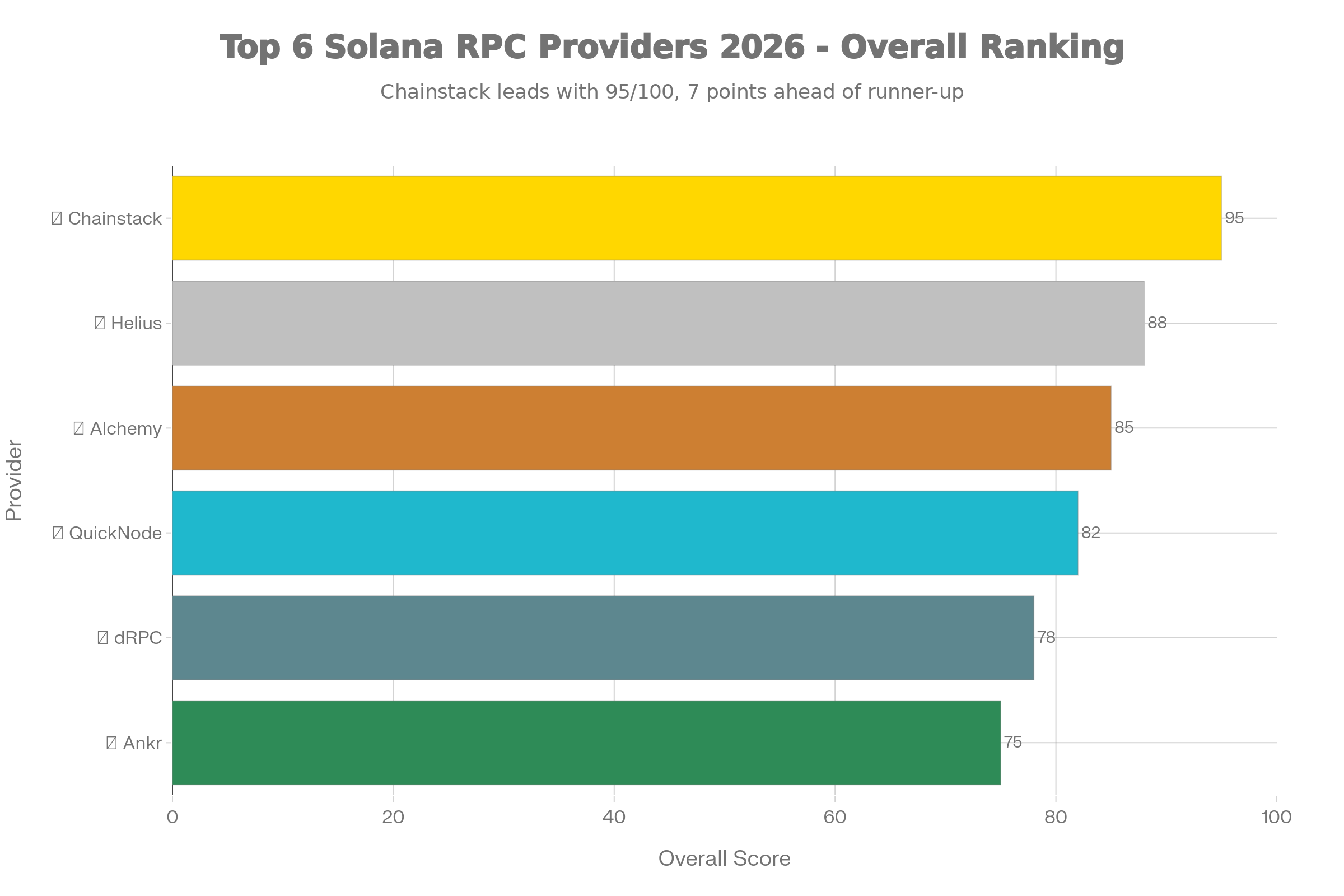
Top 5 Solana RPC providers 2026
🥇 1. Chainstack
Best all-around provider excelling across performance, reliability, security, and cost. Supports 70+ networks with Solana-first focus.
Key strengths:
- Custom RPS on enterprise plans (400M+ requests/month), 99.99% uptime
- SOC 2 Type II certified with 99.99%+ SLA
- Transparent request-based pricing, crypto payments
- Global Nodes for low-latency dApps. Dedicated Nodes for isolated workloads and enterprise-grade reliability.
🥈 2. Helius
Solana-specialized speed & data leader.
Advantages:
- Staked validator routing (~140 ms latency)
- Native APIs for NFT/token data, webhooks, Geyser streaming
- Solana-only focus (no multi-chain)
- Credit-based pricing, no public 99.99% SLA on basic tierswith rollover unused requests
🥉 3. Alchemy
Developer favorite with rich tooling beyond raw RPC.
Strengths:
- Global routing, ~170 ms response times, 99.99% uptime targets
- Notify/Transact APIs, analytics dashboards
- 30M CU free tier (~1.2M requests), $0.45/M basic calls
- No SOC 2 certification
🏅 4. QuickNode
Performance leader with globally distributed network.
Highlights:
- Multi-region load balancing, 99.99% uptime on paid plans
- Streams API, MEV protection, transaction relays
- Trial credits (~10M calls), credit-based pricing
- RPS caps (~50-500 RPS per tier)
🏅 5. dRPC
Decentralized high-throughput RPC aggregator.
Key features:
- AI-driven routing across 50+ node operators
- ~100-250 RPS free, up to 5,000 RPS pay-as-you-go
- $6 per 1M requests, unlimited API keys, MEV-safe
- Variable performance across operator
🏅 6. Ankr
Accessible multi-chain network with a generous free tier.
Highlights:
- Anycast routing to nearest nodes (~30 RPS free)
- ~200M credits/month free, bursts to 1,500 RPS
- WebSocket, allowlisting, 99.99% enterprise SLA
- Performance varies by community operators
Conclusion
The 2026 Solana RPC landscape has matured into a competitive space with infrastructure options tailored to production-scale demands. Chainstack offers the most balanced solution overall, combining global and dedicated nodes, gRPC Geyser support, and 99.99% uptime — making it a strong fit for stablecoin payments, analytics, and enterprise deployments.
QuickNode leads in low-latency performance and traffic routing, with built-in access rules for tighter security controls. Helius focuses on Solana-native tooling, offering advanced APIs and enhanced Geyser indexing ideal for high-throughput data needs. Alchemy provides a developer-friendly platform with stable performance and a generous free tier, while Ankr and dRPC offer reliable regional coverage for teams looking to scale affordably.
With these providers, Solana developers have access to high-availability infrastructure built to support mission-critical applications across diverse use cases.
FAQ
An RPC (Remote Procedure Call) provider lets your app communicate with the Solana network without running your own validator. It lets you read account data, send transactions, and stream updates via gRPC or WebSockets. Without reliable RPC, your app can’t function properly on Solana.
Chainstack leads for production use, combining predictable request-based pricing and scalable performance for enterprise workloads, 99.99% uptime, global low-latency routing, SOC 2 Type II compliance, and both free/enterprise tiers. It covers payments, enterprise, and DeFi needs better than competitors.
Yes. Chainstack offers a free tier with ~25 RPS, mainnet/testnet access, and gRPC streaming. Helius also has a free plan, but Chainstack’s tier includes more production-grade capabilities. Ankr and Alchemy also offer limited free plans, but with tighter usage caps or fewer production-ready features.
Solana’s speed means infrastructure choices matter more than most builders think, and there’s no one-size-fits-all setup. Trading bots, dashboards, indexers, or DeFi frontends all hit the chain differently. But whatever you’re building, you need an RPC provider that can deliver low latency, stable throughput, and real-time access.
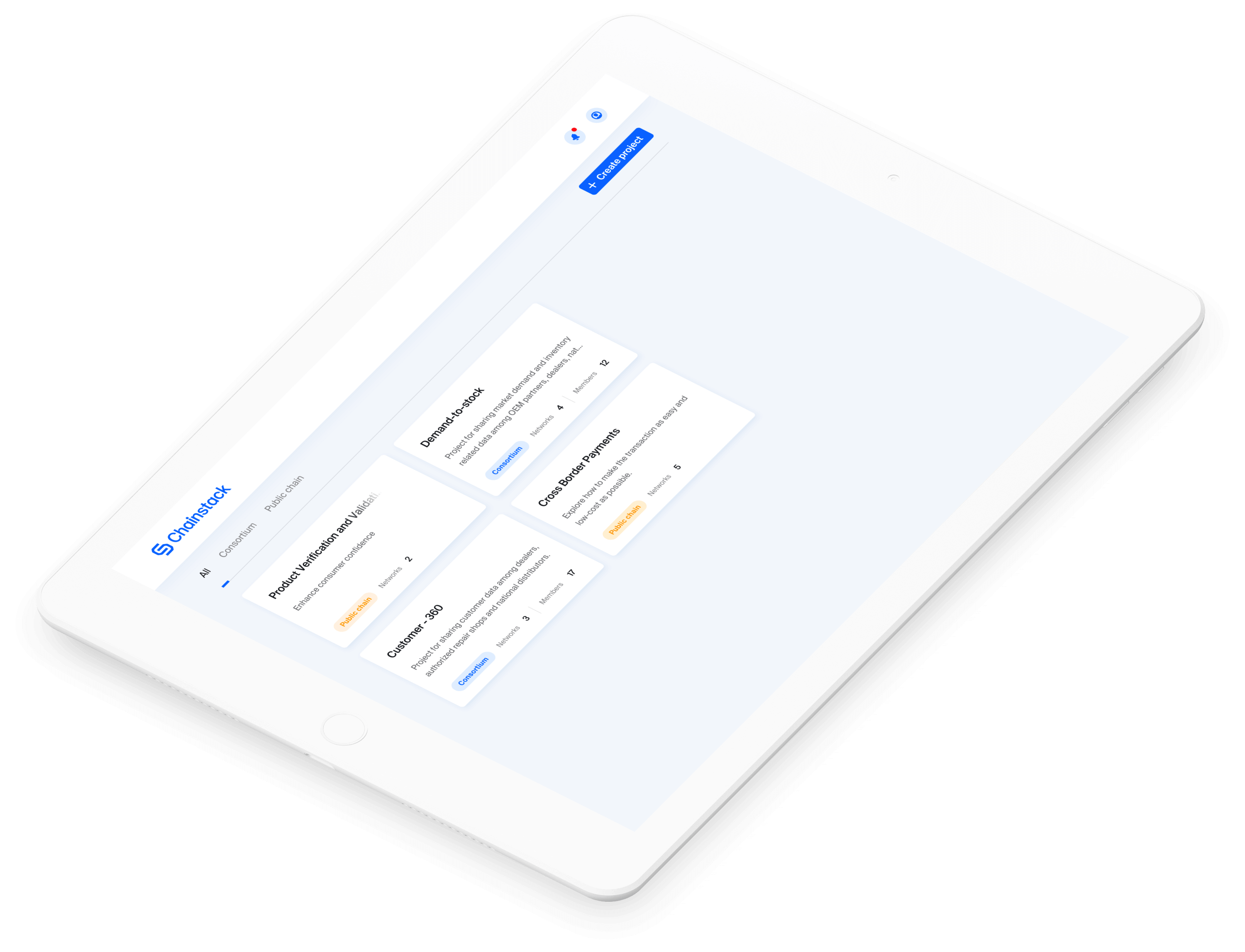
With Chainstack, that’s all built in. You can deploy a Solana RPC endpoint in under a minute and start sending requests right away with a few short steps:
– Log in to the Chainstack console (or create one if you don’t have it yet).
– Create a new project or select an existing one.
– Pick Solana as the network and choose mainnet or testnet.
– Deploy your node.
– Copy your HTTPS or WebSocket endpoint.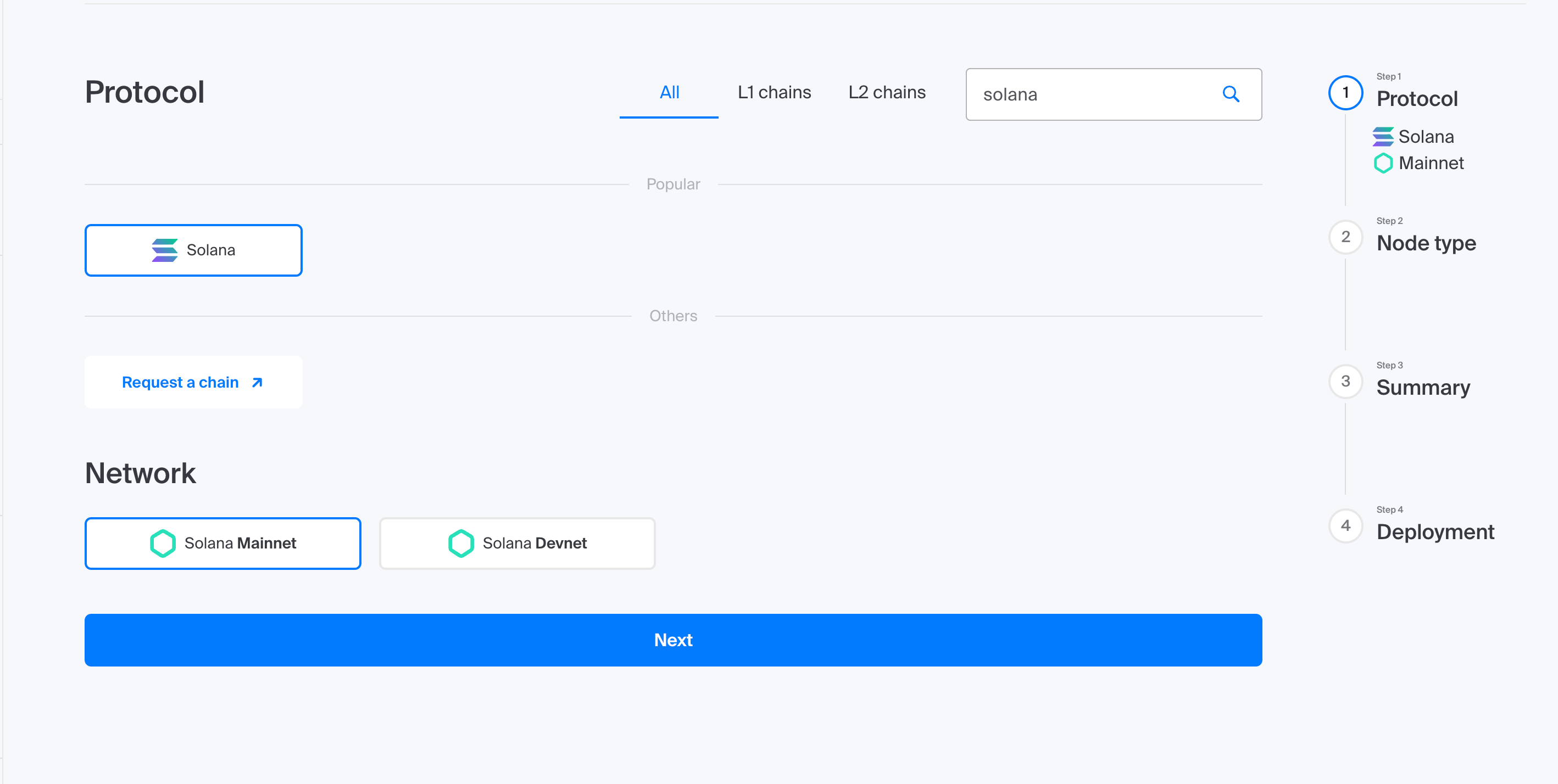
Not only do you get the option to choose between Global Nodes for shared, geo-balanced access or Dedicated Nodes for isolated performance and full control, but every deployment comes production-ready. Both options include Bolt fast sync for same-day readiness and GraphQL support.
You also get built-in security via Access rules and gRPC streaming support for real-time Solana data — everything needed to launch production-ready apps from day one.
Reliable Solana RPC infrastructure
Getting started with Solana on Chainstack is fast and straightforward — deploy a reliable node in seconds through an intuitive console, no hardware or complex setup required.
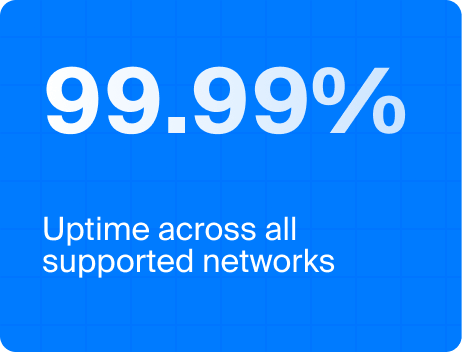
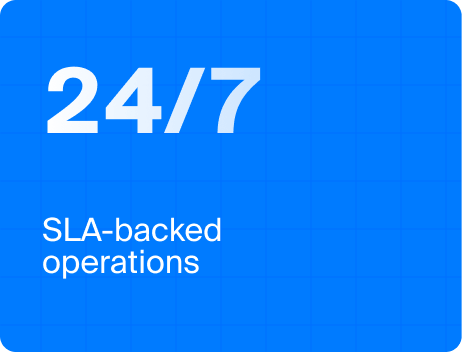
With 99.99% uptime, 24/7 SLA-backed operations, and low-latency global endpoints, Chainstack ensures seamless RPC access for building and scaling DeFi, analytics, and trading applications.