Ethereum
 Solana
 Hyperliquid
 Arbitrum
 Base
Base BNB Smart Chain
 MegaETH
 Tempo
Tempo Avalanche
 Aptos
Aptos TRON
TRON Ronin
Ronin zkSync Era
 Optimism
 Sonic
Sonic Polygon
 Unichain
 Fantom
 Gnosis Chain
 Sui
Sui Avalanche Subnets
 Polygon CDK
 Starknet Appchains
 zkSync Hyperchains




 Refer and earn
 Discord
 Telegram
 X (Twitter)
Best MegaETH RPC providers for high-throughput apps

| # | Provider | Free Plan | Pricing Model | Uptime / SLA | Dev Experience |
|---|---|---|---|---|---|
| 1 | Chainstack | 3M req/mo, ~25 RPS | Request Units (1 RU standard, 2 RU archive); | 99.9% formal SLA doc; 99.99%+ on Global/Dedicated lines | Dashboard metrics, IP/origin access rules, archive, Chainbench, Compare Dashboard |
| 2 | Alchemy | 30M CUs/mo, ~25 RPS | Compute Units by method weight; PAYG + monthly | 99.99% uptime claimed during peak; SLA formally on Enterprise | Notify & Transact APIs, Mempool streaming, MEV protection, real-time analytics dashboard, SDK support |
| 3 | QuickNode | Trial only (10M credits) | API credits (method-weighted; e.g. eth_call = 20 credits) | 99.99% guaranteed, formal SLA | Streams, Webhooks, OP-Node API, Trace API, marketplace add-ons (incl. DeFi integrations), team dashboards |
| 4 | dRPC | 210M CU/30 days (public nodes) | Flat-rate: 20 CU/request, $6 per 1M requests | High availability via multi-provider routing; no formal public SLA | Simple setup, OpenAI-compatible API, public status page, key control, front-end protection |
| 5 | Dwellir | 100K responses/day, 20 RPS, access to 140+ chains | Flat: 1 response = 1 credit (incl. trace & debug); Developer $49/mo (25M, 100 RPS); Growth $299/mo (150M, 500 RPS); Scale $999/mo (500M, 2,000 RPS) | 99.99% uptime SLA; multi-region redundancy; auto-failover & load balancing | 140+ chains (EVM, Substrate, Move, Cosmos); HTTPS & WebSocket; trace & debug APIs; autoscaling; dashboard with monitoring |
Introduction
MegaETH is one of the most infrastructure-sensitive networks to launch in the Ethereum ecosystem. It is an Ethereum-compatible Layer 2 designed for real-time applications, with 10 ms mini blocks, 1-second EVM blocks, and a throughput target above 100,000 transactions per second. That changes the usual RPC discussion. On slower EVM networks, a mediocre endpoint can still be “good enough” for many apps. On MegaETH, RPC quality quickly becomes a product-level constraint.
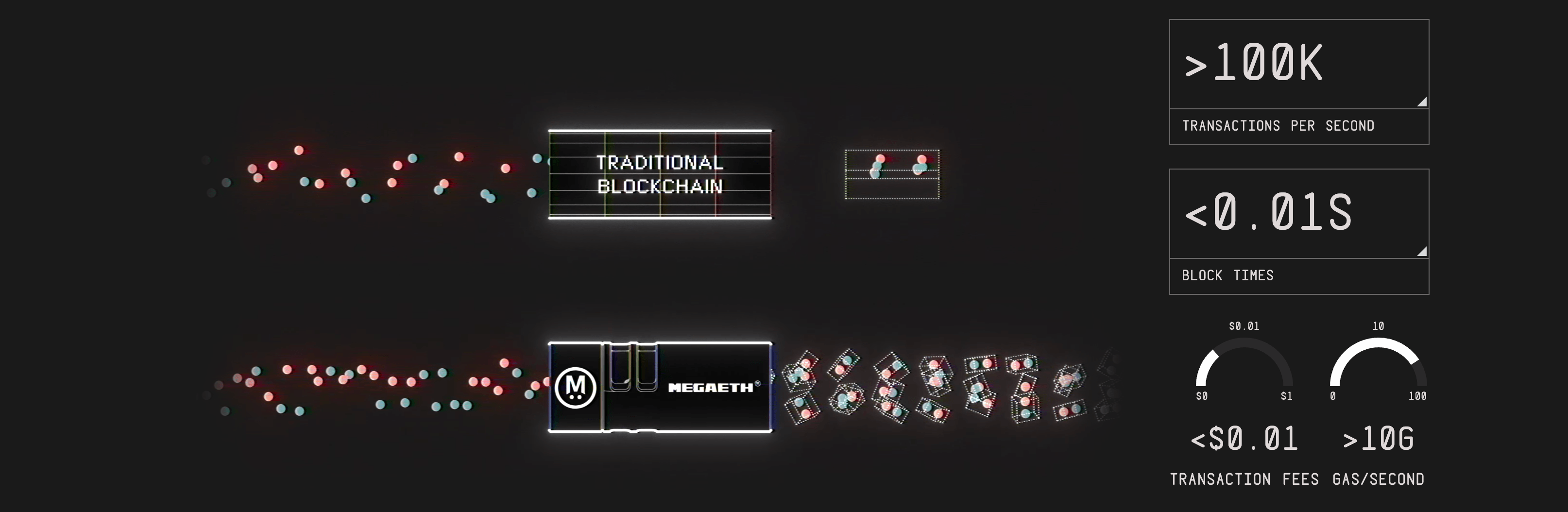
That is because MegaETH is built for workloads that feel more like low-latency systems engineering than conventional blockchain backends: real-time trading, on-chain gaming, social applications, and high-frequency state updates. When a chain can move this quickly, your MegaETH RPC provider has to do more than answer eth_call reliably. It has to keep up with large request bursts, stable WebSocket subscriptions, fast transaction submission, and often more advanced debugging or dedicated-node requirements.
MegaETH does provide a native public RPC. But the official docs also make the tradeoffs clear: methods are whitelisted, rate limiting is dynamic, and many debug, trace, and txpool methods are not available on the public endpoint. For teams building production systems, that is usually where a third-party MegaETH node provider becomes necessary.
That is why most teams evaluating MegaETH RPC providers move from public endpoints to managed infrastructure early in development.
MegaETH RPC providers comparison
Use Cases for MegaETH Infrastructure
On-chain games
MegaETH is one of the few EVM environments where real-time game logic actually becomes practical on-chain. But gaming infrastructure has demanding requirements: fast state reads, stable event subscriptions, and consistent visibility during bursts of player activity.
While shared public RPC endpoints may be sufficient for early testing, production games typically require a managed MegaETH RPC provider. Reliable WebSocket connections and predictable throughput are essential to keep gameplay responsive and prevent infrastructure bottlenecks as player activity scales.
Real-time trading and market infrastructure
Trading systems on MegaETH depend on both fast reads and fast writes. Low-latency eth_call, current-state visibility, and reliable transaction submission matter far more than they do on slower chains. If you are routing large volumes of orders, liquidation attempts, or market-making updates, a provider with strong write-path reliability and isolated infrastructure quickly becomes worthwhile. Dedicated MegaETH nodes make sense once throughput rises and trading logic depends on consistently low-latency state updates.
Social and speculative consumer apps
MegaETH is a strong fit for consumer apps built around speed, feedback loops, and live participation. Social trading, prediction-driven experiences, viral apps, and attention markets all work better when user actions feel immediate and state updates are visible in real time.
Shared public RPC may be enough to prototype, but consumer apps with growing engagement usually need infrastructure that can keep reads fast and subscriptions stable during sudden traffic spikes. That is where Chainstack Global Nodes are a strong fit, giving teams geo-balanced access, reliable performance, and the resilience needed to support real-time consumer experiences at scale.
What to look for in a MegaETH RPC provider
When comparing MegaETH RPC providers, the criteria shift compared to standard EVM networks. This is not a typical Ethereum mainnet or OP Stack evaluation—MegaETH’s performance profile exposes different bottlenecks, making latency, throughput, and real-time reliability far more critical.
- Latency is the first criterion. MegaETH is designed around real-time execution, so endpoint distance, routing quality, and queue behavior matter. On a chain with 10 ms mini blocks, the difference between a fast provider and a congested one is no longer academic.
- Throughput is next. MegaETH’s upside is that you can build applications that generate much larger request volumes than on slower chains. That means the right provider is one that remains stable under bursty read traffic and sustained write traffic, not just one that looks fine in a single-request benchmark.
- Uptime matters more than usual because real-time applications degrade badly when subscriptions fall behind or transaction forwarding becomes inconsistent. Low error rates, stable failover behavior, and predictable rate limiting are critical.
- Multi-region infrastructure is especially important for global applications. If your users, bots, or game clients are distributed across regions, a single-region endpoint can quietly become the weak point in an otherwise fast stack.
- Archive and debug APIs are another major differentiator. MegaETH’s public RPC does not expose the full debug and trace surface, so teams building analytics, transaction simulation, or advanced operational tooling should check this before committing.
- Dedicated nodes matter when shared infrastructure is no longer enough. If you are running a game backend, a trading system, or any application with aggressive burst traffic, shared RPC can become unpredictable even when the underlying chain is fast.
- Pricing model matters because MegaETH changes request economics. Credit- and CU-based pricing can become harder to forecast on high-throughput chains. Predictability becomes almost as important as raw price.
Mini blocks and WebSocket subscriptions
This is one of the most important differences between MegaETH RPC providers, especially for event-driven applications.
MegaETH’s eth_subscribe behavior depends on what the provider exposes. On a standard EVM chain, subscribing to newHeads gives you one event per block — straightforward. On MegaETH, there are two layers: mini blocks (10ms, partial state updates) and full EVM blocks (1 second, complete state).
If a provider only exposes newHeads at the EVM block level, your event-driven logic will fire once per second — not once per mini block. For a trading system or game backend built to take advantage of MegaETH’s speed, this is functionally equivalent to running on a 1-second chain. The 10ms advantage disappears at the subscription layer.
Check whether your provider explicitly supports mini block subscriptions before building event-driven architecture on MegaETH. This is the kind of implementation detail that won’t show up in a benchmark but will directly shape what your application can do.
One more MegaETH-specific point: the official docs note that MegaETH uses a multidimensional gas model, and local simulation may undercount gas. In practice, that makes RPC quality for eth_estimateGas, eth_call, and transaction confirmation more important than on many other EVM networks.
Method coverage and advanced RPC access
One important difference between MegaETH RPC providers is not the number of standard JSON-RPC methods, but how much of the extended method surface they expose.
MegaETH’s public RPC intentionally restricts many advanced methods such as debug, trace, and txpool. As a result, providers that expose a broader method surface effectively unlock more advanced use cases, including transaction simulation, analytics, and infrastructure-level debugging.
Best MegaETH RPC providers
Below is a breakdown of the most relevant MegaETH RPC providers available today, based on infrastructure depth, latency behavior, and WebSocket support.
1. Chainstack
Overview
Chainstack is the strongest all-around option for MegaETH infrastructure right now. It supports MegaETH Mainnet on Global Nodes and Dedicated Nodes, and MegaETH Testnet on Dedicated Nodes. More importantly, its MegaETH documentation is unusually complete: HTTPS and WSS endpoints are documented, standard EVM tooling is supported, and the MegaETH method surface is broad enough to cover serious production use.
That matters because MegaETH is not just another EVM chain with a public endpoint. It is a chain where real-time performance and method availability directly shape application design. Chainstack is the only provider in this comparison with a clearly documented MegaETH offering that combines shared access, dedicated nodes, WebSocket support, and broad debug/trace coverage.
| Details | |
|---|---|
| Pricing | Developer — free, 3M req/mo (~25 RPS). Growth — $49/mo, 20M req (~250 RPS). Pro — $199/mo, 80M req (~400 RPS). Business — $349/mo, 140M req (~600 RPS). Enterprise — from $990/mo, 400M+ req, custom RPS. Unlimited Node add-on from $149/mo flat. Dedicated Nodes — $0.50/hr compute. Crypto payments accepted. |
| Billing model | Request Units: 1 RU per standard call, 2 RU per archive or debug/trace call. No method-weight multipliers. |
| Uptime / SLA | Formal SLA document: 99.9% minimum with service credits. Product positioning on Global/Dedicated lines: 99.99%+. Public status page available. |
| Security | SOC 2 Type II certified. Security materials accessible via security page. |
| Archive / debug | Full debug and trace method coverage available. |
| WebSocket | HTTPS and WSS endpoints available. |
| MegaETH Testnet | Available on Dedicated Nodes. |
Pros: Transparent RU billing, Dedicated Nodes for MegaETH, full archive + debug/trace, SOC 2 Type II, broad method coverage including eth_getBlockReceipts and txpool, EVM tooling support, Unlimited Node add-on, 70+ chains. Cons: Free tier tight for high-frequency workloads; Dedicated Nodes require at least Pro plan; fixed RPS per tier means ultra-high-frequency apps may need Dedicated from day one.
2. QuickNode

Overview
QuickNode is a strong commercial option for teams that want MegaETH support with both shared endpoints and isolated enterprise infrastructure. QuickNode documents HTTP and WSS MegaETH endpoints, and its MegaETH docs explicitly include Debug API and Trace API sections. On the enterprise side, it offers Dedicated Clusters, positioned as isolated, redundant infrastructure for higher-scale workloads.
QuickNode’s MegaETH product is well suited to teams that want more than basic node access and are already comfortable with a credit-based RPC model.
| Details | |
|---|---|
| Pricing | Build — $49/mo, 80M credits, 50 RPS. Accelerate — $249/mo, 450M credits, 125 RPS. Scale — $499/mo, 950M credits, 250 RPS. Business — $999/mo, 2B credits, 500 RPS. Enterprise — custom. Credits roll over. |
| Billing model | API credits, method-weighted. Call composition directly affects cost. |
| Uptime / SLA | 99.99% formally guaranteed on paid plans; enterprise SLA available. |
| Security | SOC 2 Type II + SOC 1 Type 2 + ISO 27001. |
| Archive / debug | Debug API and Trace API sections documented for MegaETH. |
| WebSocket | HTTP and WSS endpoints documented. |
| MegaETH Testnet | Not explicitly documented. |
Pros: 99.99% formal SLA, SOC 2 Type II + ISO 27001, Debug and Trace API for MegaETH, Dedicated Clusters, Streams/Webhooks, strong commercial positioning for wallets and DeFi. Cons: No free tier (trial only); method-weighted credits make cost modeling complex on high-throughput chains; no flat-rate unlimited option for burst-heavy workloads.
3. Alchemy
Overview
Alchemy supports MegaETH with both RPC and WebSocket endpoints and treats MegaETH as a standard JSON-RPC network inside its broader developer platform. That makes it attractive for teams already standardized on Alchemy’s SDKs, dashboards, and operational tooling.
The tradeoff is that Alchemy’s public MegaETH positioning is more about developer platform integration than chain-specific infrastructure differentiation. It clearly supports MegaETH, but it is less explicit than Chainstack or QuickNode about dedicated MegaETH node patterns.
| Details | |
|---|---|
| Pricing | Free — 30M CUs/mo (~25 RPS). Pay-as-you-go — $5 per 11M CUs. Enterprise — custom with volume discounts. Method-weighted pricing applies. |
| Billing model | Compute Units: method-weighted. Bill depends on call composition, not just volume. Requires tracking method mix for accurate budget modeling. |
| Uptime / SLA | 99.99% uptime claimed during peak market conditions; global infrastructure with automatic failover. Formal SLA on Enterprise plans. |
| Security | SOC 2 Type II certified; public trust center available. |
| Archive / debug | Archive and debug access available on paid plans; method coverage for MegaETH not explicitly documented in public docs at time of writing. |
| WebSocket | WSS endpoints available. |
| MegaETH Testnet | Available. |
Pros: SOC 2 Type II, broad SDK and platform tooling (Notify, Transact, Mempool APIs), MEV protection, 40+ chains, rich analytics, strong developer experience for teams already on Alchemy. Cons: CU pricing requires careful method-mix tracking; less explicit about dedicated MegaETH node patterns; billing less predictable at scale; very high RPS requires Enterprise plan.
4. dRPC
Overview
dRPC supports MegaETH through its NodeCloud platform with both free and paid access. Its main value proposition is predictability: flat-rate pricing, multi-region routing, and managed failover. dRPC is especially attractive for teams that want global RPC access without running their own infrastructure and do not want their costs distorted by method-weight multipliers.
The main limitation is that dRPC’s MegaETH public materials are less explicit than Chainstack’s about dedicated MegaETH node patterns. It is strong as a managed multi-region RPC layer, but not the most complete MegaETH-specific infrastructure story in this comparison.
| Details | |
|---|---|
| Pricing | Free — 210M CU/30 days (public nodes only). Paid — PAYG with deposit, flat-rate: 20 CU per request, $6 per 1M requests. “Go unlimited” option available. |
| Billing model | Flat-rate per request — no method-weight multipliers. Predictable cost regardless of call composition. |
| Uptime / SLA | High availability through multi-provider routing. Public status page available. No formal published SLA. |
| Security | No publicly documented SOC 2 certification at time of writing. |
| Archive / debug | Not explicitly documented for MegaETH. |
| WebSocket | Available through NodeCloud. |
| MegaETH Testnet | Not explicitly documented. |
Pros: Flat-rate pricing (no method surprises), most generous free tier, multi-provider redundancy, OpenAI-compatible API, no vendor lock-in. Cons: No formal SLA; no SOC 2 certification; less explicit MegaETH-specific documentation; dedicated node patterns not clearly documented; performance consistency varies across distributed provider network.
5. Dwellir

Overview
Dwellir is one of the more interesting MegaETH options for teams that care about simple pricing and explicit multi-region operations. It lists MegaETH mainnet HTTPS and WSS endpoints, advertises 99.99% uptime SLAs, and positions itself around a simple billing model: 1 response = 1 credit. It also offers Dedicated Clusters in its wider infrastructure product line.
For MegaETH specifically, that pricing simplicity is meaningful. High-throughput applications tend to punish complex CU math, and Dwellir’s flat model removes that variable entirely.
| Details | |
|---|---|
| Pricing | Developer — $49/mo, 25M responses, 100 RPS. Growth — $299/mo, 150M responses, 500 RPS. Scale — $999/mo, 500M responses, 2,000 RPS. Free tier: 100K responses/day at 20 RPS. |
| Billing model | 1 response = 1 credit, regardless of method. Trace and debug calls count the same as standard calls. |
| Uptime / SLA | 99.99% uptime SLA; multi-region redundancy; auto-failover and load balancing. |
| Security | Not explicitly documented at time of writing. |
| Archive / debug | Trace and debug APIs included across plans. |
| WebSocket | HTTPS and WSS endpoints available. |
| MegaETH Testnet | Not explicitly documented. |
Pros: Simple flat pricing including trace/debug, 99.99% uptime SLA, multi-region redundancy, 140+ chains, high RPS ceiling on Growth and Scale plans. Cons: Smaller ecosystem than Chainstack or QuickNode; security certification not publicly documented; less MegaETH-specific documentation depth; Dedicated Clusters not prominently featured for MegaETH specifically.
Which MegaETH RPC provider should you choose?
If you are just testing contracts, verifying network behavior, or building an internal prototype, the native MegaETH public RPC is usually enough. It gives you direct chain access and works well for low-volume development.
For production applications, managed RPC providers become the default choice. This is where differences between providers start to matter.
Chainstack is the most complete option in this comparison, covering both shared and dedicated MegaETH infrastructure with broad method support and production-ready reliability. It is particularly strong for teams building real-time applications that need consistent performance and a clear scaling path.
QuickNode is a strong alternative for teams already operating within a credit-based model and looking for additional ecosystem tools such as Streams and Webhooks, especially for analytics-heavy or event-driven architectures.
Alchemy fits best for teams already integrated into its developer platform. It offers a smooth experience with strong tooling and SDK support, but is less focused on MegaETH-specific infrastructure depth.
Dwellir stands out for its simple and predictable pricing model. It is a practical option for teams that want to control costs on high-throughput workloads without dealing with method-weighted pricing.
dRPC is best positioned as a managed multi-region RPC layer with flat pricing and built-in routing. It works well for teams that want global coverage without managing infrastructure, though it is less focused on deep MegaETH-specific features.
Overall, most teams will benefit from a provider that can handle both early-stage development and production workloads without requiring a migration later. In that context, Chainstack stands out as the most complete all-around MegaETH RPC provider, covering the full range of use cases from prototyping to high-throughput production systems.
Conclusion
MegaETH changes what developers should expect from RPC infrastructure. A chain built for 10 ms mini blocks, high throughput, and real-time applications puts more pressure on endpoint latency, WebSocket stability, and method availability than a conventional EVM network.
For low-volume testing, the native public RPC is enough. But once you move into production workloads such as gaming, trading, or high-volume consumer apps, a managed MegaETH RPC provider is the safer choice. And when traffic becomes latency-sensitive or burst-heavy, dedicated infrastructure becomes the practical next step.
For most teams, Chainstack is the strongest all-around MegaETH RPC provider in 2026. It combines shared and dedicated MegaETH support, WebSocket access, broad method coverage, and a clear path from prototype to production infrastructure.
FAQ
A MegaETH RPC provider gives your application access to MegaETH nodes over JSON-RPC, usually through HTTPS and WebSocket endpoints. In production, providers are used to improve reliability, scaling, and operational stability beyond what public RPC can offer.
Usually not. MegaETH’s official RPC documentation shows dynamic rate limiting based on compute usage and bandwidth, and several methods are unavailable on the public endpoint, including eth_subscribe, eth_getBlockReceipts, debug_*, trace_*, and txpool_*. That makes public RPC useful for testing, but limited for real-time production apps.
For many applications, yes. If you rely on real-time event streams, confirmation tracking, or state-driven UX updates, WebSocket support is important. This is especially true for trading systems, gaming backends, and event-heavy applications.
Use a dedicated node when shared RPC starts to introduce latency variance, subscription instability, or throughput bottlenecks. Dedicated infrastructure is usually justified for high-frequency trading, high-throughput gaming, and other workloads with sustained or burst-heavy traffic.
For most high-throughput workloads, Chainstack is the strongest option thanks to dedicated MegaETH infrastructure, stable WebSocket subscriptions, and broad method support.
QuickNode is a solid alternative for teams using a credit-based model and building event-driven systems. Dwellir fits high-throughput workloads where predictable, flat pricing matters more than platform features.
Focus on latency, throughput behavior under load, uptime, WebSocket support, debug/trace availability, dedicated-node options, and pricing predictability. On MegaETH, method support and request economics matter more than they do on slower EVM chains.
Additional resources