AI-ready infrastructure
 Refer and earn


 Ethereum
 Hyperliquid
 Solana
 Arbitrum
 BNB Smart Chain
 Base
Base Polygon
 TRON
TRON Sui
Sui Robinhood


Best Aptos RPC providers in 2026

Aptos continues to scale as a high-throughput Layer 1, with the network consistently handling tens of millions of transactions per day and demonstrating sub-second finality under real workloads. The network is designed for parallel execution and low latency, supporting Move smart contracts, on-chain applications, trading systems, and stablecoin transfers. As Aptos adoption grows across DeFi and payments, reliable RPC access has become a critical foundation for production workloads.
Different teams optimize for different priorities — some need ultra-low latency, others focus on cost efficiency, scalability, or enterprise-grade reliability. In this comparison, we evaluate the best Aptos RPC providers in 2026 across key criteria such as performance, uptime, pricing models, and security capabilities.
We focus on two critical Aptos use cases – stablecoin payments and enterprise applications – to see how each provider measures up.
Aptos RPC providers comparison
| # | Provider | Free plan | Paid plans & pricing | Latency & uptime | Developer Experience |
|---|---|---|---|---|---|
| 1 | Chainstack | 3M requests/mo, 25 RPS | Starting from 250 RPS and scaling beyond 600 RPS on custom Enterprise plans, with an Unlimited Node add-on for unmetered requests at a flat monthly rate | Low latency global routing with 99.99%+ measured uptime | Docs, dashboard metrics, testnet faucets, archive, Access rules |
| 2 | OnFinality | 400K response units/day, up to 40 RU/sec | Growth $49/mo (20M RU, $6/M extra); Accelerate $249/mo (100M RU, $3.75/M extra); Ultimate custom | Public rate limit 5 req/sec; REST-based (not JSON-RPC) | Dedicated nodes pay-as-you-go, archive access, request analytics on paid plans |
| 3 | Dwellir | 20 responses/s, 100,000 responses/day | Developer $49/mo (25M responses, 100/s); Growth $299/mo (150M, 500/s); Scale $999/mo (500M, 5,000/s); Unlimited Nodes from $119/mo; dedicated cluster $5,460/mo | No Aptos-specific latency figures published; 99.99% SLA on dedicated clusters (custom terms) | 1 credit per response (no CU weighting), usage dashboard, chat support on Developer, account manager from Growth, crypto payments |
| 4 | Ankr | 200M credits/month, ~30 RPS | Pay-as-you-go ($10 per 100M credits), up to about 1,500 RPS on Premium, with custom limits on Enterprise. | GEO-distributed network, 99.9% contractual SLA on Enterprise (99.99% negotiable) | Simple dashboard, multi-chain support, HTTPS, archive available |
| 5 | Alchemy | 30M CUs/mo; 300 CU/s (about 15 RPS) | Pay-as-you-go or monthly; higher CU throughput on paid plans | Low latency routing, uptime available on higher tiers | REST + gRPC on Aptos, analytics, SDK support |
| 6 | Quicknode | No free tier; 10M credits trial only | 50–500 RPS; credit-based (method-weighted) monthly plans | Globally distributed, stated 99.99% uptime | Streams, Webhooks, team dashboards, multi-region setup |
What separates one RPC provider from another usually comes down to the same few metrics: pricing, latency, uptime, and scalability options available. Here’s how the leading Aptos options measure up:
Key takeaways from the comparison:
- Chainstack offers the most balanced feature set with transparent request-based pricing, 99.99%+ measured uptime, and full SOC 2 Type II and ISO 27001 certification
- Quicknode pairs high per-endpoint RPS on paid tiers with globally distributed infrastructure and SOC 1/2 + ISO 27001
- Alchemy provides the broadest multi-chain tooling, with REST and gRPC access on Aptos
- Dwellir bills one credit per response with no compute-unit weighting, and adds flat-rate Unlimited Nodes and a dedicated cluster for teams that outgrow shared plans
Before diving into detailed provider reviews, let’s examine how each performs across critical Aptos use cases:
Choose Aptos RPC provider by your use case:
Stablecoin & payments infrastructure
Stablecoins have become the backbone of on-chain payments, now making up ~30% of all crypto transaction volume (over $4 trillion in 2025). Payment applications require Aptos RPC service with consistent throughput, near-zero downtime, and predictable costs. Even minor RPC outages or high latency can disrupt thousands of stablecoin transfers.
Top providers address this with robust multi-region infrastructure that automatically fails over if any node goes down. Chainstack’s network delivered 99.99%+ availability in testing, with multi-cloud architecture that reroutes traffic instantly if a region fails. Such redundancy ensures stablecoin transactions aren’t halted by regional outages.
Enterprise-grade performance
Enterprise Aptos deployments demand strong performance guarantees. Corporate and institutional users often have high-throughput workloads and strict SLA requirements.
Enterprise RPC essentials:
- High throughput: Chainstack offers high-throughput plans with custom RPS configurations on Aptos and achieves ~99.99% measured uptime via global load balancing
- SLA guarantees: Quicknode handles enterprise-scale volumes and states 99.99% uptime, with contractual SLAs on Enterprise
- Low-latency across regions: Multi-region data centers and intelligent routing keep response times uniform worldwide
SOC 2 compliant providers
Security and compliance are paramount for enterprises integrating with Aptos. SOC 2 certification has become a key benchmark of a provider’s security controls and operational integrity.
Security leaders:
- Chainstack achieved SOC 2 Type II and ISO 27001 (SOC 2 Type II in December 2025, ISO 27001 in July 2026), underscoring enterprise-grade security and 99.99%+ measured uptime
- Quicknode maintains SOC 1 Type 2, SOC 2 Type 2, plus ISO 27001 certifications
Note: Certification coverage varies: Alchemy holds SOC 2 Type II but has not published ISO 27001; Ankr holds SOC 2 Type II (report under NDA); Dwellir publishes no SOC 2 or ISO 27001 attestation on its public pages
In-depth Aptos provider analysis:
Chainstack
Chainstack is a multi-chain infrastructure platform offering one of the most complete ways to connect to Aptos without the overhead. By choosing Chainstack Aptos RPC node, you get secure HTTP access to Aptos, backed by 99.99%+ uptime and globally distributed routing for consistently low latency.
What makes it stand out is how much is available from the same console:
- Global Nodes for geo-balanced Aptos RPC access.
- Dedicated Nodes for isolated performance and full control over node configuration.
- Archive nodes for deep historical reads, with full historical blocks from genesis to the latest one.
- Access rules to manage allowed domains and IPs directly from the dashboard.
- Unlimited Node add-on for unlimited requests with flat monthly pricing, so you never have to worry about hitting plan limits.
All of this adds up to the Aptos setup that covers nearly every use case. Whether you’re deploying contracts, building DeFi products, or streaming on-chain data, Chainstack gives you reliable performance, clear pricing, and infrastructure to scale with.
| How much does it cost? | Developer — free, 3M requests/month (~25 RPS), $20 per extra million. Growth — $49/month, 20M requests (~250 RPS), $15 per extra million. Pro — $199/month, 80M requests (~400 RPS), $12.5 per extra million. Business — $499/month, 200M requests (~600 RPS), $10 per extra million. Enterprise — from $990/month, 400M requests (custom RPS), extra from $5 per million. Unlimited Node Add-on — flat monthly fee for unmetered requests starting from $149, priced by RPS tier. Dedicated Nodes — billed per node (compute plus storage) from the Pro plan, for exclusive, isolated Aptos node instances. While others price in shifting compute units, Chainstack keeps it simple with request-based billing and clear RPS tiers, so you always know what you’ll pay. What’s more, on Chainstack, you are able to pay in crypto. |
| Performance | Uptime: 99.99%+ availability backed by a multi-cloud network that reroutes automatically if a region drops. Public status page is also available. Latency: Choose endpoints in the US, EU, or APAC to keep response times tight. Throughput: Plans come with enough RPS capacity to absorb traffic surges without forcing you to throttle the app. Stability: Remains steady under load, including during network-wide surges. Monitoring: Built-in console metrics plus public performance/compare dashboards and a status page. |
| Pros | – High throughput at price point (~250 RPS on Growth, ~600 RPS on Business) – Predictable, request-based pricing with Unlimited Node add-on for flat, unmetered traffic within your chosen RPS tier – Built-in testnet faucets – 99.99%+ measured uptime, SOC 2 Type II + ISO 27001, globally distributed routing for low latency One provider for Aptos plus 70+ other chains |
| Cons | – Fixed RPS per tier; ultra-low-latency apps may need Dedicated Nodes – Free plan (3M calls, ~25 RPS) can be tight for bots or indexers – Dedicated Nodes require at least a Pro plan |
🤖 You can also access Chainstack Aptos RPC directly from Claude, Cursor, Codex, Windsurf, Gemini CLI, GitHub Copilot, Antigravity, Claude.ai, or ChatGPT using Chainstack MCP. Learn more about Chainstack MCP.
Chainstack offers a full-featured infrastructure stack for running Aptos, including high RPS capacity, global routing, and archive access. The deployment model stays consistent as workloads grow, helping teams scale without re-architecting their setup or losing cost visibility.
OnFinality
OnFinality provides Aptos RPC access over its own REST-based API surface (Aptos doesn’t use EVM JSON-RPC), covering account, transaction, block, and ledger endpoints. It offers a path from public testing to authenticated API access and pay-as-you-go dedicated Aptos nodes for teams that outgrow shared infrastructure.
| How much does it cost? | Developer — free, 400,000 response units/day, up to 40 RU/sec. Growth — $49/month, 20M response units/month, no daily cap, 200 RU/sec, $6/million extra. Accelerate — $249/month, 100M response units/month, 500 RU/sec, $3.75/million extra. Ultimate — custom pricing, custom throughput, crypto payments accepted. |
| Performance | Public rate limit: 5 req/sec on the public endpoint. Access: REST-based (GET /v1/accounts/{address}, /v1/transactions/by_hash/{hash}, /v1/blocks/by_height/{height}), not JSON-RPC. Dedicated nodes: pay-as-you-go, for isolated capacity and custom operations. Archive: available for historical Aptos state, analytics, and audits. |
| Pros | – Simple path from free public testing to authenticated production access – Pay-as-you-go dedicated Aptos nodes, no long-term commitment – Archive access for historical state – Request visibility/analytics on paid plans |
| Cons | – Public free-tier rate limit (5 req/sec) is tight without upgrading – REST-only surface — no WebSocket subscriptions documented for Aptos – Security certifications not explicitly documented |
Dwellir
Dwellir is a Swedish RPC provider with a long Polkadot track record that now serves 150+ networks, Aptos among them. For Aptos it offers the Aptos REST API (/v1) over HTTPS, with a WebSocket endpoint listed on its Aptos page, plus a dedicated node cluster for teams that want isolated, unmetered access.
Shared plans bill one credit per response with no compute-unit weighting, so a heavy call costs the same as a light one. Plans scale by responses per month and responses per second, and you can pay in crypto.
| How much does it cost? | Free — 20 responses/second, 100,000 responses per day. Developer — $49/month, 25M responses, 100 responses/second. Growth — $299/month, 150M responses, 500 responses/second. Scale — $999/month, 500M responses, 5,000 responses/second (10,000 burst). Unlimited Nodes — from $119/month flat, 25 to 1,000 RPS. Dedicated Node Cluster — $5,460/month list price for Aptos, unmetered. Pay-as-you-go is available above 1B responses per month. (Pricing checked October 9, 2026.) |
| Performance | Uptime: 99.99% SLA on dedicated clusters (custom terms); a public status page covers the shared service. Latency: No Aptos-specific latency figures published on its product pages. Throughput: Plan-based, up to 5,000 responses/second on Scale; no rate limits or request counting on a dedicated cluster. Monitoring: Usage dashboard; chat support on Developer, a dedicated account manager from Growth. |
| Pros | – 1 credit per response, no compute-unit weighting – REST over HTTPS plus a listed WebSocket endpoint – Flat-rate Unlimited Nodes and a dedicated cluster in the same account – Crypto payments accepted |
| Cons | – No SOC 2 or ISO 27001 attestation found on its public pricing and dedicated-cluster pages – Free tier is capped at 100,000 responses per day – The Aptos dedicated cluster is listed at $5,460/month |
Dwellir works well for teams that want predictable per-response billing and a path from shared plans to a dedicated cluster on Aptos. If your vendor review requires SOC 2 or ISO 27001, ask for its compliance documents up front.
Ankr
Ankr provides Aptos RPC through a globally distributed network of node operators, routing traffic across regions to keep latency low and reduce reliance on any single infrastructure provider. You can connect to Aptos mainnet and testnets via HTTPS, across multiple global regions, with archive access available for historical queries
It’s a solid option for teams that prefer a pay-as-you-go model and want to tap into a decentralized setup, though it skips some of the advanced tooling and analytics you’d find in larger, more centralized providers.
| How much does it cost? | Ankr uses an API credits model where credit cost varies by method (heavier calls cost more). Pricing is pegged at $0.10 = 1M API credits (PAYG), and there’s a freemium tier. It’s enough for testing, but high-traffic apps will hit the ceiling quickly. Their paid plans use a pay-as-you-go model: Premium — $10 per 100M credits (~500K requests), with up to 1,500 RPS. Enterprise — custom limits, dedicated nodes in chosen regions, and priority support (pricing on request). |
| Performance | Uptime: 99.9% contractual SLA on Enterprise only; no SLA on public or Premium pay-as-you-go endpoints. Latency: Region-routed. Throughput: 30 RPS on free; ~1.5K–15K RPS on paid tiers. Reliability: Distributed design reduces single-point failures but outages can still occur. Monitoring: The console shows usage and request stats, with more advanced visibility once you move to a paid. |
| Pros | – Freemium with 200M credits/month, – Supports HTTP and archive queries, – Multi-chain support |
| Cons | – Advanced visibility/support gated to paid, – Fixed monthly plans only through custom deals, – Fewer built-in analytics |
If you don’t mind variable performance across regions, Ankr could be a way to go when testing or for the smaller projects. Yet, if you need steady throughput and predictable billing, platforms with fixed RPS tiers and dedicated routing tend to offer a more stable path for production workloads.
Alchemy
Alchemy offers Aptos REST and gRPC access on mainnet and testnet. WebSocket, Webhooks and Transfers APIs are not available for Aptos, and its Aptos page lists no Debug or Trace API.
On top of that, Alchemy supports 100+ networks, so teams already on its SDK and dashboard can reuse them for Aptos. Backed by global infrastructure, Alchemy suits teams that want one vendor across many chains.
| How much does it cost? | Alchemy measures usage in compute units (CUs) rather than raw requests, which can make costs less predictable for teams sending large volumes of latency-sensitive calls compared to flat, request-based models. Alchemy starts with a free tier offering 30M CUs per month, roughly 1.1M basic requests at 300 CU/s (about 15 RPS). Paid plans scale by total CU usage: Pay-as-you-go — $0.525 per million CUs (from 300 RPS). Enterprise — custom pricing with lower per-unit costs at high volumes. |
| Performance | Uptime: Reports 99.9% historical uptime, but an uptime SLA is only guaranteed on Enterprise plans. Latency: Region-based routing helps keep response times low; however, Alchemy does not publish official Aptos-specific latency numbers. Throughput: Begins at 300 CU/s (about 15 RPS) on the free tier; pay-as-you-go starts at 300 RPS, with more capacity bought in 5,000 CU/s blocks. Reliability: The Supernode setup helps maintain data accuracy during heavy traffic. Monitoring: You can check usage, errors, and request patterns through the dashboard in real time. |
| Pros | – Covers Aptos plus 100+ chains, – Aptos gRPC alongside REST – Rich tooling |
| Cons | – CU pricing isn’t intuitive, – Hard to verify real performance without public benchmarks, – Throughput caps by plan, very high RPS needs an enterprise plan |
Alchemy performs reliably under heavy load with consistent low latency across global regions. Compute-based CU pricing offers flexibility but bills vary by API call complexity, making cost prediction challenging at scale. Ideal for teams already standardized on Alchemy’s tooling, less optimal for fixed-budget planning.
Quicknode

Quicknode runs a multi-region infrastructure for Aptos RPC, letting you connect to mainnet and testnets over HTTP. Archive support is available for teams that need to query deep historical data.
It also supports dozens of other chains and offers add-ons such as Webhooks and Streams if you want event-based triggers or real-time blockchain feeds. It’s popular with high-traffic teams because the network scales well under pressure, but to get to that performance you would need to move to the higher-priced tiers.
| How much does it cost? | Build — $49/month, 80M credits plus $0.62 per extra million, up to 50 RPS. Accelerate — $249/month, 450M credits plus $0.56 per extra million, up to 125 RPS. Scale — $499/month, 950M credits plus $0.53 per extra million, up to 250 RPS. Business — $999/month, 2B credits plus $0.50 per extra million, up to 500 RPS. Enterprise — custom terms for higher volumes and dedicated support. Unused credits do not roll over month to month, so variable Aptos loads need headroom, and the model adds a layer compared to straight request counts. |
| Performance | Uptime: States 99.99% uptime across supported services on its security page; premium SLA on Enterprise. Latency: Region-routed endpoints optimized for low latency; no official ms target published, so benchmark in your region. Throughput: 15 RPS on the trial, 50 RPS on Build, up to 500 RPS on Business, custom on Enterprise. Reliability: Requests are rerouted automatically. Monitoring: The dashboard gives real-time visibility into request performance and errors. |
| Pros | – Scales up to 500+ RPS on higher plans, – Archive data available (by chain/plan), – Low latency from multi-region routing |
| Cons | Free trial caps at 15 RPS with community-level support, – Method-weighted, credit-based billing makes costs less predictable, – No flat-rate unlimited option for heavy workloads |
Quicknode gives you speed, global routing, and developer tooling, which makes it good option for Aptos apps. The main limitation is its credit-based (method-weighted) pricing. Because different methods burn credits at different rates, long-term cost planning takes more effort, especially if your workload isn’t static.
Getting started with Aptos on Chainstack
The provider you choose shapes your baseline for speed, reliability, and how easily you can scale over time. Chainstack bundles the full stack into a setup that takes minutes to deploy:
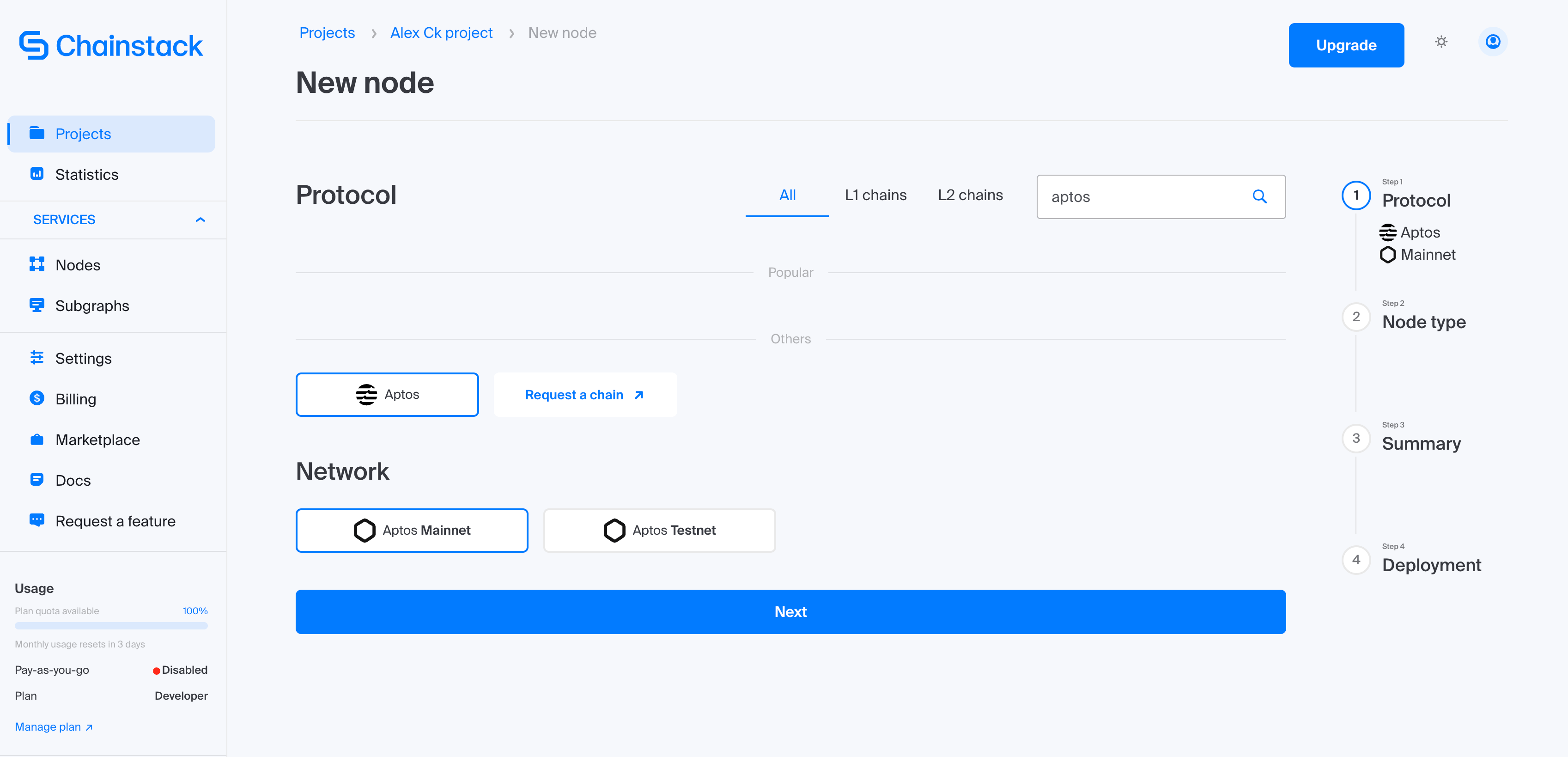
- Log in to your Chainstack account (or create one if you don’t have it yet).
- Create a new project or select an existing one.
- Choose Aptos, then pick mainnet or a testnet.
- Deploy a node with RPC access and copy the HTTP endpoint into your app.
Once your endpoint is live, query Aptos over its REST-based API — for example, checking the current ledger:
curl https://YOUR_CHAINSTACK_ENDPOINT/YOUR_API_KEY/v1Conclusion
The 2026 Aptos RPC landscape is more competitive and mature than ever. Chainstack leads as the top all-around provider, combining enterprise-grade performance and 99.99%+ measured uptime via multi-cloud routing, transparent request-based pricing with an Unlimited Node option, and full SOC 2 Type II and ISO 27001 compliance. It serves stablecoin payments and enterprise dApps well, with 70+ chains supported from one platform.
Quicknode is a strong choice for latency-sensitive workloads, offering up to 500 RPS on its published tiers and robust compliance certifications. Alchemy remains a developer-first platform with rich tooling and a generous free tier, best suited for teams prioritizing productivity over raw infrastructure control.
Dwellir and Ankr serve more cost-conscious and early-stage use cases. Dwellir offers flat per-response billing, flat-rate Unlimited Nodes and a dedicated-cluster path but publishes no compliance attestation, while Ankr offers broad multi-chain access and flexible pricing—but with fewer enterprise-grade features compared to top-tier providers.
Overall, developers now have a wide range of Aptos RPC options—from enterprise-ready infrastructure to flexible, budget-friendly platforms—making it easier to match providers to specific performance, compliance, and cost requirements.
Additional resources
- Chainstack Aptos product page — build better with Aptos.
- Aptos tooling — supported libraries and SDKs.
- Chainstack Enterprise plans — custom RPS, SLAs, and dedicated support.
Reliable Aptos RPC infrastructure
Getting started with Aptos on Chainstack is fast and straightforward — deploy a reliable node in seconds through an intuitive console, no hardware or complex setup required.
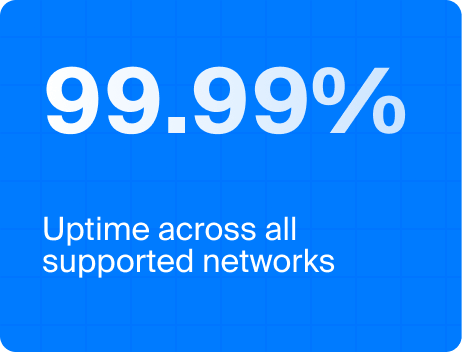
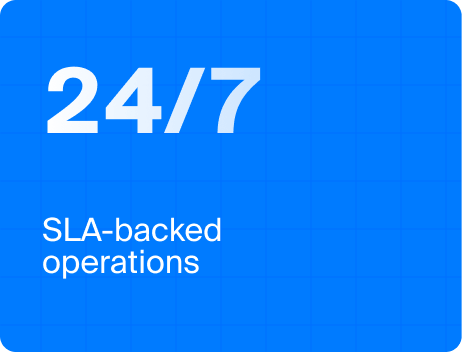
With 99.99%+ measured uptime, a 99.9% contractual SLA and low-latency global endpoints, Chainstack ensures seamless RPC access for building and scaling DeFi, analytics, and trading applications.
FAQ
Aptos RPC is the standard interface that lets applications communicate with the Aptos blockchain. Through an RPC provider, you can read blockchain data (balances, transactions), send transactions, deploy smart contracts, and interact with dApps using the Aptos REST API. Without reliable RPC, your app can’t connect to Aptos.
For production workloads, Chainstack is a strong option, combining predictable request-based pricing, scalable performance, 99.99%+ measured uptime, global low-latency routing, SOC 2 Type II and ISO 27001 compliance, and both free/enterprise tiers. It covers payments, enterprise, and DeFi needs better than competitors.
Yes. Chainstack offers 3M requests/month (~25 RPS) free with full mainnet/testnet access and testnet faucets. Alchemy gives 30M CUs (~1.1M requests), Dwellir allows 100,000 responses a day, and Ankr includes a limited free tier suitable for testing and light usage.
When you start building on Aptos, the provider you choose shapes your baseline for speed, reliability, and how easily you can scale over time. While different platforms cater to different use cases, Chainstack bundles the full stack into a setup that takes minutes to deploy:
1. Log in to your Chainstack account (or create one if you don’t have it yet).
2. Create a new project or select an existing one.
3. Choose Aptos, then pick mainnet or a testnet
4. Deploy a node with RPC access and copy the HTTP endpoint into your app.