AI-ready infrastructure
 Refer and earn


 Ethereum
 Hyperliquid
 Solana
 Arbitrum
 BNB Smart Chain
 Base
Base Polygon
 TRON
TRON Sui
Sui Robinhood


Wallet sign-in: 5 Web3 tools with distinct jobs

A wallet connection can tell an application that someone controls an address. That is useful, but it is not the same as knowing a name, establishing a login session, checking a credential, or proving that a person is unique. Treating all of those jobs as one “identity layer” leads to fragile product decisions.
Web3 identity is better understood as a set of focused primitives. ENS makes addresses readable and can resolve records. SpruceID helps applications use wallet-based sign-in and decentralized identity standards. Ethereum Attestation Service and Sign Protocol let applications issue structured claims. World ID offers a privacy-preserving way to establish a proof of human for flows where Sybil resistance matters.
This guide compares five tools from the Chainstack Marketplace by the trust question each one can answer. Most applications will not need all five. The goal is to choose the smallest set that matches the user action you need to protect.
Start with the claim you need to verify
| If your application needs to… | Start by comparing… | Why |
|---|---|---|
| Display an address as a readable name or retrieve public name records | ENS | ENS resolves human-readable names, addresses, and other records. |
| Let a user create a session by proving control of a wallet | SpruceID | SpruceID’s Sign-In with Ethereum tooling is designed for wallet-based authentication. |
| Issue or read flexible attestations against a public schema | Ethereum Attestation Service | EAS provides schema registration and onchain or offchain attestations. |
| Define an attestation model with explicit data location and validity settings | Sign Protocol | Sign Protocol schemas include controls such as data location, revocability, and validity. |
| Limit a sensitive action to a unique human without collecting identity documents | World ID | World ID provides privacy-preserving credentials for proof-of-human flows. |
1. ENS
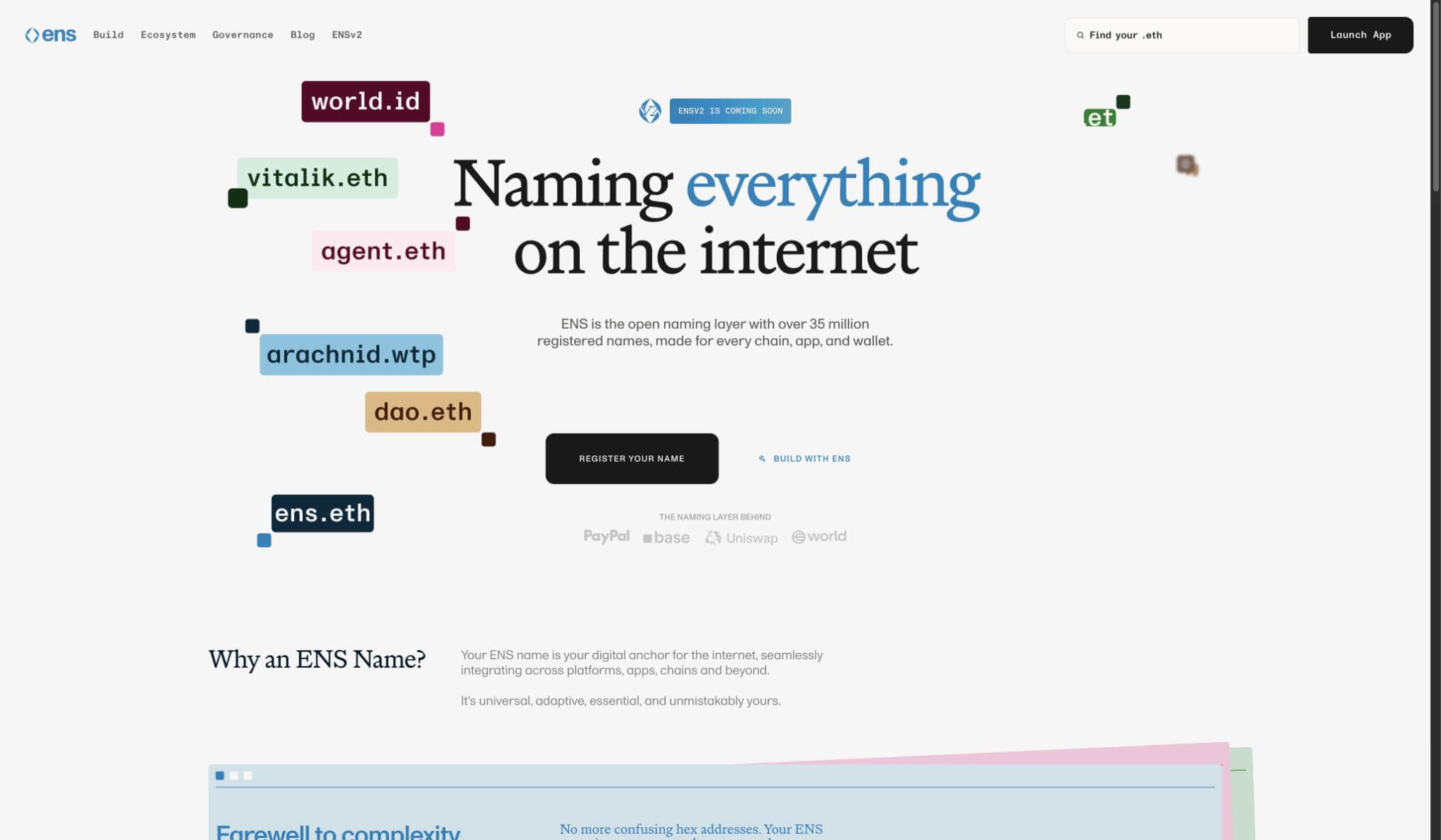
ENS is a distributed naming system built on Ethereum. It maps human-readable names such as alice.eth to machine-readable identifiers, including Ethereum addresses, other cryptocurrency addresses, content hashes, and public records. It also supports reverse resolution, which lets an application look up a primary name for an address.
ENS is the right starting point when the problem is address readability and user-owned public metadata. A wallet screen can show a verified primary name instead of a raw address. A profile can retrieve a name’s avatar, text records, or website URL. An application can also issue subnames when it needs a readable identifier for its own users, communities, or accounts.
The key implementation detail is verification. A reverse lookup alone is not enough. ENS documentation recommends resolving the returned name forward and checking that it points back to the original address before showing it as a verified primary name. Names also do not prove personhood, reputation, or authorization on their own.
Choose ENS if: you need human-readable addresses, primary names, public records, or subnames as part of an application experience.
Think twice if: your actual requirement is authentication, anti-Sybil protection, or a claim about a user’s qualifications. ENS can make identity easier to read, but it does not make that claim for you.
2. SpruceID
SpruceID provides decentralized identity tooling, including Sign-In with Ethereum (SIWE). SIWE standardizes a message that a user signs with an Ethereum account to establish a session with an application. It gives an application a wallet-controlled login flow without asking the user to create a separate password.
This is useful when a wallet address should be the account identifier for a Web3 application. A well-designed SIWE flow binds the signed message to the correct domain, includes a nonce to prevent replay, and gives the backend enough context to create and manage a session. The result is an authentication event, not a transaction or an onchain credential.
Wallet sign-in should remain narrow in scope. Proving control of an address does not prove that the address belongs to a unique person, an employee, an accredited participant, or a particular community member. Add a separate credential or proof only when the product genuinely needs one.
Choose SpruceID if: you need standards-based wallet sign-in and a foundation for user-controlled decentralized identity workflows.
Think twice if: you want an embedded wallet or a complete consumer onboarding platform. SIWE addresses authentication, not every part of a wallet product.
3. Ethereum Attestation Service
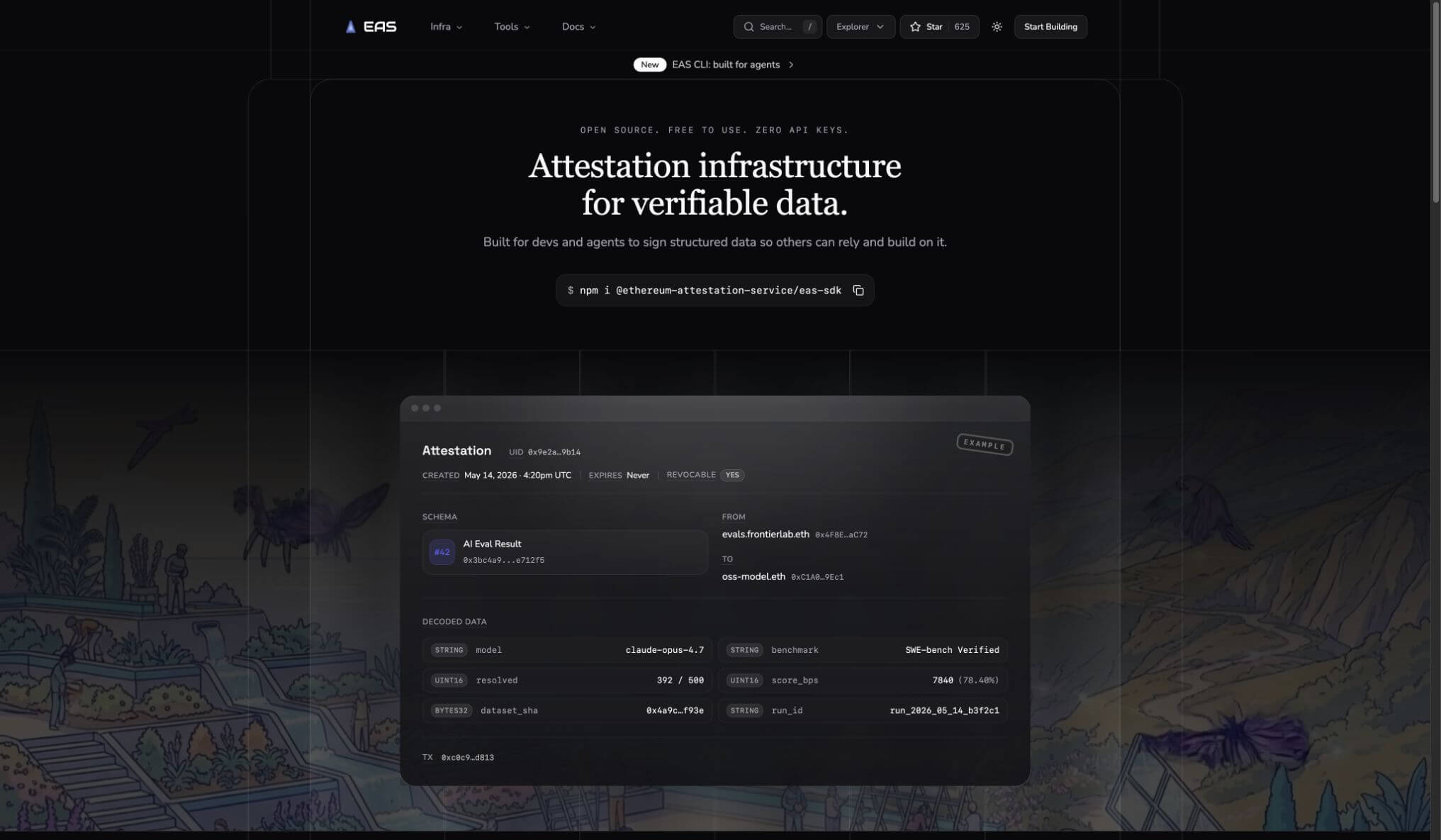
Ethereum Attestation Service is open-source infrastructure for structured attestations. An application registers or reuses a schema that defines the fields of a claim, then creates an attestation that points to that schema. EAS supports both onchain and offchain attestations, and its explorer can expose the relevant schema and attestation records.
EAS is a useful general-purpose choice when a product needs a verifiable statement with a clear issuer, recipient, expiration, and optional revocation. Examples include event participation, a membership state, an eligibility decision, a credential issued by a known organization, or a reference between two trusted records.
The trust model matters more than the data structure. An attestation shows who signed or issued a claim and what schema they used. It does not automatically make the underlying claim true. Your application still needs to decide which issuers, schemas, chains, expiry rules, and revocation states it will accept.
Choose Ethereum Attestation Service if: you need a flexible public attestation layer with reusable schemas and clear onchain or offchain records.
Think twice if: you have not defined who should be trusted to attest, how claims expire, or how a user can challenge an incorrect claim. The protocol can record the statement, but your product owns the acceptance policy.
4. Sign Protocol
Sign Protocol is an attestation protocol built around schemas and digitally signed structured data. Its schema model includes fields for the registrant, revocability, data location, a maximum validity period, and optional hooks. That gives teams a way to make lifecycle choices part of the credential design rather than leaving them as application conventions.
Sign Protocol is worth comparing when the application needs to define exactly how a credential should be structured, how long it should remain valid, whether it may be revoked, and where the associated data should live. For example, a project could design a contributor credential that expires after a season, a proof of completion that is permanent, or an access entitlement that must be revocable.
It overlaps with EAS at the category level, but the choice should come from your schema, ecosystem, chain, and verification requirements. Do not issue the same claim through two attestation layers just to appear more decentralized. Choose one verification path that your application, users, and partners can actually inspect.
Choose Sign Protocol if: your credential model needs explicit schema-level choices around validity, revocation, and data placement.
Think twice if: the product only needs a login session. A signed-in wallet and a long-lived credential solve different problems.
5. World ID
World ID is a privacy-preserving identity protocol for proving that a user is a real and unique human. Its developer documentation describes credentials such as Proof of Human, Document, and Selfie Check. A relying application receives a proof rather than the user’s raw personal data.
World ID is relevant for user actions where duplicate accounts or automated abuse would damage the product. Examples include one-person-one-vote governance experiments, scarce reward claims, referrals, account creation, and community gates that need a stronger signal than wallet ownership. The product decision is not “do we need identity?” but “do we need a unique-human constraint for this action?”
Be precise about the signal you request. Proof of human, document possession, and a selfie-based liveness check have different assurance and friction profiles. World ID also does not replace wallet authentication or application-specific credentials. It is an additional proof that can help a product apply fairer limits without making personal data part of its own user database.
Choose World ID if: you need a privacy-preserving proof of human for a specific sensitive action or anti-Sybil rule.
Think twice if: wallet sign-in is enough for the action. Stronger verification should be proportional to the abuse risk and user friction.
Three identity stacks that make sense
A wallet-aware consumer application
- Use SpruceID and SIWE for authentication.
- Resolve ENS names and records to make wallet activity understandable.
- Add World ID only to high-abuse actions such as referrals, rewards, or one-person voting.
This keeps everyday login lightweight while applying a stronger proof only where it is justified.
A contributor or membership program
- Use SIWE to establish the wallet-controlled account.
- Select EAS or Sign Protocol for the credential and issuer model.
- Verify expiry, revocation, and issuer rules before granting access or a benefit.
The important choice is the verification policy. A user should be able to understand what they qualified for, who issued it, and when it stops being valid.
A public community with scarce actions
- Use ENS for readable profiles and wallets.
- Use World ID for actions that must be limited to one human.
- Use an attestation layer only when the product needs a reusable, inspectable claim beyond the immediate action.
Do not turn every interaction into a credential. The smallest credible set of checks is usually the clearest user experience.
Questions to answer before shipping
- What does the user need to prove: wallet control, name ownership, membership, eligibility, or unique humanity?
- Who is allowed to issue a claim, and how will the application recognize that issuer?
- Can the claim expire or be revoked? Who has that authority?
- Is the data appropriate to publish onchain, or should the proof reference offchain data?
- What happens if a user loses wallet access or changes their primary ENS name?
- Which actions truly need Sybil resistance, and which can stay open to all wallet users?
How Chainstack fits into the stack
Chainstack does not issue identity proofs. It provides RPC and WebSocket access for the onchain components of an identity flow. Use it to resolve ENS records, read attestation schemas and records, submit related transactions, and watch the events that change access or credential state on supported chains.
For example, an application can verify a user’s ENS primary name before rendering a profile, check an EAS attestation before unlocking a feature, and subscribe to relevant contract events so an expired or revoked credential is not treated as valid. Authentication and trust rules remain application decisions. Reliable access to the underlying blockchain state lets the application apply them consistently.