AI-ready infrastructure
 Refer and earn


 Ethereum
 Hyperliquid
 Solana
 Arbitrum
 BNB Smart Chain
 Base
Base Polygon
 TRON
TRON Sui
Sui Robinhood


Top 7 Arbitrum RPC providers for fintech in 2026

Arbitrum is Ethereum’s largest layer-2 network by DeFi TVL, built on the Nitro rollup stack with sub-second transaction finality and sub-cent fees while inheriting Ethereum’s security guarantees. In 2026 that combination has made it the default settlement rail for regulated fintech: native USDC issuance, PayPal’s PYUSD, and Visa-linked stablecoin card rails all route through Arbitrum liquidity.
Arbitrum’s stablecoin supply has grown roughly 200% year-over-year to nearly $4 billion — the fastest growth rate of any major Ethereum L2 — and the network has been reported clearing more than $74 billion in stablecoin transfers every 30 days. Robinhood’s tokenized-equities product launched on Arbitrum One before shifting settlement to Robinhood Chain, its own Arbitrum Orbit rollup that went live in July 2026 — a reminder that “built on Arbitrum” and “is Arbitrum One” are not always the same claim, and RPC providers need to be evaluated against the specific chain a fintech app actually settles on. With the US GENIUS Act in active rulemaking and the EU’s MiCA framework in full enforcement, fintech teams routing payments through Arbitrum One now need RPC infrastructure that can produce an audit trail on demand — shared endpoints with no SLA, no published compliance certification, and no trace API access were never built for that job.
This guide compares the Arbitrum RPC providers that meet fintech-grade requirements: trace and debug API access for audit reconstruction, SOC 2 Type II and ISO 27001 certification, contractual SLAs, and pricing that doesn’t fall apart at settlement-grade request volume.
💡 Already using Chainstack? Jump straight to the Arbitrum tooling docs or deploy your endpoint in minutes from chainstack.com/build-better-with-arbitrum.
Fintech on Arbitrum: RPC requirements
Fintech workloads on Arbitrum are not latency-critical in the HFT sense, but they are latency-sensitive in a different way: consistency matters more than raw speed. A payment processor confirming a USDC settlement needs a response from eth_getTransactionReceipt quickly enough to keep UX tight and meet payment SLA commitments to downstream systems — not to win a block race. Balance queries via eth_call must return consistent, non-stale results; a cached or lagged response can cause a payment rejection at the application layer even when the on-chain state is correct. Unlike batch analytics workloads that tolerate spiky throughput, stablecoin payment flows need sustained RPS headroom because peaks coincide with business hours — precisely when a rate limit is least affordable.
Fintech compliance requires archive and trace access without exception. Operators must be able to reconstruct the full call tree of any transaction for audit and dispute resolution: arbtrace_transaction for pre-Nitro history and debug_traceTransaction for the Nitro era. Both are unavailable on free shared endpoints and selectively supported at premium tiers — some providers block them entirely on Arbitrum One. Historical state queries for reconciliation reports, such as checking a USDC balance at a specific historical block, require a true archive node rather than a full node. Providers that advertise “archive access” but route debug calls through a partner network introduce latency variability and reliability uncertainty that may not satisfy audit trail requirements for products operating under MiCA or the GENIUS Act.
Key RPC methods for fintech on Arbitrum
| Method | Purpose | Fintech concern |
|---|---|---|
eth_getTransactionReceipt | Payment confirmation, final status | Must return promptly post-inclusion; critical for settlement UX |
eth_call | USDC balance queries, allowance checks | Stale responses cause payment failures at the application layer |
eth_getLogs | Transfer event monitoring, payment tracking | High-volume on active apps; does not require archive for recent blocks |
eth_subscribe | Real-time payment monitoring over WebSocket | Requires stable persistent connections; beta WebSocket is unacceptable |
eth_getTransactionByHash | Payment lookup, dispute resolution | Used when receipt is unavailable pre-confirmation |
eth_estimateGas | Gas estimation for payment submission UX | Must reflect real-time gas conditions |
debug_traceTransaction | Full call trace for compliance audit trail | Requires archive node + debug namespace; blocked on many shared endpoints |
arbtrace_transaction | Pre-Nitro historical call traces | Arbitrum-specific; required for transactions predating the Nitro upgrade |
A precision note on archive requirements: eth_getLogs with a block range filter does not require an archive node; it works on full nodes for recent and historical event log data. Archive access becomes necessary for historical state queries — eth_call or eth_getBalance at a specific past block — and for all debug_ and arbtrace_ namespace methods.
Infrastructure requirements for fintech differ from general DeFi. Payment processors benefit from Dedicated Nodes — not for MEV isolation, but because shared endpoints expose you to other tenants’ traffic spikes. A load surge from an unrelated app on the same shared endpoint can degrade payment confirmation latency precisely when SLA exposure is highest. Geographic proximity to EU and US financial centers reduces tail latency on high-value transactions. WebSocket connections must be stable and persistent — fintech event listeners monitoring USDC Transfer events cannot tolerate reconnects every few minutes.
See the full method list in the Chainstack Arbitrum API overview.
Provider comparison
The table below summarizes public positioning as of August 2026.
| Provider | Pricing model | Free tier | Dedicated nodes | Trace/debug on Arbitrum | Why it matters for fintech |
|---|---|---|---|---|---|
| Chainstack | RU — 1 RU/request, archive 2 RU | 3M RU/month, 25 RPS | Yes (Pro+, from $199/month) | Yes — full archive, debug_, arbtrace_ from Growth ($49/month) | SOC 2 Type II and ISO 27001 as two separately audited certs, no method multipliers, MEV protection on by default |
| RouteMesh | Per-request, tiered by method/chain | Free community endpoint (no API key) | No — routing layer, not a node operator | Depends on which upstream provider handles the request | Automatic multi-provider failover, under 15-second traffic migration on node failure |
| OnFinality | Managed API + node tiers, custom | Not published for Arbitrum — evaluate via signup | Yes (Dedicated Node, Enterprise Node) | Yes — archive and debug/trace confirmed for Arbitrum One | Managed SubQuery indexing for reconciliation and reporting pipelines |
| Blockdaemon | Custom, sales-engaged | None | Yes — High-Availability Clusters + Smart Routing | Yes on Dedicated Nodes | SOC 2 Type II and ISO 27001, institutional custody/staking bundle |
| Infura | Credit-based (heavy multipliers) | 100k credits/day | No | Via DIN partners, not native Infura infrastructure | WebSocket in public beta; DIN-routed trace adds reliability risk |
| Alchemy | CU-based — eth_call = 26 CU | 30M CU/month | No | Not supported on Arbitrum | SOC 2 Type II only, no published ISO 27001; missing trace/debug blocks audit trail compliance |
| Quicknode | Credit-based (method-weighted); Flat Rate RPS from $799/month | 30-day trial only | Yes (dedicated clusters, custom pricing) | Yes (paid plans) | SOC 2 Type II and ISO 27001; trace available but credit costs increase at scale |
Chainstack
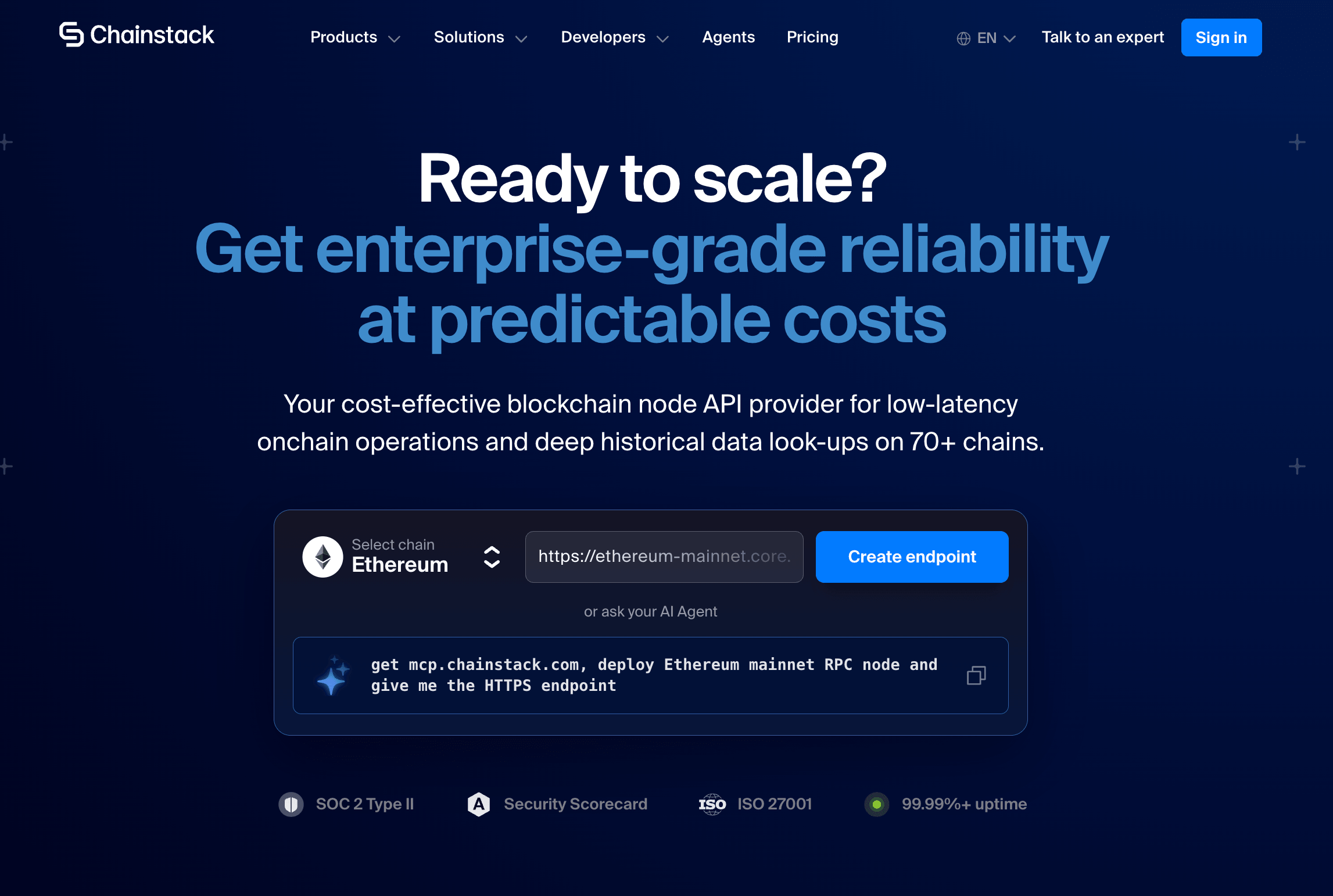
Chainstack runs a purpose-built fintech infrastructure offering on Arbitrum One, combining geo-balanced low-latency endpoints, full archive and trace access from $49/month, flat per-call pricing with no method multipliers, and two separately, externally audited compliance certifications — the combination regulated payment and stablecoin settlement teams need to clear procurement.
Compliance rests on two distinct reports, not one bundled claim: SOC 2 Type II, completed December 2025, and ISO 27001, completed July 2026. For fintech operators building under MiCA or the GENIUS Act, vendor attestation is shifting from a nice-to-have to a procurement gate, and Chainstack is one of a small number of RPC providers with both reports published rather than self-reported.
On infrastructure: Dedicated Nodes on Arbitrum One are available from the Pro plan ($199/month), giving payment processors isolated throughput instead of sharing a node with an unrelated tenant’s traffic spike. Global Nodes provide geo-balanced shared access with 99.99%+ uptime. Full archive, debug_*, and arbtrace_* access is available from Growth ($49/month) at 2 RU per request — every other call costs a flat 1 RU, with no method multipliers, which is what keeps the monthly invoice predictable at payment scale. MEV protection is switched on by default on Arbitrum Global Nodes at deployment, free on every plan tier including the free Developer plan, and can be turned off from the node’s Add-ons tab if a workflow specifically needs public-mempool behavior. For payment processors that want flat-fee throughput instead of per-request billing, the Unlimited Node add-on starts at $149/month for 25 RPS and scales to $3,199/month for 500 RPS. Teams that need to run Arbitrum nodes inside their own environment can also use Self-Hosted — Arbitrum One and Sepolia are both supported deployments per the supported clients and protocols docs. The enterprise plan adds a contractual SLA and dedicated account management for vendor due diligence.
Limitations: Archive and trace access require the Growth plan or above, not the free Developer tier. Dedicated Nodes and SSO both require Pro ($199/month) or higher, so teams evaluating on Growth won’t have either yet.
Fit by workload:
- Stablecoin payment settlement: Excellent — flat RU pricing removes the cost-forecasting problem method-weighted competitors create at volume.
- Compliance and audit trail reconstruction: Excellent — both certifications are externally audited, and trace/debug access starts at $49/month instead of being gated behind an enterprise-only tier.
- Tokenized asset / RWA infrastructure: Strong — archive depth and Dedicated Nodes cover the historical-state queries these platforms depend on.
RouteMesh
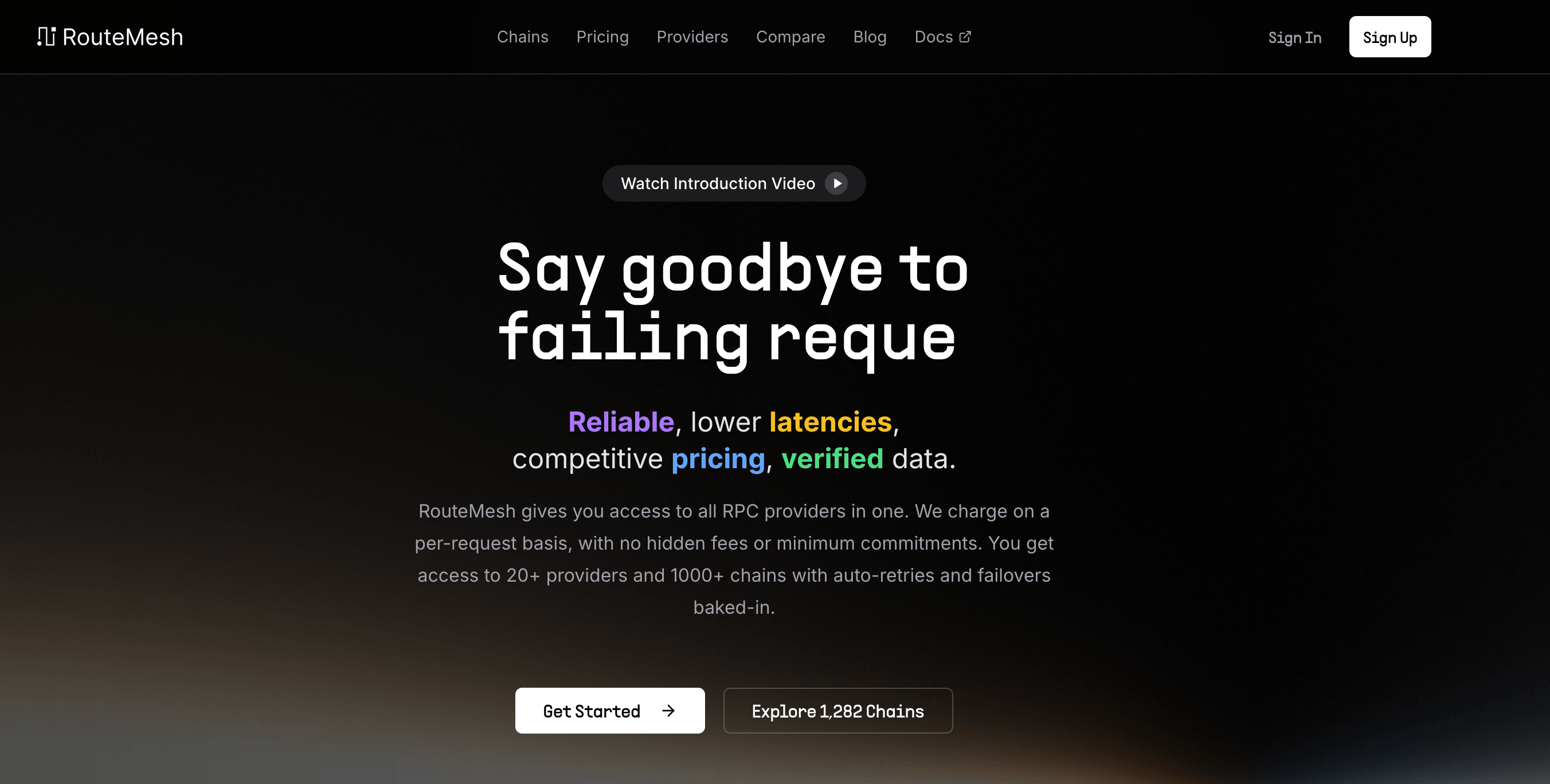
RouteMesh is an intelligent RPC routing layer covering 1,000+ EVM networks, including Arbitrum One, with automatic failover across its provider inventory and traffic migration to healthy infrastructure in under 15 seconds when a node degrades — the kind of resilience payment infrastructure needs when a dropped connection means a missed settlement window.
For fintech teams, the value is architectural rather than feature-specific: RouteMesh pools multiple upstream RPC providers (Chainstack among them) behind one endpoint, with replay checks and lag detection meant to catch stale or inconsistent responses before they reach the application layer — directly relevant to USDC balance queries where a stale read can trigger a false payment rejection. Pricing is per-request based on key type, chain, and method, and a free community endpoint is available without an API key for lower-stakes testing.
Limitations: As a routing layer rather than a node operator, RouteMesh’s compliance posture is a function of whichever upstream provider handles a given request rather than a single published certification — fintech teams should confirm which backend serves their traffic before relying on it for regulated workloads. It has no Dedicated Nodes offering of its own.
Fit by workload:
- Stablecoin payment settlement: Strong — the failover architecture is built for exactly this kind of uptime pressure.
- Compliance and audit trail reconstruction: Moderate, and it depends which upstream provider lands the request.
- Tokenized asset / RWA infrastructure: Good — broad EVM coverage helps multi-chain tokenization platforms, though a single provider’s own archive depth may serve compliance-heavy RWA reporting better.
OnFinality
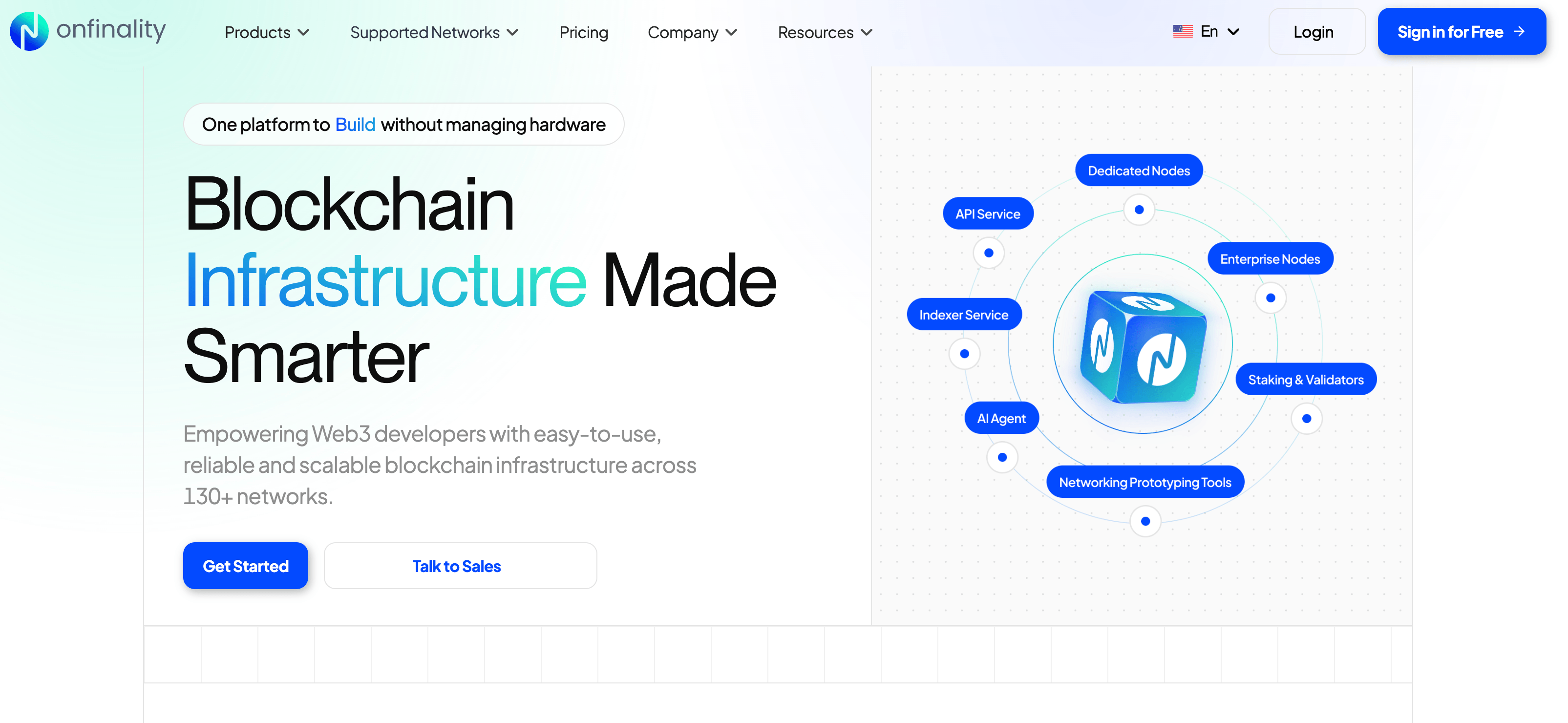
OnFinality operates a managed multi-chain node service across 100+ networks, with Arbitrum One coverage that includes archive access, trace/debug APIs, and endpoints across Hong Kong, France, and N. Virginia — a real option for fintech teams that need geographic diversity beyond one provider’s default regions.
Beyond the managed API, OnFinality offers Dedicated Node and Enterprise Node tiers plus managed SubQuery indexer hosting, which is a genuine differentiator for fintech platforms building reconciliation or reporting pipelines on top of raw RPC rather than just serving reads.
Limitations: OnFinality’s core strength is breadth across 100+ chains rather than depth on any single one — Arbitrum-specific SLA terms and certification scope should be confirmed directly during procurement rather than assumed from the general platform.
Fit by workload:
- Stablecoin payment settlement: Good — regional endpoint diversity helps latency-sensitive payment flows outside a single default region.
- Compliance and audit trail reconstruction: Strong — archive and trace/debug are both confirmed for Arbitrum.
- Tokenized asset / RWA infrastructure: Strong — managed SubQuery indexing is a real advantage for the reconciliation and reporting work RWA platforms need.
Blockdaemon
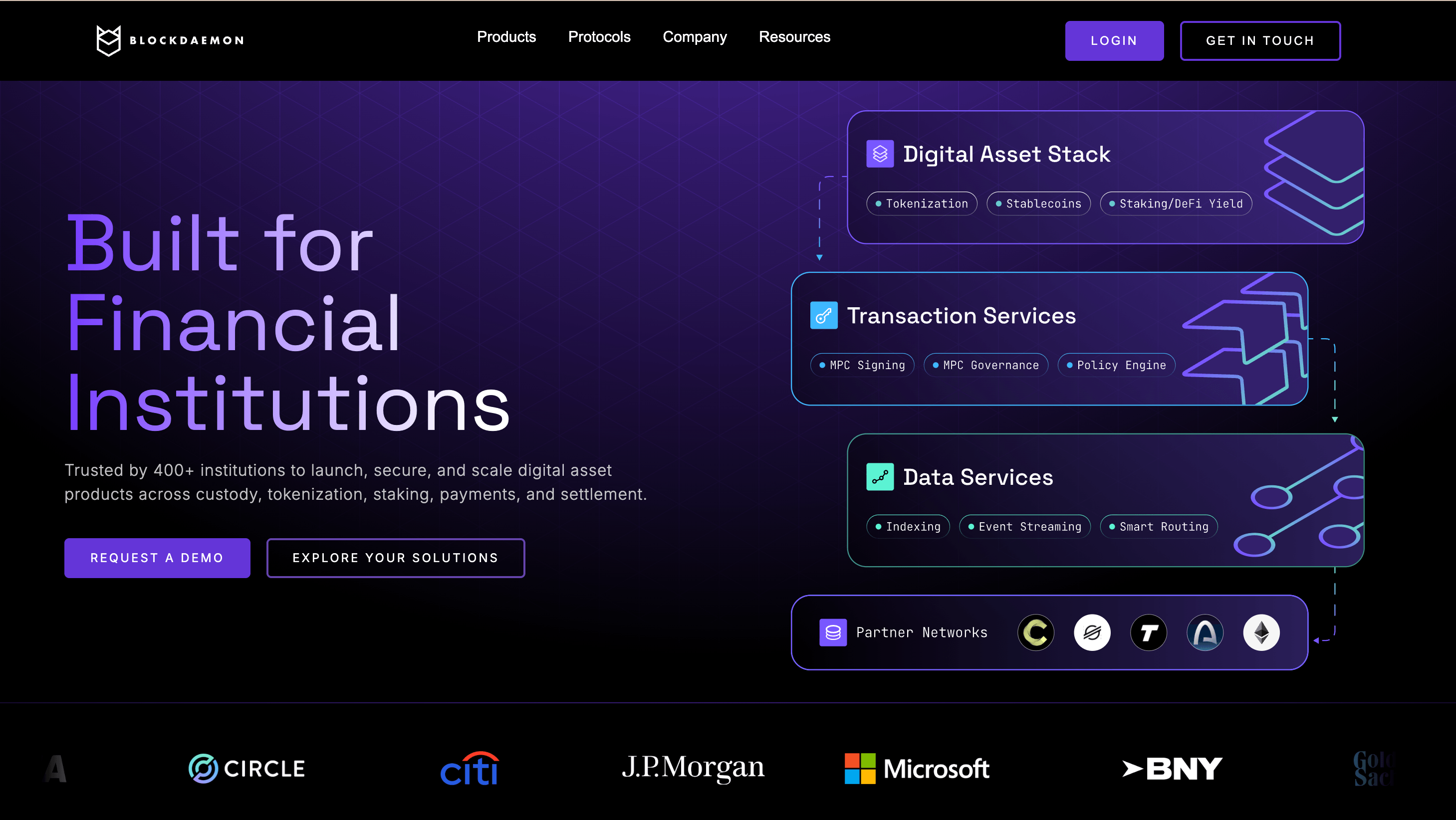
Blockdaemon is an institutional infrastructure provider offering Dedicated Nodes for Arbitrum with High-Availability Clusters and Smart Routing built to absorb unexpected load surges — positioned for custody, staking, and enterprise buyers rather than self-serve developers. It holds both SOC 2 Type II and ISO 27001 certification, the same dual-compliance story as Chainstack and Quicknode in this comparison.
Blockdaemon bundles nodes with custody and staking services, which fits institutions that already run asset infrastructure through Blockdaemon and want RPC access from the same vendor rather than adding a separate provider. Pricing is custom and requires a sales engagement rather than self-serve signup.
Limitations: No self-serve pricing or free tier — evaluation requires a sales conversation, a longer procurement cycle than API-key self-serve providers. It’s built for institutional buyers already in a custody or staking relationship, not for teams that just need a fast Arbitrum endpoint.
Fit by workload:
- Stablecoin payment settlement: Good — High-Availability Clusters and Smart Routing are built for exactly this kind of load resilience.
- Compliance and audit trail reconstruction: Strong — dual SOC 2 Type II and ISO 27001 certification matches the top compliance tier in this comparison.
- Tokenized asset / RWA infrastructure: Strong — institutional custody and staking bundling suits regulated tokenized-asset platforms already using Blockdaemon elsewhere.
Infura
Infura routes Arbitrum trace and debug calls through its Decentralized Infrastructure Network (DIN) rather than owned infrastructure — an architectural choice with direct implications for fintech audit trail reliability. DIN partners, not ConsenSys-operated nodes, handle arbtrace_ and debug_ requests, introducing reliability uncertainty that most fintech compliance teams would want to scrutinize before treating Infura as an audit trail provider.
WebSocket support for Arbitrum on Infura remains in public beta. Beta WebSocket is not appropriate for production fintech event listeners monitoring USDC Transfer events for payment confirmation — connection reliability and latency are not covered by production SLAs. Infura’s credit pricing applies heavy method multipliers: roughly 1,000 credits per debug call and 80 credits per eth_call. The free tier covers 100k credits per day, consumed by around 1,250 eth_call requests — insufficient for any production payment application.
The ConsenSys ecosystem integration (MetaMask, Truffle, Linea) is a genuine advantage for teams already embedded in that stack. For standalone Arbitrum fintech infrastructure, the DIN architecture for trace calls and the beta status of WebSocket subscriptions are risks worth pricing in.
Limitations: WebSocket in public beta, not production-ready for Arbitrum. Trace/debug routed through DIN partners — reliability is partner-dependent. Heavy method multipliers on credit pricing.
Fit by workload:
- Stablecoin payment settlement: Moderate — beta WebSocket is a real constraint for real-time payment monitoring.
- Compliance and audit trail reconstruction: Moderate — trace access exists but reliability depends on a third-party DIN partner, not Infura’s own infrastructure.
- Tokenized asset / RWA infrastructure: Moderate — strong ConsenSys tooling integration, weaker on the archive/trace depth regulated RWA reporting tends to need.
Alchemy
Alchemy is a strong general-purpose EVM provider with a polished developer experience, SOC 2 Type II certification, and a generous free tier of 30M Compute Units per month (roughly 1.15M eth_call requests at 26 CU each). Archive access is included across all tiers, including free. Its enhanced API — including alchemy_getAssetTransfers and transaction simulation — is genuinely useful for payment tracking and fraud screening workflows.
Alchemy does not support trace or debug APIs on Arbitrum One or Nova. debug_traceTransaction, arbtrace_transaction, arbtrace_call, and arbtrace_block are not available. This is a hard blocker for any fintech operator that needs to reconstruct transaction call trees for compliance audits or dispute resolution — which describes most regulated fintech use cases. Archive data for historical state is available, but the debug namespace is not. Alchemy has not published an ISO 27001 certification alongside its SOC 2 Type II report, which matters for procurement teams specifically checking for both.
CU pricing adds a second concern. eth_call costs 26 CU and eth_getLogs costs 75 CU, with complex simulation methods costing more. At 30M CU/month free, a payment app making 500k daily transaction receipt calls burns through the free tier in roughly two days.
Limitations: No trace or debug API support on Arbitrum — a disqualifying constraint for fintech use cases requiring audit trail access. No published ISO 27001. CU method multipliers complicate cost forecasting.
Fit by workload:
- Stablecoin payment settlement: Good — the enhanced transfer API is genuinely useful for payment tracking, latency aside.
- Compliance and audit trail reconstruction: Limited — no trace/debug on Arbitrum, and only one of the two certifications fintech procurement teams typically ask for.
- Tokenized asset / RWA infrastructure: Limited — the same trace/debug gap blocks the audit trail work RWA platforms need most.
Quicknode

Quicknode supports Arbitrum One and Nova with both HTTP and WebSocket endpoints. It holds SOC 2 Type II and ISO 27001 certifications — one of the few providers here with both — and its enterprise support tier offers dedicated technical account management. Archive and trace methods are available on paid plans, making it one of the small set of providers that can actually service fintech audit trail requirements.
Pricing is credit-based with method weighting, which introduces cost unpredictability at scale. Quicknode’s Flat Rate RPS for EVM chains starts at $799/month for 75 RPS — a better model for fintech workloads than the credit plans, but the entry price is well above Chainstack’s Growth plan for comparable trace access. Teams scaling past the free trial often find credit consumption outpaces what the headline pricing suggested, especially once debug calls or event log queries make up a meaningful share of the request mix.
The platform offers add-ons including QuickAlerts (WebSocket event notifications), analytics dashboards, and a marketplace of data add-ons. Dedicated clusters are available but require enterprise engagement for pricing. There’s no permanent free tier — only a 30-day trial — which limits evaluation flexibility compared to Chainstack’s or Alchemy’s permanent free plans.
Limitations: Credit-based billing with method multipliers makes cost modeling difficult at payment scale. Flat Rate RPS resolves this but starts at $799/month — a high entry point for teams that don’t yet need 75 RPS. No permanent free tier.
Fit by workload:
- Stablecoin payment settlement: Strong, once on Flat Rate RPS — the credit model alone is harder to forecast for steady payment volume.
- Compliance and audit trail reconstruction: Strong — dual SOC 2 Type II and ISO 27001, with trace access on paid plans.
- Tokenized asset / RWA infrastructure: Strong — the same certification and trace coverage that supports payments applies here too.
Getting started with fintech on Chainstack
Deploy a production Arbitrum endpoint in a few steps:
- Log in to the Chainstack console (or create an account).
- Create a new project
- Select Arbitrum as your blockchain protocol
- Choose network: Arbitrum One Mainnet or Arbitrum Sepolia testnet
- Deploy the node
- Open Access and credentials and copy your HTTPS and WebSocket endpoints
For payment infrastructure that can’t share a node with unrelated traffic, evaluate Dedicated Nodes after the initial deploy — available inside the same project from the Pro plan.
Code example: monitoring USDC Transfer events in real time
const { ethers } = require("ethers");

// WebSocket provider for persistent event monitoring
const provider = new ethers.providers.WebSocketProvider(
  "wss://YOUR_CHAINSTACK_ARBITRUM_WS_ENDPOINT"
);

// USDC contract — replace with your token address
const USDC_ADDRESS = "YOUR_USDC_CONTRACT_ADDRESS";
const USDC_ABI = ["event Transfer(address indexed from, address indexed to, uint256 value)"];
const usdc = new ethers.Contract(USDC_ADDRESS, USDC_ABI, provider);

// Your settlement address to watch for incoming payments
const SETTLEMENT_ADDRESS = "YOUR_SETTLEMENT_ADDRESS";

usdc.on("Transfer", (from, to, value, event) => {
  if (to.toLowerCase() === SETTLEMENT_ADDRESS.toLowerCase()) {
    const amount = ethers.utils.formatUnits(value, 6); // USDC uses 6 decimals
    console.log(`Payment received: ${amount} USDC from ${from}`);
    console.log(`Transaction: ${event.transactionHash}`);
  }
});
The Arbitrum tooling documentation covers viem, ethers.js, Web3.py, and Hardhat setup in full detail.
🤖 You can also access Chainstack Arbitrum RPC directly from Claude, Cursor, Codex, Windsurf, Gemini CLI, GitHub Copilot, Antigravity, Claude.ai, or ChatGPT using Chainstack MCP. For a fuller agent stack — MCP, the Chainstack skill, llms.txt for context ingestion, and WebMCP for agentic browsers — see the Chainstack Agents page.
Conclusion
For fintech on Arbitrum, the compliance filter narrows the field before pricing or latency come into play: SOC 2 Type II and ISO 27001 — as two separately audited reports, not one bundled claim — combined with native trace/debug access rule out more than half the providers in this comparison before cost modeling even starts.
- Stablecoin payment processors and settlement infrastructure: Chainstack — SOC 2 Type II and ISO 27001 as separate audited certs, native trace/debug from $49/month, Unlimited Node add-on for flat-fee throughput.
- Regulated fintech that wants dual SOC 2 + ISO 27001 with self-serve signup: Quicknode — both certifications published, trace access available on paid plans, Flat Rate RPS for predictable throughput.
- Institutional platforms already using custody or staking through one vendor: Blockdaemon — same dual-certification story, bundled with the custody/staking relationship.
- Multi-region failover as a resilience layer in front of a primary provider: RouteMesh — automatic failover across upstream providers with sub-15-second traffic migration.
- Reconciliation and reporting pipelines for tokenized-asset platforms: OnFinality — managed SubQuery indexing alongside archive and trace access.
Frequently asked questions
Q: Which Arbitrum-specific trace methods do fintech operators need for compliance audit trails?
Arbitrum uses two trace namespaces depending on era. For transactions after the Nitro upgrade, debug_traceTransaction and debug_traceBlock provide full call traces. For pre-Nitro history, arbtrace_transaction, arbtrace_call, and arbtrace_block are required. Both namespaces require an archive node and are unavailable on shared free-tier endpoints, and neither is supported at all on Alchemy for Arbitrum.
Q: Which Arbitrum RPC providers offer a permanent free tier for evaluating fintech infrastructure?
Chainstack’s Developer plan (3M RU/month, 25 RPS) and Alchemy’s free tier (30M CU/month) are both permanent, no-card-required plans. Quicknode’s entry offering is a 30-day trial rather than a standing plan. Neither RouteMesh’s free community endpoint nor Blockdaemon’s sales-only model is a self-serve free tier in the same sense — RouteMesh’s is usable immediately, Blockdaemon’s requires a sales conversation before any pricing is visible.
Q: What’s involved in migrating a fintech app from a provider without Arbitrum trace support to one that has it?
The endpoint swap itself is a config change — point the RPC URL at the new provider and redeploy. The real work is validating that debug_traceTransaction or arbtrace_* calls return consistent results against your existing dispute-resolution and reconciliation logic before cutting traffic over, and confirming the new provider’s archive depth covers however far back your compliance retention window requires. Run both providers in parallel against a sample of historical transactions before decommissioning the old endpoint.
Q: What latency should I target for Arbitrum payment confirmation endpoints?
Arbitrum’s block time is roughly 250ms, so most of the latency budget for eth_getTransactionReceipt comes from the RPC provider’s response time rather than block production. Dedicated endpoints consistently hold tighter p95s than shared endpoints, since shared infrastructure can spike under load from unrelated tenants. Benchmark candidate providers with a curl timing loop or k6 script from your application’s region before committing, and check compare.chainstack.com for a live cross-provider view on Arbitrum.
Q: Which RPC providers hold SOC 2 Type II and ISO 27001 certification for Arbitrum fintech infrastructure?
As of August 2026, Chainstack (SOC 2 Type II completed December 2025, ISO 27001 completed July 2026), Quicknode, and Blockdaemon publish both certifications. Alchemy holds SOC 2 Type II but has not published ISO 27001. RouteMesh and OnFinality don’t publish a single certification of their own — RouteMesh’s posture depends on the upstream provider handling a given request. For regulated fintech procurement, always verify the specific scope of any certification directly with the vendor rather than assuming parity across providers.
Q: How does Chainstack’s RU pricing compare to CU-based providers for fintech workloads on Arbitrum?
Chainstack charges 1 RU per request regardless of method — eth_call, eth_getLogs, and debug_traceTransaction all cost 1 RU, with archive requests at 2 RU. Alchemy charges 26 CU per eth_call and 75 CU per eth_getLogs; Infura charges roughly 80 credits per eth_call and 1,000 per debug call. For a fintech workload with heavy eth_call and eth_getLogs volume, that difference compounds fast once debug or trace calls enter the request mix — model your own request breakdown rather than comparing headline prices directly.
Additional resources