AI-ready infrastructure
 Refer and earn


 Ethereum
 Hyperliquid
 Solana
 Arbitrum
 BNB Smart Chain
 Base
Base Polygon
 TRON
TRON Sui
Sui Robinhood


Top 7 Ethereum RPC providers for stablecoin infrastructure in 2026

Ethereum carries more stablecoin supply than any other chain, and an RPC outage here can stall payment rails moving billions in USDC and USDT a day. Stablecoin supply crossed $320 billion in May 2026, with over $150 billion of it on Ethereum mainnet, and Circle‘s USDC and Tether‘s USDT moved a combined $8 trillion across Ethereum in Q4 2025 alone.
MiCA’s full enforcement window opened July 1, 2026, and the GENIUS Act’s monthly reserve-attestation requirement is now more than a year into production use — both regimes are live, not upcoming. Monthly attestations lean on eth_call reads against reserve contracts, and MiCA’s daily transaction cap for non-EU-currency stablecoins pushes issuers toward continuous eth_getLogs monitoring to track volume in near real time. The infrastructure implications of both are covered in Chainstack’s 2026 crypto regulation guide.
This guide ranks seven Ethereum RPC providers on what actually matters for stablecoin operations: settlement throughput, nonce handling, real-time monitoring, and the compliance documentation both regimes now require from infrastructure vendors.
💡 Already using Chainstack? Jump straight to the Ethereum tooling docs or deploy your endpoint in minutes.
Stablecoin infrastructure on Ethereum: RPC requirements
Stablecoin operations are write-heavy and continuously monitored — a different shape than the read-heavy queries most Ethereum dapps generate. An issuer moving thousands of USDC transfers a day can’t absorb a throttled eth_sendRawTransaction call, a dropped WebSocket subscription mid-settlement, or a rate-limited eth_getLogs scan during end-of-day reconciliation.
Proof-of-reserves attestations, mandatory monthly under the GENIUS Act, add a second workload: periodic eth_call reads against reserve contracts that need consistent state, not a degraded shared endpoint under concurrent load. MiCA’s daily cap on non-EU-currency stablecoin transfers (1 million transactions or €200 million, whichever is lower) means issuers serving EU users have to instrument transfer volume continuously rather than check it at month-end.
Latency and throughput profile
Stablecoin payment rails run sustained write throughput (50–300 RPS for large issuers) alongside continuous read monitoring — two patterns that stress different parts of a provider’s stack:
- Transaction submission —
eth_sendRawTransactionat sustained high RPS, with nonce management to prevent queue buildup behind a single stuck transaction. - Settlement monitoring — WebSocket
eth_subscribe(logs) on stablecoin contract addresses for real-time Transfer event detection. A dropped subscription means a missed settlement event, which triggers manual reconciliation. - Attestation reads — periodic
eth_callagainst reserve contracts for proof-of-reserves. These are bursty and low-RPS, but they can’t be throttled or return stale state.
A shared endpoint that rate-limits by method fails all three patterns at once during peak traffic. Issuers running sustained volume above a shared plan’s blended RPS ceiling move to dedicated throughput instead of tuning around the limit.
Key RPC methods for stablecoin infrastructure
eth_sendRawTransaction submits every transfer, mint, or redemption an issuer initiates. At high volume, a provider that queues or throttles this call under load creates a visible settlement delay — EIP-1559 type-2 transaction handling (maxFeePerGas, maxPriorityFeePerGas) is table stakes at this point.
eth_getTransactionCount retrieves the nonce, and it’s the most underappreciated method in high-volume stablecoin infrastructure. Concurrent submission from a single issuer address creates race conditions if nonce reads return stale state — the pending tag returns the next nonce including in-flight transactions, which matters for any concurrent submission pattern. See Chainstack’s Ethereum nonce management guide for production patterns, including stuck-transaction replacement.
eth_getLogs indexes Transfer, Mint, and Burn events for MiCA volume monitoring. Issuers track daily transaction counts and aggregate values against multiple contract addresses, typically with 5,000-block range windows. This method does not require an archive node for recent-block scans — a full node handles rolling-window monitoring; archive only enters the picture for point-in-time historical reads.
eth_subscribe (logs) delivers Transfer events over WebSocket within the same block they confirm, removing the polling latency of repeated eth_getLogs calls. For payment rails where settlement confirmation triggers a downstream action — unlocking funds, updating a balance, kicking off a bridge transfer — subscription reconnect handling and filter persistence across reconnects are the operational details that matter.
eth_call reads reserve contract state for GENIUS Act attestations and checks ERC-20 allowances before processing delegated transfers. At "latest", a full node handles it; a point-in-time historical read for a month-end attestation snapshot needs archive access. Providers with method-weighted billing charge multiples of a standard call here — see the pricing subsection below.
eth_estimateGas and eth_feeHistory together drive fee strategy. Underpaying stalls a transaction during congestion; overpaying wastes gas at volume. Accurate estimates depend on a node that’s actually in sync with mainnet state — a lagging node returns wrong numbers with no error to flag it.
eth_getTransactionReceipt confirms settlement. The status field (1 success, 0 reverted) plus emitted logs are the definitive record, called on every submitted transaction — it needs to return reliably immediately after confirmation, not eventually.
Infrastructure requirements
Sustained throughput is the primary requirement for active payment rails. Shared endpoints throttle at the plan’s blended RPS limit across every method combined; dedicated infrastructure isolates the workload from everyone else on the same cluster. Chainstack’s Unlimited Node add-on runs flat-rate tiers from $149/month at 25 RPS up to $3,199/month at 500 RPS with no per-request charges, and Dedicated Nodes start at $0.50/hour compute for fully isolated capacity.
WebSocket stability matters more here than for most workloads, because a dropped subscription means a missed settlement event rather than just a slower response. A provider that silently drops connections under load pushes reconnection engineering onto the issuer’s side.
Pricing model at scale decides whether the monthly bill is forecastable. The formula every issuer should apply before picking a plan: true cost per call = (method’s CU/credit weight × price per million units) ÷ 1,000,000 — multiply by monthly call volume for the real bill. Method-weighted billing applies that multiplier to eth_call and eth_getLogs specifically, the two methods a stablecoin issuer’s attestation and monitoring workloads run constantly — see the interactive cost calculator for current multipliers across providers rather than a number frozen at publish time.
MEV protection ships switched on by default on Chainstack’s Ethereum Global Nodes (also BNB Smart Chain), routing signed transactions to a private builder network instead of the public mempool. It’s a real consideration for large USDC or USDT transfers that could move a dependent DeFi pool’s price if visible in the mempool first — disabling it is one toggle in the node’s Add-ons tab if a workflow doesn’t need it.
SOC 2 Type II is becoming a GENIUS Act vendor-attestation line item. A monthly attestation package that names its infrastructure vendor’s security controls has a documentation gap if that vendor has no audited report to attach.
For the full method list and less-common calls, see the Ethereum API reference.
Ethereum RPC providers for stablecoin infrastructure
The table below summarizes public positioning as of August 2026.
| Provider | Pricing model | Free tier | Dedicated nodes | MEV protection | Why it matters for stablecoin infra |
|---|---|---|---|---|---|
| Chainstack | Flat RU (1 RU full, 2 RU archive/trace) | 3M RU/mo, 25 RPS, no card | Yes, from $0.50/hr | Yes (default on) | Dedicated stablecoin product page, flat eth_call billing, SOC 2 + ISO 27001 |
| RouteMesh | Per-request, $3–$6/M | Free community endpoint (rate-limited) | Not applicable (routing layer) | Depends on routed backend | Multi-provider failover keeps submission alive if one backend degrades |
| Uniblock | CU-based, free through $549/mo tiers | Yes, 40M CU/mo | Not applicable (aggregation layer) | Depends on routed backend | Webhook-based settlement delivery without managing raw WebSocket reconnects |
| Blockdaemon | Custom, contact-based | No | Yes (Node Clusters) | Not documented | Institutional compliance stack (SOC 2 + ISO 27001) built for regulated buyers |
| Infura | Credit-based, daily quota | Yes, 3M credits/day | Enterprise only | Not documented | Daily quota resets create mid-day exhaustion risk at high settlement volume |
| Alchemy | CU-based PAYG, $0.45/1M (tiered) | Yes, 30M CU/mo | No standard offering | Not documented | Notify + Transact APIs ease event delivery and nonce handling for smaller issuers |
| Quicknode | Credit-based, tiered plans | 1-month trial, 10M credits | Yes (Enterprise) | Not documented as default | Streams delivers settlement events without raw WebSockets; dual SOC 2 + ISO 27001 |
Chainstack
Chainstack runs Ethereum RPC infrastructure with a dedicated stablecoin infrastructure product page and named enterprise clients including Circle, Rabobank, Itaú, and Trust Wallet — the only provider in this comparison with a stablecoin-specific landing page and public reference customers in the space.
The flat 1 RU per request model (2 RU for archive and debug/trace calls) is the differentiator that matters most for attestation-heavy operators: an issuer running thousands of daily eth_call reads for proof-of-reserves pays the same per-call rate as eth_blockNumber. Plans run from the free Developer tier (3M RU/month, 25 RPS) through Growth ($49/month, 20M RU, 250 RPS), Pro ($199/month, 80M RU, 400 RPS), and Business ($499/month, 200M RU, 600 RPS), with Enterprise contracts from $990/month for custom throughput. Dedicated Nodes start at $0.50/hour compute, with Bolt fast-sync cutting node startup time when spinning up additional capacity, and the Unlimited Node add-on runs flat RPS tiers from $149/month for teams that want submission throughput billed independent of call volume. Ethereum is also on Chainstack’s Self-Hosted roster (Reth + Prysm, mainnet plus Sepolia and Hoodi testnets), for issuers whose data-sovereignty requirements rule out shared cloud infrastructure entirely.
Chainstack’s SOC 2 Type II certification (December 2025) and ISO 27001 certification (July 2026) cover the security-controls documentation a GENIUS Act attestation package needs to name its infrastructure vendor by. The enterprise plan adds SSO and granular role-based access for teams assembling that documentation, and the Enterprise Support SLA commits to a 99.9% quarterly uptime guarantee with sub-1-hour response on Premium support.
Here’s a WebSocket subscription that watches a stablecoin contract for Transfer events in real time, using ethers.js:
import { ethers } from "ethers";

// Chainstack WebSocket endpoint
const provider = new ethers.WebSocketProvider("YOUR_CHAINSTACK_WSS_ENDPOINT");

// Stablecoin contract to watch (your USDC/USDT deployment)
const TOKEN_ADDRESS = "YOUR_TOKEN_CONTRACT_ADDRESS";
const TRANSFER_TOPIC = ethers.id("Transfer(address,address,uint256)");

provider.on(
  { address: TOKEN_ADDRESS, topics: [TRANSFER_TOPIC] },
  (log) => {
    const from = ethers.getAddress("0x" + log.topics[1].slice(26));
    const to = ethers.getAddress("0x" + log.topics[2].slice(26));
    console.log(`Settlement: ${from} -> ${to} | tx ${log.transactionHash}`);
  }
);

provider.on("error", (err) => console.error("WebSocket error:", err));
The Ethereum tooling documentation covers full setup, including viem and Web3.py equivalents.
Limitations: The Unlimited Node add-on‘s flat RPS tiers can be over-provisioned for issuers with genuinely spiky traffic rather than sustained load. MEV protection routes through a third-party builder network, which is one more dependency to monitor even though it’s opt-out rather than opt-in.
Fit for stablecoin infrastructure: Excellent — dedicated product page with named clients, flat eth_call billing removes the attestation-cost problem outright, and dual SOC 2 + ISO 27001 covers the GENIUS Act documentation ask.
RouteMesh

RouteMesh is an intelligent RPC routing layer that sits in front of 21 underlying providers on Ethereum mainnet, covering 85 methods and picking a route per request based on live health scoring rather than a static endpoint list. A free community tier (lb.routeme.sh/rpc/evm/1) handles reads at shared rate limits, while paid tiers price at $3.00 per million requests (standard) or $6.00 per million (premium), with transaction sends directed to premium infrastructure for delivery reliability.
For stablecoin payment rails, the pitch is resilience rather than raw capability: if one upstream provider degrades or rate-limits mid-settlement, RouteMesh’s automatic failover keeps the submission path alive without the issuer’s own code needing to detect the failure and retry against a backup endpoint. That’s a genuinely different problem than the one raw RPC access solves, and it’s worth layering on top of a primary provider for teams running settlement infrastructure across multiple regions.
Limitations: RouteMesh doesn’t operate its own archive nodes or offer dedicated infrastructure — it routes to whatever the underlying 21 providers expose, so archive depth and MEV protection depend on which backend a given request lands on. Neither SOC 2 nor ISO 27001 is published, so a regulated attestation package still needs a certified primary provider behind it.
Fit for stablecoin infrastructure: Good as a resilience layer — the failover model is a real answer to “what happens when my primary endpoint degrades mid-settlement,” but it isn’t the vendor a GENIUS Act attestation package names on its own.
Uniblock
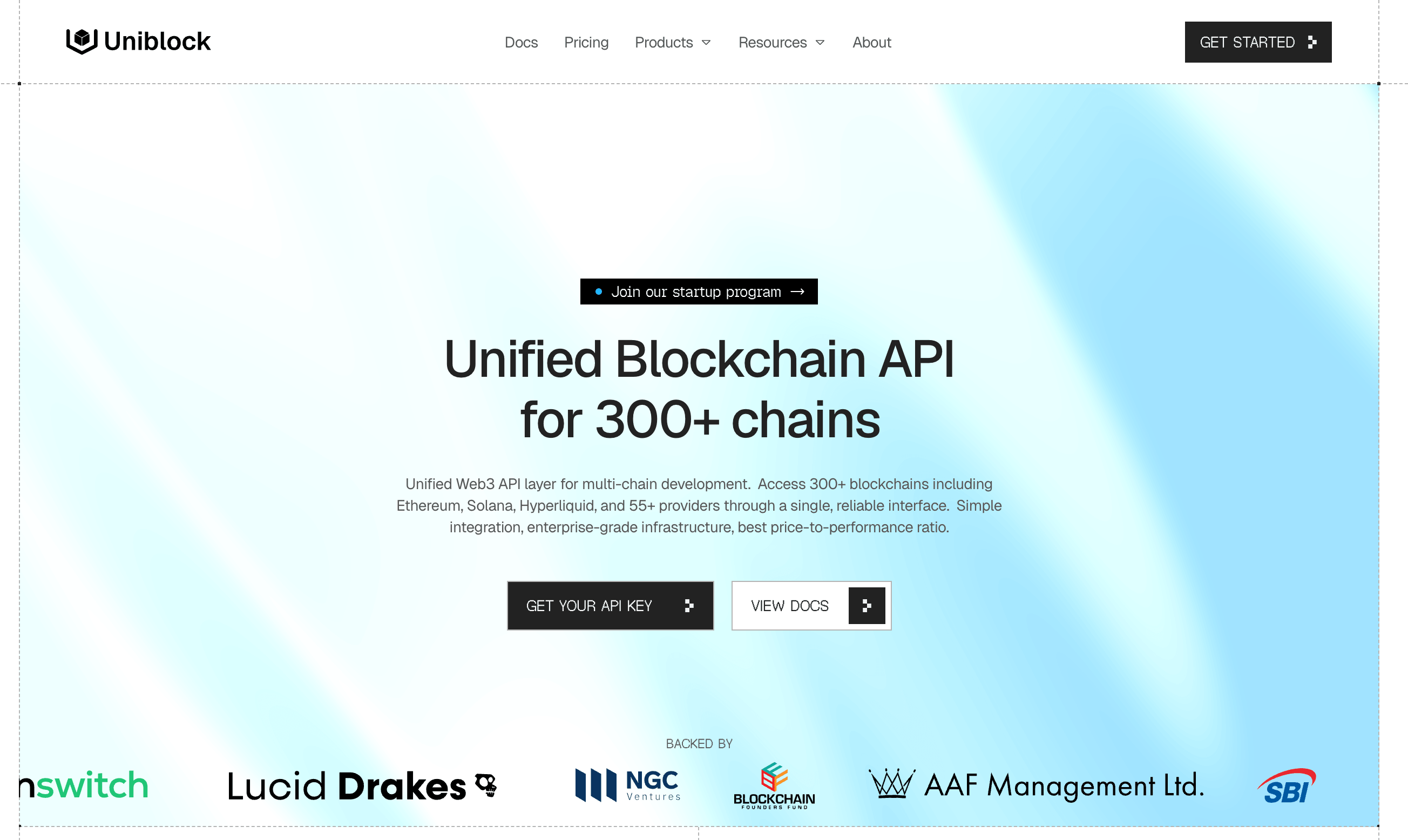
Uniblock pools 55+ underlying RPC providers behind a single Unified API covering 300+ blockchains, including Ethereum, with automatic routing and failover across that pool plus a Direct Provider APIs tier for methods that haven’t been standardized yet. The free Startup tier includes 40 million CUs and 1,000 CU/s; Growth runs $49/month for 500 million CUs, up through Business at $549/month for 5.5 billion CUs and a custom Enterprise tier above that.
The webhook and WebSocket layer on top of Unified APIs is the part most relevant to stablecoin settlement monitoring: instead of managing raw eth_subscribe reconnect logic in-house, a reconciliation pipeline can subscribe to Transfer events as a managed stream and let Uniblock absorb the underlying provider churn. Pooling 55+ providers behind one API also means more aggregate rate-limit headroom during a traffic spike than any single upstream plan would offer alone.
Limitations: Certifications and archive depth are a function of whichever underlying provider serves a given request, and Uniblock’s own trust documentation doesn’t publish SOC 2 or ISO 27001 status independent of that pool. Dedicated infrastructure isn’t part of the product — it’s an aggregation layer, not a node operator.
Fit for stablecoin infrastructure: Good for event-delivery pipelines and rate-limit headroom during bursts, but the same compliance-documentation gap as RouteMesh limits it to a complementary role rather than the primary attestation-package vendor.
Blockdaemon
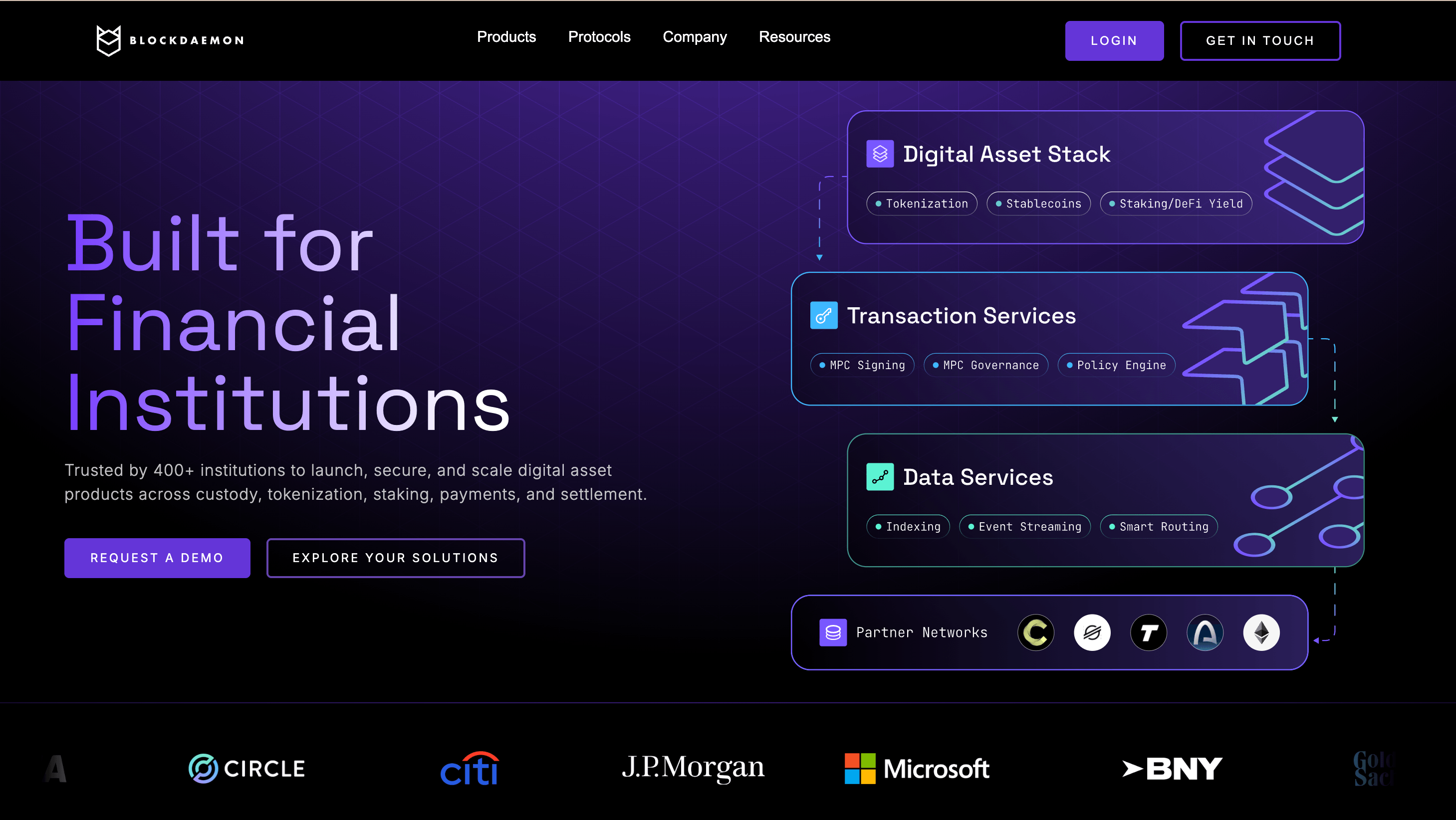
Blockdaemon runs Ethereum RPC and Node Clusters as part of a broader institutional stack that also covers custody (Institutional Vault, a self-hosted MPC wallet) and staking — built explicitly for “the world’s most regulated institutions” rather than individual developers. Both SOC 2 Type II and ISO 27001 are published, and pricing is contact-based across the board rather than published tiers.
For a stablecoin issuer that’s already a bank, asset manager, or exchange evaluating vendors through a formal procurement process, Blockdaemon’s positioning as custody-plus-nodes-plus-staking under one compliance umbrella is a legitimate fit — the sales motion assumes a due-diligence process rather than a self-serve signup. That’s a different buyer than the developer spinning up an endpoint from a console in ten minutes.
Limitations: No public pricing or free tier means there’s no way to evaluate the product without engaging sales first, which rules it out for early-stage teams or anyone prototyping before committing budget. No documented MEV protection.
Fit for stablecoin infrastructure: Strong for institutions already inside a formal vendor-onboarding process, where the certifications and custody adjacency are real assets. Teams still validating their integration have no self-serve path to try it first.
Infura
Infura carries deep brand recognition through its MetaMask and ConsenSys lineage and serves a large share of Ethereum’s largest protocols. Pricing runs on a daily credit quota: Core is free at 3 million credits/day, Developer is $50/month for 15 million credits/day, and Team is $225/month for 75 million credits/day, with Enterprise custom above that.
The daily-quota structure is the operational concern for stablecoin workflows specifically: a payment rail processing unevenly through the day can exhaust its quota before the calendar reset, causing a mid-day outage rather than a graceful throttle. For a settlement system where a missed window means delayed payments, that failure mode is worth modeling against actual traffic shape before committing.
Limitations: No published SOC 2 or ISO 27001 compliance documentation, which is a real gap for a GENIUS Act attestation package. Dedicated infrastructure isn’t part of the published tiers — it sits behind the custom Enterprise conversation.
Fit for stablecoin infrastructure: Moderate — the daily quota model needs careful capacity planning for high-volume rails, and the missing compliance documentation limits it for issuers building a formal vendor-attestation package.
Alchemy
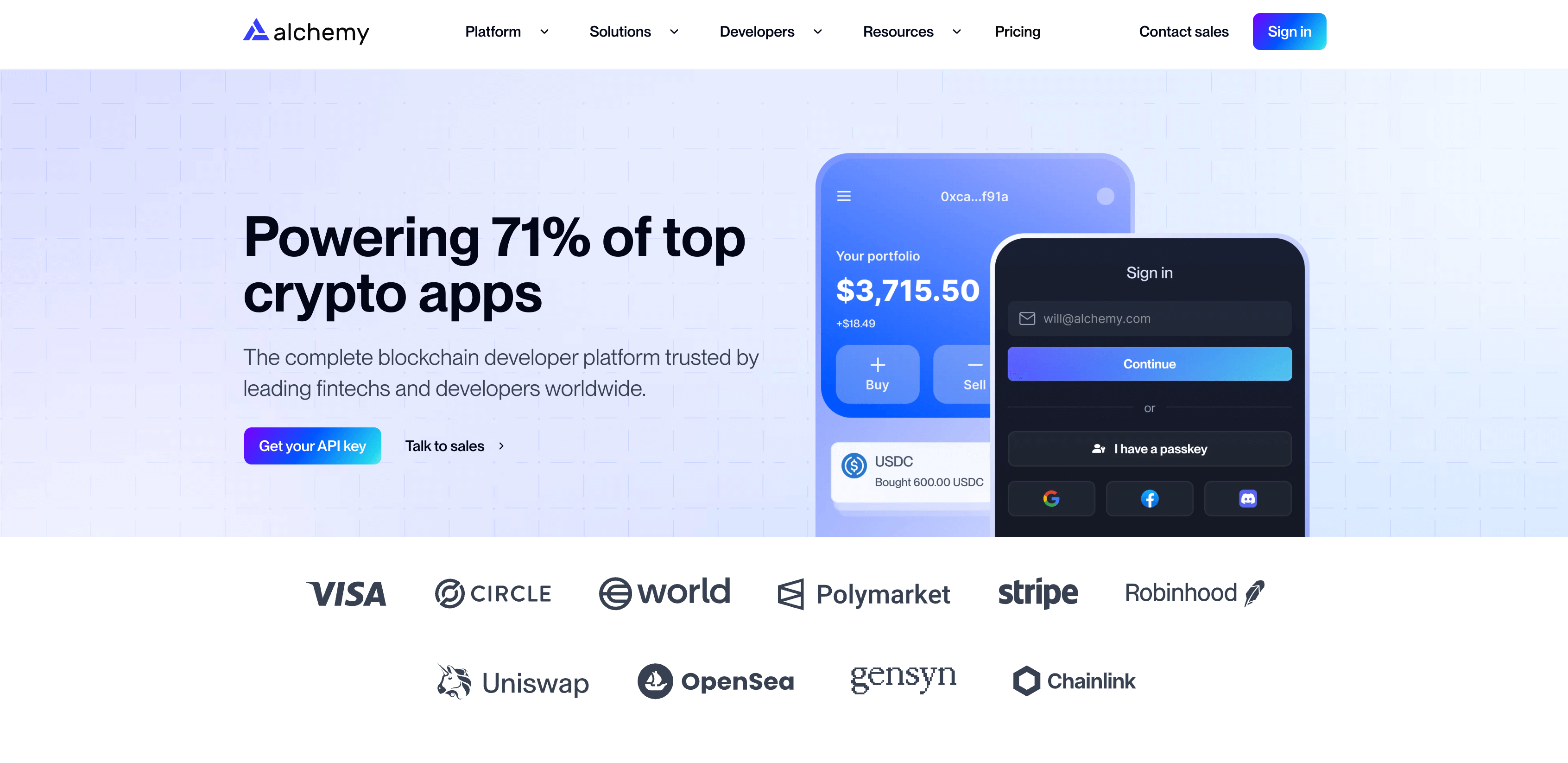
Alchemy’s Notify product delivers webhook notifications for Transfer events, and its Transact API adds managed transaction submission with automatic nonce handling and gas estimation — addressing two of the operational pain points in this guide’s method list directly. The free tier includes 30 million CU/month at 25 RPS, with pay-as-you-go billing at $0.45 per million CU for the first 300 million and $0.40 per million above that.
Compute-unit billing weights heavier calls more than simple reads, and eth_call — the method proof-of-reserves attestations run constantly — falls into that heavier category. At meaningful daily attestation volume, that consumes CU quota faster than the headline plan size suggests. Alchemy’s own security documentation references SOC 2 controls at the infrastructure level; a specific, current ISO 27001 certification isn’t published, so issuers should confirm exact certification status directly with Alchemy before citing it in a vendor-attestation package.
Limitations: No standard dedicated node offering — production isolation isn’t available outside a custom Enterprise conversation. CU-weighted billing on eth_call makes attestation-heavy workloads costlier to forecast than flat-rate alternatives.
Fit for stablecoin infrastructure: Moderate — Notify and Transact genuinely simplify settlement monitoring and nonce handling for smaller issuers, but the CU cost on attestation reads and the compliance documentation gap limit it for large-scale regulated operations.
Quicknode

Quicknode’s Streams product delivers on-chain events — including Transfer events — through webhooks, S3 buckets, or SQL queries, turning WebSocket reliability into a managed data pipeline rather than something an issuer’s own code has to handle. Quicknode holds both SOC 2 Type II and ISO 27001 certification, making it one of two providers in this comparison with both. Plans run Build ($49/month, 80M credits, 50 RPS) through Accelerate, Scale, Business, and Business+ tiers up to $2,999/month, with dedicated infrastructure available from Enterprise.
Method-weighted credit billing is the primary cost concern for stablecoin operators here: heavier calls consume credits at a multiple of a simple read, and the free entry point is a one-month trial rather than a permanent tier — teams evaluating without committing to a paid plan need to plan around that clock. At production volume, credit consumption on attestation-heavy workloads tends to outpace what the headline plan size suggests, so it’s worth running the actual numbers through a cost calculator before settling on a tier.
Limitations: No permanent free tier — the one-month trial converts or lapses rather than continuing indefinitely. Dedicated infrastructure sits behind the Enterprise tier, so mid-market teams share endpoints with the broader user base.
Fit for stablecoin infrastructure: Strong — Streams and dual certification cover real operational and compliance needs, but the trial-only free tier and credit-weighted billing on heavy calls are worth modeling before committing at scale.
Real-world performance benchmark
Ethereum is one of the chains tracked on the Chainstack performance comparison, which updates every few minutes across providers. As of this writing, the tracker’s blended availability-and-latency ranking for Ethereum shows Alchemy and Quicknode ahead of Chainstack on raw P95 latency, while all three hold identical 99.98% availability:
| Provider | Availability | P95 latency |
|---|---|---|
| Alchemy | 99.98% | 330 ms |
| Quicknode | 99.98% | 454 ms |
| Chainstack | 99.98% | 689 ms |
| dRPC | 99.77% | 1.10 s |
That ranking blends a general method mix across all traffic the tracker samples — it isn’t isolated to the write-path methods (eth_sendRawTransaction, eth_getTransactionReceipt) that actually drive settlement confirmation speed for a payment rail, nor does it capture cost, archive depth, or compliance documentation, all of which carry more weight for a regulated stablecoin operator than a few hundred milliseconds of blended P95. For a method-level breakdown by region, the Chainstack performance dashboard has the drill-down; for a specific settlement path, benchmarking the exact method mix from the target deployment region remains the only number that actually predicts production behavior.
Getting started with Ethereum on Chainstack
Deploy a production Ethereum endpoint for stablecoin infrastructure in a few steps and build better with Ethereum on Chainstack:
- Log in to the Chainstack console (or create an account).
- Create a new project
- Select Ethereum as your blockchain protocol
- Choose network: Ethereum Mainnet or Sepolia / Hoodi testnet
- Deploy the node
- Open Access and credentials and copy your HTTPS and WebSocket endpoints
For payment rails that outgrow a shared endpoint’s blended RPS limit, evaluate Dedicated Nodes or the Unlimited Node add-on after the initial deploy — both are available inside the same project without a separate signup.
Need testnet ETH for integration testing? Grab some from the Chainstack Sepolia faucet.
🤖 You can also access Chainstack Ethereum RPC directly from Claude, Cursor, Codex, Windsurf, Gemini CLI, GitHub Copilot, Antigravity, Claude.ai, or ChatGPT using Chainstack MCP. For a fuller agent stack — MCP, the Chainstack skill, llms.txt for context ingestion, and WebMCP for agentic browsers — see the Chainstack Agents page.
Conclusion
For Ethereum stablecoin infrastructure in 2026, the decision comes down to whether a provider’s pricing model and compliance documentation survive contact with a real attestation package — not which one benchmarks fastest on a generic call.
- For production rails needing GENIUS Act attestation documentation: Chainstack or Quicknode — both hold published SOC 2 Type II and ISO 27001, both offer dedicated infrastructure
- For high-volume proof-of-reserves and
eth_call-heavy attestation workflows: Chainstack — flat 1 RU per call regardless of method, with a dedicated stablecoin infrastructure page and named enterprise clients - For institutions already inside a formal procurement process: Blockdaemon — custody, staking, and nodes under one compliance umbrella, contact-based pricing
- For settlement-event delivery without managing raw WebSockets: Quicknode Streams, Alchemy Notify, or Uniblock’s Unified APIs webhook layer — pick based on which certification and cost model fits
- For resilience layered on top of a primary provider: RouteMesh’s multi-backend failover is a genuine answer to endpoint degradation mid-settlement
- For development and testing: any provider’s free tier is sufficient; validate against a certified provider before promoting to production
Frequently asked questions
Q: Does proof-of-reserves attestation under the GENIUS Act require an Ethereum archive node?
Only for historical snapshots — verifying a reserve balance at a prior reporting period’s close, for example. Live attestations using eth_call at "latest" run fine on a full node. Chainstack includes archive access from the Growth plan up.
Q: Which providers in this comparison hold both SOC 2 Type II and ISO 27001?
Chainstack (SOC 2 Type II in December 2025, ISO 27001 in July 2026) and Quicknode are the only two providers here with both certifications published. Blockdaemon also holds both but sells through a contact-based enterprise process rather than self-serve plans. Alchemy and Infura have not published both; always request the current audit report directly from a vendor before citing it in a GENIUS Act attestation package.
Q: What’s the migration path from a daily-quota provider like Infura to flat-rate billing?
Point the application’s RPC URL at the new endpoint, confirm method support and archive depth match, and run both endpoints in parallel briefly to compare response shape before cutting over nonce-sensitive submission paths. The main behavioral difference to test for is how each provider handles concurrent eth_getTransactionCount reads under load, since that’s where migration bugs usually surface first.
Q: How should I benchmark Ethereum RPC latency for a stablecoin payment rail specifically?
eth_sendRawTransaction propagation time and eth_getTransactionReceipt response latency are the metrics that actually matter for settlement UX — not a blended eth_blockNumber average. The Chainstack performance dashboard has method-level data across providers and regions, but running the exact method mix from the target deployment region is still the number that predicts production behavior.
Q: Does MiCA’s transaction cap for non-EU stablecoins change infrastructure requirements?
Yes. The 1-million-transaction or €200-million daily cap on non-EU-currency stablecoins processed for EU-resident users requires continuous volume monitoring, not a month-end check. eth_getLogs filtering on stablecoin contract addresses over rolling windows is the standard implementation, and it needs a provider with reliable sustained throughput and no artificial block-range caps.
Q: Why does eth_call pricing vary so much between providers, and does it matter here?
eth_call executes EVM code without broadcasting a transaction, which makes it computationally heavier than a simple state read — providers with method-weighted billing charge a multiple of a standard call for it. For an issuer running daily proof-of-reserves attestations, that multiplier compounds across thousands of calls a day. Chainstack’s flat 1 RU per call removes the multiplier entirely; for other providers, run the current numbers through the interactive cost calculator rather than relying on a number that may already be out of date.
Additional resources