AI-ready infrastructure
 Refer and earn


 Ethereum
 Hyperliquid
 Solana
 Arbitrum
 BNB Smart Chain
 Base
 Polygon
 TRON
 Sui
 Robinhood


Top 7 Base RPC providers for AI agents in 2026

Base is Coinbase’s L2 built for mass adoption, launched in August 2023 on the OP Stack and running Base’s own node software since 2026. In our assessment, Base is a widely used settlement layer for onchain AI agents: autonomous DeFi strategies, keeper bots, and LLM-orchestrated workflows, including ones built on Coinbase’s AgentKit, run on it.
Quick verdict: best Base RPC providers for AI agents in 2026
Chainstack is our top pick for Base AI agents that mix archive, debug/trace and event calls and want predictable billing and published certifications (an editorial judgment, not a latency ranking). Chainstack publishes this page and is one of the 7 listed providers, so see how we compared before relying on the order. In the Chainstack Compare 24-hour Base snapshot taken on October 29, 2026 (before the Denim upgrade), Quicknode ranks first on latency score and Chainstack second, and Chainstack’s P99 (158 ms) is more than double Quicknode’s (68 ms); see the latency snapshot. Last updated November 6, 2026. The best fit by need:
- Best for agents with mixed archive, debug/trace and event traffic that want predictable billing and certification paperwork: Chainstack (1 RU or 2 RU per request, Unlimited Node add-on, Dedicated Nodes, SOC 2 Type II and ISO 27001).
- Best for research and portfolio agents that want MCP access, indexed data and webhooks alongside RPC: Tatum (method-weighted credits; 100K lifetime free credits; not measured by Compare).
- Best for unattended agents that want flat per-response billing and crypto payments: Dwellir (1 credit per response; no SOC 2 or ISO 27001 found; not measured by Compare).
- Best for early-stage agent development on a large free allowance: Ankr (200M credits/month, about 1M EVM requests; archive and trace on Base not clearly documented; not measured by Compare).
- Best as a failover and routing layer in front of other providers: RouteMesh (archive and trace depth depends on the backend; not measured by Compare).
- Best for event-driven agents that want webhook and notify tooling: Alchemy (30M CU/month free tier; best US P95 of the three listed providers measured in the Compare Base snapshot).
- Best for latency-sensitive agents on a paid plan: Quicknode (first on score, P95 and P99 in the Compare Base snapshot; no permanent free tier; dedicated clusters).
Denim update (November 6, 2026). Base’s Denim upgrade went live on mainnet on November 5, 2026: blocks now arrive every 200 ms (about five per second) and Flashblocks is retired. Provider notes below that mention Flashblocks reflect pre-Denim documentation and were not re-verified, and the Compare latency snapshot was taken before Denim.
Base sustains roughly 70 transactions per second on an ongoing basis (Chainspect) and carries about $6.3 billion in total value locked (DefiLlama, October 2026) — activity an agent has to read, simulate against, and react to in real time. The mismatch that matters for provider choice: agents generate traffic in bursts, not steady streams. A liquidation bot fires hundreds of eth_getLogs and eth_call requests the moment a price moves, then sits idle for minutes. Most RPC pricing models were built around predictable human traffic, not that pattern, and choosing the wrong provider shows up as rate-limit failures at the worst possible moment, unpredictable bills, or silent archive gaps.
This guide covers the RPC requirements specific to AI agent workloads on Base, how each provider addresses them, and where each one fits.
💡 Already using Chainstack? Jump straight to the Base tooling docs or deploy your Base endpoint in minutes from the console.
Provider comparison: 7 Base RPC providers for AI agents (2026)
The table below summarizes public positioning as of October 2026. The rank is the editorial order used in this article (see how we compared), not a benchmark result. The last column shows the order in the Chainstack Compare 24-hour Base snapshot, which measured only four providers (three of the seven listed ones).
| Rank (editorial) | Provider | Best for | Pricing model | Free tier | Dedicated nodes | Archive & trace | Why it matters for AI agents | Compare 24h Base rank (by score) |
|---|---|---|---|---|---|---|---|---|
| 1 | Chainstack | Mixed archive, trace and event traffic with predictable billing and certifications | RU (1 RU full, 2 RU archive-depth and all debug/trace) | 3M RU/month, no card | Yes | Full (debug/trace) | Per-request pricing with no method weighting beyond the 1 RU / 2 RU split; Optimized Submission (on by default for new Base Global Nodes, free) | 2nd of 4 measured |
| 2 | Tatum | MCP access, indexed data and webhooks for research and portfolio agents | Method-weighted credits | Yes, 100K lifetime credits | Dedicated API keys; confirm node isolation separately | Archive access; debug_traceCall and debug_traceTransaction listed for Base | MCP access, indexed data, and webhooks support agent workflows | Not measured |
| 3 | Dwellir | Unattended agents that want flat per-response billing and crypto payments | 1 credit per response, method-agnostic | 20 responses/s, 100,000 responses/day | Yes (dedicated archive clusters) | Archive endpoints on all plans; trace/debug on paid plans | Flat billing and crypto payments suit agents that run unattended; no SOC 2 / ISO 27001 found | Not measured |
| 4 | Ankr | Early-stage development on a large free allowance | API credits | 200M credits/month | Enterprise only | Not clearly documented on Base | 200M credits/month, about 1M EVM requests at 200 credits per call | Not measured |
| 5 | RouteMesh | Failover and routing in front of other providers | Per-request, key/chain/method-based | Available (per-key) | No (routing layer) | Depends on backend provider | Routing decisions under 10 ms and automatic failover across providers when one backend degrades mid-burst (provider-stated) | Not measured |
| 6 | Alchemy | Event-driven agents that want webhook and notify tooling | CUs (eth_call ~26 CU) | 30M CU/month (~15 RPS) | Sales-gated | Archive and Debug API; no trace_ namespace | Webhook and notify tooling for event-driven agent triggers | 3rd of 4 measured |
| 7 | Quicknode | Latency-sensitive agents on a paid plan with dedicated clusters | Credits (method-weighted) | 1-month trial only | Yes (clusters) | Yes (trace/debug on paid plans) | Dedicated clusters for isolated, latency-sensitive agent traffic | 1st of 4 measured |
How we compared Base RPC providers for AI agents
Disclosure: this comparison is published by Chainstack. Chainstack is one of the 7 listed providers and is ranked first, so read the ranking as a vendor perspective and check the figures against the official pricing pages linked in each provider section.
Criteria. Each provider is compared on the same attributes: pricing model and free tier, dedicated infrastructure, archive and debug/trace support on Base, private transaction routing, WebSocket support, published SOC 2 and ISO 27001 information, and fit for the three agent workloads described above (autonomous trading bots, event-driven DeFi agents and enterprise deployments).
Ranking basis. The order of the seven providers is the order of the original article and is editorial judgment: it weights pricing predictability for bursty agent traffic, archive and trace depth, certifications and dedicated infrastructure, and it is not the output of a benchmark. The Chainstack Compare snapshot below ranks Quicknode (listed seventh) first on latency score, Chainstack second and Alchemy (listed sixth) third, so the order should not be read as a latency ranking. The positions of Tatum, Dwellir, Ankr and RouteMesh relative to each other are not backed by data on this page; to defend the order, measured latency, price-per-workload and certification evidence would be needed for every listed provider.
Sources. Prices, limits and capability statements come from each provider’s public pricing, documentation and security pages as summarized in this article (October 2026); only the items marked “checked October 29, 2026” were re-checked for this update. Chain statistics (Chainspect, DefiLlama) are as cited in the original article and were not re-checked. Latency figures come from the Chainstack Compare snapshot described below. Chainstack’s platform uptime is shown as 99.99%+ platform uptime (status.chainstack.com, Base Mainnet, 99.99%+ over the 90 days to October 29, 2026). Status-page figures are for the Mainnet component of each chain; testnet components are tracked separately. Platform uptime is not an SLA and not a guarantee, it covers Chainstack only, and it is separate from the Compare probe success rate and from contractual SLAs.
Not covered. Other RPC providers may also support Base. They are not part of this comparison. dRPC appears in the Compare snapshot because Compare measures it, but it is not one of the 7 listed providers. Tatum, Dwellir, Ankr and RouteMesh are not measured by Compare.
Latency data. See the Compare 24-hour Base snapshot for the figures, the method and what the snapshot does not show. For your own agent, measure from the region where it runs; see how to measure RPC latency (P50, P95, P99).
AI agents on Base: RPC requirements
Not every AI agent workload stresses an RPC provider the same way. A liquidation bot scanning Aave for undercollateralized positions has almost nothing in common, traffic-wise, with a batch analytics agent summarizing a week of DEX volume. Knowing your agent’s actual RPC profile is the first step toward infrastructure that won’t become the bottleneck.
Latency requirements
Event-driven agents — liquidation bots, arbitrage bots, keeper bots — are latency-critical. They subscribe to new blocks or specific contract events over WebSocket and, in our assessment, need sub-100ms notification latency to act before someone else’s bot does. One dropped WebSocket message can be the difference between landing a liquidation and missing it entirely.
Analytical and planning agents that synthesize onchain data over a longer decision horizon are more batch-tolerant — a 200–500ms round trip per call is usually fine. The risk here is compounding, not single-call latency: 50 sequential eth_call simulations at 300ms each is 15 seconds of decision latency, and that adds up even for a “slow” strategy.
Since the Denim upgrade (mainnet, November 5, 2026), Base produces a full canonical block every 200 ms (about five per second), replacing the 2-second blocks and the Flashblocks pre-confirmations that preceded them (Base Flashblocks docs), a latency advantage most L1 agents do not have. The Base sequencer is reported to run out of US East, so providers with infrastructure near it may shave round-trip time off the calls that matter; this article did not verify the sequencer location.
Throughput requirements
Agent traffic is bursty by nature. A quiet market might generate 5–10 calls a minute from a given agent; a liquidation cascade or a large price move can trigger thousands of calls in seconds as the agent simulates, checks conditions, and prepares transactions. A provider whose shared infrastructure degrades under load, or that trips a hard rate limit exactly when the agent needs headroom most, turns a market event into a systemic failure for the strategy.
Key RPC methods for AI agents on Base
The following methods make up the core of most agent RPC profiles on Base:
| Method | Use in AI agents | Archive node required? |
|---|---|---|
eth_call | Simulate contract logic, read state, test decisions with no gas cost | Only for historical block queries |
eth_getLogs | Monitor swaps, liquidations, and transfers as agent triggers | Only if fromBlock is far behind the tip (on Chainstack, 127 or more blocks behind bills as archive, about 25 seconds at 200 ms blocks) |
eth_subscribe | Real-time streaming of new blocks or filtered logs over WebSocket | No |
eth_sendRawTransaction | Execute agent-signed transactions onchain | No |
eth_getTransactionCount | Nonce management for sequential or parallel submission | No |
eth_estimateGas | Pre-submission validation to avoid onchain reverts | No |
debug_traceTransaction | Post-execution trace for agent debugging and strategy refinement | Yes |
eth_getLogs over recent blocks runs on a full node. Archive access is required for eth_call and eth_getLogs at a historical block number and for every debug_/trace_ namespace call. On Chainstack Global Nodes, a request that targets a block 127 or more blocks behind the tip (about 25 seconds at Denim’s 200 ms blocks) bills at 2 RU, every debug_* and trace_* call bills at 2 RU regardless of block age, and other calls bill at 1 RU (request units documentation, checked October 29, 2026) — see the Base methods reference for the full method list.
Infrastructure requirements
Geographic proximity: Base’s sequencer is reported to run out of US East (not verified here), so agents chasing minimum confirmation latency may benefit from a provider with US East presence. Measured latency also varies by probe region: in the Compare Base snapshot below, Chainstack’s P95 is 65 ms from Germany, 82 ms from the US and 62 ms from Japan, so test from the region where your agent runs.
Dedicated vs. shared nodes: In our assessment, below roughly 200 sustained RPS shared infrastructure is normally enough. Above that — or anywhere p99 consistency matters more than the average — Dedicated Nodes reduce shared-infrastructure variability.
Private transaction routing: Base has no public mempool, but inclusion delay still costs an agent in fast markets. Chainstack offers Optimized Submission on Base Global Nodes — a private, optimized submission path designed to reduce inclusion delays; it is off on a new node and is enabled from the node’s Add-ons tab.
WebSocket stability: Agents subscribing to eth_subscribe need connections that hold for hours or days without dropping. A provider that caps WebSocket session duration, or treats it as a secondary protocol, creates a reliability risk that only shows up in production.
Failover: An agent wired to a single endpoint fails when that endpoint does. Production deployments need either a provider with built-in geo-failover (Chainstack states on its Global Nodes page that traffic is rerouted in under 1 second) or application-level fallback across more than one provider.
Code example: monitoring and simulating agent decisions on Base
The snippet below shows the core pattern behind most Base agents — scanning recent swap events as a trigger, then simulating the response before submitting anything onchain:
from web3 import Web3
web3 = Web3(Web3.HTTPProvider("YOUR_CHAINSTACK_ENDPOINT"))
# Swap event topic hash and the pool the agent watches
SWAP_TOPIC = "YOUR_SWAP_EVENT_TOPIC"
POOL_ADDRESS = "YOUR_POOL_ADDRESS"
# eth_getLogs works on a full node — no archive required for recent blocks (100 blocks is about 20 seconds at 200 ms blocks)
logs = web3.eth.get_logs({
    "address": POOL_ADDRESS,
    "topics": [SWAP_TOPIC],
    "fromBlock": web3.eth.block_number - 100,
    "toBlock": "latest",
})
for log in logs:
    # eth_call simulates the agent's response with no gas cost or state change
    result = web3.eth.call({"to": POOL_ADDRESS, "data": "YOUR_ENCODED_CALL_DATA"}, "latest")
    print(f"Trigger in block {log['blockNumber']}, simulated state: {result.hex()}")
This is the connection style used across the Base tooling documentation, which also covers ethers.js, Hardhat, Foundry, and Brownie. For real-time triggers, swap the HTTPProvider for a WebSocketProvider and use eth_subscribe on newHeads instead of polling eth_getLogs.
Base RPC rate limits and free tiers compared
Rate limits and billing units differ between providers, so the same number of calls can cost different amounts. This table uses only the figures given in this article; “Not stated here” means this article gives no figure.
| Provider | Free tier | Free-tier rate limit | Paid tiers or flat-rate throughput | Billing unit |
|---|---|---|---|---|
| Chainstack | Permanent, 3M RU/month, no card | Not stated here | Growth $49/month (20M RU, 250 RPS); Unlimited Node add-on $149/month (25 RPS) to $3,199/month (500 RPS); Dedicated Nodes available from the Pro plan | Request Units: 1 RU, 2 RU for archive-depth and debug/trace |
| Tatum | 100K lifetime credits | Not stated here | Not stated here; dedicated API keys reserve throughput | Method-weighted credits: 2 standard, 5 eth_call, 50 debug and trace |
| Dwellir | 20 responses/s, 100,000 responses/day | 20 responses/s | Developer $49/month (25M responses, 100/s); Growth $299/month (150M, 500/s); Scale $999/month (500M, 5,000/s); Unlimited Nodes from $119/month; Base dedicated cluster listed at $3,366/month | 1 credit per response |
| Ankr | 200M credits/month | Not stated here | Dedicated infrastructure: enterprise only | Credits (about 200 per EVM request) |
| RouteMesh | Available (per-key) | Not stated here | Per-request pricing by key, chain and method | Per request |
| Alchemy | 30M CU/month | About 15 RPS (300 CU/s) | Pay-as-you-go about $0.52 per million CUs; Dedicated Clusters sales-gated | Compute units (eth_call about 26 CU) |
| Quicknode | 1-month trial, 10M credits | 15 RPS | Paid plans (prices not stated here); dedicated clusters available | Credits (method-weighted) |
Chainstack alternatives for Base AI agents
If Chainstack is not the right fit, these are the head-to-head differences between Chainstack and each alternative, using the facts in this article:
- Chainstack vs Tatum: Tatum adds an MCP server, indexed data and Base webhooks and has a 100K lifetime-credit free key, but bills debug and trace methods at 50 credits each and lists HTTPS interfaces for Base, so persistent eth_subscribe connections need confirming; Chainstack bills debug/trace at 2 RU and offers Dedicated Nodes. Neither is measured for Base latency in the Compare snapshot.
- Chainstack vs Dwellir: Dwellir bills 1 credit per response for every method, including trace and debug on paid plans, accepts crypto payments and offers a dedicated archive cluster (listed at $3,366/month for Base) and cites a 99.99% uptime SLA on its marketing pages (contract terms not read), but no SOC 2 or ISO 27001 was found; Chainstack publishes SOC 2 Type II and ISO 27001. Dwellir is not measured by Compare.
- Chainstack vs Ankr: Ankr has a larger free allowance on paper (200M credits, about 1M EVM requests, against 3M RU of requests on Chainstack) but archive and trace on Base are not clearly documented and dedicated infrastructure is enterprise only; Chainstack documents debug/trace on Base. Ankr is not measured by Compare.
- Chainstack vs RouteMesh: RouteMesh adds routing decisions under 10 ms and automatic failover across several backends (Chainstack among them) but is not a node operator, so archive and trace depth and compliance posture depend on the backend; Chainstack runs the nodes. RouteMesh can be layered in front of a primary provider and is not measured by Compare.
- Chainstack vs Alchemy: Alchemy has a larger free tier (30M CU/month), Notify webhooks and the best US P95 (76 ms against 82 ms) in the Compare Base snapshot, but CU weighting penalizes archive- and trace-heavy workloads and dedicated capacity is sales-gated. Chainstack ranks higher on snapshot score (0.069 against 0.107) and has the lower P50 and P95 overall, but trails Alchemy in the US.
- Chainstack vs Quicknode: Quicknode ranks first on score in the Compare Base snapshot (0.049 against 0.069) with the lower P95 (49 ms against 69 ms) and P99 (68 ms against 158 ms), and offers dedicated clusters and published SOC 2 Type 2 and ISO/IEC 27001, but has no permanent free tier and bills with method-weighted credits. Chainstack has a permanent free tier, 1 RU / 2 RU billing and the lower P50 (31 ms against 32 ms).
In-depth reviews: 7 Base RPC providers for AI agents (2026)
1. Chainstack: best for mixed archive, trace and event traffic with predictable billing and certifications
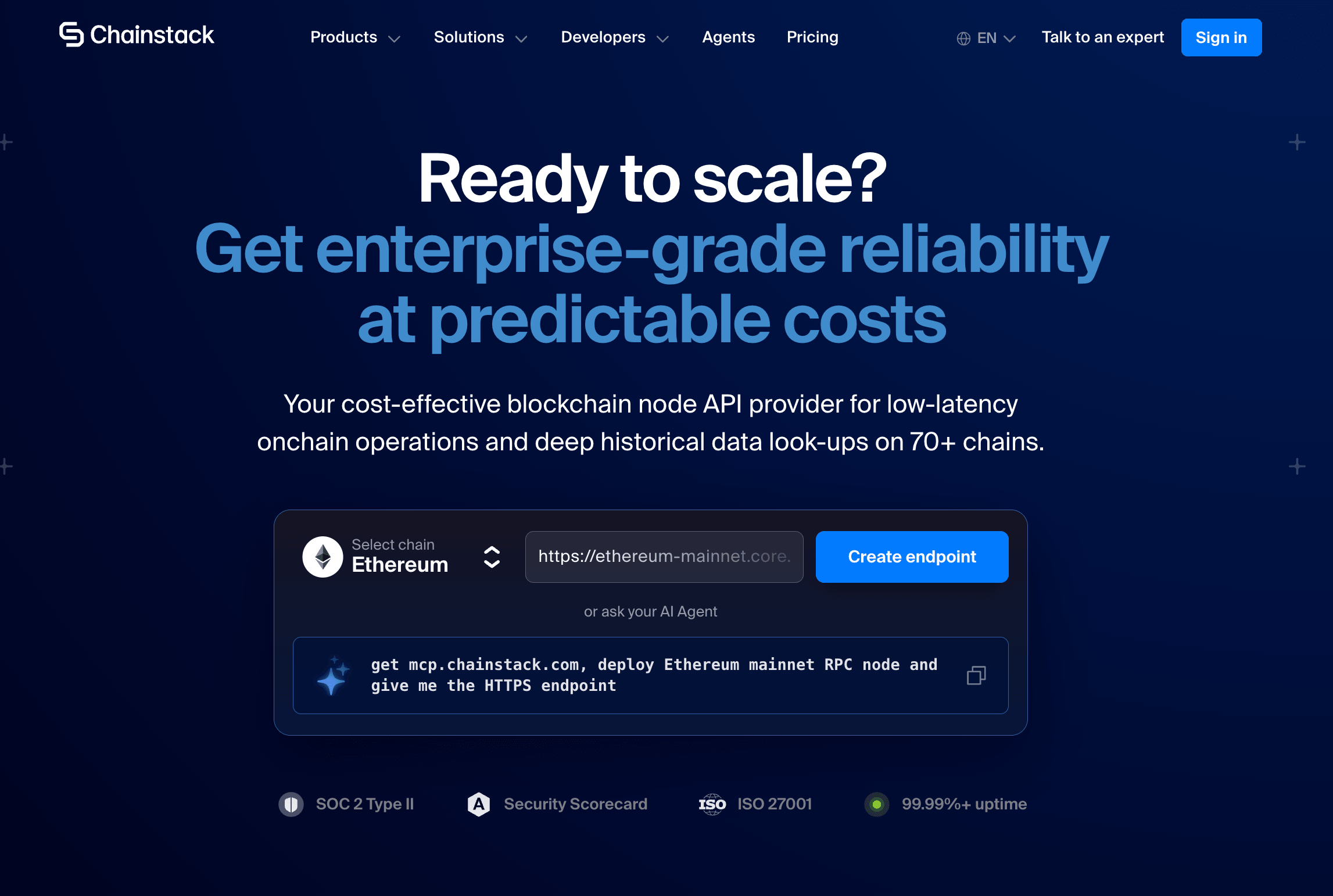
Verdict: Per-request billing of 1 RU or 2 RU, Unlimited Node add-on, Dedicated Nodes, SOC 2 Type II and ISO 27001. Trade-off: in the Compare 24-hour Base snapshot Chainstack ranks second on score behind Quicknode and its P99 (158 ms) is more than double Quicknode’s (68 ms). Chainstack publishes this page. Official pricing: Chainstack pricing.
Chainstack runs Base RPC across Global Nodes, an Unlimited Node add-on, and Dedicated Nodes, billing 1 RU for requests within 127 blocks of the tip (about 25 seconds since Denim) and 2 RU for archive-depth requests and for all debug_* and trace_* calls, with no other per-method weighting — an agent mixing eth_call and eth_getLogs on recent blocks pays 1 RU for each, and debug_traceTransaction pays 2 RU.
The Developer plan gives 3M RU/month at no cost and no card required, enough to build and test an agent before any paid commitment. The Growth plan ($49/month, 20M RU, 250 RPS) is, in our assessment, enough for many single-agent production deployments. For agents whose traffic spikes unpredictably, the Unlimited Node add-on replaces per-request billing with flat monthly tiers from $149/month (25 RPS) up to $3,199/month (500 RPS), with no overage charge within the purchased RPS tier, however hard a market event drives call volume. Base is also one of Chainstack’s Self-Hosted supported networks (Base-Reth client stack), a third deployment tier for teams that need the node inside their own perimeter rather than on Chainstack’s infrastructure.
Optimized Submission is on by default for new Base Global Nodes (free on every plan), full archive and debug_traceTransaction access are available, and SOC 2 Type II and ISO 27001 certification cover compliance requirements that many enterprise AI agent deployments ask for. The Chainstack MCP server lets Claude, Cursor, Codex, or any MCP-compatible coding assistant deploy nodes, check platform status, search docs and query on-chain data from inside the development environment (as described on Chainstack’s MCP page), and Chainstack’s RPC infrastructure for AI agents page covers node deployment, testnet funding, and migration tooling built specifically for agent-driven workflows.
Limitations: the 3M RU/month free tier looks smaller than Alchemy’s 30M CU allowance on paper, but at roughly 26 CU per standard call that is about 1.15M calls against Chainstack’s 3M, and the flat-RU model is simpler to model against; the Unlimited Node add-on’s floor is 25 RPS, so agents well below that threshold may do better on shared-tier metered pricing. In the Compare Base snapshot, Chainstack ranks second on latency score behind Quicknode, and its P99 (158 ms) is more than double Quicknode’s (68 ms).
Fit by workload:
- Autonomous trading bots: Strong (our assessment; Chainstack publishes this page) — flat-rate Unlimited Node billing absorbs burst traffic without overage charges within the RPS tier, and Chainstack states that Global Nodes reroute around a degraded region in under 1 second. The Compare Base snapshot shows a higher P99 than Quicknode.
- Event-driven DeFi agents: Strong (our assessment) — full archive and debug/trace plus WebSocket endpoints for
eth_subscribe(WebSocket stability was not measured for this article). - Enterprise AI agent deployments: Strong (our assessment) — dual SOC 2 Type II and ISO 27001 certification, Dedicated Nodes for isolation, and 24/7 enterprise support with a 1-hour response SLA on the top support tier.
2. Tatum: best for research and portfolio agents that want MCP access, indexed data and webhooks
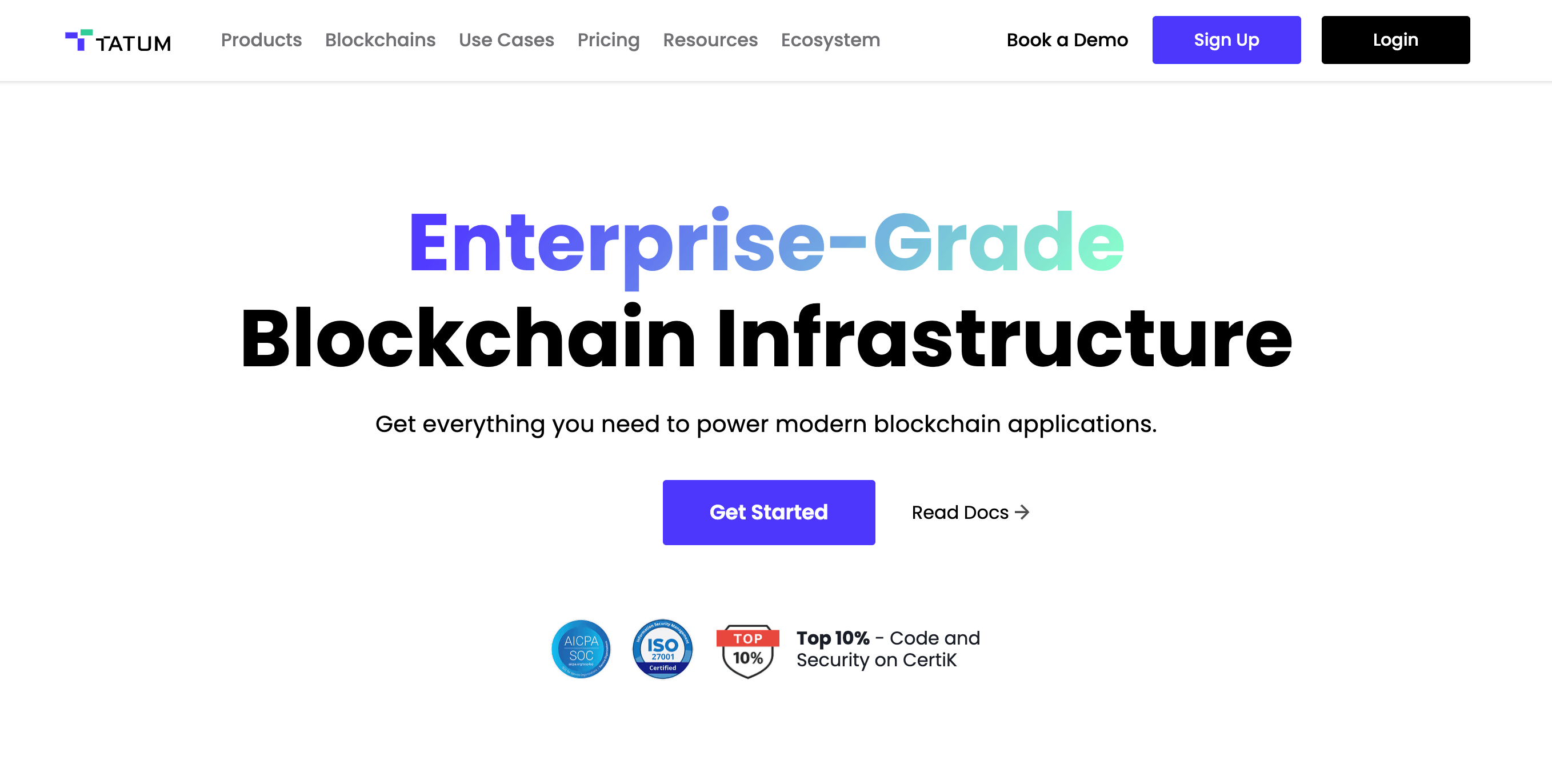
Verdict: Blockchain MCP server, indexed data and Base webhooks alongside a JSON-RPC gateway. Trade-off: debug and trace methods cost 50 credits each, Base documentation lists HTTPS interfaces (confirm WebSocket needs), the SOC 2 and ISO 27001 claim is not verified here, and Compare does not measure Tatum. Official pricing: Tatum pricing.
Tatum supports Base mainnet and Base Sepolia through its JSON-RPC gateway, with load balancing, automatic failover, and archive access. Its documented method set includes eth_call, eth_getLogs, eth_sendRawTransaction, debug_traceCall, and debug_traceTransaction, covering contract reads, transaction submission, and execution analysis. See supported Base RPC methods.
For AI agents, Tatum’s main distinction is the tooling around RPC. Its Blockchain MCP server lets compatible agents query wallet portfolios, transaction histories, token holdings, and blockchain state through structured tools. Agents can also discover supported networks and RPC methods before making calls. This suits research assistants, portfolio agents, and automated workflows that need both indexed data and direct contract access. Explore Tatum’s Blockchain MCP.
Tatum also offers Base webhooks for wallet, contract, and token activity, giving applications an alternative to continuously polling for changes. Pricing uses method-weighted credits: standard RPC methods consume two credits, eth_call consumes five, and debug and trace methods consume 50. The free API key includes 100K credits for initial testing.
Limitations: Trace-heavy agents consume credits substantially faster than agents making basic reads. Tatum’s current Base RPC documentation lists HTTPS interfaces, so teams requiring persistent eth_subscribe connections (for example newHeads at Denim’s 200 ms cadence) should confirm support before choosing it for latency-critical triggers. Dedicated API keys reserve throughput; confirm node-level isolation separately.
Fit by workload:
- Autonomous trading bots: Suitable for contract reads, simulation, and transaction submission; benchmark burst handling and confirm streaming requirements.
- Event-driven DeFi agents: Good for webhook-driven monitoring and indexed-data workflows, with debug methods for execution analysis.
- Enterprise AI agent deployments: Possible candidate; the original article says Tatum publishes SOC 2 Type II and ISO 27001 assurance materials, but this was not verified (tatum.io/security returned HTTP 404 on October 29, 2026); confirm certifications, isolation, SLA, and support terms during procurement.
3. Dwellir: best for unattended agents that want flat per-response billing and crypto payments
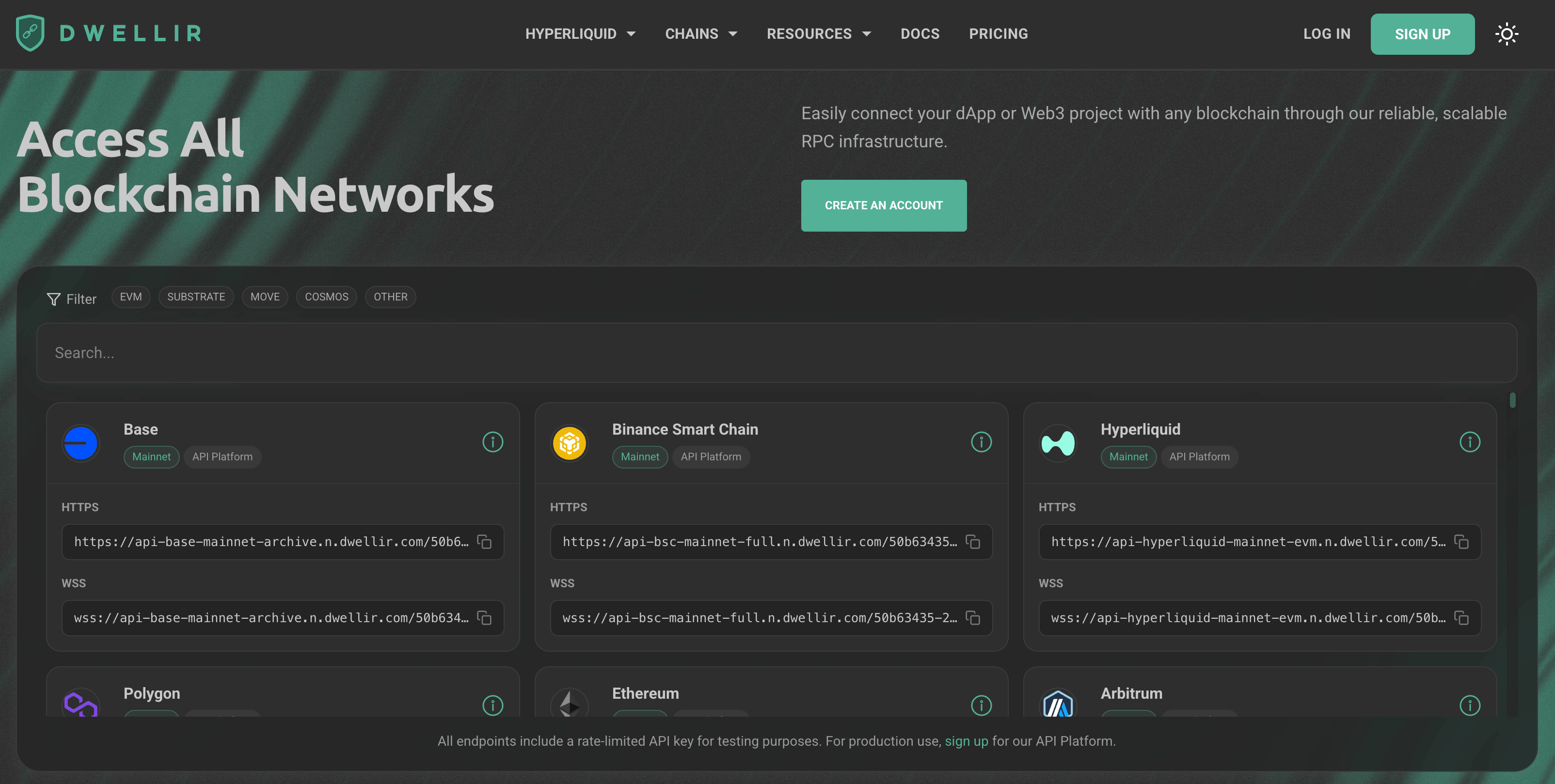
Verdict: 1 credit per response for every method, 150+ networks, archive endpoints and a dedicated archive cluster. Trade-off: no SOC 2 or ISO 27001 found, the free tier is capped at 100,000 responses per day, the Base dedicated cluster is a large step up, and Compare does not measure Dwellir. Official pricing: Dwellir pricing.
Dwellir is a Swedish RPC provider with a long Polkadot track record that now serves 150+ networks, Base among them. It serves Base over HTTPS and WebSocket, with debug and trace methods on paid plans, and its Base page documented Flashblocks support (the pending tag and the newFlashblocks WebSocket stream) before Denim retired the feature; its post-Denim Base coverage was not re-verified for this update. Its Base endpoints run archive nodes, and a dedicated cluster (listed at $3,366/month for Base) adds unmetered throughput and no rate limits; Dwellir’s pages cite a 99.99% uptime SLA, but the contractual terms were not read.
The billing model is the relevant part for agents: every response costs one credit regardless of method, so an agent alternating between eth_call, eth_getLogs, and debug_traceTransaction pays the same per call. Free covers 20 responses/second and 100,000 responses per day; Developer is $49/month (25M responses, 100/second), Growth $299/month (150M, 500/second), Scale $999/month (500M, 5,000/second), and Unlimited Nodes start at $119/month flat. Every plan accepts crypto payments, which fits agents that settle their own bills onchain.
Limitations: we found no SOC 2 or ISO 27001 attestation on Dwellir’s public pricing and dedicated-cluster pages, and the free tier is capped at 100,000 responses per day. The Base dedicated cluster is a large step up from shared plans.
Fit by workload:
- Autonomous trading bots: Good — flat per-response billing and plan ceilings up to 5,000 responses/second suit bursty traffic, with a dedicated cluster as the isolation path.
- Event-driven DeFi agents: Good — trace and debug on paid plans and WebSocket on every plan cover trigger logic; verify newHeads behavior at the 200 ms block cadence against your own workload.
- Enterprise AI agent deployments: Limited — Dwellir’s pages cite a 99.99% uptime SLA (contract terms not read), but no published SOC 2 or ISO 27001 was found.
4. Ankr: best for early-stage agent development on a large free allowance
Verdict: 200M free credits per month (about 1M EVM requests) on a distributed node-operator model. Trade-off: archive and trace availability on Base is not clearly documented, latency can vary by operator, and Compare does not measure Ankr. Official pricing page not linked: it did not load when checked on October 29, 2026.
Ankr supports Base through a distributed node-operator model and offers 200 million API credits per month on its free tier, which is about 1M EVM requests at 200 credits per call. Ankr’s trust page (last updated October 28, 2026) states that its infrastructure operator holds a SOC 2 Type II attestation audited by A-LIGN, with the full report under NDA, and that ISO 27001 certification is in progress and not held. Because requests are served by a distributed operator set, latency and reliability can vary depending on which node handles a given call.
For AI agents, the open question is archive and trace depth on Base specifically: those capabilities aren’t as clearly documented or as consistently available on Base as they are on Chainstack or Quicknode. An agent relying on debug_traceTransaction or historical eth_call should confirm coverage on Base before committing rather than assuming parity with Ankr’s better-documented chains.
Limitations: archive/trace availability on Base isn’t clearly documented; the distributed model can introduce latency variability that latency-critical agents may notice; enterprise SLA options are thin.
Fit by workload:
- Autonomous trading bots: Good — throughput is adequate for development and moderate production use, but the distributed model’s p99 variability is a real cost for latency-critical paths.
- Event-driven DeFi agents: Moderate — the free-tier size is genuinely useful for early-stage agent development, but trace-method availability on Base needs verifying first.
- Enterprise AI agent deployments: Moderate — a SOC 2 Type II attestation held by its infrastructure operator per Ankr’s trust page (report under NDA, no ISO 27001), though contractual SLA depth appears thinner than for several other listed providers.
5. RouteMesh: best as a failover and routing layer in front of other providers
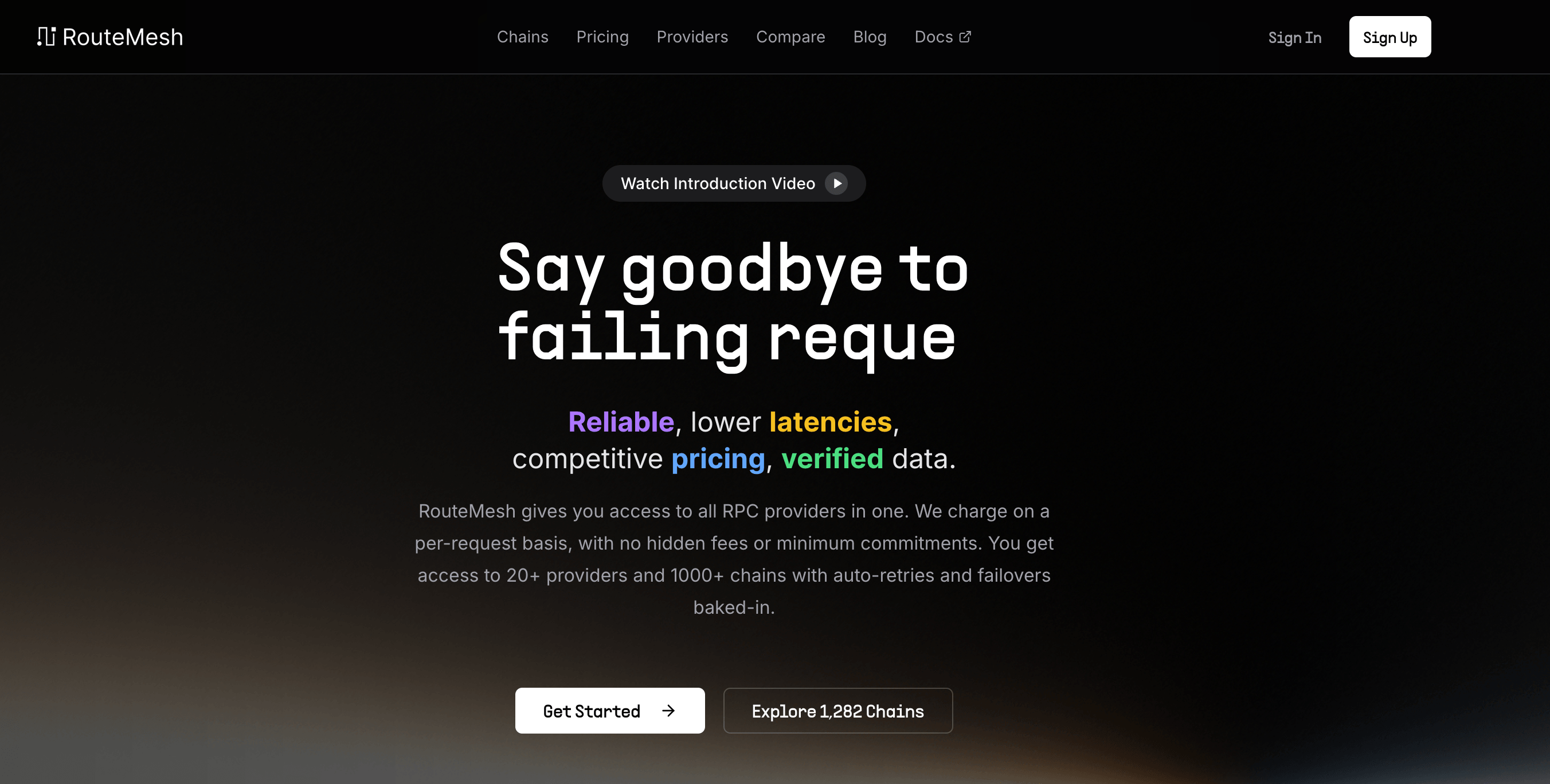
Verdict: Routing layer with automatic failover across several backend providers. Trade-off: not a node operator, so archive and trace depth and compliance posture depend on the backend that answers, and Compare does not measure RouteMesh. Official pricing page not linked: it did not load when checked on October 29, 2026.
RouteMesh is an intelligent RPC routing layer spanning 1,000+ EVM networks, including Base, with 82 supported methods on Base specifically. It routes each request across several backend providers (Chainstack among them) with sub-10ms routing decisions, continuous health scoring, and automatic failover — a different product shape from a direct RPC connection, closer to a traffic-management layer sitting in front of several providers at once.
For AI agents, that is aimed at resilience: an agent wired to RouteMesh does not need to hand-roll its own multi-provider fallback logic, because the routing layer is designed to detect a degrading backend and shift traffic before the agent’s calls start failing. Customers cited on RouteMesh’s own site include LI.FI, which reports routing 97% of its EVM RPC calls through the platform across 60+ chains (as stated on RouteMesh’s site; not verified here) — a workload shape (cross-chain aggregation, bridge backends) not far from what a multi-chain agent framework needs. Pricing is per-request, scoped by key, chain, and method.
Limitations: RouteMesh is a routing/aggregation layer, not a node operator itself — archive and trace depth depend on whichever backend provider handles a given request, so agents with heavy historical-state needs should confirm coverage for the specific method they rely on rather than assuming uniform depth across all traffic.
Fit by workload:
- Autonomous trading bots: Strong — sub-10ms routing and automatic failover matter most exactly when a market event is already straining a single provider.
- Event-driven DeFi agents: Good — real-time health scoring keeps WebSocket-dependent triggers alive even if one backend degrades, though archive-heavy agents should verify method-level coverage first.
- Enterprise AI agent deployments: Moderate — an option for resilience, but compliance posture is inherited from whichever backend serves a given call rather than a single unified certification.
6. Alchemy: best for event-driven agents that want webhook and notify tooling
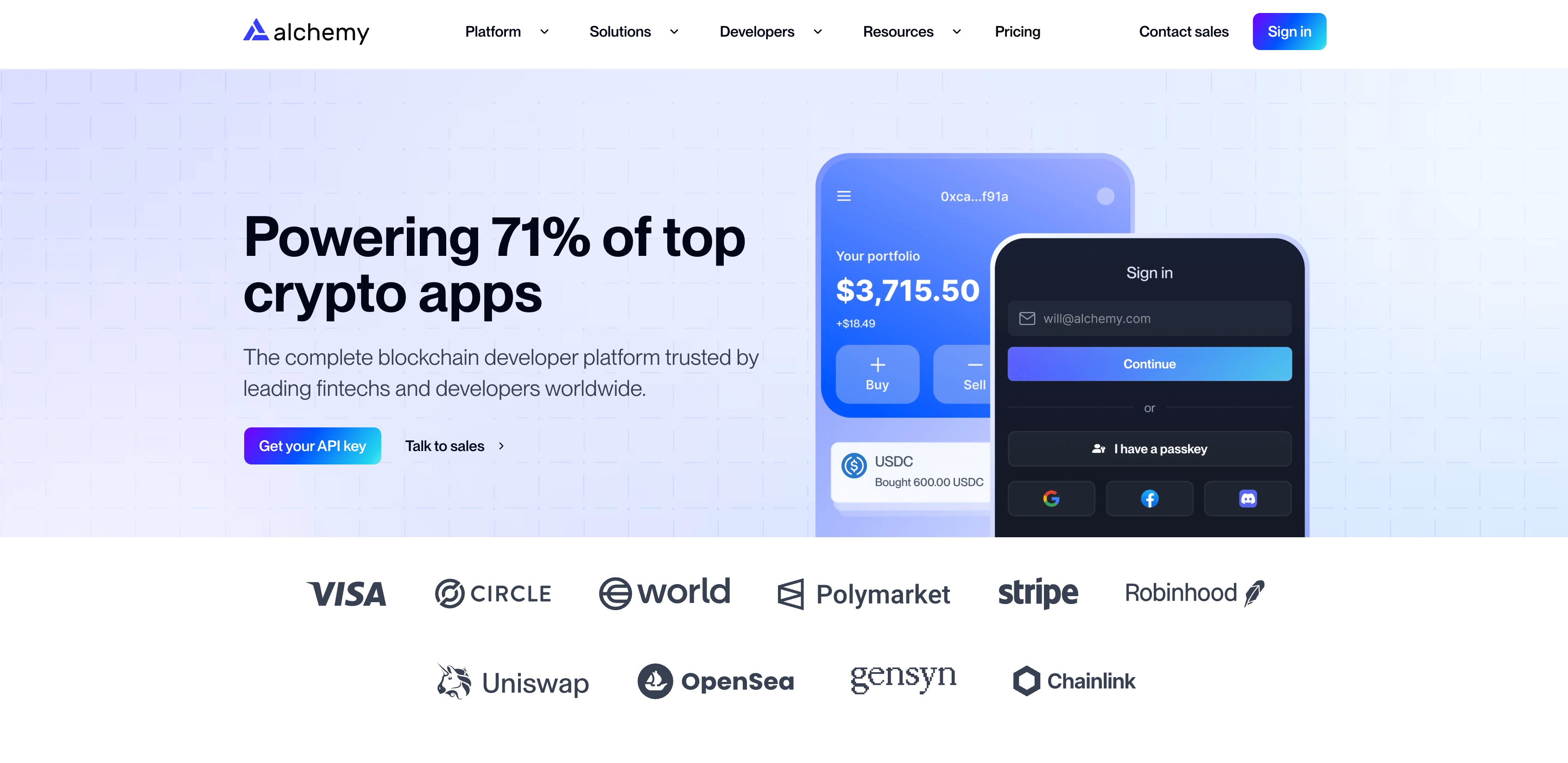
Verdict: Alchemy SDK, Notify webhooks and a 30M CU/month free tier; best US P95 (76 ms) of the providers in the Compare Base snapshot. Trade-off: CU weighting raises the cost of archive- and trace-heavy workloads, dedicated capacity is sales-gated, and it ranks third on snapshot score (0.107) with the highest Japan P95 (162 ms). Official pricing: Alchemy pricing.
Alchemy supports Base on a compute-unit model (an eth_call costs about 26 CUs), with a free tier of 30 million CUs/month at about 15 RPS (300 CU/s), roughly 1.1M typical calls, and pay-as-you-go pricing at about $0.52 per million CUs (alchemy.com/pricing, checked October 29, 2026). Dedicated capacity (Dedicated Clusters) is sales-gated rather than self-serve.
In our assessment, Alchemy’s main strength for agent builders is tooling: the Alchemy SDK plus enhanced APIs (Transfers, Token) and Notify webhooks give an agent event-based triggers without hand-rolling a polling loop. The trade-off shows up on archive-heavy or trace-heavy workloads, where CU costs run materially higher than for a plain read — a sustained debug_traceTransaction campaign against historical state can burn through a CU budget faster than the headline pricing suggests. Alchemy’s Trust Center (checked October 29, 2026) lists a SOC 2 Type II report held by Alchemy Insights, Inc. (available on request) and no ISO 27001 certification; its security page names SOC 2 for its cloud vendors. Teams that need ISO 27001 should ask Alchemy directly.
Alchemy’s pay-as-you-go pricing can add up once an agent is past the free tier — it is worth running the numbers through Chainstack’s interactive cost calculator before committing to sustained production volume.
Limitations: no self-serve dedicated nodes (Dedicated Clusters are sales-gated); CU costs penalize archive- and trace-heavy agent workloads specifically; enterprise SLA commitments require the top tier at 1,000+ RPS.
Fit by workload:
- Autonomous trading bots: Strong — high RPS ceilings on paid tiers; in the Compare Base snapshot Alchemy has the best US P95 (76 ms) of the providers measured but the highest Japan P95 (162 ms) of the three listed ones, and the lack of a self-serve dedicated-node option caps how tightly p99 can be controlled.
- Event-driven DeFi agents: Strong — Notify webhooks meaningfully simplify event-driven agent architecture, but archive-heavy historical scans can spike the bill.
- Enterprise AI agent deployments: Good — a SOC 2 Type II report listed on its Trust Center (no ISO 27001 listed), but enterprise-grade SLA only kicks in at the highest tier, and node isolation is sales-gated rather than self-serve.
7. Quicknode: best for latency-sensitive agents on a paid plan

Verdict: First on score, P95 and P99 in the Compare Base snapshot, dedicated clusters, and a security page listing SOC 2 Type 2, SOC 1 Type 2 and ISO/IEC 27001. Trade-off: no permanent free tier (one-month trial) and method-weighted credits make trace-heavy agents harder to budget. Official pricing: Quicknode pricing.
Quicknode supports Base mainnet and Base Sepolia testnet on a credit-based model where heavier methods like debug_traceTransaction consume more credits per call than a standard read. Dedicated clusters — isolated infrastructure, not a shared pool — are available for teams that need node-level separation, and Quicknode’s security page (checked October 29, 2026) lists SOC 2 Type 2, SOC 1 Type 2 and ISO/IEC 27001.
For AI agents specifically, the credit model introduces budget uncertainty that flat-rate competitors don’t have: a market event that triggers a burst of trace calls can consume a large share of a credit allocation quickly. There’s no permanent free tier — only a one-month trial (10M credits, 15 RPS) before a paid plan becomes mandatory, meaning any agent still in testing past that window needs a commitment. Quicknode’s add-on ecosystem — event streaming, Alerts — requires paid-plan activation but does add real capability for agents with more complex trigger logic.
Quicknode’s credit-based pricing can surprise teams once archive or trace calls enter the mix at production volume — worth modeling against a flat-rate alternative before locking in a tier.
Limitations: no permanent free tier; method-weighted credit billing adds real budget uncertainty for trace-heavy agents; trace and debug methods are not available on the trial tier.
Fit by workload:
- Autonomous trading bots: Strong — dedicated clusters are an option and Quicknode ranks first on latency score, P95 and P99 in the Compare Base snapshot, though credit consumption on high-frequency trace calls needs active monitoring.
- Event-driven DeFi agents: Strong — trace APIs are available and the credit model is manageable for moderate trace volume with careful budgeting.
- Enterprise AI agent deployments: Strong — SOC 2 Type 2 and ISO/IEC 27001 listed on its security page plus dedicated clusters cover many compliance checklists, though contractual SLA terms vary by plan.
Base RPC latency: Chainstack Compare 24-hour snapshot (October 29, 2026)
Source and disclosure. The figures below come from the Chainstack Compare dashboard, 24-hour Base view, captured October 29, 2026 at about 14:58 UTC. Chainstack operates the Compare dashboard and the scoring formula and is one of the providers measured, so treat this as a vendor-run measurement. This snapshot predates Base’s Denim upgrade (mainnet, November 5, 2026, 200 ms blocks), so re-run the latency comparison before relying on these figures. It is a rolling 24-hour snapshot, not a dated research report: the live dashboard refreshes every 3 minutes, so current figures will differ from this table. Probes run every 1-3 minutes from three regions (Germany, US and Japan) against each provider’s entry paid plan. The score is response time divided by the probe success rate cubed, calculated per region; the three regions are averaged equally and lower is better. Compare labels the probe success rate column “availability”; it is the share of probe requests that succeeded in the window, not platform uptime. The same method is described in the Chainstack research reports (reports index), none of which covers Base. The Chainstack performance dashboard (Grafana) remains the place for per-method breakdowns.
| Provider | Listed in this article | Score (lower is better) | Probe success rate | P50 | P95 | P99 | Germany P95 | US P95 | Japan P95 |
|---|---|---|---|---|---|---|---|---|---|
| Quicknode | Yes | 0.049 | 100.00% | 32 ms | 49 ms | 68 ms | 32 ms | 82 ms | 33 ms |
| Chainstack | Yes | 0.069 | 100.00% | 31 ms | 69 ms | 158 ms | 65 ms | 82 ms | 62 ms |
| Alchemy | Yes | 0.107 | 100.00% | 39 ms | 107 ms | 157 ms | 84 ms | 76 ms | 162 ms |
| dRPC | No (measured, not listed here) | 0.213 | 99.54% | 55 ms | 210 ms | 387 ms | 167 ms | 224 ms | 240 ms |
Source: Chainstack Compare, 24-hour Base view, captured October 29, 2026 at about 14:58 UTC.
What the snapshot shows. The dashboard headline reads “Quicknode ranks #1 for Base”. Quicknode has the best score (0.049), P95 (49 ms), P99 (68 ms), Germany P95 (32 ms) and Japan P95 (33 ms). Chainstack ranks second (0.069) and has the lowest P50 (31 ms against 32 ms for Quicknode), but its P99 (158 ms) is more than double Quicknode’s and its Japan P95 (62 ms) is nearly double. In the US, Alchemy has the best P95 (76 ms), ahead of Quicknode and Chainstack (both 82 ms). Chainstack, Quicknode and Alchemy all show a 100.00% probe success rate in this window; dRPC, which is not listed here, shows 99.54%. This article advises treating P99 rather than the average as the number that matters for event-driven agents, and on that measure Quicknode leads in this snapshot.
What this snapshot does not show. Tatum, Dwellir, Ankr and RouteMesh are not measured, so this page does not claim Chainstack or any other listed provider is the fastest of the 7. It covers one 24-hour window, uses synthetic probes from three cloud regions rather than end-user latency, and measures standard calls on each provider’s entry paid plan: it does not measure WebSocket subscription stability, Flashblocks behavior, throughput under load, cost, archive depth or debug/trace calls. Because Chainstack chose the scoring formula, a different formula could reorder close pairs.
Reproduce a latency check. The command below returns the total round-trip time for one eth_blockNumber call. Run it repeatedly against each endpoint from the region where your agent runs and compare the median and the 95th percentile. See how to measure RPC latency (P50, P95, P99) for the full method.
curl -s -o /dev/null -w "%{time_total} s" -X POST https://YOUR_BASE_ENDPOINT -H "Content-Type: application/json" -d '{"jsonrpc":"2.0","id":1,"method":"eth_blockNumber"}'Getting started with AI agents on Base on Chainstack
Deploy a production Base endpoint for AI agents in a few steps and build better with Base on Chainstack:
- Log in to the Chainstack console (or create an account).
- Create a new project
- Select Base as your blockchain protocol
- Choose network: Base Mainnet or Base Sepolia testnet
- Deploy the node
- Open Access and credentials and copy your HTTPS and WebSocket endpoints
For agents that need flat-rate billing regardless of traffic spikes, activate the Unlimited Node add-on from the Chainstack Marketplace after the initial deploy — flat monthly tiers with no overage charge within the purchased RPS tier. For latency-critical trading agents or deployments that need node isolation, evaluate Dedicated Nodes from the same project.
Need testnet ETH? Grab some from the Chainstack Base faucet.
🤖 You can also manage Chainstack Base nodes and query on-chain data from Claude, Cursor, Codex, Windsurf, Gemini CLI, GitHub Copilot, Antigravity, Claude.ai, or ChatGPT using Chainstack MCP. For a fuller agent stack — MCP, the Chainstack skill, llms.txt for context ingestion, and WebMCP for agentic browsers — see the Chainstack Agents page.
Conclusion
In our assessment, the decisive factor for AI agent workloads on Base in 2026 is whether a provider’s pricing model survives contact with real agent traffic — bursty, mixed-method, and impossible to schedule around — rather than its headline latency number. Latency still matters: the one dated data point on this page, the Compare 24-hour Base snapshot, ranks Quicknode first and Chainstack second and covers only three of the seven listed providers. The picks below follow the article’s editorial order, not that ranking.
- Autonomous trading bots: Chainstack with the Unlimited Node add-on or Dedicated Nodes for flat-rate billing and dedicated isolation (its snapshot P99 of 158 ms trails Quicknode’s 68 ms); Quicknode as a strong alternative with the best latency score in the snapshot, dedicated clusters and SOC 2 Type 2 and ISO/IEC 27001 on its security page.
- Event-driven DeFi agents: Chainstack for full archive and debug/trace at 2 RU per call; Dwellir for flat per-response billing that includes trace and debug on paid plans.
- Enterprise AI agent deployments: Chainstack for dual SOC 2 Type II and ISO 27001 certification, Dedicated Nodes for isolation, and 24/7 enterprise support (support terms as stated in the original article); Quicknode for teams that specifically need dedicated clusters alongside its listed SOC 2 Type 2 and ISO/IEC 27001.
Frequently asked questions
Q: Does Base’s Denim 200 ms block upgrade matter for AI agents now that Flashblocks is gone?
Base’s Denim upgrade (mainnet, November 5, 2026) made Flashblocks unnecessary. Base now produces a full canonical block every 200 ms, so an agent watching for a trigger sees state changes at the same cadence without a separate pre-confirmation stream. The Flashblocks subscriptions (newFlashblocks, newFlashblockTransactions, pendingLogs) no longer deliver data and the pending tag has no equivalent: subscribe to newHeads and logs and read latest. Blocks still pass through unsafe, safe and finalized states, so an agent still needs to handle the rare reorg.
Q: Which Base RPC provider has the best free tier for testing an agent before production?
Ankr’s 200M credits/month sounds largest but works out to about 1M EVM requests at 200 credits per call, while Chainstack’s 3M RU/month Developer plan (no card required, no time limit) is about three times that in requests, and every standard call on recent blocks bills a flat 1 RU, which keeps prototype costs easy to predict (archive-depth and debug/trace calls bill at 2 RU). Tatum includes 100K lifetime credits for initial testing, while RouteMesh also offers free access; check the applicable route and key limits before planning an unattended workload. Quicknode’s entry offering is a 1-month trial rather than a standalone free tier, so it isn’t a fit for open-ended prototyping.
Q: How do I migrate an agent from one Base RPC provider to another without downtime?
Point the agent at the new endpoint in a staging environment first and diff the responses for the methods it actually calls — eth_call, eth_getLogs, and debug_traceTransaction behave slightly differently in archive depth and rate-limit behavior across providers. Once verified, cut over during a low-activity window and keep the old endpoint live as a fallback for 24–48 hours in case the agent’s error-handling assumes the old provider’s specific failure modes.
Q: What latency should an AI agent target on Base?
Event-driven agents (liquidation, arbitrage) should target sub-100ms WebSocket notification latency and treat p99, not average latency, as the number that matters — a provider that’s fast on average but spikes under load will cost more real opportunities than one that’s consistently mediocre. Batch and planning agents can tolerate 200–500ms per call but should watch for compounding latency across sequential simulation calls.
Q: Which Base RPC provider is fastest for AI agents?
In the Chainstack Compare 24-hour Base snapshot captured on October 29, 2026, Quicknode ranked first on latency score (0.049), P95 (49 ms) and P99 (68 ms), Chainstack ranked second (0.069) with the lowest P50 (31 ms) and a P99 of 158 ms, and Alchemy ranked third (0.107) with the best US P95 (76 ms). Chainstack runs Compare and is one of the providers measured. Tatum, Dwellir, Ankr and RouteMesh are not measured, and the figures are a rolling 24-hour snapshot that changes every 3 minutes, so test from your own region before choosing.
Q: What compliance certifications should an enterprise AI agent deployment on Base require from its RPC provider?
SOC 2 Type II and ISO 27001 are common requirements in enterprise vendor reviews. Chainstack and Quicknode publish information about both (Quicknode’s security page lists SOC 2 Type 2, SOC 1 Type 2 and ISO/IEC 27001); Ankr’s trust page states a SOC 2 Type II attestation held by its infrastructure operator (no ISO 27001), Alchemy’s Trust Center lists a SOC 2 Type II report (no ISO 27001), and this article could not verify Tatum’s certification status. Request current assurance documents and check their scope, then assess contractual support, infrastructure isolation, and data handling separately. For RouteMesh, review both the routing service and its upstream providers.
Q: Is flat-rate or metered pricing better for AI agent workloads on Base?
A fixed monthly allowance or unlimited plan can make costs easier to forecast for bursty agents. Method-agnostic per-request billing simplifies mixed-method workloads, but total spending still grows with request volume. Method-weighted models, including Tatum, Alchemy, and Quicknode, require closer attention to the agent’s call mix because debug and trace requests consume more credits than basic reads. Compare expected monthly volume, peak throughput, and method costs before choosing a plan.
Additional resources
- How to get a Base RPC endpoint in 2026
- Base official documentation
- Base RPC for AI agents: infrastructure and setup
- Chainstack pricing
- Base tag — Chainstack blog
- Chainstack Compare: Base RPC provider performance
Changelog
We review this comparison regularly so that the information stays accurate, clear, and easy to verify. This page was reviewed to improve how the comparison is structured and sourced.
- November 6, 2026: Updated for Base’s Denim upgrade (200 ms blocks, mainnet November 5, 2026): block-time and archive-threshold timings, retired Flashblocks claims, FAQ on Denim, and a note that the Compare latency snapshot predates the upgrade.
- October 29, 2026: Added a quick verdict, a Rank and Best for column in the provider comparison table (moved up), a methodology and disclosure section, a Chainstack Compare 24-hour Base latency snapshot replacing the previous benchmark paragraph, a rate limits and free tiers comparison, alternatives guidance, numbered provider sections with one-line verdicts, a sourced Chainstack platform uptime statement, request-unit billing corrections, vendor certification wording clarifications, corrected vendor pricing, limits and certification details, and a FAQ entry on latency.
- May 20, 2026: Original publication.