AI-ready infrastructure
 Refer and earn


 Ethereum
 Hyperliquid
 Solana
 Arbitrum
 BNB Smart Chain
 Base
 Polygon
 TRON
 Sui
 Robinhood


What is Zcash? The privacy chain that rebuilt itself in 2026

Zcash spent 2026 rebuilding itself while it kept producing blocks. Its original node software, zcashd, was halted for good on July 18 at block 3,417,100, according to the zcashd end-of-life page. A flaw in the circuit behind the Orchard shielded pool, found during an audit and disclosed on May 29, forced an emergency soft fork and then a hard fork within days. On July 28, block 3,428,143 opened a new shielded pool called Ironwood. And block 3,543,405, mined on November 6, was the first one under a 25-second block target, after years at 75 seconds.
The core shielded-transaction design did not change through any of it: holders still choose between public and shielded addresses, and the privacy guarantees held. This guide covers what Zcash is, how its transparent and shielded pools work, what each upgrade did, who maintains the software now, and what to check before pointing production traffic at a Zcash node.
⏭ Skip ahead: if you are here for the infrastructure angle, jump to Getting RPC access to Zcash.
Short answer: Zcash is a proof-of-work, UTXO-based Layer 1 that launched on October 28, 2016 and was built from the Zerocash research and a fork of Bitcoin Core. It caps supply at 21 million ZEC and lets users choose between public transparent addresses and shielded addresses that hide the sender, receiver, and amount with zero-knowledge proofs. Since the NU7 upgrade it targets a block every 25 seconds, it runs mainly on Zebra, the Zcash Foundation’s node, and it is not a smart contract platform.
What is Zcash?
Zcash grew out of the Zerocash paper, whose authors include Eli Ben-Sasson, Alessandro Chiesa, Christina Garman, Matthew Green, Ian Miers, Eran Tromer, and Madars Virza. The paper describes a way to hide sender, recipient, and amount on a Bitcoin-style ledger using zk-SNARKs, and reports transactions under 1 kB that verify in under 6 milliseconds (figures for the original construction, not for today’s Zcash). The Zcash documentation dates the mainnet to October 28, 2016, and the first node, zcashd, was forked from Bitcoin Core v0.11.2, as its README states.
That ancestry shows up in the plumbing. Zcash tracks unspent outputs rather than account balances, secures blocks with Equihash proof of work (parameters n = 200 and k = 9, per the protocol specification), and counts value in ZEC, where one ZEC is 100,000,000 zatoshis. The same documentation describes a fixed total supply of 21 million units.
The table below is the quick comparison for anyone coming from Ethereum tooling.
| Zcash | Ethereum | |
|---|---|---|
| State model | UTXO | Accounts |
| Consensus | Proof of work (Equihash) | Proof of stake |
| Block time | 25 seconds since NU7 (75 seconds from December 2019, 150 seconds before) | About 12 seconds |
| Privacy | Optional: transparent or shielded addresses | Public by default |
| Smart contracts | None | EVM |
| Node API | Bitcoin-style JSON-RPC over HTTPS, plus z_* methods for shielded pool state | JSON-RPC, with WebSocket subscriptions |
| Smallest unit | Zatoshi (10-8 ZEC) | Wei (10-18 ETH) |
How do shielded transactions work?
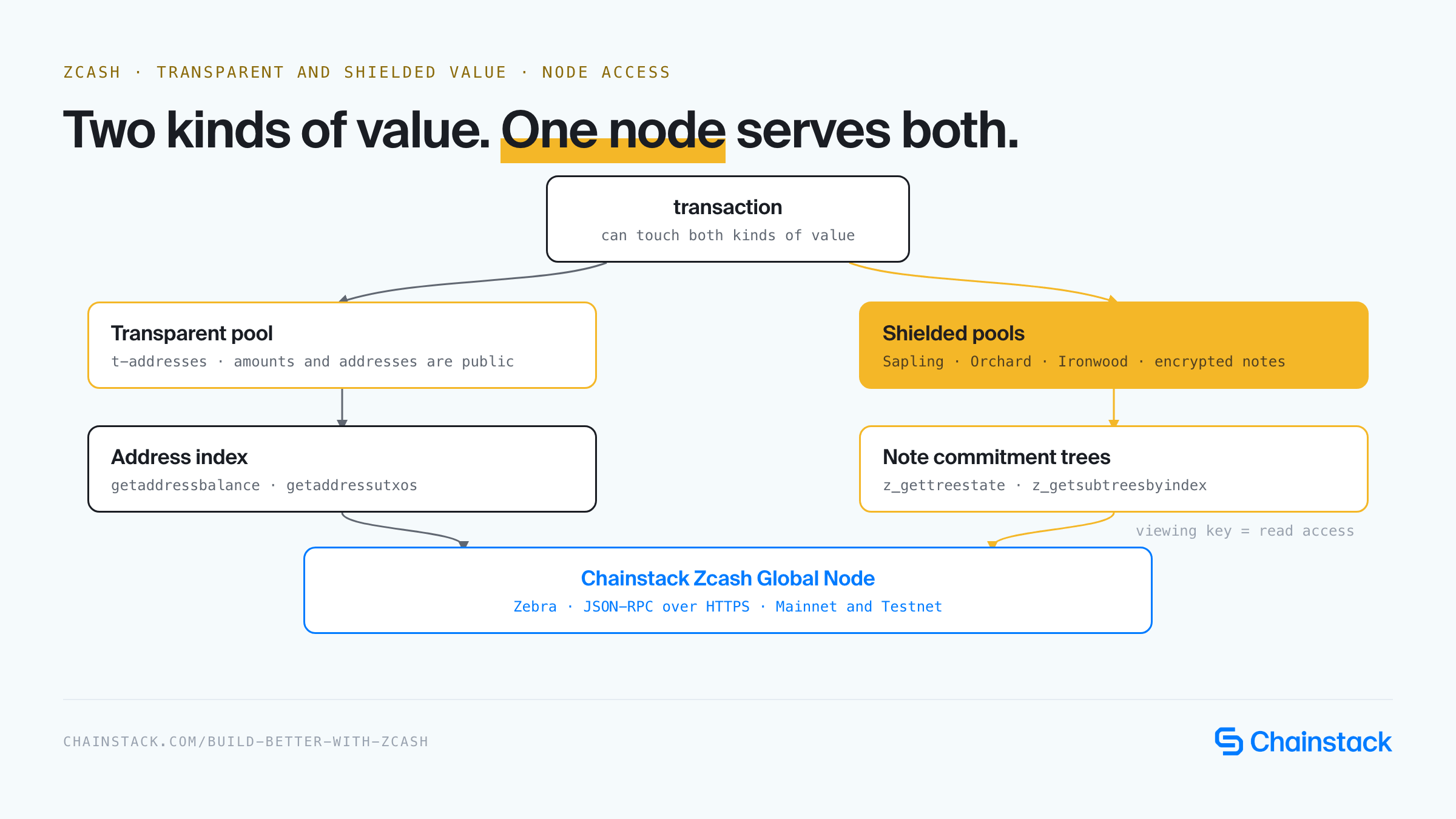
ZEC lives in pools. In the transparent pool, addresses and amounts are public and the model works, in the words of the Zcash docs, just like Bitcoin. In the shielded pools, sender, receiver, and amount stay private, and funds can move between the two kinds of address. Over time Zcash has shipped several shielded pools. Sprout used BCTV14, Sapling uses Groth16, and Orchard and Ironwood both use Halo 2.
| Pool | Introduced | Proof system | Status in November 2026 |
|---|---|---|---|
| Transparent | Genesis, October 2016 | None | Active |
| Sprout | Mainnet launch, October 2016 | BCTV14 | Funds are unspendable since NU7 disallowed version 4 transactions |
| Sapling | Sapling upgrade, October 29, 2018 (height 419,200) | Groth16 | Active |
| Orchard | NU5, May 31, 2022 (height 1,687,104) | Halo 2 | Restricted since Ironwood: value can only move out |
| Ironwood | NU6.3, July 28, 2026 (height 3,428,143) | Halo 2, the same proof system as Orchard | Active |
The proof systems come from the protocol specification. Sprout used BCTV14, which the specification says had a soundness vulnerability believed to be fully mitigated by Sapling, and Sapling moved to Groth16. Orchard switched to Halo 2, which Electric Coin Company describes as eliminating the need for a trusted setup. Ironwood reuses the Orchard action encoding and the Halo 2 proof system, per ZIP 229. The Sprout row follows ZIP 259, which says funds left in Sprout become unspendable after NU7.
Three details matter in practice. A unified address, defined in ZIP 316, bundles Orchard, Sapling, and transparent receivers behind one string, so a wallet can pick the most private receiver the sender supports. A viewing key gives read access to a shielded address’s history without the power to spend, which the docs present as the route to selective disclosure for audits or tax. And every shielded output can carry an encrypted memo field of 512 bytes, according to the specification.
A consensus rule keeps each pool honest. ZIP 209 requires nodes to reject any block that would push a pool balance negative, so a shielded pool can only pay out what was shielded into it. Nobody can see inside a shielded pool, but every node can see its total.
That total is a live number you can query. These were the pool balances reported by a Zebra 7.0.0 node at block 3,561,595 on November 11, 2026, taken from the public explorer API. They move every block, so read the current values from the valuePools field of getblockchaininfo before quoting them. Figures are rounded to whole ZEC.
| Pool | ZEC held | Share of supply |
|---|---|---|
| Transparent | 11,970,284 | 70.3% |
| Ironwood | 4,236,402 | 24.9% |
| Sapling | 419,583 | 2.5% |
| Orchard | 321,601 | 1.9% |
| Deferred funding lockbox | 75,575 | 0.4% |
| Sprout | 12,224 | 0.07% |
| Total supply | 17,035,670 | 100% |
Add up the four shielded rows and about 29% of all ZEC sits in shielded pools on that date. The Orchard drain shows up in Ironwood: CoinDesk put Orchard at roughly 3.66 million ZEC on the day Ironwood activated, it holds about 0.32 million now, and Ironwood has also taken in new shielding from other pools.
How has Zcash changed through its upgrades?
Zcash ships changes as numbered network upgrades, each with an activation height. The table lists the mainnet ones that matter for this story. Heights come from Zebra’s source, and dates are the block-header times of the activation blocks as listed by the Blockchair explorer.
| Upgrade | Height | Date (UTC) | What changed |
|---|---|---|---|
| Sapling | 419,200 | Oct 29, 2018 | Groth16-based shielded pool |
| Blossom | 653,600 | Dec 11, 2019 | Block time cut from 150 to 75 seconds (ZIP 208) |
| Canopy | 1,046,400 | Nov 18, 2020 | Same height as the first halving; the Dev Fund starts (ZIP 214) |
| NU5 | 1,687,104 | May 31, 2022 | Orchard pool with Halo 2 proofs |
| NU6 | 2,726,400 | Nov 23, 2024 | Second halving; 12% of the subsidy goes to a deferred lockbox and 8% to community grants (ZIP 1015) |
| NU6.1 | 3,146,400 | Nov 24, 2025 | Funding streams extended to height 4,406,400 (ZIP 214, revision 2), later moved to 6,132,390 by NU7 (revision 3) |
| NU6.2 | 3,364,600 | Jun 3, 2026 | Hard fork that re-enables Orchard with the corrected circuit (ZIP 257) |
| NU6.3 (Ironwood) | 3,428,143 | Jul 28, 2026 | New Ironwood shielded pool (ZIP 258) |
| NU7 | 3,543,405 | Nov 6, 2026 | 25-second blocks, 60% of fees removed from circulation, version 4 transactions disallowed (ZIP 259) |
Issuance follows the same history. The specification sets a maximum subsidy of 12.5 ZEC per 150-second block, reached after a slow-start ramp over the first 20,000 blocks, and the two halvings landed at heights 1,046,400 and 2,726,400. Until the first halving, 20% of the subsidy went to a Founders’ Reward. The funding that replaced it ran through ZIP 1014, which split a 20% stream between the Bootstrap Project, the Zcash Foundation, and major grants, and then through the lockbox model from NU6.
NU7 changed the clock without changing the schedule. ZIP 218 cuts the target spacing from 75 to 25 seconds, divides the per-block subsidy by three so yearly issuance stays about the same, and stretches the halving interval to 5,040,000 blocks. Decrypt reports that NU7 removes 60% of fees from circulation and gradually reissues them to fund future block rewards, from about 2031; ZIP 237 specifies this as the Network Sustainability Mechanism, with reissuance starting at block 8,939,664. One caveat on sourcing: ZIPs 214 (revisions 2 and 3), 218, 237, and 259 still carry a Proposed status on GitHub even though NU7 is live, so this article takes activation facts from Zebra and the chain itself and uses the ZIPs only for design.
What went wrong with Orchard, and what is Ironwood?
Orchard went live with NU5 in May 2022, and a defect arrived with it. The advisory (GHSA-ww9q-8r59-xv46, rated Critical with a CVSS score of 9.3) describes a missing copy constraint in the variable-base scalar multiplication gadget of halo2_gadgets: the base point was assigned as an unconstrained witness instead of being copied from the real base. A malicious prover could therefore pass the diversified-address integrity check with arbitrary inputs. The advisory says the consequences were double-spending inside Orchard and forged spend authorizations, that a double-spend would leave no signature on chain, and that the zero-knowledge property itself was not broken.
The audit that found it was done for Shielded Labs, and the advisory dates the disclosure to ZODL engineers to May 29, 2026. The Zcash Foundation’s account of the response says private coordination with miners and exchanges began on May 31. An emergency soft fork then disabled Orchard actions at height 3,363,426 on June 2 UTC, and the NU6.2 hard fork re-enabled Orchard with the corrected circuit at height 3,364,600 on June 3. Josh Swihart of ZODL later summed up the timeline this way:
Whether anyone exploited the flaw is the part that cannot be settled by looking. The advisory says there is no evidence of exploitation before remediation. The authors of the forum disclosure, Zooko Wilcox, Jason McGee, and Taylor Hornby, go further and call earlier exploitation unlikely, but add that there is no way to cryptographically prove it and that users should not rely on their assessment. Orchard’s privacy is what makes the question unanswerable, and that is the problem Ironwood was designed around.
ZIP 258 creates the Ironwood pool at height 3,428,143. It reuses the Orchard action encoding and Halo 2 proof system on the corrected circuit, and its transactions use the version 6 format. The legacy Orchard pool is restricted: cross-address transfers are disabled, coinbase must have an empty Orchard component, and Orchard can no longer gain value, though value can still move out into Ironwood. Shielded Labs argues the payoff is verifiability: after activation anyone can check circulating supply by summing the active pools with nothing but a node, and any excess ZEC that tried to leave Orchard would be stuck and publicly visible. That is the logic behind the pool table above. Ironwood outputs also use a note format ZIP 258 describes as quantum-recoverable, which Shielded Labs, in its Epoch announcement, calls a bridge and not a post-quantum Zcash today.
What replaced zcashd?
The zcashd end-of-life page says every unmodified zcashd 6.20.0 node shut down at block 3,417,100 on July 18, 2026 and refuses to restart, a halt timed to come before NU6.3. ZIP 258 states that zcashd will not implement the upgrade and that Zebra is expected to be the only full validator that can follow the chain after activation. Zebra, written in Rust and maintained by the Zcash Foundation, is therefore the main node implementation: version 6.0.0, released July 10, shipped the NU6.3 activation, and Zebra 7.0.0, released October 22, was the first stable release with NU7.
Around the node sits a new stack that the community site zecdev.org calls Z3: Zebra as the validator, Zaino from ZingoLabs as the indexer, and Zallet from ZODL as the wallet. Treat it as work in progress. Zallet is still in beta, and the October Arborist call notes say the Zaino backend was temporarily removed from Zallet. Valar Group publishes Zakura, a Zebra fork that the zcashd README also lists as a successor node implementation.
One operational rule is easy to miss. Every Zebra release is supported only for a limited window, and the Zebra Book says the node shuts down and refuses to start once the chain passes that release’s end-of-support height. The Book says about eight weeks, and the 7.0.0 release notes describe that as shortened from the usual 12. Anyone who runs a node themselves needs a standing upgrade routine, and a stale Zebra is the new way to fall off the chain.
Who maintains Zcash now?
The organizations around Zcash reshuffled in early 2026. On January 7, Electric Coin Company’s team resigned; CEO Josh Swihart said they had been “constructively discharged” after a governance clash with members of the Bootstrap board, as The Block reported. Those are his claims. In February the former ECC developers announced ZODL, the Zcash Open Development Lab, and the Zashi wallet was renamed Zodl. A Bootstrap board statement from February 27 said it authorized the transfer of the Zashi wallet technology and related intellectual property to a new company and that ECC would begin an orderly wind-down, with the z.cash domain slated to move to the Zcash Foundation. CoinDesk reported on March 9 that ZODL raised more than $25 million in seed funding; the investors it names include Paradigm and a16z crypto, and the usage figures that came with the announcement are ZODL’s own.
| Group | What it does in late 2026 | Source |
|---|---|---|
| Zcash Foundation | Maintains Zebra; a 501(c)(3) public charity | zfnd.org, Zebra 7.0.0 release |
| ZODL | Builds Zallet and the Zodl wallet, and contributed the Orchard fix | Advisory credits, zecdev.org (community page) |
| Shielded Labs | The audit that found the Orchard flaw was done for it; co-proposed Ironwood, proposes Crosslink, launched the Epoch research effort | Advisory, Crosslink, Epoch |
| ZingoLabs | Builds the Zaino indexer | zecdev.org (community page) |
| Valar Group | Publishes Zakura, a Zebra fork | zecdev.org (community page) |
What is next for Zcash?
None of the three big research tracks shipped in NU7, since the contents of ZIP 259 include none of them. Crosslink, which Shielded Labs describes as combining the security of proof of work and proof of stake, is still pre-mainnet; the Shielded Labs updates describe a FeatureNet, and the October Arborist call notes say it restarted on October 1 with 12 finalizers. Project Tachyon’s full scaling design is still a proposal, though the team is already upstreaming parts of its recursive-proof work into Zakura, per CoinDesk Research. Zcash Shielded Assets have an externally audited implementation, but the same call notes say activation has not been decided.
Quantum resistance deserves a careful sentence. Shielded Labs announced the Epoch research effort on October 1 with a target of a production-ready post-quantum implementation by the end of 2027, and the announcement itself says it does not make Zcash post-quantum today. The next governance decision is closer. Coinholders and community panels are voting on the future of the Community Grants share of the Dev Fund; Decrypt reports that proposals were due on November 8, that polls run from November 16 to 30, and that rough consensus would be implemented in a follow-on upgrade called NU 7.1.
Getting RPC access to Zcash
Chainstack serves Zcash on Global Nodes for Mainnet and Testnet, running Zebra, with transparent transaction history available from the first block. Because Zebra is a node and not a wallet, the endpoint is a data and broadcast interface: you read the chain, query the transparent address index, fetch shielded tree state, and send raw transactions you built elsewhere. The Chainstack Zcash tooling docs list the Mainnet and Testnet details, including explorers and the Testnet faucet. If you need isolated resources, Dedicated Nodes are available from the Pro plan, and the docs note that they can also run lightwalletd for light wallet clients.
A few behaviors to design around, all from the Chainstack docs:
- HTTPS only. Zebra serves JSON-RPC over HTTP, so there is no WebSocket and no subscriptions. Follow new blocks by polling
getbestblockhashorgetblockcount. At a 25-second target, a poll every few seconds is plenty. - The address index is transparent only.
getaddressbalance,getaddresstxids, andgetaddressutxoswork without an indexer, but shielded balances and history are visible only to the holder of the viewing key, through a wallet that scans the chain. - Two units. Outputs report amounts in ZEC as
valueand in zatoshis asvalueZat, and the address index methods report zatoshis only. Use the zatoshi fields for arithmetic. - No network check. The address index accepts an address from the other network and returns an empty result instead of an error. Run
validateaddressfirst. - Mining and node control are blocked.
getblocktemplate,submitblock,stop,addnode,generate,invalidateblock, andreconsiderblockreturn HTTP 403 with error code -32601, and the wallet methods of the old zcashd, such asz_sendmany, do not exist in Zebra.
This call returns the chain name, the height, every upgrade with its activation height, and the pool balances. The response below is trimmed from a Zebra 7.0.0 node on November 11, 2026:
curl YOUR_CHAINSTACK_ENDPOINT \
  -H "Content-Type: application/json" \
  -d '{"jsonrpc":"1.0","id":1,"method":"getblockchaininfo","params":[]}'

# result, trimmed
{
  "chain": "main",
  "blocks": 3561595,
  "upgrades": {
    "...": { "name": "NU6.3", "activationheight": 3428143, "status": "active" },
    "...": { "name": "NU7",   "activationheight": 3543405, "status": "active" }
  },
  "valuePools": [
    { "id": "transparent", "chainValue": 11970283.98 },
    { "id": "sapling",     "chainValue": 419583.32 },
    { "id": "orchard",     "chainValue": 321600.53 },
    { "id": "ironwood",    "chainValue": 4236402.26 }
  ]
}
A transparent address lookup needs no indexer. This Python example reads the balance of the address that received the founders’ reward in Mainnet block 1, using the address from the Chainstack docs:
import requests

ENDPOINT = "YOUR_CHAINSTACK_ENDPOINT"
ZATOSHIS_PER_ZEC = 100_000_000

def rpc(method, params=None):
    r = requests.post(
        ENDPOINT,
        json={"jsonrpc": "1.0", "id": 1, "method": method, "params": params or []},
        timeout=30,
    )
    body = r.json()
    if body.get("error"):
        raise RuntimeError(body["error"]["message"])
    return body["result"]

address = "t3Vz22vK5z2LcKEdg16Yv4FFneEL1zg9ojd"
balance = rpc("getaddressbalance", [{"addresses": [address]}])
print("Balance (ZEC):", balance["balance"] / ZATOSHIS_PER_ZEC)
print("Received (ZEC):", balance["received"] / ZATOSHIS_PER_ZEC)
🚀 Zcash Mainnet and Testnet endpoints deploy from the same console flow as any other chain, and the Developer plan is free. Get a Zcash endpoint →
How to get a Zcash RPC endpoint on Chainstack
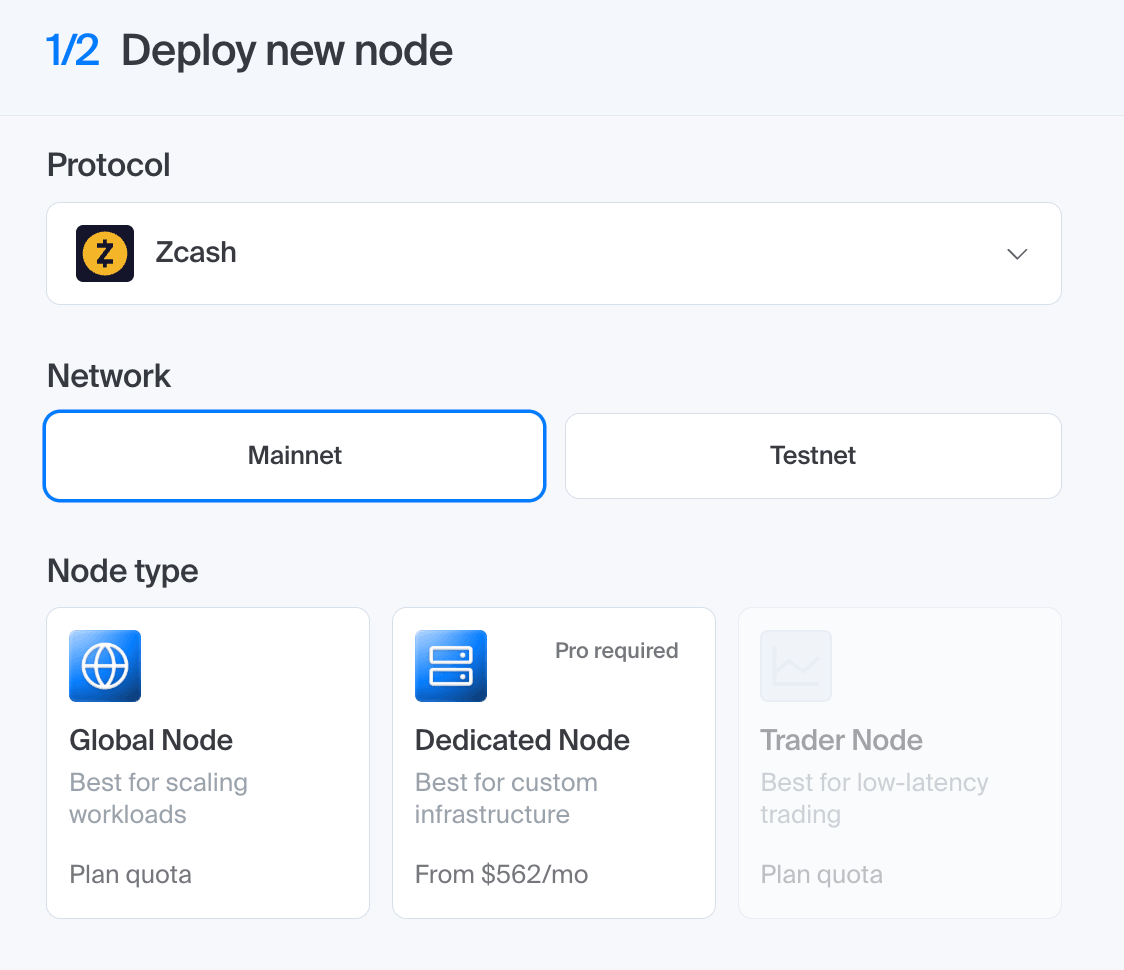
- Log in to the Chainstack console, or create an account.
- Create a new project.
- Select Zcash as the blockchain protocol.
- Choose Mainnet or Testnet.
- Deploy a Global Node.
- Open Access and credentials and copy your HTTPS endpoint.
Chainstack’s Developer plan includes 3 million request units a month at 25 requests per second, and the pricing page lists the paid plans and the flat-fee Unlimited Node add-on for higher throughput.
Conclusion
Zcash is a useful case study in how to change a live chain. In one year it retired its first node, patched a proof flaw by soft fork and hard fork, opened a new shielded pool built to make supply checkable, and shortened the block time to a third, while the user-facing idea stayed the same: a public ledger where holders choose whether the amounts and addresses are public. The balance table shows the result: roughly 29% of all ZEC sits in shielded pools, most of it in the pool that did not exist in July.
For builders the lessons are concrete. Poll instead of subscribing, validate addresses against the network before trusting an empty result, treat shielded balances as something only a viewing key can read, and keep a Zebra upgrade routine if you run your own node. Several parts are still moving, from Dev Fund decisions to Crosslink and Tachyon, so re-read the sources linked here when you build.
FAQs
Zcash caps supply at 21 million ZEC. The first halving came at block 1,046,400 on November 18, 2020 and the second at block 2,726,400 on November 23, 2024. After NU7, ZIP 218 sets the halving interval at 5,040,000 blocks of 25 seconds.
No. Transparent addresses are public like Bitcoin addresses, and only shielded addresses hide the sender, receiver, and amount. On November 11, 2026 about 29% of all ZEC sat in shielded pools, according to a Zebra node’s pool balances.
Ironwood is the shielded pool created by the NU6.3 upgrade at block 3,428,143 on July 28, 2026. It reuses Orchard’s Halo 2 proof system on the corrected circuit, and the legacy Orchard pool is restricted to moving value out. Anyone can verify supply by summing the active pools, as Shielded Labs explains.
Mainly Zebra, maintained by the Zcash Foundation; Zakura, a Zebra fork, is also listed as a successor. The older zcashd node halted for good at block 3,417,100 on July 18, 2026. Zebra releases stop working after an end-of-support height, so self-hosted nodes need regular upgrades.
Since NU7 activated at block 3,543,405 on November 6, 2026, the target is 25 seconds, down from 75. On November 11, 2026, Blockchair counted 3,461 blocks over the previous 24 hours, an average of about 25 seconds.
No. A node serves transparent address data and the shielded pools’ note commitment tree state, but shielded balances and history are visible only to the holder of a viewing key, through a wallet that scans the chain. Chainstack Zcash endpoints also have no WebSocket, so poll for new blocks.
Additional resources
- Zcash on Chainstack
- Chainstack docs: Zcash tooling
- Zcash documentation: basics
- Zerocash: Decentralized Anonymous Payments from Bitcoin
- ZIP 258: deployment of the NU6.3 network upgrade (Ironwood)
- ZIP 259: deployment of the NU7 network upgrade
- Zebra security advisory GHSA-ww9q-8r59-xv46 (Orchard flaw)
- Zcash Foundation: Zebra 7.0.0 release
- zcashd end-of-life and migration guide
- Electric Coin Company: explaining Halo 2
- Shielded Labs: Ironwood and the verifiability of supply
- CoinDesk Research: Zcash’s NU7 upgrade goes live as developers launch quantum-resistance effort