AI-ready infrastructure
 Refer and earn


 Ethereum
 Hyperliquid
 Solana
 Arbitrum
 BNB Smart Chain
 Base
 Polygon
 TRON
 Sui
 Robinhood


What is X Layer? The chain under OKX’s onchain exchange

OKX says the old Polygon zkEVM chain ended at block 42,810,021 and the OP Stack chain picked up from that same height. We checked the public RPC at rpc.xlayer.tech while writing this: blocks 42,810,021 and 42,810,022 both carry October 27, 2025 timestamps, one second apart. The block counter never reset and the chain ID is still 196, but the machinery underneath had been replaced.
So what is X Layer in October 2026? Since that cutover it has swapped its execution client, added Flashblocks pre-confirmations, and started moving to a hybrid proof system, while OKX has begun running onchain trading markets on top of it. This guide covers how each change works, who is behind the chain, what runs on it, and what to check before pointing production traffic at it.
⏭ Skip ahead: if you are here for the infrastructure angle, jump to Getting RPC access to X Layer.
Short answer: X Layer is the EVM-equivalent Layer 2 of the OKX exchange, built on the OP Stack and settling to Ethereum. It uses OKB as the gas token, has chain ID 196 on mainnet and 1952 on testnet, and produces a block every second. It launched in April 2024 on Polygon CDK and moved to the OP Stack in October 2025.
What is X Layer?
X Layer is a Layer 2 network run by OKX. The exchange announced the public mainnet on April 16, 2024, describing it as a zero-knowledge L2 built with Polygon CDK and renamed from X1, according to Crypto Briefing’s launch report. Fees are paid in OKB, the OKX token.
The chain is tied closely to OKX products. In an August 2025 announcement, OKX said X Layer would focus on DeFi, payments, and real-world assets, would become the default network for OKX Pay, and would power zero-gas fast withdrawals on the exchange. The same notice began shutting down OKTChain, a separate OKX network, and converting its OKT token to OKB.
The OKB token changed with it. OKX burned 65,256,712.097 OKB held from past buybacks and treasury reserves, fixed the total supply at 21 million, and slated an upgrade to the OKB contract that removes minting and burning, per the same announcement. For developers the day-to-day basics are simple: the Chainstack tooling docs list chain ID 196, 18 decimals for OKB, and 1-second blocks, and standard libraries such as ethers.js, viem, and Foundry work without changes. The public RPC reported block 73,812,402 at 11:17 UTC on October 21, 2026.
How did X Layer move from Polygon zkEVM to the OP Stack?
The move was not one event. OKX first upgraded the Polygon-based chain, changed the economics of OKB, and then replaced the stack, so the table below is the shortest way to keep the sequence straight.
| When | What changed | Source |
|---|---|---|
| Apr 16, 2024 | Public mainnet launches on Polygon CDK as a zk L2 | Crypto Briefing |
| Aug 5, 2025 | “PP upgrade” to the latest Polygon CDK; OKX claims 5,000 TPS | OKX announcement |
| Aug 2025 | OKB burn of 65,256,712.097 tokens; supply fixed at 21 million | OKX announcement |
| Oct 27, 2025 | Cutover to the OP Stack at block 42,810,021 | OKX engineering post and the public RPC |
| Dec 2025 | Jovian (OP Network Upgrade 17) active on mainnet; Optimism publishes its post on the migration | OKX, Optimism |
| By May 2026 | Execution client moves from geth to reth, with Flashblocks | OKX engineering post |
| Spring 2026 | Hybrid Proof goes live on testnet; mainnet rollout pending | OKX post |
| May 2026 | Exchange OS whitepaper v1.0 published | OKX whitepaper |
OKX’s stated reason in August 2025 was to build X Layer into a network focused on DeFi, payments, and RWA applications. The Optimism Foundation’s post on the migration adds that the OP Stack gives OKX full autonomy over network operations while tying it to a larger engineering community, without building L2 infrastructure from scratch.
One quirk follows from the table: a mainnet block number alone does not tell you which architecture produced it. Anything older than block 42,810,021 comes from the zkEVM era, which is why the next section matters to anyone reading history.
How does the xlayer-reth client work?
OKX replaced geth with reth for two reasons it spells out in its engineering post: archive disk usage that grows linearly, and tail-latency spikes from Go garbage collection and database compaction. The resulting client, xlayer-reth, sits on three layers: Paradigm’s reth, then op-reth from Optimism, then an X Layer customization layer attached through reth’s extension hooks. OKX says the two lower layers are consumed as-is, with no private patches.
Two details matter if you read history through RPC. The state below block 42,810,021 exists only on the legacy Polygon zkEVM node, so xlayer-reth adds a middleware that checks the requested block number and proxies older requests there. An eth_getLogs range that crosses the cutoff is split into two sub-requests and merged. The other detail is the genesis: reth assumed block zero, so the X Layer team contributed a fix upstream for chains that start at a non-zero block.
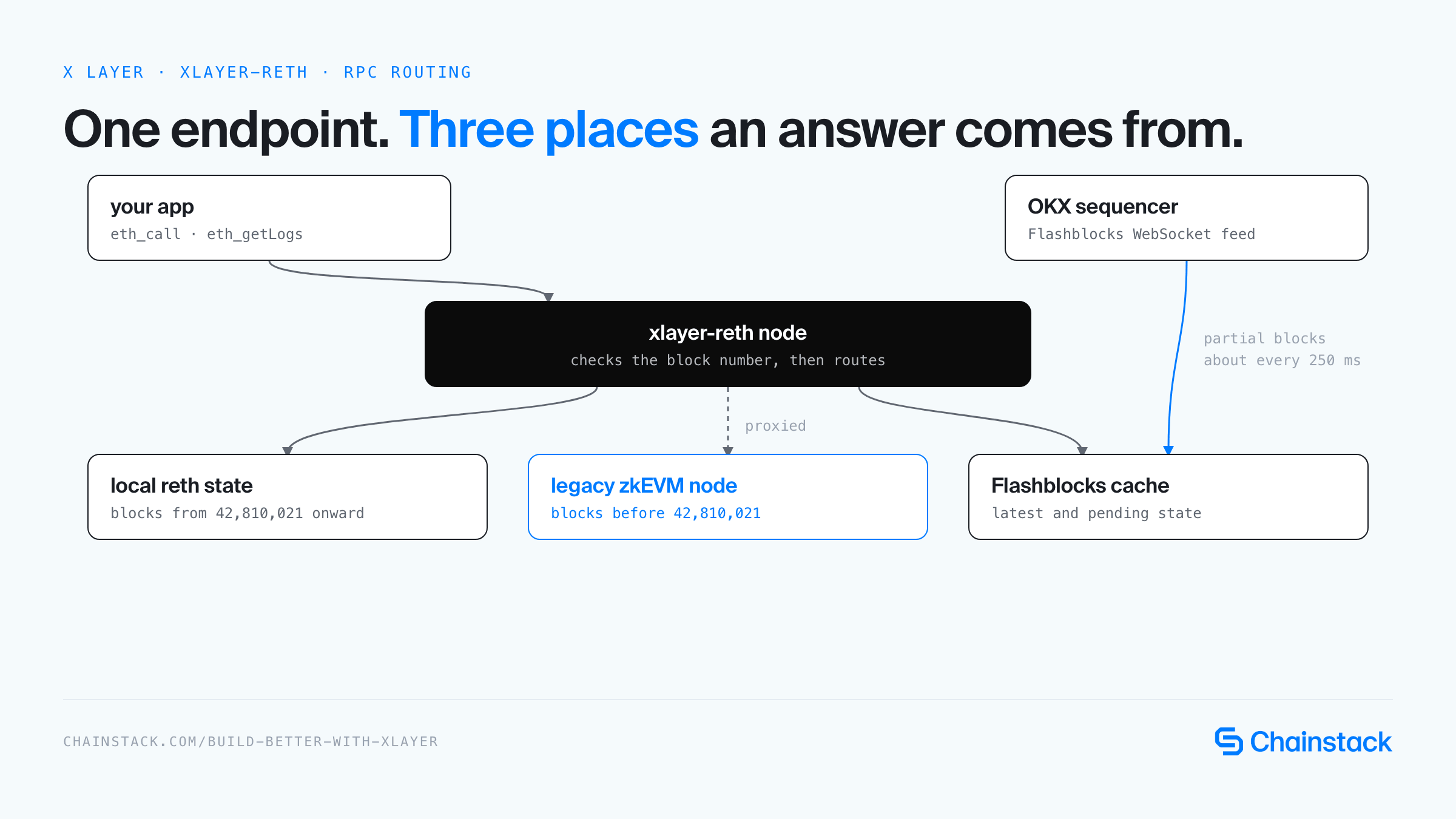
Flashblocks is the second piece. A standard OP Stack block takes about two seconds, and X Layer seals one every second. On top of that, the sequencer publishes partial block state roughly every 250 milliseconds, and the node executes each partial block into an in-memory cache. According to OKX, 22 standard JSON-RPC methods, including eth_getBlockByNumber, eth_getBalance, and eth_call, read from that cache for the latest or pending block. The client also adds eth_flashblocksEnabled and eth_flashblocksPeerStatus.
Fees dropped alongside. With the Jovian upgrade, X Layer sets a minimum base fee of 0.02 Gwei, and OKX puts a standard ERC-20 transfer at about $0.0001. The OP Stack L1 data fee is zero because X Layer sets the L1 fee scalars in the GasPriceOracle predeploy to zero, as the Chainstack tooling docs note.
This is the subscription that streams preconfirmed transactions on Mainnet, taken from the same docs. It returns every transaction that calls the L1 attributes predeploy, with its receipt:
{"jsonrpc":"2.0","id":1,"method":"eth_subscribe","params":["flashblocks",{
  "subTxFilter":{
    "subscribeAddresses":["0x4200000000000000000000000000000000000015"],
    "txInfo":true,
    "txReceipt":true
  }
}]}
How is X Layer secured? Hybrid Proof explained
Today X Layer settles to Ethereum as an OP Stack rollup, and OKX is adding a Hybrid Proof that brings in a zero-knowledge proof only when someone challenges a state claim. In the OKX write-up, the proposer posts output roots optimistically, with no proving cost. If a challenger opens a dispute, the proposer has a proving window to submit an SP1 zkVM proof, built with the op-succinct framework from Succinct, and a single L1 verification settles the game.
The headline benefit is time: the challenge period shrinks from the OP Stack default of 7 days to 1 day, and a dispute needs one contract call rather than a multi-round bisection game. A prover outage would affect only dispute settlement, not block production. OKX says the system is live on testnet and that mainnet rollout will follow testnet data, so treat the 1-day figure as a testnet property for now. OKX counts this as the third major change to the architecture, after the OP Stack migration and the reth swap.
What is Exchange OS, and why does it matter for X Layer?
Exchange OS is an OKX protocol upgrade that lets anyone launch a market venue on X Layer: spot, perpetuals, or outcome markets. The whitepaper, version 1.0 from May 2026, splits the design in two. The X Layer EVM anchors assets and enforces governance, while a separate environment called TradeZone handles order matching, margining, and liquidation.
- A deployer stakes OKB to create a venue, and the stake can be slashed under published rules if the deployer misbehaves.
- Users deposit into an X Layer EVM contract and sign with their own key, so funds stay self-custodial.
- The matching engine runs as protocol code, and if the TradeZone sequencer goes offline, users can withdraw directly to the EVM through an escape hatch.
- TradeZone is described as offering millisecond matching, 300,000 TPS, and gas-free trading. Those are whitepaper claims, and we could not verify them independently.
On October 15, 2026, the X Layer account announced that OKX’s onchain perps and spot markets built on Exchange OS were live.
For infrastructure teams the split has a practical edge. Deposits, withdrawals, stakes, and slashing settle on the X Layer EVM, which an X Layer RPC node serves, while matching happens inside TradeZone.
How is X Layer different from Ethereum?
| Ethereum | X Layer | |
|---|---|---|
| Chain ID | 1 | 196 on mainnet, 1952 on testnet |
| Gas token | ETH | OKB |
| Block time | 12 seconds | 1 second |
| Pre-confirmations | None | Flashblocks, partial blocks about every 250 ms |
| Public mempool | Yes | No: pending transactions stay with the sequencer |
| L1 data fee | Not applicable | Zero, because the L1 fee scalars are set to zero |
| Execution client | Geth, Reth, Nethermind, Erigon | xlayer-reth, built on reth and op-reth |
| Security model | Own validator set | Settles to Ethereum; optimistic, with Hybrid Proof in testnet |
| Typical transfer cost | Varies with gas price | About $0.0001 for an ERC-20 transfer, per OKX |
🚀 X Layer Mainnet and Testnet run on Chainstack Global Nodes with archive data, plus Flashblocks on Mainnet. Start on the free Developer plan and build on X Layer with Chainstack →
Who created X Layer and who backs it?
X Layer is built and run by OKX. OKX says it launched the chain in collaboration with Polygon, which supplied the original Polygon CDK stack. At launch, Haider Rafique, then OKX’s chief marketing officer, framed it as a chain for builders bringing millions of people onchain, and Polygon CEO Marc Boiron called it a major step toward a unified Web3, both per Crypto Briefing.
The stack today has more names in it: the Optimism Foundation’s OP Stack, Paradigm’s reth, and Succinct’s op-succinct and SP1 for the Hybrid Proof. The sources we read do not name individual X Layer leaders or an outside funding round, so we do not list any.
What runs on X Layer?
On October 21, 2026, DefiLlama showed about $164.7 million in TVL on X Layer, a $1.49 billion stablecoin market cap (down 7.9% over seven days), $34.2 million in 24-hour DEX volume, and 31,228 active addresses. Its protocol list includes Aave V3, the GMGN trading app, the PotatoSwap DEX, and the Ignix launchpad. These figures move daily, so check the live page.
The X Layer account says the chain has passed 1.5 million smart contract deployments, up 500% in six months, and that Paxos Labs chose X Layer for the first EVM deployment of PAXGy outside Ethereum.
RWA is the stated priority. OKX runs a liquidity incentive program for RWA assets on the chain and announced a second round in September 2026, as its Learn post describes. The X Layer account also claims that 77% of tokenized-stock volume on X Layer happens outside regular market hours, a figure we could not verify.
📖 Related reads: What is Robinhood Chain? and the best Base RPC providers in 2026.
Getting RPC access to X Layer
Chainstack serves X Layer Mainnet and Testnet on Global Nodes with archive data and both the debug_* and trace_* namespaces, as the tooling docs state. Debug and trace need a paid plan, and the X Layer page says Mainnet archive covers blocks from before the migration. The table lists what to know before you build.
| Topic | What to expect |
|---|---|
| Chain IDs | 196 on Mainnet, 1952 on Testnet |
| Flashblocks | Mainnet only: pending block tag, eth_flashblocksEnabled, and eth_subscribe("flashblocks"); Testnet returns the latest block for pending |
| Pending transactions | eth_subscribe("newPendingTransactions") and txpool_status deliver nothing; see mempool access |
| Tracers | callTracer and prestateTracer; not flatCallTracer, muxTracer, or erc7562Tracer |
| Range limits | A 10,000-block eth_getLogs covers under 3 hours; eth_getProof serves the latest 256 blocks, about 4 minutes. See limits |
| Request units | 1 RU for standard calls; 2 RU for debug and trace, and for archive reads at or beyond 127 blocks behind the tip, per the X Layer page |
The free Developer plan includes 3 million request units a month at 25 requests per second, per the pricing page.
How to get an X Layer RPC endpoint on Chainstack
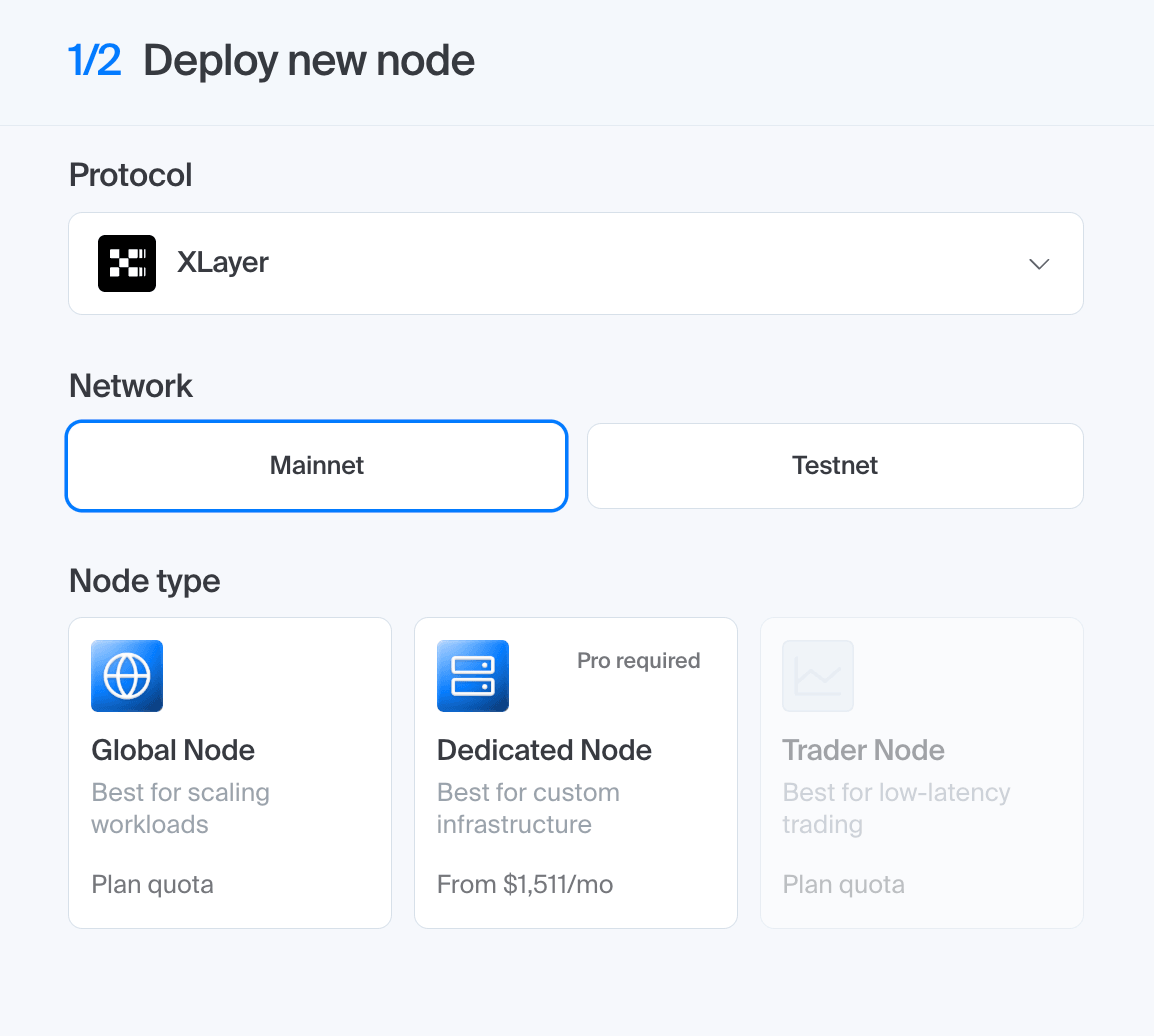
- Log in to the Chainstack console, or create an account.
- Create a new project.
- Select X Layer as the blockchain protocol.
- Choose X Layer Mainnet or Testnet.
- Deploy the node.
- Open Access and credentials, then copy your HTTPS or WSS endpoint.
Then connect with viem, which ships X Layer chain definitions, as the docs show:
// npm install viem
import { createPublicClient, http } from "viem";
import { xLayer } from "viem/chains";

const client = createPublicClient({
  chain: xLayer,
  transport: http("CHAINSTACK_NODE_URL"),
});

console.log("Chain ID:", await client.getChainId());
console.log("Block:", await client.getBlockNumber());
🚀 Flashblocks streaming and archive reads come from the same Mainnet endpoint. Get an X Layer endpoint →
Conclusion
X Layer is a case study in rebuilding a chain while it runs. In about a year it changed its stack from Polygon CDK to the OP Stack, swapped its execution client, added sub-second pre-confirmations, and put a proof upgrade into testnet, all without resetting the block counter. The direction is consistent: make X Layer the settlement base for OKX products, now including onchain exchange markets.
For builders, the lessons are specific. Test any history query on both sides of block 42,810,021, treat Flashblocks as pending state and not as finality, plan around the missing public mempool, and check your tracer and range limits before launch. Because several parts are still moving, from Hybrid Proof to Exchange OS, re-read the OKX sources when you build.
FAQs
X Layer Mainnet uses chain ID 196 (0xC4) and X Layer Testnet uses 1952 (0x7A0). The native currency symbol is OKB, with 18 decimals.
Yes. X Layer is EVM-equivalent, so standard tooling such as ethers.js, viem, Foundry, and Hardhat works against an X Layer node without modification.
OKB is the only gas and native token. After a one-time burn of 65,256,712.097 OKB, OKX fixed the total supply at 21 million. OKX puts a standard ERC-20 transfer at about $0.0001 after the Jovian upgrade.
Not anymore. X Layer launched in April 2024 as a zk L2 built on Polygon CDK. Since the October 27, 2025 cutover it runs on the OP Stack, which is optimistic. OKX’s Hybrid Proof adds ZK arbitration through SP1 for disputes, and it is live on testnet only so far.
X Layer produces a block every second. Flashblocks add partial-block pre-confirmations roughly every 250 milliseconds, which supported nodes serve for the latest or pending block.
No. Pending transactions stay with the sequencer, so eth_subscribe("newPendingTransactions") and txpool_status return nothing. On Mainnet you can follow transactions earlier through Flashblocks.
Exchange OS is an OKX protocol upgrade for X Layer that lets anyone launch spot, perpetual, or outcome-market venues by staking OKB. Assets and governance stay on the X Layer EVM, while a separate environment called TradeZone matches orders.
X Layer runs xlayer-reth, a customization layer on top of op-reth and Paradigm’s reth. It replaced geth and routes requests for blocks older than 42,810,021 to a legacy zkEVM node.
Additional resources
- X Layer on Chainstack
- Chainstack docs: X Layer tooling
- Chainstack docs: debug and trace APIs for X Layer
- Chainstack docs: mempool access
- OKX Learn: from geth to reth
- OKX Learn: X Layer Hybrid Proof
- OKX announcement: PP upgrade and OKB model
- OKX: Exchange OS whitepaper
- Optimism: OKX migrates X Layer to the OP Stack