AI-ready infrastructure
 Refer and earn


 Ethereum
 Hyperliquid
 Solana
 Arbitrum
 BNB Smart Chain
 Base
 Polygon
 TRON
 Sui
 Robinhood


How Global Node GEN 2.0 upgrade made Solana RPC up to 12x faster

Summary: GEN 2.0 is a major update to Chainstack Global Nodes, as significant for RPC users as a network upgrade is for a blockchain. On Solana mainnet the median time to first byte (TTFB) went from 229 ms to 79 ms, a 65.5% cut or about 2.9x faster. The same probe measured both routes in 9 cities, and all 9 improved, from 1.5x in Dubai to 12.3x in New Delhi. Solana devnet improved in all 16 cities.
A Solana app makes many small calls in a row: fetch a blockhash, simulate, send, confirm. Chainstack moved Solana to GEN 2.0 in late August 2026. This post shows what that change looks like from 16 cities, tested on Oct 29, 2026.
What GEN 2.0 changed for Solana requests
GEN 2.0 takes the edge worker out of the Solana request path. Instead of a Cloudflare Workers layer deciding where each call goes, DNS load balancing points your hostname at the nearest healthy region, and the call lands directly on the regional gateway and the node. Mainnet and devnet both run this way.
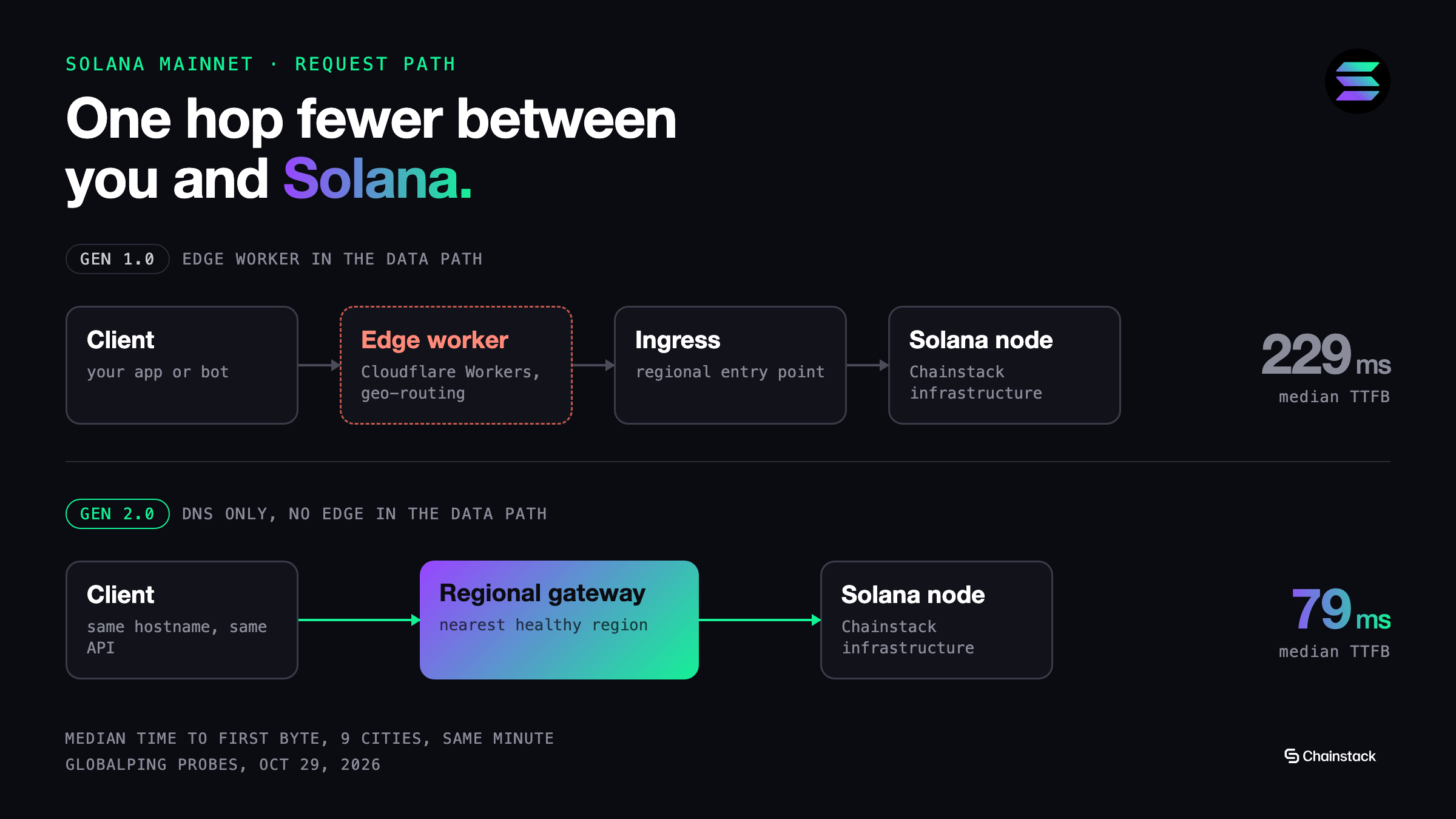
The announcement. How the DNS routing works and which chains it covers: Chainstack GEN 2.0 is live: faster Global Nodes.
Going deeper on Solana. GEN 2.0 is one part of a larger Solana rebuild: method-aware routing,
getProgramAccountslimits by program size, a steadier shred feed, and more. Read what changed for Solana RPC on Chainstack in 2026, with the numbers.
How we measured Solana
TTFB is the time from sending an RPC request to receiving the first byte of the reply. We measured it against Chainstack Solana endpoints with Globalping probes in 16 cities, testing the pre-GEN 2.0 route (through Cloudflare) and the GEN 2.0 direct route at the same moment on Oct 29, 2026.
Only 9 of the 16 cities had the same probe on both routes, so the headline uses those 9. The other 7 (Melbourne, Cape Town, San José, Lisbon, Istanbul, London and New York) used different probes, so they are marked in the full table and left out.
Solana mainnet results: median TTFB fell from 229 ms to 79 ms
| Metric (9 cities) | Before GEN 2.0 | GEN 2.0 |
|---|---|---|
| Median TTFB | 229 ms | 79 ms |
| Mean TTFB | 309 ms | 96 ms |
| Reduction at the median | – | 65.5% |
| Faster at the median | – | 2.9x |
| Cities that improved | – | 9 of 9 |
| Range of improvement | – | 1.5x to 12.3x |
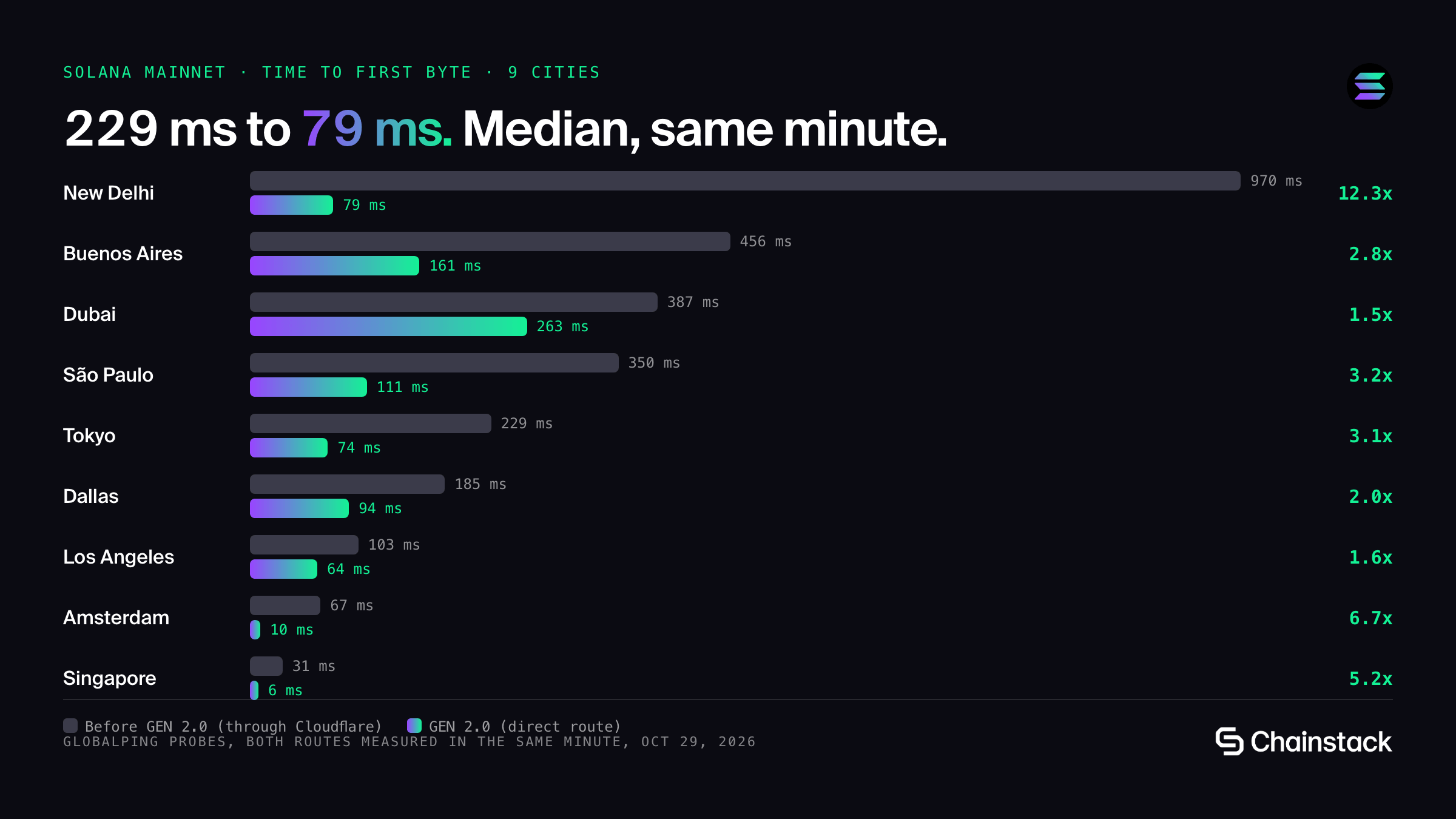
Full per-city results (Solana mainnet)
| City | Country | Before GEN 2.0 (ms) | GEN 2.0 (ms) | Saved (ms) | Faster (x) |
|---|---|---|---|---|---|
| Melbourne* | Australia | 1039 | 307 | 732 | 3.4 |
| New Delhi | India | 970 | 79 | 891 | 12.3 |
| Cape Town* | South Africa | 511 | 156 | 355 | 3.3 |
| Buenos Aires | Argentina | 456 | 161 | 295 | 2.8 |
| Dubai | United Arab Emirates | 387 | 263 | 124 | 1.5 |
| São Paulo | Brazil | 350 | 111 | 239 | 3.2 |
| San José* | Costa Rica | 293 | 74 | 219 | 4.0 |
| Tokyo | Japan | 229 | 74 | 155 | 3.1 |
| Dallas | United States | 185 | 94 | 91 | 2.0 |
| Lisbon* | Portugal | 150 | 41 | 109 | 3.7 |
| Istanbul* | Turkey | 129 | 49 | 80 | 2.6 |
| London* | United Kingdom | 105 | 11 | 94 | 9.5 |
| Los Angeles | United States | 103 | 64 | 39 | 1.6 |
| Amsterdam | Netherlands | 67 | 10 | 57 | 6.7 |
| New York* | United States | 34 | 4 | 30 | 8.5 |
| Singapore | Singapore | 31 | 6 | 25 | 5.2 |
Rows marked with an asterisk (*) used different probes for the two routes and are not in the headline numbers. Across all 16 cities the median goes from 207 ms to 74 ms.
Where the gains are biggest
- In milliseconds: New Delhi saves 891 ms (970 ms to 79 ms), followed by Buenos Aires with 295 ms, São Paulo with 239 ms and Tokyo with 155 ms. The farther the caller is from a Chainstack region, the more time the direct route saves.
- As a ratio: New Delhi is 12.3x faster, Amsterdam 6.7x and Singapore 5.2x.
- The smallest gain: Dubai improves 1.5x, from 387 ms to 263 ms.
What the public Solana dashboard shows
The same step is visible on the public Solana RPC dashboard. In Frankfurt, median getLatestBlockhash latency dropped from about 17 ms to about 2 ms when Solana moved to GEN 2.0 in late August 2026.
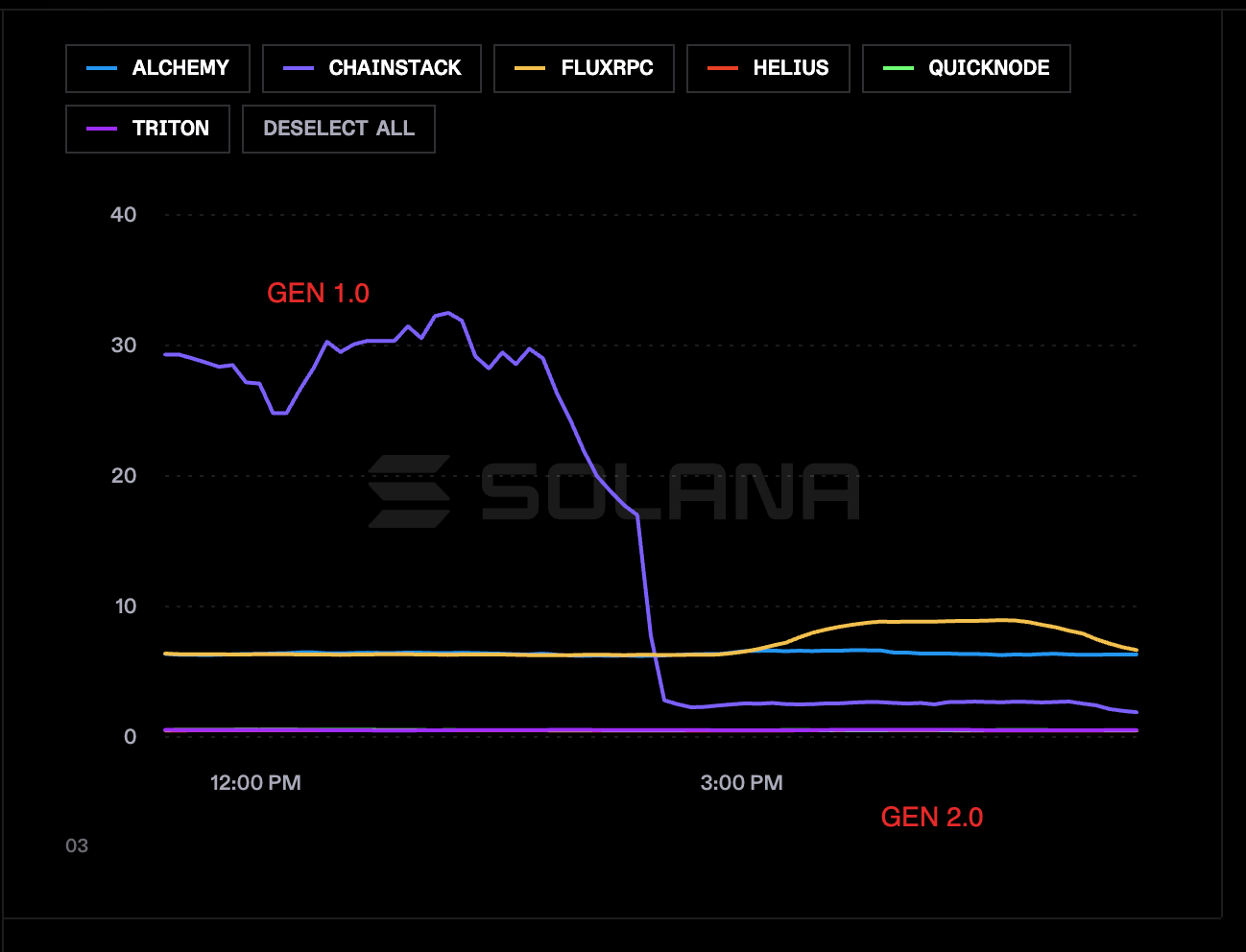
Chainstack getLatestBlockhash latency on the public Solana RPC dashboard, Frankfurt, around the GEN 2.0 switch.
Solana devnet
Devnet was tested the same way as mainnet, from the same 16 cities.
| Network | Median before GEN 2.0 | Median with GEN 2.0 | Cities that improved |
|---|---|---|---|
| Devnet | 405.5 ms | 121.5 ms | 16 of 16 |
The devnet median is about 3.3x lower, and every city improved.
How does Solana compare today?
Compare ranks RPC providers on p95 latency and success rate, measured from three regions. For Solana, Chainstack holds #1 as of Nov 17, 2026 (last 7 days):
- Score 0.042 (lower is better), availability 99.98%.
- p50 / p95 / p99: 21 ms / 41 ms / 90 ms.
- p95 by probe region: Germany 28 ms, US 55 ms, Singapore 40 ms.
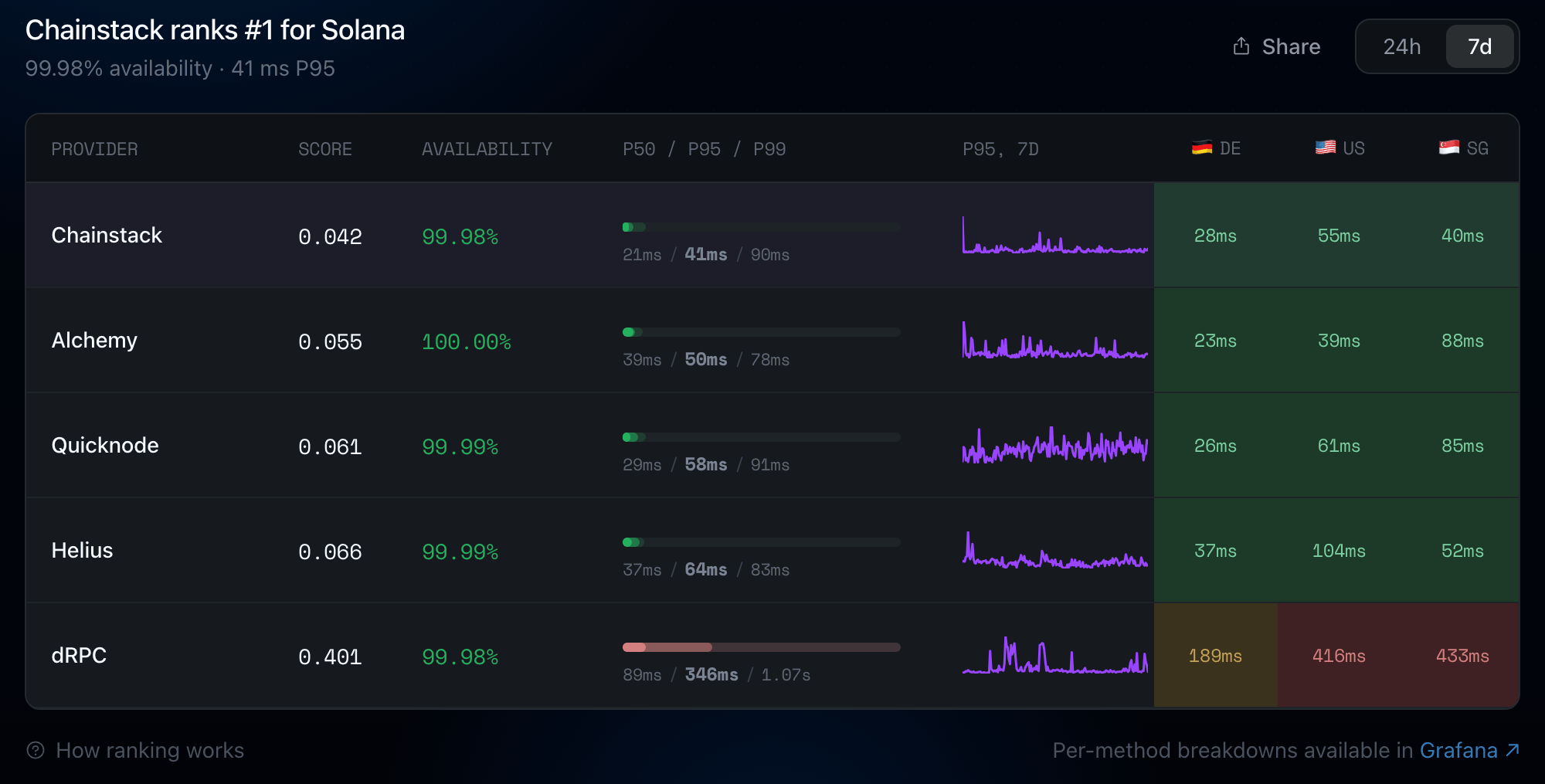
Check the current ranking on Solana on Compare. It measures p95 over a week from three regions, not a one-minute snapshot like the test above. The fixed-window version (Nov 5 to Nov 12, 2026) is the Solana RPC provider benchmark: latency and uptime (November 2026).
How to read these numbers (and what they don’t prove)
- One day, one run. Every city is a single measurement from Oct 29, 2026. Judge by the median and ignore single outliers.
- First byte only. The clock stops at the first byte, so it excludes the time to download a big response and the time a node needs to build it. Heavy calls such as
getProgramAccountsdepend mostly on that second part. - JSON-RPC only. WebSocket subscriptions and Yellowstone gRPC streams were not part of this test.
- Probes are not your servers. Your gain depends on how far your servers are from the nearest region.
- Chainstack against Chainstack. The “before” column is the Cloudflare route, measured at the same moment. For other providers, see Compare. For a head-to-head with Alchemy on seven other networks, see the Chainstack vs Alchemy RPC benchmark.
What this means for Solana builders
On Solana the calls are chained: a trading bot fetches a recent blockhash, then sends a transaction, so the delay is paid on every step. New Delhi dropped from 970 ms to 79 ms and Buenos Aires from 456 ms to 161 ms. Wallets and indexers that make many sequential calls feel the same effect.
In short: GEN 2.0 is a major update for Solana RPC, on the scale of a network upgrade for the chain itself. The endpoint and the API are the same, and the median first byte now arrives in 79 ms instead of 229 ms.
To try Solana on GEN 2.0, deploy a Global Node in a few seconds on the free Developer plan. More about Solana on Chainstack.
FAQ
Yes, nothing to reconfigure. The hostname is unchanged, and GEN 2.0 applies to Solana Mainnet and Devnet.
The median TTFB fell from 229 ms to 79 ms (about 2.9x) across the 9 cities where the same probe measured both routes on Oct 29, 2026. Per-city gains ran from 1.5x to 12.3x.
Yes. Global Nodes keep the same hostname and the API stays the same, so there is nothing to reconfigure. GEN 2.0 applies to Solana Mainnet and Devnet.
New Delhi went from 970 ms to 79 ms, while Dubai went from 387 ms to 263 ms. The gain depends on the distance to the nearest region and on the network path, so it varies by city. Close to a region the saving in milliseconds is small but the ratio is large.
Compare queries each provider’s first paid plan every 1 to 3 minutes from Germany, the US and Singapore. The score combines p95 latency per method with the success rate, and lower is better.
No. 2.9x is the median of a single test across 9 cities, run on Oct 29, 2026. Measure from your own regions to see your gain.
Related reading