AI-ready infrastructure
 Refer and earn


 Ethereum
 Hyperliquid
 Solana
 Arbitrum
 BNB Smart Chain
 Base
 Polygon
 TRON
 Sui
 Robinhood


Robinhood RPC provider scores for wallets (November 2026)

Data sources: the Chainstack Compare scorecard and the 7-day dashboard, both read on Nov 10, 2026. The scorecard page shows no timestamp.
Abstract
Chainstack scores 82 out of 100 for Robinhood wallets, Alchemy 63 and Quicknode 61. The score rests on 78% of the scorecard weight. Chainstack leads on Cost and Limits and RPS, and trails on Support and gRPC and streams coverage.
Key findings
- Chainstack scores 82, 18 points ahead of Alchemy (63). Alchemy and Quicknode (61) are 2.7 points apart unrounded, a tie by the page's own rule.
- Cost: $2.62 per 1M requests on Chainstack Growth, against $12.37 on Quicknode Build and $14.46 on Alchemy Pay As You Go.
- Reliability: availability of 99.9950% on Chainstack, 100% on Alchemy and 99.9416% on Quicknode, which scores 62 against 100 for the other two. Quicknode's Singapore rate was 99.8622%.
- Performance: all three score 100. Mean regional P95 is 43.1 ms on Alchemy, 55.2 ms on Chainstack and 62.3 ms on Quicknode, so Alchemy is lowest on latency.
- Where Chainstack does not lead: Enterprise (88 against Quicknode at 93), Support (12, the lowest of the three, against Alchemy at 26) and raw RPS on the roughly $50 plan (250 against 360 on Alchemy).
Verdict and best for
| Rank | Provider | Score | Best for |
|---|---|---|---|
| 1 | Chainstack | 82 | Cost, Limits and RPS, Coverage, Reliability (tie) |
| 2 | Alchemy | 63 | Reliability (tie), latency, Support, raw RPS on the roughly $50 plan |
| 3 | Quicknode | 61 | Enterprise |
Scores are out of 100 and higher is better. Rank is by score on this scorecard. Alchemy and Quicknode are tied by the page's rule. Performance and AI-readiness are three-way ties.
Contents
- How the score is built
- Robinhood RPC provider scores: pillar table
- Provider summaries
- Robinhood RPC provider comparison by pillar
- Reliability and Performance from the 7-day dashboard
- Conclusion
- Appendix: weights and rules
- Other RPC providers
How the score is built
The report covers Robinhood with the Wallet use case. Weights: Reliability 30, Cost 25, Performance 15, Limits and RPS 10, Coverage 5, Enterprise 5, Support 5, AI-readiness 5.
Limits
What the scorecard scored:
- Chainstack publishes the scorecard and is one of the three providers compared.
- Cost, limits, coverage, enterprise, support and AI-readiness are compiled by hand from public pages. The page says to confirm prices and limits with each provider.
- Six pillars were scored by the page. Limits and RPS is 60% scored, because behavior under a spike (2x the limit) needs a load test the page has not run.
What this report adds:
- The page showed Reliability and Performance as not scored on Nov 10, 2026. This report computes both from the 7-day dashboard window read the same day, using the page's published formulas.
- Reliability rests on availability alone, which counts for 40% of its pillar. Freshness and correctness are not scored.
- The score is the page's weighted mean over the six static pillars plus these two. It rests on 78 of 100 weight points.
- The scorecard's own total over its six static pillars was 72 for Chainstack, 44 for Alchemy and 49 for Quicknode. It excludes live Reliability and Performance and is not the score in this report.
What the dashboard measures:
- Three probe regions (Frankfurt, US West, Singapore), the first paid plan of each provider (Chainstack, Quicknode Growth, Alchemy Growth), no end-user latency and no correctness measurement.
- dRPC appears on the dashboard but is not scored by the scorecard, so it is left out.
How to read the numbers:
- Displayed scores are rounded. A gap under 3 unrounded points is a tie by the page's rule.
- Behavior under a spike is a load-test metric the page does not score.
Robinhood RPC provider scores: pillar table
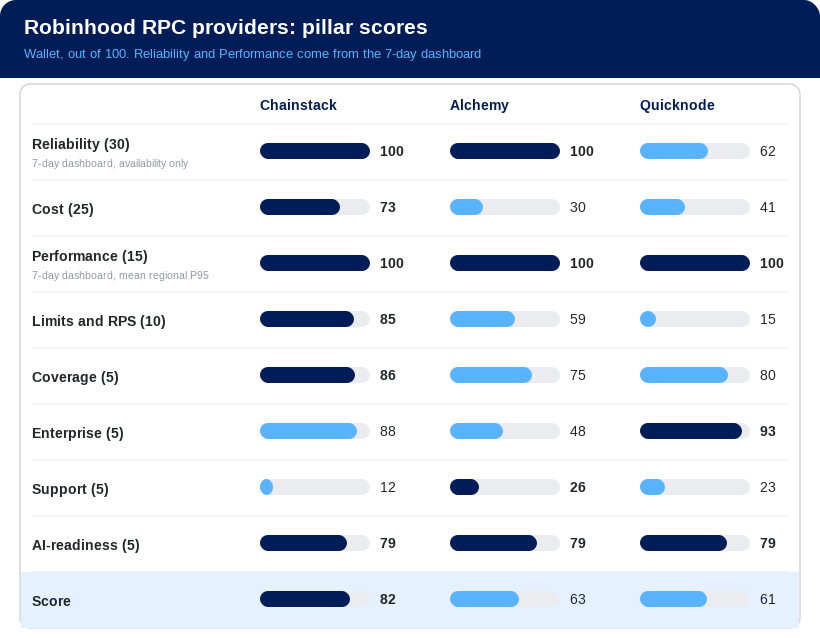
Chainstack leads with 82, then Alchemy with 63 and Quicknode with 61.
| Pillar | Weight | Scored share | Chainstack | Quicknode | Alchemy |
|---|---|---|---|---|---|
| Reliability (7-day dashboard) | 30 | 40% | 100 | 62 | 100 |
| Cost | 25 | 100% | 73 | 41 | 30 |
| Performance (7-day dashboard) | 15 | 100% | 100 | 100 | 100 |
| Limits and RPS | 10 | 60% | 85 | 15 | 59 |
| Coverage | 5 | 100% | 86 | 80 | 75 |
| Enterprise | 5 | 100% | 88 | 93 | 48 |
| Support | 5 | 100% | 12 | 23 | 26 |
| AI-readiness | 5 | 100% | 79 | 79 | 79 |
| Score | 100 | 78% of weight | 82 | 61 | 63 |
Highest score in each row in bold, ties included.
Provider summaries
Each summary gives the score, the strongest pillar and the weakest pillar from the table above.
1. Chainstack: 82
- Strength: Cost (73, $2.62 per 1M requests) and Reliability (100, 99.9950% availability).
- Weak spot: Support (12, response under 24 h on 24×5 at both plan levels) and gRPC and streams (0).
2. Alchemy: 63
- Strength: Reliability (100, 100% availability in all three regions), lowest mean regional P95 (43.1 ms) and 360 RPS on the roughly $50 plan.
- Weak spot: Enterprise (48, ISO 27001 and SLA percent not disclosed) and Cost (30, $14.46 per 1M requests).
3. Quicknode: 61
- Strength: Enterprise (93, a 99.99% SLA on Enterprise only) and Streams on all plans.
- Weak spot: Limits and RPS (15, 50 RPS on the roughly $50 Build plan), Cost (41, $12.37 per 1M requests) and Reliability (62, 99.8622% availability in Singapore).
Robinhood RPC provider comparison by pillar
Cost (weight 25)
| Metric | Chainstack | Quicknode | Alchemy |
|---|---|---|---|
| $ per 1M requests, EVM dApp mix, 18.69M calls per month (70% of pillar) | $2.62 (Growth) | $12.37 (Build) | $14.46 (Pay As You Go) |
| Bill predictability (20%) | 100 | 100 | 70 |
| Archive, trace and history, $ per 1M compute only (10%) | $10.65 | $13.32 | $19.97 |
Lowest price and highest predictability marked in bold.
Limits and RPS (weight 10, 60% scored)
| Metric | Chainstack | Quicknode | Alchemy |
|---|---|---|---|
| RPS on the roughly $50 plan (40%) | 250 RPS, Growth $49 | 50 RPS, Build $49 | 360 RPS, Pay As You Go |
| Flat-fee or unlimited RPS (20%) | 100: Unlimited Node, 25–500 RPS from $149 per month | 0: no self-serve option | 0: Enterprise from 1,000 RPS by contract |
| Behavior under spike (40%) | not scored | not scored | not scored |
Coverage (weight 5)
| Metric | Chainstack | Quicknode | Alchemy |
|---|---|---|---|
| Listed chain count (30%) | 98: 93 listed protocols | 91: 77 catalogue chains | 90: 75 mainnets |
| gRPC and streams (8.8%) | 0: WebSocket only | 100: Streams on all plans | 50: webhooks on Pay As You Go |
| Dedicated nodes (8.8%) | 100: self-serve from Pro | 50: Enterprise only | 50: sales only |
| Region selection (8.8%) | 100 | 50 | 50 |
| MEV protection and private transactions (8.8%) | 50: optimized submission only | 0: not disclosed | 0: not disclosed |
| Archive, debug and trace, WebSocket, testnets | 100 each | 100 each | 100 each |
Enterprise (weight 5)
| Metric | Chainstack | Quicknode | Alchemy |
|---|---|---|---|
| SOC 2 Type II | 100 | 100 | 100 |
| ISO 27001 | 100 | 100 | 0: not disclosed |
| SLA of 99.9% or more with credits | 100: 99.9% | 100: 99.99%, Enterprise only | 0: percent not disclosed |
| SSO, RBAC and audit log | 67: audit log not documented | 100 | 100 |
| Single-tenant and jurisdiction | 50 | 50 | 50 |
| Status page with 90 days of history | 100 | 100 | 0: under 90 days |
Support (weight 5)
| Metric | Chainstack | Quicknode | Alchemy |
|---|---|---|---|
| Response time, roughly $50 plan | 0: under 24 h, 24×5 | 18: 24-hour SLA | 18: 24 h |
| Response time, roughly $500 plan | 0: under 24 h, 24×5 | 46: 8-hour SLA | 18: 24 h |
| Channels and coverage | 60 | 0 | 60 |
AI-readiness (weight 5)
| Metric | Chainstack | Quicknode | Alchemy |
|---|---|---|---|
| MCP, 5 reference tasks | 80: 4 of 5 | 40: 2 of 5 | 40: 2 of 5 |
| Docs for LLMs | 100 | 100 | 100 |
| Machine-readable pricing | 100 | 100 | 100 |
| Skills and plugins | 50 | 100 | 100 |
| Agent self-serve and payments | 40 | 100 | 100 |
Reliability and Performance from the 7-day dashboard
Reliability and Performance come from the dashboard window read on Nov 10, 2026 (7 days, no error or degradation flags), not from the page.
| Measure | Chainstack | Quicknode | Alchemy |
|---|---|---|---|
| P95 Frankfurt | 46.9 ms | 24.3 ms | 22.7 ms |
| P95 US West | 71.7 ms | 65.4 ms | 20.7 ms |
| P95 Singapore | 47.0 ms | 97.3 ms | 85.7 ms |
| Mean regional P95 | 55.2 ms | 62.3 ms | 43.1 ms |
| Performance score | 100 | 100 | 100 |
| Availability, mean of three regions | 99.9950% | 99.9416% | 100% |
| Reliability score (availability only) | 100 | 62 | 100 |
Lowest latency and highest availability marked in bold. Performance scores 100 at a mean regional P95 of 80 ms or less, so all three tie despite a 19.2 ms spread. Quicknode's regional availability was 100% in Frankfurt, 99.9628% in US West and 99.8622% in Singapore. Chainstack's was 99.9963% in Frankfurt and US West and 99.9926% in Singapore.
Conclusion
Chainstack has the highest score on this scorecard for Robinhood wallets: 82, 18 points ahead of Alchemy at 63, on 78% of the weight. Quicknode scores 61, a tie with Alchemy.
Per-pillar picks:
- Reliability: Chainstack and Alchemy tie at 100 on availability alone.
- Cost: Chainstack, 73.
- Performance: a three-way tie at 100. Alchemy has the lowest mean regional P95, 43.1 ms.
- Limits and RPS: Chainstack, 85. Alchemy offers the most RPS on a roughly $50 plan.
- Coverage: Chainstack, 86.
- Enterprise: Quicknode, 93.
- Support: Alchemy, 26.
- AI-readiness: a three-way tie at 79.
A wallet team that weights Enterprise or Support above Cost should read those rows first.
Appendix: weights and rules
Wallet weights: Reliability 30, Cost 25, Performance 15, Limits and RPS 10, Coverage 5, Enterprise 5, Support 5, AI-readiness 5. Performance is 100 at a mean regional P95 of 80 ms or less and 0 at 1,500 ms or more, with a log scale between. Reliability is 100 at 99.99% availability or more and 0 at 99% or less. Score = sum of weight x scored share x pillar score, divided by the sum of weight x scored share.
Other RPC providers
The scorecard scores only the providers in this report. These Chainstack lists cover others: