AI-ready infrastructure
 Refer and earn


 Ethereum
 Hyperliquid
 Solana
 Arbitrum
 BNB Smart Chain
 Base
 Polygon
 TRON
 Sui
 Robinhood


How to reduce operational costs for Web3 businesses


A successful payment should not create three more jobs.
A customer tops up an account. The transfer arrives, but someone still has to find it, match it to an order, calculate the amount to credit, and answer a message asking why the balance has not updated. The blockchain transaction worked. The business process did not.
For teams trying to reduce operational costs for Web3 businesses, this gap matters as much as the infrastructure bill. Low transaction fees help, but they do little for a workflow that needs an engineer or finance specialist to finish every payment.
The useful question is what it costs to complete a customer action reliably. That includes network and processing fees, infrastructure, reconciliation, support, and the maintenance work that keeps them connected. Reducing that total starts with making the work visible.
Measure cost per completed action
An API subscription is easy to count. The afternoon spent investigating an unmatched deposit is easier to miss. Yet both belong in the cost of serving a customer.
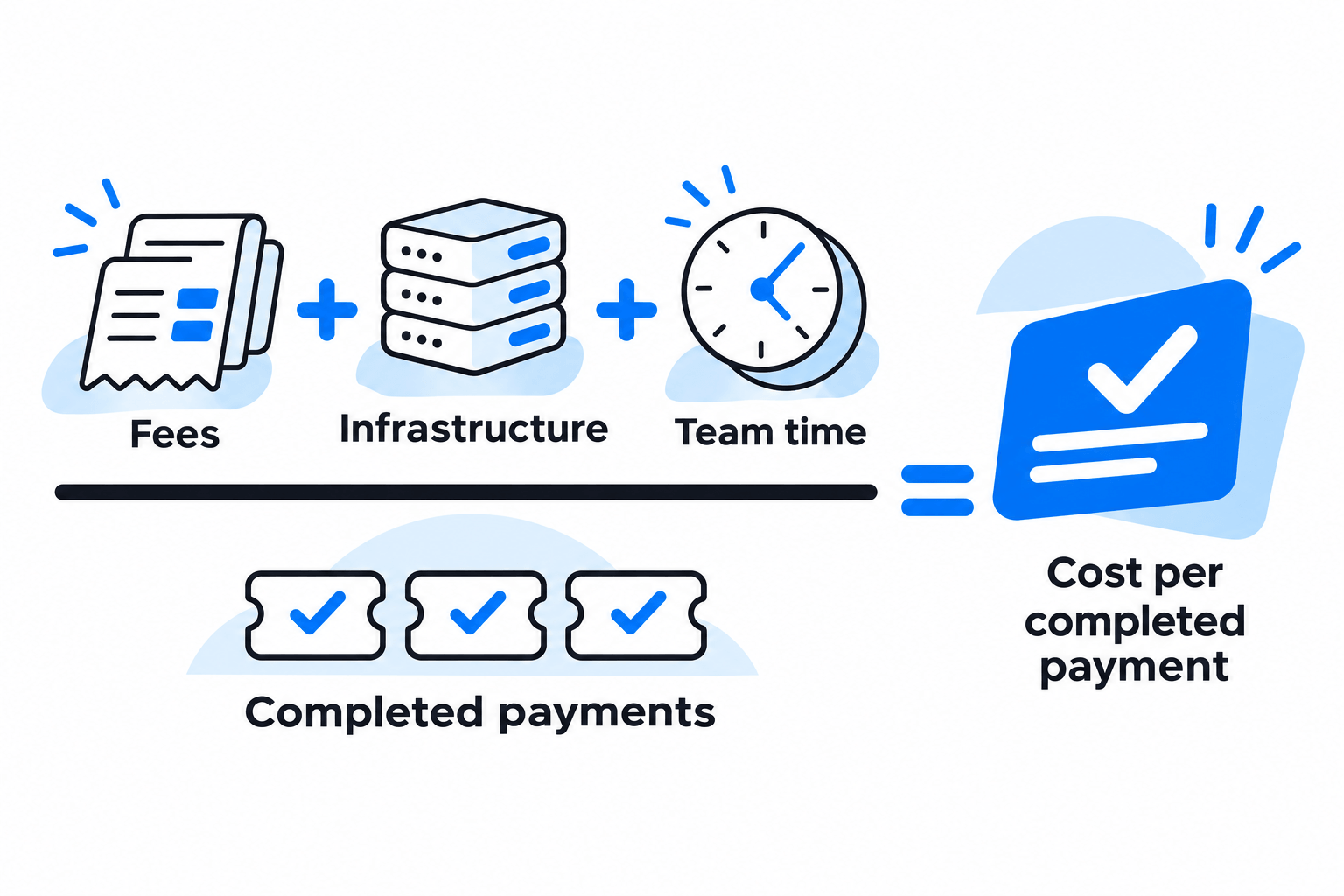
Start with a single flow, such as an account top-up or a marketplace purchase. Record the direct fees, infrastructure usage, and staff time required to complete it. Include failed attempts and follow-up work in the cost pool, then divide by successful completions.
A practical starting metric is: cost per completed payment = (payment fees + allocated infrastructure costs + reconciliation and support labor) ÷ completed payments.
Consider an illustrative business processing 1,000 payments a month. If each needs three minutes of manual checking, that is 50 hours of work. At an assumed internal cost of $30 an hour, the handling cost is $1,500. Cutting it to one minute per payment would save roughly 33 hours, or $1,000 a month. These are hypothetical inputs, not measured customer results.
This calculation changes what deserves attention. A small fee discount may be useful. Removing a routine manual check from every payment may be worth more. Measure both before choosing the next project.
Separate the fees before trying to reduce them
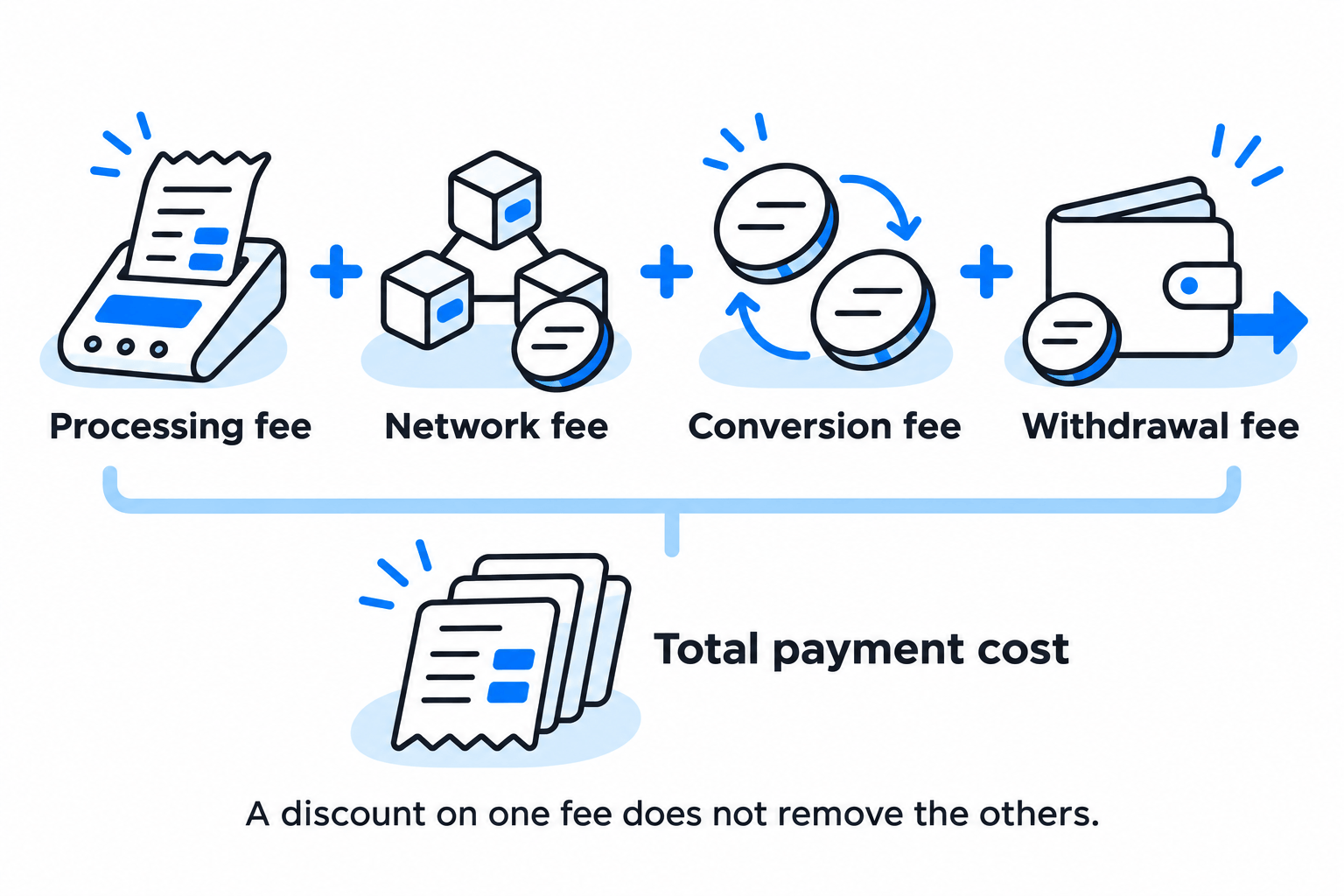
A crypto payment can incur several distinct costs: processing the payment, moving funds on-chain, converting assets, and withdrawing the proceeds. A discount on one part does not remove the others.
Even network fees need context. TRON, for example, uses Bandwidth for transaction data and Energy for smart contract execution. Available resources and network rules affect the cost. Choosing a network by a fixed, supposedly universal transfer fee can therefore produce a misleading forecast.
Promotions can make a pilot cheaper, provided the team understands which charge is covered. For example, NOWPayments offers new partners 60 days of zero network fees on USDT TRC-20 deposits when they activate Custody. Treat it as a temporary reduction in a defined part of the payment cost, rather than a promise that the whole payment lifecycle is free.
Before modeling savings, confirm eligibility, the covered deposit charges, and pricing after the offer ends. Account separately for service fees, conversion, withdrawals, and any fee charged by the customer’s sending wallet. The public offer describes merchant deposit costs; it should not be read as a waiver of every sender-side charge.
Use the promotional window to learn what a completed payment actually costs. The decision to keep a payment route should still make sense in month three.
Automate the handoff from payment to product
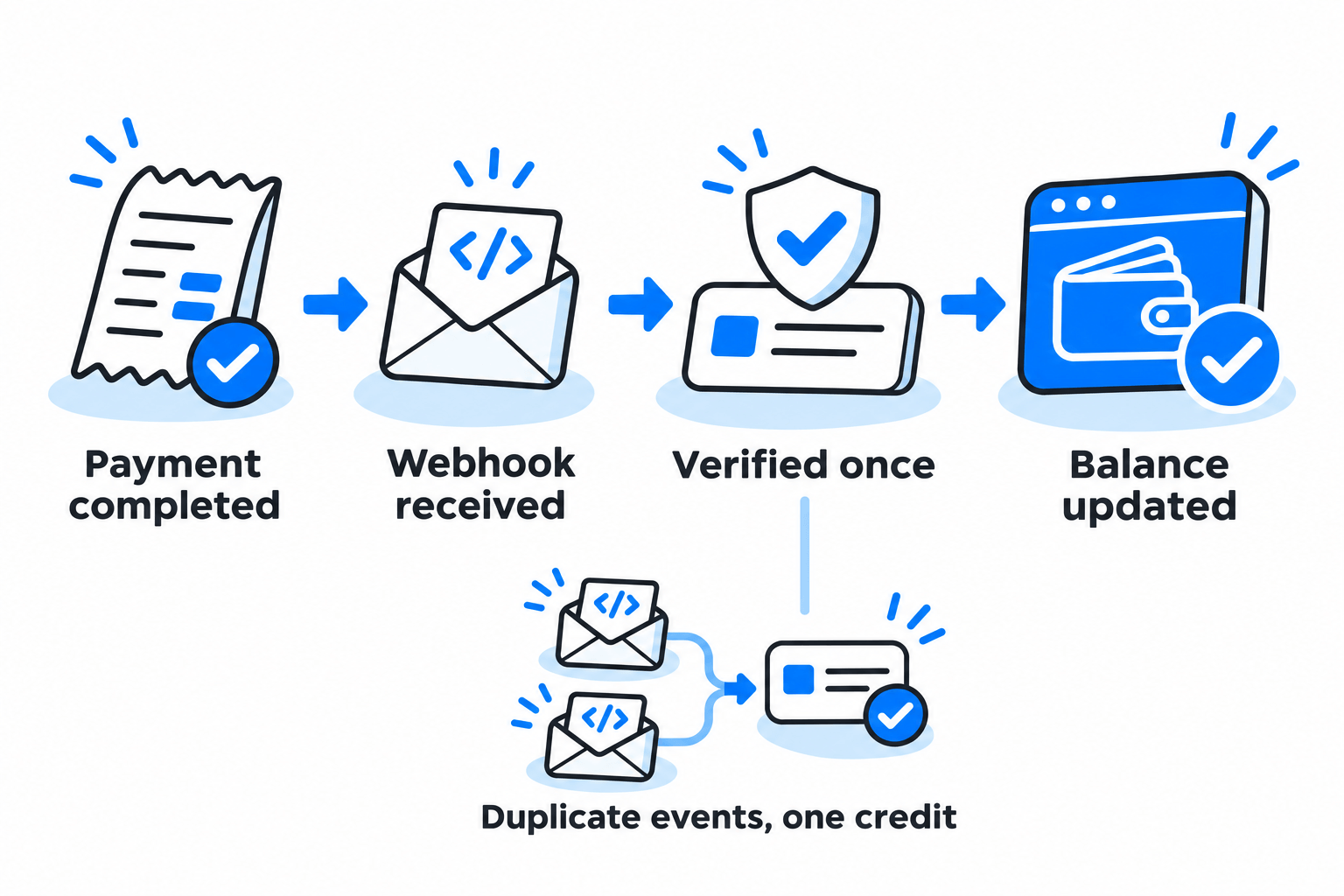
The most expensive gap often sits between receiving money and delivering what the customer bought. Payment processing needs to update an order, activate a subscription, or credit an account without requiring someone to check a dashboard.
A payment API provides a way to connect those steps inside an application. NOWPayments, for example, documents both direct payment creation and hosted invoices, as well as currency discovery and payment-status retrieval. Its crypto payment gateway api gives teams an integration option without having to build every payment operation themselves.
The architecture choice still matters. A hosted checkout can reduce the interface work a team owns. A direct API flow can offer more control, while leaving the application responsible for presenting payment details and handling the customer journey. Check the exact assets and features supported by the chosen flow before committing to it.
Status notifications make the handoff practical. NOWPayments calls these Instant Payment Notifications, or IPNs, and documents signature verification and updates when payment status changes. These events can feed the application’s order and balance logic.
Build the integration so that an event delivered twice cannot credit a balance twice. Keep the provider payment ID connected to the internal order, verify incoming notifications, and define which status permits fulfillment. Maintain a recovery path for missing notifications and route underpayments, expired requests, and other exceptions to a review queue.
The goal is a routine flow that completes automatically, with enough context for a person to resolve the unusual cases quickly.
Offer more payment options without multiplying the work
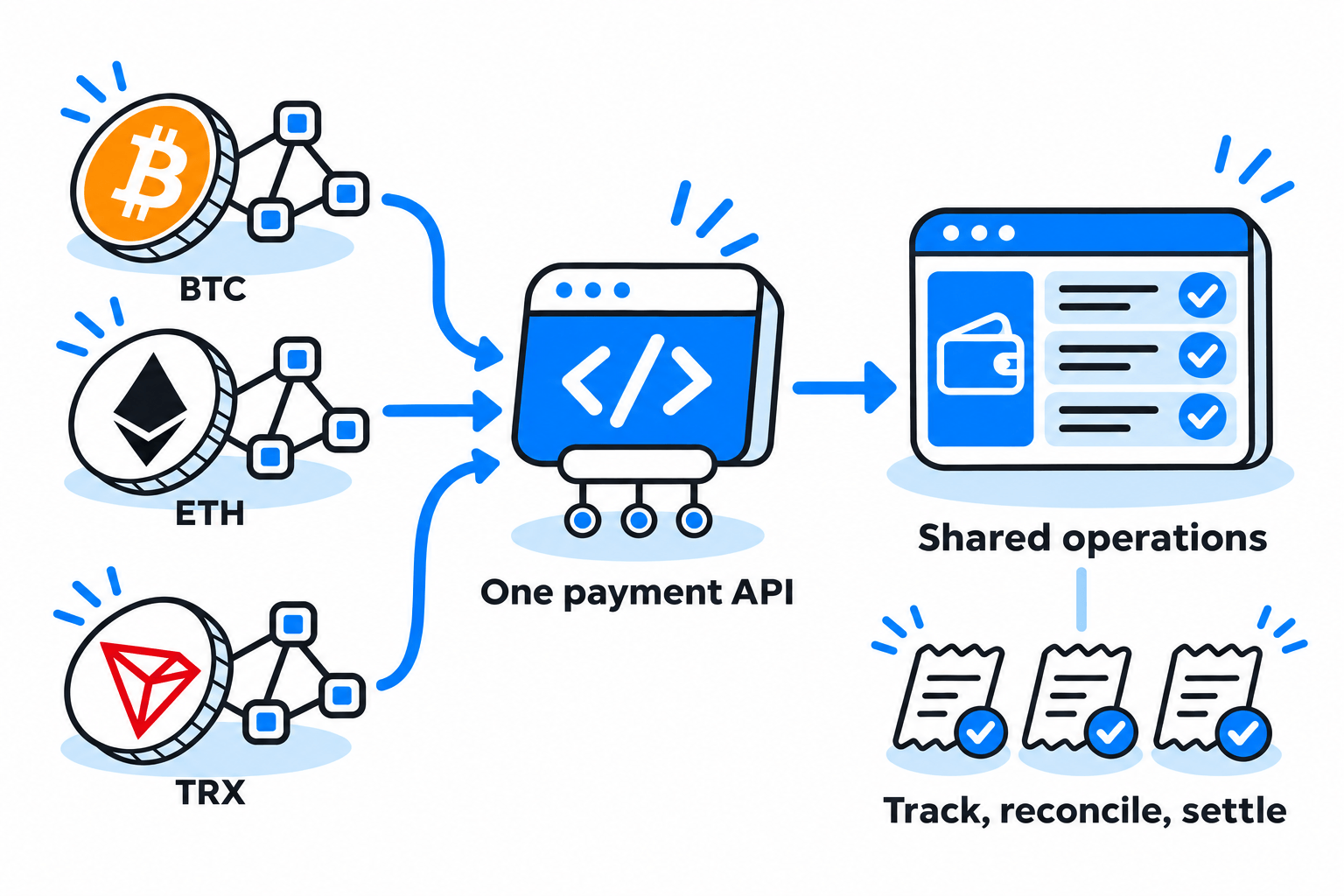
Customers may hold different assets or use different networks. Supporting their preferences can reduce the need for them to move funds before paying. Building a separate operational process for every option, however, can make the business harder to run.
NOWPayments supports 350+ cryptocurrencies. The operational value of that breadth is access through a shared integration and payment-management process. It does not mean a business needs to show every asset at checkout, or that every feature works identically across them.
Start with the asset and network combinations customers request. Confirm minimum amounts, payment-method compatibility, settlement availability, and refund procedures for each. Track actual use and support demand before expanding the list.
Keep the network visible wherever a ticker could be ambiguous. USDT on TRON and USDT on another network should be distinguishable before the customer sends funds. A longer currency list is useful only if customers can choose correctly and finance can reconcile the result.
Reduce unnecessary conversions and balance movements
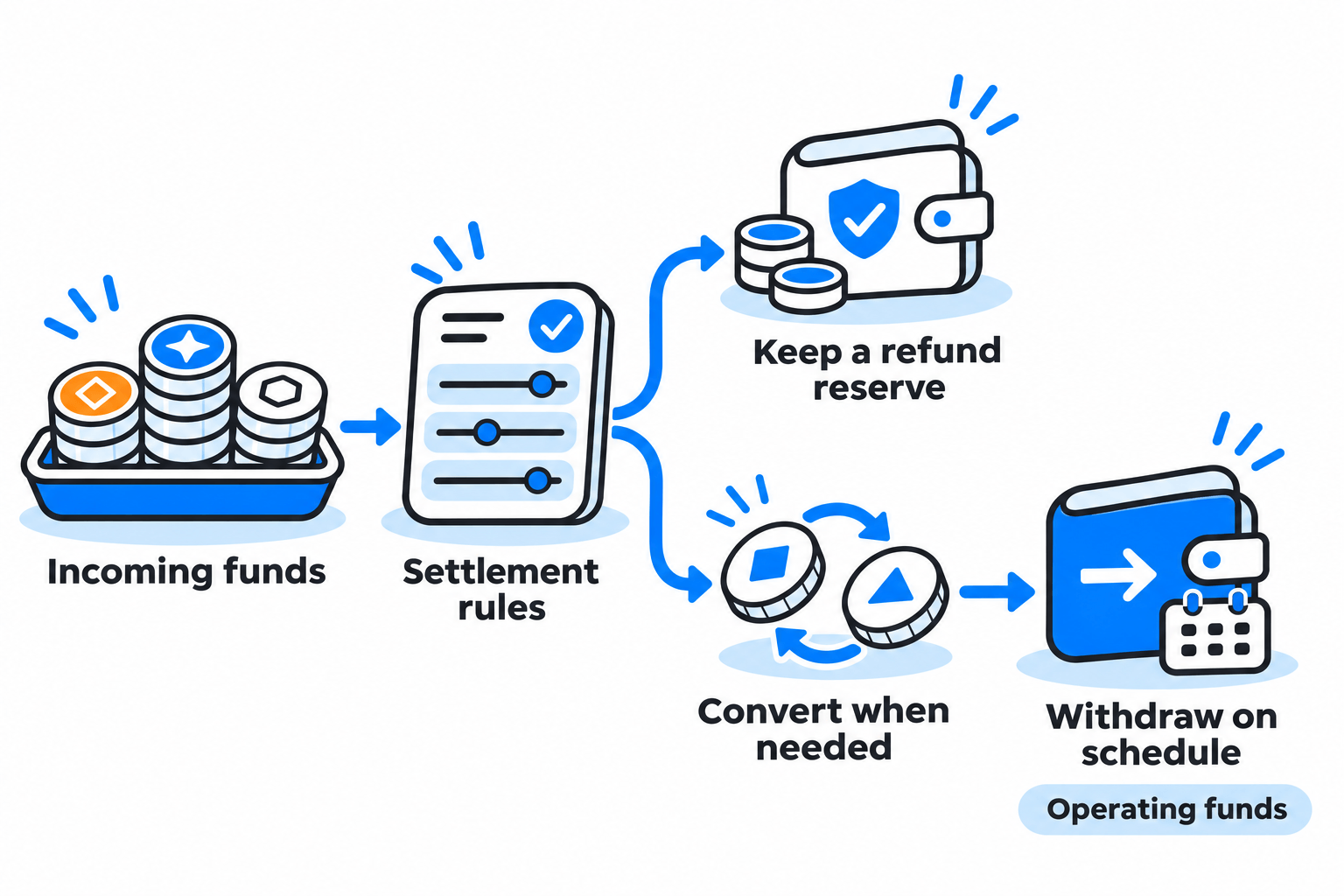
Accepting several assets can leave a business with money scattered across currencies and wallets. If operating expenses are paid in one currency, every extra conversion or transfer adds a step to the path from revenue to usable funds.
Define a settlement policy before automating it. Decide which assets to retain, which to convert, how much liquidity is needed for refunds and payouts, and when funds should leave the payment provider. This lets the team evaluate conversion and withdrawal costs together.
NOWPayments’ Custody product brings receiving, storing, converting, and withdrawing assets into one service. It is an example of consolidating fund-management tasks that might otherwise span several tools and manual transfers.
Consolidation introduces a tradeoff: some work moves to the provider, and the business relies on that provider for access to the held funds. Set balance limits, access permissions, approval rules, and withdrawal schedules that fit the operation. Compare the amount received after conversion and withdrawal, not just the quoted exchange rate.
Automation is most useful when it follows a clear policy. Automatically converting every incoming payment without considering near-term obligations can simply create another conversion later.
Make infrastructure usage explain the bill
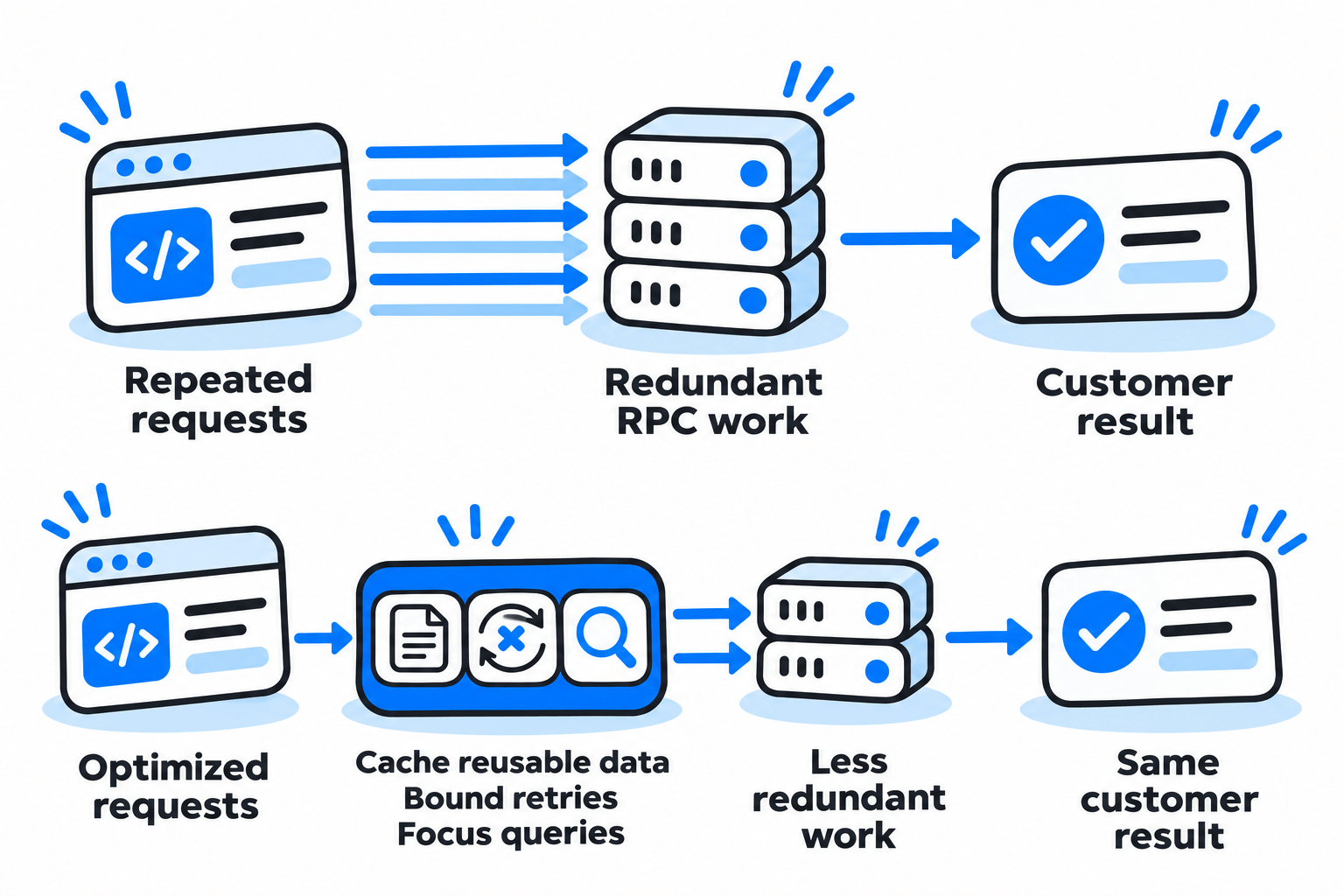
Payments are one part of the operating model. Web3 applications also spend resources reading blockchain state, checking transactions, serving balances, and maintaining backend services. Repeated work in these paths can raise costs without improving the customer experience.
Audit the busiest remote procedure call (RPC) paths. Look for multiple screens requesting the same data, polling that continues after a task ends, retries without a limit, and historical queries broader than the feature needs. Cache data only where its freshness requirements allow it, and keep recovery checks even when events handle the normal path.
Measure consumption in the units your infrastructure provider bills. Chainstack’s request-unit documentation explains how request classification affects usage, so raw request counts alone may not describe the bill. That gives teams a concrete starting point for deciding which calls to optimize.
Use the same cost-per-action approach here. Compare infrastructure consumption per completed payment, active customer, or successful user operation. Cutting request volume is useful when it removes redundant work; cutting checks needed for correct balances or transaction status can create a larger support problem.
Treat support as part of the operating model
A provider’s support process becomes part of your own when payments stop completing. An unclear escalation path can pull engineers away from product work while customers wait for access.
NOWPayments offers 24/7 support, as well as dedicated support and account optimization. Its API can also be adapted to different application workflows. These are useful evaluation points, but response commitments and the scope of any custom solution need to be agreed for the business concerned.
Ask practical questions before launch: Who handles a payment that is confirmed on-chain but missing from the merchant balance? What information should an escalation include? Who owns an integration change, and how are changes communicated? A named contact helps, but a defined process makes that contact useful.
Start with one flow and prove the saving
Trying to optimize the entire business at once makes it difficult to tell which change helped. Choose one payment route or customer journey, establish its baseline, and make a limited change.
- Measure the starting point: fees, staff minutes, infrastructure usage, and time to make funds usable.
- Automate one recurring task, such as matching a payment to an order or updating a balance.
- Record exceptions and support effort alongside successful completions.
- Compare total cost per completed payment before and after the change.
- Repeat the calculation using standard pricing after any promotion expires.
A Web3 business becomes cheaper to operate when routine customer activity stops creating routine manual work. Payment APIs, shared currency support, conversion tools, and managed infrastructure can all contribute, but the saving depends on how they fit together. Keep the changes that reduce cost per completed action while preserving accurate balances, usable funds, and a reliable customer experience.
Frequently asked questions
What should a Web3 business optimize first?
Start with the flow that combines high volume with repeated manual intervention. Measure its fees, infrastructure usage, and handling time. The largest visible vendor bill is not necessarily the largest avoidable cost.
Does a zero network-fee promotion mean crypto payments are free?
No. Identify the covered charge and who pays it. Processing, conversion, withdrawal, or sender-side costs may still apply. NOWPayments’ USDT TRC-20 offer is limited to new partners activating Custody and the initial promotional period.
Does accepting more cryptocurrencies require a separate integration for each?
A payment API can provide a shared integration for many assets, but teams still need to check network-specific requirements, supported payment flows, limits, and settlement options. A common API reduces integration duplication; it does not remove operational differences between assets.