AI-ready infrastructure
 Refer and earn


 Ethereum
 Hyperliquid
 Solana
 Arbitrum
 BNB Smart Chain
 Base
 Polygon
 TRON
 Sui
 Robinhood


How to get an Elysium RPC endpoint for trading (2026 guide)

TL;DR
A trading bot on Elysium cannot see its own transaction waiting anywhere: there is no public mempool, so a pending-transaction listener never fires, and the only signal is the next block. Blocks arrive in bursts. In a 150-block sample on November 18, 2026, the public Mainnet RPC returned between 1 and 10 blocks in the same second, with a median of 2. The chain targets 100 ms blocks, but the same RPC averaged 181 ms per block over the last 100,000 blocks and 751 ms over the last 1,000, because block production follows load. The rest of this guide covers what an Elysium RPC endpoint for trading has to do, why the public endpoint stops being enough, and how to deploy a private Mainnet or Testnet endpoint on Chainstack.
Short answer: send transactions over HTTPS, follow blocks over WebSocket, confirm from receipts and budget the block stream, because every newHeads notification counts as one request on Chainstack. Global Nodes serve both on the free Developer plan (3M RU a month, 25 RPS).
| Option | What it gives a bot | Limits | Best for |
|---|---|---|---|
| Kinetiq public RPC | HTTPS only in Kinetiq’s docs, shared by every user | debug_* needs an API key, eth_getLogs capped at 2,000 blocks | Smoke tests |
| Chainstack Global Nodes | HTTPS and WSS, newHeads and logs subscriptions | 25 RPS on Developer, 250 on Growth, 400 on Pro, 600 on Business | Strategy development and most production loops |
| Chainstack Dedicated Nodes or Unlimited Node | Isolated resources, or a flat fee tied to an RPS tier | Pro plan for Dedicated Nodes, Growth plan for Unlimited Node | Sustained high request volume |
What is an Elysium RPC endpoint for trading?
An Elysium RPC endpoint is the HTTPS and WebSocket URL your bot uses to read state and send transactions on Elysium, an Arbitrum Orbit chain built by Kinetiq that settles to HyperEVM and uses HYPE as gas. Kinetiq’s documentation names high-frequency trading and professional market-making AMMs as the flagship tenants and says the fee environment is tuned so that refreshing quotes 5 to 10 times per second is cheap. The API is standard Ethereum JSON-RPC, so the work of the endpoint is about speed and signal, not about new methods.
What a trading workload asks of the endpoint:
- Send signed transactions and learn the outcome:
eth_sendRawTransaction,eth_sendRawTransactionSync,eth_getTransactionReceipt - Follow the chain tip over WebSocket:
eth_subscribewithnewHeadsandlogs - Quote and simulate against current state:
eth_call,eth_simulateV1,eth_createAccessList - Read fee data to set a tip:
eth_baseFee,eth_feeHistory,eth_maxPriorityFeePerGas - Send a transaction that the sequencer includes only if conditions hold:
eth_sendRawTransactionConditional - Read all receipts of a block in one call:
eth_getBlockReceipts
You can review the full per-method availability in the Chainstack Elysium methods reference.
With no mempool to watch, the endpoint is the only place a bot learns that its transaction landed, so the latency and stability of block and receipt reads are the quality of the bot’s confirmation logic.
How trading on Elysium differs from trading on Ethereum
Elysium accepts the same JSON-RPC calls as Ethereum, but the properties a trading bot depends on are different enough to break a straight port.
| Property | Elysium | Why it matters for a bot |
|---|---|---|
| Block time | Target 100 ms; measured 181 ms on average over the last 100,000 blocks and 751 ms over the last 1,000 blocks on Mainnet (November 18, 2026) | The block stream is a range, not a constant, so budget requests for the high end |
| Receipt | About 300 ms perceived receipt, per Kinetiq | Confirm from the receipt at latest, not from finalized |
| Mempool | None: a single sequencer, and pending subscriptions deliver nothing | There is no queue to watch or front-run |
| Ordering | By priority fee within each block, with no privileged lanes, per Kinetiq | The tip decides position, and the public RPC’s eth_maxPriorityFeePerGas returned 0 on November 18, 2026 |
| Fees | Minimum base fee 0.5 gwei on Mainnet and 0.1 gwei on Testnet, per Kinetiq; observed base fee 0.5 to 0.5005 gwei over 150 blocks | Base fee barely moves, so tips are the competitive variable |
| Finality | safe and finalized trail latest by minutes; on November 18, 2026 finalized was 5,211 blocks and about 41 minutes behind, and later the same day 6,010 blocks and about 49 minutes, longer than the roughly 15-minute batch interval in Kinetiq’s docs | Do not gate a trade on finalized |
| Withdrawals | Optimistic, with a challenge period of about 5.5 days | Plan inventory on the chain you trade on |
| HyperCore data and orders | The read precompile and the ElysiumCoreWriter predeploy are planned for an ArbOS upgrade that was not live on November 18, 2026; Kinetiq’s docs said about four weeks after mainnet | A contract cannot read HyperCore books on Elysium at the time of writing |
These differences decide provider selection: an endpoint has to deliver newHeads reliably, answer receipt reads fast, and hold a request ceiling that survives a burst of blocks.
Elysium RPC endpoint options for trading
Public vs private Elysium RPC endpoints
Kinetiq’s connecting docs list a public endpoint for each network and say that every user shares it, so production traffic belongs on a provider endpoint.
Official public endpoints:
- Mainnet:
https://rpc.elysium.kinetiq.xyz(chain ID 99901) - Testnet:
https://testnet-rpc.elysium.kinetiq.xyz(chain ID 99801)
Warning: The public endpoints are shared by every user, and Kinetiq’s connecting guide lists only HTTPS URLs for them. A bot that needs a block stream has no documented public WebSocket to subscribe to, so plan on a private endpoint for anything beyond a smoke test.
| Public endpoint | Private endpoint (Chainstack) | |
|---|---|---|
| Access | Free and open | Restricted access |
| Resources | Shared infrastructure | Your plan’s quota on Global Nodes, or isolated Dedicated Nodes |
| Best use case | Development and testing | Production workloads |
| WebSocket | None documented | HTTPS and WSS on Global Nodes |
debug_* | API key required (-32401 on November 18, 2026) | Included on paid plans |
| Request ceiling | None documented | 25 to 600 RPS by plan, unlimited on Enterprise |
A quote loop that refreshes several times per second hits the request ceiling long before it hits a monthly quota, which is why a shared endpoint with no documented limit is a prototype tool and not a place to run a strategy.
Full node vs archive Elysium node
Chainstack serves Elysium in Full and Archive modes, and classifies a request as archive once it targets a block 127 or more behind the tip, which at the block rates above is roughly 23 to 95 seconds of chain time.
| Full node access | Archive node access |
|---|---|
| Latest balances, nonces and pool reserves before a trade | Reserves or prices at a block more than 127 blocks behind the tip |
eth_call quotes against current state | Re-running a past quote with eth_call at a historical block |
| Receipts and logs of trades from the last minute or so | eth_getLogs backfills that rebuild fills from an older block |
Backtests and post-trade analysis are archive territory almost immediately on a chain with this block rate, so confirm archive data access before you design the replay. Archive access starts at the Growth plan, and archive requests cost 2 RU against 1 RU for full requests.
HTTPS vs WebSockets
For a bot, the connection overhead that matters is not the handshake but the bill: on Chainstack each WebSocket notification counts as one request, and Elysium produces many blocks.
| Feature | HTTPS | WebSocket |
|---|---|---|
| Model | Request/response | Persistent connection |
| Complexity | Simple operationally | Requires reconnect and heartbeat logic |
| Best for | eth_sendRawTransaction, eth_call quotes, simulation, receipt reads | newHeads and logs streams that drive the quote loop and detect fills |
| Latency | Standard | Lower for frequent updates |
| Connection overhead | Per request | One-time handshake, then one request per notification |
On Chainstack, newHeads and logs subscriptions deliver on Elysium, newPendingTransactions subscribes but delivers nothing, and syncing returns -32601. A single newHeads subscription costs one request per block, so its monthly cost follows the block rate:
| Block rate | Requests per day | RU per 30 days | Share of the Growth plan (20M RU) |
|---|---|---|---|
| 1 per second | 86,400 | 2,592,000 | 13% |
| 1.79 per second (last 150 blocks, November 18, 2026) | 154,656 | 4,639,680 | 23% |
| 5.5 per second (last 100,000 blocks) | 475,200 | 14,256,000 | 71% |
| 10 per second (the 100 ms target) | 864,000 | 25,920,000 | 130% |
At the target block time, one subscription alone is larger than a Growth plan’s allowance. A flat-fee Unlimited Node add-on removes per-request billing for sustained subscriptions, per Chainstack’s request-unit docs.
How to get a private Elysium RPC endpoint with Chainstack
Chainstack serves Elysium RPC on Mainnet and Testnet through Global Nodes, available on every plan including the free Developer plan.
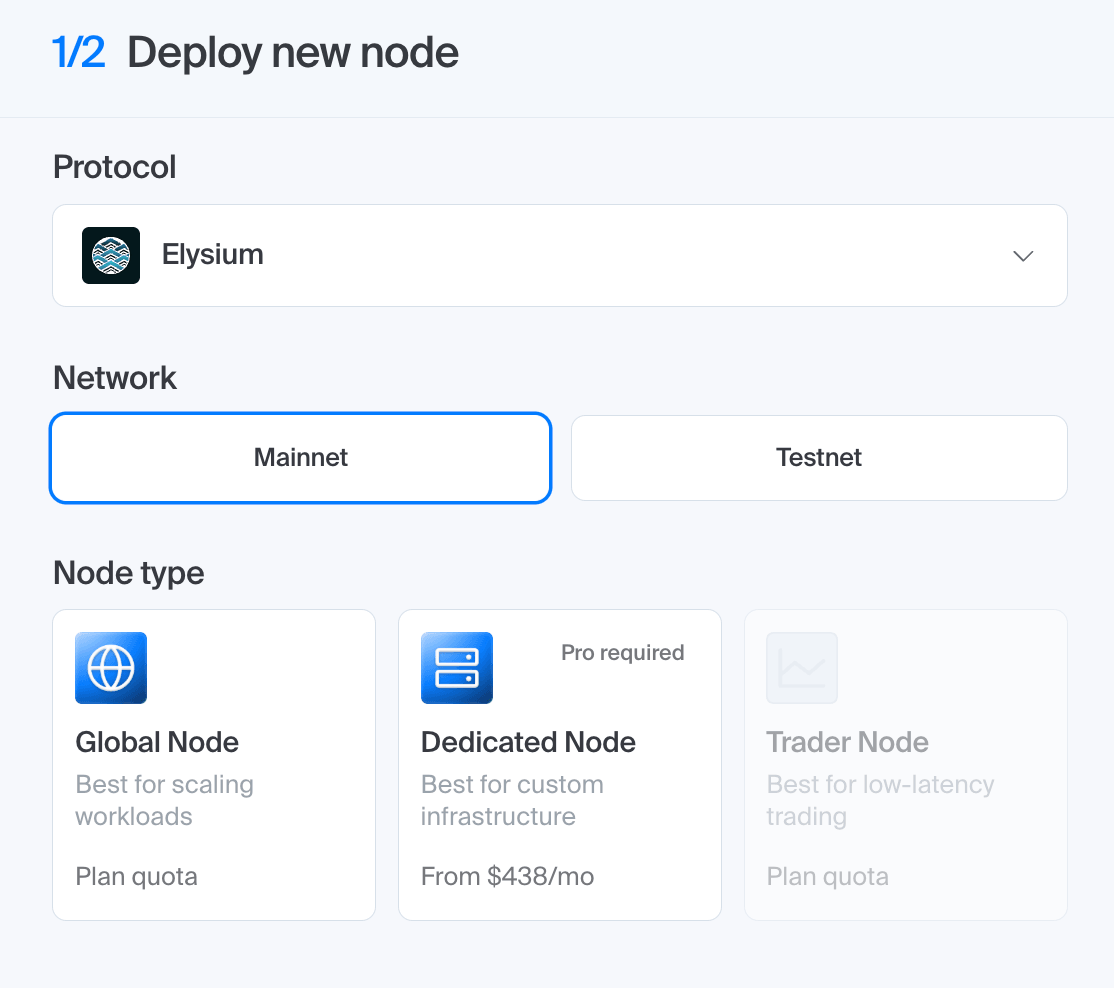
- Log in to the Chainstack console (or create an account).
- Create a new project
- Select Elysium as your blockchain protocol
- Choose network: Elysium Mainnet or Elysium Testnet
- Deploy the node
- Open Access and credentials and copy your HTTPS and WebSocket endpoints
Dedicated Nodes give you isolated resources from the Pro plan. Need HYPE? Bridge it from HyperEVM to Elysium 1:1 through Kinetiq’s bridge, and on Testnet use Kinetiq’s faucet; both are linked in the Chainstack Elysium tooling docs.
The snippet below, from the Chainstack tooling docs, follows new blocks with ethers.js over WebSocket. Replace the placeholder with your WSS endpoint:
const { WebSocketProvider } = require("ethers");

const provider = new WebSocketProvider("YOUR_CHAINSTACK_WSS_ENDPOINT");

// No public mempool: follow new blocks, not pending transactions
provider.on("block", (blockNumber) => {
  console.log("New block:", blockNumber);
});
For the full integration guide, including MetaMask, viem, web3.py, Foundry and Hardhat, see the Chainstack Elysium tooling documentation.
You can also access Chainstack Elysium RPC directly from Claude, Cursor, Codex, Windsurf, Gemini CLI, GitHub Copilot, Antigravity, Claude.ai, or ChatGPT using Chainstack MCP. For the full agent stack, including MCP, the Chainstack skill, llms.txt and WebMCP, see the Chainstack Agents page.
Chainlist is a poor guide here: the registry behind it lists Kinetiq’s Elysium as chain 99901 and Testnet 99801 next to two unrelated Elysium entries (1338 and 1339, paid in PYR), and Chainstack’s docs identify chain 1338 as Vulcan Forged’s, so assert the chain ID in your bot instead of picking a network from a list.
Chainstack pricing for Elysium trading
Every Elysium request on Chainstack is 1 RU for a full request and 2 RU for an archive request, with debug and trace calls at 2 RU, so a bot’s bill follows its request count. Prices below were checked against the Chainstack pricing page on November 18, 2026; see it for plan details and overage rates.
| Plan | Cost | Requests/Month | RPS | Overage (per 1M extra) |
|---|---|---|---|---|
| Developer | $0/mo | 3M | 25 | $20 |
| Growth | $49/mo ($40/mo annual) | 20M | 250 | $15 |
| Pro | $199/mo ($166/mo annual) | 80M | 400 | $12.5 |
| Business | $499/mo ($416/mo annual) | 200M | 600 | $10 |
| Enterprise | from $990/mo ($825/mo annual) | 400M | Unlimited | $5 |
Advanced options:
- Unlimited Node add-on, from the Growth plan: a flat monthly fee tied to an RPS tier, from $149 a month for 25 RPS
- Dedicated Nodes, from the Pro plan: compute from $0.50 per hour per node, plus storage at $0.01 per 20 GB per hour
How to estimate monthly cost
- Count the RPS of your quote loop: refreshes per second times calls per refresh.
- Multiply by 86,400 seconds and 30 days to get requests per month.
- Add the block stream from the table above, because each
newHeadsnotification is a request. - Add 20-30% headroom for bursts, since blocks arrive in clusters.
- Compare the plan quota and the plan RPS ceiling, not only the price.
A worked example: a loop that refreshes quotes 5 times per second with 3 eth_call requests per refresh is 15 RPS, or 38,880,000 requests in 30 days. The loop is above a Growth plan’s 20M RU, and at the $15 overage rate it costs $49 plus 18.88M times $15 per 1M, about $332 a month, against $199 for a Pro plan that includes 80M RU. The same loop also fits the 250 RPS Growth ceiling with room to spare, so the quota and not the RPS limit sets the plan here.
Production readiness checklist
- Primary and fallback RPC provider configured
- Request timeout policy set
- Retry logic with exponential backoff implemented
- Credentials stored in an env variable or secret manager, never hardcoded
- Monitoring for latency, error rate and throttling
- Alerts for sustained degradation
- Chain ID 99901 asserted at startup, so a Testnet or Vulcan Forged configuration cannot trade real funds by mistake
- Confirmation built on receipts and
newHeads, never on pending-transaction subscriptions - Priority fee set explicitly, because the public
eth_maxPriorityFeePerGasreturned 0 - Block-stream budget calculated for the 10 blocks per second target, not only the average
finalizedused for settlement logic only, never as the trigger for the next trade- Contracts that call HyperCore precompiles gated off until Kinetiq’s upgrade is live
Troubleshooting Elysium RPC issues for trading
| Issue | Likely cause | How to fix |
|---|---|---|
429 Too Many Requests | Quote loop above the plan’s RPS ceiling, or a burst of blocks | Move to a higher plan or an Unlimited Node, and batch reads with Multicall3 |
Pending listener or newPendingTransactions never fires | One sequencer and no public mempool | Watch newHeads and poll eth_getTransactionReceipt |
txpool_status returns -32601 | Global Nodes do not serve txpool methods | Do not build logic on the txpool |
| WebSocket bill higher than planned | Each newHeads notification is a request and the block rate varies with load | Use the block-rate table above, or an Unlimited Node |
| Transaction lands later than expected | Ordering is by priority fee and the suggested tip was 0 | Set maxPriorityFeePerGas yourself from eth_feeHistory |
eth_sendRawTransactionConditional returns -32003 | Block bounds were built from the Elysium block number | Take the bounds from the block’s l1BlockNumber, which tracks the parent chain |
eth_getProof returns -32000 historical state ... is not available | The block is 127 or more behind the tip | Request a recent block, or use an archive request |
Conclusion
The Elysium bugs that cost a trading bot money do not look like RPC problems. A pending listener that never fires looks like a strategy that never gets signals, a gas tip left at the suggested 0 looks like unlucky ordering, and a newHeads subscription at the 100 ms target looks like a plan that ran out of requests in the middle of the month.
The pattern that works is short: send over HTTPS, follow blocks over WebSocket, confirm from receipts at latest, set the priority fee yourself, and price the block stream at the high end of the range before you pick a plan. Use an Unlimited Node when subscriptions dominate, and a Dedicated Node when you need isolated resources.
Chainstack’s free Developer plan gives you 3M requests a month to test this on Testnet, and Dedicated Nodes are there when a loop outgrows shared infrastructure.
FAQ
Does Elysium have a mempool? No. Elysium has a single sequencer and no public mempool. eth_newPendingTransactionFilter and eth_subscribe("newPendingTransactions") return an ID and then deliver nothing, even for transactions you send yourself, so a bot confirms from receipts and new blocks.
How fast are Elysium blocks, and what does a block stream cost? Kinetiq targets 100 ms blocks, and the public Mainnet RPC averaged 181 ms over 100,000 blocks and 751 ms over 1,000 on November 18, 2026, so the rate follows load. On Chainstack each newHeads notification is a request, which makes one subscription between roughly 2.6M and 25.9M RU a month across the range of 1 to 10 blocks per second.
Should a trading bot wait for finalized? No. On Elysium the safe and finalized tags advance only after the batch containing a block lands on HyperEVM, which was a measured lag of about 41 to 49 minutes on November 18, 2026, longer than the roughly 15-minute batch interval Kinetiq documents. A receipt is available as soon as the sequencer includes the transaction in a block at latest, so wait for finalized only when you need settlement on HyperEVM.
Can my contract read HyperCore order books on Elysium? Not yet. Kinetiq documents a read precompile and an ElysiumCoreWriter predeploy that are planned for an ArbOS upgrade, which was not live on November 18, 2026; Kinetiq’s docs said about four weeks after mainnet. Until it ships, a call to the HyperEVM precompile addresses succeeds and returns empty data, so a ported contract reverts when it decodes the result.
Do I need a WebSocket endpoint for a market-making bot? In practice yes, because a quote loop reacts to every block and polling over HTTPS adds a request and a delay per check. Kinetiq’s docs list only HTTPS for the public endpoint, so a WebSocket needs a private endpoint such as Chainstack Global Nodes.
Which Chainstack plan fits a quote loop? Size it from the loop, not the price. A 15 RPS loop is 38.9M requests a month, which fits a Pro plan (80M RU, 400 RPS) better than a Growth plan (20M RU, 250 RPS) once overage is counted, and a flat-fee Unlimited Node is the alternative when the call count is hard to predict.
Additional resources
- Elysium tooling
- Elysium methods
- Request units
- Chainstack introduces Elysium support
- More Elysium tutorials and articles on the Chainstack Blog
Changelog
- November 18, 2026: first version. Last checked on this date against Kinetiq’s Elysium docs, the Chainstack Elysium docs, the Chainstack pricing page and the public Elysium RPCs (block timestamps, fee data, finalized block lag).