AI-ready infrastructure
 Refer and earn


 Ethereum
 Hyperliquid
 Solana
 Arbitrum
 BNB Smart Chain
 Base
 Polygon
 TRON
 Sui
 Robinhood


How to get an Elysium RPC endpoint for DeFi (2026 guide)

TL;DR
A contract ported from HyperEVM to Elysium does not revert where you expect it to: a call to a HyperCore precompile address succeeds and returns empty data, so the contract fails later, when it tries to decode the result. Two more surprises wait in the same workflow. A plain HYPE transfer with a hard-coded 21,000 gas limit can fail with intrinsic gas too low on Testnet, where eth_estimateGas returned 21,180 on November 18, 2026, while the same estimate on Mainnet returned exactly 21,000. And the public endpoints gate debug_* behind an API key, which is the call you need when a router transaction reverts. The rest of this guide covers what a DeFi team needs from an Elysium RPC endpoint, where the public endpoint stops being enough, and how to deploy a private Mainnet or Testnet endpoint on Chainstack.
Short answer: deploy and test against a private endpoint on a paid plan, so that debug_traceTransaction and 10,000-block eth_getLogs ranges work, let your library estimate gas, and verify contracts on Blockscout. Global Nodes serve Elysium in Full and Archive modes, and the free Developer plan is enough to start on Testnet.
| Option | What it gives a DeFi team | Limits | Best for |
|---|---|---|---|
| Kinetiq public RPC | HTTPS, shared by every user | debug_* needs an API key, eth_getLogs capped at 2,000 blocks | A first deployment on Testnet |
| Chainstack Global Nodes | HTTPS and WSS, archive reads, debug_* tracing on paid plans | eth_getLogs 100 blocks on Developer, 10,000 on Growth and above | Development, testing, indexing and front ends |
| Chainstack Dedicated Nodes | Isolated resources, billed monthly for compute and storage instead of per request | Pro plan | Protocols with heavy indexing or tracing load |
What is an Elysium RPC endpoint for DeFi?
An Elysium RPC endpoint is the HTTPS and WebSocket URL your deployment scripts, tests, indexers and front end use to talk to Elysium, an Arbitrum Orbit chain built by Kinetiq that settles to HyperEVM and uses HYPE as gas. Elysium runs stock ArbOS 61 with standard tooling and no support for blob transactions, so Solidity and Vyper contracts compile unchanged, and Kinetiq’s documentation describes the chain as general-purpose DeFi: anything that runs on an EVM runs there. Kinetiq’s documentation also describes a token path that stays inside the Hyperliquid ecosystem, from a launch on an Elysium AMM to a HyperCore spot orderbook and a HIP-3 perpetual listing.
What a DeFi workload asks of the endpoint:
- Deploy and verify contracts:
eth_sendRawTransaction,eth_getTransactionReceipt, plus the Blockscout API for verification - Estimate gas and simulate before sending:
eth_estimateGas,eth_call,eth_simulateV1 - Batch reads for a front end through Multicall3, which Kinetiq lists among Elysium’s key contracts
- Find out why a call reverted:
debug_traceTransaction,debug_traceCall - Index events:
eth_getLogsandlogssubscriptions over WebSocket - Read historical state for audits and analytics: archive requests
You can review the full per-method availability in the Chainstack Elysium methods reference.
On a chain where a precompile call can succeed and return nothing, the endpoint’s tracing and state reads are what turn a mysterious revert into a diagnosis.
How DeFi on Elysium differs from DeFi on HyperEVM
Elysium accepts the same JSON-RPC calls as other EVM chains, but a contract written for HyperEVM meets several differences. The table compares the two chains for a team that deploys on both.
| Property | HyperEVM | Elysium |
|---|---|---|
| Block cadence | 1 s small blocks with 3M gas, and 60 s big blocks with 30M gas | 100 ms block target and a 300 Mgas/s execution target, per Kinetiq |
| HyperCore reads | HyperEVM’s L1Read precompiles | Not available yet: a market-data precompile is planned for an ArbOS upgrade that was not live on November 18, 2026 |
| HyperCore writes | CoreWriter | Not available yet: an ElysiumCoreWriter predeploy ships in the same upgrade |
| Chain ID | 999 (testnet 998) | 99901 (Testnet 99801) |
| Finality | HyperEVM is the settlement layer Elysium posts to | Optimistic rollup: withdrawals finalize after a challenge period of about 5.5 days, and safe and finalized trail latest by minutes |
| Gas for a plain transfer | Not measured here | 21,000 on Mainnet and 21,180 on Testnet by eth_estimateGas on November 18, 2026 |
The practical effect for provider selection: a DeFi team needs tracing, wide log ranges and archive reads on Elysium for the same reasons it needs them elsewhere, but the block rate makes each of those limits cover much less time.
Elysium RPC endpoint options for DeFi
Public vs private Elysium RPC endpoints
Kinetiq’s connecting guide lists a public endpoint for each network and says every user shares it, so use a provider endpoint for production traffic.
Official public endpoints:
- Mainnet:
https://rpc.elysium.kinetiq.xyz(chain ID 99901) - Testnet:
https://testnet-rpc.elysium.kinetiq.xyz(chain ID 99801)
Warning: Both public endpoints answered
debug_traceTransactionwith-32401 authenticated API key required for methodon November 18, 2026, and cappedeth_getLogsat 2,000 blocks per request (a wide unfiltered Mainnet query also hit a 10,000-log limit). A team that debugs reverts or backfills events cannot do either on the public endpoint, so move to a private endpoint before the first failing router call.
| Public endpoint | Private endpoint (Chainstack) | |
|---|---|---|
| Access | Free and open | Restricted access |
| Resources | Shared infrastructure | Your plan’s quota on Global Nodes, or isolated Dedicated Nodes |
| Best use case | Development and testing | Production workloads |
debug_* tracing | API key required | Included on paid plans |
eth_getLogs range | 2,000 blocks | 100 blocks on Developer, 10,000 on Growth and above |
| WebSocket | None documented | HTTPS and WSS on Global Nodes |
On a chain that produces blocks every few hundred milliseconds, a log backfill or trace session that fits a public endpoint on Ethereum overruns these limits within minutes, which is why anything beyond a first deployment belongs on a private endpoint.
Full node vs archive Elysium node
Chainstack serves Elysium in Full and Archive modes, and classifies a request as archive once it targets a block 127 or more behind the tip. At the block rates measured on November 18, 2026 (1.3 to 5.5 per second), that is roughly 23 to 95 seconds of chain time.
| Full node access | Archive node access |
|---|---|
| Latest balances, allowances and pool reserves | Balances, code or storage at a block 127 or more behind the tip |
eth_call and eth_estimateGas against current state | Re-running a past eth_call against historical state |
| Recent logs and new-block streams | eth_getLogs backfills from a protocol’s deployment block |
| Tracing a transaction from the last minute | Tracing an older transaction with debug_traceTransaction, which Chainstack serves back to genesis |
An indexer that starts from a contract’s deployment block is on archive territory from its first call, so confirm archive data access before you design the backfill. Archive access starts at the Growth plan; on the Developer plan an archive request returns -32002.
HTTPS vs WebSockets
For a DeFi front end and indexer, most work is request/response, and WebSocket earns its place for event streams.
| Feature | HTTPS | WebSocket |
|---|---|---|
| Model | Request/response | Persistent connection |
| Complexity | Simple operationally | Requires reconnect and heartbeat logic |
| Best for | Deployments, eth_call reads through Multicall3, gas estimates, paged eth_getLogs backfills | logs and newHeads streams for dashboards and indexers |
| Latency | Standard | Lower for frequent updates |
| Connection overhead | Per request | One-time handshake, then one request per notification |
On Chainstack, newHeads and logs subscriptions deliver on Elysium, while newPendingTransactions subscribes but delivers nothing because there is no public mempool. A logs subscription filtered to one contract costs one request per matching event, so it stays cheap, while an unfiltered newHeads stream costs one request per block.
How to get a private Elysium RPC endpoint with Chainstack
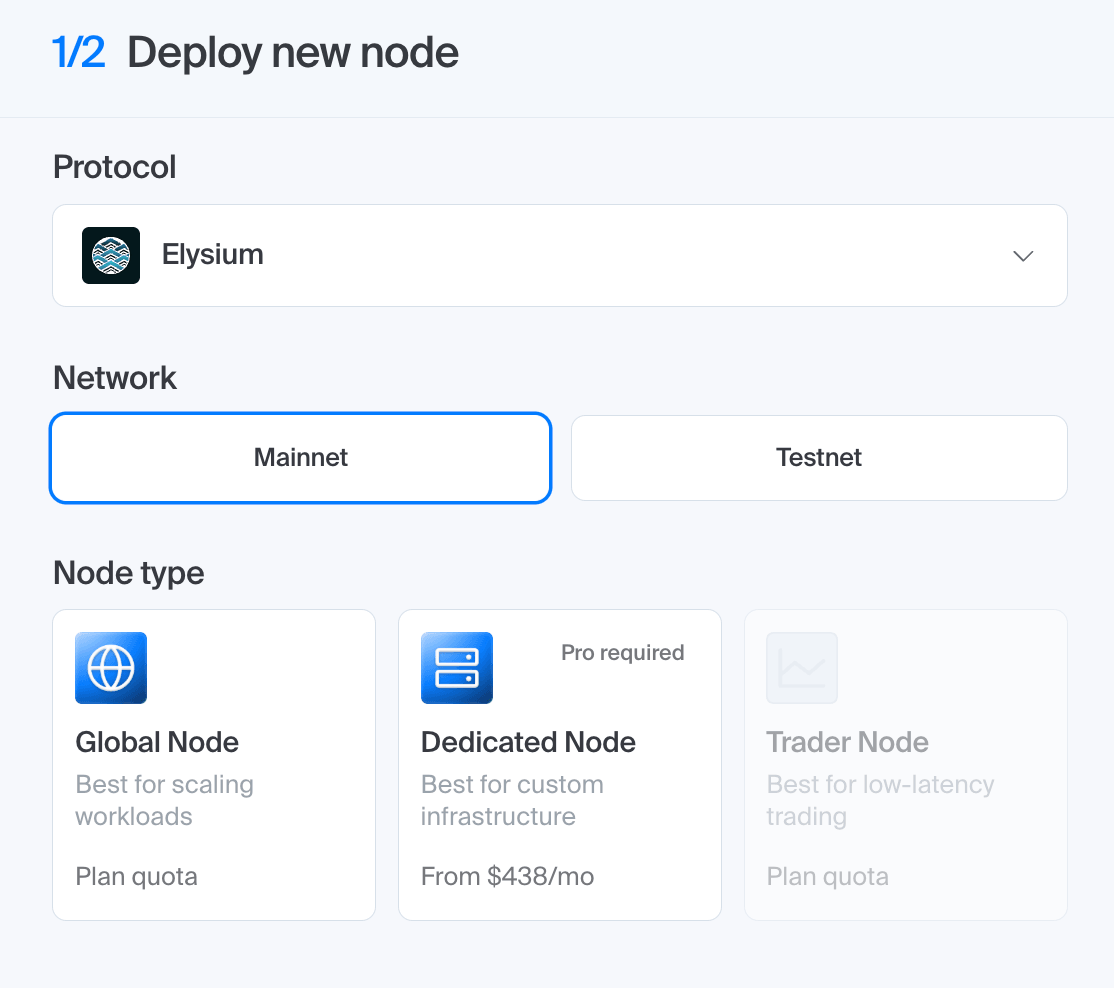
Chainstack serves Elysium RPC on Mainnet and Testnet through Global Nodes, available on every plan including the free Developer plan.
- Log in to the Chainstack console (or create an account).
- Create a new project
- Select Elysium as your blockchain protocol
- Choose network: Elysium Mainnet or Elysium Testnet
- Deploy the node
- Open Access and credentials and copy your HTTPS and WebSocket endpoints
Dedicated Nodes give you isolated resources from the Pro plan. Need HYPE? Bridge it from HyperEVM to Elysium 1:1 through Kinetiq’s bridge, and on Testnet use Kinetiq’s faucet; both are linked in the Chainstack Elysium tooling docs.
The snippet below, from the Chainstack tooling docs, deploys a contract with Foundry and verifies it on the Mainnet Blockscout API. Replace the placeholders, and keep the real private key in an environment variable or keystore, not in the command history:
forge create src/Counter.sol:Counter \
  --rpc-url YOUR_CHAINSTACK_ENDPOINT \
  --private-key YOUR_PRIVATE_KEY \
  --broadcast

forge verify-contract DEPLOYED_CONTRACT_ADDRESS src/Counter.sol:Counter \
  --chain 99901 \
  --verifier blockscout \
  --verifier-url https://elysium.kinetiq.xyz/api/ \
  --watch
For the full integration guide, including Hardhat, viem, ethers.js, web3.py and MetaMask, see the Chainstack Elysium tooling documentation.
You can also access Chainstack Elysium RPC directly from Claude, Cursor, Codex, Windsurf, Gemini CLI, GitHub Copilot, Antigravity, Claude.ai, or ChatGPT using Chainstack MCP. For the full agent stack, including MCP, the Chainstack skill, llms.txt and WebMCP, see the Chainstack Agents page.
Chainlist is a poor guide here: the registry behind it lists Kinetiq’s Elysium as chain 99901 and Testnet 99801 next to two unrelated Elysium entries (1338 and 1339, paid in PYR), and Chainstack’s docs identify chain 1338 as Vulcan Forged’s; the elysiumTestnet export that ships with viem is also Vulcan Forged’s chain. Define the Elysium chain yourself with the chain ID from the table above.
Chainstack pricing for Elysium DeFi workloads
Every Elysium request on Chainstack is 1 RU for a full request and 2 RU for an archive request, with debug and trace calls at 2 RU. Prices below were checked against the Chainstack pricing page on November 18, 2026; see it for plan details and overage rates.
| Plan | Cost | Requests/Month | RPS | Overage (per 1M extra) |
|---|---|---|---|---|
| Developer | $0/mo | 3M | 25 | $20 |
| Growth | $49/mo ($40/mo annual) | 20M | 250 | $15 |
| Pro | $199/mo ($166/mo annual) | 80M | 400 | $12.5 |
| Business | $499/mo ($416/mo annual) | 200M | 600 | $10 |
| Enterprise | from $990/mo ($825/mo annual) | 400M | Unlimited | $5 |
Advanced options:
- Archive data and debug and trace APIs start at the Growth plan
- Unlimited Node add-on, from the Growth plan: a flat monthly fee tied to an RPS tier instead of per-request billing
- Dedicated Nodes, from the Pro plan: compute from $0.50 per hour per node, plus storage at $0.01 per 20 GB per hour
How to estimate monthly cost
- List the calls per user action in your front end: balance, allowance, quote, receipt polling.
- Multiply by expected actions per month for a request-unit baseline.
- Add test and deployment runs, which poll receipts heavily.
- Add trace sessions at 2 RU per
debug_*call. - Price the event backfill: at the block rates measured on November 18, 2026, one day of history is about 112,320 to 475,200 blocks at 1.3 to 5.5 blocks per second. Paged at the 10,000-block cap that is 12 to 48
eth_getLogsrequests per filter, and because each reaches back more than 127 blocks it bills as archive, so a day of history for one filter costs about 24 to 96 RU.
Backfills are cheap in request units and expensive in wall-clock time, so the plan that matters for an indexer is the one with the 10,000-block cap, which starts at Growth.
Production readiness checklist
- Primary and fallback RPC provider configured
- Request timeout policy set
- Retry logic with exponential backoff implemented
- Credentials stored in an env variable or secret manager, never hardcoded
- Monitoring for latency, error rate and throttling
- Alerts for sustained degradation
- Chain ID asserted at startup: 99901 on Mainnet and 99801 on Testnet, so a Vulcan Forged configuration can never be used by mistake
- Gas limits taken from
eth_estimateGas, never hard-coded to 21,000 - Canonical token addresses checked against Kinetiq’s contract list before integration, because look-alike tokens exist
- Contracts verified on Blockscout after every deployment
eth_getLogsbackfills paged to the plan’s block cap- No contract logic that depends on a HyperCore precompile until Kinetiq’s upgrade is live
Troubleshooting Elysium RPC issues for DeFi
| Issue | Likely cause | How to fix |
|---|---|---|
429 Too Many Requests | Request rate above the endpoint’s limit, such as a plan’s RPS ceiling on Chainstack | Add backoff, spread parallel calls, or move to a higher plan |
| A ported contract reverts when it decodes a precompile result | Elysium has no HyperCore precompiles yet, and a call to those addresses succeeds with empty data | Gate the HyperCore path off, or wait for Kinetiq’s market-data precompile and ElysiumCoreWriter predeploy |
intrinsic gas too low on a plain transfer | On Testnet, Nitro added a parent-chain posting cost: a Testnet estimate was 21,180 gas on November 18, 2026, while Mainnet estimated exactly 21,000 | Do not hard-code 21,000; let the library call eth_estimateGas |
| Wrong currency symbol or explorer links | The elysiumTestnet chain in viem/chains is Vulcan Forged’s chain 1338 | Define the Elysium chain with defineChain and your own RPC URL |
-32602 on eth_getLogs | The range is wider than the cap: 100 blocks on Developer, 10,000 on Growth and above | Page the backfill, or move up a plan |
-32401 on debug_* | The public endpoint requires an API key | Use debug_traceTransaction on a paid Chainstack node |
-32000 historical state ... is not available from eth_getProof | The block is 127 or more behind the tip | Request a recent block |
web3.py raises InvalidAddress | web3.py rejects lowercase addresses | Wrap addresses in Web3.to_checksum_address() |
Conclusion
The Elysium problems that cost a DeFi team time look like contract bugs. A precompile that returns empty data makes a working HyperEVM contract fail at the decode step, a hard-coded gas limit fails only on Testnet, and a public endpoint that refuses debug_* leaves a reverted router call with no explanation.
The pattern that works is short: define the chain yourself and assert its ID, let the library estimate gas, develop on a private endpoint with tracing and 10,000-block log ranges from the start, verify every deployment, and keep HyperCore-dependent logic switched off until the upgrade ships. Use a Dedicated Node when indexing or tracing load needs isolated resources.
Chainstack’s free Developer plan lets you deploy and test on Testnet, and Dedicated Nodes are there when a protocol outgrows shared infrastructure.
FAQ
Do HyperEVM contracts work unchanged on Elysium? Contracts that use only the standard EVM do, because Elysium runs stock ArbOS 61. Contracts that call HyperEVM’s HyperCore read precompiles or CoreWriter do not work yet: the call succeeds and returns empty data, so the contract reverts when it decodes the result. Kinetiq plans a market-data precompile and an ElysiumCoreWriter predeploy for an ArbOS upgrade that was not live on November 18, 2026; its docs said about four weeks after mainnet.
Why does a plain transfer need more than 21,000 gas on Testnet? Nitro adds the cost of posting the transaction to the parent chain when that cost is above zero. On November 18, 2026 eth_estimateGas returned 21,180 on Testnet and exactly 21,000 on Mainnet, so let your library estimate gas instead of hard-coding either number. Kinetiq’s docs say Mainnet transactions pay no parent-chain data fee, which matches the Mainnet estimate.
How do I debug a reverted transaction on Elysium? Trace it with debug_traceTransaction and a tracer such as callTracer. The public endpoints require an API key for debug_*, while Chainstack serves it on paid plans, and the Chainstack tutorial on tracing internal calls and HYPE transfers on Elysium shows how to read the result.
How do I get HYPE on Elysium? HYPE bridges from HyperEVM to Elysium 1:1 as native gas through Kinetiq’s bridge, and on Testnet you can use Kinetiq’s faucet or bridge testnet HYPE from HyperEVM Testnet. Both are linked from the Chainstack Elysium tooling docs.
How far back can I query logs and state? Chainstack serves Elysium in Archive mode on Global Nodes, and debug_* tracing works back to genesis. eth_getLogs is capped at 100 blocks per request on the Developer plan and 10,000 on Growth and above, and eth_getProof serves only blocks less than 127 behind the tip.
Which libraries work with an Elysium endpoint? Foundry, Hardhat, viem, ethers.js and web3.py all work unchanged. Define the Elysium chain yourself in viem, and wrap addresses in Web3.to_checksum_address() in web3.py.
Additional resources
- Elysium tooling
- Elysium methods
- Elysium: Trace internal calls and HYPE transfers
- Request units
- What is Elysium?
- More Elysium tutorials and articles on the Chainstack Blog
Changelog
- November 18, 2026: first version. Last checked on this date against Kinetiq’s Elysium docs, the Chainstack Elysium docs, the Chainstack pricing page and the public Elysium RPCs (gas estimates,
eth_getLogscap,debug_*gating).